Search

Super Library Marketing: Practical Tips and Ideas for Library Promotion

Month

January 2018

Inspiring Advice From An Expert Blogger

A few months ago, I asked readers whether their library had a blog. 61 percent of respondents said no. I have to include myself in that statistic. And the more I think about it, the more that bothers me.

Blog-less libraries are missing a HUGE opportunity. A blog has a number of promotional advantages that simply cannot be replicated with any other type of tactic. And to make my case, I am going to share insights with you from a session at Content Marketing World–one that I haven’t been able to stop thinking about in the months since the conference.

Amanda Todorovich is the Director of Content Marketing at the Cleveland Clinic. She’s the 2016 winner of the Content Marketer of the Year from the Content Marketing Institute and she runs the most visited hospital blog in the United States, Health Essentials. Her session was all about the Cleveland Clinic blog and its success. And her story made me want a blog for my library.

Amanda says a blog is the best promotional tool because it creates brand awareness and relationships with current and potential customers. The goal of the Cleveland Clinic blog is to create a space in which the hospital is top of mind all the time with people looking for health information. Think about this: the hospital cannot create demand for their services. So they aim to provide credible health information at all times so that, in the unfortunate moment when someone is sick or injured, the first place they think of is the Cleveland Clinic.

That principle applies to libraries as well. There are times when a library cardholder may not need their library, but we want to stay top of mind with them so that they’ll turn to us when they do need books, or help with a struggling reader in their home, a passport, a voter registration form, help to create a resume, or whatever problem they might have. Libraries are not just about programs and books and there is a lot of value to offer your cardholders beyond those two basic services.

But Amanda also says in order for your blog to work, you have to stand strong. Your blog cannot be all things to all people. You’ll have to decide on your mission, write it down, and stick to it. This doesn’t mean that you are ignoring certain cardholders. It means that your blog has one focus, one mission and that everything you write–no matter the audience–drives at completing that mission. For example, Health Essentials mission isĀ to engage users in daily conversation using health, wellness and clinical content that is unique to Cleveland Clinic. They’re not ignoring anyone. Rather, they are focusing all their energy on delivering on that mission to all of their potential patients and patient families. See the difference?

Blogs have a value beyond pure promotion. Using the right keywords and paying attention to metadata, tags, and links will help boost your position in search traffic. That means people will be able to find you first during a search. Some big brands pay big money for great search results placement. Can you imagine what would happen if; every time someone searches Google for a book, a DVD, or information that they land on your library’s blog? The impact would be mind-blowing.

Some library marketers are already taking this advice to heart, including Brook Savoie, who works for Lafourche Public Library in Thibodaux, Louisiana. She told me, “Our librarians take turns writing a post weekly. The purpose is to just bring more awareness to things that we do! It works well for me for social media, because I can share these blog posts weekly with our audiences without having to create any content myself.”

So, step one is convincing you, your staff, and your administration, to launch a blog. It’s worth it. You can do it. Here are Amanda’s other tips for blog success.

Focus on creating better posts, not more posts.Ā You don’t have to post every day. Just pick a CONSISTENT schedule. Create a list of topics and then write. That’s what I do with this blog. I spend roughly three hours a week on this blog and that’s really only because I am my own editor. If I could just write and revise a draft and then hand it off to another person to edit, it wouldn’t take much time at all. I spend about ten minutes crafting and testing headlines. I spend about ten minutes making the graphic. I spend about ten minutes scheduling all the distribution. I write on the weekend and it feels like it doesn’t take much time at all.

Be willing to say no. Amanda says she doesn’t have a lot of friends outside her team because she says no to a lot of requests by other departments for blog posts. The hospital blog is focused on the needs of their readers, not on the needs of the organization and that’s why it works. When your customers are the center of your universe, you are providing them with value and they’ll keep coming back to you. You are beholden to your cardholders, and they should be your only concern.

Measure and test and test again. Never be content with the results, even when they seem good. Ask ā€œwhat ifā€ all the time–it could lead you to an extraordinary idea that takes your blog to the next level. Testing actually keeps blog writing interesting and keeps life exciting (I AGREE).

Subscribe to this blog and you’llĀ receiveĀ an emailĀ every time I post. To do that, click on ā€œFollowā€ button on the bottom left-hand corner of the page. Connect with me on Twitter and Snapchat–it’s where I talk about library marketing! I’mĀ @Webmastergirl.Ā I’m also onĀ LinkedIn,Ā InstagramĀ andĀ Pinterest.Ā Views in this post are my own and do not represent those of my employer.


Facebook Does It Again! What the New Algorithm Changes Mean for Your Library

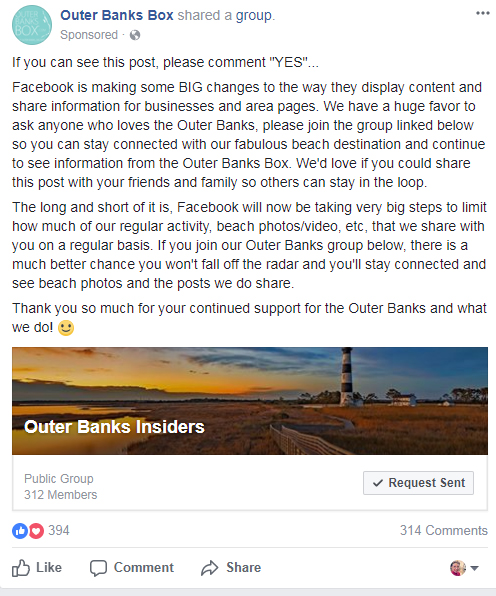
This week, Facebook announced it is making another change in the way the social media platform chooses to show content to its users. The big shift, as you likely know by now, is that Facebook will prioritize posts from friends and family in its news feed over public content from pages, like that of your library. In particular, the Facebook team will give top priority to posts that drive conversation between friends and family.

The announcement is causing consternation for many libraries, which relyĀ heavily on organic, unpaid traffic for their promotional efforts. I honestly don’t know what the end effect will be. I have the same worries as most of my library colleagues. We’ve adjusted well since the last major algorithm change in 2015. So will we have to start over? In the wake of this announcement, I’ve wondered if the chicken comes before the egg. In other words, do our well-performing posts get more interaction because, prior to this week, Facebook has shown them to people in anticipation of interaction… or do they perform well because people are interacting with them? (Deep thoughts!!)

In the Facebook group, Libraries and Social Media, I asked social media marketers at libraries to comment on the change. Caleb Sheaffer of Shreve Memorial Library in Shreveport, LA said, “I never know what to expect until it actually happens. Right now, all the posts that perform well for our library are ones that have the most interaction anyway.”

Jennifer Redford from Boise, Idaho added, “I think that we’ll just need to focus more on writing and sharing great content. We’ve also started using events more and I wonder how that will be affected by the change.”

Finally, Molly Wetta, manager of the Santa Barbara Public Library, told me, “These announcements are pushing me to move forward more quickly with an idea I’ve had for a while. We’re experimenting with linked groups – I started one for youth services specific content, and we may also try one for smaller communities and branches within our system if this one is successful. The goals are to work more to create community connections in addition to marketing our events/services. I do love the events feature, and the notifications will hopefully be helpful but not intrusive. We’ll be sharing book recommendations and answering book-related questions, sharing early literacy tips and activities, and hopefully answering questions.”

The bottom line is that your library’s page may see your overall statistics drop. Your reachĀ and referral traffic, your shares, and your comments may drop. MAY is the key word there. My overall impression of this change is that it will force library marketers to work smarter when using Facebook. All of the pointers in this recent article on Facebook still apply.

And now, more than ever, you must make sure your posts are really good. Share content from other sources related to books and literature–don’t just promote your own stuff, particularly on posts. Use events to promote your events. Ask questions. Create polls. And most importantly, shoot video. As we know, Facebook users respond in a big way to video. Facebook says live videos often lead to discussion among viewers and live videos get six times as many interactions as regular videos. So video marketing must be part of your plan.

You can also explain to your followers what is happening and ask them to choose to see your posts. People who want to see more posts from your library page can selectĀ See First in News Feed Preferences.Ā You can also do what Molly’s library is doing and experiment with groups. One of my favorite Facebook pages did that this weekend and they put a little money behind it to make sure all their followers know about the move.

Finally, don’t bait people to interact with your posts. In this week’s announcement, Facebook made it very clear that they will penalize pages which use engagement bait, like. Use real questions and conversation starters. Read this article to see how to avoid engagement bait.

Here’s the thing to remember: posting content on Facebook is like building your house on rented land. It doesn’t belong to you and as much as it pains your library system when changes are made, there is little we can do about it. The big lesson is that we need to start relying on our own platforms and websites for promoting our programs and services. That means we should be building our own audience with blogs, podcasts, and other content delivery systems. We should be developing email subscriber lists so we can target and market to our specific library cardholders and give them the content they really want.

Facebook is great, but they’re not the only way to reach customers. Let’s make a concerted effort to start moving to other content delivery platforms where we have more control. Our fans are loyal and they’ll respond when we deliver content specifically targeted to them.

Subscribe to this blog and you’llĀ receiveĀ an emailĀ every time I post. To do that, click on ā€œFollowā€ button on the bottom left-hand corner of the page. Connect with me on Twitter and Snapchat–it’s where I talk about library marketing! I’mĀ @Webmastergirl.Ā I’m also onĀ LinkedIn,Ā InstagramĀ andĀ Pinterest.Ā Views in this post are my own and do not represent those of my employer.
The Best Library Customer Service Advice from an Expert

There is an undeniable connection between customer service and successful marketing and to ignore the role that a personal, caring interaction with a customer can have for your library is dangerous. Don’t take your customers for granted. Help them solve their problems–even when the problem is your library–and keep them loyal for a lifetime.

I started to really think about the role customer service plays in my library when I stumbled across a podcast a few years ago called Focus on Customer Service. Host Dan Gingiss interviewed marketers from brands which are known for outstanding customer service in the social media area. Those conversations are enlightening and, although the podcast is no longer in production, I would suggest you go back and listen to the archives. They’re really worth your time.

Meanwhile, Dan has gone on to write a new book,Ā Winning at Social Customer Care: How Top Brands Create Engaging Experiences on Social Media. It is the best marketing book I’ve read recently. I reached out to Dan to ask him some specific advice about libraries and customer service and he was kind enough to give his advice.

Dan’s 20-year career has consistently focused on delighting customers, spanning multiple disciplines including social media, customer service, marketing, and digital customer experience. Dan has hands-on experience as an executive at multiple Fortune 300 companies, including as the Senior Director of Global Social Media at McDonald’s Corporation, the Head of Digital Marketing at Humana and the Head of Digital Customer Experience & Social Media at Discover Card.Ā A frequent conference speaker,Ā Dan holds a B.A. in psychology and communications from the University of Pennsylvania, and an M.B.A. in marketing and strategy from the Kellogg School of Management at Northwestern University. You can find him on Twitter at @dgingiss.

Libraries often do things by committees and many have a long and bureaucratic approvals process for everything, including responses to customer service issues. Can you tell us why libraries should consider empowering their employees to surprise and delight customers by resolving issues in a more expedient way?

What libraries — and all organizations — need to remember is that customers are comparing you to every other customer experience they have with companies. You’re not being compared to another library; rather, you are being compared with Amazon, Wendy’s, Zappo’s, and any other brand with which the customer has engaged recently. Customer expectations are higher than ever, and a speedy response has become table stakes to competing with other superior experiences.

Libraries have such meager budgets, and many focus solely on getting the most product (books) to customers as possible. They don’t want to spend any money on providing good customer service. There are a lot of products out there that can make it easier for libraries to enhance their customer service. If you had to pick one thing that libraries should spend money on to improve their customer service, what would it be (software? More agents? )

Self-service capabilities. Most customers are willing to pursue self-service solutions if they are available, and many even prefer it. In the case of libraries, this could be used both in person at computer terminals and online, where like other industries much of the customer interaction is now taking place. Considering that libraries are still physical structures and much of the experience is still enjoyed in person, it’s also critical that they hire friendly and helpful staff who are willing and able to help readers who have no idea how to navigate the archaic Dewey Decimal System, for example. (Think about how people search for things today; it certainly does not involve decimals!)

Training for customer care, particularly in social media, is not always a strong suit for libraries. They train mostly for front-line customer service. Can you explain the difference between training for front-line interactions with customers and online customer care, and why there is a value in providing specific training for online care?

First of all, it’s critical to remember that social media is still the “front line”. It’s just another channel in which your customers have chosen to engage. So just as you wouldn’t leave a Help Desk unattended or let the phone ring and ring, you also shouldn’t make people wait for answers on social media either. That said, there are some key training differences (explained in Chapter 7 of my book) between online and offline Customer Service agents. The two most notable are writing ability and social media platform knowledge. Agents must have good spelling and grammar, as mistakes cast a poor light on the organization, and they must have at least a working knowledge of each individual social media platform so they understand the culture, norms, and limitations.

I think community building is a good strategy for libraries to engage with cardholders and offer customer care. Based on your book, I assume you agree. Can you explain how building an online community might benefit an organization like a library which is looking to improve customer service?

Online communities are especially helpful in answering questions that are likely to recur over time. For example, I recently learned that libraries often have passes to local museums but that they are reserved quickly. I wanted to know the process of obtaining such a pass from my local library. While calling the library worked just fine, an online community could have provided the same answer without leveraging paid library staff. In addition, I’d point out that books, by their very nature, are community-building in that people love talking about their similar interests and experiences. So I think an online community hosted by a library could be very successful on several fronts.

What do you think the future looks like for customer service? Is there anything libraries should be considering as they plan for the future, so they can stay competitive with bookstores and offer excellent service to cardholders?

Libraries have a huge advantage over bookstores because they provide the product for free! If they were also to provide a consistently superior customer experience, the discussion in the media might not be about Amazon undercutting brick-and-mortar bookstores, but about how libraries are experiencing a great resurgence at the expense of Amazon! Like any industry, libraries must adapt to changing technology and customer expectations. In some ways, they have, like the availability of e-books, but I’ve never found those to be either marketed effectively or easy to use. Libraries should learn from for-profit businesses to become better marketers of what is already a competitive product, to draw in new card members but also to remind existing ones why they signed up in the first place.

Bonus Secret: Go to www.winningatsocial.com/discount, click on “Buy Now”, then enter the code “Winning” to get a signed copy of Dan’s book for the best available price.

Subscribe to this blog and you’llĀ receiveĀ an emailĀ every time I post. To do that, click on ā€œFollowā€ button on the bottom left-hand corner of the page. Connect with me on Twitter and Snapchat–it’s where I talk about library marketing! I’mĀ @Webmastergirl.Ā I’m also onĀ LinkedIn,Ā InstagramĀ andĀ Pinterest.Ā Views in this post are my own and do not represent those of my employer.

A WordPress.com Website.

Up ↑