Search

Super Library Marketing: Practical Tips and Ideas for Library Promotion

Month

March 2019

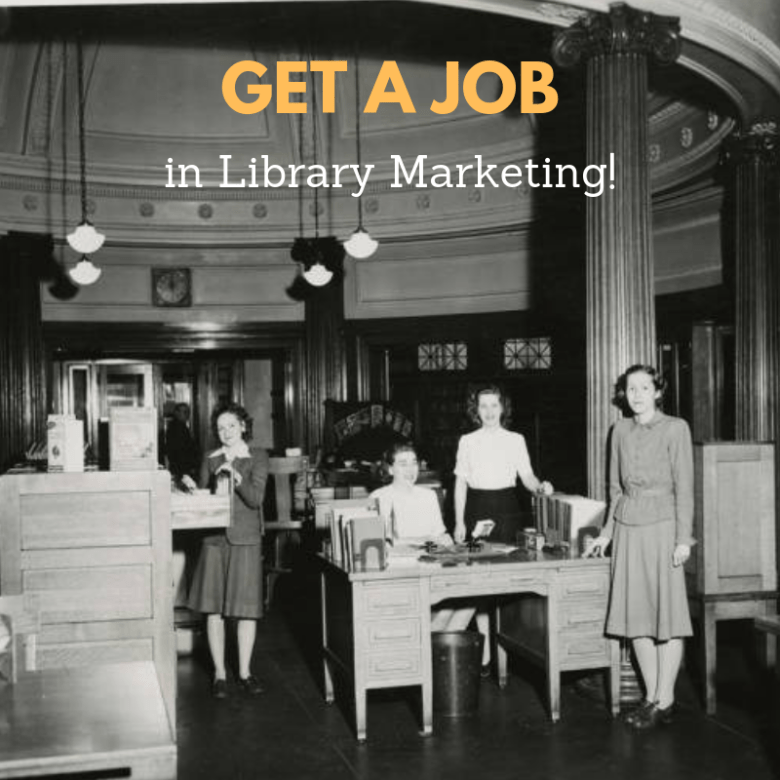
The Big Things You Must Do to Land a Job in Library Marketing

I never like to see a staff member resign. But when they do, it’s usually to take the next step in their marketing career, and that’s something to be proud of.

However, I suffer through several days of worry after I receive a resignation letter. Will I find a good person to fill this role? How long will it take? How hard will it be to orient them to the bureaucratic workings of my library?

In truth, despite the worry, I love to hire new people. A new employee can bring new ideas and energy to your library. Staff recruitment and nurturing is one of my favorite parts of the job. It’s also one of the hardest things to do. Hiring a manageable, long-term, qualified candidate who meshes well with your current team is crucial to the success of your library. The wrong hire can cause issues for you for a long time. So it’s important to get it right.

A job in library marketing is fun. It isn’t glamorous but it’s fulfilling. It’s also a popular field. For my last open position, I received more than 130 resumes in seven days. And many of those resumes were from candidates with the right degree and experience. But many of my candidates neglected to do some simple things that could have helped them land my open job.

I want to share some of the things I look for in a good library marketing candidate. These aren’t the things you’re told are important when you’re taking that college job placement class. Confession: I do want my candidates to have a degree but I don’t care where it’s from. These are the things that really, truly improve your chances of landing a job in library marketing.

And, if you hire library marketing candidates or hire for positions in your library in which marketing is part of the job description, look for candidates who have these qualifications.

A complete LinkedIn account. Your LinkedIn profile should include an updated photo of a professional nature. List your school and work experiences. Make sure you mention any professional organizations to which you belong. If you have writing or artistic samples, post them on your profile or include a link to your online portfolio or blog.

Most importantly, ask relevant professional peers to write recommendations of your work before you start applying for jobs. The candidates who got past my first round of resume culling where those who had at least one professional recommendation on their LinkedIn profile. And the more positive recommendations they had, the more likely I was to consider their resume.

A completed automatic application form. My library’s application asks questions that are usually answered in a candidates’ resume. Many of my candidates skipped the application step. I assume it’s because they felt it was redundant. However, it’s important to fill out the application for two reasons.

Many libraries use software to comb the online application for certain keywords to identify qualified candidates. They can’t do that search on a resume. If you don’t fill out the application, you’re automatically disqualified. Filling out the application form also shows you can follow directions.

A cover letter, particularly if the job you’re applying for involves writing. This is your chance to shine. Avoid using clichés such as “I’m a great fit for this position.” Write in your own voice. Be creative and personal.

The person I hired for my last open position began her cover letter by telling me the story of the library in her childhood–how her mother used to bring her to the library every night for activities and homework help because she was such an active and energetic child. That story stuck in my mind and demonstrated her writing skills. She wrote conversationally yet was professional in her tone. And it worked… she got the job!

Spelling and grammar are accurate on EVERYTHING, especially if your new job involves writing. This demonstrates professionalism and attention to detail. I eliminated some qualified candidates because they misspelled words or made grammar errors in their resume, application, or cover letter.

Writing samples. Generally, I would have two or three samples linked to your resume, and two or three more in your back pocket to send in if the recruiter needs them to help winnow down the pool of candidates. Prove you can write a variety of content including blog posts, press releases, emails, and long-form articles.

Social media accounts.  If you’ve worked on a social media account for another brand, nonprofit, or volunteer organization, include a link to those accounts in your resume. If you don’t have professional experience, you should have personal accounts and you need to be active on them. This demonstrates you have knowledge of how social media works. If you aren’t actively on social media, the recruiter will assume you don’t have a complete understanding of how the social landscape works.

Video examples. In TV news, we used to call this the “demo reel.” Make two or three videos to show your shooting style, and to show you know how to edit and upload videos. Put them on YouTube or your personal blog, and link to them in your resume.

Research the heck out of the library you want to work for. The more you know about the library, the better your chances will be of landing the job. Look at the library’s social media accounts, website, and mobile app, then visit a branch. Pick up some print marketing materials and pay attention to displays, signage, and customer service. This prepares you for the classic questions “What are we doing well and what would you like to improve on, if you were hired for this position?” The inability to answer that question is an automatic disqualifier for me.

Subscribe to this blog and you’ll receive an email every time I post. To do that, click on “Follow” button in the bottom left-hand corner of the page. Connect with me on Twitter, Snapchat, and LinkedIn. I talk about library marketing on all those platforms!

Five Totally Doable Things That Make Your Library Content More Shareable

Every content creator fears no one will read their work. By contrast, the most exhilarating thing you can do in marketing is to write something that people read, share, and comment on. I speak from experience. There is no better compliment.

Last week, I told you about the upcoming keynote I’m giving on content marketing and shared some reasons why your library should be creating content. The more I write for this blog, the more I learn about the kinds of content my audience will read AND share. That second part is important. You want to reach new people and make them library fans. But what makes your content shareable?

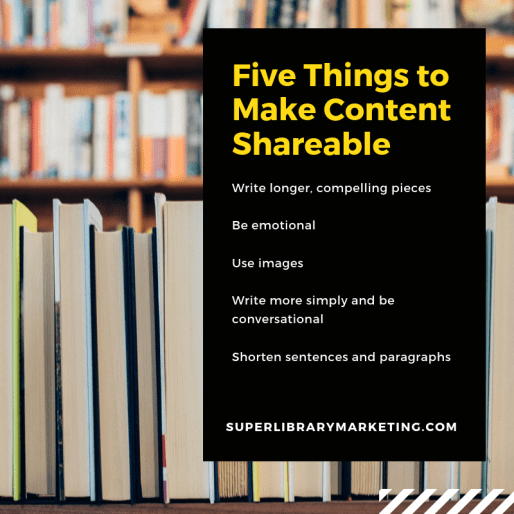
I have five simple ideas for you. Each of these increase the likelihood that your content gets shared.

Write longer, compelling pieces. Seriously, the whole thing about how your audience only has the attention of a goldfish is bunk. They will read a 2,000-word post from you if it’s compelling.  People read whole books with 50,000 plus words! I don’t know why this myth of the “too-long content piece” exists when there is literally hundreds of years’ worth of proof that it’s not true.

If you tell a story in long form, with authentic quotes, an emotional arch with conflict and resolution, and a clear beginning, middle, and end, it will not feel like a long read. And a piece of content with all of those characteristics is also likely to be memorable. Great stories stick in our minds long after we read them. And memorable posts get shared!

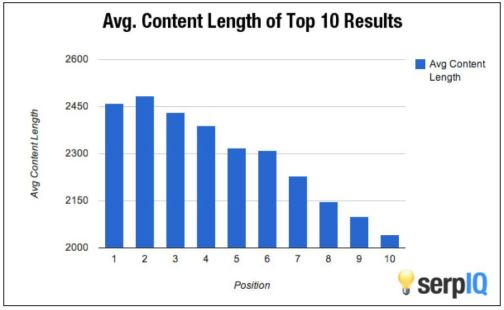
Long form content is also better for your library’s search results. Back in 2012, serpIQ conducted a study involving more than 20,000 keywords. The results showed that the average content length of the top 10 search results was more than 2,000 words.

I have some evidence that this works personally. In 2018, I purposefully started writing longer blog posts here. Most of my posts land at around 1,000 words… not quite up to serpIQ’s standards but about 200-300 more words per post than I wrote in 2017. And guess what happened? My engagement stats increased by nearly 215 percent over 2017!

My library just started a blog two weeks ago. We will experiment with post length. And you can bet that I’ll push our writers to put out longer and more compelling stories, even if that means we have to publish fewer total posts. Write longer, more interesting posts and people will respond.

Be emotional. According to research from the journal Psychological Science, our emotional responses to content play a huge role in our decision to share that content. But all emotions are not created equal. The study shows people will share content that makes them feel fearful, angry, or amused. There is also a ton of evidence to suggest that people like to share content that inspires or contains a surprise.

Conversely, you should avoid creating content with negative emotions like sadness or even contentment, which tend to cause inaction. We don’t want that!

Insert images in your content. You may have noticed I’ve started inserting more images into my posts on this blog. That’s because adding images to your content is proven to increase the likelihood that it is seen and shared. My post popular post ever is this one, which contains three images. Those three images are strategically placed to emphasis the meaning of the words. They also break up the text for a visually pleasing read.

You must also use images on social media when promoting your content. This rule applies to all platforms. Your audience is visual and they want to see images in addition to your important words. The right image–one that evokes emotions or really serves to succinctly illustrate whatever you are saying in your content–will also make your content more shareable.

Write simply and conversationally. The more your audience understands what you’re trying to say, the most likely they are to share your posts. Define unfamiliar or difficult words, titles, or services. Go through the draft of your material and highlight words or terms that may confuse your audience. Then, find a better way to say or explain those words.

Never take it for granted that your reader has been a lifelong user or follower of the library. Words used by librarians to describe services, programs, catalogs, and databases may seem common to you and your staff. They are not common to your reader. Always explain. Then, ask a non-library employee to read your work. I often take my stuff home and ask my husband or my teenage daughter to read it. If they find anything to be confusing or convoluted, I know I need to change it.

Shorten your sentences and paragraphs. Shorter sentences will make it easier for your reader to understand and absorb what you are saying. The same is true with paragraphs. A piece of material with lots of long paragraphs looks thick and off-putting. Readers will skip lengthy paragraphs, according to British grammarian H. W. Fowler. In addition, the Poynter Institute’s Eyetrack Study shows people are more likely to read an entire web page when the paragraphs are short. And if you can get the reader to look at the entire post, it’s more likely that they’ll share the content.

Subscribe to this blog and you’ll receive an email every time I post. To do that, click on “Follow” button in the bottom left-hand corner of the page. Connect with me on Twitter, Snapchat, and LinkedIn. I talk about library marketing on all those platforms!
Eight Major Reasons To Add Content To Your Library Marketing {Infographic}

I’m so excited to be the keynote speaker for the Illinois Library Association Marketing Forum Mini-Conference in Chicago in a few weeks. My brain is entirely engulfed in content marketing as I formulate the talk. There are also some big content changes afoot at my library. I’ll talk more about those when we have our campaigns up and running. But, let’s just say that most of my marketing focus in my professional life is on content–why we should do it, how to make it work better, and how to be efficient in our content creation.

The most important part of the speech I’ll give next month is the “why.” Why is content marketing important to libraries? This was actually the focus of one of my early posts here on blog. The argument for content marketing hasn’t changed. You can make all the posters and fliers you want. People don’t pay attention to those push promotional tactics. That’s why marketing seems frustrating.

You want desperately to break through the noise of life and become a subconscious part of your cardholders’ thought process. You want them to think of you every time they face a problem. You want them to remember they can come to you for pretty much anything they need. This is the common struggle for libraries everywhere, no matter their size, staffing, or service area. Honest to goodness, the only way to achieve that is through content marketing. I know this from experience.

There is now a lot of data to back up the assertion that content works. I want to share some of that with you. I’m hoping that, if you are hesitant or nervous about working content marketing into your overall library marketing strategy, these stats will convince you. I truly believe this is an opportunity for libraries that cannot be missed. If we are to survive and thrive as an industry, we need to do more content marketing.

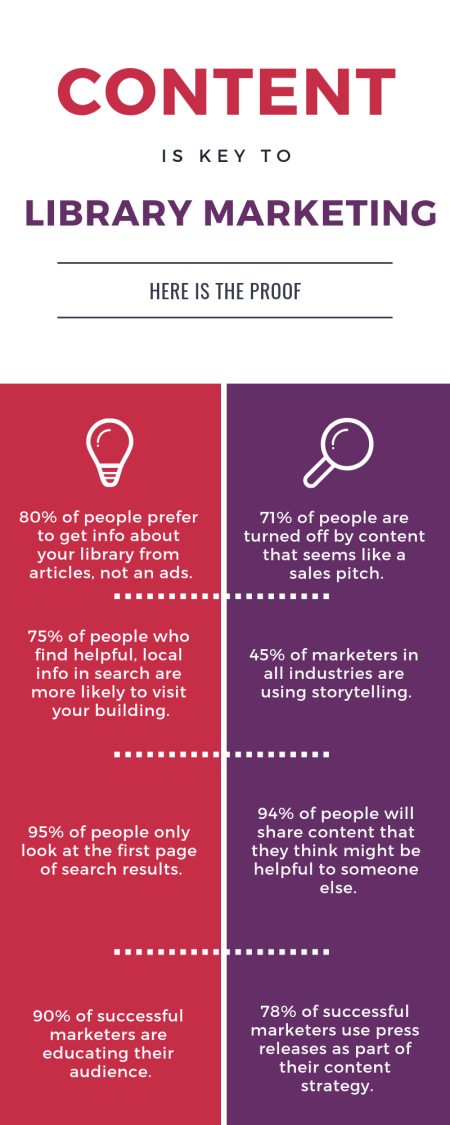
Here are the facts for why content is key to library marketing.

Why Content is Key to Library Marketing

80 percent of people prefer to get information about your library from a series of articles versus an advertisement.

71 percent of people are turned off by content that seems like a sales pitch. Which means, if you are doing mostly traditional promotional marketing, it’s not working.

75 percent of people who find local, helpful information in search results are more likely to visit a physical building. We want to get more bodies inside our libraries. Content is the key.

Only 45 percent of marketers are using storytelling to create a relationship with their audience. Most big brands are still running ads and push promotion. This is our open door. It’s a huge opportunity for libraries. This is how we sneak in and take away audience share… by telling stories. And who doesn’t love a good positive story about a library?

95 percent of people only look at the first page of search results. Optimized content (that’s content that uses keywords that are likely to be picked up by Google and other search engines) is incredibly helpful. If your library’s content appears on the second page or later, people won’t see it.

Blog posts are the content that get the most shares. And if your post is helpful to others, it’s more likely to be shared. 94 percent of readers share a blog post because they think it can be useful to someone they know. And the more often you publish blog content, the more often your content will show up in search, which increases the likelihood that people will find your library while doing a search. Amazing, right?

90 percent of the most successful marketers prioritize educating their audience over promotion their company’s promotional messages. Education is our main industry. Libraries are perfectly aligned to make this work for us.

But here’s a stat that really surprised me. 78 percent of effective content marketers use press releases as part of their strategy. Yep, press releases can be content marketing too. Use your releases to be informative but to really pitch amazing story ideas to the media. If you have a great story and you can make all the elements available to the media, you can let them tell it and take advantage of their built-in audience to spread the word about your library.

These stats come from a variety of great blogs including Impact, Marketing Profs, OptinMonster, Elite Copywriter, Cision, and Forbes. I hope they’ve convinced you to do content marketing at your library.

Subscribe to this blog and you’ll receive an email every time I post. To do that, click on “Follow” button in the bottom left-hand corner of the page. Connect with me on Twitter, Snapchat, and LinkedIn. I talk about library marketing on all those platforms!
A WordPress.com Website.

Up ↑