Angela Hursh leads an outstanding team of marketing and training professionals at NoveList, a company dedicated to helping libraries reach readers. A 2023 Library Journal Mover & Shaker, she has also created courses on LearnwithNoveList.com designed to help library staff learn how to create effective marketing. Before her job at NoveList, Angela led the content marketing team for the Public Library of Cincinnati and Hamilton County. She also has more than 20 years of experience as an Emmy-award-winning broadcast TV journalist.
Your library’s digital signage is every bit as important as the print signs and posters you put up. But how can you maximize the effectiveness of your digital signs?
I have five tips to help you get the most out of that incredibly valuable space, all learned during my time with the Cincinnati and Hamilton County Public Library.
Plus we’ll give away kudos to a library doing outstanding work in library marketing. Watch the video to find out who is being recognized.
Do you have a suggestion for a topic for a future episode? Want to nominate someone for kudos? Let me know here.
Thanks for watching!
Subscribe to this blog and you’ll receive an email whenever I post. To do that, enteryouremail addressand click on the “Follow” button in the lower left-hand corner of the page. You can also follow me on the following social media platforms:
For my birthday, my 23-year-old daughter gave me a gratitude journal. She told me about her own practice of writing in her journal first thing in the morning and right before bed. She gives herself space to list what she’s grateful for and sets her mindset for the day.
In fact, she’s got a whole routine for morning and night that’s incredibly healthy. She eats well, exercises, and tells me all the time that I’m worth taking care of. She’s my self-care inspiration.
I’m trying hard to follow her example. I think people of my generation (Gen X) have been trained to overwork. We were told that productivity equals worth. But that philosophy leaves many of us feeling exhausted, overworked, and underappreciated.
Burnout is real, especially for communicators. Nearly 75 percent of people working in marketing and communications say they experience burnout.
I want to help my readers avoid burnout and love their job in library marketing! These are my personal tips for managing stress.
10 tips to manage stress in library marketing
#1: Create a space where you want to work.
When I worked at the library, my office was in a windowless basement. It was lit by fluorescent lights and was incredibly sterile. It looked like a glass cage.
I was happy to have my own workspace, but it was not a space in which I wanted to work. So, I made a few minor changes.
I hung blue twinkling lights around the perimeter and bought a funky blue desk lamp at Goodwill. I papered the glass windows with cards and notes that I’d received from former interns and co-workers. I bought a tiny portable speaker and played soft music through my iPhone while I worked.
These changes may seem very small. But they worked to create a place where I looked forward to coming each morning.
You can do the same by auditing your current workspace. Is your desk a place that will foster creativity and productive work?
If not, then spend some time working on your workspace. Dim the lighting. Declutter your desk. Store some snacks or your favorite candy in your desk. Bring your favorite mug to work to make coffee or tea time more enjoyable. Hang some artwork.
If you’re working in a shared area, do what you can to add a personal touch to the space. And invest in headphones so you can play music or white noise or whatever you need to help you focus.
#2: Don’t eat at your desk.
Stopping for half an hour to eat gives you a natural boost in productivity and it helps to refresh your mind for the second half of your workday.
Don’t use this time to catch up on emails. Grab a book. Head outside if you can and spend half an hour in the sun.
#3: Don’t try to multitask.
It’s tempting to try and tackle several tasks simultaneously. That seems like a productive use of time. But it’s the opposite because you do none of them well.
Constantly switching focus makes you less productive and strains your brain. Try your hardest to focus on one task at a time.
I’ll often close my email and Teams when I know my focus might be pulled away from an important task. When I worked at the library, I would take my laptop into the stacks or into a conference room. A change of scenery can often help you hyperfocus on a task that needs tackling.
#4: Take breaks during the day.
You want to look away from your computer every 20 minutes. And every hour, give yourself a few moments to take a mindful break. Stretch, look out the window, or go outside and really pay attention to what you see, hear, feel, and smell.
If you need help with this, there are lots of apps for your phone that will remind you to take time for yourself. Or you can use Tomato Timer on your laptop or desktop to nudge you.
#5: Create a shut-down routine.
When you’re done working, create a routine to tell your brain that work time is over. Turn off notifications on your phone if you can. Shut the computer. Resist the temptation to look at your library’s social media accounts when you’re not on call. This is an especially important step for those of you who work from home.
#6: Give yourself the grace to be imperfect.
Even though I know it feels like it sometimes, no one will die if your email or social media post doesn’t get the engagement you were hoping for.
So much of what impacts our marketing is out of our control. And all of marketing is an experiment. That’s what drives innovation in your promotions.
If your promotion fails, it doesn’t mean you are a failure. Give yourself permission to try something else!
#7: Celebrate success.
Success is a great motivator, and we often focus too much on what we have to do next. We should spend just as much time celebrating and examining the emails, social media posts, flyers, website graphics, videos… etc. that do well.
Why did a specific promotion work? How did that tactic help your library reach its overall goals? Ask yourself this question for every promotion you do. Pretty soon, you’ll start to see your successes pile up!
Before you leave work each day, write down one thing you did well that day. Share your successes with your co-workers (and keep a running list for your performance review.) You can also share your successes every Friday on the Library Marketing Book Club Facebook page.
#8: Find ways to recharge your creativity
You might have noticed that every time I interview a library marketer, I ask them what they do for inspiration. That’s because motivation naturally flags over time. It helps to have sources of inspiration and energy when we’re stuck in a rut.
Go to a conference. Read a book. Listen to a podcast. Watch a TED Talk. Read a blog post. Meet with a mentor. Pick one thing that will get your creativity and productivity flowing again and schedule it as part of your regular work routine.
#9: Use your vacation and sick time.
If you are having a day where you’re just feeling drained, exhausted, and stressed, use your sick time to take a mental health day.
And plan to take time off from work at least once a year. For me, disconnecting from work for an extended period is the best productivity boost. For the first day, I’m super tempted to check my email. Then, I go into a period of about 2-3 days where work is the furthest thing from my mind. I have a job?? Then, right around day 5, I start to process new ideas for promotions and posts for this blog! I end up sending emails to myself with those ideas so I can tackle them when I get back.
But I firmly believe that I would never come up with those new ideas if I didn’t give myself permission to not think about work. And for me, that means physical separation from the office. Maybe you’re the same way!
#10: Ask for help.
73 percent of people don’t ask for help on the job when they need it, according to Study Finds. The survey also found that 53 percent of people feel held back from achieving certain goals in their lives because they try to go at it alone.
These numbers are incredibly sad. And I would hope that you would feel comfortable enough in your library to ask your co-workers and fellow library marketers for help. But if that’s not something you can do, you can always reach out to me. I’ll always do my best to get back to you.
Subscribe to this blog and you’ll receive an email whenever I post. To do that, enter your email address and click on the “Follow” button in the lower left-hand corner of the page. You can also follow me on the following social media platforms:
My childhood TV crush is organizing an event at public libraries across the United States and your library needs to get ready for it, especially in terms of promotions.
Watch this episode for tips on how to prepare now and educate your community about the importance of inclusive reading.
Plus we give away kudos. Watch the video to find out which library is being recognized.
Do you have a suggestion for a topic for a future episode? Want to nominate someone for kudos? Let me know here.
Thanks for watching!
Subscribe to this blog and you’ll receive an email whenever I post. To do that, enteryour email addressand click on the “Follow” button in the lower left-hand corner of the page. You can also follow me on the following social media platforms:
I sometimes daydream about taking a nap in the middle of the workday.
It would be easy enough. My office is in a shed in our backyard and ya’ll, there’s a pullout bed in here. I could totally take a power nap any time I wanted to.
But I never do.
Why NOT?? Seriously, what is wrong with me?
For many of you, a midday work nap is something you could never consider. You simply don’t have time. Marketing your library is not the only work task you are expected to do. You are answering phones. You’re filling holds. You’re making sock puppets for story time. You’re cleaning the restroom.
Your work is demanding. And for many of you, it’s leading to staff burnout.
Burnout is a big problem in library marketing. A quarter of all public libraries in the United States lost staff positions after the pandemic, according to the Public Library Association. And in more than half of those libraries, those positions were not replaced.
So, we’re doing more with less. And the burden is even heavier for those of you working to promote your library.
According to a survey by Blind, the burnout rate for anyone working in marketing and communications was already high pre-pandemic, at 74.8 percent. After the pandemic, that rate shot up to 83.3 percent.
We have a problem. But I’m certain my readers already knew that.
What do we do about it?
For the next two weeks, I want to address this issue. I’ll share some strategies I’ve learned in my own work and research.
I decided to write this series now because:
Summer is stressful and busy for library promotions.
You’ll do better promotional work when you aren’t stressed, and that’s good for your library.
I like you. A lot.
What the heck is burnout?
The World Health Organization (WHO) classifies burnout as a “syndrome conceptualized as resulting from chronic workplace stress that has not been successfully managed.”
There are three main symptoms:
Feelings of fatigue, lethargy, or exhaustion
Feelings negative or apathetic about your library marketing work
Reduced productivity
Why are library marketers experiencing burnout?
This is, by no means, a comprehensive list. But I talk with libraries every day as part of my day job. And here are the main causes of burnout I’ve noticed.
Outside threats, like book challenges, hostile library boards, and antagonistic community members.
I put this first because, to be honest, I think it’s the biggest threat to libraries right now.
The constant, never-ending, soul-sucking, scary, demeaning, and demoralizing effects of book challenges are doing more than impacting our freedom to read. It’s threatening the very existence of libraries by making working conditions impossible.
This month, during Pride, I have held my breath every time I see a library post on social media. I tentatively check the comments, looking for anyone who might say something derogatory.
I hear stories from fellow library marketers who tell me they receive replies to their regular library emails from people threatening and demeaning them.
And I’ve listened as library staff break down in tears, describing hostile community members who threaten them, dox them, and call them all kinds of names, for doing their jobs–providing inclusive books and services.
Lack of support or recognition from leadership
You, my readers, are smart. You think strategically about your promotions and measure your results. And when you take those results to your boss and they ask you to keep doing the thing that isn’t working anyway… that leads to burnout.
If you are a manager reading this, here is a call to action: your job is to support your staff. Your job is to remove hurdles so your team members can do their best library marketing work.
That doesn’t mean you have to agree with every idea your team members bring. But if you disagree, provide context. And allow your team members to conduct library promotional experiments, even if you personally think they’re going to fail. You could be wrong. And the goodwill and trust you build with your team members are valuable.
Unrealistic deadlines and results expectations
How many times have you been asked to create an email, a social media post, or an ENTIRE campaign… right now, like yesterday.
Library marketing work takes time and it’s difficult to get others to understand that. And when they don’t, that leads to stress and burnout.
It’s also stressful when you’re receiving pressure from fellow staff who expect you to drive hundreds of people into their programs.
Remote work and mobile devices
There is a downside to remote work—one I personally struggle with.
Before the pandemic, most of us had to commute. And that driving time, as stressful as traffic can be, did create a barrier that helped us disconnect from our work.
Now, it’s so dang easy to open your laptop after dinner and finish that email newsletter you didn’t quite get through today. Or to check your email. We also carry these little computers around in our hand/purse/pocket that keep us constantly connected to the office.
For a while, my home office was in my bedroom. HUGE MISTAKE. I would wake up in the middle of the night, glance over at my to-do list for the next day which was laying on the desk right next to me, and suddenly, the gears in my brain would start churning.
Don’t get me wrong: working at home is FANTASTIC. But remote workers do have to consciously create a barrier between their workday and their home life.
The never-ending promotional content cycle
The work that sets library promotions aside from every other bit of work in the library is the constant need for online content.
Update the website. Write a blog post. Record a podcast episode. Post to social media.
The content beast is always hungry. And that constant need to feed the beast leads to burnout.
Are you experiencing burnout?
If you are feeling like one more social media post or newsletter is going to put you over the edge, you are not alone. Next week, I’ll share 10 tips for avoiding burnout for anyone working in library promotions.
Meanwhile, if you feel comfortable, share your burnout experience here. This form allows you to remain anonymous. I’m not a therapist, but hopefully, the act of writing about your feelings will help ease the burden a bit. I care about you.
Subscribe to this blog and you’ll receive an email whenever I post. To do that, enter your email address and click on the “Follow” button in the lower left-hand corner of the page. You can also follow me on the following social media platforms:
One of the websites I use to learn about social media has just published an industry report. And there are some very interesting details in there that have big implications for your work in library marketing.
I’ll explain how this new data can help you make your library’s social media promotions more effective.
Plus we give away kudos. Watch the video to find out which library is being recognized.
Do you have a suggestion for a topic for a future episode? Want to nominate someone for kudos? Let me know here.
Thanks for watching!
Subscribe to this blog and you’ll receive an email whenever I post. To do that, enteryour email addressand click on the “Follow” button in the lower left-hand corner of the page. You can also follow me on the following social media platforms:
When Renee Naylor was a child, the library seemed like the most wondrous place on the planet.
“I couldn’t understand how it was legal to be allowed to borrow as many books as I wanted!” remembered Renee.
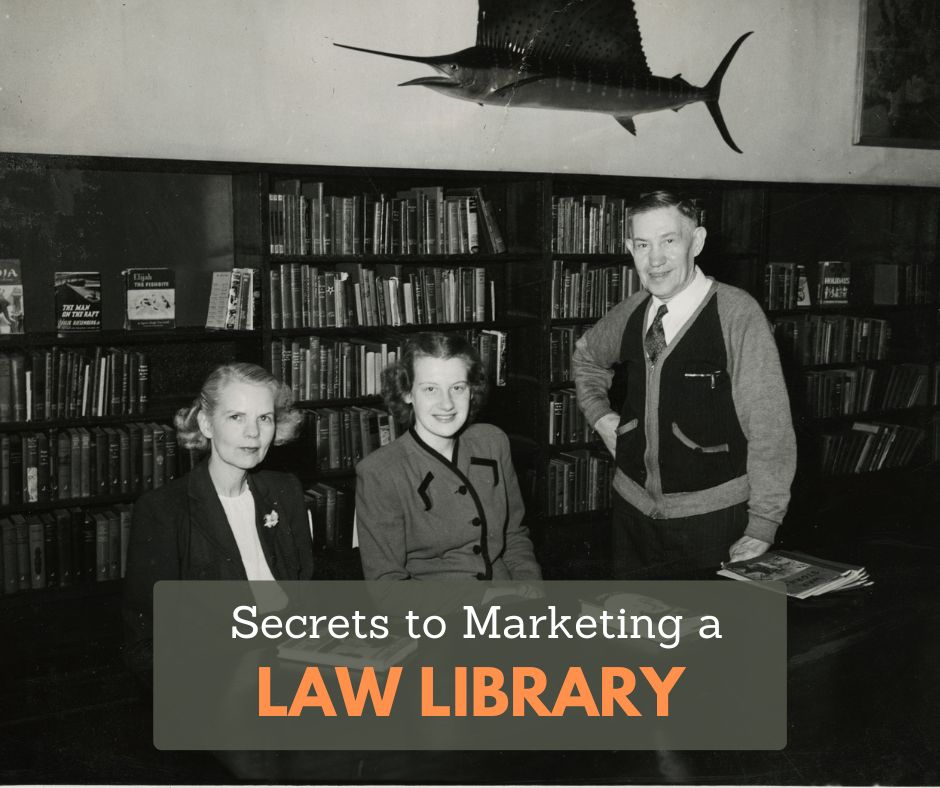
Now Renee gets to spend every day surrounded by books (and other great services, of course) in her role as Library Education and Communications Coordinator for the Law Library Victoria.
Law Library Victoria is based in Melbourne, Australia, and is the umbrella organization that manages the collections of the Victorian law jurisdictions: the Supreme Court, County Court, Magistrates’ Court, Victorian Civil and Administrative Tribunal, and Victorian Bar libraries. Their physical and digital collections are made up of legal databases, textbooks, legislation, journals, law reports, and research tools.
“Our aim is to help support the administration of justice by providing access to authoritative legal information to judicial staff and lawyers,” explained Renee. “We provide research support and training and assist users to find the information they need.”
Renee has been in her current role for 8 years. It’s a position that seems tailor-made for her!
“I applied for my first role as Reference Librarian with no experience in law, but the library director liked my personality so much she hired me,” remembered Renee. “She later told me ‘I can teach legal research, but I can’t teach enthusiasm.’”
I can’t claim credit for discovering Renee’s library marketing work. One of you did that!
In the last Super Library Marketing survey, a reader recognized the Law Library Victoria for doing great work in promotions and marketing. Specifically, they said, “They are a hybrid of government and public library, similar to the service we offer, and it’s great how they manage to have everything in a website with an amazing crisp design.”
“We are actually in the process of a complete rebuild,” exclaimed Renee. “The functionality and design will be improved, with a better user experience. The menus, content, and access to resources will be easier to navigate, with new features coming such as ‘My List’, where users can save a custom list of shortcuts. This will be launched in late 2023.”
The Law Library Victoria has an outstanding social media presence. As a special library, Renee takes a nuanced and targeted approach to how she decides what to post.
“For special libraries on social media I would say look at related organizations in your field, see what they are doing and what their audiences respond well to,” advised Renee. “Build relationships with them so they start sharing your content. This will increase awareness and give your library a sense of authority in the eyes of its audience.
“We have Twitter for timely information such as judgment alerts and announcements,” explained Renee. “I try to schedule at least 3 posts per week, always with an image or video, but we often end up posting every day.”
“LinkedIn is still fairly new for us, and its focus is education and research skills. We post exclusive content there, such as videos and research articles. We post less often as the audience is still small, once every week or two.”
“And we have Instagram. It’s very popular, and the focus is more on general engagement. We post pictures of the heritage Supreme Court Library, and of our collections, and will include some facts or interesting information.”
There are challenges to promoting and marketing the Law Library Victoria. Like many of you, Renee battles for attention amidst the constant barrage of content coming at her target audience.
“There is so much information coming at lawyers every day, via email, social media, and websites,” explained Renee. “It’s hard to penetrate and reinforce your brand identity.”
“We get confused with other organizations, or people aren’t aware of how modern we are and the digital focus.”
“Getting people to read your content and act on it is a challenge we are still grappling with. Stakeholder relationships are key, and leveraging our relationships with well-known legal organizations has really helped.”
Renee Naylor
When she’s looking for inspiration, Renee says you don’t need to reinvent the wheel.
“I look at what related organizations are doing on social media, and complete regular professional development, such as social media conferences, communications courses, and webinars,” she said. “They allow me ‘creative thinking time’ for new ideas. I really like what the Victorian State Library does on their social media, it’s very engaging across all channels.”
Subscribe to this blog and you’ll receive an email whenever I post. To do that, enter your email address and click on the “Follow” button in the lower left-hand corner of the page. You can also follow me on the following social media platforms:
Tell me if this sounds familiar: your library staff wants you to promote their events and programs, but they don’t give you the information that you need to create those marketing messages in a timely manner.
How do you set up a system where your fellow staff members help you help them? I’ll share some tips I learned on the job at my former library to make effective library promotions.
Plus we give away kudos. Watch the video to find out which library is being recognized.
Do you have a suggestion for a topic for a future episode? Want to nominate someone for kudos? Let me know in the comments.
Thanks for watching!
Subscribe to this blog and you’ll receive an email whenever I post. To do that, enteryour email addressand click on the “Follow” button in the lower left-hand corner of the page. You can also follow me on the following social media platforms:
Photo courtesy Cincinnati and Hamilton County Public Library
On a mild night in April 2019, I arrived at a steak restaurant in Schaumburg Township, Illinois to have dinner with a group of people I’d never met.
I had been invited to speak at an event put on by the Illinois Library Association. I was set to meet some of the library marketers who conspired to bring me to their event.
That’s the first time I laid eyes on Sue Wilsey. Sue is the gregarious, dynamic Director of Strategic Communications and Marketing for Helen Plum Library.
Sue is a lot of fun. She has a set of eyeglasses to match every single outfit. And she’s a fierce advocate and supporter of libraries.
At that table, I first heard her talk about her work to help bring a new library building to her community. Now, four years later, the new Helen Plum Library is finally open. I asked Sue and her team to share how they managed the final piece of that journey: the communication surrounding the building’s opening.
Sue works with Marketing Content Coordinator Emily Bradshaw, who volunteered at Champaign Public Library for a short time during her undergrad.
“I will never forget during my orientation tour, a proud library staff member showed me their new automated materials-sorting machine,” remembered Emily. “They had placed a Sorting Hat from Harry Potter on top of the platform where it scanned in the books. I knew I had found my people.”
Kristie Leslie is Marketing Manager for Helen Plum. She and her twin sister met their current adult groups of friends at a library storytime as preschoolers.
The final member of the team is Graphic Designer Steph Koblich, who grew up browsing picture books at the library, and admiring their illustrations, which led her to a career in illustration and design.
“My high school was a few blocks from a library, so I would walk there after school almost daily to read or study,” said Steph.
As for Sue, she’s been an avid library user since she was a pre-teen.
“My local branch library was more than a mile away, but my two younger sisters and I happily clomped through the snow or dripped with sweat carrying arms full of Nancy Drew and Bobbsey Twins books,” recalled Sue. “So, it was natural that decades later while needing to research a new career move, I visited my suburban neighborhood library. There are saw a job opportunity posted for a Marketing Supervisor. I knew I had found the final chapter of my life.”
The Helen Plum Library dates to 1928. The original building was the home of Colonel William and Helen Plum. A new library was constructed and opened in 1963, then renovated in 1978.
But in 1999, a space needs study called for an expansion that would more than double the size of the library building to 79,000 square feet. It took another 17 years for the library to secure the funding and property they needed for the construction and operation of a new facility.
Then the project hit a snag. After several years of negotiation with the library’s neighboring Park District, the two parties were unable to come to a suitable agreement regarding air rights and other construction issues. The Library Board decided to relocate to a new site that would best suit the needs of the community. There was an upside to this approach: the new building could be constructed without interruption to day-to-day operations.
“The key to this story is how we were able to convince a Chicago suburban community to vote in favor of a referendum that would raise their taxes,” said Sue. “I personally spoke to folks in the community at nearly 50 different places. We held meet and greets at local watering holes, met with parents and teachers at their schools and organizations, and went to churches, clubs, and service organizations. We recruited believers to help fundraise for lawn signs and ads. Our supporters received a great amount of guidance from John Chrastka and EveryLibrary.”
And that hard work paid off. The new facility, which opened in April, includes a drive-up window, a maker space, and lots of room for patrons to browse and mingle.
“The access to equipment and all of the possibilities for creating that our Studio 411 maker space provides is what I am personally most excited about,” exclaimed Steph. “From color and fabrics to natural light, every spot in the library is aesthetically pleasing and welcoming.
“I’m personally quite excited for our new fireplace as well as the two outdoor spaces, a children’s garden, and outdoor patio,” said Emily. “Everything will be so beautiful, and I’m really looking forward to taking gorgeous Instagram pics!”
The library created a landing pageto communicate everything involved with the move.
“The inspiration for the ‘dashboard’ approach came from our COVID-era communications,” explained Kristie. “We wanted one place for patrons to be able to see everything at-a-glance during our closure in 2020, with the bonus of also keeping the content updates focused on one spot rather than the headache of having to hunt throughout the site for making changes.
“We started with everything we thought necessary and considered it a living document. “If we received a question that we consider other patrons likely to have, we would add it to the page.”
And there were lots of other communication channels to consider as the project progressed.
“Our communications plan included myriad facets, from regularly updated videos of the ongoing construction posted on our website and linked in our social media, to print mailers to the community,” said Sue. “We also held a series of virtual ‘Community Conversations’ for the public with our architects and administrators. Recordings of those meetings are available online.”
“Before and during the move, we made information available at services desks as well as in our email newsletter and social media channels detailing which services would and would not be available during the closure,” explained Emily. “We encouraged patrons to sign up for reciprocal borrowing at nearby libraries and promoted our digital materials and resources heavily.”
As you can imagine, there were lots of challenges for the marketing staff at Helen Plum, starting with the uncertainty of the construction schedule. Supply chain issues and other construction glitches caused delays. But the team decided to be open and transparent about the process with the community to help combat concerns and complaints.
“What has gone smoothly is the abundance of community support we have received and the resilience of our staff members,” said Sue. “The flexibility and pivoting that was learned during the pandemic has been valuable in this process.”
As the move-in day approached, the marketing team began prepping for the grand opening celebration.
“We sent a printed invitation to the residents of Lombard and posted Grand Opening information on our website, social media, and email newsletters,” explained Emily. “We also sent out press releases and got coverage from several local newspapers. We partnered with local restaurants to provide small bites throughout the Grand Opening weekend, and several of those restaurants posted about us on social media, as well as some other local businesses whom we didn’t partner with but who were so excited to see us open!”
“One of the most fun collaborations was with two local breweries who created special library-themed brews for the occasion,” continued Emily. “We took some photos and videos with them and made custom coasters which we included in gift bags at the Grand Opening and at their breweries.”
Emily also helped produce a video in which prominent community members pass the library’s copy of Mo Willem’s Waiting is Not Easy from the old library to the new library.
“It made many of our followers emotional,” shared Emily.
The library’s grand opening weekend drew a whopping 5,508 attendees, far more than the marketing team expected! Guests received a swag bag, participated in a scavenger hunt, and munched on local snacks.
“It was amazing to see the place come alive with patrons who were so thrilled to finally step inside their new library,” remembered Emily. “We were overwhelmed by the amount of joy and support we received that weekend. I think everyone was a bit shocked – in the best way!”
The library recently sent an extra-large version of their summer newsletter featuring building photos to all residents, to make sure everyone who couldn’t attend the grand opening understands the value this new building brings to the community.
Now, as the library staff settles into the building, the marketing staff of Helen Plum is planning for a new, busier normal. There are still areas of the library undergoing construction, so they’ll continue to provide updates on building developments as the space comes to life.
“For example, since opening, we’ve added a fire table to our outdoor patio space, bike racks, a coffee machine, and some beautiful wallpaper murals,” explained Emily. “Our maker space, Studio 411, is still adding new equipment, and we hope to launch programs in that space in the fall. We are also kicking off our 2023 Summer Reading Program on June 1, and we’re looking forward to using that as an opportunity to welcome patrons who haven’t gotten a chance to stop by yet.”
“As we all get the hang of things in the new space, we plan to dip our toes into exhibits and library-wide events that can bring the whole community in and give us village-wide exposure,” planned Kristie. “I’m so excited to have seen such a huge uptick in new cardholders—from April 22 to May 22, we registered 1,133 new cardholders, an over 600 percent increase from the previous year.”
Subscribe to this blog and you’ll receive an email whenever I post. To do that, enter your email address and click on the “Follow” button in the lower left-hand corner of the page. You can also follow me on the following social media platforms:
Here is a bonkers idea: what if your library fully and completely committed to promoting JUST ONE THING for a concerted amount of time? What would be the advantages? Would it be risky?
I’ll explain why it’s a good idea (and how I know it works because you’re already doing it!!) in this episode.
Plus we give away kudos. Watch the video to find out which library or group of libraries is being recognized.
Do you have a suggestion for a topic for a future episode? Want to nominate someone for kudos? Let me know in the comments.
Thanks for watching!
Subscribe to this blog and you’ll receive an email whenever I post. To do that, enteryour email addressand click on the “Follow” button in the lower left-hand corner of the page. You can also follow me on the following social media platforms:



 Super Library Marketing: Practical Tips and Ideas for Library Promotion