Library friends, we did it! We made it through 2025. We faced numerous issues and threats to libraries, yet we celebrated many triumphs. I’m proud of you. I’m proud of this community. And if no one has told you this lately, GOOD JOB YOU!
And now, we look forward to a new year and new chances to grow the connection between your library and your community.
Want to make 2026 your best year yet? Let’s start by learning from the content your fellow library marketers found most helpful this year.
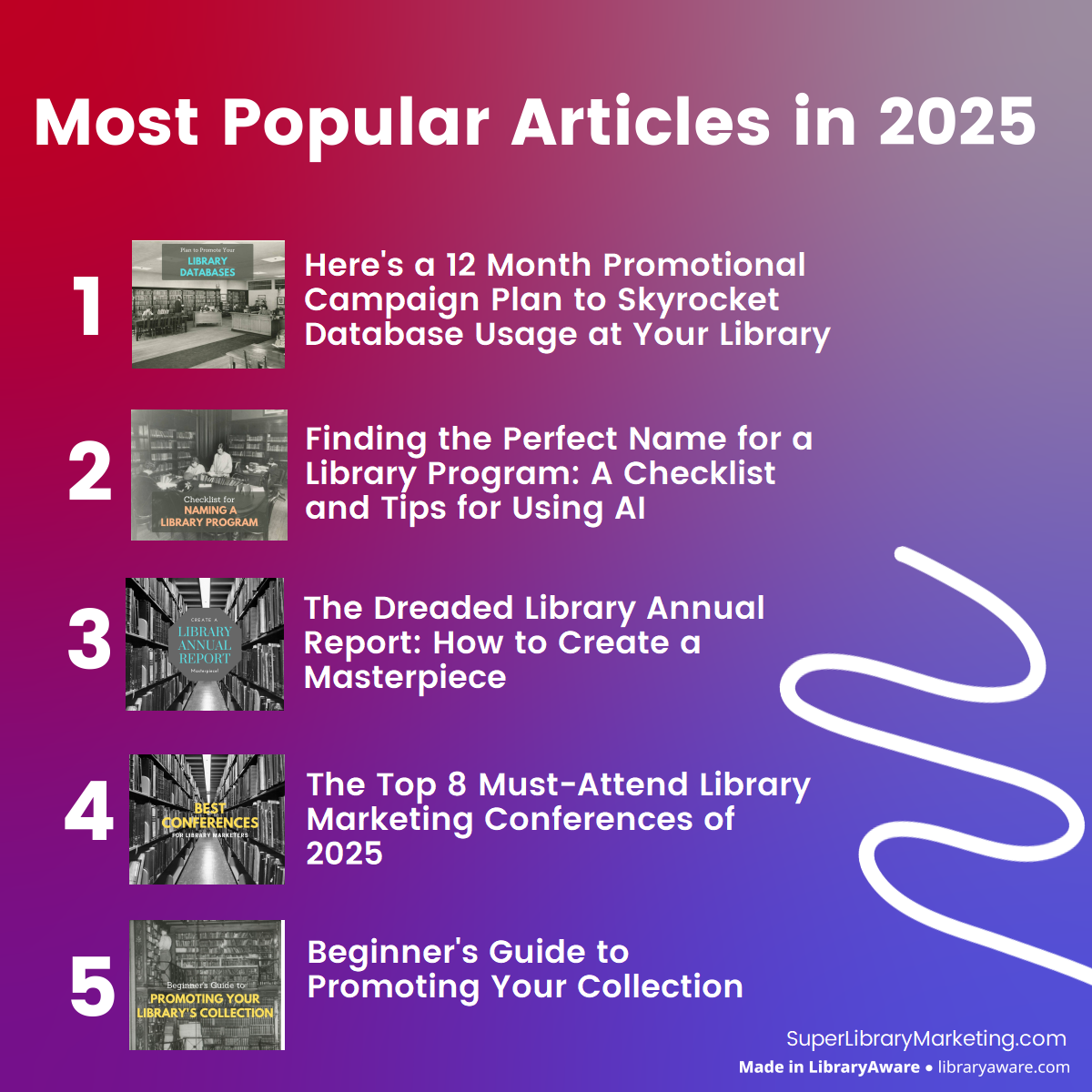
Most Popular Super Library Marketing Articles of 2025
I hope you are looking forward to 2026 as much as I am. My next post will be on Monday, January 5, when I’ll unveil the State of Library Marketing. I’ve got a calendar full of posts and videos featuring tips to make your work easier, as well as profiles of libraries to inspire you. Happy holidays!
Are you tired of being blamed for low program attendance?
You’re not alone. Many library marketers struggle to balance program promotion with broader library advocacy — and it can feel impossible to do both well.
One of my viewers recently asked for help with this exact challenge, so in this episode of The Library Marketing Show, we’re tackling it head-on.
You’ll learn how to strike the right balance between promoting events and promoting your library’s overall value without feeling like you’re constantly falling short.
Do you have a suggestion for a future episode’s topic? Do you want to nominate someone for kudos? Let me know here.
Subscribe to this blog, and you’ll receive an email whenever I post. To do that, enter your email address. Then, click the “Follow” button in the lower left-hand corner of the page. You can also follow me on the following social media platforms:
Photo courtesy Cincinnati and Hamilton County Public Library
Key Takeaways
Start with a video concept, not a promotion. Focus on an engaging idea first, then connect it back to library services. This approach makes Reels feel authentic rather than like an advertisement.
Keep production simple and relatable. Using an iPhone, a tripod, and free tools like CapCut or Instagram’s Edits app creates approachable videos that audiences find more trustworthy than overly polished content.
Engagement matters more than views. The most successful Reels spark conversation, shares, and community pride. Your library wants impact that goes beyond vanity metrics.
“Some of my favorite library memories were from the Scholastic Book Fairs at school,” Emily recalls. “Our school librarians did such a great job getting us excited about books, and the book fairs were the pinnacle of that excitement.”
Emily, who grew up in the far southwest suburbs of Chicago, came to work in a library in a roundabout way. First, she became a high school English teacher. Then, she got her MLIS. She spent about five years as a Reference Librarian whose “other duties as assigned” included marketing. Marketing was her favorite part of the job, so she started to look for marketing-specific library jobs.
That’s how, three years ago, she landed a job as the Content Coordinator at Helen Plum Library in Lombard, Illinois. Among her responsibilities is the library’s Instagram account.
Now, here’s something I probably shouldn’t confess. But I want to be fully transparent.
I love scrolling Instagram. But I’m finding that it’s tough for one person working in a remote office to create engaging content, particularly videos, for Instagram. (Know your weaknesses, dear readers!)
A few months ago, after watching hilarious/inspiring/creative posts on the Helen Plum account, made by Emily, I emailed her and begged her for help. She looked at the account I am trying to build and sent me a list of tips. (Thank you!)
Then, I asked her if she would also share her expertise with my readers. Here is her interview. Scroll to the end for the tips Emily shared with me for making engaging, effective Instagram Reels.
What inspired you to start creating Instagram videos for Helen Plum Library?
I started at Helen Plum in September of 2022, and short-form video was quickly becoming the most popular form of social media, so I knew we had to start consistently making videos. My job includes the management of our social accounts, so I always just considered it a regular part of my job from the beginning.
How do you decide what content to feature in your videos?
I always start with a video concept instead of starting with a promotional need (with a few exceptions). Maybe this is a hot take (and perhaps a difficult argument to make to your admin), but I find that starting with “How can we promote XYZ service” usually results in less engaging, less effective content.
If you flip the order and start with a video concept, then try to make it relevant to your services and organizational mission, the promotional aspect will follow.
The few times I’m asked to promote a specific program or service, I spend a lot of time thinking about how I can make it engaging and not appear “promotional,” because no one likes being advertised to.
-Emily Bradshaw
For instance, this video’s concept started with an audio clip I liked from BBC’s The One Show of Harlen Coben discussing the benefits of reading. The original video went viral, and I thought it was a compelling audio clip to use over shots of our collection. I didn’t start with “how can I promote our collection,” but this video does promote our collection by nature.
What tools or apps do you use to film and edit your videos?
I film on an iPhone, which works well for the persona we present on social media. We’re a mid-sized, friendly hometown public library, not filmmakers or professional advertisers. So I don’t want our videos to look overly produced or fancy. I honestly think having an overly polished look for Reels puts people off since it makes you look less relatable and more like an ad.
I also use a basic tripod. You should always use a tripod for stationary shots. You may not realize how big a difference it makes until you see it.
For audio, I use lapel mics for on-camera speaking if it’s appropriate for the video. To record voiceovers, we’re lucky enough to have a recording booth in our makerspace. But before we had that, the voice memos app on my iPhone worked just fine!
Editing tools depend on how complex the video is. If it’s simple, I use the Edits mobile app, which is Instagram’s answer to CapCut. If the video requires more labor-intensive editing, I use the free desktop version of CapCut because editing on a tiny phone screen gets difficult. After I’m finished in CapCut, I still use Edits to add captions, audio, or other features before posting to Instagram.
Adam Moserri has said that Instagram is giving a slight boost right now to Reels that use Edits, so I take advantage of that. (Aside: everyone should follow Adam on Instagram – he is constantly giving updates on Instagram tools, algorithms, and more!)
Do you use a script or storyboard before filming, or is it more spontaneous?
It depends: the more complex the video, the more thorough my planning. For shorter, simpler videos, the storyboard just lives in my head. For others, I simply write down a list of shots I need.
If I’m doing a voiceover video, I write a script and a shot list to go with it. And for the most complex videos, I have a detailed outline of shots, timing, which people are in which shots, etc.
But sometimes the result is a bit different than my original plan. I always film more than I need so that while I’m editing, I have options for what works best.
How do you get your coworkers excited about participating in videos?
This is a common struggle. From my experience, if you start making engaging content that people enjoy, your coworkers will earn your trust and become more comfortable. When I started two and a half years ago, I was on my own, but now that we have a booming Instagram account, I have coworkers asking to be in videos!
It takes time, but that time pays off. If you’re still on your own, there are a lot of ways to make videos without coworker participation, such as POV (point of view) videos.
What types of videos have gotten the most engagement from your audience?
Our most engaging videos have messages that resonate with readers or library lovers. Readers are passionate and want to share that passion, so they share these types of videos with their friends and followers.
An example is our video about “reading what you enjoy” rather than what anyone thinks you should be reading. And more recently, with libraries in the U.S. under funding threats, this video about how we provide free services resonated so much that James Patterson posted it to his feed.
Other types of videos that get lots of engagement include anything humorous (see our spoof of The Bear) and anything in which viewers can share their own opinions. Our series of “Real Librarians Rating Fictional Librarians” has the most fun and lively comments sections of any videos I’ve ever posted, with folks debating the merits of favorite (and not-so-favorite) librarians from pop culture.
How do you measure the success of your videos?
The number of views is the first thing I measure since it’s what Instagram measures before anything else. However, I still consider many of our lower-view videos successes based on comments and shares.
For instance, I expect videos that are more specific to our local community to get fewer views simply because they are targeted to a smaller population to begin with (like our Lilac Time video). So, with those, I look at the number of comments and shares.
I have also been asked if we’ve seen an impact on our local community. Since we’ve had so much success, do our videos reach actual cardholders, or is the reach too broad? The answer is yes, we are reaching our community. We regularly receive comments at our service desks about how much our patrons enjoy our videos.
How do you stay inspired and avoid burnout when creating content regularly?
I get inspired by other content creators across many industries. I do a lot of scrolling. I save videos that inspire me into an “Ideas” collection on our account, so I have a trove of inspiration there if I need it. These not only include libraries, but also other reader-related accounts — Bookstagram influencers, publishers, etc. — as well as other companies and organizations I follow, especially local ones (all our Chicago-area museums, DuPage County Forest Preserve, etc.).
What advice would you give to a library just starting to create short-form videos for social media?
Scroll. Get a pulse on what’s happening in your content area and in your local community. Then try participating in a trend that you can make relevant to your organization and your target audience. Trends are easy and low-pressure, and they are good starter videos to try if you’re a beginner developing filming and editing skills.
Once you start to feel comfortable with simple videos, don’t be afraid to try your own original content ideas. Your library is unique, so show off what’s unique about it.
-Emily Bradshaw
This is easier said than done, of course, and like anything, it takes time and persistence. But originality will take you to the next level. Try new things, and don’t take yourself too seriously.
Emily’s 6 tips for creating Reels
Using sound bites from Bookstagram creators helps me save time and can have powerful effects. No audio to edit! Here’s an example.
For many videos in which I appear, it’s just me and a tripod with no other people to help (here’s an example of that.) I typically hide an earbud in my ear if I’m lip-syncing or have the audio playing on a separate device nearby.
Creating a video clip content bank of reusable B-roll is incredibly useful in a pinch! I have about two dozen various shots of our adult stacks alone. Batch-filming can also help if you have the time to block out for shooting a bunch of stuff all at once to use later.
Consistent scheduling: I post one video per week for Helen Plum Library, which works for me. Typically, I’m working on next week’s video the week before, so I’m always one week ahead. I find this to be the perfect balance of making sure I have something lined up while still being timely and flexible enough for the content to vibe with the current social media climate.
One of the most valuable things to me is literally scrolling through Instagram and saving videos that inspire me. It also helps me to see what works and what doesn’t.
If you’re looking to expand your audience, I recommend using trial Reels, which will share out your Reel only to non-followers and give you insights. Then you can decide whether to share it with your followers after 24 hours.
Subscribe to this blog, and you’ll receive an email whenever I post. To do that, enter your email address and click on the “Follow” button in the lower left-hand corner of the page. You can also follow me on the following social media platforms:
Photo courtesy Cincinnati and Hamilton County Public Library
Where I live, the air is thick and humid right now, the fault of something called “corn sweat.” That’s the process of corn plants releasing moisture into the atmosphere through transpiration, similar to how humans sweat. My friend from my TV days, meteorologist John Gumm, says the corn crop in my area is releasing billions of gallons of water daily. Fun, right?
To cool off, I swim laps at the local YMCA. And underwater, I have a lot of time to think. Lately, I’ve been using that time to figure out how to help my library friends prepare for what will come when the weather turns cooler.
In the United States, the full ramifications of the loss of the Institute of Museum and Library Services and its funding will hit in September. For libraries in Canada, the United Kingdom, Australia, and New Zealand, funding cuts and intellectual freedom challenges are making work more difficult and threatening the core mission of libraries.
Longtime readers may already know that I’m not the kind of person who says, “There’s nothing I can do about it” very often. Action is how I deal with my anxiety. So, here’s the plan of library marketing action for the coming months.
The Big Problems We Face
Library marketers face a lot of obstacles. But in the coming months, the big threats are:
Decline or elimination of funding for libraries, which leads to…
No money for marketing or promotions, which impacts the effectiveness of our marketing, making it seem like marketing is no longer valuable. That often leads to…
Hiring freezes or the elimination of dedicated library marketing staff, which leads to…
Less use of the library, which leads to…
More funding cuts and library closures.
We do not want to get caught in that vicious circle.
What Library Marketers Need to Do
1. Lead with your value.
As we face the prospect of shrinking budgets and rising scrutiny, your library’s value must be front and center. And you must create a plan that communicates that value clearly and consistently, not just during certain times of the year like Library Works Week or National Book Month, but all year long.
Use every channel you have to reinforce how your library improves lives. Share patron success stories, promote your most-used services, and highlight how your library supports literacy, learning, and community connection.
2. Focus on the most cost-effective promotions.
We still have a good many low-cost, high-impact channels for promotions. But focus is the key.
This fall, I want my library marketing friends to spend their time and precious money on the following:
Email marketing: This is still one of the most effective tools for engagement. Targeted, opt-in messages are the most effective means of communication, with no algorithm to circumvent. So, get a plan together to grow your subscriber list now. And, as you put your emails together, think of them as a conversation between you and your audience. Try to keep your messages short and enticing. And offer your email recipients a way to email you back with feedback and questions. It will make them feel valued, and that feedback will make your messages stronger and more effective.
Collection marketing: Books are the heart of what you do. And we know most people come to the library for the collection. Don’t shy away from books! They’re your brand. Promote your books, databases, and digital resources through curated lists, displays, and themed promotions.
Strategic partnerships: Work with local organizations to amplify your reach without spending more money. Partnerships can take time to cultivate, but the investment is worth it. Your partners can strengthen your library’s offerings and give you access to audiences you’ve never reached before.
Organic social media: I put this last because of my mixed feelings about it. Social media effectiveness overall is declining. But posts that tell stories, highlight staff, or have some kind of interactive element like a poll or question, do boost visibility. So don’t use your social media accounts to highlight programs. I know that’s going to be upsetting to some readers, but the data shows it doesn’t work. Instead, think of your social media as an effective way to build relationships and reinforce your library’s personality.
3. Make it easy for new users to engage.
The moment someone signs up for a library card is critical for library marketing. It’s your first chance to make a good impression and use that person’s “new cardholder” status to convert them to a lifelong fan! You should:
Create a “New Here?” section on your website with the same information as the email series.
In those emails and on that website section, highlight services that are easy to access and immediately useful, like eBooks, streaming movies or music, or personalized reading recommendations.
4. Empower your front-line staff.
Your staff are your best ambassadors. Train them to talk about services, recommend materials, and encourage sign-ups for newsletters or events. Give them talking points so they can highlight personalized services like readers’ advisory, chat reference, and book bundles. These human touches build loyalty and word-of-mouth buzz and reinforce the message that your library is filled with helpful people.
5. Track what matters — and act on it.
No more excuses… stop doing what doesn’t work, even if it’s something you’ve always done. That means:
If your supervisor pushes back, ask them to message me. Seriously.
6. Experiment.
All marketing is an experiment. And some people shy away from experimentation during tough times. But now is the perfect time to try innovative approaches!
Try sending your videos in an email to see if you get more views.
Launch a blog or podcast.
Pilot a new format for your newsletter.
Test a new tone or voice in your messaging.
7. Streamline your approval process.
If internal red tape is slowing you down, advocate for a more efficient workflow. There are a lot of things you can do to make the approval process less painful,
Use templates to speed up content creation.
Set clear deadlines and expectations.
Build trust with leadership by showing how faster approvals lead to better results.
What are you doing to prepare your library and yourself for the challenges ahead? Let me know in the comments.
Subscribe to this blog, and you’ll receive an email whenever I post. To do that, enter your email address and click on the “Follow” button in the lower left-hand corner of the page. You can also follow me on the following social media platforms:
Photo courtesy of Cincinnati and Hamilton County Public Library
It’s not surprising that Tina Walker Davis and her communications team at Deschutes Public Library in Bend, Oregon, have a robust and interesting video strategy for YouTube. Tina, who grew up in the San Francisco Bay area and graduated from Washington State University, has a previous career as a television anchor and reporter.
“I left journalism to go into marketing and communications and owned my own marketing business for 10 years until I made the financially disastrous decision to open an independent bookstore,” explains Tina. “While the bookstore didn’t pan out, it did enmesh me in the literary community here, including the library system.”
Tina took a job at the library in 2012 in event planning and coordination. Now she’s Communications Manager for the library. She manages four people, including a Graphic Design Coordinator and Dana O’Connell, Keifer McCool, and Michael Rivera, who are all Digital Communications Coordinators.
“Michael almost exclusively does video work, and Dana and Kiefer both manage social media,” says Tina. “Dana also does all of our Spanish-language communications. I’ve told the team many times that I’ve never worked with such a collaborative group.”
“We have bi-weekly brainstorming sessions that are so fun. There’s no agenda. It’s just a time for us to come together and talk about what we’re seeing, what we’re excited about, and generally throw some spaghetti at the wall. A lot of our best content was conceptualized in those brainstorming meetings.”
Deschutes Public Library’s YouTube channel was already up and running when Tina began her job. At first, Tina’s team used it to share story time videos and videos of their marquee events, as well as a Why We Love the Library series in 2016 and 2017. At the end of 2019, they had 265 subscribers.
Then COVID hit. Like most libraries, Deschutes Public Library pivoted to online programs and saw its subscriber count grow to 14,500 at the time of this writing.
When Tina hired Michael in 2022, he “brought a wealth of professional video production experience—just phenomenal skills in shooting and editing, but also a fantastic eye and ear for storytelling,” exclaims Tina.
“I don’t know if it’s my background in journalism, but I’ve always believed in the power of stories to do the work that we can sometimes struggle to do in marketing.”
“We can run ads telling people how great the library is, but it’s so much more impactful when it comes from real people who truly believe in the power of libraries to change lives.”
-Tina Walker Davis
Dana says the library’s strategy, when it comes to producing videos for YouTube, is to strike a balance between the information the community needs to know about the library and fun or trending content.
“Everyone who comes into the library has a story,” explains Dana. “Some of our human-interest pieces come from referrals by our public services staff, in the form of kudos from our online web form, or a chance meeting while in one of our branches.”
“Staff, volunteers, and customers offer the chance to talk about the library in a unique voice where we aren’t necessarily promoting a product or service. For me, it’s about having a touch point with a customer and listening to what excites them about the library; no two answers are the same.”
“One thing we do every time someone is interviewed for a video, regardless of the topic, is to ask, ‘Why are libraries important?’” adds Tina. “The answer to that question is evergreen. We can pull the answer and use it along for a series of shorts, turn it into a graphic quote for social, or string together several answers for a stand-alone piece.”
Dana and Kiefer shoot and edit the short-form, vertical format for Instagram, Facebook, TikTok, and YouTube shorts. Michael uses videography equipment to do the longer-form and documentary-style videos.
“But rarely do they work alone,” explains Tina. “They’re writing together, and often Dana or Kiefer will act as Michael’s grip during shoots and take care of the interview portions. Michael is definitely a dedicated videographer, but it’s truly a team effort between the three of them—and it’s magical.”
All videos from Deschutes Public Library have captions for accessibility and clarity. They also have video thumbnails featuring a branded, consistent look. That helps to capture the attention of scrollers while making sure viewers know this content comes from the library.
“When I choose the image(s), I’m looking for a visually pleasing frame that tells the viewer just enough to pique their interest without giving away too much of the story,” reveals Michael. “The best images will also have some clean space in the frame that the title will naturally fall into.”
“The title in the thumbnail usually doesn’t match the video title, and that’s on purpose. The main title is always clear and matter-of-fact, while the thumbnail title often uses one of the most impactful quotes in the story. The key here is to be concise to maximize the size of the text in the frame, so the titles are usually no more than six words.”
Deschutes Public Library doesn’t rely on pure chance to get views on its videos. They promote them!
“Our flagship eNewsletter has 55,000 subscribers, and we’ll sometimes link to videos from the newsletter,” says Tina. “We embed some videos on our website. In particular, we’ve used our videos on our website to help inform the public about our bond projects.”
“I also do some paid promotion of videos on YouTube, Facebook, and Instagram if I can see that a monetary ad boost is needed and will help us really target our Deschutes County residents.”
“So, with all that said, our investment in YouTube as a platform was very organic. It started slowly, but we saw real growth. But nothing happens on YouTube alone in terms of storytelling. Anything that is shared there is also pushed out on Instagram and Facebook, and some also make their way to TikTok if they’re humorous or have that viral potential.”
Tina and her team say the videos help boost awareness of the library and its services, and they’ve received a wealth of positive community feedback.
“Our recent viral video — where our director, Todd Dunkelberg, is giving a Gen Z-inspired tour of the new Redmond Library — was a great community experience. Between Facebook, Instagram, TikTok, and YouTube, we are now close to 5 million views on that video. But what I loved seeing was locals commenting amongst folks from across the country and the world — the locals took so much pride in claiming the library as their own (‘That’s MY library!’).”
“And Todd became a little local celebrity after it, with folks coming up to him in the community and telling him how much they loved the video. We immediately jumped on the ‘Slay’ and ‘So Julia’ lines and created stickers with the characters Todd points to in the video, and those were really popular with our customers.”
For inspiration, Tina and her team often look inside and outside the library world.
“I’m guilty of being an Instagram reels scroller,” confesses Tina. “My brain often goes to, ‘Could we put a spin on that?’ Often in our brainstorming sessions, we’ll bring forward videos that we’ve seen over the past two weeks, share them with the team, and see if there’s something we can do along those lines.”
“Library systems are really growing into their own niche on social. They’re funny, sometimes irreverent. People really enjoy watching library folks, who are perhaps historically thought of as buttoned up, be funny.”
– Tina Walker Davis
Tina says the key factors in the success of the library’s video marketing strategy are her talented team and library leadership that believes in the power of communication.
“I know that for a lot of libraries across the county, being able to spend this kind of time on video work is an absolute luxury,” says. Tina. “I feel very fortunate to not only have the trust from our leadership to do that work, but also lucky to work with a team of communications professionals who are passionate about the work and the message.”
“The goal is to remind our customers, the taxpayers who make the library’s work possible, that the library is here for them, in whatever way they may need, from checking out a book to finding a job. We’re here to meet people where they are and make their lives better.”
Subscribe to this blog, and you’ll receive an email whenever I post. To do that, enter your email address and click on the “Follow” button in the lower left-hand corner of the page. You can also follow me on the following social media platforms:
Photo courtesy Cincinnati and Hamilton County Public Library
We are now firmly in the second half of the calendar year. I don’t know about you, but when I worked in a library, this was the time I usually started to “drag” a little. I was tired and uninspired. (Hey, that rhymes!) I needed a little boost… someone to remind me to focus on what was important.
I’m here for you. These are the eight things I want you to focus on as you move into the next six months. This is also a great post to share with new hires who work on library promotions. The eight principles listed below are the most valuable tips I can offer to help you center your work and find direction.
And I’m curious… do you think I missed anything in this list? Add your guiding principles to the comments!
8 Tips to Focus Your Library Promotions
1. Plan ahead — don’t just react.
This is my number one tenet because so many of the library staff members I work with say they feel like order takers! They are asked by different departments and branches to promote the things that are important to those people, which allows no time to create a strategic library marketing calendar or campaign that supports the library’s overall goals.
Effective marketing is proactive, not reactive. You want your promotions to be holistic, covering all the channels where your target audience is located (see item #4). List the goals you want to achieve over the next six months, and create holistic campaigns. Before you know it, you’ll have a full editorial calendar.
And I know this might sound scary, but be transparent. Share your calendar with the rest of your coworkers. Inform them of the overall goals and provide them with regular updates on the content you share and the results you are achieving. At the end of the year, let everyone know how you did.
This will help educate your coworkers about marketing! Many of them probably think marketing is reactive. They don’t know how much planning and coordination go into an effective campaign.
2. Promote the benefits, not the features.
Listen, I know this one is hard. But your community is looking for a solution to their problems.
So instead of saying, “Use our personalized reader recommendation service”, highlight how your service solves real problems, like helping readers to find the right books for them (because, let’s be honest, there are SO many good books out there!), or helping readers who feel like they’re stuck in a rut, reading the same things over and over again.
You want your readers to think of the library, not Google or Goodreads, as the best place to find a book.
3. Tell more stories of how the library impacts lives.
User-centered storytelling, like Loyola Marymount’s Library Fans video series, connects emotionally with users and shows the library’s impact on real lives. These stories are more memorable than stats or service lists.
Storytelling helps your community to see how others are using the library and imagine how they might use the library too!
4. Meet your audience where they are.
Use the channels your patrons prefer. And remember, you don’t have to be on every channel. You just need to be on the right ones.
The channels you choose should match the preferences of your primary audience segments.
Teens and college students? Think TikTok and YouTube Shorts.
Parents and caregivers? Facebook groups and email are the best way to reach this audience.
Adults over age 65? In-person outreach and local newspapers or printed newsletters can be most effective.
Most importantly, don’t try to build an audience on the channels your patrons don’t use. How do you know which channels your audience prefers? Use metrics (see #8) and surveys to pinpoint where your energy will be best spent.
5. Consistency builds brand recognition and affinity.
At the Fourth of July parade two weeks ago, I instantly recognized the library’s entry coming down the street, even without my glasses. How? The color scheme of their banner and vehicle! (As an aside, I was sitting right in front of one of the branches, and the cheering that rose from the crowd when the library drove by warmed my heart.)
You can have the same impact. Use your brand logos, color palettes, and tone across channels. Patrons should instantly recognize your library’s content, whether it’s on a digital sign, flyer, or Instagram Story.
I know this seems like a constraint to some of my more creative readers, but the discipline pays off with instant brand recognition.
Beyond your brand colors and logo, remember to name your services clearly and tie all services to your library (e.g., “Consumer Reports from Maple Tree Library”).
6. Empower your advocates.
Your best marketing tool might be your most loyal library users. Feature them in campaigns and encourage user-generated content. When your superfans talk about how much they love the library and how it impacts their lives, people will listen!
Encourage staff to promote programs on their own social media (with branded templates or messaging prompts).
And provide your Friends group or foundation with a marketing kit: shareable graphics, key talking points, and event blurbs.
7. Always be repurposing.
Library marketers are asked to create a lot of content! Just like you may do in your home, you can reuse and recycle some of that content to help ease your workload and ensure your best content is seen on multiple channels. You can do that by:
Repurposing blog posts, newsletters, and program guides into social media snippets, videos, or infographics. Share this content with local media and community partners.
Turning book displays into short videos for social media by adding trending audio and creative elements like stickers.
Clipping moments from author talks or storytimes for Instagram Stories, YouTube Shorts, or TikTok videos.
Breaking down long blog posts into carousel posts or pull quotes for your homepage, digital signs, or social media posts.
8. Measure what matters.
Your metrics are key to guiding your marketing strategy. And listen, I’m the first person to admit I can easily go down the rabbit hole of data and measure everything.
But my boss coaches me to only spend time measuring the things I need to help make the decisions that will guide my future library marketing actions. That means I don’t obsess over likes and followers.
Instead, I track engagement metrics like watch time on videos, shares of social media posts, and read time on blog articles. I also urge you to use UTM codes like Bit.ly and Google Analytics to track campaign sources, so you know which channels are driving traffic to your library and which pieces of content resonate most with your community.
Subscribe to this blog, and you’ll receive an email whenever I post. To do that, enter your email address and click on the “Follow” button in the lower left-hand corner of the page. You can also follow me on the following social media platforms:
Photo courtesy Cincinnati and Hamilton County Public Library
Ray Holley, the communications manager for Sonoma County Library, is fascinated with economic development and planning. When he took his current job at the library in 2018, one of the first questions he wanted to answer was… what is the return on investment of a library?
Ray commissioned a respected local economist to conduct an independent study of the library system’s economic impact. The result? A headline-grabbing finding: For every $1 invested in the library, the community received $3.42 in return.
Ray knew this would make for great press coverage. He strategically timed his pitch, used an existing relationship with a reporter, and landed a feature story on the front page of the paper. That story sparked ongoing conversations about the value of libraries and gave the library system a powerful stat they continue to use in marketing and advocacy efforts.
As a former newspaper editor, Ray knows how to frame a story in a way that earns coverage. In a recent panel for the online event“Putting Principles Into Practice,” organized by the Library Marketing Conference Group, he joined me and another former journalist–turned–library communicator, Leslie Marinelli of Forsyth County Public Library, to share insider tips on how libraries can achieve better media coverage.
Libraries have great stories to tell. But getting the media to listen isn’t always easy. Here are the top 10 practical tips that Leslie, Ray, and I shared for getting your library into the news.
1. Know your media market size, so you can tailor your approach to press coverage.
Knowing whether you’re in a small, medium, or large media market helps you tailor your approach and your expectations.
To determine the size of your media market, you need to identify your Designated Market Area (DMA). DMAs are geographic regions determined by the reach of local television stations and are used to define local television and radio markets.
You can find your DMA by consulting Nielsen’s DMA rankings, which are based on population size and the reach of broadcast signals. The top 25 cities on the list are considered large markets. Medium markets are numbers 25-100 on the list. If your area is listed at number 101 or lower, you are in a small market. Why does this matter?
Small markets may be more receptive to informal pitches, good stories, and contributor-written columns.
Medium markets might have a mix of overworked reporters and community-focused outlets. Relationship-building and persistence are key in these markets.
Large markets typically have more gatekeepers and higher competition for coverage. You’ll need a strong angle, professional press materials, and sometimes long-term relationship nurturing to break through.
2. Learn what’s truly newsworthy.
Tip from Ray: “There’s what library staff think is newsworthy, and then there’s what reporters think is newsworthy. Your job is to bridge the gap.” How do you do that?
Focus on stories that have a community impact, emotional appeal, or broad interest.
Think strategically. Don’t pitch everything. Pitch what’s most likely to get picked up. Look through your local newspaper, magazine, radio, and TV stations to see what stories they normally cover. And check their social media accounts to see which stories receive a lot of engagement. They’re more likely to respond to your pitch if they think it will draw attention to their platforms.
Highlight grand openings, author visits, new services, renovations, or impactful patron stories. Those are usually sure bets for press coverage.
3. Personalize your pitches.
Tip from Leslie: “I don’t send out very many formal press releases. I prefer casual emails — sometimes with emojis — and it works better for my small market.” Leslie talked about this approach in depth in this post.
Know your market (see tip #1). It can help you decide how best to approach reporters. For example, in smaller communities, informal, friendly outreach can be more effective than polished press releases.
Use conversational language.
Personalize your email to each journalist, especially if you’re targeting a larger outlet.
4. Build relationships with reporters.
Tips from both Ray & Leslie:
Read or watch the media in your market. Know who’s covering what.
Reach out with thanks, praise, or helpful information, even when you’re not pitching a story.
Say yes when reporters ask for quotes or information and respond quickly.
Ray reads the paper every day and sends personal follow-ups after he sends his press releases. Leslie has even gotten coffee with the editor of her local paper. And when I worked at a library, I often invited reporters for a personal, behind-the-scenes tour to get to know them and vice versa!
5. Pitch less, but pitch better.
Tip from Ray: “Too many press releases can cause outlets to tune you out. Be strategic.”
Avoid sending releases for every single event, especially small, localized programs.
Always follow mass press releases with personalized outreach to key contacts.
When a brand-new library branch opened at Forsyth County Public Library, Leslie wrote a formal press release, and she packed it with everything a reporter might need: quotes with emotion, accurate stats, and ready-to-use details. That preparation led to multiple front-page stories, including this one, and a professionally produced video by the local government, something Leslie couldn’t have done on her own as a one-person team.
6. Time your pitches well.
My rules of thumb:
Big events (e.g., author visits, renovations): Send your release 4–6 weeks out, with a reminder a week before.
New services: Send your release 1–2 weeks ahead.
Awards: Send your release 1 week ahead. If you want to send it earlier, include an “embargo notice” which specifies that the news outlet can’t publish or air anything about the story until a specific date. Newsrooms will honor embargoes.
And always include:
High-resolution images or video that the press can use to add visuals to the story if they can’t get a reporter to the scene.
Human-sounding quotes. For example:
Corporate-speak quote (what not to do): “You can see our dynamic approach to customer service is essential to our strategic initiatives.”
Human-sounding quote (what to do instead): “We’re adding an online, real-time reading recommendation service because we wanted to do a better job of helping people find the books they want.”
Clear, simple language. As you write, you’ll want to avoid jargon, focus on benefits to the public, and make it easy for reporters (and readers) to understand. For example:
“The library is opening a brand-new branch with more space, updated technology, and a dedicated children’s area to better serve the community.”
“This program gives families a chance to enjoy a free movie night together, right at the library.”
7. Write the story yourself.
Media outlets are short-staffed. If you can provide a full article or press-ready content, your chances of getting coverage go up, and you control the message.
Leslie prepares a media packet to distribute at every Library Board meeting, complete with pertinent figures, dates, quotes, and the correct spellings of people’s names so that it’s easier for her local reporters to write stories about the library. This saves her reporters from having to go digging for information, and it leads to much more accurate news stories, which is a win-win for both the library and the newspaper.
Bonus: Offer to write a monthly column for local papers or magazines. Leslie turned her proactive event roundups into a recurring feature!
8. Be your own news channel.
Tip from Ray: “We break our own news via newsletters and email. It gets our message out without relying on the press.”
Start a blog or email newsletter and communicate directly with your community. Ray’s library has an entire news page with newsletters and blog posts to make it easy for reporters and stakeholders to see the latest library news.
Share bite-sized stories with elected officials, nonprofits, and other community partners.
Build a “partner relay” list to quickly spread info during closures or tech issues.
9. When things go wrong, work to control the narrative.
If negative press is brewing, you’ll need to move quickly.
Ray says that when a change in how content was communicated upset some internal staff, one of them contacted the press, claiming the library was turning its back on DEI values. He immediately pulled together a response team, wrote talking points, coached his colleagues, and scheduled a call with the reporter, who happened to be someone he had previously hired!
Because he acted fast and came prepared, the story was successfully reframed to highlight the library’s expanded and ongoing commitment to DEI. It ran as a positive feature instead of a negative exposé. Some other tips include:
Have talking points ready, as Ray did.
Role-play interviews with your spokespeople.
Use your own platforms to clarify or correct the record.
On that last point, while I was working in marketing at the Cincinnati and Hamilton County Public Library, one of our biggest challenges was the lack of accessibility in several of our historic Carnegie-era branches. We knew renovations were needed and were preparing to ask voters to approve a levy to fund them.
Just as we were in the planning stages of the levy, a Vietnam veteran went to a local news station and shared that he couldn’t access his neighborhood branch because it had no elevator or wheelchair ramp. (Here’s that story.) It was true, but it didn’t mention our plans to renovate the branches.
Instead of ignoring the coverage or going on the defensive, we reached out. I invited the veteran to return to the library for a follow-up story, this time focused on what it would mean to him if he could fully access library services. We recorded an interview and shared it on the library’s YouTube channel.
That heartfelt video helped us take control of the narrative and became a key part of our campaign messaging when it came time to ask the community to vote “yes” on the levy.
10. Show gratitude.
Tip from Leslie: “Send thank-you notes. Nobody gets them anymore, and reporters remember.”
Praise good stories, thank writers publicly and privately, and copy their bosses when appropriate. It builds goodwill and earns more coverage next time.
Subscribe to this blog, and you’ll receive an email whenever I post. To do that, enter your email address and click on the “Follow” button in the lower left-hand corner of the page. You can also follow me on the following social media platforms:
Photo courtesy Cincinnati and Hamilton County Public Library
Laura Solomon grew up in upstate New York with a mother who was an avid reader. She took Laura and her brother to the local library about once per week.
“My favorite memory about a library wasn’t directly in a library,” recalls Laura. “When I got the chicken pox and was out of school for days, my mother asked the children’s librarian for books I would like. The librarian sent her home with a huge stack. I loved every book!”
Now, Laura helps libraries with digital marketing and website design for the Ohio Public Library Information Network. I reached out to Laura after the company I work for, NoveList, began work on digital accessibility. And, of course, that made me think of my library friends and their commitment to accessibility.
So, I asked Laura to share her expertise and tips. But first, Laura wants to clear up one misconception. I thought that the push for full compliance was the result of a new law. I was wrong.
Laura says there are no new legal risks, but there is likely to be much more scrutiny and even fewer accepted excuses for not meeting legal obligations after the deadlines.
“There are no changes to the Americans with Disabilities Act (ADA) regarding web accessibility,” declares Laura. “Websites have had the legal requirement of being accessible to people with disabilities for many years. The Department of Justice has long stated this clearly.”
Laura says that, in April 2024, the Department of Justice added two new rulings that impact your library.
There is now an official deadline for compliance for state and local government entities. The specific deadline depends on the population of your library’s community, which is not the same thing as your library’s service area.
“The Department of Justice has drawn a line in the sand because too many government entities (including libraries) have been ignoring the legal requirement.”
Laura Solomon
In addition, there is now an official standard for compliance. WCAG 2.1 AA is a set of internationally recognized guidelines developed by the World Wide Web Consortium (W3C) to ensure web content accessibility, particularly for people with disabilities. This is the standard your library must meet in order to be compliant.
So, it’s time for your library to get serious about compliance. Where should you start?
“I would recommend starting with automated testing, using a tool like Webaim’s WAVE tool,” advises Laura. “However, I always recommend testing with more than one tool. They will usually catch slightly different errors.”
“Most tools (including WAVE) only check one page at a time, not an entire site at once. It takes manual testing to really dig into things correctly. However, it’s a good starting point for most laypersons.”
“It’s important to understand that the WCAG standard is a technical standard. It’s used to evaluate the code that creates the website, not what you see on the screen. That means it often requires someone with both web development and web accessibility expertise to completely remediate issues.”
“WebAIM also has a great introduction to web accessibility. The best thing a library can do right now is to add accessibility checks into content workflows.”
That means, for every piece of content your library creates, a library will need to check for accessibility, including color contrast, alt text, keyboard navigation, and structured content.
Laura says the most common accessibility mistake she encounters on library websites is a lack of alt text or poorly written alt text.
“As the web has become increasingly visual, much of that content has become completely unavailable to people using assistive technology,” explains Laura. “Alternative text is mission-critical and not just a nicety.”
“Another thing that many libraries do is to pack images with tons of text. This isn’t just problematic for web accessibility, but it’s also poor design.”
Laura says another problem that’s become increasingly pervasive is the use of accessibility overlays, which are third-party products that usually have some kind of button that provides additional accessibility features when activated.
“Accessibility advocates have long begged site owners to stop purchasing these,” says Laura. “They can often interfere with the technology that people with disabilities already use to make their online experiences accessible. Also, they don’t protect libraries from lawsuits. If your library has purchased one of these, I strongly recommend removing it and focusing on making your website accessible from the ground up.”
Your library may feel overwhelmed by both the scope of this work and the cost.
“To be honest, retrofitting a website for accessibility can be more time-consuming and expensive than starting with a framework that already provides accessibility as part of its core functioning,” says Laura. “Sadly, a lot of popular content management systems don’t do this or only provide some accessibility features.”
Your library’s website isn’t the only thing you need to review to be compliant. PDFs, e-newsletters, and social media graphics should also be considered. Laura says it’s difficult to make PDFs compliant. The best advice is to not use PDFs. As for e-newsletters, they have the same requirements as any regular web page. Social media graphics require alt text.
“It’s important to understand that web accessibility includes everything,” shares Laura. “It includes databases, apps, and anything else that connects to the internet. It also includes a lot more than just the blind or visually impaired.”
“People with disabilities are not a small part of our communities; statistically, they represent at least 1 in 4 people. Libraries are about serving their communities, and this is an especially important way in which they can do that, regardless of legal requirements.”
Subscribe to this blog, and you’ll receive an email whenever I post. To do that, enter your email address and click on the “Follow” button in the lower left-hand corner of the page. You can also follow me on the following social media platforms:
Photo courtesy Cincinnati and Hamilton County Public Library
Have you ever wondered what you could do for your library if you had more people working on promotions?
Staffing up in library marketing is very uncommon. I believe this is a huge mistake that many libraries make. Leaders and board members don’t understand the essential connection between smart, strategic library marketing and the organization’s success.
“I have fond memories of storytime with Mrs. Pittman,” remembers Nicole. “We’re Going on a Bear Hunt was a classic! But even more special was bringing my own children back to that library when we visited the grandparents for them to get to enjoy a storytime.”
Nicole is now the Communications Coordinator for the Delaware County District Library, a five-branch system with a bookmobile and other outreach services. DCDL serves a population of nearly 166,000 people.
Nicole came to the library in 2012. She had one Communication Specialist but was certain she needed more help.
“As the Library grew, the strain on our department of two grew, as well,” explains Nicole. “In 2018, the Library passed a levy with the promise to build a new branch. Feelings of overwhelm were setting in, and we knew it was time to really look at what jobs we accomplished for the system, what was being asked of us, and what we could realistically provide to the best of our abilities.”
“The first thing I did was sit down with my Communications Specialist and perform a job task audit. We each took a stack of colored Post-it notes and in about 30 minutes wrote down every job that we do or anticipate doing with the construction of the new branch.”
Nicole says it became clear their job responsibilities were unbalanced and not always aligned with the library’s priorities. So, she decided to use a graphing technique she had learned from business books.
She created a chart. At the top, she put two columns: Library needs and Library doesn’t need. Then, on the side, Nicole made two rows, one labeled I like, and one labeled I don’t like.
“Take your tasks and put them into those squares,” directs Nicole. “What do you like doing, but the library doesn’t need? What do you not like doing but the library needs? This gives a clear, hard-truth picture of tasks that might need to be eliminated or that could be given to a different person.”
“We took the Post-its that remained and looked at the common themes. Much of the work that was overwhelming me had to do with maintaining the website and managing email communications. I liked those tasks, and the library needed those, but I was doing both jobs poorly because I was not giving them the time or investment of education they deserved.”
“I knew the potential we could reach with email segmentation, but I had no desire to even begin to creep into that world because I was already overwhelmed with the basics of simple bulletin communications.”
“Our patrons were not being served in the best way that they could be. We knew a second Communications Specialist was needed to focus on the website and email communications.”
-Nicole Fowles
Nicole says the next step was to approach her director. But before that meeting, she did some additional prep work.
“I looked at the job description and had to decide if we’d keep the same job description or if it would need to be a new title,” remembers Nicole. “We decided to keep it the same, as this person would still have much cross-over with general communications duties. We’d post it with clarity that we were focusing on digital comms. I also needed to be sure that the organization’s pay scale for the title was appropriate for the job we wanted to accomplish.”
“When I had title, job description, and overall benefits and pay impact figured out, I listed the things I wanted to do and the cost if I simply contracted them out. I got various quotes for full-scale website management from other companies. I also got quotes for contract email support or PR for-hire agencies.”
“In the end, the benefit of hiring someone who would do the work of those two contracts (web and PR agency), in addition to being a DCDL employee and helping as needed with other Communications Department duties (campaigns, community events, etc.) outweighed the cost of hiring external contract help.”
Armed with that pitch, Nicole was ready to make her case to the director.
“The Director was sympathetic to our anecdotal evidence,” recalls Nicole. “He was also receptive to the financial analysis of what those things would cost if we used outside contractors as opposed to an internal employee.”
Nicole had to get approval for the potential staff member’s salary and benefits from the Board of Trustees. She knew the board liked to be on track or ahead of similar libraries, so she made sure to provide that information.
“Take a close look at your Board of Trustees and attend a Board meeting, if you aren’t already,” advises Nicole. “It’s wise to know where they dig in and where they relinquish control to their Directors.”
“I had already learned after many years of attending Board meetings that they were big on the numbers side and slightly competitive, and those would be the angles I’d need to use to approach them.”
-Nicole Fowles
As you know from the title of this post, Nicole was granted an extra staff member! That meant her original Communications Specialist could focus on print communications and social media. Nicole says the work she put into advocating for a second Communications Specialist focused on digital marketing was well worth it.
“Our website was not showing up on Google searches well, but she cleaned up our Search Engine Optimization,” says Nicole. “We did not have a great place to utilize news. We now effectively have a blog. A widget that I constantly broke but desperately wanted to use was something she took and ran with and used on several other pages that needed it! Our website needed a drastic facelift, specifically regarding organizational hierarchy; she led the charge.”
And Nicole’s second staff member also took the library from sporadic monthly emails to email marketing success.
“Our new employee was able to build many segments and help us reach our cardholders more appropriately for targeted messages,” shares Nicole. “She helped create a brand-new Mature Reader newsletter that specifically reaches our 55+ community, a Pre-K newsletter utilizing our mascot, and an A-Z newsletter specifically for children going into kindergarten. Our reach has grown leaps and bounds.”
Nicole has one final piece of advice for her fellow library marketers.
“Read the business books!” she implores. “Most of what inspired me to do our task analysis came from a book called Do More Great Work by Michael Bungay Stanier. There are many more out there!”
One way to get more business books into your TBR is to join The Library Marketing Book Club! I’m now the co-host of the club with Anna Lowry of the Central Rappahannock Regional Library. Want to join? Contact me here.
Subscribe to this blog, and you’ll receive an email whenever I post. To do that, enter your email address and click on the “Follow” button in the lower left-hand corner of the page. You can also follow me on the following social media platforms:



 Super Library Marketing: Practical Tips and Ideas for Library Promotion