Search

Super Library Marketing: Practical Tips and Ideas for Library Promotion

Category

Expert Advice

Six Shrewd Ways to Spot Trends For Your Library Marketing

Contrary to popular belief, librarians are trendy! I’m not just talking about the physical sporting of tattoos, body piercings, and colored hair. I’m talking about the more important stuff. Most librarians know how to work all kinds of advanced technological equipment like 3D printers. They are well-versed in the latest studies about public space, childhood literacy, mental illness, and poverty. Because they interact with all ages of the public all the time, they often see issues like the opioid epidemic, emerging before anyone else. They have inside knowledge about how trends affect the lives of their cardholders.

It’s important to library marketing pros to spot trends too. We have to make decisions about whether to react. So how do you keep an eye on the things that matter to your cardholders? Here are six easy tools for keeping up-to-date on trends of all sorts.

Facebook Topics and Trends ReportThis annual report is worth your time. It’s a yearly summary of the most popular conversations happening on the platform. This report covers everything from culture to technology to food. It’s useful for planning your marketing calendar. You can take any of these topics and apply it to items and services available at the library, then work those into your marketing plan. Use keywords and suggestions in this report to boost the engagement of your posts on Facebook, Instagram, and beyond.

Google Trends. This tool is a lot of fun! Type in a keyword and get a picture of what people are talking about related to that word. It will even drill down on data, showing you specific searches, timelines, and places where that term is searched. I often use this tool to search book titles or authors, seasonal keywords, or pop culture references to get a more accurate feel for how many people are talking about them.

What is trending on social media platforms? Most of the major social platforms now have an area where you can check keywords or trending topics. Do so regularly. Then use those trending topics to curate posts from reliable sources. Pick content that is appealing and relevant to your audience. Even if you don’t immediately find a way to use the ideas you find on these social channels, checking them keeps you connected to the things that matter to your users. Twitter is a great place to discover the topics used in social conversation specific to your geographic area. The Pinterest trending section is a feast for the eyes but can also show you the kinds of Pins that are getting engagement so you can mimic that success or share them with your followers. There is ALWAYS a booklist in the Pinterest trending feed that you can repin, as well as tons of fun craft and program ideas for your librarians! Snapchat’s Discover section will help you keep up to date on pop culture so you can market your items and services, like streaming music and downloads, and appeal to that coveted younger audience. Ditto with Instagram’s trending section.

What is trending in the podcast world? Every month or so, I open my podcast player and check the trending podcast list. Why? Podcasts are a commitment. If the public is taking the time to listen to 20 minutes of talk about a particular topic, then it might be something we want to pay attention to!

Ted Talks. The nonprofit is dedicated to spreading ideas that are worth talking about. New talks appear several times a week. If you don’t have time to actually listen to all the talks, a quick check of the topics will give you a sense of the kinds of technology, humanitarian, and educational ideas flowing into mainstream thought.

What questions are your librarians getting? Every once in a while, I’ll email the manager of our Virtual Information Center. That’s the department in my library that takes all the calls and chats from the public. I ask for the top ten questions they’re getting from people and then I use that list to create content to answer those questions. It’s easy and it directly impacts your users (and your staff!).

Subscribe to this blog and you’ll receive an email every time I post. To do that, click on “Follow” button in the bottom left-hand corner of the page. Connect with me on Twitter, Snapchat, and LinkedIn. I talk about library marketing on all those platforms! 

Introducing the Nine Blogs That Will Make You a Better Library Marketer

(Read time: 2 minutes, 28 seconds)

I am a fan of blogs. God bless the internet, it’s the best way to keep up to date on everything–food, fashion, the news, and the changes in library marketing. And, as much as I am also a fan of books of all kinds, I am not a fan of marketing books! The landscape of this profession changes fast. Unless it’s a philosophical take on marketing, most marketing books feel out of date within a year or two of publication.

Instead, I get my advice from blogs. So I’ve listed the nine blogs I recommend you read to stay on abreast of all the news in marketing. For the best use of your time, sign up for the email newsletters offered by these sites. Most will let you choose which topics you like to hear about and will send you content at the frequency that’s best for you. Set aside time on your calendar every day to read the content shared by these blogs. It’ll be time well spent. I’ve listed them in alphabetical order.

The Content Strategist

This blog features interesting articles broken into categories like storytelling, strategy, and ROI. They also post inspirational articles, which I love to save and read on days when I feel like my work is not having the impact it could or should.

Content Marketing Institute

At first glance, you might be intimidated. This blog is aimed at C-Suite or executive level marketers. But it’s good to read this advice even when you’re a little guy! There are always pieces of their strategy and bits of advice you can pick up and mold to work for your library. And the writers of this blog always seem to see the trends in consumer and business marketing before any other experts. Also, when you sign up for this newsletter you’ll get notifications about CMI’s free webinars. They have the most helpful webinars of any company in the marketing space.

Coschedule

I found this blog after using their online tool for writing better headlines. It’s among my favorites. Coschedule creates a lot of useful templates and writes easy-to-read, concise instructions on how to use them and how to improve your marketing.

The Daily Carnage

I read this one for laughs, good advice, and a lesson on how to write with humor and still be taken seriously.

Hubspot

Hubspot also gives away a lot of free templates and online courses that have tremendous value. Their blog posts cover a range of topics and are fun and insightful.

Mashable Marketing

One of my favorites by far. Their content is easy to read and interesting. They cover topics from social media to graphic elements to equipment to how pop culture affects marketing. It’s also written very, very well. This website is daily appointment reading for me!

PR Daily

If you sign up or bookmark just one blog from this post, this should be it. It’s essential for library marketing. This blog contains everything you need to know about public relations and the media. You have my permission to stop reading and subscribe to this one now. Then come back. Please.

Social Media Examiner

When I interview candidates for a social media position, I asked them where they get their news about social media. If they name this blog, they get a big A+ from me. Read it AND listen to Michael Stelzner’s podcast to get the best advice on social media from the industry’s best minds.

Spin Sucks

This blog offers a lot of helpful PR advice with a mix of fun posts designed to stretch your creative brain and general marketing advice. I really look forward to their daily email newsletter. I always learn something!

What is your favorite marketing blog? Please share the name in the comments so I can read it too!

Subscribe to this blog and you’ll receive an email every time I post. To do that, click on “Follow” button on the bottom left-hand corner of the page. Connect with me on Twitter and Snapchat–it’s where I talk about library marketing! I’m @Webmastergirl. I’m also on LinkedInInstagram and Pinterest. Views in this post are my own and do not represent those of my employer.


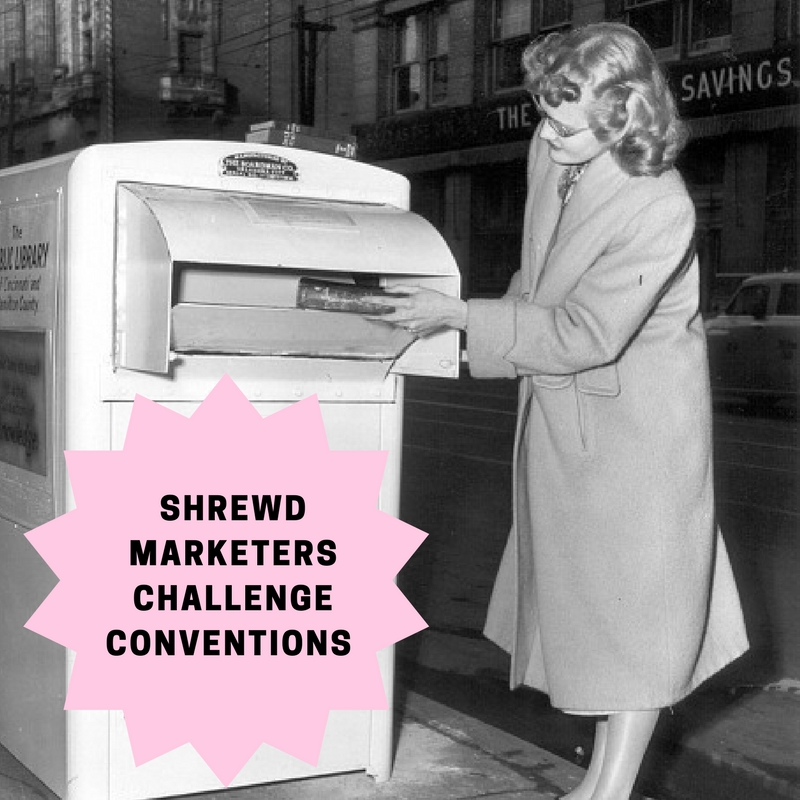
Shrewd Marketers Challenge Conventions. So Should We!

I’ve thought a lot lately about how to approach library marketing in a new and fresh way. As my library creates and executes our strategy for summer reading, I am looking at each tactic and wondering if we can improve the marketing of this legendary initiative. According to the American Library Association, summer reading programs began in the 1890s as a way to encourage school children, particularly those in urban areas and not needed for farm work, to read during their summer vacation, use the library, and develop the habit of reading. That’s a long time to be marketing a program and I think the industry might be a bit stuck in terms of how we do it.

For inspiration, I’ve looked over notes from a session I attended at Content Marketing World. It was led by Doug Kessler, co-founder and creative director of Velocity Partners, a B2B marketing agency with offices in the U.S. and England. Doug’s session was inspiring. It was titled Exceptional Content–Challenging the Invisible Conventions of Marketing. I printed out my notes and have read them through each morning, then thinking about the points he made every time I need a brain break.

Kessler focused his session on a concept he calls invisible conventions. We have so many invisible conventions in libraries. These are the ideas and practices that library staffers hold as traditional and unchangeable. If you hear someone say, “But we’ve always done it that way”, you know you’re talking about their invisible conventions. Invisible conventions are powerful.  Kessler says they guide and constrain us without us even knowing it.

We do need conventions.  But we don’t need to be slaves to convention. Kessler says it’s our job as marketers to expose the hidden conventions in our institution and play with them. Libraries can’t be precious about their conventions because your cardholders aren’t.  Conventions are a signal to your cardholders that marketing is involved–even if you’re trying to be sneaky about it. Your customers are smart, and they’ll put up their defense barriers.

Think about how you respond to marketing messages for invisible conventions. We’ve all developed a sense of when the pitch is coming and we run the other way! You don’t want to turn off your cardholders–you want to inspire them. But if you hang on to your invisible conventions for safety, you’ll never move forward in the marketing of your library.

Challenging your invisible conventions isn’t going to make you very popular, Kessler warns. And that’s okay. Your administration, leaders of other departments, even fellow librarians may have a strong reaction when you decide to challenge conventions. They are more comfortable with traditional marketing practices and they want you to create pieces that make them feel comfortable. Be strong. Take the long view. Persuade your co-workers that change is necessary and that safe marketing isn’t going to cut it with your cardholders. Your job is not to make everyone else in the library happy. Your job isn’t to make friends with everyone in you work with. Your job is to serve your cardholders, and you can only do that when you put your cardholders first. If that means you need to throw convention out the window, then it’s the best move. Don’t second guess yourself. When your instincts as a marketer tell you that something needs to change, you are right. Change it.

I’m reminded of advice I heard from another Content Marketing World speaker, Amanda Todorovich of the Cleveland Clinic. She confessed she’s made some people at the hospital unhappy with her relentless focus on the customer. She has a strategy and she often says “no” to people who want her to do conventional marketing. That means there are some folks she works with who don’t like her. Amanda is okay with that because she realizes her job is to serve the patients, not her co-workers. I draw inspiration from her attitude when I’m faced with having a difficult conversation with a co-worker. You can too! (Read my post about Amanda here.)

So how do you turn conventional marketing on its head? By doing more content marketing. Kessler says, thanks to the companies who came before us, the public knows marketing messages are often filled with compulsive and shameless lies (thanks, cigarette companies). Traditional marketing is all about the brand: a one-sided sales message.  Content marketing, by contrast, is all about the audience. Content marketing rewards libraries for telling the truth. It’s focused on utility–how can we best help our cardholders. It delivers value, builds trust, and it gives our cardholders the power!

Kessler left me with a final thought: unconventional marketing can lead to great stories. Be straight, simple, conversational, and relevant. You will change hearts and minds.

Subscribe to this blog and you’ll receive an email every time I post. To do that, click on “Follow” button on the bottom left-hand corner of the page. Connect with me on Twitter and Snapchat–it’s where I talk about library marketing! I’m @Webmastergirl. I’m also on LinkedInInstagram and Pinterest. Views in this post are my own and do not represent those of my employer.

What a Firecracker and a Watermelon Have to Do with Library Video Marketing

I am so excited that the focus of marketing in the current era is video. I’m positively giddy at the prospect of how this medium will help us transform the popular view of libraries. The power of video is mind-blowing. It’s easier than ever to create a video. The hard part is compelling your viewers to watch it and to keep coming back for more.

I want to encourage you by sharing tips I learned from an extraordinary marketing expert.  Andrew Davis is CEO of Monumental Shift and author of the book Brandscaping. He is a former journalist and producer for The Muppets and Charles Kuralt. He’s a brilliant storyteller and a gifted speaker. He spoke at Content Marketing World this year about the power of video marketing and how to make sure your videos are working at their fullest potential–engaging viewers, building compelling stories, and getting your whole message through to your target audience. His talk was energizing and I want to spread some of his enthusiasm around!

Davis says we need to change the way we think about engagement. Most libraries declare engagement victory when we get a certain amount of views, impressions, shares, or likes. But the social media landscape is so saturated that those numbers really have no meaning anymore. We need to shift our definition of engagement to audience retention.

Audience retention is, simply put, the amount of time our cardholders spend viewing our content. This translates to watch time on YouTube and Facebook and page time on Google Analytics. A compelling video will persuade people returning to those platforms to view your content over and over. Davis says we must stop blaming our viewers for having the attention span of a goldfish. It isn’t that our viewers can’t pay attention to what we are saying. The problem is that what we are saying is boring.

Create videos that your cardholders really want to watch. To do this, you’ll need to get inside the mind of your viewer. Start by creating a series of “how to” videos, which have high audience retention. How-to videos are low-hanging fruit for a library. Your librarians can be your guide–ask them to name the questions they are asked most often by cardholders and then help you create a simple video to explain the answers. To prove the power of the how-to video, Davis played this video, which is one of the most watched how-to videos on YouTube.

Davis says your next video marketing challenge is to create suspense by raising the stakes. The best way to explain this concept is with this video from the Slo-Mo guys.They inserted a firecracker into a watermelon. It takes 18 seconds from start to finish for it to blow up. I admit it’s kind of exciting.  But it’s over in less than half a minute–not the greatest way to create audience retention!

Davis says there is a better way to do that video–and the example comes from Buzzfeed. They did a Facebook live where they burst a watermelon with rubber bands. It took forever to make the watermelon explode but tons of people were watching when it finally blew up. At the 20 minute mark, they had 375,000 viewers. By 40 minutes, they had 800,000 viewers. In all, more than 11 million watched it on demand after the fact. So the lesson is… DON’T INSERT A FIRECRACKER INTO A WATERMELON.

Next, Davis says, teach your audience to chase answers. The pursuit of the answers builds momentum. Your videos need to occupy your audience’s desire to know more over time. Davis says you need to stop worrying about how long a video is. Rather, ask yourself if your entire video worth watching. When someone says your video is too long, what they’re really saying is “I have no more questions.” Make sure there are questions that need answering and keep the audience constantly asking what’s next.

Remember that building suspense isn’t just part of the story line of your video. The title and the thumbnail you choose is part of the equation–don’t give it all away in those two elements. To demonstrate, Davis shared this video from the ancestry research company 23 and Me. Honestly, if you just read the title and look at the thumbnail, you will already know what’s going to happen. There’s no suspense and that translates into no real reason to watch.

A more compelling example of building suspense through the title and use of video is this Dove Choose Beautiful spot.

Finally, Davis says when you are creating drama with your videos, it is important to remember to pay it off. Make sure you deliver a catharsis or an emotional release our audience craves. If you don’t, you risk alienating your viewers. For example, Billy Gene The Wolf of Advertising made the following video. Watch it and see if you can guess why it was widely criticized.

There is no resolution! You must resolve every question you raise by the end of the video. Be sure to provide answers to all the questions in your video, so you avoid frustrating your audience. A frustrated audience will not come back to watch more of your content.

Subscribe to this blog and you’ll receive an email every time I post. To do that, click on “Follow” button on the bottom left-hand corner of the page. Connect with me on Twitter and Snapchat–it’s where I talk about library marketing! I’m @Webmastergirl. I’m also on LinkedInInstagram and Pinterest. Views in this post are my own and do not represent those of my employer.

Inspiring Advice From An Expert Blogger

A few months ago, I asked readers whether their library had a blog. 61 percent of respondents said no. I have to include myself in that statistic. And the more I think about it, the more that bothers me.

Blog-less libraries are missing a HUGE opportunity. A blog has a number of promotional advantages that simply cannot be replicated with any other type of tactic. And to make my case, I am going to share insights with you from a session at Content Marketing World–one that I haven’t been able to stop thinking about in the months since the conference.

Amanda Todorovich is the Director of Content Marketing at the Cleveland Clinic. She’s the 2016 winner of the Content Marketer of the Year from the Content Marketing Institute and she runs the most visited hospital blog in the United States, Health Essentials. Her session was all about the Cleveland Clinic blog and its success. And her story made me want a blog for my library.

Amanda says a blog is the best promotional tool because it creates brand awareness and relationships with current and potential customers. The goal of the Cleveland Clinic blog is to create a space in which the hospital is top of mind all the time with people looking for health information. Think about this: the hospital cannot create demand for their services. So they aim to provide credible health information at all times so that, in the unfortunate moment when someone is sick or injured, the first place they think of is the Cleveland Clinic.

That principle applies to libraries as well. There are times when a library cardholder may not need their library, but we want to stay top of mind with them so that they’ll turn to us when they do need books, or help with a struggling reader in their home, a passport, a voter registration form, help to create a resume, or whatever problem they might have. Libraries are not just about programs and books and there is a lot of value to offer your cardholders beyond those two basic services.

But Amanda also says in order for your blog to work, you have to stand strong. Your blog cannot be all things to all people. You’ll have to decide on your mission, write it down, and stick to it. This doesn’t mean that you are ignoring certain cardholders. It means that your blog has one focus, one mission and that everything you write–no matter the audience–drives at completing that mission. For example, Health Essentials mission is to engage users in daily conversation using health, wellness and clinical content that is unique to Cleveland Clinic. They’re not ignoring anyone. Rather, they are focusing all their energy on delivering on that mission to all of their potential patients and patient families. See the difference?

Blogs have a value beyond pure promotion. Using the right keywords and paying attention to metadata, tags, and links will help boost your position in search traffic. That means people will be able to find you first during a search. Some big brands pay big money for great search results placement. Can you imagine what would happen if; every time someone searches Google for a book, a DVD, or information that they land on your library’s blog? The impact would be mind-blowing.

Some library marketers are already taking this advice to heart, including Brook Savoie, who works for Lafourche Public Library in Thibodaux, Louisiana. She told me, “Our librarians take turns writing a post weekly. The purpose is to just bring more awareness to things that we do! It works well for me for social media, because I can share these blog posts weekly with our audiences without having to create any content myself.”

So, step one is convincing you, your staff, and your administration, to launch a blog. It’s worth it. You can do it. Here are Amanda’s other tips for blog success.

Focus on creating better posts, not more posts. You don’t have to post every day. Just pick a CONSISTENT schedule. Create a list of topics and then write. That’s what I do with this blog. I spend roughly three hours a week on this blog and that’s really only because I am my own editor. If I could just write and revise a draft and then hand it off to another person to edit, it wouldn’t take much time at all. I spend about ten minutes crafting and testing headlines. I spend about ten minutes making the graphic. I spend about ten minutes scheduling all the distribution. I write on the weekend and it feels like it doesn’t take much time at all.

Be willing to say no. Amanda says she doesn’t have a lot of friends outside her team because she says no to a lot of requests by other departments for blog posts. The hospital blog is focused on the needs of their readers, not on the needs of the organization and that’s why it works. When your customers are the center of your universe, you are providing them with value and they’ll keep coming back to you. You are beholden to your cardholders, and they should be your only concern.

Measure and test and test again. Never be content with the results, even when they seem good. Ask “what if” all the time–it could lead you to an extraordinary idea that takes your blog to the next level. Testing actually keeps blog writing interesting and keeps life exciting (I AGREE).

Subscribe to this blog and you’ll receive an email every time I post. To do that, click on “Follow” button on the bottom left-hand corner of the page. Connect with me on Twitter and Snapchat–it’s where I talk about library marketing! I’m @Webmastergirl. I’m also on LinkedInInstagram and Pinterest. Views in this post are my own and do not represent those of my employer.


The Best Library Customer Service Advice from an Expert

There is an undeniable connection between customer service and successful marketing and to ignore the role that a personal, caring interaction with a customer can have for your library is dangerous. Don’t take your customers for granted. Help them solve their problems–even when the problem is your library–and keep them loyal for a lifetime.

I started to really think about the role customer service plays in my library when I stumbled across a podcast a few years ago called Focus on Customer Service. Host Dan Gingiss interviewed marketers from brands which are known for outstanding customer service in the social media area. Those conversations are enlightening and, although the podcast is no longer in production, I would suggest you go back and listen to the archives. They’re really worth your time.

Meanwhile, Dan has gone on to write a new book, Winning at Social Customer Care: How Top Brands Create Engaging Experiences on Social Media. It is the best marketing book I’ve read recently. I reached out to Dan to ask him some specific advice about libraries and customer service and he was kind enough to give his advice.

Dan’s 20-year career has consistently focused on delighting customers, spanning multiple disciplines including social media, customer service, marketing, and digital customer experience. Dan has hands-on experience as an executive at multiple Fortune 300 companies, including as the Senior Director of Global Social Media at McDonald’s Corporation, the Head of Digital Marketing at Humana and the Head of Digital Customer Experience & Social Media at Discover Card. A frequent conference speaker, Dan holds a B.A. in psychology and communications from the University of Pennsylvania, and an M.B.A. in marketing and strategy from the Kellogg School of Management at Northwestern University. You can find him on Twitter at @dgingiss.

Libraries often do things by committees and many have a long and bureaucratic approvals process for everything, including responses to customer service issues. Can you tell us why libraries should consider empowering their employees to surprise and delight customers by resolving issues in a more expedient way?

What libraries — and all organizations — need to remember is that customers are comparing you to every other customer experience they have with companies. You’re not being compared to another library; rather, you are being compared with Amazon, Wendy’s, Zappo’s, and any other brand with which the customer has engaged recently. Customer expectations are higher than ever, and a speedy response has become table stakes to competing with other superior experiences.

Libraries have such meager budgets, and many focus solely on getting the most product (books) to customers as possible. They don’t want to spend any money on providing good customer service. There are a lot of products out there that can make it easier for libraries to enhance their customer service. If you had to pick one thing that libraries should spend money on to improve their customer service, what would it be (software? More agents? )

Self-service capabilities. Most customers are willing to pursue self-service solutions if they are available, and many even prefer it. In the case of libraries, this could be used both in person at computer terminals and online, where like other industries much of the customer interaction is now taking place. Considering that libraries are still physical structures and much of the experience is still enjoyed in person, it’s also critical that they hire friendly and helpful staff who are willing and able to help readers who have no idea how to navigate the archaic Dewey Decimal System, for example. (Think about how people search for things today; it certainly does not involve decimals!)

Training for customer care, particularly in social media, is not always a strong suit for libraries. They train mostly for front-line customer service. Can you explain the difference between training for front-line interactions with customers and online customer care, and why there is a value in providing specific training for online care?

First of all, it’s critical to remember that social media is still the “front line”. It’s just another channel in which your customers have chosen to engage. So just as you wouldn’t leave a Help Desk unattended or let the phone ring and ring, you also shouldn’t make people wait for answers on social media either. That said, there are some key training differences (explained in Chapter 7 of my book) between online and offline Customer Service agents. The two most notable are writing ability and social media platform knowledge. Agents must have good spelling and grammar, as mistakes cast a poor light on the organization, and they must have at least a working knowledge of each individual social media platform so they understand the culture, norms, and limitations.

I think community building is a good strategy for libraries to engage with cardholders and offer customer care. Based on your book, I assume you agree. Can you explain how building an online community might benefit an organization like a library which is looking to improve customer service?

Online communities are especially helpful in answering questions that are likely to recur over time. For example, I recently learned that libraries often have passes to local museums but that they are reserved quickly. I wanted to know the process of obtaining such a pass from my local library. While calling the library worked just fine, an online community could have provided the same answer without leveraging paid library staff. In addition, I’d point out that books, by their very nature, are community-building in that people love talking about their similar interests and experiences. So I think an online community hosted by a library could be very successful on several fronts.

What do you think the future looks like for customer service? Is there anything libraries should be considering as they plan for the future, so they can stay competitive with bookstores and offer excellent service to cardholders?

Libraries have a huge advantage over bookstores because they provide the product for free! If they were also to provide a consistently superior customer experience, the discussion in the media might not be about Amazon undercutting brick-and-mortar bookstores, but about how libraries are experiencing a great resurgence at the expense of Amazon! Like any industry, libraries must adapt to changing technology and customer expectations. In some ways, they have, like the availability of e-books, but I’ve never found those to be either marketed effectively or easy to use. Libraries should learn from for-profit businesses to become better marketers of what is already a competitive product, to draw in new card members but also to remind existing ones why they signed up in the first place.

Bonus Secret: Go to www.winningatsocial.com/discount, click on “Buy Now”, then enter the code “Winning” to get a signed copy of Dan’s book for the best available price.

Subscribe to this blog and you’ll receive an email every time I post. To do that, click on “Follow” button on the bottom left-hand corner of the page. Connect with me on Twitter and Snapchat–it’s where I talk about library marketing! I’m @Webmastergirl. I’m also on LinkedInInstagram and Pinterest. Views in this post are my own and do not represent those of my employer.

Library Marketing Secrets You Can Steal From General Electric

The woman who manages marketing at one of the biggest companies in the United States–and perhaps the world–made a huge impression on me at Content Marketing World. Linda Boff is Chief Marketing Officer at General Electric. You might think a huge brand like GE would be mired in traditional marketing practices and have nothing to teach us about agility and experimentation. You would be wrong.

Boff has led the company into a new realm of marketing, using tactics that libraries have access to, like podcasts and Facebook Live. Her focus is storytelling–finding the stories within your company and sharing them with your audience. She insists you don’t need a big budget to do what she’s doing. She’s a dynamic speaker and her presentation was one of the more memorable moments in the two-day conference because I ended up coming away with so many ideas for my library marketing. I left the room excited and energized!

Boff says there are five reasons to tell your library’s story: To sell (library translation: improve circulation, visits, and attendance), to inspire, to explain strategy, to reach audiences, and to educate. She told the audience that the success of GE with storytelling relies on a simple formula: Be first on platforms + activate unlikely audiences + find the human in the digital times. She laid out exactly what she means in her main brand storytelling tips.

Know who you are. GE embraces its nerd identity. The company produced a series of videos showcasing its nerd employees. They are professionally produced but you can do the same thing using your iPhone. Remember, it’s the story that’s important–not the production value of your video. In fact, our library produced a similar series of videos back in April for National Library Workers Week. We shot everything on a DSLR camera and edited it using free software available on the internet. Our fans–and our employees–loved the videos.

Identify your secret sauce. What is your tone? How do you come to life? Every brand has to figure out what this means to them. This next part is going to sound really familiar. GE has had to fight to be relevant, contemporary, relatable, and modern. Everyone knows who GE was in the company’s past. Everyone is familiar with GE’s legacy. Boff said one of her marketing goals is to teach people what GE is in the present.  To do this, Boff recommends you need to “show up as a person”–in other words, use real and personal stories about your workers to put a face to your company’s name. GE went to its employee’s children to ask them what their parents do. They told stories and drew pictures explaining their parent’s work. Then GE took those pieces and used them internally and externally. You can see some of those stories here.

 Find unexpected audiences. At South by Southwest, GE created a BBQ incubation area. They set up a BBQ smoker and had data scientists on hand to smoke the meat with exact precision so it came out right every time. They also had their scientists use data to make BBQ sauce, and they let people taste the sauce while hooked up to a scanner so they could see what their brain responded to via scan. Then took the super smoker to college campuses, so instead of the tent and handouts, they had this cool interactive centerpiece. I think that idea could translate for libraries too. Instead of just having a table at events, let’s bring MakerSpace equipment and traveling library collections so people can interact with our “products.”

Experiment early, experiment often. When a new social media platform or technology emerges, don’t hesitate–jump on board quickly and learn all you can about it, says Boff. The cost barrier to entry is always very low at the beginning of any new trend and the audience has no expectations about what you can or should produce. Boff says it’s important to be on the playing field and really skin your knees; you can’t just read about new trends. I really took this point to heart. We now have permission to move forward on new trends–let’s embrace it!

Good content speaks for itself. Boff and her team created GE Podcast Theater. They create long-form, lightly branded podcasts that are full content marketing platforms. GE’s “The Message” podcast was named as one of the New York Times 11 Fiction Podcasts Worth Listening To and was in the #1 spot on iTunes after its release.  Boff says if you are putting great stories out into the world, they’ll do their own marketing with their amazing content.

Stories are right under your nose: The hardest thing is finding stories to tell. GE works had to find stories reach customers, investors, thought leaders, media, AND employees. I’ve talked about finding stories in the library on this blog before in this article and this article. We should always be looking to connect with narratives that inspire all of those audiences. I really loved how Boff emphasized storytelling as a way to grow employee pride. At GE they do this through a YouTube series called In the Wild. It’s entertaining and engaging. Libraries could imitate that on a smaller scale. In fact, my library did that using a GoPro camera! We did time-lapse videos of various jobs and departments in the library and posted them on our YouTube channel. Those videos had more than a thousand views total and continue to draw new people to our YouTube content.

Subscribe to this blog and you’ll receive an email every time I post. To do that, click on “Follow” button on the bottom left-hand corner of the page. Connect with me on Twitter and Snapchat–it’s where I talk about library marketing! I’m @Webmastergirl. I’m also on LinkedIn, Instagram and Pinterest. Views in this post are my own and do not represent those of my employer.

The Most Exciting Library Marketing Lessons from Content Marketing World

The future of content marketing at your library is stories, videos, and making personal connections between your cardholders and your libraries. That’s the big takeaway for me from the year’s Content Marketing World, a giant marketing conference in Cleveland. I’ve just returned with a head full of ideas and heart full of energy. Rubbing elbows with 4,000 marketers bursting with love for the profession will do that to you.

At #CMWorld, I attended 15 sessions and learned a ton of new information which I will flesh out here over the course of the next several months. Some tips can be put into action immediately and some will need time for processing in my brain, as I work to figure out how to make them doable for libraries of all sizes, shapes, and missions.

Here are the main takeaways I received from 15 sessions with links so you can check out more of the speaker’s work and get started on transforming your own library marketing.

Linda Boff, Chief Marketing Officer at General Electric:  Stories are everywhere, right under your nose. Find and embrace them.

Jay Acunzo, host of the podcast Unthinkable:  Content marketing is about inspiring your true believers, not coercing the skeptics. (This was an ah-ha moment for me!)

Drew Davis, a former marketer, best-selling author, and speaker:  Audience retention is the true definition of video engagement. Stop trying to just get views and get audiences to watch your whole video!

Doug Kessler, creative director and co-founder of Velocity Partners: It’s our job as marketers to expose the hidden marketing conventions and turn them on their heads. In other words, conventional thinking will get you nowhere. Now is the time to be creative.

Ian Cleary, founder of Razorsocial: Be smart when you publish your content because if no one sees it, what’s the point? Use smart keywords, collaborate with influencers, and promote yourself. During this session, I realized I know nothing about web optimization!

Amanda Todorovich, Content Marketing Director at the Cleveland Clinic: Never be content. Measure and test and test again. Ask “what if” all the time.

Casey Neistat, YouTube star: Do what you can’t. Make it count. Follow your gut. Cut through the bullshit. Yes, I put that all in bold because IT’S IMPORTANT.

Colson Whitehead, author of The Underground Railroad and a bunch of other books, Pulitzer Price Winner, National Book Award Winner, etc., etc., etc. You know him, you work at a library: If you have ideas and you’re not sure you can pull them off, it’s ok to wait until you are actually ready. I’ll be honest, I don’t know if I agree with this but I’m going to think about it for a while.

Amy Schmittauer Landino, vlogger, author, and speaker: The secret to great video is asking yourself…would you share it?? Really?? Not just because you think everything you do is fantastic, but because what you do is actually fantastic.

Arnie Kuen, CEO of Vertical Measures: There is only a two percent chance your followers will see your organic post. (YIKES!)

Scott Stratten, author, speaker, blogger, podcaster, promoter of unconventional marketing. This was a session on public speaking: Tell a personal story but only if it makes a point. Respect the audience’s time.

Tamsen Webster, speaker, and producer of TEDx Cambridge, during the same session on public speaking: Go ask for the stage you deserve. The way to speak more is… to speak more.

Joseph Gordon-Levitt, actor and creator of hitRECord, an online collaboration and creation website for video, graphics, music, and more: Community, fair compensation, and collaboration are the future of content creation.

Joseph Gordon-Levitt

Jonathan Stanley, Executive Producer for Lowe’s: Test all the time on YouTube. Fail fast and learn fast. Don’t spend years scripting.

Michelle Park Lazette, Content Marketer for the Federal Reserve Bank of Cleveland: Deliver different! Try your best to produce the “okra breakfasts” of content. Okra breakfasts are content that is unexpected but delicious and filling!

Subscribe to this blog and you’ll receive an email every time I post. To do that, click on “Follow” button on the bottom left-hand corner of the page. Connect with me on Twitter and Snapchat–it’s where I talk about library marketing! I’m @Webmastergirl. I’m also on LinkedIn, Instagram and Pinterest. Views in this post are my own and do not represent those of my employer.


A WordPress.com Website.

Up ↑