Search

Super Library Marketing: Practical Tips and Ideas for Library Promotion

Category

library marketing ideas

Inspiring Advice from Library Marketers Who Love Their Work

Every two years, my library holds staff development days. It’s a conference of sorts that lasts all day. The training focuses on one issue that generally affects our public library customers, like addiction, poverty, homelessness, and mental illness. I always learn something, even though I’m not a member of frontline staff. But this year, I was actually inspired while listening to the speakers. Their talks made me think about how the work of my marketing team affects the lives of our cardholders. During the closing session, I found myself writing part of this blog post on the back of a worksheet. It was a bit of advice and inspiration for myself… but then I got to thinking that I should share it here.

If you work in a public library, I bet you are as exhausted as I am after the long season of promotion leading up to summer reading. If you work in academia, the month or two before exams can feel like a marathon. Some elementary and secondary librarians are struggling just to make it to summer vacation. Six months into the year, we all feel a little worn down, don’t we? We need a reminder that our work is important. Here’s what I want you to know about the work you do.

Library marketing professionals are committed to cardholders. Every single marketer I’ve ever met in this space is thinking about the good of the cardholder over the good of anything else. I’m so proud of this profession!

The work you do feels small… but it’s a movement. We tend to think our work is not important. But we are part of a large social movement to make a real difference in the world. It feels normal and insignificant because we’ve done it for so long. It’s not normal or insignificant. You are heroes. You are amazing. Keep it up!

To recharge your batteries further, I asked for some advice from some fellow library marketing professionals. Here’s what they want you to think about as you head into the next six months

Amanda L. Goodman, Publicity Manager at Darien Library in Darien, Connecticut:  “Stay organized. Teach project management skills to colleagues that you work closely with. When you’re working on a big project with tight deadlines, it’s helpful when you’re all pulling together to get tasks accomplished on time. Schedule more time than you think you will need. Something else will always come up.”

Athens Miguel Moreno, Technology Manager at Glencoe Public Library in Glencoe, Illinois: “Organize your photos, whether on your phone or computer, make it easier on yourself to never have to hunt around for a good picture.”

Tanya Milligan, Project Librarian at Falkirk Library in the United Kingdom: “Always think of the needs, interests and wants of your users in everything you do. If you aren’t sure about their needs, interests and wants, then ask!”

Lori Juhlin, Library Director at Hawarden Public Library in Hawarden, Iowa: “Your frontline staff are your best marketers, because if someone receives great service, they may tell others, but even more so if they have a bad experience.”

Kristin Lauri Readel, Director, Frost Free Library in Marlborough, New Hampshire: “Double check dates & times with the correct calendar. Use Canva!”

Carol Eyman, Outreach Coordinator of the Nashua Public Library in Nashua, New Hampshire: “Find out what publicity is working and what’s not by adding a question in your online registration forms, how did you hear about this program?”

And a few more from yours truly: Make an effort to talk to staff. Ask the librarians about their jobs. Learn about the problems they deal with. Talk to customers! Strive to be a little uncomfortable in your work.  Push yourself a little. Make time to rest and be creative.

Subscribe to this blog and you’ll receive an email every time I post. To do that, click on “Follow” button on the bottom left-hand corner of the page. Connect with me on Twitter and Snapchat–it’s where I talk about library marketing! I’m @Webmastergirl. I’m also on LinkedInInstagram and Pinterest. Views in this post are my own and do not represent those of my employer.

Four Instant Ways to Improve the Most Valuable Page on Your Library Website

I find lately that I’m obsessed of late with library web pages. I’ve set aside time every week to look at how different libraries around the world set up their websites. What do library’s feature or highlight their homepage? How robust is their search engine? What’s in their drop-down menu? How is their library staff set up?

That last question usually ends with me scrolling through a library’s “About Us” page. And it’s there that I really get a sense of that organization, how it views itself, and how it views its relationship to its cardholders. This research brought me recently to this conclusion: Most libraries, including mine, need to update their About Us page.

Your library’s About Us page can be a gateway to all kinds of traffic to your website. Perhaps your analytics show that you aren’t getting any visits to that section of your website and therefore, you might think you don’t need to mess with it. But if you want to increase your market penetration or if you are considering any campaigns or direct marketing messages to increase the number of cardholders you serve, you’re going to want a kick a** About Us page. Likewise, if your library is in the midst of a levy campaign or waging any kind of battle with your city or county over funding, hours, or locations, your About Us page could help you in that battle. And that page will need to look inspire to win new users and funding.

The concept of a revolutionary change in the way About Us web pages are written and formatted is something that gets a lot of discussion in marketing circles for major brands. I hear it all the time at Content Marketing World. Many big companies have moved away from a traditional approach–a long and wordy mission statement in non-conversational language that usually includes goals which have no meaning to the customer. They’re writing in a conversational tone, including specific calls to action for customers, and striving for full transparency. They’re using their About Us page to connect with potential customers, build trust, and communicate what their brand stands for and what the customer can expect from a relationship with that brand. And I think it’s about time for the library world to get on board.

Chicago Public Library’s page is minimalist with clear language and an easy-to-navigate menu.

We should transform our About Us pages into something that really has meaning to our community. This is the web page where decisions are made by all of your stakeholders. You want the page to make potential cardholders feel “at home” and community leaders understand what it is that your library does and why it’s vital.

Here are four ways to transform your About Us page from an abstract section of your website into an amazing marketing tool.

Focus on the cardholder. Here’s a thought that many libraries have a hard time grasping: your About Us page isn’t actually about you. It’s about your cardholders. What is it that your library can do for the cardholder? Take your mission, vision, and values statement, which is likely written in lofty language, and rewrite it in a conversational tone. Or drop it from the page altogether! I know that’s a controversial standpoint but if your mission, vision, values statement is written with a bureaucratic bent, it won’t have any meaning to anyone outside your organization. Instead, think of your About Us page as a conversation between you and a non-library user. How would you, in normal conversation, tell someone about all the things your organization does? That’s what your About Us page should say. You might also take the opportunity to answer the most frequent questions your library gets from new cardholders.

I love how the Columbus Public Library answers the #1 most frequent question right on their About Us page.

Tell your Library’s story. Whether your library has been around for decades or is newly formed, there’s a fantastic story about its birth and its longevity. Tell it on your About Us page, in a paragraph, with inspiring and optimistic language. Keep your bragging to a minimum. If your library has won many awards, you can mention them briefly and put them into the context of how that award translates to better service for your cardholders.

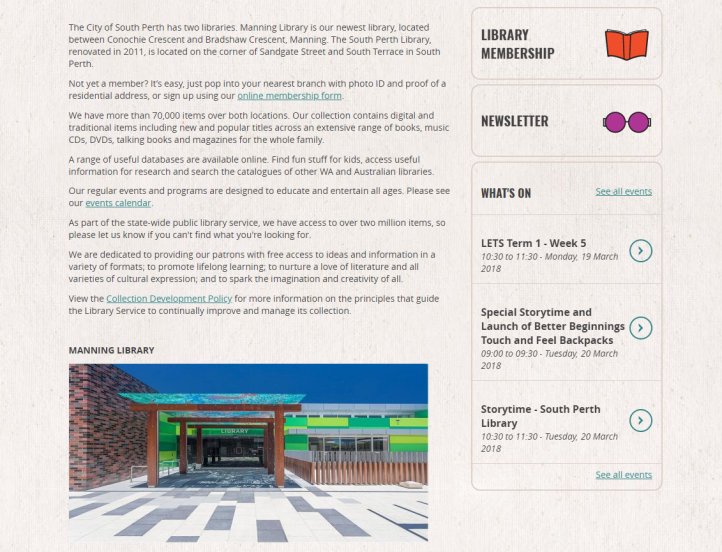
The Perth, Australia library’s About Us page includes all the essentials-how to get a card, sign up for a newsletter, and what is happening today at the library.

Less is more. Many libraries, including mine, have a long list of accomplishments and sub-headers on their About Us page. My library has 19 clickable sub-links!  Pare it down. White space is good. Pick the five most important things you’d want people to know and move the rest to another section of your website. Remember, your About Us page isn’t really about you… it’s about your cardholder. What are the five things a person would need to know to convince them to get a library card or to give you more money?

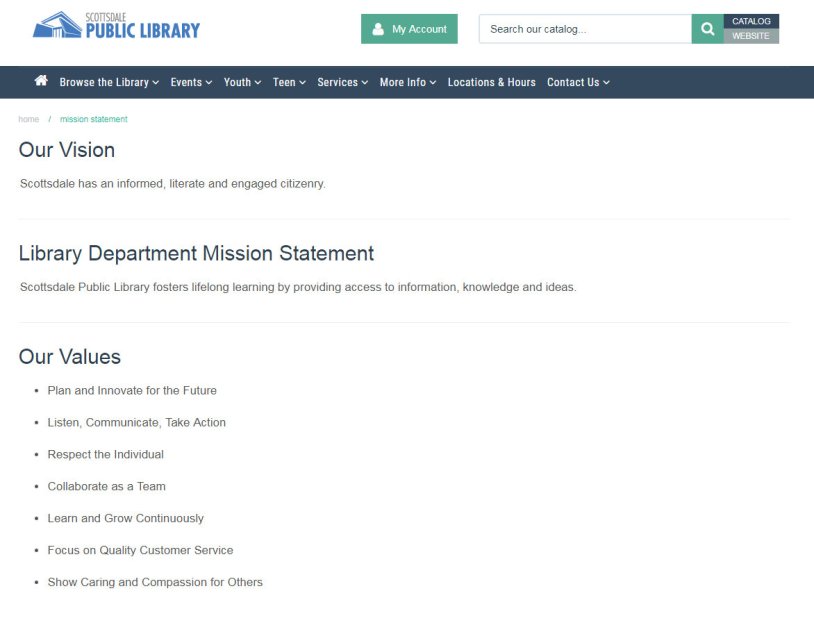
The Scottsdale, Arizona library takes a minimalist approach and it works!

Visuals are key.  Great, high-resolution photos that show people using your library and the workers who man the buildings are essential. Photos of faces are scientifically proven to be a more effective communication tool that text. Bold, easy to read fonts and primary colors work best for communicating ideas and drawing the eye to the page. Keep text to a minimum and pare down to five concepts that will tell your story.

I like how the Toledo Public Library’s page is heavy on visuals and includes easy-to-navigate sub links written in plain language.

Subscribe to this blog and you’ll receive an email every time I post. To do that, click on “Follow” button on the bottom left-hand corner of the page. Connect with me on Twitter and Snapchat–it’s where I talk about library marketing! I’m @Webmastergirl. I’m also on LinkedInInstagram and Pinterest. Views in this post are my own and do not represent those of my employer.

Five Excellent Ways To Improve Every Sign in Your Library

I have a love/hate relationship with library signage.

Part of my job as a marketing professional in a major metropolitan public library is to conduct signage evaluations and to make changes or improvements to the signs in our 41 locations. As a customer, I know how helpful the right kind of signage can be, and my perspective as a customer helps me to understand the importance of the task. But to be honest, it’s probably one of my least favorite job requirements. That’s because I’ve found that signs seem like a simple thing but are, in truth, very complicated. My coworkers and my cardholders have passionate feelings about them.

Good signage serves as a silent employee to draw cardholders to your location, direct traffic inside your building, and answer basic customer questions. Signs can actually be a part of your library’s overall strategy and should certainly be worked into your marketing strategy each year. Ask yourself: What are your library’s overall goals, and how can signs help to meet those goals?

The task of tackling your library’s signage is much easier when you have brand specifications documented. The color, size, and language should be consistent throughout the building and multiple locations. Once you have that document created and have decided how signage will help you to execute your library’s goals, here are five tips to keep in mind as you work on signage for each building.

Tip #1: Less is more. Too many signs in a branch, particularly in a small location, can create clutter and can actually cause confusion. And too much signage can actually annoy your cardholders, particularly if most of your signs are bombarding them with marketing messages. Just as white space works to create breadth and depth for a website or a graphic, well-spaced signage in a branch creates flow. About 75 percent of the signs in your library locations should be wayfaring only–directing cardholders to important service points in the building. The other 25 percent can be selective marketing–promoting services and items that are of interest to your cardholders or that might be of interest to them, based on their patterns of checkout.

Tip #2: Match the signage display to the user of each physical space. Make sure that in your children’s area, the signs, shelves, and computers are all lowered to be a child’s level. Create larger signs for the section that holds your large print items. Place teen signs where the teens hang out, like near charging stations or computers. Use a combination of large and small signs to blend with the space requirements in your library and to keep your signage from becoming monotonous, without being overpowering.  Use a bold font and keep colors and designs simple.

Tip #3: Your library materials make the best displays. Use them instead of signs. Think about how your local bookstore will display books. They often turn them front-facing. Why? Book covers are a visual cue and publishers spend thousands of dollars creating beautiful and eye-catching covers. Use these designs to create a visually pleasing display instead of a sign. A good display will not even need a sign–it should be obvious to the cardholder what you are trying to market to them.

Tip #4: Use customer-friendly, positive language. Cardholders prefer conversational language in all our marketing, so it makes sense to incorporate that into your signage. Some examples are:

Replace self-check or circulation with checkout.

Replace reference with information.

Replace periodicals with magazines.

Replace juvenile with children’s and teens.

I know this is controversial but I’m saying it anyway. Drop the Dewey decimal system from your end panels and arrange your fiction and nonfiction items alphabetically. And incorporate positive language into your signs. Don’t tell customers what they can’t do. Rather, tell them what they can do or how they can enjoy a particular space or item in the collection.

Tip #5: Don’t forget the signs on the outside of your building. Your main sign should say LIBRARY in large letters. Save the actual name of the building, particularly if it’s a long name, for smaller letters by the door. Make sure your open and close times are large and clear and in an easy to spot location. The same goes for the signage for any outdoor services like book drops or drive-thru windows. Make sure the signs are as large as is allowed by your local government.

Bonus tips: Don’t rely on signs to convey everything you want to tell the customer. Hire staff who are willing to speak with customers and show customers where items are located with patience and kindness. And set a schedule for re-evaluating and refreshing your signage–once a year, if you can handle it.

Subscribe to this blog and you’ll receive an email every time I post. To do that, click on “Follow” button on the bottom left-hand corner of the page. Connect with me on Twitter and Snapchat–it’s where I talk about library marketing! I’m @Webmastergirl. I’m also on LinkedInInstagram and Pinterest. Views in this post are my own and do not represent those of my employer.

Manipulating Cardholder Feelings to Get Results

A cardholder recently leveled an accusation against my marketing department for making her feel all the feels.

Here’s the brief story: our library is trying to raise money for a facilities plan. We have several Carnegie-era branches that are not yet accessible to those with disabilities. So we’ve started a content marketing campaign to educate our cardholders and the residents of our service area about the problem, as we will be asking them for money to fund the facilities plan. In our first video portion of the campaign, we interviewed a veteran who cannot get into the library branch in his neighborhood.

When we released the video, one of the viewers sent us a message. She said, “How dare you  manipulate my emotions and try to make me feel sorry for this guy.” I think this person was trying to make us feel guilty for marketing to her.

Sorry, not sorry.

Emotional marketing is effective. We have seen it work time and again for our library and other libraries. You may remember the story of the Leeds Library campaign, which used story-driven emotional marketing to change that community’s perception of the modern library and its value. Leeds won an award for their campaign, and one judge commented, “We loved the application of real-life, personal journeys to draw on the emotions, capture the imagination and change the perceptions of the audience.”

Effective marketing appeals to emotions, not logic, reason, or even facts. This is particularly effective in the world now, where social media algorithms are cutting into our organic reach. If we want better unpaid reach, we need to constantly engage our audience. To constantly engage our audience, we need them to take an action on every post. To get them to take action, we need to motivate them through emotion.

Research from the Institute of Neuroscience and Psychology at the University of Glasgow, published in Current Biology, says humans really feel just four basic emotions: happy, sad, afraid/surprised, and angry/disgusted. The kind of messages that get us engagement are all based on these basic emotions. When you feel happy or angry, you want to share that emotion with others in your social network. When you feel sad, you empathize with the subject your sadness and feel a motivation to help ease their suffering. When you are afraid, you want to take action to ease your fear.

Your most loyal cardholders are likely already emotionally connected to your brand, particularly if you work in a school or public library. The people who already use your library on a regular basis know it’s value. I bet you have superfans, and you know who they are. So what do you do with all that emotion? How do you make it work in your library’s marketing?

Ask loyal customers to share their stories with you. Conduct interviews with those passionate customers by email or on video and use those answers in many ways. Video marketing is the best way to capture emotion. There is no substitute for talking to someone on camera, for hearing their voice and seeing their facial expressions as they talk about your library. You don’t need fancy equipment. Pull out your cell phone, have them stand facing a window or head outside for a few minutes to take advantage of the natural light, and then ask them some emotionally charged questions about their library experience.

What is your favorite library memory?

Tell me about how the library has changed your life.

How would you feel if the library suddenly closed tomorrow?

If a  neighbor asked you to describe how you feel about the library, what would you say?

Ask your staff to share their stories with you. The next time you’re at an all-managers meeting, visiting another branch, or enjoying lunch with a fellow employee, ask them about life in their branch. Ask them to describe their customers. Inevitably, they’ll have one or two specific examples of people who have an unbridled enthusiasm for their location, or whom the branch staff has helped with a specific problem. Once again, pull out your phone, find some good lighting, and ask open-ended questions like:

How did that request by that cardholder make you feel?

Tell me how the situation was resolved.

Did you worry about how you would handle that request?

What is your relationship with the customer now?

And for good measure, I always ask, What compelled you to look for work in a library?

You can post these emotional marketing videos as a whole edited piece or in sections. You can turn the quotes into a printed piece for your newsletter or email list. You can create digital slides or posters in your branches using the quotes. My library used this tactic last year for a series of videos we called Customer Impact stories. We posted them on YouTube and on Facebook and is was one of our first pieces of video content marketing. The audience and our staff LOVED them. We broke them down and used them in our Library Links publication and in other ways, and they prompted more customers and staff to come forward with more amazing stories. It wasn’t hard and it didn’t take a long time to put together. It was effective. Score!

Adding emotional marketing to your regular promotional schedule keeps your cardholders engaged and feeling all the feels whenever they think of your library. It’s not something to apologize for. It’s something to be proud of.

Subscribe to this blog and you’ll receive an email every time I post. To do that, click on “Follow” button on the bottom left-hand corner of the page. Connect with me on Twitter and Snapchat–it’s where I talk about library marketing! I’m @Webmastergirl. I’m also on LinkedInInstagram and Pinterest. Views in this post are my own and do not represent those of my employer.
 

A WordPress.com Website.

Up ↑