Search

Super Library Marketing: Practical Tips and Ideas for Library Promotion

Category

library marketing ideas

How to Get Over Fear and Other Big Challenges to Library Marketing

When I was in first grade, I wanted to be famous. My big break arrived in the form of a school contest. The winner got to read a public service announcement about education on the radio. “IT HAS TO BE ME!!!” I exclaimed to my bewildered mother when I learned of the contest. She gently explained that I couldn’t win. She knew I faced a huge obstacle. I did not know (yet) how to read! The time between the contest announcement and the audition was short. How would I ever learn to read well enough to do it on the air? My mother is a very practical person. This was an insurmountable obstacle in her eyes.

I proved my mother wrong through sheer determination, and with a little help from the “Dick and Jane” series. I learned to read and won the contest! That was likely the first time I realized this powerful fact: there really isn’t any problem out there that can’t be solved.

20 years later, I found myself in a similar situation at my job as TV producer. The station suffered a huge power failure. The generators died. We had no way to get on the air. But failure was not an option and with airtime fast approaching, we came up with a plan. We would broadcast live from the parking lot using our live truck. It worked. We felt like heroes. Once again, I realized there was no problem that could not be solved.

We all face obstacles every day. Library marketing is not an easy job. You deal with deadlines, staffing issues, tiny budgets, and bureaucracy. Despite these obstacles, you make it work, day after day.  Your attitude plays a huge role in determining whether you overcome obstacles. Many of our problems are unique to this industry. Do. Not. Fear. You can find ways around anything. Here are some ideas to help.

The obstacle: there is never enough time. The library year is like the “lazy river” at my local YMCA; a constant, swirling flow of events that keeps pushing us forward. It takes some force to break free. When you’re under pressure to promote each big event, you may feel like you never have enough time to do anything well. All the emphasis is on the result and most people don’t give too much thought to the process.

The solution: Create a marketing strategy and STICK TO IT. The strategy must be clear, with expectations and goals set in writing. Get it approved by your supervisor and administrators. Explain it to staff. A strategy will help you stay laser-focused. Your marketing can be consistent. Library users will start to recognize the strategy of your organization without reading the mission statement. You’ll be able to accurately measure results. And, most important, you’ll be able to say “no” to promotions that don’t serve to drive your library’s overall strategic mission.

The obstacle: there is never enough money.  Budgets are a pain. Nothing can make you feel like you can’t reach your goals like facing the cold, hard reality of zero cash flow.

The solution: start small and partner up. Ask your administration for money to fund social media advertising. It’s cheaper than traditional ad buys. Your administrators might not realize how effective targeted social media ads can be. You can easily prove that you can make a good return on their investment. Look for partnership opportunities to promote more than the big programs. Create a standard agreement for media sponsorships of major programs, listing the action items your potential sponsors will fulfill and what benefits you can offer them in return. For every big program or marketing push, brainstorm partnership opportunities. For instance, my library uses partnerships for author events and to promote our collection.

The obstacle: too much work, too few people. Trying to take on a concerted, strategic marketing initiative can be overwhelming when you work alone. It’s a struggle just to keep up with the day-to-day stresses of social media, press, and meetings.

The solution: Ask for more help. You’ll find librarians who have an interest and skill in social media, writing, video, and design. Ask around and recruit those staff members to help you create content, with their supervisor’s permission of course. Ask for permission to engage an intern or two. Every organization has people with hidden talents!

The obstacle: There is never enough data about customers. This one sounds like the most difficult of the problems to solve but it’s actually one of the easiest. If your library isn’t already collecting data about your current customers, it should. I know libraries have a long and proud tradition of protecting the data and privacy of users and I respect that. I think there is a balance that can be struck. We can’t serve our cardholders well and point them in the direction of the items and services they need and want unless we know something about them. Collecting data on their card use preferences isn’t intrusive and I bet if you ask your cardholders, they’d confirm my assertion as long as we don’t share the data or lose it.

The solution: Ask, ask, and ask again. When people come to programs, hand them a three-question survey: How did you find out about this program? Do you have a library card already? What other kinds of things would you like to see at this library?  Create a new cardholder survey to gauge the interests of people just entering your library system. A yearly satisfaction survey for all cardholders is also necessary, particularly when you can take the results and split them into your different persona groups.

There are a number of software companies that can help you sort through cardholder use while masking the names of the actual items checked out by your cardholders, like Savannah by Orangeboy. From there, you can map your customer’s journey: When they get a card, how long does it take them to use it? Are they checking out books or using your digital collection or computers? Do they simply let it languish? Do you have some customers who got a card years ago, used it a specific way, and then stopped altogether? Do you have some customers who are making the transition from print items to digital materials? Do you have some customers who are only interested in one particular kind of item–DVDs, audio books, or computers? Break your customers into groups based on what they do with the card. Start creating pieces of content that target those groups.

The obstacle: fear. After five years of sharing library marketing information, this is still the biggest problem we face. Libraries are afraid of change AND afraid of failure. How many times have you heard someone in your library say, “But that’s the way we’ve always done it!” It’s the phrase I dread. It takes an enormous amount of effort and energy to change the minds of our fellow library staff members and our administration. It seems like it would just be easier to stay the course.

The solution: no one will die if you try something and it doesn’t work. It’s just marketing. Try stuff. Just try!  We have to remember our main goal–to get customers to move through the cardholder journey and engage with the library. Without that engagement, the people who argue that libraries are obsolete will win! We can’t have that. Do not be afraid. Marketing works best when you start small. Think of it like a staircase. On the bottom step, you make a small argument and you try a new thing. You see results. You report the results and chances are you’ll get to climb to the next step. If you fail, it’s just failure. No one dies. You stay on that step and you try something else! You’ll never get to the top of the stairs unless you try.

Subscribe to this blog and you’ll receive an email every time I post. To do that, click on “Follow” button in the bottom left-hand corner of the page. Connect with me on Twitter, Snapchat, and LinkedIn. I talk about library marketing on all those platforms! 

Six Shrewd Ways to Spot Trends For Your Library Marketing

Contrary to popular belief, librarians are trendy! I’m not just talking about the physical sporting of tattoos, body piercings, and colored hair. I’m talking about the more important stuff. Most librarians know how to work all kinds of advanced technological equipment like 3D printers. They are well-versed in the latest studies about public space, childhood literacy, mental illness, and poverty. Because they interact with all ages of the public all the time, they often see issues like the opioid epidemic, emerging before anyone else. They have inside knowledge about how trends affect the lives of their cardholders.

It’s important to library marketing pros to spot trends too. We have to make decisions about whether to react. So how do you keep an eye on the things that matter to your cardholders? Here are six easy tools for keeping up-to-date on trends of all sorts.

Facebook Topics and Trends ReportThis annual report is worth your time. It’s a yearly summary of the most popular conversations happening on the platform. This report covers everything from culture to technology to food. It’s useful for planning your marketing calendar. You can take any of these topics and apply it to items and services available at the library, then work those into your marketing plan. Use keywords and suggestions in this report to boost the engagement of your posts on Facebook, Instagram, and beyond.

Google Trends. This tool is a lot of fun! Type in a keyword and get a picture of what people are talking about related to that word. It will even drill down on data, showing you specific searches, timelines, and places where that term is searched. I often use this tool to search book titles or authors, seasonal keywords, or pop culture references to get a more accurate feel for how many people are talking about them.

What is trending on social media platforms? Most of the major social platforms now have an area where you can check keywords or trending topics. Do so regularly. Then use those trending topics to curate posts from reliable sources. Pick content that is appealing and relevant to your audience. Even if you don’t immediately find a way to use the ideas you find on these social channels, checking them keeps you connected to the things that matter to your users. Twitter is a great place to discover the topics used in social conversation specific to your geographic area. The Pinterest trending section is a feast for the eyes but can also show you the kinds of Pins that are getting engagement so you can mimic that success or share them with your followers. There is ALWAYS a booklist in the Pinterest trending feed that you can repin, as well as tons of fun craft and program ideas for your librarians! Snapchat’s Discover section will help you keep up to date on pop culture so you can market your items and services, like streaming music and downloads, and appeal to that coveted younger audience. Ditto with Instagram’s trending section.

What is trending in the podcast world? Every month or so, I open my podcast player and check the trending podcast list. Why? Podcasts are a commitment. If the public is taking the time to listen to 20 minutes of talk about a particular topic, then it might be something we want to pay attention to!

Ted Talks. The nonprofit is dedicated to spreading ideas that are worth talking about. New talks appear several times a week. If you don’t have time to actually listen to all the talks, a quick check of the topics will give you a sense of the kinds of technology, humanitarian, and educational ideas flowing into mainstream thought.

What questions are your librarians getting? Every once in a while, I’ll email the manager of our Virtual Information Center. That’s the department in my library that takes all the calls and chats from the public. I ask for the top ten questions they’re getting from people and then I use that list to create content to answer those questions. It’s easy and it directly impacts your users (and your staff!).

Subscribe to this blog and you’ll receive an email every time I post. To do that, click on “Follow” button in the bottom left-hand corner of the page. Connect with me on Twitter, Snapchat, and LinkedIn. I talk about library marketing on all those platforms! 

Inspiring Advice from Library Marketers Who Love Their Work

Every two years, my library holds staff development days. It’s a conference of sorts that lasts all day. The training focuses on one issue that generally affects our public library customers, like addiction, poverty, homelessness, and mental illness. I always learn something, even though I’m not a member of frontline staff. But this year, I was actually inspired while listening to the speakers. Their talks made me think about how the work of my marketing team affects the lives of our cardholders. During the closing session, I found myself writing part of this blog post on the back of a worksheet. It was a bit of advice and inspiration for myself… but then I got to thinking that I should share it here.

If you work in a public library, I bet you are as exhausted as I am after the long season of promotion leading up to summer reading. If you work in academia, the month or two before exams can feel like a marathon. Some elementary and secondary librarians are struggling just to make it to summer vacation. Six months into the year, we all feel a little worn down, don’t we? We need a reminder that our work is important. Here’s what I want you to know about the work you do.

Library marketing professionals are committed to cardholders. Every single marketer I’ve ever met in this space is thinking about the good of the cardholder over the good of anything else. I’m so proud of this profession!

The work you do feels small… but it’s a movement. We tend to think our work is not important. But we are part of a large social movement to make a real difference in the world. It feels normal and insignificant because we’ve done it for so long. It’s not normal or insignificant. You are heroes. You are amazing. Keep it up!

To recharge your batteries further, I asked for some advice from some fellow library marketing professionals. Here’s what they want you to think about as you head into the next six months

Amanda L. Goodman, Publicity Manager at Darien Library in Darien, Connecticut:  “Stay organized. Teach project management skills to colleagues that you work closely with. When you’re working on a big project with tight deadlines, it’s helpful when you’re all pulling together to get tasks accomplished on time. Schedule more time than you think you will need. Something else will always come up.”

Athens Miguel Moreno, Technology Manager at Glencoe Public Library in Glencoe, Illinois: “Organize your photos, whether on your phone or computer, make it easier on yourself to never have to hunt around for a good picture.”

Tanya Milligan, Project Librarian at Falkirk Library in the United Kingdom: “Always think of the needs, interests and wants of your users in everything you do. If you aren’t sure about their needs, interests and wants, then ask!”

Lori Juhlin, Library Director at Hawarden Public Library in Hawarden, Iowa: “Your frontline staff are your best marketers, because if someone receives great service, they may tell others, but even more so if they have a bad experience.”

Kristin Lauri Readel, Director, Frost Free Library in Marlborough, New Hampshire: “Double check dates & times with the correct calendar. Use Canva!”

Carol Eyman, Outreach Coordinator of the Nashua Public Library in Nashua, New Hampshire: “Find out what publicity is working and what’s not by adding a question in your online registration forms, how did you hear about this program?”

And a few more from yours truly: Make an effort to talk to staff. Ask the librarians about their jobs. Learn about the problems they deal with. Talk to customers! Strive to be a little uncomfortable in your work.  Push yourself a little. Make time to rest and be creative.

Subscribe to this blog and you’ll receive an email every time I post. To do that, click on “Follow” button on the bottom left-hand corner of the page. Connect with me on Twitter and Snapchat–it’s where I talk about library marketing! I’m @Webmastergirl. I’m also on LinkedInInstagram and Pinterest. Views in this post are my own and do not represent those of my employer.

Four Instant Ways to Improve the Most Valuable Page on Your Library Website

I find lately that I’m obsessed of late with library web pages. I’ve set aside time every week to look at how different libraries around the world set up their websites. What do library’s feature or highlight their homepage? How robust is their search engine? What’s in their drop-down menu? How is their library staff set up?

That last question usually ends with me scrolling through a library’s “About Us” page. And it’s there that I really get a sense of that organization, how it views itself, and how it views its relationship to its cardholders. This research brought me recently to this conclusion: Most libraries, including mine, need to update their About Us page.

Your library’s About Us page can be a gateway to all kinds of traffic to your website. Perhaps your analytics show that you aren’t getting any visits to that section of your website and therefore, you might think you don’t need to mess with it. But if you want to increase your market penetration or if you are considering any campaigns or direct marketing messages to increase the number of cardholders you serve, you’re going to want a kick a** About Us page. Likewise, if your library is in the midst of a levy campaign or waging any kind of battle with your city or county over funding, hours, or locations, your About Us page could help you in that battle. And that page will need to look inspire to win new users and funding.

The concept of a revolutionary change in the way About Us web pages are written and formatted is something that gets a lot of discussion in marketing circles for major brands. I hear it all the time at Content Marketing World. Many big companies have moved away from a traditional approach–a long and wordy mission statement in non-conversational language that usually includes goals which have no meaning to the customer. They’re writing in a conversational tone, including specific calls to action for customers, and striving for full transparency. They’re using their About Us page to connect with potential customers, build trust, and communicate what their brand stands for and what the customer can expect from a relationship with that brand. And I think it’s about time for the library world to get on board.

Chicago Public Library’s page is minimalist with clear language and an easy-to-navigate menu.

We should transform our About Us pages into something that really has meaning to our community. This is the web page where decisions are made by all of your stakeholders. You want the page to make potential cardholders feel “at home” and community leaders understand what it is that your library does and why it’s vital.

Here are four ways to transform your About Us page from an abstract section of your website into an amazing marketing tool.

Focus on the cardholder. Here’s a thought that many libraries have a hard time grasping: your About Us page isn’t actually about you. It’s about your cardholders. What is it that your library can do for the cardholder? Take your mission, vision, and values statement, which is likely written in lofty language, and rewrite it in a conversational tone. Or drop it from the page altogether! I know that’s a controversial standpoint but if your mission, vision, values statement is written with a bureaucratic bent, it won’t have any meaning to anyone outside your organization. Instead, think of your About Us page as a conversation between you and a non-library user. How would you, in normal conversation, tell someone about all the things your organization does? That’s what your About Us page should say. You might also take the opportunity to answer the most frequent questions your library gets from new cardholders.

I love how the Columbus Public Library answers the #1 most frequent question right on their About Us page.

Tell your Library’s story. Whether your library has been around for decades or is newly formed, there’s a fantastic story about its birth and its longevity. Tell it on your About Us page, in a paragraph, with inspiring and optimistic language. Keep your bragging to a minimum. If your library has won many awards, you can mention them briefly and put them into the context of how that award translates to better service for your cardholders.

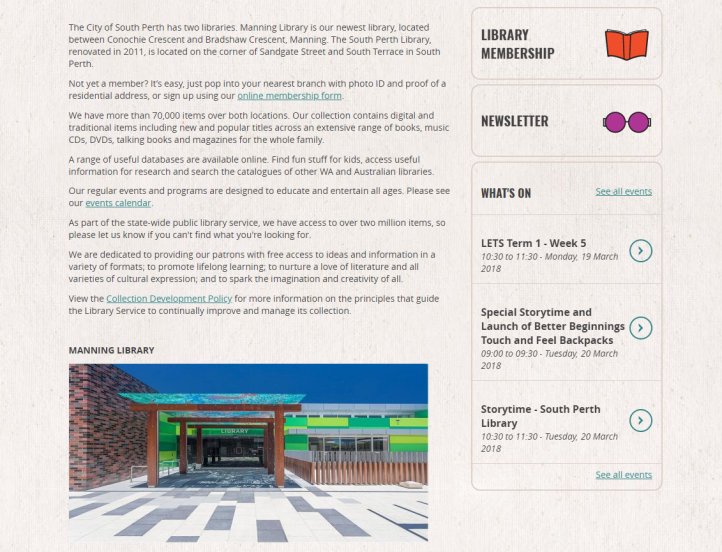
The Perth, Australia library’s About Us page includes all the essentials-how to get a card, sign up for a newsletter, and what is happening today at the library.

Less is more. Many libraries, including mine, have a long list of accomplishments and sub-headers on their About Us page. My library has 19 clickable sub-links!  Pare it down. White space is good. Pick the five most important things you’d want people to know and move the rest to another section of your website. Remember, your About Us page isn’t really about you… it’s about your cardholder. What are the five things a person would need to know to convince them to get a library card or to give you more money?

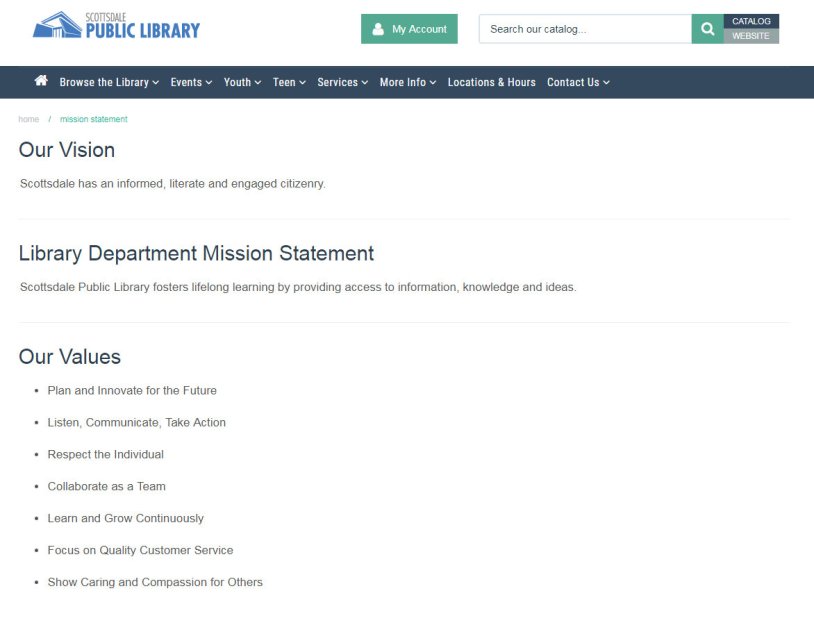
The Scottsdale, Arizona library takes a minimalist approach and it works!

Visuals are key.  Great, high-resolution photos that show people using your library and the workers who man the buildings are essential. Photos of faces are scientifically proven to be a more effective communication tool that text. Bold, easy to read fonts and primary colors work best for communicating ideas and drawing the eye to the page. Keep text to a minimum and pare down to five concepts that will tell your story.

I like how the Toledo Public Library’s page is heavy on visuals and includes easy-to-navigate sub links written in plain language.

Subscribe to this blog and you’ll receive an email every time I post. To do that, click on “Follow” button on the bottom left-hand corner of the page. Connect with me on Twitter and Snapchat–it’s where I talk about library marketing! I’m @Webmastergirl. I’m also on LinkedInInstagram and Pinterest. Views in this post are my own and do not represent those of my employer.

Five Excellent Ways To Improve Every Sign in Your Library

I have a love/hate relationship with library signage.

Part of my job as a marketing professional in a major metropolitan public library is to conduct signage evaluations and to make changes or improvements to the signs in our 41 locations. As a customer, I know how helpful the right kind of signage can be, and my perspective as a customer helps me to understand the importance of the task. But to be honest, it’s probably one of my least favorite job requirements. That’s because I’ve found that signs seem like a simple thing but are, in truth, very complicated. My coworkers and my cardholders have passionate feelings about them.

Good signage serves as a silent employee to draw cardholders to your location, direct traffic inside your building, and answer basic customer questions. Signs can actually be a part of your library’s overall strategy and should certainly be worked into your marketing strategy each year. Ask yourself: What are your library’s overall goals, and how can signs help to meet those goals?

The task of tackling your library’s signage is much easier when you have brand specifications documented. The color, size, and language should be consistent throughout the building and multiple locations. Once you have that document created and have decided how signage will help you to execute your library’s goals, here are five tips to keep in mind as you work on signage for each building.

Tip #1: Less is more. Too many signs in a branch, particularly in a small location, can create clutter and can actually cause confusion. And too much signage can actually annoy your cardholders, particularly if most of your signs are bombarding them with marketing messages. Just as white space works to create breadth and depth for a website or a graphic, well-spaced signage in a branch creates flow. About 75 percent of the signs in your library locations should be wayfaring only–directing cardholders to important service points in the building. The other 25 percent can be selective marketing–promoting services and items that are of interest to your cardholders or that might be of interest to them, based on their patterns of checkout.

Tip #2: Match the signage display to the user of each physical space. Make sure that in your children’s area, the signs, shelves, and computers are all lowered to be a child’s level. Create larger signs for the section that holds your large print items. Place teen signs where the teens hang out, like near charging stations or computers. Use a combination of large and small signs to blend with the space requirements in your library and to keep your signage from becoming monotonous, without being overpowering.  Use a bold font and keep colors and designs simple.

Tip #3: Your library materials make the best displays. Use them instead of signs. Think about how your local bookstore will display books. They often turn them front-facing. Why? Book covers are a visual cue and publishers spend thousands of dollars creating beautiful and eye-catching covers. Use these designs to create a visually pleasing display instead of a sign. A good display will not even need a sign–it should be obvious to the cardholder what you are trying to market to them.

Tip #4: Use customer-friendly, positive language. Cardholders prefer conversational language in all our marketing, so it makes sense to incorporate that into your signage. Some examples are:

Replace self-check or circulation with checkout.

Replace reference with information.

Replace periodicals with magazines.

Replace juvenile with children’s and teens.

I know this is controversial but I’m saying it anyway. Drop the Dewey decimal system from your end panels and arrange your fiction and nonfiction items alphabetically. And incorporate positive language into your signs. Don’t tell customers what they can’t do. Rather, tell them what they can do or how they can enjoy a particular space or item in the collection.

Tip #5: Don’t forget the signs on the outside of your building. Your main sign should say LIBRARY in large letters. Save the actual name of the building, particularly if it’s a long name, for smaller letters by the door. Make sure your open and close times are large and clear and in an easy to spot location. The same goes for the signage for any outdoor services like book drops or drive-thru windows. Make sure the signs are as large as is allowed by your local government.

Bonus tips: Don’t rely on signs to convey everything you want to tell the customer. Hire staff who are willing to speak with customers and show customers where items are located with patience and kindness. And set a schedule for re-evaluating and refreshing your signage–once a year, if you can handle it.

Subscribe to this blog and you’ll receive an email every time I post. To do that, click on “Follow” button on the bottom left-hand corner of the page. Connect with me on Twitter and Snapchat–it’s where I talk about library marketing! I’m @Webmastergirl. I’m also on LinkedInInstagram and Pinterest. Views in this post are my own and do not represent those of my employer.

A WordPress.com Website.

Up ↑