In this episode, we will answer a viewer’s question.
Margaret Luedke is Programs and Marketing Coordinator at Juneau Public Library in Juneau, AK. She writes, “I am new to library marketing and do not have a marketing background. My library did not have a marketing plan or brand style guide when I started so I am working to develop them now. I’ve found your guides on both topics very helpful! I wanted to ask though, how far do you suggest we take our branding?”
Kudos in this episode go to the winners of the Library Science Tuition Scholarship in Kentucky.
Do you have a suggestion for a topic for a future episode? Want to nominate someone for kudos? Let me know in the comments. And subscribe to this series to get a new video tip for libraries each week.
Thanks for watching!
Subscribe to this blog and you’ll receive an email every time I post. To do that, enter your email address and click on the “Follow” button in the lower left-hand corner of the page.
Photo courtesy Cincinnati and Hamilton County Public Library
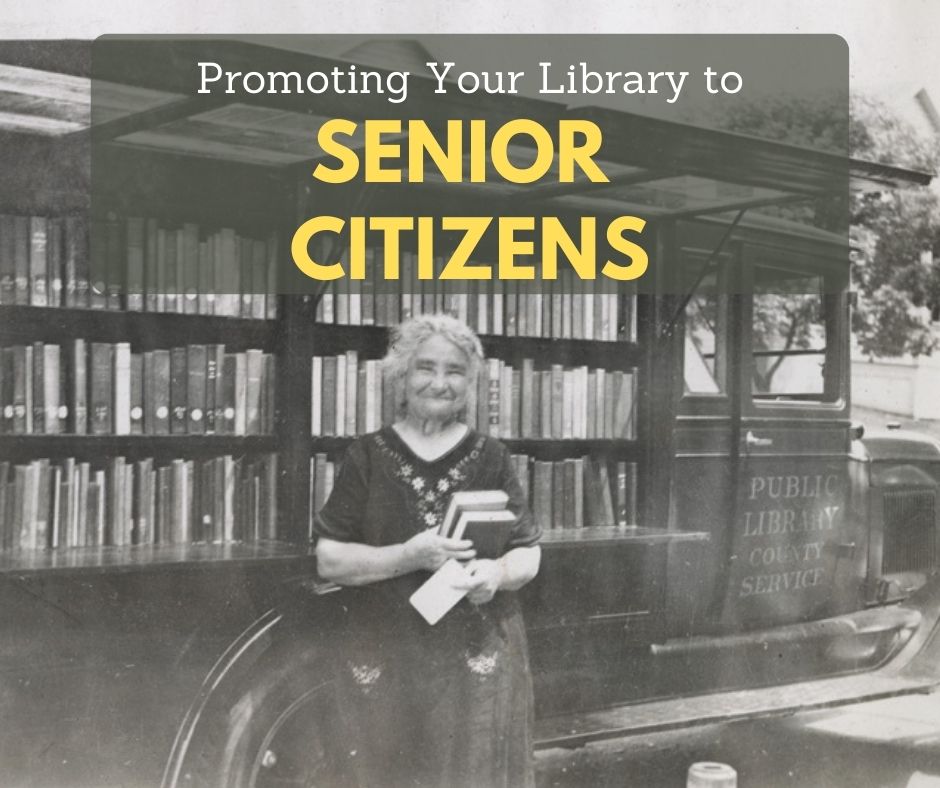
A few weeks ago, I learned that, as a 50-year-old, I can technically join the American Association of Retired Persons (AARP).
I have NO INTENTION of retiring for many, many more years (maybe never?!). But in learning about my newfound status, I start to think about how libraries market to senior citizens.
More than 54 million adults ages 65 and older live in the United States, according to the U.S. Census Bureau. That accounts for about 16.5 percent of the nation’s total population. And seniors are expected to outnumber children in the United States by 2035.
Goals focused on seniors require marketing target to seniors
Depending on your library’s overall goals, it may be critical for your organization to focus on attracting and retaining a larger percentage of your community’s older residents.
For example, the Queens Library’s strategic plan specifically says, “The borough is growing older, with its elderly population projected to increase by more than 30% by 2040.” The plan then lists among its goals, a provision for providing a more robust large print collection, as well as a goal to connect the older residents intentionally and strategically with library services.
Today’s senior citizen is not your stereotypical grandma
If your mental picture of an older person is frail, technologically challenged, and dependent on others, you couldn’t be more wrong.
Older patrons are Interested in keeping healthy so they can stay independent at home. And they’re active on social media. More than 70 percent have a Facebook account, and more than 40 percent are on Instagram. And The Guardian recently published statistics that show the number of older people on TikTok is growing significantly.
Particularly during the pandemic, seniors learned to embrace technology. They readily engage with video chats and content on mobile devices. In fact, three out of every four seniors say they depend on technology to help them manage their lives and to stay in touch with family and friends.
More than half of older adults still work at least part-time. They’re more likely to volunteer their time. And the poverty rate is high among this group. 10.5 percent of white Americans over age 65 live in poverty and rates are three times higher for Hispanic and Black Americans.
Getting to know your older patrons
Of course, the older patrons in your service area may have different wants and needs. You’ll need to do is your own market research. A strategic survey targeted at this age group will help your library get concrete data on the makeup and needs of your older population.
You can also consult data provided by the US Census Bureau to build an accurate picture of your older patrons. Finally, conduct focus groups in partnership with senior community centers. You’ll have the chance to get direct feedback on the ways your library can connect with, and serve, your older residents.
Based on what you learn, you should develop a marketing persona to specifically address segments of your older population. And you may find you need more than one persona to capture the essence of your older patrons.
For example, you may find that you have three key groups of older residents: those approaching retirement, those who are retired and active, and those who require assistance from caregivers. These three groups will all have distinct library service needs. They’ll respond differently to your library promotions.
Highlight the things they value
Older folks love to bargain hunt and save money. This is where price comparison and other promotions that highlight the savings provided by a library card can be advantageous for your library.
For example, if you check out kitchen tools in your library of things, a “try before you buy” message drives home the value of the library. Your marketing piece should include the price of one or two kitchen tools, purchased new, to help your older patrons see they can potentially save money by trying the gadgets out first.
Seniors are looking for advanced tech help. Surveys show that people ages 50 and older want to learn how to manage smart-home technology, stream entertainment from sites like Hulu or Netflix, and video chat with friends and family. Programs at your library should address this need.
Focus on communicating the mission, vision, and values of your library. Seniors are more likely to vote and more likely to believe in investments in institutions.
Have a plan to target your older population with value-oriented messages. Build empathy through storytelling and show how your library provides value. You will be rewarded with the support of your older population.
In-person outreach is critical to targeting your older population. This demographic values personal, face-to-face interaction. Partner with faith-based organizations, meals on wheels, senior clubs, and community centers to distribute promotional material and get a chance for those in-person opportunities with your older community members.
Include testimonials and storytelling as part of your marketing strategy aimed at seniors. Older patrons aren’t influenced by sweeping claims or generalizations. They value personal experience, especially from people they can relate to.
More tips to create effective marketing targeted at seniors
Older people love print marketing materials. Seniors grew up receiving advertisements and physical catalogs in the mail. Print is familiar and even nostalgic to this group. They prefer something tangible they can hold in their hands.
Make digital communications accessible and mobile responsive. The Marketing Rule of 7 applies to this demographic. And they do love to sign up for email newsletters and visit websites. So make sure your digital marketing material is accessible to meet the various physical needs of this age group. Use as little text as possible, surrounded by white space and generous margins. Make fonts on your website, emails, and in print material 16 pt. or larger. Increase the size of your website and email buttons for messages aimed at this demographic.
Facebook posts are especially effective for targeting seniors. Regular readers know I’m not a fan of Facebook for marketing. The exception is this. Senior patrons are still heavy users of Facebook. I would recommend experimenting with a focused Facebook strategy aimed exclusively at connecting with your older population.
Examples of great library marketing aimed at seniors
Subscribe to this blog and you’ll receive an email every time I post. To do that, enter your email address and click on the “Follow” button in the lower left-hand corner of the page.
Photo courtesy Public Library of Cincinnati and Hamilton County
My first American Library Association Annual Conference was a whirlwind.
I spent my time in DC searching for my people. You know them–the library staff members who are tasked with promoting their libraries.
It’s a job that you can’t really understand unless you’ve done it. And these five people have done it.
So, I asked them to share their best piece of advice for library promotion. And I got five amazing answers that I wanted to share with you.
Because, no matter where you are, and no matter what size library you work for, these nuggets of wisdom will inspire you. They will cause you to think deeply and intentionally about your work.
And best of all, they will reassure you that other library marketers share your worries, problems, and challenges. You, my friends, are not alone.
Advice from 5 staffers working in library marketing and promotions
“The most important part of marketing is to remember that it is about the customer. Before deciding on a strategy or a tactic, there has to be a very clear understanding of who would be most interested in an author, book, database, product, or service. Think about what it will help a customer do and what would that mean for them.”
“Next, use that information to think through what message would resonate with that person, what is the best way to communicate that message, and when is the best time to share that message. For example, resume help, in a practical sense, helps someone update a document. But the function it serves is to help someone rebrand their career, find a better job, or end the frustration of not being called for an interview.”
“Using that insight can help you figure out a lot of ways to talk about a service that we offer every day, That could change the trajectory of a customer’s life. Building a communications plan from that insight creates a lot of opportunities beyond a flyer that says ‘resume help.'”
“Our goal is always to connect with our customers. Starting from their perspective in planning makes a huge difference.”
“In light of the last few years and how difficult it has been for staff to adjust to changes, be flexible. Be willing to change your methods. And then be willing to change them back if things change again. That flexibility in how you are delivering your message and how people want to receive it is key.”
“Make sure everyone on your team is cross-trained and everyone can step in at any moment and help each other out. That support aspect is super important when you’re making changes on the fly and adapting to how you deliver the message based on our changing times.”
“A lot of our library workers in their silos in the library like to produce their own visuals for social media and my one piece of advice that I’m always giving them is a social media image is not a flyer. You don’t need to get all the words on it, you don’t need to get all the information on it, you just need a nice image.”
Mark Aaron Polger, Coordinator of Library Outreach and Associate Professor, College of Staten Island, City University of New York.
“Create a marketing plan to tackle specific library services and resources. Make it scalable and manageable. Set realistic, tangible, quantifiable goals.”
“Conduct market research before planning marketing activities. All your marketing initiatives should be informed by data. Don’t assume or guess what your users want. Conduct market research to identify your segments and learn about your library community.
“When conducting market research, use primary sources to obtain original data about your library community. Supplement with secondary sources like census, survey data from Pew Research, and community survey data.”
“You can’t market to everyone; be selected and specific. Your marketing should target specific segments of your library community. Those segments are identified in your market research.”
“Get involved in your community. Libraries are essential to the community, but too many people assume they are only there to provide books. We all know that is not the reality! From driver’s test assistance and notary services to free Wi-Fi and computer help, libraries provide so many beneficial opportunities for free! By getting involved in the community, not only are you able to get your name and services out there, but you’re showing that your library is a team player.”
“Small businesses and civic organizations around your community can offer volunteers, provide giveaway items, sponsor events, and so much more. Join the chamber(s), put library representatives in civic organizations, and show up in the community and they will show up for you.”
Do you have any advice to share with fellow library marketers? Add your thoughts in the comments section.
Subscribe to this blog and you’ll receive an email every time I post. To do that, enter your email address and click on the “Follow” button in the lower left-hand corner of the page.
Photo courtesy Public Library of Cincinnati and Hamilton County
My favorite bedtime snack is cereal. There’s something comforting about climbing into bed to watch TikTok while munching on Cheerios or Rice Krispies or, God forgive me, Cookie Crisp.
But it costs a lot more now to indulge in my favorite nighttime ritual. The average price of a gallon of milk rose by $1.23 between 2020 and 2022. The price of an average box of dry cereal rose by $1 between 2020 and 2022, according to my research.
Everything is getting more expensive, and not just in the United States. According to the Organization for Economic Cooperation and Development, consumer prices are up 9.2 percent in 2022. Some countries like Turkey and Estonia are seeing double-digit inflation rates.
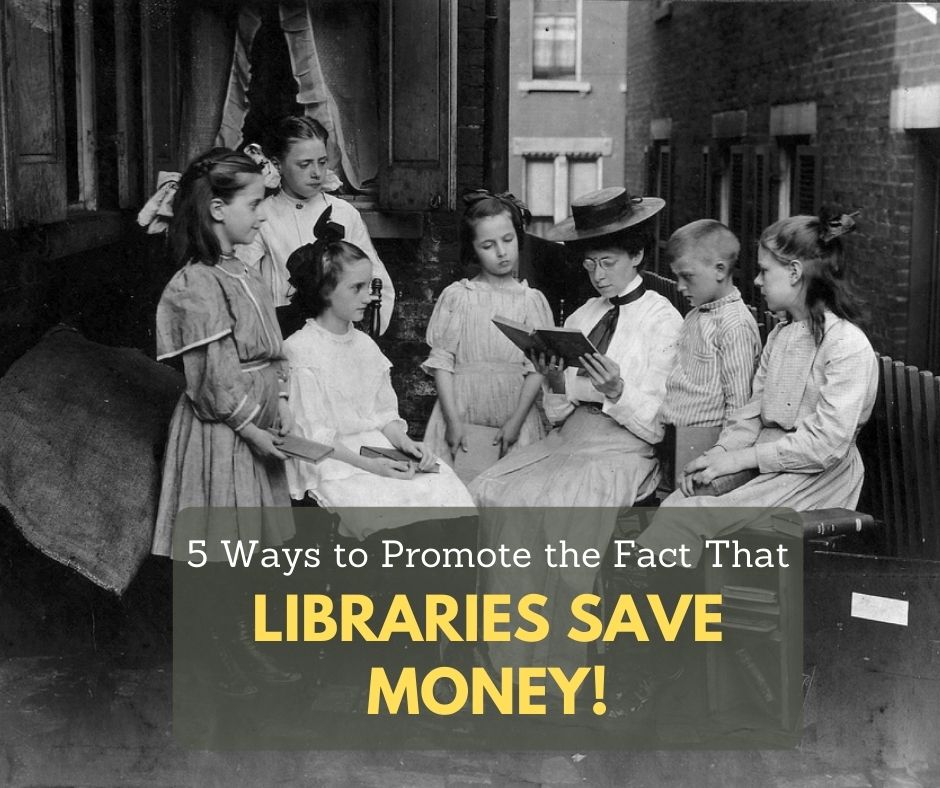
Your patrons are struggling, as I’m sure you know. That’s why now is the moment to start promoting your library as a money-saving opportunity for your community.
This isn’t a new idea. During the recession of 2008, libraries marketed themselves as a place for free books, DVDs, education, and entertainment. We’ve expanded our services since then, and we can show our community the value of using their library card to save money.
This approach has benefits for the library too. It will help reconnect community members who may have stopped coming to the library during the pandemic. That will drive circulation, visitors, and attendance.
Specificity is key.
Libraries, in our well-intentioned effort to appeal to everyone, often appeal to no one. So instead of saying, “The library saves you money,” be specific.
Think about the audiences you have on the platforms where you promote your library. Your Facebook followers have a specific demographic makeup. So do your Instagram followers. Your email newsletter subscribers react positively to certain promotions.
Think about those specific audiences. Write down what you know about them. For example:
Our library’s Instagram audience is women between the ages of 25 and 34. We get the most likes, shares, and comments for posts featuring historic photos of our library and book recommendations.
Next, do some research about the financial state of your area. Census statistics from 2020 are a great place to start. You can also search local news articles for more recent reports from your city or county about the state of the economy in your service area. If I were to do this for the city where I live (Cincinnati, Ohio), I would write:
The average household income according to the 2020 census is $65,000 and the poverty rate is 24 percent. Our population is majority white (50 percent) and black (41 percent). Cincinnati was ranked by the Bureau of Labor Statistics in the bottom ten urban areas for job growth. The homeownership rate is only 39 percent. Most households consist of three people. Most residents have at least a high school diploma.
Armed with just those few statistics, I can make a list of the needs my service community has.
Finding a job
Career growth for better-paying jobs
Adult education advancement and the money to pay for higher education
Family activities that are cheap or free
Entertainment that is cheap or free
Now I can identify the specific library services that fall into those categories. Then, I can make plans to promote each of those library offerings as cost savings to my community.
Here are five ideas for specific promotions. Scroll down to the bottom of the post for examples of libraries that are promoting their services to save money.
Include a price comparison.
How much does a subscription to Netflix, Spotify, Hulu, or Audible cost compared with your library’s free streaming movies and music? How much does it cost to rent a workspace compared to using the library as a remote workspace? How much does it cost to buy a folding table versus checking one out from your library of things? Make the comparison so community members can see how much money they can save.
Always start with your collection.
Books are your library’s brand. In your print collection, focus on bestselling fiction and nonfiction, cookbooks, DIY, and children’s books. If you’re worried about growing the holds list, be sure to promote these books in all formats, including digital and audio, to give your patrons access faster.
You should also promote your library’s digital magazines and online newspapers. Remember to do a price comparison to show people how much they can save by using your library.
Remember, don’t promote the entirety of your collection. Be specific. Pick one to three titles that match a specific target audience. Your promotions will be more effective.
For example, when I worked at the Cincinnati Library, I promoted Reminisce Magazine to baby boomers on Facebook. Before our promotion, we had only a few downloads of this magazine each month. Afterward, downloads rose by more than 100 percent! Our community also really loved Cincinnati Magazine and whenever I marketed it by itself, downloads spiked. Specificity is the key.
Consumer reports database
This is a huge money saver for your community. Show your fans how they can research the best products and save time and money.
Homework help
Tutoring isn’t cheap. Many libraries offer help for kids struggling with schoolwork, either in person or online. If your homework help is in-person, introduce people to the faces their kids will see at the library. The Cincinnati Library did this in a blog post. You can also make a short video or a series of slides on Instagram or Facebook stores.
Other library services that save money
Library of things
Free Wi-Fi hotspots
Video games
Free or cheap classes and testing preparation.
The library as a workspace
Real-life examples of libraries promoting their cost-savings
Explore the value of your library membership! A $25.00 annual family membership can save you over $1600 a year! Sign up today online at: https://t.co/cTRw0mtWTW
Subscribe to this blog and you’ll receive an email every time I post. To do that, enter your email address and click on the “Follow” button in the lower left-hand corner of the page.
In this episode, we’ll answer a question from a viewer. They wanted to know how to tell which of their promotions are working. It’s sometimes tricky work trying to figure out where people are learning about your library’s services and collection. I’ll share three strategies to help you figure out what is working… and what isn’t!
Kudos in this episode go to the Baytown Library. Watch the video to find out why they’re being recognized.
Do you have a suggestion for a topic for a future episode? Want to nominate someone for kudos? Let me know in the comments. And subscribe to this series to get a new video tip for libraries each week.
Thanks for watching!
Subscribe to this blog and you’ll receive an email every time I post. To do that, enter your email address and click on the “Follow” button in the lower left-hand corner of the page.
He’s seeing great success with this approach. Says Ned, “Using these guidelines we’ve increased our Instagram reach by 1149% in 12 months. This stuff really works!” Ned kindly granted permission to reblog his post here.
The caveat
This is an internal doc. It’s literally just the guidance I wrote for the York staff who help me do the Instagram. So that means it’s not a definitive all-encompassing guide! There are probably things we’ve talked about internally that everyone knows, so it’s not codified here.
Also, we’re an academic library so it may be skewed towards that sector. Generally speaking though, I think pretty much everything here is applicable to any non-profits using Instagram.
Another small caveat is, that I’m not trying to present York’s Insta as the finished article, the account to which everyone should aspire. We’re still learning, still improving, and still trying to increase our reach. We don’t nail everything, we still post things people don’t respond to. We’re a work in progress, and this post is really about how to make that progress happen.
The context
Our Instagram was created in 2016 by a Comms Team rather than by us in the library. We finally got control of it ourselves in mid-2017. From that point on it went okay, gradually building up followers and levels of engagement but not setting the world on fire.
From the time the pandemic started, I spent much more time actively involved in social media rather than just writing the guidelines, and our Instagram use increased accordingly. We posted a lot more to the Grid, essentially tried harder, and, frankly, started to do more of the things I was always telling other libraries to do in social media workshops. It worked well, but it was still very much in the shade of our Twitter account, and not quite hitting the heights we wanted.
Exactly a year ago, I decided that we needed to invest more time in Instagram and make it work better.
Instagram is absolutely essential for reaching undergrads
It is THE communication channel on which to get messages to undergraduates, nothing else comes close. Our Twitter was doing really well and was where we put the most time, and all that time paid off with lots of growth and engagement. But I did some follower analysis and, at least among those who engaged by replying and quote-tweeting us, it was clear that our audience there primarily consisted of PostGrads, Researchers, and Academics. So our key social media messages were not getting through to UGs. Insta is the answer to that problem.
In 2021 I co-presented at an event with Liverpool Uni Library, whose social media really is something of a gold standard in academic libraries. Before the event we chatted on zoom – they had grown their Instagram massively in recent times, which made me think perhaps we could do the same. So I asked my colleague Rebecca Connolly to go on a little fact-finding mission and check out Liverpool, Glasgow and other university libraries with good Instagram engagement went about their business and what we could learn. Rebecca produced a brilliant report and we set to work on transforming our Insta into something much more effective for getting key messages out to undergrads in particular – a process that is still ongoing.
How we changed our Instagram
Some things we tweaked right away, like following more York-based accounts and using Stories a lot more. Using Stories is key and I really feel like it was something I didn’t understand well enough before Rebecca became involved with the account at York. She is an essential part of the progress we’ve made. Stories are so good for newsy items, and the more success you have with Stories the better things seem to go on the Grid too.
Other things evolved over time, like avoiding the use of words and graphics on the grid (only using them on Stories), and making sure to pair big announcements in the captions (NOT the picture) with visually arresting pictures of the library.
If you’ve not read the guidance doc linked at the top of this post, have a look – we basically did all the things in that document! In addition to all that, we’ve created and posted a lot more Reels (you can see all our Reels videos here), and also tried some fancy split photography, that involves dividing a wide-angle shot up into even squares so it can be seamlessly swiped through. Here’s an example that I posted that I really like…
With any kind of social media, I’m always looking for engagement rather than follower numbers. I want more followers of course – a larger audience of students and staff for our key messages. But they come naturally as a by-product of posting stuff that gets engagement. So for Instagram, I’m looking at Likes, Comments, Shares, and Reach, and hoping that if we increase those our followers will increase at the same time.
As it happens, our followers have increased by about a thousand people in the last twelve months. That’s great. More excitingly for me, is that the number of Likes has gone up 42 percent, despite us posting slightly less frequently overall. So the likes Per post has actually gone up 69 percent – meaning we’re posting stuff the students actually respond to, more of the time. Over 2 years, our total number of Likes hasincreased by over 350 percent.
Shares are way up, and Comments also increased which is great because we want that interaction and chance to answer questions – up by more than 600 percent over the two years.
What isn’t captured by the analytics is the amount of DMs we’ve had – either just messages out of the blue or responses to questions in our Stories. I can’t get figures on this without manually counting but the increase is huge. People love feedback one-to-one on Instagram.
The reach is the thing that most amazed me though – an increase of over 1000 percent in the 12 months is just fantastic.And the reason is that if people don’t Like your posts, Instagram doesn’t share them widely. So now that we’re posting content that gets engagement, a much higher proportion of our followers are seeing our posts. This means our key messages are reaching more undergraduates, and that was the whole aim of this focused attempt to increase engagement.
Like with all social media, the key thing is to learn what your particular community responds best to, and do more of it.
Ned Potter
Finally, do check out Liverpool, they’re so good
So that’s it! There was a lot to get through in this post; if you’ve made it this far, I salute you. I hope people find these guidelines useful, and if you have any questions leave me a comment below.
I’ll leave you with a recommendation to look at Uni of Liverpool Library’s Instagram account – however good our numbers are I know theirs will be astronomically better! They’re really good at this stuff, and you’ll find them @livunilibrary.
Subscribe to this blog and you’ll receive an email every time I post. To do that, enter your email address and click on the “Follow” button in the lower left-hand corner of the page.
The Library Marketing Show, Episode 146: In this episode, we’ll answer a question from a viewer.
They want to know how far in advance to start promoting their library programs on social media. I’ll share some tips to help you find the “sweet spot” for your library audience.
Kudos in this episode go to the Ann Arbor Public Library. Watch the video to see why they’re being recognized.
Do you have a suggestion for a topic for a future episode? Want to nominate someone for kudos? Let me know in the comments. And subscribe to this series to get a new video tip for libraries each week.
Thanks for watching!
Subscribe to this blog and you’ll receive an email every time I post. To do that, enter your email address and click on the “Follow” button in the lower left-hand corner of the page.
Photo courtesy Cincinnati and Hamilton County Public Library
Libraries know the power of storytelling. Most of us are literally and physically surrounded by some of the best stories in the world.
But the quest for library stories that have emotion and a compelling story arch is daunting for many libraries. A Kentucky librarian has the solution: let your patrons tell their own stories!
Levi Simonton has worked for the Jessamine County Public Library for three and a half years and is now the library’s social media coordinator. “I love this place,” said Levi when I asked him about his work experience.
In January, Levi and his library launched a video series called Share A Story. The videos were created to amplify the voices of library superfans.
Levi’s library believes that patrons’ real-life experience is the best way to increase the use of the library and relay the library’s value. “We think that a community member is more likely to visit the library after hearing a story from one of their peers rather than seeing an advertisement from us,” explains Levi.
Approaching a patron and asking them to share their story is often intimidating for libraries. But Levi has a remarkably simple approach. “We typically ask other staff members if they know anyone who might be willing to share an impactful story with the library,” says Levi. “We may also ask for patrons with experience on a specific topic we plan to promote. Sometimes it’s a bit more serendipitous, though. We met the first patron we interviewed by chance at our big comic con event last October.”
The interview itself doesn’t take much time, according to Levi. He typically spends about 45 minutes interviewing his subject. Then he focuses on getting footage of the subject that matches what the patron talked about (in the TV world, this is called B-roll). The footage is used later in editing, to cover parts of soundbites and edits. It also makes the video more interesting.
Once the interview and footage are shot, it’s time to put it all together. For Levi, this is the most labor-intensive part of the process. “These particular pieces usually take 10-15 hours over a week or two,” recalls Levi. “Honestly, that’s longer than it should take. I’m just new to video editing and have a bit of compulsive behavior when it comes to getting those darn details right.”
When the library launched the first video, the reaction was positive, both from patrons and staff. “We showed the videos at a recent staff meeting,” says Levi. “They seemed to resonate with everyone. Hearing directly from patrons about the library’s impact on their lives brought at least a few staff to tears.”
So far, the library has released three videos in the series, including one from a woman who has been visiting the library since she was a little girl. “I grew up in an environment that was considered impoverished,” says Anna Kenion, who is featured in one of the videos. “However, my way of escape, to solitude time and to dream bigger was when I would go to our public library,”
The library is taking a break from releasing videos over the summer to focus on summer reading. But they are working on videos to promote their new outreach vehicle and children’s storytimes. “We may release podcasts, written pieces, or other media that fall under the Share A Story umbrella in the future,” said Levi.
Is your library telling patron stories as part of your marketing? Let me know in the comments!
Subscribe to this blog and you’ll receive an email every time I post. To do that, enter your email address and click on the “Follow” button in the lower left-hand corner of the page.
The Library Marketing Show, Episode 145: In this episode, we’ll answer a question from Leica. She says, “I am a one-gal, part-time show here. I can set my priorities easily, but I’d like to hear your thoughts on working with NO goals or strategic plans? I know it sounds crazy, but I’m not given anything to work TOWARD. So, as much as I *think* I do well, I don’t really have any measurable way to verify.”
Kudos in this episode go to the Garland County Library. Watch the video to see why they’re being recognized.
Do you have a suggestion for a topic for a future episode? Want to nominate someone for kudos? Let me know in the comments. And subscribe to this series to get a new video tip for libraries each week.
Thanks for watching!
Subscribe to this blog and you’ll receive an email every time I post. To do that, enter your email address and click on the “Follow” button in the lower left-hand corner of the page.



 Super Library Marketing: Practical Tips and Ideas for Library Promotion