In this episode, we’ll answer a question from a viewer. They wanted to know how to tell which of their promotions are working. It’s sometimes tricky work trying to figure out where people are learning about your library’s services and collection. I’ll share three strategies to help you figure out what is working… and what isn’t!
Kudos in this episode go to the Baytown Library. Watch the video to find out why they’re being recognized.
Do you have a suggestion for a topic for a future episode? Want to nominate someone for kudos? Let me know in the comments. And subscribe to this series to get a new video tip for libraries each week.
Thanks for watching!
Subscribe to this blog and you’ll receive an email every time I post. To do that, enter your email address and click on the “Follow” button in the lower left-hand corner of the page.
He’s seeing great success with this approach. Says Ned, “Using these guidelines we’ve increased our Instagram reach by 1149% in 12 months. This stuff really works!” Ned kindly granted permission to reblog his post here.
The caveat
This is an internal doc. It’s literally just the guidance I wrote for the York staff who help me do the Instagram. So that means it’s not a definitive all-encompassing guide! There are probably things we’ve talked about internally that everyone knows, so it’s not codified here.
Also, we’re an academic library so it may be skewed towards that sector. Generally speaking though, I think pretty much everything here is applicable to any non-profits using Instagram.
Another small caveat is, that I’m not trying to present York’s Insta as the finished article, the account to which everyone should aspire. We’re still learning, still improving, and still trying to increase our reach. We don’t nail everything, we still post things people don’t respond to. We’re a work in progress, and this post is really about how to make that progress happen.
The context
Our Instagram was created in 2016 by a Comms Team rather than by us in the library. We finally got control of it ourselves in mid-2017. From that point on it went okay, gradually building up followers and levels of engagement but not setting the world on fire.
From the time the pandemic started, I spent much more time actively involved in social media rather than just writing the guidelines, and our Instagram use increased accordingly. We posted a lot more to the Grid, essentially tried harder, and, frankly, started to do more of the things I was always telling other libraries to do in social media workshops. It worked well, but it was still very much in the shade of our Twitter account, and not quite hitting the heights we wanted.
Exactly a year ago, I decided that we needed to invest more time in Instagram and make it work better.
Instagram is absolutely essential for reaching undergrads
It is THE communication channel on which to get messages to undergraduates, nothing else comes close. Our Twitter was doing really well and was where we put the most time, and all that time paid off with lots of growth and engagement. But I did some follower analysis and, at least among those who engaged by replying and quote-tweeting us, it was clear that our audience there primarily consisted of PostGrads, Researchers, and Academics. So our key social media messages were not getting through to UGs. Insta is the answer to that problem.
In 2021 I co-presented at an event with Liverpool Uni Library, whose social media really is something of a gold standard in academic libraries. Before the event we chatted on zoom – they had grown their Instagram massively in recent times, which made me think perhaps we could do the same. So I asked my colleague Rebecca Connolly to go on a little fact-finding mission and check out Liverpool, Glasgow and other university libraries with good Instagram engagement went about their business and what we could learn. Rebecca produced a brilliant report and we set to work on transforming our Insta into something much more effective for getting key messages out to undergrads in particular – a process that is still ongoing.
How we changed our Instagram
Some things we tweaked right away, like following more York-based accounts and using Stories a lot more. Using Stories is key and I really feel like it was something I didn’t understand well enough before Rebecca became involved with the account at York. She is an essential part of the progress we’ve made. Stories are so good for newsy items, and the more success you have with Stories the better things seem to go on the Grid too.
Other things evolved over time, like avoiding the use of words and graphics on the grid (only using them on Stories), and making sure to pair big announcements in the captions (NOT the picture) with visually arresting pictures of the library.
If you’ve not read the guidance doc linked at the top of this post, have a look – we basically did all the things in that document! In addition to all that, we’ve created and posted a lot more Reels (you can see all our Reels videos here), and also tried some fancy split photography, that involves dividing a wide-angle shot up into even squares so it can be seamlessly swiped through. Here’s an example that I posted that I really like…
With any kind of social media, I’m always looking for engagement rather than follower numbers. I want more followers of course – a larger audience of students and staff for our key messages. But they come naturally as a by-product of posting stuff that gets engagement. So for Instagram, I’m looking at Likes, Comments, Shares, and Reach, and hoping that if we increase those our followers will increase at the same time.
As it happens, our followers have increased by about a thousand people in the last twelve months. That’s great. More excitingly for me, is that the number of Likes has gone up 42 percent, despite us posting slightly less frequently overall. So the likes Per post has actually gone up 69 percent – meaning we’re posting stuff the students actually respond to, more of the time. Over 2 years, our total number of Likes hasincreased by over 350 percent.
Shares are way up, and Comments also increased which is great because we want that interaction and chance to answer questions – up by more than 600 percent over the two years.
What isn’t captured by the analytics is the amount of DMs we’ve had – either just messages out of the blue or responses to questions in our Stories. I can’t get figures on this without manually counting but the increase is huge. People love feedback one-to-one on Instagram.
The reach is the thing that most amazed me though – an increase of over 1000 percent in the 12 months is just fantastic.And the reason is that if people don’t Like your posts, Instagram doesn’t share them widely. So now that we’re posting content that gets engagement, a much higher proportion of our followers are seeing our posts. This means our key messages are reaching more undergraduates, and that was the whole aim of this focused attempt to increase engagement.
Like with all social media, the key thing is to learn what your particular community responds best to, and do more of it.
Ned Potter
Finally, do check out Liverpool, they’re so good
So that’s it! There was a lot to get through in this post; if you’ve made it this far, I salute you. I hope people find these guidelines useful, and if you have any questions leave me a comment below.
I’ll leave you with a recommendation to look at Uni of Liverpool Library’s Instagram account – however good our numbers are I know theirs will be astronomically better! They’re really good at this stuff, and you’ll find them @livunilibrary.
Subscribe to this blog and you’ll receive an email every time I post. To do that, enter your email address and click on the “Follow” button in the lower left-hand corner of the page.
The Library Marketing Show, Episode 146: In this episode, we’ll answer a question from a viewer.
They want to know how far in advance to start promoting their library programs on social media. I’ll share some tips to help you find the “sweet spot” for your library audience.
Kudos in this episode go to the Ann Arbor Public Library. Watch the video to see why they’re being recognized.
Do you have a suggestion for a topic for a future episode? Want to nominate someone for kudos? Let me know in the comments. And subscribe to this series to get a new video tip for libraries each week.
Thanks for watching!
Subscribe to this blog and you’ll receive an email every time I post. To do that, enter your email address and click on the “Follow” button in the lower left-hand corner of the page.
Photo courtesy Cincinnati and Hamilton County Public Library
Libraries know the power of storytelling. Most of us are literally and physically surrounded by some of the best stories in the world.
But the quest for library stories that have emotion and a compelling story arch is daunting for many libraries. A Kentucky librarian has the solution: let your patrons tell their own stories!
Levi Simonton has worked for the Jessamine County Public Library for three and a half years and is now the library’s social media coordinator. “I love this place,” said Levi when I asked him about his work experience.
In January, Levi and his library launched a video series called Share A Story. The videos were created to amplify the voices of library superfans.
Levi’s library believes that patrons’ real-life experience is the best way to increase the use of the library and relay the library’s value. “We think that a community member is more likely to visit the library after hearing a story from one of their peers rather than seeing an advertisement from us,” explains Levi.
Approaching a patron and asking them to share their story is often intimidating for libraries. But Levi has a remarkably simple approach. “We typically ask other staff members if they know anyone who might be willing to share an impactful story with the library,” says Levi. “We may also ask for patrons with experience on a specific topic we plan to promote. Sometimes it’s a bit more serendipitous, though. We met the first patron we interviewed by chance at our big comic con event last October.”
The interview itself doesn’t take much time, according to Levi. He typically spends about 45 minutes interviewing his subject. Then he focuses on getting footage of the subject that matches what the patron talked about (in the TV world, this is called B-roll). The footage is used later in editing, to cover parts of soundbites and edits. It also makes the video more interesting.
Once the interview and footage are shot, it’s time to put it all together. For Levi, this is the most labor-intensive part of the process. “These particular pieces usually take 10-15 hours over a week or two,” recalls Levi. “Honestly, that’s longer than it should take. I’m just new to video editing and have a bit of compulsive behavior when it comes to getting those darn details right.”
When the library launched the first video, the reaction was positive, both from patrons and staff. “We showed the videos at a recent staff meeting,” says Levi. “They seemed to resonate with everyone. Hearing directly from patrons about the library’s impact on their lives brought at least a few staff to tears.”
So far, the library has released three videos in the series, including one from a woman who has been visiting the library since she was a little girl. “I grew up in an environment that was considered impoverished,” says Anna Kenion, who is featured in one of the videos. “However, my way of escape, to solitude time and to dream bigger was when I would go to our public library,”
The library is taking a break from releasing videos over the summer to focus on summer reading. But they are working on videos to promote their new outreach vehicle and children’s storytimes. “We may release podcasts, written pieces, or other media that fall under the Share A Story umbrella in the future,” said Levi.
Is your library telling patron stories as part of your marketing? Let me know in the comments!
Subscribe to this blog and you’ll receive an email every time I post. To do that, enter your email address and click on the “Follow” button in the lower left-hand corner of the page.
The Library Marketing Show, Episode 145: In this episode, we’ll answer a question from Leica. She says, “I am a one-gal, part-time show here. I can set my priorities easily, but I’d like to hear your thoughts on working with NO goals or strategic plans? I know it sounds crazy, but I’m not given anything to work TOWARD. So, as much as I *think* I do well, I don’t really have any measurable way to verify.”
Kudos in this episode go to the Garland County Library. Watch the video to see why they’re being recognized.
Do you have a suggestion for a topic for a future episode? Want to nominate someone for kudos? Let me know in the comments. And subscribe to this series to get a new video tip for libraries each week.
Thanks for watching!
Subscribe to this blog and you’ll receive an email every time I post. To do that, enter your email address and click on the “Follow” button in the lower left-hand corner of the page.
The Library Marketing Show, Episode 144: In this episode, we’ve got our monthly social media headlines, and this month, we’re going to focus exclusively on Instagram. The platform is testing some new features and they could have significant implications for library marketing on the app.
Kudos in this episode go to the Coos Bay Library. Watch the video to find out why they’ve been recognized.
Do you have a suggestion for a topic for a future episode? Want to nominate someone for kudos? Let me know in the comments. And subscribe to this series to get a new video tip for libraries each week.
Thanks for watching!
Subscribe to this blog and you’ll receive an email every time I post. To do that, enter your email address and click on the “Follow” button in the lower left-hand corner of the page.
The Library Marketing Show, Episode 143: In this episode, we’ll answer a viewer’s question.
Sara of the Washington State Library asked for help promoting library chat services. I have six suggestions that will work for any size library.
Kudos in this episode go to the Greenwich Library. Watch the video to find out why they’re being recognized.
Do you have a suggestion for a topic for a future episode? Want to nominate someone for kudos? Let me know in the comments. And subscribe to this series to get a new video tip for libraries each week.
Thanks for watching!
Subscribe to this blog and you’ll receive an email every time I post. To do that, enter your email address and click on the “Follow” button in the lower left-hand corner of the page.
Photo courtesy Cincinnati and Hamilton County Public Library
Every time I see a misaligned pink square on top of blue and white plaid, my heart skips a beat.
I realize that may be the weirdest sentence I’ve ever posted to this blog but hear me out.
I am a die-hard fan of Bath and Body Works.
The bath gels, the body lotions, the candles, the hand soap. There is a scent for every season, every mood, every situation.
No, they did not pay me to say this. (But if anyone from Bath and Body Works ever reads this blog, I am willing to work as an influencer.😊)
Bath and Body Works has a strong, recognizable brand. They don’t want you to just buy their products one time. They want you to come back, again and again. They know a strong brand style that is recognizable across all platforms is key to creating a relationship with their customers.
You want that for your library. You want your community to recognize the promotional materials you make. When someone sees a sign or a social media post or a video, you want them to know that it comes from your library without having to see your library’s name or logo anywhere in the brand.
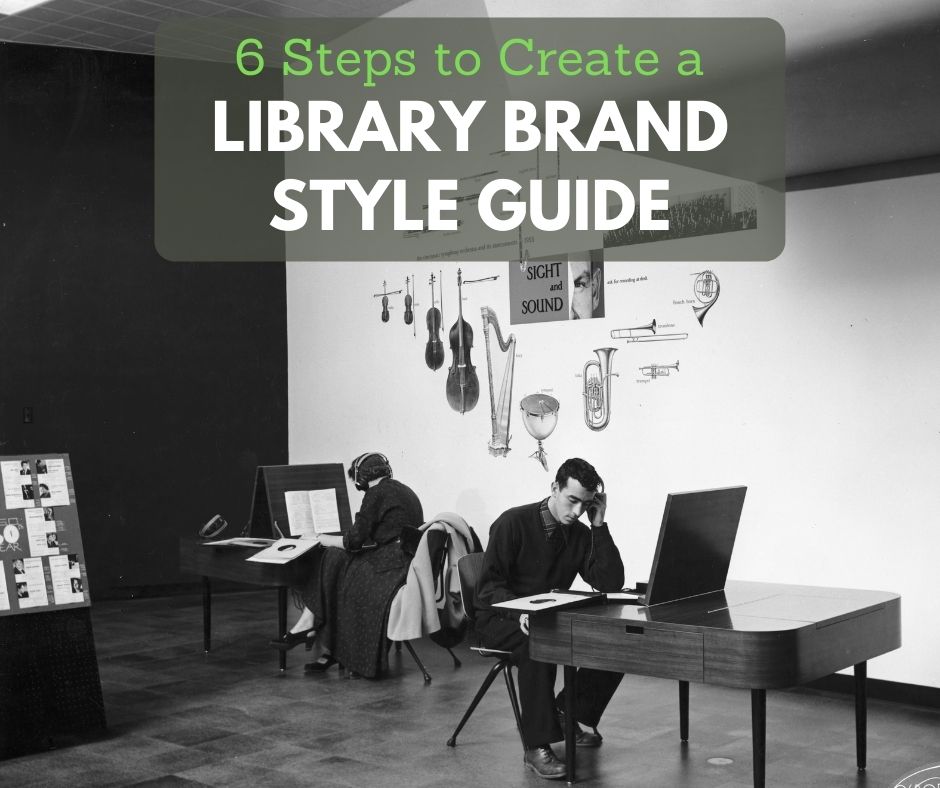
Building a library brand takes consistency. And to remain consistent when multiple departments and staff members create graphics, social media posts, posters, and other promotional materials, your library needs to create a brand style guide.
A brand style guide will clearly define the look and tone of marketing materials. It saves staff time. It will be used by staff when creating graphics and writing text. Most importantly, it will ensure your library’s marketing is recognizable.
Here’s a step-by-step guide for creating your library’s brand style guide. Scroll to the bottom of this post for examples of library brand style guidelines.
Grounding statements
Begin your document by centering your library’s brand on the guiding principles of your organization. Remind your staff of your core mission. You want to explain the importance of this work and create buy-in for your style guide.
Set the tone with your mission, vision, and values statement.
Include a sentence or two that positions your library’s strategy, personality, and customer service principles.
Define your library’s personality. Do you want people to think of you as authoritative and resilient? Whimsical and conversation? Warm and welcoming?
List the perceptions your library is trying to avoid, like boring, traditional, formal, or pretentious.
Logo use
Emphasize the proper use of your logo across all platforms, including print and digital.
Define space rules, including the use of white space in relation to the logo.
Set the acceptable color variations for your logo.
List the minimum logo sizes, including pixels, print proportions, and aspect ratios.
Colors
Your color palette is the tangible component of your brand that people notice first. Color increases brand recognition up to 80 percent. Your colors also play a significant role in how your library’s brand is perceived.
Include the RGB, CMYK, Hex Code, and Pantone versions of your color palette.
List the shades of your color palette which are acceptable for use, including those variations required for accessibility on digital screens.
Include color contrast requirements for print and digital screens, keeping accessibility in mind.
Typography
Like color, the fonts your library chooses are a visual cue about your brand. Your fonts should tie all communications together, from your website to print promotions. It’s important to set clear guidelines for the use of fonts.
List the styles, sizes, and weights that can be used. Be sure to include instructions on acceptable fonts for headers, copy, and footers or fine print.
Include acceptable variations on fonts, if the font is unavailable in a particular piece of creative software.
Set guidelines concerning spacing to maintain a consistent style when font size changes.
Tone and text
This section is important to maintain a consistent brand through all the text written for your library promotions. These guidelines will ensure people recognize the copy is coming from your library, no matter who is doing the writing.
Outline your preferred word and sentence length. Shorter words and sentences are easier to read and will speed up the tempo of your message. Longer words and sentences will require your audience to do more in-depth thinking but may also be more nuanced.
List the jargon or library terms that staff members should use. This includes terminology for how you will refer to patrons, non-cardholders, staff, branches, and your branded names for services.
Determine the acceptable terminology for equity, diversity, and inclusion. Set guidelines for the use of gendered pronouns, ability, and references to racial and ethnic groups within your community.
Set your grammar guidelines. Will you use contractions? Will you allow prepositions? What grammar rules will you keep sacred, and which can be broken?
Images
In this section, you’ll give anyone creating promotional materials for your library the rules they need to find graphics, photos, and artwork that represent your library.
Set standards for the proper size, style, and composition of images for social media, email, digital signs, print, video, and your library’s website.
List approved image sources, including a list of websites that provide free stock photos and images. Here are ten websites to help build out your list.
Include clear guidelines on diversity representation to ensure staff use images that accurately represent your community.
Incorporate guidance on the use of graphics, GIFs, and memes.
Subscribe to this blog and you’ll receive an email every time I post. To do that, enter your email address and click on the “Follow” button in the lower left-hand corner of the page.
The Library Marketing Show, Episode 142: In this episode, we’ll answer a viewer’s question.
Jennifer says her library has some followers that regularly comment on their posts, but never say anything positive. She wants to know how to handle those repeated negative commenters.
Do you have a suggestion for a topic for a future episode? Want to nominate someone for kudos? Let me know in the comments. And subscribe to this series to get a new video tip for libraries each week.
Thanks for watching!
Subscribe to this blog and you’ll receive an email every time I post. To do that, enter your email address and click on the “Follow” button in the lower left-hand corner of the page.




Is It Ever Okay to Hide Negative Comments on My Library’s Social Media Pages? How to Handle Trolls!
Watch Now
The Library Marketing Show, Episode 142: In this episode, we’ll answer a viewer’s question.
Jennifer says her library has some followers that regularly comment on their posts, but never say anything positive. She wants to know how to handle those repeated negative commenters.
Kudos in this episode go to the Fremont Area District Library. Watch to see why they are being recognized.
Do you have a suggestion for a topic for a future episode? Want to nominate someone for kudos? Let me know in the comments. And subscribe to this series to get a new video tip for libraries each week.
Thanks for watching!
Subscribe to this blog and you’ll receive an email every time I post. To do that, enter your email address and click on the “Follow” button in the lower left-hand corner of the page.
Share this: