In this episode, I’ll address a post I saw recently on the Libraries and Social Media Facebook page. A library staffer shared their plans to pull back on the amount of posts they are doing on Twitter. There was a bit of debate among the members about whether that was a good idea.
Kudos go to the San Marcos Public Library for their Breakfast Club inspired photo shoot.
Do you have a suggestion for a topic for a future episode? Want to nominate someone for kudos? Let me know in the comments. And subscribe to this series to get a new video tip for libraries each week.
Here is something I’ve noticed in my conversations with library staff over the past six months.
Staff share a profound feeling of separation from their communities. They’ve been working for more than a year without the normal interactions with the public. And that has led to increased anxiety about whether things will ever return to normal.
The big questions I’m getting are: How long will it take before circulation returns to normal? How long will it take before program attendance is back to where it was before the pandemic?
I can’t answer those questions. I’m not sure anyone credibly can.
But what I can do is help you to rebuild use of your library through marketing and promotions.
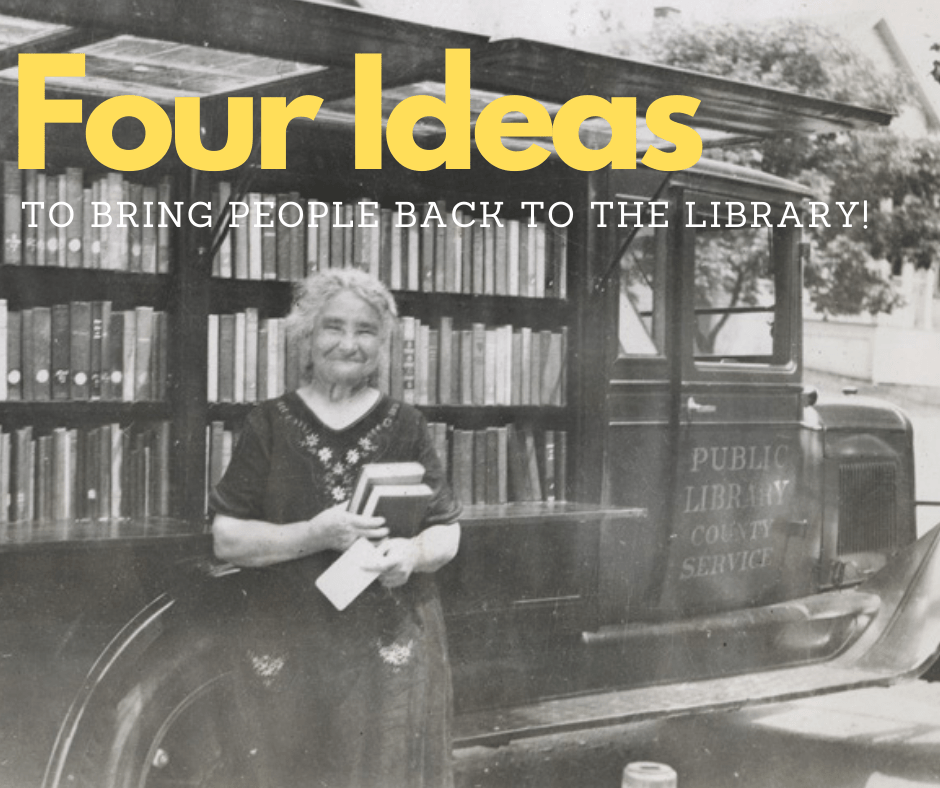
Here are four ideas that libraries can strategically use to bring people back to the library, re-engage cardholders, and get new community members to use the library.
Renew everyone’s library cards automatically and incentivize people to use them. Then, use that interaction to re-connect.
If you have a system where cards need to be renewed, a blanket automatic renewal is a great promotional tactic. Automatic renewal of library cards is a customer service best practice. And doing so right now, when we are coming off more than a year of service limitations, is strategically smart.
If your senior leaders have concerns about a blanket renewal, ask them to read Cordelia Anderson’s book. It explains the advantages of this action.
The next step is to gather prizes from partners, like you would for summer reading. Let people know they’ll be entered into a drawing to win a prize if they use their card. If they check out a book or use an online resource, they can fill out an entry. If your priorities are to drive attendance at in-person programs or to get people to physically come into a branch, you can tell people they get two entries in the drawing!
Once they come back, make sure you do everything you can to re-connect with these cardholders. Have your staff do three things with every person they interact with.
Get their email address.
Get them to self-identify their interests. Are they looking for help solving a particular problem, like finding a job? Are they looking for books for entertainment and relaxation? Ask your public to name at least one topic they would want more information about.
Give them a print piece of marketing material to encourage further use of the library. Don’t let them leave this interaction without something in their hands. Remind them that the library is open and actively providing service to your community again.
Rebuild a sense of community.
One of the things that library users said they missed most during the pandemic was social interaction. This is another opportunity for libraries to rebuild.
Rather than re-starting our one-off programs, let’s spend our energy putting together programs that everyone can participate in. Wider-ranging programs, which focus on getting large groups people to do an activity together, help to build a sense of community.
One idea: everyone reads the same book, or watches the same movie, or listens to the same piece of music. Then, your library creates ways for your community to share their thoughts and experiences around that group activity.
Another idea: ask your patrons to share their pandemic stories. Encourage them to share how they survived their time in lockdown, what they learned, and how the experience changed them.
Let the public know you’ll be posting their contribution on a special landing page of your website, and sharing them through social media and in email. You can even print short versions of the stories on a bookmark, which you’ll slip into holds and checkouts to encourage other library users to share their stories.
Finally, hold an event where people can have the chance to read their stories to an audience.
A shared experience builds community. And a community that feels connected to your library, and to each other, will keep coming back to use your services.
Use your virtual programs and videos to encourage your community to expand their library use.
Since the beginning of the pandemic, libraries have embraced livestream and video programming. Now we can use the platforms and audiences we have built for promotions.
Do a livestream from inside your building. Show your audience one thing they can do in your library that they haven’t been able to use since the building was closed or operating under limited services. Save the video and repost it later for on-demand viewing.
Do a livestream where the community can ask questions about the library… an “ask me anything” type event. During your livestream, be sure to mention programs or services that may be interesting to those asking questions.
It’s like working the front desk: people ask questions and you provide the answers. You’ll be demonstrating your staff’s expertise and reminding people that the library is there to help.
Buy two kinds of social media ads.
We know social media algorithms do not work in favor of organic posts. Use some of your budget to circumvent the system by purchasing ads.
Your ad approach can have two methods. One ad should focus on followers. They don’t necessarily see your posts because of the algorithm. But a purchased ad will make sure you are in their feeds. Use the ad to alert them to your expanded changes in service.
The other ad should be focused on people who aren’t library users or followers. You can even split this audience into people you think might be interested in coming into a branch versus people who might want to use digital resources. Social media platforms do a great job of helping you to target specific audiences with your ads.
Spend $25 and see what kind of results you get. If you have more money, use the data you’ve received from this smaller test to run larger, longer ads.
Subscribe to this blog and you’ll receive an email every time I post. To do that, click on the “Follow” button in the bottom left-hand corner of the page. Connect with me on YouTube, Twitter, Instagram, Goodreads, andLinkedIn.
In this episode, we’ll go through the latest updates for social media platforms and what they mean for libraries.
This month’s headlines include a change in Twitter’s image cropping policy, a new report on Instagram use, and another new report that lays out the “alleged” best times to post on each social media platform. Watch the video to find out why I believe libraries should take this third report with a grain of salt!
Kudos go to the Coralville Public Library. Watch the video to find out why a fellow viewer nominated them for mention in this episode.
Do you have a suggestion for a topic for a future episode? Want to nominate someone for kudos? Let me know in the comments. And subscribe to this series to get a new video tip for libraries each week.
A picture is worth a thousand words. That’s so true in marketing.
The visual you choose to accompany your promotions can make all the difference. The quality of that image may determine whether a person engages with your content… or moves on.
Most libraries don’t have a budget to hire a photographer for every campaign or marketing initiative. They may not have a graphic designer to create illustrations. So, they rely on free stock photos and art to create promotional material that looks professional and modern.
But libraries must navigate the tricky legal maze of copyright issues associated with images, icons, and photos.
The basics of copyright laws
Unless you have a stock photo subscription, your library should use images in the Public Domain or images that are covered by Creative Commons.
Public Domain: If a photo of image is in the public domain, that means the creator has dedicated the work to the public domain by waiving all his or her rights to the work worldwide under copyright law, including all related and neighboring rights, to the extent allowed by law. You can copy, change, distribute and perform the work, even for commercial purposes, all without asking permission.
Creative Commons: Anyone can then use the work in any way and for any purpose, including commercial purposes, subject to other laws and the rights others may have in the work or how the work is used.
This post gives a thorough explanation of copyright issues surrounding stock photos in particular.
Finding the right image for your library promotions
Your library can purchase a stock photo subscription. But, if you are working with a limited budget, there are many websites where you can find high quality, free stock photos. That’s where this list comes in handy.
I based my list on a couple of factors.
Websites where finding a photo or illustration is easy.
Websites where you don’t need an account to download photos or images.
Websites that had photos and/or art of subjects that pertain to libraries, like books, reading, and diverse populations.
I have provided a brief explanation of the copyright licensing for these websites. But, to fully protect yourself and your library, read the license requirements for each site thoroughly before you download.
The complete list of ten free stock photo websites for libraries
Creative Commons: This site is dedicated contains the most diverse selection of shots I’ve seen on a free photo site to date, with more than 500 million photos available. You can search by license so you can be sure to get the photos that you can use in any situation with or without attribution, according to your preferences. You can also search by the sources, and by the way in which you wish to use the photos. Attribution is required for most photos.
Freepik: Freepik has a limited number of free photos for download. You can use them for commercial or personal projects and in digital or printed media. Attribution is required.
Gratisography: This site contains a limited number of free photos and vectors. They are bright and eye-catching, even whimsical. It’s divided into easy-to-understand search categories. You can use the photos for personal and commercial projects including advertising campaigns, websites, blogs, and social media. Attribution is required.
Negative Space: Another site under Creative Commons with full use of photos for commercial purposes. Their photos are organized into collections for easy searching. They have plenty of photos of books and readers.
Pexels: A great site containing lots of high-quality photos and videos. They’re all free to use on your website, blog or app, in print materials, on social media, and in ads. Attribution is not required. You can modify the photos and videos.
Pixabay: The site contains 2.3 million free images and royalty free stock photos as well as free illustrations, vectors, videos, and music. You can download and modify content for commercial or non-commercial use without attribution. You cannot use the content for any products for sale, like t-shirts or other library merchandise.
Reshot: You can use any of the 25,000 photos and icons from this website for social media, online ads, education, commercial, and editorial projects for free. No attribution is required. Photos are searchable by orientation.
Stockvault: This site offers more than 138,000 free photos. You can search by license, but there are plenty of free photos for libraries licensed as Creative Commons CCo, which means you can use the works for personal, education, and commercial purposes without attribution.
Vecteezy: This website contains free vectors, photos, and videos. There are premium pieces for purchase, but their selection of free art is great. I like the modern feel of the work on this site. You can search by orientation, image style, number of people or age of people in the photo, and the composition of the photo (head shots, full body, etc.). Attribution is required and there are limits to the ways in which you can use the art under the free license.
Unsplash: An amazing site with a huge selection of high-resolution photos. Their license allows you to download and use the photos for free for commercial and non-commercial purposes. No permission is needed, although attribution is appreciation.
Subscribe to this blog and you’ll receive an email every time I post. To do that, click on the “Follow” button in the bottom left-hand corner of the page. Connect with me on YouTube, Twitter, Instagram, Goodreads, andLinkedIn.
In this episode, I’m sharing two fun tests you can do that may lead to more effective email marketing messages for your libraries.
Kudos go to the Chicago Public Library for their initiative to include affordable housing units in the renovations of their library buildings. Check out the video for links to read more about this work.
Do you have a suggestion for a topic for a future episode? Want to nominate someone for kudos? Let me know in the comments. And subscribe to this series to get a new video tip for libraries each week.
In this episode, we’ll go through the three big new stories on social media that impact your library work. This includes new Pew Research on social media use, YouTube’s overview on how it recommends videos to viewers, and a new feature for Facebook posts.
Kudos in this episode go to the Siouxland Libraries for their new library card designs.
Do you have a suggestion for a topic for a future episode? Want to nominate someone for kudos? Let me know in the comments. And subscribe to this series to get a new video tip for libraries each week.
Every night before bed, I watch TikTok for about 20 minutes. The videos in my “For You” feed consist of funny animals doing hilarious things, fashion and makeup (I really miss dressing up!) and books.
I’m outside of the platform’s average demographic in terms of age, but I love the original and creative content. I find it inspiring.
I have only created a few TikToks to share. It takes a lot of effort and time. And that is why I usually hesitate when I am asked if libraries should be posting on TikTok.
Consuming TikTok content is easy. Making it is harder.
But in the past year, TikTok has really taken off. As of March 2021, the app has 689 million active users worldwide. By comparison, Facebook has 2.8 billion users and Twitter has 192 million active daily users (Twitter doesn’t report monthly use).
TikTok says it’s users are roughly 60 percent female and 40 percent male. Most of the global users are under the age of 34 years.
But here’s the kicker. The average user spends about 52 minutes a day on TikTok. By comparison, the average user spends 53 minutes a day on Instagram, 33 minutes a day on Facebook, and six minutes a day on Twitter.
It took Twitter and Facebook years to get to the same level of use that TikTok enjoys now, so clearly people love TikTok. But does that mean that your library should spent time and energy posting to TikTok? And if you do, will you see any measurable marketing results?
Here are some things to consider as you make that decision.
The TikTok algorithm is kinder to libraries.
TikTok’s algorithm offers more organic growth potential than any other major social platform.
TikTok shows a new post to a small group of people (both followers and non-followers) who are likely to be interested in the content. It shows up on a user’s “For You” page. If that content gets a lot of engagement on the “For You” page, TikTok will then expose the post to more people. As the content continues to drive engagement, the algorithm keeps adjusting to show it to a wider and wider audience.
By contrast, other platforms like Facebook and Instagram filter content in feeds. Facebook and Instagram have lots of rules in place that make it unlikely that your content will ever be seen by all your followers. And getting Facebook and Instagram posts in front of non-followers is nearly impossible unless your library is willing to pay to boost a post or buy an ad.
There isn’t as much content about libraries and reading.
Although TikTok has a lot of users, the competition levels in the feed for the kind of content your library would likely create is very low. There are really only a handful of libraries posting to the platform right now.
That means your content has more of an opportunity to catch attention and gain popularity on TikTok than on other platforms.
TikTok only lets you add links in your bio.
As is the case with Instagram, you can’t embed a directly clickable link in your TikToks. If you have a call to action that requires a link, you’ll have to add it to your bio.
Great content on TikTok doesn’t equal effective marketing.
The TikTok algorithm does not take the location of your library into account when it shows your content to followers. That means many of your most engaged followers may live outside your service area. Your library may have a huge, highly engaged TikTok following without any measurable marketing results.
It takes time to learn to create TikTok content.
I found creating my own TikToks to be time-consuming and a little confusing. And I think I’m adept at social media, plus I have video editing experience!
That said, if you have staff who are driven to post on TikTok, there are lots of great tutorials on YouTube about how to use the various creative tools. Some of the best are this one by Katie Steckly and this one from Social Media Examiner.
You can get super creative on TikTok.
TikTok has more tools to create unique videos than most other social platforms.
For example, the duet feature lets you make reaction videos in response to what other users post. You can also add music and special effects to posts.
Each of these tools adds a layer of difficulty and a measure of time in creating content. But they also increase the chances that your TikToks will be engaging and impact more people.
Advertising on TikTok is expensive.
Right now, the cost of buying an ad on TikTok is $10 per 1000 views, which doesn’t seem like much. But the platform requires you to spend a minimum of $500 per campaign, which immediately prices it out of the range of most libraries.
What to do if you decide to try TikTok
Set an experimental period of one to two months.
Decide on a consistent posting pattern, like once a week or every Monday and Friday. Then stick to it for the entirety of your experimental period.
Keep a record so you can track how your posts are doing. Start a spreadsheet and record the type of post you create, when you post it, how long your video is, what affects you use, and how much engagement you get. If you are using your videos to drive attendance at an event or drive circulation, be sure to track that.
At the end of your experimental period, you’ll have enough data to determine if it’s worth your library to continue to post on TikTok.
I also suggest you read this article by Kelsey Bogan, a library media specialist at Great Valley High School, for the perspective of a library staffer who is using TikTok. Scroll to the bottom for a great list of libraries and book accounts to follow on TikTok for inspiration.
What to do if you decide NOT to try TikTok
Get on the platform and claim you library’s name anyway, in case you change your mind later. This is especially important if you use the same handle for all of your library’s social media accounts. Save the name and password you create.
Libraries, librarians, and book-related accounts to follow on TikTok.
Subscribe to this blog and you’ll receive an email every time I post. To do that, click on the “Follow” button in the bottom left-hand corner of the page. Connect with me on YouTube, Twitter, Instagram, Goodreads, andLinkedIn.
This week, I heard a truism about email marketing.
Marketing expert Ann Handley said, “Email is the only place where people, not algorithms, are in control.”
When the pandemic struck, email became the only reliable way libraries had to communicate with their patrons. More libraries are sending email newsletters. And they’ve gotten good at the basics.
So, it’s time to take the power of email newsletters to the next level.
Focus less on the news, more on the letter
Handley has one of the best newsletters I’ve ever seen. It stands out because she focuses less on the news part… and more on the letter. Sign up, and you’ll see what I mean.
What I’ve learned from Handley is that your newsletter is your opportunity to directly connect with cardholders in their inbox. What does your community need? What can you provide for them? And most importantly, how can your library demonstrate the way it is different than any other organization?
Ann recommends you lose the marketing voice for your newsletter. Instead, write as you would if you were trying to convince a friend or family member to use the library. Be personable and relatable. Your authentic voice will connect to your readers.
New topic ideas for your library email newsletter
Your library newsletter can and should contain more than book recommendations and announcements about programs and services. Here is a list of ideas that go beyond the typical library information.
Send simple how-to instructions for using your library.
There are all kinds of opportunities to share instructions. Write simple steps for using one of your services. Or share instructions on how to complete a task outside of your library, like fill out an absentee ballot form or make a COVID-19 vaccination appointment.
Step-by-by-step instructions shared in your newsletter will help you build a relationship and form trust with your community. It demonstrates your library’s ability to find solutions to your community’s most pressing problems.
Answer frequently asked questions.
Ask your front line staff, your chat service operator, or the person who handles your library’s main email inbox to share the questions they get most frequently from the public. Then, answer them in your newsletter!
Your email audience will learn new things about your library. You’ll make your library more accessible. And you’ll build trust with your community by proving your library is a place where answers are found.
Promote blog posts.
Use your newsletter to promote your blog and get more views.
Take the first few lines of your post and use them to tease your newsletter audience. Include a photo or graphic from the post to tie your newsletter into your blog. If you send one newsletter a month but post several blogs, tease each post and include a link.
Your newsletter audience will be introduced to a new way to interact with and get news from your library. It will also give you valuable information about which blog posts your newsletter audience is interested in.
For instance, if you see that your newsletter audience always click on links for blog posts about genealogy and history, then you’ll know to write more posts on that topic and include them your next newsletter.
Promote your videos.
If your library is creating and posting videos on YouTube, Facebook, Vimeo, or another platform, your newsletter is the perfect place to give those videos an extra boost. As with the blog posts, share a sentence or two to entice your audience to click on a link to the video.
One note: Include a link to the video on the original platform to which you published. Don’t embed the video in your newsletter. Many email services view embedded video code as suspicious, and will mark your email as spam.
Create lists.
There’s a reason Buzzfeed articles are so popular… they contain listicles, which are articles that feature a numbered list (Hey, this post is a listicle of sorts!) A list is easy for your audience to digest and remember.
Create a top ten list of anything: your staff’s book picks, the ten things a patron can create in your Makerspace, the best albums to download from the library… the possibilities are endless. Your email readers will love it. You can even ask your readers to suggest a topic for a list in your next email newsletter!
Share social media content in your newsletter.
If you library had a popular social media post, you can replicate it by adding it to your newsletter.
For instance, if your library posted a book review that got a lot of comments, likes, and shares, put that post into your newsletter, along with a link so your patrons can visit the social media platform, see the original post, and interact with it.
Likewise, when your library gets a great piece of user-generated content, share it in your newsletter as well as on your social media audience.
Share testimonials and reviews.
We know that trust is built between your community and your library through social proof: namely, other community members talking about how they’ve used and loved your library. So, when you get those reviews and testimonials, insert them into your newsletter.
You should also ask your email readers to share reviews and testimonials of your library. Include an easy way for them to send you feedback on what they love about your library. Then share those in your next newsletter and on social media.
Advocate your library.
As a library staffer, you likely know about all the good work your library is doing. But your community has a very limited understanding of the value of your work.
Your newsletter is a great way to begin to share examples and stories of how your library works to make your community a better place. Share short tidbits or an infographic to explain your library’s value.
Subscribe to this blog and you’ll receive an email every time I post. To do that, click on the “Follow” button in the bottom left-hand corner of the page. Connect with me on YouTube, Twitter, Instagram, Goodreads, andLinkedIn.
In this episode, I talk about a crazy story of monkeys on the loose in Cincinnati and introduce the concept of newsjacking. I share the four questions you should ask yourself before you use newsjacking to promote your library.
Kudos in this episode go to Patchogue-Medford Library for their baby chick cam!
Do you have a suggestion for a topic for a future episode? Want to nominate someone for kudos? Let me know in the comments. And subscribe to this series to get a new video tip for libraries each week.



 Super Library Marketing: Practical Tips and Ideas for Library Promotion