Search

Super Library Marketing: Practical Tips and Ideas for Library Promotion

The Dreaded Library Annual Report: How to Create a Masterpiece that Showcases Your Library’s Value and Inspires Your Readers

Is there any library marketing task as daunting as the annual report? I don’t think so.

Neither does reader Carrie Weaver of Peters Township Public Library. She is the inspiration behind this post.

Carrie writes, “I am sure many other libraries are preparing their 2020 summaries for stakeholders, elected officials, and the folks in the communities they serve. Can you talk about what they should/should not be? What should be included? What is a good length? I want our annual report to be more than a bunch of stats – I want to tell the story of how our library served our community in this year like no other!

Confession: I created six annual reports during my time at the The Cincinnati and Hamilton County Public Library. And I found it to be the most difficult work I had to do every year.

Carrie was spot on. The annual report has an importance that no other piece of library marketing holds. And that’s especially true this year. It must convey the work you did, the value you provided, and the ways the pandemic affected your library.

And, as Carrie says, your annual report is more than an archive of your library’s work. It is a way to tell the story of your library.

Your annual report can show the connection between your library’s mission and strategy. It can clarify the impact your organization had on the community. And of course, your annual report can thank donors and volunteers, as well as inspire future donations and volunteers.

You are no longer locked into using a brochure or a longform magazine. Your library may decide to change format, the size, and the way you present that information to best serve your audience.

We’ll start with ten tips for putting together a highly effective annual report. Then, I’ve gathered examples of library annual reports, as well as annual reports from other non-profit organizations for inspiration!

Decide what your key message will be.

Your annual report should be more than a list of your work. It can tell a story. And you can use it to stir emotion.

Ask yourself: What do you want your readers to feel once they’re finished reading your annual report? Think about how you’ll construct a narrative and take your readers through the various pieces to an end point, the focus of your key message.

Think of this as a call to action for readers. How can they help your organization to make progress this year? The answer should be very clear to readers once they reach the end of your document.

Focus on your library’s accomplishments, not just activities.

The readers of your annual report want to know why your library did what it did in 2020. You’ll want to highlight how your library staff responded to the pandemic. Don’t just talk about how you pivoted to provide support to your community. Talk about why that pivot was so important.

Write about the impact your work had on your community. Connect the everyday activities of your library to your mission statement and your library’s overall strategy.

Create an outline to lay out what you want to cover and how you’ll cover it. 

Plan to mix elements, with some pages including text, photos, and data. This mix will keep your audience interested and will help them to comprehend and remember the story and data points in your annual report.

Also, make sure that the pages include room for photos, as well as plenty of white space.

Use infographics to convey data.

Infographics can explain complex ideas and information in a simple way that is accessible to many audiences.

Our brains are hard wired for visuals. An infographic can trigger a reaction in the human brain, sometimes even before the person consciously realizes and processes that reaction. For more tips about constructing an infographic, read this post.

Balance data with stories.

Stories can humanize the work of your library and make your annual report more compelling.  

Clearly show the change that resulted from your library’s work. Use a storytelling structure with a beginning, middle, and end to show what changed as a result of your library.

In addition to patron stories, you might also consider including stories about your senior staff and employees to showcase the value of the people who do your library’s work. 

Finally, share a story of one person rather than a group. Your readers will find it easier to connect to a single person than a group of people. For the most compelling story, use that person’s own words as much as you can by including quotes and first-person narratives.

Use your words to inform and inspire.

The text portions of your report must be in your library’s brand voice. You’ll want your words to feel authentic and intimate to appeal to the heart of your audience.

Try to avoid being professorial or aloof. You can excite, surprise, and delight readers of your annual report by writing in a conversational tone.  

In fact, your library may consider using a blog-like model for the text in your annual report. Streamline your text to highlight only the most interesting tidbits for your readers.

Let the story determine the length.

There is no right or wrong length for an annual report. The amount of space you need to accurately convey the story of your library’s journey through the past year is exactly the right length.

Of course, you may need to add or cut sections based on factors outside of the story. For instance, if you use a vendor to print copies of your report, you may be bound to fill or fit a certain number of pages. But in general, let the story of your library be the guide when determining the length of your report.

Convey a sense of gratitude throughout the document.

An attitude of gratitude should permeate the entire report. Be sure to emphasize how important taxpayer and donor support is to your success. Saying “thank you” creates a personal connection to your supporters that can boost engagement for future fundraising campaigns, as well as loyalty to your library.

If you highlight a specific initiative or program, you can conclude the text with a line like: This was made possible with the support of taxpayers, corporate partners, foundation, friends, and individual supporters.

Proofread like your life depends on it.

Your annual report should be professional, polished, and proof-read. Recruit at least three staff members outside of your department to read the proof before it goes to the printer.

And double check the names of donors. Donors will feel slighted if their name is misspelled or if their donation is not acknowledged in the annual report.

Repurpose your annual report for additional marketing content.

You can extend the value of all the hard work you’ve put into your annual report by using the pieces for marketing.

Put the full report on your website for public transparency. Write a blog post version of the report and link to the full document.

Add a line to your emails and newsletters to prompt the community to read the report. And separate out the sections to create condensed social media posts for further reach.

Library annual reports for inspiration

San Mateo County Libraries 2019-2020 Annual Report

Mid-Continent Public Library 2019-2020 Annual Report

Cuyahoga County Public Library 2019 Annual Report

Spokane Public Library’s 2019 Annual Report

New York Public Library’s 2019 Annual Report

Other annual reports for inspiration

EveryLibrary’s 2019 Annual Report

Feeding America’s 2019 Annual Report

Equal Justice Initiative 2018 Annual Report

You may also like these posts

Nine Free Online Writing Tools To Help Add Clarity and Creativity to Your Writing Every Day!

Experts Reveal the Truth About What Your Library Needs to Do Now to Build Support for the Future

Latest Book Review

Seven Days of Us by Francesca Hornak

Subscribe to this blog and you’ll receive an email every time I post. To do that, click on the “Follow” button in the bottom left-hand corner of the page. Connect with me on YouTube, Twitter, Instagram, and LinkedIn.

Four Tips to Get Library Staff EXCITED About Sharing Ideas for Library Marketing!

Watch Now

The Library Marketing Show, Episode 76

In this episode, I’ll share some ideas for getting your fellow library staff members excited and energized to give you photos, ideas, and information that you can use for library marketing. Thank you to Jamie from the Boise Public Library for submitting this question.

Kudos in this episode go to Kanawha County Public Library for their library TV show “More Than Books.”

Do you have a suggestion for a topic for a future episode? Want to nominate someone for kudos? Let me know in the comments. And subscribe to this series to get a new video tip for libraries each week!

Thanks for watching.

Six Years Later, Library Marketing No Longer Stinks! Here are Four Forward-Thinking Things Libraries Must Do Now.

Text of Four Forward Thinking Things Libraries Must Do Now over a vintage photo of library shelves. Photo courtesy Public Library of Cincinnati and Hamilton County.

I started this blog six years ago. Can you believe it?

When I published my first post, I really had one goal: To help other library workers. I believed that sharing tips, strategies, ideas, and best practices for library marketing would strengthen the whole library industry and help secure the future of libraries.

I still believe that.

And we’ve come a long way in library marketing. Many libraries are promoting their collection and services in ways they would have never imagined six years ago. They’re focused on strategy and innovation. They’re not afraid to try new things. They’re experimenting. They’re putting cardholders first.

Library marketing no longer stinks! Now it’s time to advance library marketing to the next level. Here are the four things libraries should do now to move successfully into the future.

Put your collection front and center on your website.

When I visit a library website, the first thing I notice is how prominently they promote their books, movies, and streaming content. When I must search for these things, it causes me real grief. It’s like going to the grocery store and finding the milk and eggs hidden in a back room accessible only to the most intrepid shoppers.

Most of the folks who interact with your library online are there for the collection. If you don’t believe me, check your website statistics. Look at Google Analytics. I’ll bet you the most visited pages of your website are the homepage, your catalog, and any page that showcases your collection items.

Don’t hide your collection on your website.

If you have a personalized reading recommendation service, put it right in the middle of your homepage. If you have reading recommendation newsletters, put your opt-in link right in the middle of your homepage. Post about your collection on social media at least 50 percent of the time.

Books are your brand. If your library wants to have a part in making the world more informed, more educated, and more empathetic, put your collection right where people can find it on your website.  

Shift your energy from library programs to library services.

I have shared many conversations in the past few years with library workers who express frustration over program promotion.

This reached a fever pitch in 2020, as the pandemic forced programs to move online. Library workers couldn’t measure attendance as they once did. And attendance and registration numbers dropped off.

The frustration is palpable. We put all this work into quality programs, and no one shows up. Doesn’t that bother anyone else? Why are we doing this?

Libraries need to have a hard conversation with themselves. Programming gets too much emphasis in libraries.

We should spend our energy instead on developing and promoting our unique services, like homework help, adult education courses, genealogy research, and small business support.

No one else in our community does these things for free. They are so important to our communities. These are the hidden treasures of libraries. And they are underused because people don’t know they exist.

So, let’s spend this year shifting our focus to strategically and systematically promoting these services. Add mentions of these services in your email newsletters. Post about these services on social media at least 25 percent of the time.

And use those precious in-person interactions to market your services. If you see someone picking up curbside items on topics like career, education, or family history, let the patron know about the appropriate matching service.

Use data to make current library cardholders happy.

Many libraries spend an awful lot of time focused on trying to get new customers. But once a person signs up for a library card, we take it for granted that this cardholder will use their card again.

It takes a lot of time and energy to get a cardholder signed up in the first place. That time and energy is better spent working to make current library users realize everything their magical library card can offer them. Because what would you rather have… lots of library cardholders or lots of library users?

This year, I want libraries to spend less time chasing new cardholders and more time gathering data about our current cardholders. Then target current cardholders with marketing messages that keep them coming back to the library.

We can create surveys to gather demographic data and psychographic data. Then we can use that data to ask ourselves: what do our current cardholders want and need from us? Focus on those things this year for maximum effectiveness in your library marketing.

Make it easier for people to use your library.

Let’s be honest: people must clear a lot of hurdles to use the library.

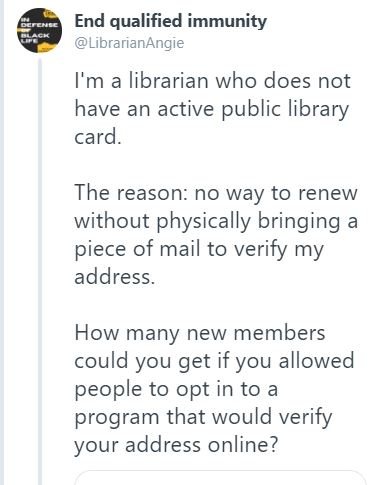
It’s hard to get a library card. Community members must provide proper identification. If they apply online, they must show up at a branch to claim their card, often within a specific amount of time. I was reminded of this just a few days ago, when I received this Tweet.

Library users also must have separate logins and passwords to use services like Hoopla, Overdrive, Kanopy, and Freegal.

And if cardholders don’t return items on time, they get fined. If a library user accumulates too many fines, they lose the ability to use their card.

All these things may seem like little inconveniences. But it is these little hurdles that stand in the way of advancing our libraries in the future.

I know some of these hurdles are not the fault of the library. We’re often at the mercy of our vendors. But our communities don’t know that and, frankly, I don’t think it matters. People expect easy access to library services. And they receive easy and convenient services from other companies.

Libraries need to make a concerted and deliberate effort to make it easier for people to use the library in 2021. We’ll have to do this to compete with convenient services that threaten to take away our market share.

First, let’s fix the things that are in our control. We can make it easy for anyone to get a library card online without ID. And we can eliminate fines and fees that serve as a barrier to many of our patrons.

Next, let’s band together to demand vendors create integration that allows library users to access their services from our website with one-step authentication: their library card number. Demanding this change as an industry will be one of the best ways to advocate on behalf of our cardholders this year.

You may also like these posts

The New Year is Here! Here are Five Things for Your Library to Promote in 2021.

Zoom Fatigue is RUINING My Library Programming! How the Heck Should Libraries Deal With That?

Latest Book Reviews

The Invisible Life of Addie Larue by VE Schwab

Find more 60-second Book Reviews here.

Subscribe to this blog and you’ll receive an email every time I post. To do that, click on the “Follow” button in the bottom left-hand corner of the page. Connect with me on YouTube, Twitter, Instagram, and LinkedIn.
🎉🥳The New Year is Here! Here are Five Things for Your Library to Promote in 2021.

Watch Now

The Library Marketing Show, Episode 75

In this episode, I’ll go over five library strategies for 2021.

Kudos in this episode go to the Elsmere Library for a Facebook post and their fun cookie recipe exchange!

Do you have a suggestion for a topic for a future episode? Want to nominate someone for kudos? Let me know in the comments. And subscribe to this series to get a new video tip for libraries each week! Thanks for watching.

Should My Library Spend 💵 on Social Media Ads?

Watch Now

The Library Marketing Show, Episode 74

In this episode, I talk about whether it’s worth it for libraries to spend budget on social media ads!

Do you agree with my assessment? Have you purchased ads on social media for your library? Let us know in the comments!

Kudos in this episode go to Thomas G. Carpenter Library for their fun meme promoting digital resources.

Do you have a suggestion for a topic for a future episode? Want to nominate someone for kudos? Let me know in the comments. And subscribe to this series to get a new video tip for libraries each week!

Thanks for watching.

Use This Tool to Make Your Library Website Better Than Ever!

Watch Now

The Library Marketing Show, Episode 73

In this episode, I explain how Hotjar works to help you understand how people are using your library website… and how you can use that information to improve the user experience for your community. (Hotjar did NOT pay for this video… I just think it’s a cool idea!)

Kudos in this episode go to the Mansfield Richland County Public Library for producing an amazing video.

Do you have a suggestion for a topic for a future episode? Want to nominate someone for kudos? Let me know in the comments. And subscribe to this series to get a new video tip for libraries each week!

Thanks for watching.

COVID is Forcing My Library to Close Again! How Do I Communicate These Changes to My Patrons?

Watch Now

The Library Marketing Show, Episode 72

In this episode, Angela lays out a step-by-step plan for libraries who may be forced to close their physical buildings again because of rising COVID cases.

Kudos in this episode go to the Manatee County Library system for their incredible Enjoy From Home website section.

Do you have a suggestion for a topic for a future episode? Want to nominate someone for kudos? Let me know in the comments. And subscribe to this series to get a new video tip for libraries each week!

Thanks for watching.

Zoom Fatigue is RUINING My Library Programming! How the Heck Should Libraries Deal With That?

Watch Now

The Library Marketing Show, Episode 71

In this episode, Angela answers a viewer question from Debbie Walter, who wanted to know how libraries can get people to attend virtual programs when so many people are suffering from “Zoom Fatigue.”

Kudos in this episode go to the Whatcom County Library System for a piece of user-generated content that they turned into a cute and exciting marketing piece.

Do you have a suggestion for a topic for a future episode? Want to nominate someone for kudos? Let me know in the comments. And subscribe to this series to get a new video tip for libraries each week!

Thanks for watching.

Behind the Scenes of The Library Marketing Show: Anyone Can Create Library Videos!

Watch Now

The Library Marketing Show, Episode 70

In this episode, Angela answers a viewer question from Lori Hagen, who wanted to see how these videos come together. She’ll take you behind the scenes. It’s a lot easier than you think… in fact, anyone can create videos!

Kudos in this episode go to the Tacoma Public Library for their innovative virtual programming for adults, including tutorials for how to use their digital resources.

Do you have a suggestion for a topic for a future episode? Want to nominate someone for kudos? Let me know in the comments. And subscribe to this series to get a new video tip for libraries each week!

Thanks for watching.

A WordPress.com Website.

Up ↑