Search

Super Library Marketing: Practical Tips and Ideas for Library Promotion

Tag

Creativity

The 4 Essential Podcasts To Add to Your Playlist To Improve Your Library Marketing and Promotions

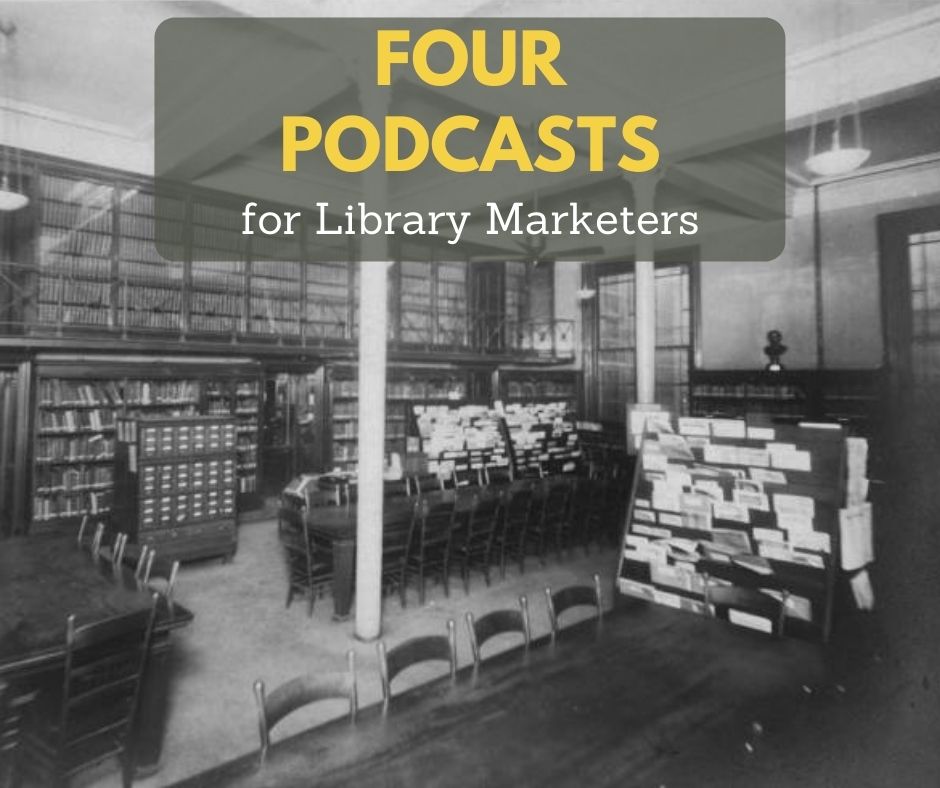
Photo courtesy Cincinnati and Hamilton County Public Library

In my day job, I create and teach professional development courses about library marketing. In a recent class, I asked the learners whether they wanted to learn about podcasts as promotional tools. The answer was loud and clear: “YES!”

Many of these library staffers were fans of podcasts. They understand the power of this medium.

Podcasts are fun, informative, and engaging. Listeners get valuable information and insight delivered in a way that feels intimate.

They’re also incredibly convenient. They show up on your phone when and wherever you want to listen to them–while exercising, while grocery shopping, while driving, while doing chores, and while crunching marketing data for your monthly reports. If you go on vacation, you don’t miss anything.

In my quest for lifelong learning and inspiration, I’ve found a bunch of shows that are really awesome–funny, fun, thoughtful, and well-produced. I subscribe to more than 20 podcasts, and I love them all. (If you want my full playlist, it’s at the bottom of this article).

The following four podcasts are essential for anyone who works in library promotion and who wants to do it well. Listening to these four shows will improve your work, inspire you, and help you feel more connected with the world.

I’ve got a blog post coming soon full of valuable advice from libraries with podcasts! Want to be a part of that post? Let me know by completing this short form.


Podcast Recommendation #1: That’s How it All Began from Andrew Davis

This is a series from one of my favorite experts. And, no surprise, it’s packed with incredible, intriguing stories.

In each episode, Andrew Davis focuses on a famous entrepreneur or business owner… except you don’t know who the famous person is until the very end of the episode.

By listening to this show, I’ve learned new techniques for storytelling and suspense. I’m also inspired by the stories. These are people who have found ways to overcome incredible hurdles. And because Andrew Davis is a marketing expert, his stories usually include a turning point, where his subject makes a marketing or promotional decision that changes their life.

Each episode is just 15 minutes or less. It’s the perfect show to listen to on the way to work.

Podcast Recommendation #2: Duct Tape Marketing from John Jantsch

This show was one of the first podcasts created. John Jantsch has been interviewing marketing experts, authors, and business owners about a vast range of topics including leadership since 2005.

I’ve learned a lot of practical marketing tips from this podcast. But this show is also a great example of how to turn an audio experience into an opportunity to drive more traffic to your website.

Each episode has its own website landing page, which includes a show description that’s packed with searchable keywords. John Jantsch shares his key takeaway, the questions he asked the guests, and a full transcript of the show. He also makes it easy to either listen to the show on the landing page or subscribe on a variety of platforms. And at the bottom of the page, he includes a further call to action to watch more podcasts, download a free resource, or sign up for a newsletter.

Each episode is between 20 and 30 minutes long. It’s another perfect show for your commute.

Podcast Recommendation #3: Death, Sex, and Money from WYNC Studios

This show, first released in 2014, is one of my staples. It’s hosted by Anna Sale, and it features stories of celebrities and regular folks talking about the most fundamental of human topics: death, sex, and money.

I’ve learned two big lessons from listening to this podcast. The first is how to interview. Anna Sale is an exemplary listener. That skill naturally allows her to ask deeply thoughtful follow-up questions. I can always tell that she is fully in the moment and present with her interview subjects.

The second lesson is how to offer additional support and resources. For many of her episodes, Sale and her team have created “starter kits.” They include playlists of songs, curated by listeners, to deal with tough subjects or get through challenging times. There are also starter kits for new listeners, featuring the best or most popular episodes, arranged by subject.

Most episodes range in length from 30 to 45 minutes. I usually save them for chore time on weekends. During the pandemic, this show made me feel more connected with the outside world.

Podcast Recommendation #4: This American Life from WBEZ Chicago

Hosted by the incomparable Ira Glass, a staple of NPR, This American Life meshes journalism and storytelling in a seamless and captivating format. It’s a masterclass in storytelling.

From listening to this podcast, I’ve learned how to find extraordinary stories in ordinary settings. Ira Glass and his team often use a technique called “story of self” to introduce a topic. They relate how or why they become interested in this subject. And that, in turn, makes it relatable to their audience.

Like Death, Sex, and Money, I’ve also learned lessons about interviewing from this show. In particular, the team is not afraid of silence when they are interviewing their subjects. They give their interviewees time to think and the audience time to reflect.

This show is a long-form podcast, with episodes lasting around an hour. I listen to this podcast on my walks and the stories are so intriguing and told so expertly that I am always surprised at how fast the time goes.

The rest of my podcast playlist

Armchair Expert

Conviction

Lovett or Leave It

The Librarian is In

Offline

Pod Save America

Professional Book Nerds

Reply All

Smartless

Sounds Like a Cult

This Old Marketing

Unhappy Hour

Unthinkable

You and Me Both

If you have a great podcast suggestion, please let me know in the comments.


Read These Articles Too!

A Library Staffer Reveals the Secret Formula for Connecting With and Entertaining Patrons. (Spoiler Alert: Itโ€™s a Podcast!)

I Asked a Podcast Host to Stop Interrupting His Guests.  What His Reaction Can Teach Us About Library Customer Service.

Latest Book Review

Project Hail Mary by Andy Weir

Subscribe to this blog and youโ€™ll receive an email every time I post. To do that, enter your email address and click on the โ€œFollowโ€ button in the lower left-hand corner of the page.

The Secret to Writing Engaging Copy for Any Library Promotion AND Getting Results Starts With a โ€œKISSโ€!

	
Delivery room (2nd floor of intermediate building) - in 1898-1899 Annual Report. Moved here from first floor in 1898-1899. Photo courtesy Public Library of Cincinnati and Hamilton County.

In 1960, Kelly Johnson was the lead engineer at a division of Lockheed that made spy plans.

One day, he handed a team of design engineers a handful of tools. Then he told the engineers that they must design a jet aircraft that would be repairable by the average mechanic in the field under combat conditions using only those tools.

At that moment, the popular design phrase “Keep it Simple, Stupid” or KISS was born. It describes the idea that most systems will work better if they are designed simply.

I first heard this phrase in journalism school. Reporters, marketers, ad agents, and public relations employees are all taught the power of simplified language in copy.

Simplified copy is easy to read and understand. It sounds authentic. Conversational copy subconsciously signals to your audience that you are a person, and people like communicating with other people.

Librarians are intelligent and sophisticated people. They have a deep understanding and appreciation of complex concepts. They’re driven by accuracy and information. It’s challenging to write clearly when you’re an expert in your field!

But our cardholders may have a difficult time understanding library brochures, posters, blogs, and websites with convoluted and confusing language. They may be tune out if the wording of your promotions isn’t conversational.

Your job as a library marketer is to translate complex thoughts and concepts into a concise and clear language your audience can understand and appreciate.ย You must present information in a way that the cardholder can understand.

It’s easier said than done, but here is some guidance you can put into practice any time you’re asked to write a piece of library marketing.

Identify your target audience and the action you want them to take.  

Before you even write the first draft of any promotion, pinpoint your audience as precisely as possible.

Are you writing for teens ages 13-15? Are you writing for women, ages 25-54, who love to read cozy mysteries? Are you aiming your message at parents of preschoolers who need help finding books to read to their children?

When you’ve settled on your target audience, write a sentence about them at the top of the page. Be as descriptive as possible.

Underneath that, write a sentence that describes the point of your marketing material. Are you trying to persuade someone to try a new service? Do you want to increase participation in a preschool storytime? Are you trying to get teens to enter an art contest?

Once you know precisely who your audience is and what you want them to do after they’re read your marketing material, you’ll have an easier job of writing clearly.

Define unfamiliar or difficult words, titles, or services. 

Go through the draft of your material and highlight words or terms that may confuse your audience. Then, find a better way to say or explain those words.

Never take it for granted that your reader has been a lifelong user or follower of the library. Words used by librarians to describe services, programs, catalogs, and databases, which may seem common and every day to you and your staff, may not be so to your reader.

Shorten your sentences and paragraphs. 

You may have noticed that, about 18 months ago, I started writing shorter sentences and paragraphs here on the blog. Views rose by 118 percent!

That’s because shorter sentences and paragraphs make it easier for your reader to understand and absorb what you are saying. Long paragraphs look thick and off-putting. Multiple studies show readers will skip lengthy paragraphs. And the Poynter Institute’s Eyetrack Study shows people are more likely to read an entire webpage when the paragraphs are short.

There are two rules you can remember to help you get into the habit of shortening sentences and paragraphs.

  • Ziomek’s 1-2-3-4-5 rule: Created by Jon Ziomek, a professor at the Medill School of Journalism. The rule says each paragraph must contain: 1 idea, expressed in 2 to 3 short sentences, taking 4 to 5 lines.
  • Nityesh Agarwal‘s 80-20 rule: You can convey 80 percent of the information in any piece of writing using 20 percent of the words.

Get into the habit of hitting your return key more often. You can also break your writing up using bullet points or lists.

Use online writing tools.

There are lots of free tools that can help you craft sentences that are clear and concise, even when the subject matter is not! They can help you figure out a headline that will draw readers in. They can help you discover just the right word to make your meaning clear.

Here’s a list of my favorite online writing tools. The Grammarly extension for Windows is also extremely helpful.

Ask a non-library employee to read your work.

I often ask my family members to read my writing. If they find anything to be confusing or convoluted, I know I need to change it.

Bonus Tip: Read or listen to the bookย Everybody Writesย by Ann Handley. It’s life-changing. Check your library collection first. If you have Overdrive, you’ll have the audiobook version. You MUST read this. It will make you a better writer.

Do you have tips for writing more clearly or examples where you have taken a complex library concept and simplified it for an audience? Share your experience or questions in the comments.  

Related Posts

Library Blogs are the Best! How to Use Your Website to Amplify Your Library Marketing Message on Your Own Terms

Breaking News: Make Sure Your Library Gets More Press Coverage with These Six Tips from a Former Journalist

Angela’s Latest Book Review

The Office of Historical Corrections by Danielle Evans


Subscribe to this blog and youโ€™ll receive an email every time I post. To do that, enter your email address and click on the โ€œFollowโ€ button in the lower left-hand corner of the page.

A WordPress.com Website.

Up ↑