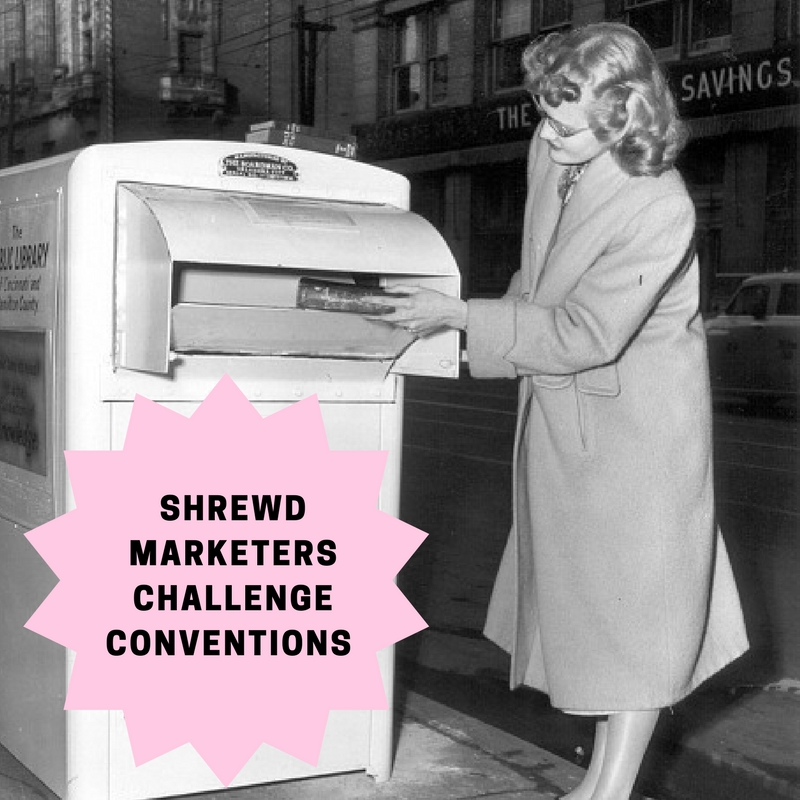
I’ve thought a lot lately about how to approach library marketing in a new and fresh way. As my library creates and executes our strategy for summer reading, I am looking at each tactic and wondering if we can improve the marketing of this legendary initiative. According to the American Library Association, summer reading programs began in the 1890s as a way to encourage school children, particularly those in urban areas and not needed for farm work, to read during their summer vacation, use the library, and develop the habit of reading. That’s a long time to be marketing a program and I think the industry might be a bit stuck in terms of how we do it.
For inspiration, I’ve looked over notes from a session I attended at Content Marketing World. It was led by Doug Kessler, co-founder and creative director of Velocity Partners, a B2B marketing agency with offices in the U.S. and England. Doug’s session was inspiring. It was titled Exceptional Content–Challenging the Invisible Conventions of Marketing. I printed out my notes and have read them through each morning, then thinking about the points he made every time I need a brain break.
Kessler focused his session on a concept he calls invisible conventions. We have so many invisible conventions in libraries. These are the ideas and practices that library staffers hold as traditional and unchangeable. If you hear someone say, “But we’ve always done it that way”, you know you’re talking about their invisible conventions. Invisible conventions are powerful. Kessler says they guide and constrain us without us even knowing it.
We do need conventions. But we don’t need to be slaves to convention. Kessler says it’s our job as marketers to expose the hidden conventions in our institution and play with them. Libraries can’t be precious about their conventions because your cardholders aren’t. Conventions are a signal to your cardholders that marketing is involved–even if you’re trying to be sneaky about it. Your customers are smart, and they’ll put up their defense barriers.
Think about how you respond to marketing messages for invisible conventions. We’ve all developed a sense of when the pitch is coming and we run the other way! You don’t want to turn off your cardholders–you want to inspire them. But if you hang on to your invisible conventions for safety, you’ll never move forward in the marketing of your library.
Challenging your invisible conventions isn’t going to make you very popular, Kessler warns. And that’s okay. Your administration, leaders of other departments, even fellow librarians may have a strong reaction when you decide to challenge conventions. They are more comfortable with traditional marketing practices and they want you to create pieces that make them feel comfortable. Be strong. Take the long view. Persuade your co-workers that change is necessary and that safe marketing isn’t going to cut it with your cardholders. Your job is not to make everyone else in the library happy. Your job isn’t to make friends with everyone in you work with. Your job is to serve your cardholders, and you can only do that when you put your cardholders first. If that means you need to throw convention out the window, then it’s the best move. Don’t second guess yourself. When your instincts as a marketer tell you that something needs to change, you are right. Change it.
I’m reminded of advice I heard from another Content Marketing World speaker, Amanda Todorovich of the Cleveland Clinic. She confessed she’s made some people at the hospital unhappy with her relentless focus on the customer. She has a strategy and she often says “no” to people who want her to do conventional marketing. That means there are some folks she works with who don’t like her. Amanda is okay with that because she realizes her job is to serve the patients, not her co-workers. I draw inspiration from her attitude when I’m faced with having a difficult conversation with a co-worker. You can too! (Read my post about Amanda here.)
So how do you turn conventional marketing on its head? By doing more content marketing. Kessler says, thanks to the companies who came before us, the public knows marketing messages are often filled with compulsive and shameless lies (thanks, cigarette companies). Traditional marketing is all about the brand: a one-sided sales message. Content marketing, by contrast, is all about the audience. Content marketing rewards libraries for telling the truth. It’s focused on utility–how can we best help our cardholders. It delivers value, builds trust, and it gives our cardholders the power!
Kessler left me with a final thought: unconventional marketing can lead to great stories. Be straight, simple, conversational, and relevant. You will change hearts and minds.
Subscribe to this blog and you’ll receive an email every time I post. To do that, click on “Follow” button on the bottom left-hand corner of the page. Connect with me on Twitter and Snapchat–it’s where I talk about library marketing! I’m @Webmastergirl. I’m also on LinkedIn, Instagram and Pinterest. Views in this post are my own and do not represent those of my employer.

 Super Library Marketing: Practical Tips and Ideas for Library Promotion