Search

Super Library Marketing: Practical Tips and Ideas for Library Promotion

Tag

library blogs

The 5 Best Free Keyword Research Tools To Find the Perfect Keywords for Your Library Promotions (With Video Tutorials)

Photo courtesy Cincinnati and Hamilton County Public Library

A war is being waged 10 feet from my office window.

I love watching birds feed and listening to them chirp, squawk, and sing. I have a feeder that I’ve positioned so I can see the birdies enjoying their meal as I work.

But something is ruining my relationship with my feathered friends.

Some mornings, I come outside to find my oversized bird feeder, which I always fill the night before, COMPLETELY EMPTY. The seed is scattered all over the ground. And a scurry of squirrels are gorging themselves on the spoils.

The first time this happened, I did what anyone does in this modern era. I turned to the internet for help.

I typed “how to keep squirrels off my bird feeder” into Google. Suddenly I found myself down a rabbit hole (pun intended) with all the squirrel battle content you could ever want.

Repellant. Special bird feeders. Tips for installing slinkies on the pole to prevent climbing. SPIKES. Videos, advice, and products galore.

Why is it so hard to find tips on fighting squirrels?

The internet is a giant swirling vortex of content. According to Master Blogging, there are 7.5 million blog posts published every single day. (Thanks for reading this one!)

When you factor in social media posts, videos, website content, emails, etc., it’s no wonder your library has a hard time breaking through the noise. A search by anyone for anything is likely to turn up hundreds of results.

So how do you make sure your library content reaches the people who need it most?

Keywords are the key

When a community member is online, trying to find the source that will help them write a research paper, add branches to their family tree, or make a decision about whether to purchase a car, they need us to speak their language.

That’s where keywords come into play.

Keywords help search engines and social media algorithms understand what your content is about. They use those keywords to categorize your content and then match your content to people who are searching for it.

The right keywords make it more likely that the content you write will end up on the computer or mobile phone screen of the person who needs it most.

But you don’t have to guess at what keywords to use! There are tools to help find keywords to weave into your content. Here are my five favorites. They’re reliable, efficient, and free. I’ve made a video tutorial for each to show you exactly how to use them.

Spyfu

This website has a robust, free keyword research tool. You can use it without setting up an account or handing over your email.

Google Search Bar

The Google search bar allows you to see what content is rising to the top of Google’s algorithm. You can work keywords or phrases from those top-performing content pieces into your promotions.

Don’t forget to scroll to the bottom to see “people also search for,” which I find to be extremely valuable as a source of more keywords.

Google Keyword Planner

You can also use Google’s more robust Keyword Planner to search for keywords. The Keyword Planner is intended as a tool for buying Google ads but I find it to be an insightful way to find keywords for my website and social media.

Here’s a quick video to show you how both the regular Google search bar and the Google Keyword Planner work for sourcing keywords for library promotions.

Wordstream

This free tool gives you 25 keywords… more if you’re willing to provide them with your email. They’ll also show you the search volume for the phrase and the level at which you’ll compete with other content for attention. Type in your opening phrase and choose “All industries” for the best results.

Moz

This free keyword tool shows top suggestions, monthly volume, organic click-to-open rate, and difficulty ranking for any key phrase you search. You can get more robust suggestions if you hand over your email.

Whatever tool you use, the keywords you uncover should be placed in your blog headlines, in the text on your website, and in your social media posts.

But Angela, did you defeat the squirrels?

Yes, I did with the help of three slinkies, a 7-foot pole, and a baffle, which is a cone-shaped device that stops the squirrel from climbing up your pole to your feeder. I knew of the existence of baffles, but I had no idea that’s what it was called. But thanks to keyword research and placement by the vendor, I found it. Now my birds can eat in peace.
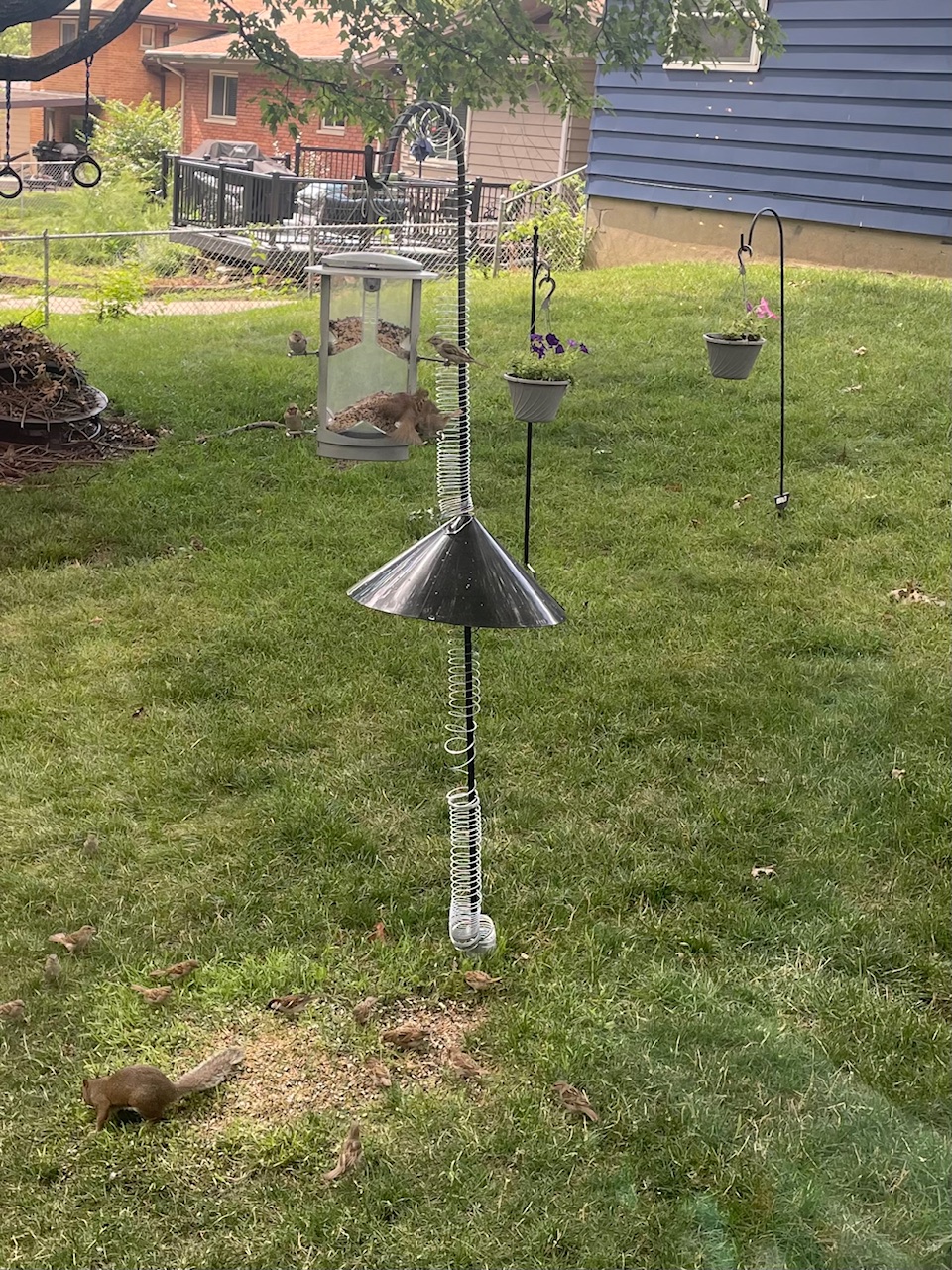
Note Mr. Squirrel, who is now relegated to picking up seeds from the ground.


P.S. You might also find this helpful

Finding the Perfect Name for a Library Program: A Checklist and Tips for Using AI

Subscribe to this blog and you’ll receive an email whenever I post. To do that, enter your email address and click on the “Follow” button in the lower left-hand corner of the page. You can also follow me on the following social media platforms:

Inspiring Advice From An Expert Blogger

A few months ago, I asked readers whether their library had a blog. 61 percent of respondents said no. I have to include myself in that statistic. And the more I think about it, the more that bothers me.

Blog-less libraries are missing a HUGE opportunity. A blog has a number of promotional advantages that simply cannot be replicated with any other type of tactic. And to make my case, I am going to share insights with you from a session at Content Marketing World–one that I haven’t been able to stop thinking about in the months since the conference.

Amanda Todorovich is the Director of Content Marketing at the Cleveland Clinic. She’s the 2016 winner of the Content Marketer of the Year from the Content Marketing Institute and she runs the most visited hospital blog in the United States, Health Essentials. Her session was all about the Cleveland Clinic blog and its success. And her story made me want a blog for my library.

Amanda says a blog is the best promotional tool because it creates brand awareness and relationships with current and potential customers. The goal of the Cleveland Clinic blog is to create a space in which the hospital is top of mind all the time with people looking for health information. Think about this: the hospital cannot create demand for their services. So they aim to provide credible health information at all times so that, in the unfortunate moment when someone is sick or injured, the first place they think of is the Cleveland Clinic.

That principle applies to libraries as well. There are times when a library cardholder may not need their library, but we want to stay top of mind with them so that they’ll turn to us when they do need books, or help with a struggling reader in their home, a passport, a voter registration form, help to create a resume, or whatever problem they might have. Libraries are not just about programs and books and there is a lot of value to offer your cardholders beyond those two basic services.

But Amanda also says in order for your blog to work, you have to stand strong. Your blog cannot be all things to all people. You’ll have to decide on your mission, write it down, and stick to it. This doesn’t mean that you are ignoring certain cardholders. It means that your blog has one focus, one mission and that everything you write–no matter the audience–drives at completing that mission. For example, Health Essentials mission is to engage users in daily conversation using health, wellness and clinical content that is unique to Cleveland Clinic. They’re not ignoring anyone. Rather, they are focusing all their energy on delivering on that mission to all of their potential patients and patient families. See the difference?

Blogs have a value beyond pure promotion. Using the right keywords and paying attention to metadata, tags, and links will help boost your position in search traffic. That means people will be able to find you first during a search. Some big brands pay big money for great search results placement. Can you imagine what would happen if; every time someone searches Google for a book, a DVD, or information that they land on your library’s blog? The impact would be mind-blowing.

Some library marketers are already taking this advice to heart, including Brook Savoie, who works for Lafourche Public Library in Thibodaux, Louisiana. She told me, “Our librarians take turns writing a post weekly. The purpose is to just bring more awareness to things that we do! It works well for me for social media, because I can share these blog posts weekly with our audiences without having to create any content myself.”

So, step one is convincing you, your staff, and your administration, to launch a blog. It’s worth it. You can do it. Here are Amanda’s other tips for blog success.

Focus on creating better posts, not more posts. You don’t have to post every day. Just pick a CONSISTENT schedule. Create a list of topics and then write. That’s what I do with this blog. I spend roughly three hours a week on this blog and that’s really only because I am my own editor. If I could just write and revise a draft and then hand it off to another person to edit, it wouldn’t take much time at all. I spend about ten minutes crafting and testing headlines. I spend about ten minutes making the graphic. I spend about ten minutes scheduling all the distribution. I write on the weekend and it feels like it doesn’t take much time at all.

Be willing to say no. Amanda says she doesn’t have a lot of friends outside her team because she says no to a lot of requests by other departments for blog posts. The hospital blog is focused on the needs of their readers, not on the needs of the organization and that’s why it works. When your customers are the center of your universe, you are providing them with value and they’ll keep coming back to you. You are beholden to your cardholders, and they should be your only concern.

Measure and test and test again. Never be content with the results, even when they seem good. Ask “what if” all the time–it could lead you to an extraordinary idea that takes your blog to the next level. Testing actually keeps blog writing interesting and keeps life exciting (I AGREE).

Subscribe to this blog and you’ll receive an email every time I post. To do that, click on “Follow” button on the bottom left-hand corner of the page. Connect with me on Twitter and Snapchat–it’s where I talk about library marketing! I’m @Webmastergirl. I’m also on LinkedInInstagram and Pinterest. Views in this post are my own and do not represent those of my employer.


A WordPress.com Website.

Up ↑