Search

Super Library Marketing: Practical Tips and Ideas for Library Promotion

Tag

library marketers

Your Patrons Are Not Goldfish! The Powerful, Scientifically Proven Reason Why Your Library Should Aim To Hold the Sustained Attention of Your Community

Photo courtesy Cincinnati and Hamilton County Public Library

When I was a child, my first pet was a goldfish.

I named it Goldie. Totally original, I know.

Goldie lived in a glass bowl decorated with neon-colored rocks and a tiny treasure chest that opened and closed to release bubbles. Iโ€™m sure when I brought her home from the pet store, she thought she’d landed in some kind of 1980s pirate hell.

I liked to watch Goldie swim around her bowl. And she liked to watch me.

When I did my homework or practiced my instrument or danced around my room to Phil Collins, she swam to the side of her bowl and stared at me. She could do this for hours. It would have been creepy had she not been a fish.

The statistic that some say ruined marketing

In 2015, large news organizations, including Time, The New York Times, and The Telegraph reported a single, mind-blowing finding from a new study by Microsoft.

The average human being’s attention span has shrunk to just eight seconds, about the same as a goldfish.

By the way, in researching this post, I found this great blog post from the University of Melbourne about the intelligence of goldfish. Their attention span is way longer than eight seconds.

The reports were grossly inaccurate

It turns out that the news organizations were not actually quoting the results of the Microsoft study. A BBC reporter investigated the origin of the goldfish statistic in 2017.

โ€œAll those references lead back to a 2015 report by the Consumer Insights team of Microsoft Canada, who surveyed 2,000 Canadians and also studied the brain activity of 112 people as they carried out various tasks. However, the figure that everyone picked up on โ€“ about our shrinking attention spans โ€“ did not actually come from Microsoftโ€™s research. It appears in the report, but with a citation for another source called Statistic Brain.โ€

Simon Maybin, BBC World Service

The goldfish comparison has since been removed from Statistic Brain. And the original study from Microsoft is no longer listed on their website.

But it was too late. The damage was done.

Marketers were told to create short, scannable promotions, use clickbait titles, and make sure our blogs and videos were “snackable.” Promotions began to all look the same.

Nothing stood out. Everything we created lacked depth and interest. And people actually paid less attention to us.

A better way to promote your library

It’s true that humans have difficulty dealing with distractions. But it’s also true that when we are consuming quality content, we can focus.

There are two kinds of attention. Transient attention is a short-term response to a stimulus that temporarily attracts us or distracts our attention. It comes into play when you read a billboard or a sign, or watch a TikTok video.

Then there is sustained attention. This describes your ability to focus on something for an extended period.

We use sustained attention when we binge-watch an entire season of Stranger Things in a single day, read a good book cover to cover in one sitting, or attend a concert, play, or sporting event.

Sustained attention is where great experiences are found. It is also the basis for information processing and cognitive development. It is where real connections are made.

That means that if you can engage your cardholders’ sustained attention, your marketing will be memorable. And memorable marketing is more effective.

How do we do this exactly?

There are circumstances in which you will need to create short promotions that appeal to transient attention. Social media is a perfect example. So are printed signs. A few, well-written but interesting sentences, and an eye-catching design are required for those formats.

But many of your library promotions should aim for the sustained attention of your cardholders. Blog posts and videos are perfect examples.

These pieces of content should be as long as they need to be to tell a good story. That means you can create a video that runs 8 minutes or write a blog post that is more than 1000 words, as long as they are interesting and compelling. They must also contain two key features.

  • Emotion: The joy of finding a book, the fear of not getting a job, the frustration of another night of homework without any helpโ€ฆ these are all emotions felt by our libraryโ€™s customers. Other people can relate to these experiences and empathize. Emotion activates many portions of the brain, including the sensory, memory, and empathy sectors. The more active the brain is while consuming content, the more likely it is that the listener or reader will remember the story.
  • Conflict and a resolution. Your sustained attention marketing must include some conflict and a problem or situation that is resolved. Without conflict, your story risks being flat and unmemorable.

How to get started

Pick one tactic to focus on. Your print or online newsletter is a perfect place to start. Take six months and watch as your audience transforms.

I’m speaking from experience here. In my former library job, I turned our print program calendar into a magazine filled with stories.

It took our community members about 10 to 15 minutes to read the magazine. That’s time they spent thinking about the library, empathizing with the patrons and staff in our stories, and committing our stories to memory.

And guess what happened? Our circulation increased. Database usage grew. Our brand awareness grew. We passed a levy to fund renovations to old libraries.

Podcasts are also a perfect example of long-form library content that holds attention. Most episodes last between 20 to 30 minutes. That’s an invaluable time in which you are talking directly to your community!

Your cardholders aren’t goldfish. They are real people with attention spans that can be used to our advantage. You can help them to make a lasting and meaningful connection to the library with longer, interesting, memorable content.


Further Reading

Latest Book Review

Subscribe to this blog and youโ€™ll receive an email every time I post. To do that, enter your email address and click on the โ€œFollowโ€ button in the lower left-hand corner of the page.

Fight for Your Ideas! Four Tips to Help You Get the Green Light for New Library Promotional Ideas

Photo of librarians, courtesy Public Library of Cincinnati and Hamilton County

It’s sometimes insanely hard to get any new marketing ideas to pass approval in a library.

If there is a silver lining to the COVID-19 pandemic, it’s that the crisis helped libraries to see that there are new ways to market and promote their library. It’s opened the door for experimentation.

Even so, presenting a new marketing or promotional idea is sometimes challenging and intimidating for library staff. I know this because every time I talk with librarians at conferences or in one-on-one consultations, they ask, “How do I get buy-in for this great promotional idea with my supervisors and co-workers?”

Here are the four things you can do to gather support and approval for your great new marketing and promotional ideas.

Tell me about a time you had to pitch a library promotional idea. What was the idea? Did you get a yes or no? What did you learn from the experience? Share your thoughts in the comments.

Thoroughly research and prepare your pitch.  

Before you pitch a new idea, do your research. You’ll want to present a clear, concise, and strategic case for your idea. Include the following information in your pitch:

  • How the work benefits your community and cardholders.
  • How the work ties into your library’s overall strategy and goals.
  • How the work will get done by staff.
  • The timeline for implementation.
  • What the success measures will be.
  • What the long-term goals of your promotional idea will be.
  • How you will handle problems that may arise.
  • The data to back up your claims.

Here’s an example pitch that includes these points.

You’ve determined that Facebook is not giving you the results you want when you promote individual programs. Registration and attendance at programs have been unchanged or decreasing in the last six months, despite the many posts you create. Instead of using social media, you want to start a targeted e-newsletter sent to the people who frequent each branch in your system. You believe these targeted emails will be more effective because they will reach the audiences most likely to attend these programs.

Your pitch will begin by explaining the problem using data. Include registration, attendance figures, and Facebook engagement figures especially clicks on your registration or event information links. Show how the Facebook posts are getting very little engagement and lead to no increase in registration or attendance.

Next, explain how the move to branch-specific e-newsletters will be better for your community and cardholders because it will offer information about events happening in their neighborhood that are specific to their wants and needs. Look for wording in your library’s strategic plan that will make it clear to senior leaders that you are working to fulfill the strategic goals by offering community-based access to information.

Next, make the case that e-newsletters are a more efficient use of your time because they will be more effective and targeted. Again, be specific when you talk about how long it takes to create a Facebook post versus an e-newsletter.

Now, talk about the ways you’ll measure success for your new e-newsletters: increases in registration and attendance, plus open and click rates on the emails. Be specific and use numbers. This will show that you are confident that your new idea will work.

Spend a few moments talking about your long-term goals: how many new subscribers do you want to get in the first six months or year? How much would you like to see registration and attendance grow? What other library services can you imagine promoting using your e-newsletters?

Layout a timeline: when do you think you can launch your first e-newsletter? How long will it take to grow your subscription list? How often will you send these e-newsletters?

Finally, talk briefly about problems you may encounter and how you’ll handle them. What program will you use to send the e-newsletters? Who will create them if you’re sick or on vacation?

Review and rehearse.

Review your plan several times. It’s a good idea to leave a few days in between each review of the plan, to let your ideas marinate. You may think of new benefits or pitfalls during those breaks. You’ll want to be fully prepared to answer any questions and defend your idea with confidence.

Next, practice presenting your idea to a friend at your organization. Choose someone you trust to give you honest feedback about your idea and your presentation.

You might also consider recording your pitch on Zoom or another video recording program. Check to make sure you are speaking slowly and clearly. Evaluate your tone of voice, eye contact, and body language during your practice pitch.

Pitch strategically.  

Find a time when your supervisor won’t be rushed. They’re more likely to listen to you when they have time to truly consider your idea.

Pick the right day of the week for your pitch. For example, Mondays are often busy and stressful for bosses. Your supervisor may be more negative at the beginning of the week and it’s likely not the best day for your pitch.

When you pitch, be mindful of your body language. If you are sitting in a chair, don’t pivot back and forth nervously or jiggle your legs. Sit still, but upright, and with confidence.

If you are standing, try separating your legs about shoulder-width apart. This is a “power” pose that will help you maintain good posture and will subconsciously give the impression that you know what you are doing… even if you don’t feel that confident!

If the answer is no, don’t necessarily give up. 

A “no” doesn’t have to mean the end of an idea, especially if you think it’s beneficial to your library and customers. There are no bad ideas–just ideas whose time has not yet come.  

Write yourself a note in your work calendar to revisit the idea in six months. Keep your eyes open for new opportunities to present your ideas in a different format.


Subscribe to this blog and youโ€™ll receive an email every time I post. To do that, click on the โ€œFollowโ€ button in the bottom left-hand corner of the page.

You May Also Want to Read These Posts

Prioritize! How to Decide Where To Spend Library Marketing Time and $$$

Five Creative Ideas to Help You Beat the Blues, Get Inspired, and Create Amazing Library Marketing Campaigns Again!

Six Years Later, Library Marketing No Longer Stinks! Here are Four Forward-Thinking Things Libraries Must Do Now.

Text of Four Forward Thinking Things Libraries Must Do Now over a vintage photo of library shelves. Photo courtesy Public Library of Cincinnati and Hamilton County.

I started this blog six years ago. Can you believe it?

When I published my first post, I really had one goal: To help other library workers. I believed that sharing tips, strategies, ideas, and best practices for library marketing would strengthen the whole library industry and help secure the future of libraries.

I still believe that.

And we’ve come a long way in library marketing. Many libraries are promoting their collection and services in ways they would have never imagined six years ago. They’re focused on strategy and innovation. They’re not afraid to try new things. They’re experimenting. They’re putting cardholders first.

Library marketing no longer stinks! Now it’s time to advance library marketing to the next level. Here are the four things libraries should do now to move successfully into the future.

Put your collection front and center on your website.

When I visit a library website, the first thing I notice is how prominently they promote their books, movies, and streaming content. When I must search for these things, it causes me real grief. It’s like going to the grocery store and finding the milk and eggs hidden in a back room accessible only to the most intrepid shoppers.

Most of the folks who interact with your library online are there for the collection. If you don’t believe me, check your website statistics. Look at Google Analytics. I’ll bet you the most visited pages of your website are the homepage, your catalog, and any page that showcases your collection items.

Donโ€™t hide your collection on your website.

If you have a personalized reading recommendation service, put it right in the middle of your homepage. If you have reading recommendation newsletters, put your opt-in link right in the middle of your homepage. Post about your collection on social media at least 50 percent of the time.

Books are your brand. If your library wants to have a part in making the world more informed, more educated, and more empathetic, put your collection right where people can find it on your website.  

Shift your energy from library programs to library services.

I have shared many conversations in the past few years with library workers who express frustration over program promotion.

This reached a fever pitch in 2020, as the pandemic forced programs to move online. Library workers couldn’t measure attendance as they once did. And attendance and registration numbers dropped off.

The frustration is palpable. We put all this work into quality programs, and no one shows up. Doesn’t that bother anyone else? Why are we doing this?

Libraries need to have a hard conversation with themselves. Programming gets too much emphasis in libraries.

We should spend our energy instead on developing and promoting our unique services, like homework help, adult education courses, genealogy research, and small business support.

No one else in our community does these things for free. They are so important to our communities. These are the hidden treasures of libraries. And they are underused because people don’t know they exist.

So, let’s spend this year shifting our focus to strategically and systematically promoting these services. Add mentions of these services in your email newsletters. Post about these services on social media at least 25 percent of the time.

And use those precious in-person interactions to market your services. If you see someone picking up curbside items on topics like career, education, or family history, let the patron know about the appropriate matching service.

Use data to make current library cardholders happy.

Many libraries spend an awful lot of time focused on trying to get new customers. But once a person signs up for a library card, we take it for granted that this cardholder will use their card again.

It takes a lot of time and energy to get a cardholder signed up in the first place. That time and energy is better spent working to make current library users realize everything their magical library card can offer them. Because what would you rather have… lots of library cardholders or lots of library users?

This year, I want libraries to spend less time chasing new cardholders and more time gathering data about our current cardholders. Then target current cardholders with marketing messages that keep them coming back to the library.

We can create surveys to gather demographic data and psychographic data. Then we can use that data to ask ourselves: what do our current cardholders want and need from us? Focus on those things this year for maximum effectiveness in your library marketing.

Make it easier for people to use your library.

Let’s be honest: people must clear a lot of hurdles to use the library.

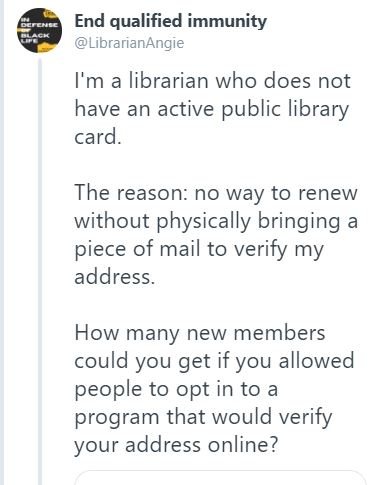
It’s hard to get a library card. Community members must provide proper identification. If they apply online, they must show up at a branch to claim their card, often within a specific amount of time. I was reminded of this just a few days ago, when I received this Tweet.

Library users also must have separate logins and passwords to use services like Hoopla, Overdrive, Kanopy, and Freegal.

And if cardholders don’t return items on time, they get fined. If a library user accumulates too many fines, they lose the ability to use their card.

All these things may seem like little inconveniences. But it is these little hurdles that stand in the way of advancing our libraries in the future.

I know some of these hurdles are not the fault of the library. We’re often at the mercy of our vendors. But our communities don’t know that and, frankly, I don’t think it matters. People expect easy access to library services. And they receive easy and convenient services from other companies.

Libraries need to make a concerted and deliberate effort to make it easier for people to use the library in 2021. We’ll have to do this to compete with convenient services that threaten to take away our market share.

First, let’s fix the things that are in our control. We can make it easy for anyone to get a library card online without ID. And we can eliminate fines and fees that serve as a barrier to many of our patrons.

Next, let’s band together to demand vendors create integration that allows library users to access their services from our website with one-step authentication: their library card number. Demanding this change as an industry will be one of the best ways to advocate on behalf of our cardholders this year.

You may also like these posts

The New Year is Here! Here are Five Things for Your Library to Promote in 2021.

Zoom Fatigue is RUINING My Library Programming! How the Heck Should Libraries Deal With That?

Latest Book Reviews

The Invisible Life of Addie Larue by VE Schwab

Find more 60-second Book Reviews here.

Subscribe to this blog and youโ€™ll receive an email every time I post. To do that, click on the โ€œFollowโ€ button in the bottom left-hand corner of the page. Connect with me on YouTube, Twitter, Instagram, and LinkedIn.

My Big Fat Failure and What I Learned From It

My Big Fat

I have a library marketing routine. Every six months, I go through all the promotions we’ve done and take a hard look at what worked and what didn’t. I adjust my email sending schedule and my promotional plans for the next six months based on the data I’ve gleaned from cardholders who’ve interacted with our messages and promotions.

This time,ย within about ten minutes of starting this process, I was reminded of what could be considered our library’s biggest promotional failure to date. It was an experiment, so the sting is lessened by the knowledge that we intended for this campaign to be a learning experience.

Yea, Ang, keep telling yourself that.

We have one library in our system with a cardholder cluster distribution that is something of a miracle. This branch is a perfect representative of our entire system as a whole. It makes it an amazing test subject for any promotion.

So our idea was to convince occasional users of that branch–people who only come in every couple of months–to come back to the branch by offering them a free gift in exchange for checking out any item. It was January and snow was swirling and we had these amazing library-branded snow scrapers. Maybe that sounds lame to you but trust me, at outreach events, those babies are flying off the table. In any case, we actually did not identify the free gift in the promotion.ย Our overall library strategic goal this year was to increase physical visits to the branch, and this promotion fell in line with that strategy.

So we identified the target audience with the help of Orangeboy, Inc., the company that manages our email promotions. Through them, we were able to pinpointย occasional users. We took a two-prong approach. We sent those cardholders a postcard, asking them to come into the branch with the postcard for their free gift. We also sent them a targeted email a week after the postcard, which you can see below.

monfort


We sent the email during a time period identified as successful for library emails in our system–on a Wednesday night at 7 p.m. 735 people got the email and the postcard.

The email’s vanity metrics were pretty good…ย  51.29% open rate and 5.57% click thru rate. But the overall results–getting people to come in and use the branch–was not exciting. 6.6% of recipients came in to claim a prize. Eight were email recipients. 41 people brought in their postcard.

What did we learn from this? Well, a couple of things may have been at play. Perhaps occasionals don’t use the library often because they can’t get to it physically. Perhaps they just don’t want to enter the building. A digital campaign–driving occasional users to our eBranch in exchange for a gift–may be more effective, although we’d have to work out the logistics of getting a gift to someone who doesn’t want to come into a branch. ย Perhaps it was the timing. The weatherย turned out to be pretty miserable, with record-breaking snowfall in the week after the postcard went out. ย The week in which the email was sent was mild. However, if we tried it in the spring or summer, we may have better luck.

And although I generally look at this as a failed promotion, I can say that we convinced 49 people who haven’t used the library in a long time to do so! ย Circulation at that branch increased by at least 49 items that month. It just seems like a lot of money and effort for a small result.

Still, we’ll keep experimenting with unique ways to draw our old customers back to our branch. Have you done something similar? Tell me about it in the comments. I’d love to hear how your library is working to increase physical visitors.

Subscribe to this blog and you’llย receiveย an emailย every time I post. To do that, click on “Follow” button on the bottom left-hand corner of the page. Connect with me on Twitter and Snapchat–it’s where I talk about library marketing! Iโ€™m @Webmastergirl.ย Iโ€™m also on LinkedIn, Slideshare, ย Instagramย and Pinterest.ย Views in this post are my own and do not represent those of my employer.

The Million-Dollar Reason You Need to Market Your Library’s Collection

THE (1)

$250,000 vs. $8 million.

That’s the spread between the amount my library spends on programming and the amount they spend on collections.

I bet if you checked your library, you’d find a similar story.ย So why, my dear friends, do library marketers spend the majority ofย their time and effort promoting programs?

$275,000

Please understand me. I’m not saying that library programming isn’t important orย worth promoting. Library programs nourish the soul of our community and offer cultural and educational opportunities for those who might not otherwise have access to them. Most library programsย are a valuable and important part of the library’s mission to serve the community. And they deserveย to be marketed!

But most libraryย marketing teams spend theirย energy and resources promoting those programs. And they miss an undeniably important fact about library usage. Library cardholders want the books. They’re checking out books. That’s why they signed up for a library card!

A study by the Pew Research Center published in September 2015 shows 66 percent of library cardholders use their card to borrow books. Only 17 percent attend a library program, class, or lecture. Think about what people say when they sign up a library card. Most are going to tell you they are excited to check stuff out! We take it for granted that people know we have circulation items–books, magazines, music, and more. We need to stop that.

If we want to compete with Amazon and other bookstores, we have to promote our main asset–the collection.ย People are hungry for information about new stuff in the collection. And every time I talk to someone about the library and I mention that we loan eBooks, eAudiobooks and downloadable music, they look at me like I have two heads. We’re spending a ton of money to build our collection and our customers don’t really know it’s there. When they want a newly released book, who do your cardholders think of first–you or Amazon?

Before I was a library marketer, I worked as a television news producer. That means I put together each night’s newscast, decided which stories were told, in what order, and how they were told. Every year, our news director would bring in a consulting firm whose job it was to help us improve our shows and increase our viewership. I was proud of my work as a journalist. But when I was presented with the feedback from focus groups, it was clear that most viewers were watching my show for the weather. Hearing what was going on in the world was nice, but what they really wanted to know was whether it would rain the next day.

In television news, weather is king. In libraries, the collection is king.ย Collection marketing is a valuable investment for every library. The best way to market the collection is through targeted emails. In the next few blog posts, I’ll be sharing some secrets for targeted email messaging–things I’ve learned in the 18 months that we’ve done so at my library.

But you can start collections marketing right now through social media–especially Twitter and Pinterest– and by featuring books on the front page of your website. ย Create themed book lists–you can enlist your collections development department for help with that task. Talk about new books and popular books in your podcast or on your blog.

For a few minutes every day, spend some time marketing your collection. It will increase circulation and will help reinforce the image of your library as a place of vast resources in the eyes of your cardholders.

Subscribe to this blog and you’llย receiveย an emailย every time I post. To do that, click on “Follow” button on the bottom left-hand corner of the page. Connect with me on Twitter and Snapchat–it’s where I talk about library marketing! Iโ€™m @Webmastergirl.ย Iโ€™m also on LinkedIn, Slideshare, ย Instagramย and Pinterest.ย Views in this post are my own and do not represent those of my employer.

A WordPress.com Website.

Up ↑