Search

Super Library Marketing: Practical Tips and Ideas for Library Promotion

Tag

library marketing

Will Anyone Come to Library Programs Ever Again? Eight Ideas for Reimagining Programming in the Age of โ€œThe Next Normalโ€

This week, I learned a new term used to describe the way the world is transforming in the wake of the pandemic.

โ€œThe Next Normalโ€ was coined by workplace consulting firm McKinsey & Company. It describes the changes which continue to emerge in every industry in the post-viral era.

A return to normal after an event like the pandemic is extremely challenging. It calls for libraries to reimagine and reform the work they do to meet their communityโ€™s needs in new ways.

Libraries seem to have the most angst about this change with regards to programming.

I have talked with many library staff members who truly enjoy creating and presenting programs. The process brings them fulfillment and purpose. And the idea that the pandemic may have permanently changed the way the public engages with library programming makes them sad and nervous.

I’ve been thinking about this a lot lately.

Change is scary and uncomfortable. But it also gives us an opportunity to approach library programs in a way that is more strategic. We have the chance to make sure our programming is creating deep relationships with our community.

Here are eight things to keep in mind as you begin to re-create your library programs in the age of The Next Normal.

Be realistic about the hurdles

Before the pandemic, libraries got a lot of program and event traffic from people who walked in to check out a book or browse the collection. They noticed an event or program happening in the library and joined in.

Because of the pandemic, libraries have implemented convenience services, like curbside pickup and book bundles. The community needs those services. But they also impact the number of physical visits to your library and in turn, the number of people who come across a program impulsively.  

There is also a significant portion of the community who is not comfortable (yet) with going back to a public indoor space. Others discovered virtual programming during the lockdown and now prefer it.

We must acknowledge that the pandemic may have changed the way people interact with library programming. When you give yourself and your library permission to accept that premise, you can begin to rebuild and reimagine the way your library creates and promotes programs.

Plan fewer, but more quality programs

The Next Normal is a great time for libraries to re-evaluate the programs they offer.  

I propose that libraries reduce the number of programs that they do. Instead, spend more money and more time planning quality programs that are unique to your community.

Set your promotional boundaries and stick to them

Library marketers are often expected to promote every program at a library, months in advance. The Next Normal is a great time to set down some ground rules for which programs get promoted and how those promotions will be carried out.

As you are determining the boundaries that will work best for your library, you may have to experiment with how far in advance you promote programs and on what channels.

Remember that your community’s schedule and expectations have changed in the wake of the pandemic. The promotions you did before the pandemic may not work in The Next Normal.

Track the results of your promotions so you can identify those changes and create new ground rules for your promotional work. Once you set those rules, stick to them.

You may be pressured to make exceptions. And there may be co-workers who donโ€™t appreciate the effort you are making to do the best job of marketing for your library. Thatโ€™s okay.

If you create a plan that puts the interest of your community and your library at its core, you will be successful.

Make promotions part of your program planning

As you begin to put your program together, make it a habit to think about the marketing piece. Ask yourself:

  • Who will be your target audience?
  • What is the best way to reach them?
  • How much time will it take you (or your co-workers who help with marketing) to create the pieces youโ€™ll need to promote your event properly? ย ย 
  • What will your event hashtag be?

If there are other library staff who will be involved in promotions, make sure you give them a heads up in plenty of time. For example, if your library has a social media manager, try meeting with them once a month to let them know about the programs youโ€™re putting together.

Choose your promotional platforms carefully.

Community members may ignore promotions because they are overwhelmed by the sheer number of marketing messages they receive. Libraries tend to want to promote everything on all channels. Letโ€™s be more intentional.

If your community actively engages with your Facebook posts, use that to your advantage. Create events on Facebook for your programs so that potential attendees get a reminder as the day of your program draws near. You can also buy Facebook ads or boost your posts to target specific demographics, even if you have a small budget.

If your community prefers interaction on another social media platform, like Instagram, spend your time and energy promoting your events there. Instagram Stories are a great way to build excitement.

Perhaps your library has a receptive and engaged email list. Add a program suggestion to your reading recommendation emails. Or send an email with a program announcement to a targeted audience.

Leverage your presenters

The Next Normal is the time to get as much promotion out of your speakers, presenters, and sponsors as possible. They likely have a ready-made audience that may like to attend your event. Ideally, this kind of collaborative promotion should be a part of your agreement with each participant.

You can make it easy on presenters by sending them a pre-written social media post or blurb for their email newsletter promoting their appearance. Supply them with copy, images, video, print assets, and anything else they need to help you spread the word.

Create some FOMO (fear of missing out)

FOMO is a powerful tool for getting more attendance at your programs. Your registered patrons and past program attendees can provide social proof that your event is going to be amazing.  Let them help you build hype.

About a week before the event, send an email reminder or a social media message to everyone who has registered or shown interest in your program. Encourage them to brag that theyโ€™ll be attending. Include a pre-written social media message to make it easy to share.

Remember your real goal

At the end of the day, programs should help your library create a relationship with those cardholders. We want them to come to us for all their problems, and all their questions, and all their needs.  

This is a more holistic approach than merely counting attendance numbers. Creating that engaged community will make your work worth all the effort.  


More Marketing and Promotional Help

Your Library Can Reach Teens With Programming and Marketing! A Look Inside the Lives and Minds of the Elusive Generation Z

Library Programming and Promotions SHOULD Be BFFs! Hereโ€™s Why They Must Work Together.

Angela’s Latest Book Review

Subscribe to this blog and youโ€™ll receive an email every time I post. To do that, enter your email address and click on the โ€œFollowโ€ button in the lower left-hand corner of the page.
Four *Easy* Ways to Promote Your Library’s Children’s Collection

Watch Now

The Library Marketingโ€‹โ€‹โ€‹โ€‹โ€‹โ€‹โ€‹โ€‹ Show, Episode 109

In this video, I’ll share four ways you can make sure the public knows about the many wonderful children’s books you have in your library’s collection.

Kudos in this episode go to the Bridges Library System, which has a wonderful and funny newsletter signup and confirmation process.

Do you have a suggestion for a topic for a future episode? Want to nominate someone for kudos? Let me know in the comments.

And subscribe to this series to get a new video tip for libraries each week.

Thanks for watching!


Subscribe to this blog and youโ€™ll receive an email every time I post. To do that, click on the โ€œFollowโ€ button in the bottom left-hand corner of the page.

Three Design Tips For Creating Beautiful Social Media Graphics for Your Library

Watch Now

The Library Marketingโ€‹โ€‹โ€‹โ€‹โ€‹โ€‹โ€‹โ€‹ Show, Episode 108

In this episode, I’ll share three easy design tips for your library’s social media graphics.

Kudos in this episode go to the Carmel Clay Public Library for turning a vacant supermarket into a super cool library space.

Do you have a suggestion for a topic for a future episode? Want to nominate someone for kudos? Let me know in the comments.

And subscribe to this series to get a new video tip for libraries each week.

Thanks for watching!

Subscribe to this blog and youโ€™ll receive an email every time I post. To do that, click on the โ€œFollowโ€ button in the bottom left-hand corner of the page.

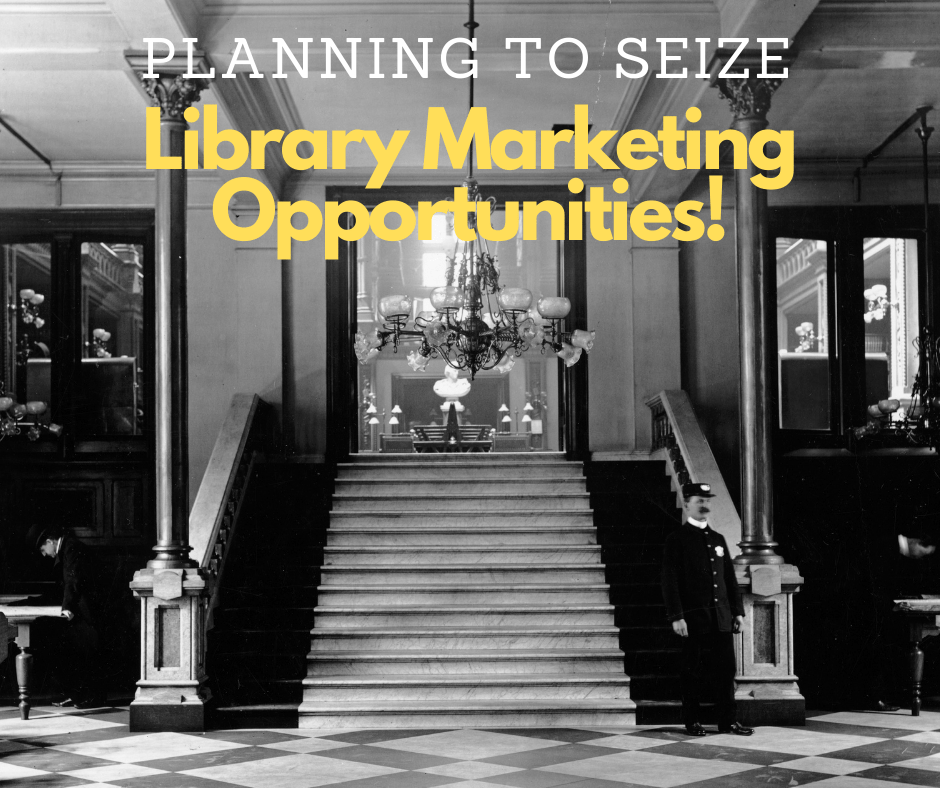
Planning for Magic! How To Keep Your Eyes (and Your Schedule) Open for Unexpected Library Promotional Opportunities

Courtesy Public Library of Cincinnati and Hamilton County. Check out their digital library here: https://digital.cincinnatilibrary.org/digital/collection/p16998coll12?fbclid=IwAR3gV2a2TMW2DFTLlsU0shgVGKzEFtzSJBYpqyAircAHN3eh6wvoE-siipw

I have never been one for spontaneous excursions. When I travel (boy, do I miss travel!), I like to have a plan.

I research restaurants. I research tourist attractions. I check to see if there’s a library in the area. I might even jump onto Google Street View and “walk” the area myself to make sure I’ll know where I’m going.

I do all of this because I want to get the most value out of the time I’m spending in a new place. I don’t want to miss anything fun, interesting, or historic.

But occasionally, I’ll stumble upon something amazing that I didn’t find in my research. Those discoveries always end up being completely amazing.

On my first few hours in Edinburgh, Scotland, I had lunch in a tavern. As I left a tour of Holyrood Palace, I realized I hadn’t eaten in 12 hours. I was starving. I didn’t feel like walking another mile to one of the restaurants I had chosen in my pre-trip planning.

I found Tolbooth Tavern tucked into a tiny corner of an ancient-looking wall near Holyrood Palace. It looked quiet and unassuming. And everything on the menu posted outside sounded delicious.

It was the best meal I had in Edinburgh. The haggis was spectacular and beautiful. The beer was perfect. The atmosphere was exactly what I imagined I’d find in that city. It’s one of my favorite memories of the trips.

What in the world does this have to do with library marketing?

On most occasions, I believe in planning. A well-executed marketing plan thatโ€™s strategic and focused is the best recipe for library marketing success.

But sometimes, you can stumble upon an amazing promotional opportunity that you didn’t plan for. And those unexpected opportunities can be surprisingly successful.

If inspiration strikes or you see a chance to grab a new marketing or promotional opportunity, you should absolutely do it. A quick pivot can lead to engaging and successful promotions.

Planning for the unpredictable

Anyone can include some flexibility in their marketing schedule. The key lies in planning… which sounds contradictory. But the trick is simple.โ€ฏโ€ฏ

When youโ€™re laying outโ€ฏyour regular marketing schedule, be sure to deliberately leave holes where you might be able to drop in promotions

In general, most of your editorial calendar, around 75 percent, will consist of promotions that have hard deadlines. The rest, 25 percent, can be open spaces for those opportunities that you cannot plan for.

How does this work, exactly?

Be on the lookout for opportunities to do some flexible marketing. Great promotional stories sometimes appear unexpectedly. They may include:

  • User-generated content on social media
  • A connection to an event happening in pop culture
  • A suggestion from a customer or staff member
  • An idea you got from another library
  • A last-minute opportunity from a vendor or a partner organization. 
  • A great event thatโ€™s been planned by a branch at the last minute. 

If you purposefully leave 25 percent of your editorial calendar open, you can seize these opportunities for the space you’ve deliberately set aside.

Example: My library turned around a movie promotionโ€ฏsent to us by a vendor, who offered a free first-run movie streaming on their site on the same day that the movie was released into theaters.

We got word a week before the movie premiere. The movie had a great cast that we thought might be popular with our cardholders.

We swung into gear. We created graphics for our website, social media, and an email campaign to let users of our digital services know about the promotion. We managed to do all of this in two days.

And the promotion was a success! On a normal day, we stream about 25 movies to cardholders. After this promotion, we streamed 244 copies of this first-rate movie alone. โ€ฏ

This happened because we left holes in our calendar for opportunities just like this.

You wonโ€™t have to turn a last-minute campaign around every week or even every month. But when you doโ€ฆ it will be worth it.โ€ฏ Sometimes the gold nuggets of promotion are the ones you canโ€™t plan of time! 

The benefits of flexibility in your library promotions

Flexible marketing can be fun. You may do some of your best work when you are formulating promotions in a few days or a few hours.โ€ฏA deadline or a great idea with a time limit can push you and your staff to be creative in ways youโ€™ve never imagined. 

Flexibility allows you to adapt to unforeseen shifts in your community’s needs and wants.

And flexible marketing makes it easy to continuously improve the way you do library marketing. It gives you an excuse to experiment.

And when you do that, you will learn new things about your audience, what they like, and what they dislike. Your marketing overall will improve.

What happens if I don’t have anything to fill my calendar holes?

Nothing.

Give yourself a break. Take that day off from promoting your library.

I know this is a crazy concept coming from a blog that is all about library marketing. But we need to spend more time in reflection if we want our library marketing to be amazing.

True creativity, the kind that adds value to your workplace and your life, is something that needs to be treasured and cultivated. If you want your library to succeed, you need to take time to be creative.

An unfilled hole in your editorial calendar is the perfect opportunity for that.


You May Also Want to Read These Articles

Part One of the Library Marketerโ€™s Definitive Guide to Creating an Editorial Calendar That Actually Works!

Fight for Your Ideas! Four Tips to Help You Get the Green Light for New Library Promotional Ideas

Latest Book Review

Subscribe to this blog and youโ€™ll receive an email every time I post. To do that, enter your email address and click on the โ€œFollowโ€ button in the lower left-hand corner of the page.
Twitter Stats, Facebook’s Free Social Impact Conference, and YouTube’s Aesthetic Guide: Social Media Updates for Libraries

Watch Now

The Library Marketingโ€‹โ€‹โ€‹โ€‹โ€‹โ€‹โ€‹โ€‹ Show, Episode 107

It’s time for social media updates for libraries! We’ll highlight three headlines and talk a bit about their impact on library social media.

Kudos in this episode go to the Columbus Library for their help with Operation Backpack.

Special note

I'm hosting a live Twitter chat next Tuesday, August 31 at 12 p.m. ET. It's on changing public perception through storytelling. To join, follow #CMWorld on Twitter. We'll ask five questions during the chat. You can answer using the hashtag. I want to make sure libraries are represented in this chat. See you there, friends!

Do you have a suggestion for a topic for a future episode? Want to nominate someone for kudos? Let me know in the comments. And subscribe to this series to get a new video tip for libraries each week.

Thanks for watching!

Angela’s Latest Book Review

Couple Found Slain by Mikita Brottman

Subscribe to this blog and youโ€™ll receive an email every time I post. To do that, enter your email address and click on the โ€œFollowโ€ button on the lower left-hand corner of the page.
How to Avoid Three Big (But Totally Understandable) Library Marketing Mistakes

Watch Now

The Library Marketingโ€‹โ€‹โ€‹โ€‹โ€‹โ€‹โ€‹โ€‹ Show, Episode 106

In this episode, I’ll answer a question I got from a library staffer: What are the biggest mistakes you see library staff making in their marketing and promotions?

I’ll talk about the three most common boo-boos and give you ideas for avoiding these pitfalls. Don’t worry… you can do it!

Watch to find out who gets kudos!

Do you have a suggestion for a topic for a future episode? Want to nominate someone for kudos? Let me know in the comments.

And subscribe to this series to get a new video tip for libraries each week.

Thanks for watching!

Subscribe to this blog and youโ€™ll receive an email every time I post. To do that, click on the โ€œFollowโ€ button in the bottom left-hand corner of the page.
Fight for Your Ideas! Four Tips to Help You Get the Green Light for New Library Promotional Ideas

Photo of librarians, courtesy Public Library of Cincinnati and Hamilton County

It’s sometimes insanely hard to get any new marketing ideas to pass approval in a library.

If there is a silver lining to the COVID-19 pandemic, it’s that the crisis helped libraries to see that there are new ways to market and promote their library. It’s opened the door for experimentation.

Even so, presenting a new marketing or promotional idea is sometimes challenging and intimidating for library staff. I know this because every time I talk with librarians at conferences or in one-on-one consultations, they ask, “How do I get buy-in for this great promotional idea with my supervisors and co-workers?”

Here are the four things you can do to gather support and approval for your great new marketing and promotional ideas.

Tell me about a time you had to pitch a library promotional idea. What was the idea? Did you get a yes or no? What did you learn from the experience? Share your thoughts in the comments.

Thoroughly research and prepare your pitch.  

Before you pitch a new idea, do your research. You’ll want to present a clear, concise, and strategic case for your idea. Include the following information in your pitch:

  • How the work benefits your community and cardholders.
  • How the work ties into your library’s overall strategy and goals.
  • How the work will get done by staff.
  • The timeline for implementation.
  • What the success measures will be.
  • What the long-term goals of your promotional idea will be.
  • How you will handle problems that may arise.
  • The data to back up your claims.

Here’s an example pitch that includes these points.

You’ve determined that Facebook is not giving you the results you want when you promote individual programs. Registration and attendance at programs have been unchanged or decreasing in the last six months, despite the many posts you create. Instead of using social media, you want to start a targeted e-newsletter sent to the people who frequent each branch in your system. You believe these targeted emails will be more effective because they will reach the audiences most likely to attend these programs.

Your pitch will begin by explaining the problem using data. Include registration, attendance figures, and Facebook engagement figures especially clicks on your registration or event information links. Show how the Facebook posts are getting very little engagement and lead to no increase in registration or attendance.

Next, explain how the move to branch-specific e-newsletters will be better for your community and cardholders because it will offer information about events happening in their neighborhood that are specific to their wants and needs. Look for wording in your library’s strategic plan that will make it clear to senior leaders that you are working to fulfill the strategic goals by offering community-based access to information.

Next, make the case that e-newsletters are a more efficient use of your time because they will be more effective and targeted. Again, be specific when you talk about how long it takes to create a Facebook post versus an e-newsletter.

Now, talk about the ways you’ll measure success for your new e-newsletters: increases in registration and attendance, plus open and click rates on the emails. Be specific and use numbers. This will show that you are confident that your new idea will work.

Spend a few moments talking about your long-term goals: how many new subscribers do you want to get in the first six months or year? How much would you like to see registration and attendance grow? What other library services can you imagine promoting using your e-newsletters?

Layout a timeline: when do you think you can launch your first e-newsletter? How long will it take to grow your subscription list? How often will you send these e-newsletters?

Finally, talk briefly about problems you may encounter and how you’ll handle them. What program will you use to send the e-newsletters? Who will create them if you’re sick or on vacation?

Review and rehearse.

Review your plan several times. It’s a good idea to leave a few days in between each review of the plan, to let your ideas marinate. You may think of new benefits or pitfalls during those breaks. You’ll want to be fully prepared to answer any questions and defend your idea with confidence.

Next, practice presenting your idea to a friend at your organization. Choose someone you trust to give you honest feedback about your idea and your presentation.

You might also consider recording your pitch on Zoom or another video recording program. Check to make sure you are speaking slowly and clearly. Evaluate your tone of voice, eye contact, and body language during your practice pitch.

Pitch strategically.  

Find a time when your supervisor won’t be rushed. They’re more likely to listen to you when they have time to truly consider your idea.

Pick the right day of the week for your pitch. For example, Mondays are often busy and stressful for bosses. Your supervisor may be more negative at the beginning of the week and it’s likely not the best day for your pitch.

When you pitch, be mindful of your body language. If you are sitting in a chair, don’t pivot back and forth nervously or jiggle your legs. Sit still, but upright, and with confidence.

If you are standing, try separating your legs about shoulder-width apart. This is a “power” pose that will help you maintain good posture and will subconsciously give the impression that you know what you are doing… even if you don’t feel that confident!

If the answer is no, don’t necessarily give up. 

A “no” doesn’t have to mean the end of an idea, especially if you think it’s beneficial to your library and customers. There are no bad ideas–just ideas whose time has not yet come.  

Write yourself a note in your work calendar to revisit the idea in six months. Keep your eyes open for new opportunities to present your ideas in a different format.


Subscribe to this blog and youโ€™ll receive an email every time I post. To do that, click on the โ€œFollowโ€ button in the bottom left-hand corner of the page.

You May Also Want to Read These Posts

Prioritize! How to Decide Where To Spend Library Marketing Time and $$$

Five Creative Ideas to Help You Beat the Blues, Get Inspired, and Create Amazing Library Marketing Campaigns Again!

Two Brilliant and Easy Ways to Get More Reach for Your Library’s Instagram Account

Library employee examining newspapers, circa 1926. Photo courtesy 	
Cincinnati & Hamilton County Public Library.

I may be addicted to Instagram.

The social media platform is my favorite place to scroll and post.

It’s fun. It’s heartwarming. It’s filled with great content. It’s inspiring and beautiful.

I follow a lot of libraries on Instagram. They are doing a great job, sharing user-generated content, promoting their collection, highlighting their patrons and volunteers, and using humor and cute stuffed puppies to drive engagement.

Instagram is super popular right now, especially with people under the age of 34. That’s a key demographic for library marketers.

According to Web Hosting Rating, 60 percent of users log in daily, and more than half of those people log in more than once a day. Best of all, the average U.S.-based Instagram user spends a whopping 53 minutes a day on the app. (That’s me! ๐Ÿ™‹)

If your library posts to Instagram, it’s time to take it up a notch. To drive your engagement stats, there are two things you can do.

Instagram takeovers and Instagram highlights are an easy way to get more reach on your Instagram account.

Instagram takeover

An Instagram takeover is when you arrange for a partner organization, library department, senior leader, or fan to take over your account for a day or during a special event.

A takeover will expose your library to a new audience of potential followers. It will also give your library external credibility.

A takeover can be done without giving your takeover partner the password to your account.

  • Ask your takeover partner to save each individual story slide to their camera roll.
  • Next, they’ll email the slides to your library.
  • Then, youโ€™ll upload them, one by one, to your Instagram story.

Before you agree to a takeover, be sure to establish some guidelines.

  • Be specific about what you want in terms of content and number of slides.
  • Set a deadline.
  • Put all of that in writing. 

Here’s a template you can use to set up the guidelines for your own library’s Instagram takeover.

My former library did an Instagram takeover with a nearby library system, with whom we had a reciprocal lending agreement. It gave each participating library access to a new audience. And people loved it! Each story got an average of 605 views.

Patrick Kinsella, Library Communications Coordinator for the library at the University of Salford in Manchester had even more success with his Instagram takeover success story.

He said, “As our Library is in the final stage of a ยฃ6.2 million redevelopment, we decided to run a campaign to promote our study spaces outside our main library. We have five main study spaces outside of Clifford Whitworth, our main library, that could give students a place to study and help make up for the reduction in space in Clifford Whitworth.”

“We also decided to take over our universityโ€™s main Instagram account to give their followers a tour of what lies beyond Clifford Whitworth. Followers were also invited to send pictures of themselves studying outside Clifford Whitworth in exchange for ยฃ5 worth of printer credits.”

“The Instagram story was viewed over 1,200 times and 14 students sent us pictures of themselves studying outside Clifford Whitworth. The cross-promotion of our Instagram account @salfordunilibrary through the story also gained us more than 20 new followers. The user-generated content that we received also allowed us to build a Twitter campaign displaying their images.”

Instagram highlights

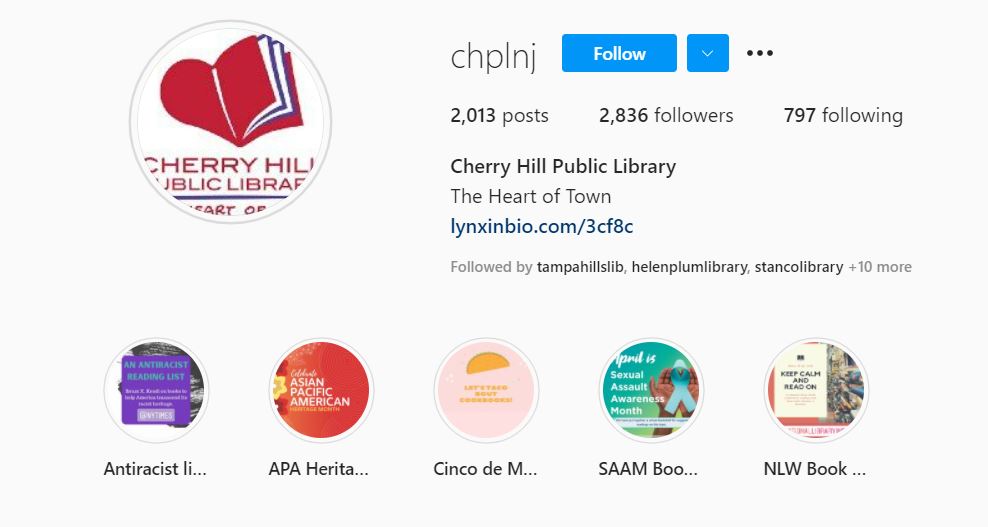
Highlights are custom containers for similarly themed Instagram stories. After you add content to your story, you can choose to highlight that content by saving it to one of these containers.

Unlike regular Instagram stories, which disappear after 24 hours, highlights live on your Instagram profile forever, or until you delete them.

Cherry Hill Public Library uses highlights to save important Instagram stories.

Highlights showcase the best of your previous Instagram content to new followers. And they create an archive of content, especially those stories that contain “evergreen” content that never expires and is always relevant. Instagram highlights are a great place to save library FAQs, book reviews, tutorials, and other wide-ranging topics.

To create a highlight from an active Instagram story:

  • View the story.
  • Click on “Highlight” in the bottom tool bar.
  • Click on the plus icon to create a new highlight container or add to a highlight container you have already created.
  • Click on “Add”. You’re done!

You can add photos or videos to each of your highlight containers any time you want. There is no limit to how many photos and videos each highlight container can hold.

Screen capture showing the Instagram highlights for Springville Library.
Springville Library uses highlights, and they’ve created icon-based covers for each container.

You can change the title of your highlights containers at any time. Just open the highlight, and then tap on the name of the highlight container in the upper left-hand corner. You’ll be given the option to edit.

Share your tips for library Instagram success! Click on the Feedback button to tell me about what you’re doing on Instagram. I’ll share your tips with others on Twitter, Instagram, and YouTube!


Subscribe to this blog and youโ€™ll receive an email every time I post. To do that, click on the โ€œFollowโ€ button in the bottom left-hand corner of the page.

You May Also Want to Read These Posts

Social Media News About Twitter, Instagram, and Facebook That Your Library Needs To Know!

The 2021 Guide to Social Media for Libraries: Instagram

Angela’s Latest Book Review

Four Hundred Souls edited by Ibram X. Kendi and Keisha N. Blain

A WordPress.com Website.

Up ↑