Search

Super Library Marketing: Practical Tips and Ideas for Library Promotion

Tag

library marketing

Eight Major Reasons To Add Content To Your Library Marketing {Infographic}

I’m so excited to be the keynote speaker for the Illinois Library Association Marketing Forum Mini-Conference in Chicago in a few weeks. My brain is entirely engulfed in content marketing as I formulate the talk. There are also some big content changes afoot at my library. I’ll talk more about those when we have our campaigns up and running. But, let’s just say that most of my marketing focus in my professional life is on content–why we should do it, how to make it work better, and how to be efficient in our content creation.

The most important part of the speech I’ll give next month is the “why.” Why is content marketing important to libraries? This was actually the focus of one of my early posts here on blog. The argument for content marketing hasn’t changed. You can make all the posters and fliers you want. People don’t pay attention to those push promotional tactics. That’s why marketing seems frustrating.

You want desperately to break through the noise of life and become a subconscious part of your cardholders’ thought process. You want them to think of you every time they face a problem. You want them to remember they can come to you for pretty much anything they need. This is the common struggle for libraries everywhere, no matter their size, staffing, or service area. Honest to goodness, the only way to achieve that is through content marketing. I know this from experience.

There is now a lot of data to back up the assertion that content works. I want to share some of that with you. I’m hoping that, if you are hesitant or nervous about working content marketing into your overall library marketing strategy, these stats will convince you. I truly believe this is an opportunity for libraries that cannot be missed. If we are to survive and thrive as an industry, we need to do more content marketing.

Here are the facts for why content is key to library marketing.
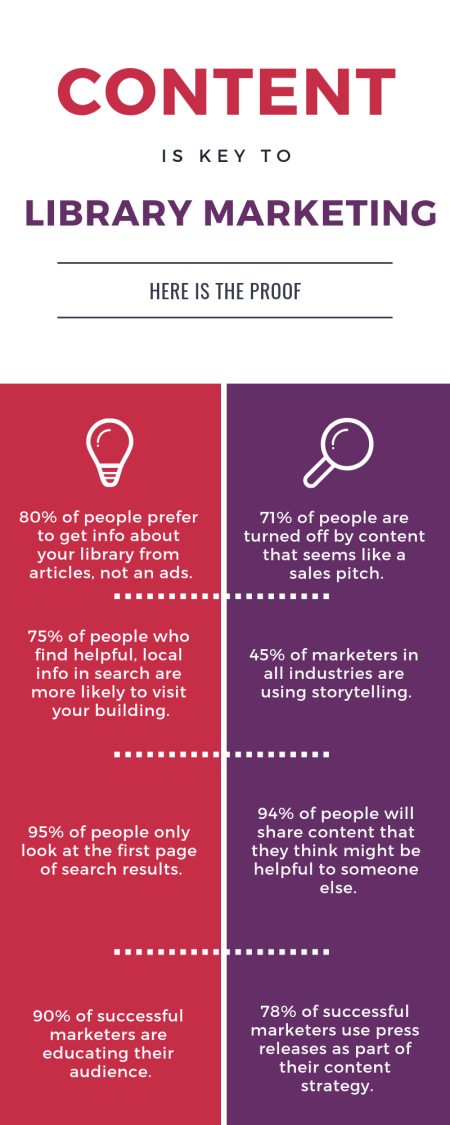
Why Content is Key to Library Marketing

80 percent of people prefer to get information about your library from a series of articles versus an advertisement.

71 percent of people are turned off by content that seems like a sales pitch. Which means, if you are doing mostly traditional promotional marketing, it’s not working.

75 percent of people who find local, helpful information in search results are more likely to visit a physical building. We want to get more bodies inside our libraries. Content is the key.

Only 45 percent of marketers are using storytelling to create a relationship with their audience. Most big brands are still running ads and push promotion. This is our open door. It’s a huge opportunity for libraries. This is how we sneak in and take away audience share… by telling stories. And who doesn’t love a good positive story about a library?

95 percent of people only look at the first page of search results. Optimized content (that’s content that uses keywords that are likely to be picked up by Google and other search engines) is incredibly helpful. If your library’s content appears on the second page or later, people won’t see it.

Blog posts are the content that get the most shares. And if your post is helpful to others, it’s more likely to be shared. 94 percent of readers share a blog post because they think it can be useful to someone they know. And the more often you publish blog content, the more often your content will show up in search, which increases the likelihood that people will find your library while doing a search. Amazing, right?

90 percent of the most successful marketers prioritize educating their audience over promotion their company’s promotional messages. Education is our main industry. Libraries are perfectly aligned to make this work for us.

But here’s a stat that really surprised me. 78 percent of effective content marketers use press releases as part of their strategy. Yep, press releases can be content marketing too. Use your releases to be informative but to really pitch amazing story ideas to the media. If you have a great story and you can make all the elements available to the media, you can let them tell it and take advantage of their built-in audience to spread the word about your library.

These stats come from a variety of great blogs including Impact, Marketing Profs, OptinMonster, Elite Copywriter, Cision, and Forbes. I hope they’ve convinced you to do content marketing at your library.

Subscribe to this blog and you’ll receive an email every time I post. To do that, click on “Follow” button in the bottom left-hand corner of the page. Connect with me on Twitter, Snapchat, and LinkedIn. I talk about library marketing on all those platforms!
Seven Podcasts that Will Make You a Better Library Marketer

An exciting thing happened this week! The library marketing profession is now the subject of a podcast. It’s called Library Figures. It’s produced by Piola, a company which designs library websites.

Many smart and strategic library marketing professionals including Kimberly Crowder of the Indianapolis Public Library (featured in this Super Library Marketing post last year) are guests on the pod. Each episode focuses on a successful library marketing strategy. The host and guest dissect the implementation, tools, success measurements, and results. I amhonored to be featured on episodes one and four. Maybe it’s silly, but I’m just beyond thrilled that we’ve got our own podcast corner where we can share and learn.

I’m a huge podcast fan. My podcast player is overflowing with episodes. I’d love to share my list with you and explain a bit about why listening to these shows will make you a better library marketer.

The Science of Social Media

This is a new discovery for me. This show, produced by Buffer, focuses on data, insight, trends, tips, and more. Anyone who works on social media for any library will find value in listening to these episodes, which cover subjects for everyone from beginners to those with advanced social media skills.

Marketing School

I just discovered this podcast last month and I’m catching up on back episodes (there are more than 900!) but I really love it. The creators release one ten-minute episode every day focused on one nugget of great marketing wisdom. Past subjects include blogs, event marketing, crisis communications, and generating great content ideas.

Brand Newsroom

This show, produced by a content marketing agency in Australia, bills itself as “the show for anyone who has a say in how companies are communicating.” The hosts use a round-table discussion format to dissect topics like crisis communications, branding, and networking.  The most interesting episodes involve disagreement between the hosts. They all have a different perceptive on marketing, and I find that they help me to consider issues from different angles. They also have a fun segment at the end of each episode called “On my Desk” where they share something they’re really excited about, from apps to software to new books.

Marketing over Coffee

As its name implies, each weekly show is recorded in a coffee shop. The two hosts talk casually about all kinds of marketing topics including writing, influencer marketing, SEO, and other relevant marketing problems and solutions. They also take listener questions, which I really love. And the episodes are short, so they’re easy to listen to during a typical 20-minute commute.

Social Media Marketing Podcast

Michael Stelzner, who runs the Social Media Examiner website, is the host of this show. His guests have a range of backgrounds and answer questions about all kinds of social media topics and tactics. Mike is really good about digging down and getting the basics about each topic. He also shares a new app at the beginning of each show. Most of his discoveries are free or very inexpensive and they’re all designed to help make marketing easier and more fun.

Unpodcast

I’m going to end in an unconventional spot by recommending this podcast, hosted by husband and wife team Scott Stratten and Alison Kramer. I have seen Scott speak at Content Marketing World several times. He’s hilarious and brutally honest about the faults and triumphs of marketing. Alison is his partner in crime and besides being the cutest couple in marketing,  their observations are always spot on. Some episodes dissect customer service, some talk about marketing mistakes, and sometimes they talk about innovation and entrepreneurship. They really make me think. Just trust me and subscribe.

And of course, we support our fellow library marketers producing podcasts. Read the back stories about how those shows are produced and then subscribe to the library podcasts on this list.

And if you have a podcast you want to recommend, please let me know in the comments!

Subscribe to this blog and you’ll receive an email every time I post. To do that, click on “Follow” button in the bottom left-hand corner of the page. Connect with me on Twitter, Snapchat, and LinkedIn. I talk about library marketing on all those platforms!

How to Hook New Cardholders and Make Them Loyal with Email

We talk a lot about emailing our cardholders with information about new products, services, and collection items. But you can also use your email list in a powerful way to reach people who have just signed up for a library card.

Most libraries take a minimalist approach to “on-boarding” a new cardholder.  Once a person fills out a library card application, we hand them a card, a welcome brochure, and send them on their way. We’re friendly and we’re genuinely excited to welcome them to our system. But we make a mistake that’s common for a lot of businesses and organizations. We know our system inside and out and we often forget that our new cardholders know nothing about what we offer. We assume they can find their way to the things they need.

It’s important to help those cardholders learn to navigate the behemoth number of resources and items available at the library. A solid on-boarding campaign retains new cardholders and turns them into lifelong loyal users of the library. The first 90 days of a new library cardholder’s experience is crucial to determining their feelings of connection and loyalty to the library.

It also makes good business sense. Studies show it costs five times as much to gain a new customer than it does to retain them. A library marketer practicing good stewardship will want to do their best to keep new cardholders coming back to use the library.

The most effective way to on-board a new cardholder is through email marketing. Many libraries create a campaign with specific emails sent to new cardholders at a pre-determined pace. Those emails slowly introduce them to new features and inspire them to try out all the library has to offer. It’s easy to do this using some mail systems, like OrangeBoy and MailChimp.

My library has a 90 day on-boarding campaign set to run automatically through OrangeBoy. Creating it was a bit of process. But the effort was worth it. In addition to retaining customers, the on-boarding emails reduce unsubscribes for future targeted promotional emails. Here’s how we did it and what we learned about doing it well.

First, make a list of the services, events, and collection types that get the most use at your library. You’ll want to include information about the most popular features you offer in your emails to new cardholders.

Then, make a list of the services, events, and collection types that are interesting or unique to your library but don’t get a lot of use. These are the gold nuggets of your on-boarding campaign. You’ll have the attention of your new cardholder. The relationship is fresh. Why not use that to showcase the hidden treasures at your library.

Finally, create an outline of your campaign, mapping out each message, when it will be sent, and what it will say. Look at the two lists you’ve created and narrow your focus. Try to promote no more than four things per on-boarding message. You don’t want to overwhelm your new cardholder. Rather, you’ll want to introduce people to the library in small doses. Pick a theme for each message with a specific call to action. Keep the language simple, conversational, and free of industry jargon.

Create, test, and release the messages. This part took me nearly as long as creating the plan did! But you’re almost there.

Track results. Of course, you’ll want to use a Google URL tracker or Bitly link to see which services and items get the most interest from your new cardholders. You can also track unsubscribe rates, and if you have the ability to divide cardholders into clusters, you can see where your new cardholders land after they finish the on-boarding process.

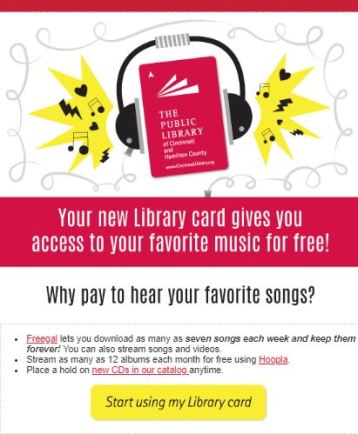
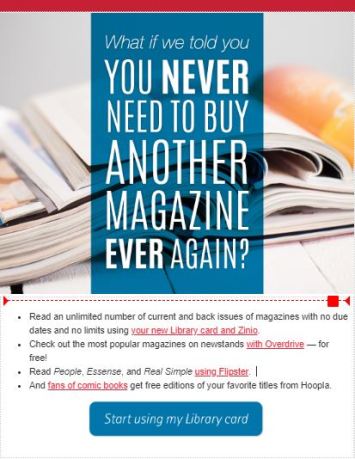
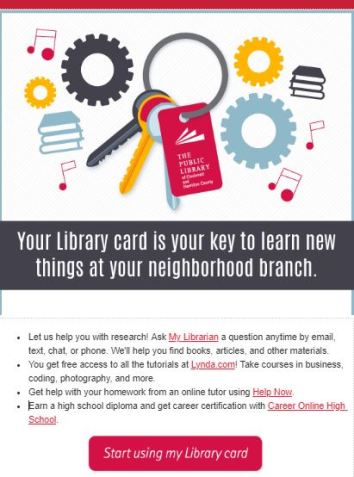
Here are a couple of examples of my library’s on-boarding emails so you can see what we do.

How do new cardholders react to these messages? They definitely don’t hate them. Our unsubscribe rate is 0%. We’re a large system and we’ve sent these for several years to thousands of new cardholders. Over the course of our campaign, we’ve had a couple of hundred people unsubscribe.

We send six emails over 90 days. The first email gets a lot of engagement, which is not a surprise.  The fifth email about using your neighborhood branch (see the image above) is the second most engaging email for us. Overall, about half of the new cardholders we sign up end up becoming loyal library customers. Most use our computers but the rest are checking out physical and digital items or using our MakerSpace.

If your library is doing something to on-board cardholders, I’d love to hear about it. Please take this poll and tell me about what you are doing in the comments.

Subscribe to this blog and you’ll receive an email every time I post. To do that, click on “Follow” button in the bottom left-hand corner of the page. Connect with me on Twitter, Snapchat, and LinkedIn. I talk about library marketing on all those platforms!
 

How to Create a Social Media Strategy That Actually Works

The most effective, free marketing tactic in the library marketing professional’s toolbox is social media. Personally, I love it. I think it’s fun. And interesting. And despite the trolls, I’ve made some actual friends and professional connections in the social space.

For my library, it’s the easiest way to get our message to the masses. But with so many platforms intended for different audiences, it’s also overwhelming. Should you post on every channel?  What should you post? How often do you have to post? If you work alone, you need to be efficient. You don’t want to spend a lot of time experimenting with social media. You want to know what works, and how to be successful. You need goals.

A few months ago, Marcy Timblin, Public Relations Specialist at East Bonner County Library, sent me this email: You always have such timely, comprehensive advice for getting the most out of social media marketing for libraries. I dream of putting it all together to formulate an amazing social media plan that I can implement – even though I am the “numero uno” social media marketer at my library district.”

I appreciate the vote of confidence. Really, any success in the social media space centers on strategy. A strategy lets you take your library’s overall strategy and use social media to make those goals a reality. But telling you to have a strategy and putting one together are two totally different things.

I am blessed with a social media specialist on my staff. Part of her job is to create and maintain our specific social media strategy. And it’s a big job. We’re a large library system (41 locations, 600,000 cardholders) and we post on multiple channels (Facebook, Twitter, Instagram, Pinterest, LinkedIn, and Tumblr). It takes time to sort out how to make each channel work for us. But we do have a process for creating a strategy. Here is how we do it.

Consider what you already know. Go through each of the social media platforms that your library already uses. Look at the analytics for those platforms. How are people using the platform? Which kinds of posts do they respond to?

Most platforms now offer analytics (Facebook is best by far) so you can evaluate success. And if your library is using a scheduling platform to manage your social media posts, you can use those analytics. For those libraries posting organically on platforms without the use of scheduling software, there are options for free analytics. Read this blog article to find one that works for you.

In this step, you are looking to replicate past success and trim past failures. You may find a platform you are using that is not working for you. Drop it. You may also discover a platform that is working really well for you. Concentrate your efforts there.

What are your library’s goals for the year? As with everything you do in library marketing, your social media work must be in service of advancing your library’s overall goals. So, get that list in front of you for the next two steps.

Create a mission statement for each social media platform. Look at your library’s goals for the year and what you know about each platform. Then write a one to two sentence mission statement for each of the social media platforms, lining up your library’s goals with the current audience for that platform. This mission statement should be something your staff and your cardholders will understand. Here’s an example:

LinkedIn: Discover career advice, business tips, and free resources that will help you succeed at work.

Twitter: Get regular updates on our collection, library events, and the literary and entertainment world.

Instagram: Photos tell the library’s story, one snapshot at a time.

And so on. Once you have created the mission statement for the platforms, you can create a persona for the people who will follow you on that platform. The mission statement and persona will help you visualize your audience every time you post. You’ll be able to connect with them because you’ll know who they are, and what they expect from you.

Experiment with scheduling. Look at your current analytics to see which time of day and day of the week work best for social media posts. Use that as a starting point for deciding when and how often you’ll post. Be consistent with your posts. And set a cadence that you know you can keep up with.

Track metrics and be flexible but not overly reactive. It takes time to achieve your library goals using any kind of marketing. The exception is social media. That’s because the platforms themselves are transforming and changing at a rapid and unpredictable rate. Algorithm adjustments and new features can throw off your strategy.

Here’s my general rule: keep an eye on changes in the social media landscape. When a big change occurs, like when Facebook changes its algorithm, sit tight for a while. Give it a month at least and see how the platform’s change affects your reach. Watch to see how your audience reacts. Watch to see how other brands adjust based on the change. Then, if you see your reach is changing negatively or positively, make the adjustment. Don’t wait until your strategy cycle (six-12 months maximum) is over to make your change. You’ll lose months of audience reach if you wait.

Never stop researching. I follow a couple of websites and podcasts religiously to keep up on social media trends. Of all the marketing tactics, that’s the one that takes the most personal learning upkeep! I rely on the Social Media Examiner Podcast, Social Media Today, Social Media Explorer, and Rebekah Radice.

Subscribe to this blog and you’ll receive an email every time I post. To do that, click on “Follow” button in the bottom left-hand corner of the page. Connect with me on Twitter, Snapchat, and LinkedIn. I talk about library marketing on all those platforms!
How to Manage Your Marketing Without Losing Your Ever-Loving Mind

A library marketer is really a project manager.

That phrase is the best description of our job. We are all planning and managing projects. We are scheduling and executing campaigns. We’re delegating. We manage multiple people who contribute to blog and social media posts. And unless you’re a super organized genius, all that coordination can cause you to lose your sanity.

I sometimes walk into my office in the morning feeling fantastic, and by the time I open my email and see a 30-message thread between departments about a piece of content I need for marketing, I can feel the steam rolling out of my ears.

Project management is like waiting tables. You have multiple customers who all want different things from you. They order at different times and their food comes out at unpredictable intervals. In the meantime, you must keep checking back and making sure they have everything they need for the moment. You must also keep them informed about how their meal is progressing.

It’s the same when for library marketing. We are working on multiple campaigns and we have lots of different customers, internally and externally. So how do you make sure you get all your work done without losing track of projects, content, and posts? It’s not easy.

Many of you have said that project management causes you grief and stress. Many of you don’t have a staff. You are doing this job solo. You’re doing branch work in addition to marketing. Your job is hard.

I have a system, developed over five years of trial and error. I thought I’d share it with you. I hope my tips relieve you of some stress.

Train other library staff to plan. I make it a point to stop by once every month or two to talk to all the departments that contribute to my marketing schedule. I ask them to tell me what is coming up in the next one to three months. At the end of each of those meetings, I make it a point to tell them to let me know if they start planning anything at any point. These “touch-base meetings” sometimes only last 15 minutes but they are incredibly valuable.

To be honest, it took me about a year of doing this to get my coworkers trained to let me in on their plans early. I realized later that most of them thought it best to wait to tell me about an event until they had all the details worked out. Now, they’ll give me a heads-up even if they only know the general subject of the event and the date. That way, I can work it into my schedule ahead of time and plan.

Share your schedule. I noticed that when I shared my promotional schedule with my coworkers, they got a good sense of the kind of work involved in creating a campaign. They started sharing more info with me because they could see the work involved. Don’t be precious with your schedule. Share it… and let everyone see how much work and planning goes into each piece.

Set deadlines and enforce them. I do this for lots of my content, but especially when it comes time for our summer reading program. It’s a massive marketing campaign, the biggest we do all year. I create a schedule by the first week of February. In it, I share the deadlines for each piece of the marketing with everyone involved. This sets clear expectations. I also do this for those who contribute to our quarterly content marketing magazine. I send reminders one month and one week before the submission deadline so it’s clear what I need and when I need it.

Use your calendar. I  put appointment reminders in my Outlook calendar to check on the status of certain projects.  I can look at my calendar each day and remember that I need to check up on certain things. I even put calendar reminders in for things like changing signs or updating content.

Don’t respond immediately to requests. This habit was hard to form but it’s the best discipline I’ve set for myself. When someone comes to be to tell me they need marketing for an event or service, I generally do not drop everything to plan out the marketing. I will put it on my to-do list for the next day, or even the next week. That gives me time to think about the best way to market each request.

Set aside time each week for planning. I have a designated planning day. I set aside a couple of hours on that day to purposefully think through my marketing. I make lists and set deadlines. It makes me more focused and helps me to know I have that time to think about what’s coming down the road.

Say no sometimes. Listen, I know it’s an uncomfortable conversation. I know you want to help everyone. You may feel pressured to do it all. I hate saying no. But sometimes, it is necessary. If the request doesn’t align with the library’s overall strategy, I say no.

Your time is limited. If you try to do everything for everyone, you won’t do anything well. Sometimes, you must say no. It may not make your friends, but it will make you better at your job. You were hired to do what’s best for the library.

Subscribe to this blog and you’ll receive an email every time I post. To do that, click on “Follow” button in the bottom left-hand corner of the page. Connect with me on Twitter, Snapchat, and LinkedIn. I talk about library marketing on all those platforms!
Hustle is Bullshit: How to Beat Stress and Get Happy Again!

I don’t know about you, but I am feeling a bit stressed out.

There are many reasons for that. It’s been an incredibly busy year for my library. We’ve gone through a ton of changes. We endured a public outcry over a potential building sale. We hired a new director–our first new director in 20 years. We passed a levy. And we started a facilities master plan to renovate or rebuild ALL our 41 locations.

I’m tired. I need a break. So why do I feel an incredible sense of guilt walking away from it all, even for just a few days?

It may be because marketing industry thought-leaders are constantly preaching the notion that extreme hustle is the only way to get results. You must post consistently, no matter what. Your audience expects a steady stream of content, no matter what. You have to keep talking or they’ll forget about you.

To some extent, that is true. Audiences do expect consistent content. But they’re also forgiving. And if you are turning out amazing work, a little break in the action can be beneficial to you and to your audience.

A break gives you space to recharge your brain and reinvigorate your creative juices. That’s really important for those of us who do this library marketing job without the help of support staff. For your audience, a small break can build anticipation for your work. It can make your audience realize how special your content is, and how much they rely on it.

I listen to the “Lovett or Leave It” podcast. Jon Lovett, the host, recently took a two-week break over the Thanksgiving holiday. His first show back was the funniest it had been in a while. And he talked about how many messages he received from listeners, especially toward the end of his break, about how they were really missing the show. Those message re-invigorated him and made him excited to get back to the microphone. He did some of his best work.

Hustle is bullshit. We’re not robots. We all need self-care. I recently asked some of my readers to share their favorite ways to keep their sanity. Here are some suggestions!

Cara Luddy from the Onondaga County Public Library says, “When you’re frustrated, you are not going to do your best at work. Get up and take a walk around the library, eat something, or make some coffee/tea. If you don’t want to take a break, switch to working on a project that you’re excited about for a little bit. Use the momentum of working on something you really enjoy to build your confidence and help yourself tackle the less desirable parts of your job.

Teresa Tidwell of the Carusthersville Public Library says, “Delegate! Delegate! Delegate!

Erika Hill works at the Provo City Library, shared a really helpful story and example. “I think sometimes as marketers, we try to turn anecdotes into generalizations. DON’T DO IT! For example, we just sent out a satisfaction survey to our patrons. About 2,000 people responded. Of those 2,000 people, 20 people had some negative comments about our website (which are totally valid! Our mobile website is terrible!). I showed those comments to some colleagues, and they started talking about how much “everyone” hated our website. Nope, not “everyone.” 20 people. We have a tendency to do this kind of thing a lot; we take a few negative patron experiences and allow them to be a referendum on our jobs, and it takes a toll! Certainly, we need to listen to feedback. Certainly we need to try to help every patron have a good experience. But just because one person didn’t hear about an event doesn’t mean that I did my job badly.

Amy Tollison works at the Weldon Public Library. She makes a great point, saying, “As I’m sure is true for many of us, marketing is not my only job at the library. If I get tired of working on this, or feel like I’m losing my creativity, I just switch hats and work on one of my other jobs such as programming or materials selection. Sometimes getting out of my chair and doing something physical like shelf reading is helpful. At home, I try to get enough sleep and to spend at least a little time each day doing my favorite thing–reading!

And Elle Mott, who works with me at the Public Library of Cincinnati and Hamilton County, has a great suggestion. “Attend an ongoing library event–just for the fun of it–your engagement will likely elicit genuine passion which will show when later promoting the library plus it will have gotten you out of the business zone for a few minutes.

The best thing sometimes for your mental health and the health of your organization is to take a short break. Reset your mind. Find your creative space. Reset your goals. Get inspired. Then, start again.

Subscribe to this blog and you’ll receive an email every time I post. To do that, click on “Follow” button in the bottom left-hand corner of the page. Connect with me on Twitter, Snapchat, and LinkedIn. I talk about library marketing on all those platforms!

Powerful Things You Can Do to Convert Cardholders

This is the second in a two-part series on how to improve the metrics that really matter for library marketing emails. To read the first part on how to improve your library email click-thru rate, click here.

The other important metric to measure for email library marketing is the conversion rate. Conversion rate refers to the percentage of people who received the email AND end up taking an action, such as checking out an item, registering for or attending a program, or using an online service.

Conversion rate really is the gold standard for the success of any email campaign. Your goal should always be to get people to act!  For every email you send, you should be able to state in one sentence what it is you want email receivers to do when they read your email. Then you need to follow-up and track the results to see if your email led to the desired action. If it doesn’t, you need to adjust your email strategy.

Here are the tips I’ve discovered, through years of email marketing success and failure, that work to drive up the conversion rate.

Do deep research to find the right target audience. Sometimes it’s hard to pinpoint the best audience for your email. It takes a lot of research. But this is an incredibly important step.

My library recently sent an email to promote a service we’ve had for many years called Career Online High School. COHS is a course that helps people who never finished high school to get their diploma and career certification. Finding the right target audience for this message is problematic. My library doesn’t ask cardholders if they also have a high school diploma, a job, or any kind of career skills. My library also doesn’t keep anything more than superficial demographic statistics on the people who already graduated from the COHS program. I don’t really know who my prime audience would be. I can’t say with accuracy what motivates a person to take this 18-month course. So, I had to do some deeper research.

I found some local studies that laid out the high school diploma concentration in geographic regions inside my library’s service area. This helped me narrow the email audience down to a few neighborhoods within my county. I also asked staff to help me create a subjective profile of past COHS students. I asked the staff to guess at the COHS program applicants ages. I asked if the applicants identified the part of the city they live in. I asked if the applicants typically have a library card when they sign up, or if they have to get one (the service requires you to be a cardholder). Finally, I asked staff if the applicants ever talked about how they first heard about COHS. The staff helped me craft a cluster that I thought *might* work.

We sent this message to about 18 percent of our cardholder base. That’s a wide net. But it worked in this instance. Five percent of the people who opened and clicked on the message are now in the process of filling out applications and completing paperwork to join the class. I consider that a huge success! The staff who run the COHS program told me they were incredibly pleased with the number of new applicants.

Sometimes, your targeted email audience will be obvious. And sometimes you’ll have to ask some questions and dig around to determine your audience. Try not to guess. Base your decisions on the information available and you’ll find success.

Experiment to determine your goal conversion rate. When I started sending emails to my cardholders, I had no idea what success looked like. Through experimentation, I set a goal. Each email must create a ten percent or higher bump in circulation, program attendance, or usage. If the email falls short of these goals, it’s not worth my time or my cardholders’ time.

This isn’t an arbitrary number. It’s a number I’ve landed on after many emails and lots of calculations. For my library system, a ten percent increase in any one of these numbers is significant enough to warrant the effort it takes to create and send an eblast.

You’ll set your own optimum conversion rate. Your optimum rate will depend on the size of your cardholder base, your staff’s capacity to handle increased circulation, program attendance, and library visits, and your overall library goals. But you must have a goal.

Make your call to action clear and persuasive. You’ll notice the call to action on the Career Online High School email is very direct. When you create a call to action (CTA), say the words “I want to…” before the CTA. In the COHS email above, that sentence ends up being, “I want to apply to Career Online High School.”  If that sentence is short, direct, and easy to follow through on, you’ve got a good call to action. Some other good CTA’s are:

Register for this program.

Put this event on my calendar.

Place a hold on this book.

Get reading recommendations.

I think you get the picture. In my emails, I put the CTA inside a button or box so it draws the eye and is intuitive for clicking.

Change focus of your email from the library to your cardholder. To persuade cardholders to act on your emails, stop talking about how great the library service is and to instead talk about how it will change or improve the life of your customer. You can do this even with a simple collection-based email.

We do this with our book recommendation service. We might be tempted to say, “Our Librarians are book experts. We give the best reading recommendations anywhere!” And we do! But by slightly pivoting our message, we show how this service helps our cardholders. Our re-focused sentence is: “You’ve got a lot to do. Let us help you pick out a good book to read.”

See how subtle it is? But it really works. You’re just changing all the “we’s” in your copy to “you’s.” By pivoting the focus of the message from how great your library is to how much you can help the cardholders, you increase the chances that cardholder will take an action.

Include humans in your emails. When you create your email, using a photo that includes a human face or faces expressing an emotion. Your cardholders will look at the faces and identify with one. That face will humanize your message. They’ll be more likely to take an action. We use one or two human faces in most of our email marketing campaigns.

Now, there is some science to suggest that human faces negatively affect conversion rates, particularly if the faces don’t align with the email’s target audience. So, you must choose the photos carefully. For instance, this email promoting our Memory Cafe accurately represents the audience and the activities at the cafe (there is often dancing!). And it worked to drive people to this recurring program. If you make a thoughtful photo choice, you’ll see good results.

Subscribe to this blog and you’ll receive an email every time I post. To do that, click on “Follow” button in the bottom left-hand corner of the page. Connect with me on Twitter, Snapchat, and LinkedIn. I talk about library marketing on all those platforms!
This Advice Will Boost Your Library Marketing Email Click-Thru Rates

A few months ago, I wrote a post about email vanity metrics. Those are the statistics like open rates that make us feel good. But if we’re being honest, they’re relatively meaningless.

The meaningful metrics like click-thru and conversion rates are harder to obtain and must be tied to your library’s overall strategy to provide any meaning. Humans naturally like doing the easy stuff! But it’s the hard metrics that make our work valuable and worthwhile.

So, I want to spend the next two posts sharing some of my strategies for improving your library email click-thru and conversion rates. I learned most of these tips through trial and error and a lot of failures. Remember that failure is okay! It teaches us lessons that lead to success.

This week we’ll focus on improving your click-thru rates. The click-thru rate is the percentage of people who, after opening your email, will click on a link. Here’s what I’ve learned about how to improve that rate.

Promote the best possible content. Don’t send an email to promote every program or service your library carries. Choose your promotions strategically. Put the best content into your emails to make it more likely that your cardholders will click on your links.

For collection-based marketing, make sure the books you choose to promote in your email are buzz-worthy, newer, have a great cover (you’d be surprised how much the cover art affects click-thru rates!). For program promotions, of course you’ll choose events that are fun and interesting. But the programs you promote through email should either in demand by your cardholders or unavailable at any other organization or community group in your area. If you are asked to promote new or existing services like databases, movie streaming platforms, or reading recommendation services, pick the best of parts of those services to promote. For example, I recently did a three-month series of emails promoting the Great Courses section of the Kanopy video platform. Instead of trying to promote the entire Great Courses section, I promoted three specific video series–yoga, family history research, and weight loss. Promoting parts of a service makes it easier to target your message. Speaking of which…

Target your message. Click-thru rates skyrocket when the message you send is targeted to the audience most likely to be interested in it. Sounds like common sense, yes? But I still hear from lots of libraries who are afraid to stop sending emails to all their cardholders. If you have the technology to segment your audience, you should do so. Try to target your email messages to about ten percent or less of your existing email list. Don’t worry if that number seems small. If that audience is getting an email about something they’re interested in. you’ll see results in big click thru rates and engagement.

Here’s my strongest example. A few months ago, my library started a short, monthly eNewsletter targeted specifically at young professionals. This newsletter goes to about 300 people once a month. For my library, an email sent to just 300 people is really tiny… that’s only about .10 percent of our total email list. But it pays off! This email gets huge engagement numbers because those 300 people are really, really interested in the contents of the email. In October, the click-thru rate was 37 percent. I wish all my emails were that successful.

Give yourself time to create and revise your emails. This is the maybe the most important step. Plan your email schedule as far in advance as possible. Set aside time to write the copy. Then, walk away.  Come back later-preferably another day-and look over your work. Revise it. Walk away again. Repeat this process until the copy and structure of your email is as good as it possibly can be. Too many of us (myself included) rush through the creative process.

If you recognize that you are the kind of creative person who feels like he or she can never release anything into the word because it’s never perfect enough, set some boundaries. Give yourself a deadline for when you’ll send the email up the chain for approval and tell your supervisor when to expect it so he or she can hold you accountable. That will help you break the endless cycle of revision!

Write like a Buzzfeed blogger, not like a librarian. Write to entice. Make the text interesting. Use conversational language within your emails. Write short sentences. And don’t write too much! Less copy is better. Make your cardholders curious to find out more and then give them the means to do it by doing this next step, which is…

Embed clickable links in more than one location within the email. My personal rule of thumb is to include a link to the book, program, or service about three times in varying places within the email. This gives your cardholder the chance to act at various points as their eyes or mouse or thumbs roam your message. It also increases the chance that they’ll be able to act, if they so choose, by making it super easy for them.

Next read: How to improve your library email marketing conversion rate!

Finally, would you be so kind as to answer a question for me?

Subscribe to this blog and you’ll receive an email every time I post. To do that, click on the “Follow” button in the bottom left-hand corner of the page.  

Get More Library Marketing Reach on Social Media

Every library marketer I know is fighting a battle for the attention of cardholders on social media. Platforms don’t make it easy for us, do they? The kind of organic reach we enjoyed even five years ago is a nearly unattainable now. Plus, we’re all stretched for time. Social media can feel like an endless treadmill or a giant monster that needs constant feeding.

But there one thing you can do to stretch your library marketing efforts further each day on social. It’s called re-purposing. Basically, you take original content created by you or content created by your fans. You reshape it, then share it on different platforms. It’s easy and it’s fun. It saves time. And it helps you get the most effective library marketing messages in front of more eyes.

Now, I want to say that I don’t recommend full cross posting… in other words, copy and pasting a post on one social media platform automatically onto another one. Always think about whether your audience really wants to see the same content on each platform. The answer is usually no. Different platforms have different audiences with different needs.

But you can take a post on one platform and re-craft it to work on a second or third social media platform. For instance, an Instagram story shot at a super-fun teen program probably won’t work on your library’s LinkedIn page but it could be re-purposed on Snapchat. You can also make minor changes to single posts to make them work on different platforms. Change the text or the captions of the posts, add or remove hashtags, and or use a different photo.

Here are some tips for spotting social media posts that can be re-purposed. First, make a daily habit of social listening. Essentially, that means you monitor mentions of your library on all social media platforms every day. It’s easiest to do when you use social media scheduling software. At our library, we use Sprout Social. We can see mentions of our library on Instagram, Facebook, and Twitter, which are the big three platforms where we spend most of our social media energy. For my personal blog promotion, I have a free version of Tweetdeck. I can add columns and get notices when readers mention me by name or through the hashtag #librarymarketing on Twitter, where I do my main promotion.

When you monitor and share mentions of your library, you are nurturing the relationship with people who are already fans of the library. By giving them some exposure on your social media channels, you’ll be generating exposure for them and creating more loyalty. However you decide to do social listening, set aside time every day to go through the platforms and look for mentions of your library. The complimentary ones can be turned into posts on other platforms. They can be shared directly with your followers in retweets.

Ask for testimonials from your cardholders through social media. Then share those posts in your print publications, on your website, in videos, and across other social media channels. My social media specialist likes to take mentions and turn them into testimonial graphics in Canva. Then she shares those posts on select platforms. Bonus tip: I also asked for testimonials using our email marketing list recently. I sent an email to the most active adult cardholders at all our branches and asked them to tell us why they loved their library. The email linked to a specific email address. I even populated the subject line. All the cardholder had to do was type a few sentences about why they love the library. I got back more than 400 responses… a gold mine of future content for all our platforms!

You can also turn all questions sent to you on social into re-purposed content. Cardholders will often choose social media to communicate with libraries. There’s a great book with lots of tips of social customer care. I interviewed the author earlier this year and you can read that post. You’ll learn lots of ways to make social media customer care work for your library. The trick again is to set aside time every work day to go through each platform. And to keep track of the platforms where your library is mentioned.

And now, I’m going to share a social media fail I suffered recently. I forget that Google Business existed! My boss checked our account and found dozens of questions posted on Google Business sites for our 41 library locations. Now, I go through the messages my library gets each day. With 41 locations, we get about five messages a day on that platform. Some are questions about things like branch hours or services. I try to answer all questions within 24 hours if possible. Many posts are people leaving specific reviews of branches. Those people are thanked by me with a personal message. The whole process takes maybe 10 minutes a day. But the quick interaction will leave cardholders who take the time to write to you feeling like they were really heard, and that’s extremely important. And now, I can take the best of those Google reviews and re-share them on other platforms. They work great because they often mention specific branches and staff members. They feel more personal to the people who live in those neighborhoods because they know that branch and staff.

Re-purposing content is a great way to stretch your library marketing reach. It’s relatively easy and it’s fun and it’s free. And here’s the big thing: many for-profit brands are not doing a good job of re-purposing content. That’s our advantage. Our cardholders love us, and they love to hear other fans rave about our work. So set aside a tiny block of time in every day to search for content that can be re-purposed.

And now, I have a favor to ask. If you didn’t see last week’s post, can you take three minutes to fill out my tiny little survey? It’ll help make this blog better in 2019. Thank you!

Subscribe to this blog and you’ll receive an email every time I post. To do that, click on “Follow” button in the bottom left-hand corner of the page. Connect with me on Twitter, Snapchat, and LinkedIn. I talk about library marketing on all those platforms!
A WordPress.com Website.

Up ↑