Photo courtesy Cincinnati and Hamilton County Public Library
My regular readers know that every year, I round up the best conferences for library marketers. It’s not work… It’s fun!
That’s because conferences are vital to professional development. And I them. You can learn about current marketing strategies and get inspiration from other library marketers. Plus, you find your people —you know, those folks who understand what it’s like to work in this field.
The problem is that library marketers who want to attend conferences face hurdles, including limited budgets, limited travel support, and limited time. But I’m delighted to report that 2026 is shaping up to be an excellent year for professional development, with a mix of virtual and in-person programs, strong marketing content, and affordable registration options.
Here’s the criteria for making my list:
Conferences must include substantial, practical content related to marketing, promotions, communications, digital engagement, or audience development.
They’re budget-friendly. If a ticket cost $1000 or more, the conference didn’t make the list.
These conferences are U.S. or Canada–based (international readers: please drop your suggestions in the comments!). Most are in-person, but two have virtual components.
Here are the top 7 conferences in 2026 for library marketing and promotion
Don’t be thrown off by the tech-centric title. This conference is a worthwhile investment for library marketers.
The program this year emphasizes practical tools, AI-enabled services, community engagement, and marketing-aligned strategy. Three tracks in particular that will interest library marketers are Building Trust & Reach, Libraries as Movement Builders, and UX & Access Foundations
Price: $350–$950 depending on workshops & packages.
Apr 1–3, 2026, in Minneapolis, MN, with a virtual component
This bi-annual conference is a must for anyone working in public libraries. There are tracks or “learning paths” on advocacy and communications, community engagement and partnerships, and technology that all apply to library marketers.
Bonus: I will be there! I’m delivering a “Hot Take” on Tuesday, March 31, near the registration area.
Price: $79-$451 depending on member type, how long you want to attend, and when you register.
SocialNext is all about digital marketing, despite the word “social” in its name. There are sessions tailored to content creation, partnerships, analytics, digital strategy, and AI-driven marketing.
If you work at a Canadian Library and you can’t make it to LMCC (scroll down for info on that conference), this is a solid alternative.
Privacy, misinformation, social responsibility, and public trust are core themes — making this conference perfectly relevant for libraries. Of particular interest are the sessions titled: “Decoding AI Driven Misinformation, “Designing Inclusive Markets: How Voice Assistants Reshape Consumer Accessibility,” and “Rethinking Marketing & Public Policy for Neurodiversity.”
Also, this is the first time this conference has been held outside the United States, which is interesting!
Price range: $700-$900, depending on membership level. Early bird prices are good through April 8.
Formerly the Special Libraries Association (SLA) Conference, this expanded event features tracks for marketing, outreach, impact, and competitive intelligence — perfect for academic, law, museum, corporate, or other specialized library environments.
Price: Ranging from $350 to $915, depending on how early you register, whether you are a student, how many days you’re attending, and whether you are a member of AIS&T.
One of my team’s favorites at NoveList, and it’s 100% free. This event is all about email marketing: subject lines, deliverability, automation, segmentation, and emerging tools. You always walk away with actionable tactics you can implement immediately. There are also fun giveaways, dance parties, and celebrity keynotes.
If you only attend one conference this year, make it this one. LMCC remains the gold standard for library-focused marketing and communications: PR, outreach, branding, social media, audience engagement, and hands-on strategy from real practitioners.
Generous networking time and a collaborative environment make this one of the most energizing conferences in our field. Registration opens mid 2026.
Price: TBD, but historically very affordable. Scholarships are also available. Sign up for the conference newsletter to get updates on the conference.
Subscribe to this blog, and you’ll receive an email whenever I post. To do that, enter your email address and click on the “Follow” button in the lower left-hand corner of the page. You can also follow me on the following social media platforms:
Photo courtesy Cincinnati and Hamilton County Public Library
Key Takeaways:
Authenticity will be a strategic advantage: In an AI-saturated world, libraries that showcase real staff, patrons, and genuine experiences will stand out.
Shift from volume to value in marketing: 2026 will reward libraries that prioritize strategic clarity over just doing more marketing.
Social media’s role is narrowing: Algorithms and private digital spaces make it harder to reach new audiences.
I don’t know about you, but I like to know what’s coming.
I’m one of those people who read the menu and decide what they’re going to eat before going to the restaurant. Before I go to the airport, I check security times online. I look at the 7-day weather forecast every day and make plans accordingly. Knowing what is ahead makes me feel more comfortable and confident.
I wish there were a solid way to check the future of library marketing so we would know exactly what to expect from 2026. Of course, that’s not entirely possible.
But there are some library marketing minds I trust who can use their expertise to predict what the future holds. So, this year, I reached out to a group of people and asked them to share their predictions for library marketing in 2026. They are:
These predictions are designed to help you prepare for what’s potentially ahead and focus your precious energy where it will matter most.
Prediction: Libraries that treat authenticity as a strategic asset will earn attention and loyalty in an AI-saturated world.
Artificial intelligence is no longer a future trend. It’s the environment we’re already working in. This year, library marketing will exist alongside a flood of AI-generated content. That reality creates both opportunity and risk.
Libraries have something many organizations don’t: deep, local trust. Jody Lazar notes that in a moment of widespread “AI slop,” authentic, emotionally warm communication becomes a differentiator.
“At Winter Park Library, we will incorporate more real staff members and patron photos and stories to showcase the services we deliver,” says Jody. “Because libraries operate in hyperlocal environments, patrons can trust that our images and communications are human-created and feature real experiences.”
At the same time, Jody emphasizes that libraries can’t ignore the AI conversation. She notes, “At our library, the AI classes fill quickly, as our patrons are eager to learn the new technology. This positions the library as an accessible, tech-forward learning institution.”
Cordelia Anderson reinforces this balance. She says, “Used thoughtfully, AI can be a powerful tool for content refinement, helping us improve clarity, accessibility, and consistency without replacing human judgment, voice, or values. The challenge will be setting clear guardrails, so AI supports our work rather than undermining trust or professional standards.”
Nick Tanzi adds that authenticity will become an increasingly precious commodity.
“To stand out in this environment, libraries should center authenticity in our marketing efforts,” he states. “This means focusing on earnest, rather than highly polished video, and the use of real photos of staff and library patrons.”
“Similarly, human connection will also be at a premium. Social media posts that feature recent in-person gatherings, discussions, and community building will be presented with the promise of similar events in the future.”
Prediction: Library marketing teams that invest time in strategy and audience clarity will see more impact.
If recent years were defined by expansion — more platforms, more campaigns, more content — 2026 will reward libraries that shift from volume to value.
Cordelia Anderson describes a growing opportunity for library marketers to move from constant tactical execution to building strategic infrastructure.
“Many of us are feeling the strain of too many platforms, too many priorities, and constant requests for ‘just one more thing,’” says Cordelia. “The opportunity isn’t doing more, but getting clearer about who we’re trying to reach, what matters most, and how marketing supports the library’s mission and long-term goals.”
Data plays a role in this, but not as a vanity metric. Jody Lazar points to the growing availability of first-party and zero-party data to create more relevant, timely communications.
First-party data is information that a library collects directly from its patrons and audiences through its own channels. Zero-party data is voluntarily and proactively shared by the patron with a library. For example, if your library has opt-in newsletters, your patrons are sharing zero-party data with you when they choose to subscribe to some newsletters and not others.
“Marketing is shifting toward personalization,” she notes. “And with responsible use of data, our communications can become even more relevant and timely. First-party and zero-party data are critical to understanding our users, but privacy and safe data handling must be ensured through clear and strict guidelines.”
Prediction: In 2026, social media will be more about connection than reach.
Social media remains a core marketing channel for libraries, but its role is narrowing. Emily Bradshaw notes that algorithms are becoming increasingly personalized, making it harder than ever for libraries to reach people who aren’t already inclined toward library content.
“For example, Instagram recently announced the ability to fine-tune your algorithm by adding or subtracting topics you’re interested in,” shares Emily. “Social apps want to keep people online as long as possible, so they feed you content they think you will enjoy. This makes it difficult to reach people who don’t already have an interest in your library or library-related content.”
“This year, assume your social audience is composed of your existing fans or fans of libraries in general, so tailor your social content to speak with those fans. After all, social media is a conversation! To reach folks who don’t engage with the library, traditional marketing strategies will be more effective than using social media.”
John Jackson sees another trend: Users are spending more time in private digital spaces like group chats and direct messages.
“It will be a challenge for libraries to engage with users who rarely step beyond those private spaces,” states John. “Combine this with algorithmically defined feeds, and now you have a situation where a library’s content may never get any eyeballs unless it can simultaneously ‘stop the scroll’ and be worth sharing.”
“I expect this will drive library marketers to create content that is intentionally designed to be shared across platforms (i.e., there’s some social benefit to the user if/when they share the library’s content), but that may also leave marketers in the dark concerning assessing the true impact of any digital campaigns.”
Katie Rothley predicts that ongoing social media fatigue and shrinking attention spans will impact the content libraries’ posts.
“We will need to vary kinds of content to keep audiences interested, intrigued, engaged, and staying connected,” predicts Katie. “Doing a simple text post, a short video, a beautifully captured candid photo in the library, a thoughtful and encouraging text-based post, will counteract waning attention spans.”
Prediction: Libraries that lean into hyperlocal storytelling and partnerships will deepen relevance and emotional connection.
Emily Bradshaw says, as national and global news cycles become increasingly overwhelming, people are seeking grounding, connection, and meaning closer to home. She predicts that hyperlocal marketing will grow even more important in 2026.
“People seek connection in their own communities,” Emily says. “The trend to support local businesses and highlight local ‘hidden gems’ will continue to grow in 2026.”
“This is a wonderful opportunity for libraries to harness their spaces, programs, and marketing strategies to focus on community building. Have conversations with local businesses and organizations to collaborate on events, programs, or services. Highlight patron success stories. Design your next campaign around a local tradition or icon. Focus on what makes your community unique!”
Prediction: Libraries that invest in marketing as essential infrastructure, rather than an add-on, will be better positioned for sustainability and trust.
Strong marketing doesn’t happen by accident. And it doesn’t happen without resources. Cordelia Anderson frames communication as a public service.
“Strong marketing doesn’t happen without staff capacity and the right tools,” she says. “For example, robust email marketing isn’t just a promotional channel, it’s a direct, equitable way to reach people with information they’ve opted into and actually care about.”
“Investing in better email platforms, audience segmentation, and training allows libraries to reduce noise, increase relevance, and serve communities more effectively, especially as social algorithms become less reliable.”
John Jackson is even more direct: Facing challenges in 2026 will require skilled content strategists and creators.
“Smarter marketing, building connections, hyperlocal relevance: none of this will be possible without content strategists and content creators who have the right skills, experience, staff, and equipment to bring this to bear,” contends John. “It behooves library administrators to commit when it comes to external communications. It’s not enough to have an amazing library. You’ve got to keep selling it, over and over and over and over again.”
Prediction: The most effective library marketing in 2026 will make people feel seen, supported, and welcome, not just informed.
John Jackson predicts 2026 will begin a golden age of library storytelling, inspired by libraries that have invested in high-quality video, on-camera talent, and serial content.
“The media success of libraries like Columbus Metropolitan Library and Los Angeles Public Library is going to drive more libraries to invest in creative storytelling,” he says. “The libraries that can muster the right amount of creativity, leadership, and resources will focus on slow storytelling (think: Craighill or Planet Money) and serial content (think: “Roomies” by Bilt or “Chit” by Jay Renshaw). This will likely drive libraries to mimic each other on social, so the challenge for any library content creator will be to find a way to rise above it all and deliver content that is both uniquely entertaining and directly relevant to their communities.”
Josh Mosey offers a sobering counterbalance. “Polarization, pay-to-play platforms, and social media fatigue aren’t going away,” he contends. “In such a climate, I believe the best course for libraries is to lead by example in their content posting strategy.”
“Consider the needs of your users. Try to break the doomscrolling cycle by giving attention to positive stories, humor, and empathy. If nearly 80 percent of the posts you create feed people’s self-worth, they are more likely to listen to the 20 percent of the posts that call them to action.”
“The cure for polarization is to see and treat everyone with kindness, empathy, and love. I think this year is going to continue to challenge us, but while we still have a voice to call people together, we must use it. We’re not in this alone, and the people who stand against us are not our enemies, but potential future patrons who deserve the respect they may be currently denying others.”
Katie Rothley echoes this emotional shift, predicting a move toward more relational, supportive, and healing messaging.
“Library marketing will continue to become a source of comic relief, entertainment, greater authenticity, and more emotionally connecting through messages of encouragement, validation, support, advocacy, and empowerment,” predicts Katie. “I think it’s possibly an unconscious or deliberate response to the stressors of news, politics, mis- and disinformation, division, artificial intelligence, and a need for comfort, real-ness, resources, community, belonging, and feeling welcome, cared about, included, and seen. Especially when it comes to inclusion and healing the trauma of 2025’s political actions.”
My Prediction
I’ve seen many libraries making statements this month that 2026 is going to be “The Year of the Reader” or “The Year of the Book.” The New York Public Library’s new strategic priorities include this statement: “Increase the number of readers, expand access to books in all forms, and foster a culture of reading in an era of digital distraction.”
Many libraries are realizing that books are the main reason people get a card. They can be the bridge to other services at the library… and libraries are starting to take advantage of that bridge.
That’s why I predict a return to a focus on the collection as the core brand of the library. Libraries and library marketers will do more to share the joy of reading with the community and reconnect with readers to build trust, loyalty, and support for their libraries.
What are your predictions for library marketing in 2026? Share your thoughts in the comments.
Photo courtesy Cincinnati and Hamilton County Public Library
To be honest, I’m not a huge fan of New Year’s Day celebrations. I am usually in bed and fast asleep by the time the ball drops.
But I do feel a certain kind of hope as I wake up on January 1st every year. It’s an opportunity to reflect on the past year and set new goals for the next 12 months.
And so, I use that day to write this post, revealing the results of the annual State of Library Marketing survey. Your answers help me plan Super Library Marketing content and episodes of The Library Marketing Show for 2026
Here are the big takeaways from this year’s survey results:
Increasing physical visits is the most important goal for more library marketers.
Time and capacity are the biggest challenges library marketers face.
Frustration with social media effectiveness continued to grow.
Formal marketing planning remains elusive for nearly half of the respondents.
Facebook and Instagram are nearly tied for promotional use by libraries.
Most library marketers either have a budget of $5000 or more or no budget at all.
Basic methodology
The survey was fielded in September 2025 and received 125 total responses, a 15 percent increase in responses over 2024. Questions included multiple-choice and open-ended items about platforms, goals, budgets, planning, evaluation cadence, AI usage, and the biggest challenges facing library marketers.
Who responded
86 percent work at a public library.
8 percent work at an academic or university library.
2 percent work at some other kind of library.
Size of libraries
38 percent serve a population of 25,000 or less.
26 percent serve a population between 25,000 and 50,000.
14 percent serve a population between 50,000 and 100,000.
8 percent serve a population between 100,000 and 250,000.
The rest work at a large library.
Marketing experience and workload
88 percent of the respondents to this survey report having three or more years of experience.
60 percent of respondents say promotion is one of many responsibilities they have.
40 percent are working solely on library marketing.
Social media platforms used by libraries in order of popularity
Facebook
Instagram
YouTube
LinkedIn
TikTok
Threads
X
Budgets
More than $5,000: 32 percent
No budget: 22.4 percent
$1,000–$5,000: 16 percent
Not certain: 16 percent
$500–$1,000: 8.8 percent
$100–$500: 4.8 percent
Top goals for the next 12 months
Drive visits to the physical library location.
Reach non-patrons.
Drive the use of services.
Increase program attendance.
How effective do libraries consider their promotions?
68.8 percent say somewhat effective.
12 percent say very effective.
18.4 percent say somewhat effective, not very effective, or not effective at all.
The top five most pressing challenges for library promotion
#1: Time & capacity
41 percent of respondents stated they feel they lack the time or resources needed to perform their jobs effectively. This is a huge shift from 2025, when staff buy-in was ranked as the number one challenge.
As one person put it, “I’m often racing to complete all my tasks. I’m the only marketing person. I try to prioritize the items that are most important. It can be a challenge.”
Another said, “With additional resources, we could expand our efforts significantly. We are constantly busy, and despite an award-winning year of results, there remains the perception that we could always do more.”
But that respondent also shared some advice that I thought was profound.
“We’ve had to accept that marketing will always be a balancing act between capacity, expectations, and impact. At the end of the day, we focus on doing the most we can with the resources we have and ensuring that our efforts deliver real value to the library and the community.
I can assure you that marketers in many other industries with larger staff and budgets feel like they are also always short of time and money. But it shouldn’t be that way, should it? We can’t do our best work when we are stressed, burned out, and chasing success with our hair on fire.
So, this year, I’ll be looking for ways to help you prioritize projects, reuse content, and convince your leadership and coworkers to give you the resources you need.
#2: Social media effectiveness
This challenge rose from the fifth biggest challenge in 2025 to the second spot in 2026.
You can hear the frustration in this respondent’s comment: “The ever-changing algorithms! What worked in the past is dead, and we constantly have to learn new things.”
Another said, “I wish we had more time for the team to get training, learn from experts, etc. Also, a budget for apps and tools to make social media content creation easier and more efficient.”
To be honest, it is very hard to be successful on social media. You may have noticed I tried in 2025 to share more tips about ways to promote the library that did not involve social media. However, some of my most popular videos and posts are about social media.
You are telling me you need to use it, and it needs to work. I hear you, and I’ll focus more on social media effectiveness in 2026.
#3: Budget and resources
I often wonder if anyone ever really has enough money to do the marketing they want to do. I suspect the answer is no. But for libraries, and especially in 2025, the money, or lack thereof, was a huge issue.
With cuts to funding and the closure of the Institute of Museum and Library Services (and all its grants), U.S. libraries in particular faced huge difficulties finding the money to market effectively.
In 2026, I’ll continue to provide tips that libraries can use without spending a fortune.
#4: Staff and leadership buy-in
I can sense sheer frustration from many respondents that their coworkers and their bosses don’t understand or support their efforts.
”Staff view participating in marketing efforts as someone else’s job, and not important,” said one respondent. “We have a social media committee that writes blog posts and manages our social media platforms, but they see very little value in posting to social media and aren’t active in social media in their personal lives.”
Said another, “There is only so much you can do from one department. In the end, the branches must facilitate the promotions and participate.”
“Also, there is still an old-school mentality of marketing in the branches that does not conform to the professional branding needed to elevate marketing throughout the library system.”
“My challenges continue to be the lack of director-level support for formalizing a process to incorporate a broader focus on non-program offerings in our publicity campaigns,” laments a third marketer.
I’ll continue to look for ways to offer tips and strategies for library marketers facing this problem, which is related to the final big challenge…
#5: Planning and strategy
It’s difficult for library marketers to know what to focus on when there is no overall plan or strategy for the promotions or for the library, in some cases.
In fact, 47 percent of respondents said they have no formal marketing plan to follow. And even when they have a plan, library marketers face challenges without someone at the helm directing everyone and keeping the focus clear.
“We have one plan, but different people do it differently,” lamented one respondent. “There are a lot of different skill sets and thoughts about marketing. It can be hard to try to get some on board.”
Another shared this wish for 2026: “Convincing management that a strategy we all adhere to really would be more effective than being spontaneous.”
Look for more posts and videos in 2026 about how to convince senior leaders to create a strategy and, if that doesn’t work, how to make your own plan!
How libraries decide what to promote
When asked how they choose which programs, services, or resources to highlight, respondents revealed a mix of strategy and necessity. About a quarter said decisions are anchored in strategic plans or leadership priorities, often guided by directors, committees, or formal marketing calendars.
Another 25 percent rely heavily onusage data and registration numbers, giving extra attention to underused services or events with low signups. Cost plays a big role, too. High‑investment programs, outside presenters, and grant‑funded initiatives often rise to the top.
Many libraries aim for fairness by rotating coverage across branches and age groups, while others admit choices are still ad‑hoc or driven by staff requests.
A smaller but notable group prioritizes seasonal themes and cultural relevance, trying promotions to holidays or trending topics.
So, while some libraries have formal frameworks, many are still juggling competing priorities and making reactive decisions when time is short.
Lessons that changed marketing approaches
I asked a new question this year: What’s one thing you learned this year that has changed your approach to marketing and promotions?
The most common answer was rethinking social media volume. Many library marketers learned that posting less, but with more intention, can boost engagement and free up time for higher‑impact tactics.
Others embraced email segmentation and onboarding email series.
Video remains a priority, with several respondents focusing on short‑form content while acknowledging capacity limits.
Partnerships stood out as another bright spot: collaborating with schools, local organizations, or influencers amplified reach and built trust.
Interestingly, AI sparked mixed reactions. Some respondents experimented and found it unreliable, while others leaned on it for editing and idea generation.
Suggestions for improving Super Library Marketing and “The Library Marketing Show.”
I also use this survey to get feedback on what I’m doing now and how I can improve! Here are some suggestions that I’d like to respond to.
“More examples or case studies from libraries in different regions and cultural settings, especially those working with multilingual communities or limited resources.” This is a great idea and one I will work more diligently to fulfill in 2026.
“Maybe highlight some things that DIDN’T work. It both makes failure okay and shows that we can learn when things don’t turn out as we expected.” Wow, great idea! And I’ll try to find some examples for you.
“I appreciate the transcript you provide. Would it be too hard to use photos as examples of what you’re talking about during your kudos?” As soon as I read this response, I started doing it… I hope you noticed!
“I would just like to see captions on the videos so those of us in common workspaces can watch them without sound.” I do provide captions on all my videos on YouTube and LinkedIn. To turn it on, click on the “CC” button in the lower right corner under the video.
“Focus a little bit more on academic libraries and special libraries.” Great idea–I would love to do more of that in 2026.
Library friends, we did it! We made it through 2025. We faced numerous issues and threats to libraries, yet we celebrated many triumphs. I’m proud of you. I’m proud of this community. And if no one has told you this lately, GOOD JOB YOU!
And now, we look forward to a new year and new chances to grow the connection between your library and your community.
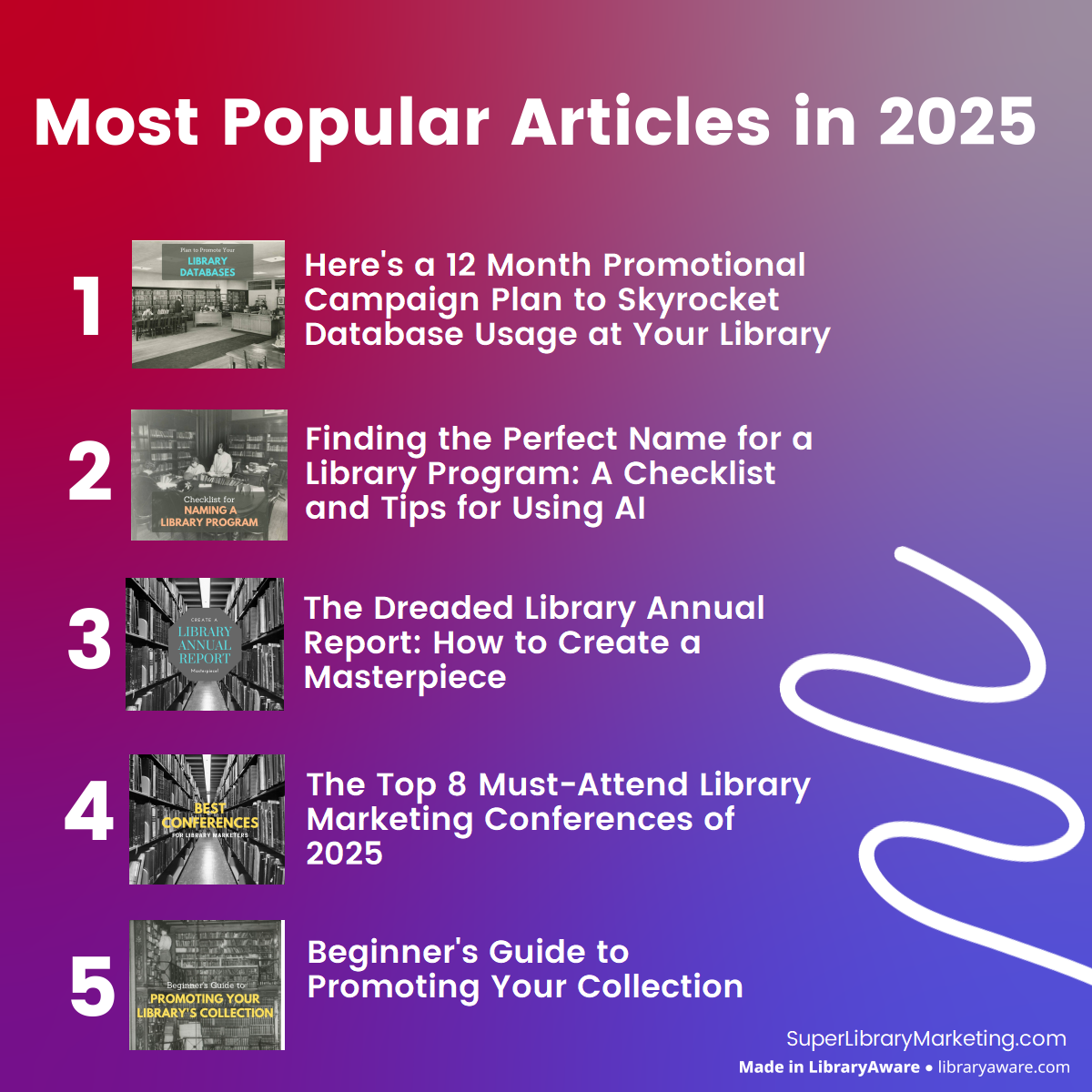
Want to make 2026 your best year yet? Let’s start by learning from the content your fellow library marketers found most helpful this year.
Most Popular Super Library Marketing Articles of 2025
I hope you are looking forward to 2026 as much as I am. My next post will be on Monday, January 5, when I’ll unveil the State of Library Marketing. I’ve got a calendar full of posts and videos featuring tips to make your work easier, as well as profiles of libraries to inspire you. Happy holidays!
Photo courtesy Cincinnati and Hamilton County Public Library
Key Takeaways:
Local business partnerships drive library engagement: By collaborating with local businesses during Library Card Sign-up Month, St. Johns County Public Library expanded its reach and boosted card sign-ups, proving that community-driven campaigns can significantly increase library visibility and impact.
Simple tools and clear communication fuel success: The library’s use of a streamlined online sign-up form, ready-to-use promotional materials, and consistent email updates made it easy for businesses to participate and promote the initiative.
It led to year-round advocacy from partners: What began as a one-month campaign evolved into a lasting network of support.
“One of my favorite places was the library,” recalls Alex. “I have so many fond memories of going there with my mom, then wandering over to the used bookstores on Beach Street to see what treasures we could find. Those visits really shaped my love of libraries and books from an early age.”
“In middle school, I joined the Turtle Patrol through the library with my mother, and it turned out to be a lot of fun,” says Hana. “That experience wouldn’t have been possible without the library.
Now, both women work at St. Johns County Public Library. Alex as Community Engagement Coordinator and Hana as Marketing Coordinator. The duo manages partnerships, campaigns, print promotions, digital marketing, and more. Along with a third coworker, they form the Marketing and Engagement Department at the library, helping with promotions at six branches and two bookmobiles.
“We’re a very community-driven organization, and I believe all of us genuinely see our community members as partners,” says Alex.
I reached out to Alex and Hana because of their unique approach to Library Card Sign-up Month. They go a step beyond the usual “sign up for a library card” campaign and get local businesses to throw their support behind the library by offering discounts to library card holders all month.
Alex and Hana confess they got the idea from the North Little Rock Library System in Arkansas, which helped them figure out the logistics of the campaign before they tried it for the first time in 2024.
“It took us a little over two months to bring in all of the participating businesses for this year’s Community Connections,” explains Alex.
“Our approach was straightforward: we reached out by email, phone calls, and in-person visits, and we leaned on relationships our staff already had with local business owners. We also made it as easy as possible to sign up by creating a simple online form.”
“It also creates a win-win. Our cardholders discover great local spots, and businesses get extra visibility. It’s about extending the library experience beyond our buildings and into everyday life.”
The campaign took a lot of coordination. Hana laid out the full plan, channel by channel:
Social Media: “We focused heavily on social media, especially Facebook and Instagram, because we knew that is where much of our audience already spends time. We highlighted both the value of a library card and the benefit of supporting local businesses through Community Connections.”
Ads: “To build awareness, we launched a month-long ad campaign and distributed printed flyers to participating businesses and community organizations. We also used Peachjar to reach families directly by sending digital flyers to parents of Pre-K through 5th-grade students across the county.”
Local media: “We sent out two press releases in partnership with our Office of Public Affairs team. One encouraged businesses to join the Community Connections program, and the other, during Library Card Sign-Up Month, highlighted the campaign and featured our partners.”
New cardholders: We also created a welcome campaign for new library cardholders, which included a full list of participating businesses as a thank-you and an incentive to explore their community.”
Local officials: “We held a proclamation ceremony and shared updates with our local officials to amplify awareness and community pride.”
Hana says that to keep communication smooth and consistent with their many business partners, she and Alex send regular email updates with key dates, promotional materials the partners can share, and reminders about ways to get involved. Many of the businesses also helped spread the word through their own social media and storefront signage.
The library proved you can build momentum with a campaign like this, year over year. In the first year, the library had 34 businesses on board. This year, that number doubled to 68 businesses. The library also saw an 8.5 percent increase in card sign-ups over the first year of the campaign.
“From the first year to this year, the main change was confidence,” reflects Alex. “In year one, we were pitching a brand-new idea and asking businesses to take a chance. This year, we could point to the success of the program, share the number of partners from last year, and show how much visibility participating businesses received. That made the ‘ask’ more compelling and helped the program grow.
“We also noticed that the businesses were much more engaged this year. One of the big differences was that we created a digital folder with ready-to-use social media images and sample copy. That simple resource made it easier for businesses to spread the word, and we saw them sharing and promoting the partnership more actively than before.”
But great campaign success is measured in more than just concrete numbers. Hana says they used several success measures when reflecting on the success of the campaign, including feedback from businesses and patrons.
For example, a local ice cream company said, “We are thrilled to partner with the St. Johns County Library and to tap into the creativity of their incredible staff! Just like books spark joy and imagination, we can’t wait to bring their flavor ideas to life with an ice cream collaboration the entire community can celebrate and enjoy!”
If you’re thinking this might be something you want to do next year for Library Card Signup Month, Alex advises you keep the process simple for the businesses that partner with you.
“A short online form and clear instructions go a long way,” says Alex. “Also, don’t be afraid to make the ask! Many businesses are excited for opportunities to connect with the community; they just need to know how.”
“This initiative has created a network and year-round advocacy for both the library and local businesses to support each other,” adds Hana.
“The Community Connections initiative is making an impact much bigger than we could have ever imagined. At the heart of it all is our local community, and we’re so excited to explore partnerships beyond Library Card Sign-up Month.
-Hana Tucker
And if they could do anything differently? “It would be to set earlier deadlines for print materials and communicate those clearly from the start,” confesses Alex. “Last-minute details are always tricky to manage. But overall, the program works because it’s a true win-win: libraries promote local businesses, and businesses help celebrate the power of a library card.”
Photo courtesy Cincinnati and Hamilton County Public Library
When she was growing up in Leicester, Massachusetts, Linnea Sheldon found the library to be… boring.
“While I enjoyed reading and admired the librarians, the library itself didn’t feel very exciting,” confesses Linnea. “Today, libraries are dynamic community hubs offering so much more than books, and I love that part of my job is sharing these opportunities with the community. When people say, ‘I didn’t know the library did that,’ I can truly relate.”
Now, in her role as Community Relations and Communications Manager for the Worcester Public Library, Linnea works hard to make sure her community finds the library to be exciting and dynamic. She’s a team of one, communicating to a city of more than 210,000 residents across seven branches and two bookmobiles. She does receive generous help from library staff with tasks like social media posts, flyer design, calendar postings, and more.
And the library is vital to this city. Linnea says nearly 20 percent of her community lives in poverty. So, when she was approached in 2023 about offering a fee forgiveness program, she was fully supportive.
“We had many kids who went home before the pandemic and left books behind in schools,” explains Linnea. “We also have a growing population of unhoused individuals in our community, and we were finding that we were losing patrons because they had lost or damaged items on their accounts.”
“From a marketing standpoint, I knew that the right hook was key for an initiative like this to succeed. I also knew I would have no budget. My goal was to come up with something fun and easy enough that people would not only want to participate but would also want to tell their friends and family about.”
Linnea, who is a self-professed “cat person,” decided to lean into her love for felines to create her campaign, which she called March Meowness. The premise was simple: People could trade cat photos for fee forgiveness.
“We began planning in the fall of 2023 and chose March 2024 because there weren’t any competing campaigns planned,” explains Linnea. “The actual marketing push happened just a week before launch. With limited time and resources, I created our collateral and focused on social media, signage, and email as our primary channels.”
“Another pivotal decision was to pitch the story to the media before we launched it ourselves. Local outlets loved the playful concept, and the first article went live within the hour. Even press outlets in Boston picked up the story, and from there it snowballed. By the time we officially launched on our website and social media, we already had significant buzz and community interest.”
Linnea says the community response far exceeded the library’s expectations. Worcester Public Library decided to launch the promotions a few days early, at the end of February. Patrons were thrilled to be welcomed back in such a fun, positive way.
“What surprised us most was that even people without fees wanted to participate,” says Linnea. “Many people asked if their cat photos could be applied toward another community member’s account, a generous show of support that really embodied the spirit of the campaign.”
The library displayed submissions on a “cat wall,” and soon cat photos started arriving from across the country. After the story was picked up by The New York Times, it spread internationally, and the library was suddenly receiving cat pictures from all over the world.
“The volume was incredible, and staff from across departments volunteered to help,” recalls Linnea. “We developed a workflow: Some saved the photos, others responded to emails, others formatted and printed the pictures, and still others hung them on the wall.”
“Our circulation staff cleared fees for patrons, and my director and I fielded multiple media requests every day. It was an all-hands-on-deck effort, and while it was exhausting, it was also one of the most energizing experiences we’ve ever had at a library.”
Besides the multitude of patrons whose fees were forgiven, the campaign led to some incredible marketing results. Those included:
10.7 percent increase in physical visits
9.2 percent rise in circulation
10.2 percent increase in new library card registrations when compared to the previous month.
46 percent increase in website traffic
244 percent increase in engaged Facebook users.
120 percent increase in Instagram interactions
16 percent increase in TikTok followers from the previous month.
“We also tracked over 500 media stories on March Meowness,” shares Linnea. “NBC Nightly News with Lester Holt even came to our library to shoot a story.”
“But the real impact was seen when you look at how our patrons were helped. Staff successfully unblocked 930 patron accounts during the campaign, while the Library Board of Directors later approved the forgiveness of an additional 3,787 accounts due to the success of the campaign.”
This past June, Linnea and her library received a John Cotton Dana Award for the campaign. That’s how I first heard about it. Sitting at the award ceremony, I can tell you there was nary a dry eye in the room when Linnea described the outpouring of cat photos from people around the world, eager to help her community reconnect with their library.
And it’s no surprise that Linnea and the library repeated the campaign this year, with a few adjustments.
“We knew nothing could match the scale and virality of the original campaign,” explains Linnea. “This year, we launched March Meowness 2.0: Marchier and Meowier. For every cat photo donated to our cat wall, the Worcester Public Library Foundation pledged $1 toward our summer reading programming.”
“The response was wonderful, we received 2,500 photos, and once again, community members came out to see the cat wall grow. We also introduced a new element: a cat mascot with a community naming contest, which resulted in the winning name Whooskers.”
“While this year’s campaign was more localized and didn’t capture the international attention of the first, our community was still excited for its return and embraced it as a fun, meaningful way to support the library and one another.”
“One of the best outcomes of this campaign was the way it allowed staff to connect with patrons and the community in an entirely new way. Library work can be particularly challenging. We deal with serious issues every day and support people in deeply meaningful but often difficult ways. March Meowness brought a sense of lightness and joy.”
“The initiative also opened incredible doors for our library and for me personally. In the past year, we have received more awards than at any other time in our organization’s history. The campaign has connected me with library marketers across the country and strengthened relationships within my own community in ways I never imagined possible.”
And when she’s not creating award-winning campaigns, Linnea says she looks to other libraries, nonprofits, large companies, and this blog (thank you!) to stay on top of trends and get creative ideas.
“I’m subscribed to a wide range of email marketing lists, I’m a regular social media user, and I follow marketing and nonprofit influencers on LinkedIn,” shares Linnea. “I also make a point to research the campaigns and libraries that win marketing awards each year. It’s inspiring to see the creativity and innovation happening across the field.”
“Harris County Public Library was one of the first libraries that really stood out to me on social media; they showed me that taking a slightly unconventional approach could actually expand your reach.”
For a library looking to launch a campaign like March Meowness, Linnea has four key pieces of advice.
Always start with your patrons. This campaign may have been fun and lighthearted, but it grew directly out of a real need identified by our New Users Task Force. Our community needed a fee forgiveness program to remove barriers to access. Without that foundation, the idea wouldn’t have resonated the way it did.
Lean into what makes your library unique. For us, it was cats. We were already known for our cat memes, and many staff (me included) are passionate cat lovers. That authenticity made the campaign feel natural and genuine, which helped it connect with people.
Remember that making marketing fun can actually make your job easier. While responding to the overwhelming interest took a lot of work, the creative and promotional side of the campaign was surprisingly simple. Of course, not every initiative lends itself to this kind of playful approach, but finding ways to add a little fun to a program or campaign benefits both patrons and staff.
It helps immensely to have supportive colleagues and leadership. Over the years, I’ve built strong relationships with staff and with our Executive Director, who is always willing to try new and creative ideas. That trust and openness were critical in bringing March Meowness to life.
Subscribe to this blog, and you’ll receive an email whenever I post. To do that, enter your email address and click on the “Follow” button in the lower left-hand corner of the page. You can also follow me on the following social media platforms:
This year marks the 10th anniversary of the Super Library Marketing Reader Survey. Over the past decade, library marketing has grown and changed in exciting ways, and so have the questions in this survey. And since I can’t visit every library (as much as I’d love to!), this survey helps me understand what’s working for libraries, what’s challenging them, and what’s next.
Your responses will shape the blog posts, videos, and presentations I create over the next year. The survey takes about 5-7 minutes. I’d be so grateful if you’d also share it with anyone at your library who works on promotions, whether or not “marketing” is in their job title.
I’ll publish the results on January 5, 2026. Thank you for being part of this amazing community.
Subscribe to this blog and you’ll receive an email whenever I post. To do that, enter your email address and click on the “Follow” button in the lower left-hand corner of the page. You can also follow me on the following social media platforms:
Photo courtesy of Cincinnati and Hamilton County Public Library
It’s not surprising that Tina Walker Davis and her communications team at Deschutes Public Library in Bend, Oregon, have a robust and interesting video strategy for YouTube. Tina, who grew up in the San Francisco Bay area and graduated from Washington State University, has a previous career as a television anchor and reporter.
“I left journalism to go into marketing and communications and owned my own marketing business for 10 years until I made the financially disastrous decision to open an independent bookstore,” explains Tina. “While the bookstore didn’t pan out, it did enmesh me in the literary community here, including the library system.”
Tina took a job at the library in 2012 in event planning and coordination. Now she’s Communications Manager for the library. She manages four people, including a Graphic Design Coordinator and Dana O’Connell, Keifer McCool, and Michael Rivera, who are all Digital Communications Coordinators.
“Michael almost exclusively does video work, and Dana and Kiefer both manage social media,” says Tina. “Dana also does all of our Spanish-language communications. I’ve told the team many times that I’ve never worked with such a collaborative group.”
“We have bi-weekly brainstorming sessions that are so fun. There’s no agenda. It’s just a time for us to come together and talk about what we’re seeing, what we’re excited about, and generally throw some spaghetti at the wall. A lot of our best content was conceptualized in those brainstorming meetings.”
Deschutes Public Library’s YouTube channel was already up and running when Tina began her job. At first, Tina’s team used it to share story time videos and videos of their marquee events, as well as a Why We Love the Library series in 2016 and 2017. At the end of 2019, they had 265 subscribers.
Then COVID hit. Like most libraries, Deschutes Public Library pivoted to online programs and saw its subscriber count grow to 14,500 at the time of this writing.
When Tina hired Michael in 2022, he “brought a wealth of professional video production experience—just phenomenal skills in shooting and editing, but also a fantastic eye and ear for storytelling,” exclaims Tina.
“I don’t know if it’s my background in journalism, but I’ve always believed in the power of stories to do the work that we can sometimes struggle to do in marketing.”
“We can run ads telling people how great the library is, but it’s so much more impactful when it comes from real people who truly believe in the power of libraries to change lives.”
-Tina Walker Davis
Dana says the library’s strategy, when it comes to producing videos for YouTube, is to strike a balance between the information the community needs to know about the library and fun or trending content.
“Everyone who comes into the library has a story,” explains Dana. “Some of our human-interest pieces come from referrals by our public services staff, in the form of kudos from our online web form, or a chance meeting while in one of our branches.”
“Staff, volunteers, and customers offer the chance to talk about the library in a unique voice where we aren’t necessarily promoting a product or service. For me, it’s about having a touch point with a customer and listening to what excites them about the library; no two answers are the same.”
“One thing we do every time someone is interviewed for a video, regardless of the topic, is to ask, ‘Why are libraries important?’” adds Tina. “The answer to that question is evergreen. We can pull the answer and use it along for a series of shorts, turn it into a graphic quote for social, or string together several answers for a stand-alone piece.”
Dana and Kiefer shoot and edit the short-form, vertical format for Instagram, Facebook, TikTok, and YouTube shorts. Michael uses videography equipment to do the longer-form and documentary-style videos.
“But rarely do they work alone,” explains Tina. “They’re writing together, and often Dana or Kiefer will act as Michael’s grip during shoots and take care of the interview portions. Michael is definitely a dedicated videographer, but it’s truly a team effort between the three of them—and it’s magical.”
All videos from Deschutes Public Library have captions for accessibility and clarity. They also have video thumbnails featuring a branded, consistent look. That helps to capture the attention of scrollers while making sure viewers know this content comes from the library.
“When I choose the image(s), I’m looking for a visually pleasing frame that tells the viewer just enough to pique their interest without giving away too much of the story,” reveals Michael. “The best images will also have some clean space in the frame that the title will naturally fall into.”
“The title in the thumbnail usually doesn’t match the video title, and that’s on purpose. The main title is always clear and matter-of-fact, while the thumbnail title often uses one of the most impactful quotes in the story. The key here is to be concise to maximize the size of the text in the frame, so the titles are usually no more than six words.”
Deschutes Public Library doesn’t rely on pure chance to get views on its videos. They promote them!
“Our flagship eNewsletter has 55,000 subscribers, and we’ll sometimes link to videos from the newsletter,” says Tina. “We embed some videos on our website. In particular, we’ve used our videos on our website to help inform the public about our bond projects.”
“I also do some paid promotion of videos on YouTube, Facebook, and Instagram if I can see that a monetary ad boost is needed and will help us really target our Deschutes County residents.”
“So, with all that said, our investment in YouTube as a platform was very organic. It started slowly, but we saw real growth. But nothing happens on YouTube alone in terms of storytelling. Anything that is shared there is also pushed out on Instagram and Facebook, and some also make their way to TikTok if they’re humorous or have that viral potential.”
Tina and her team say the videos help boost awareness of the library and its services, and they’ve received a wealth of positive community feedback.
“Our recent viral video — where our director, Todd Dunkelberg, is giving a Gen Z-inspired tour of the new Redmond Library — was a great community experience. Between Facebook, Instagram, TikTok, and YouTube, we are now close to 5 million views on that video. But what I loved seeing was locals commenting amongst folks from across the country and the world — the locals took so much pride in claiming the library as their own (‘That’s MY library!’).”
“And Todd became a little local celebrity after it, with folks coming up to him in the community and telling him how much they loved the video. We immediately jumped on the ‘Slay’ and ‘So Julia’ lines and created stickers with the characters Todd points to in the video, and those were really popular with our customers.”
For inspiration, Tina and her team often look inside and outside the library world.
“I’m guilty of being an Instagram reels scroller,” confesses Tina. “My brain often goes to, ‘Could we put a spin on that?’ Often in our brainstorming sessions, we’ll bring forward videos that we’ve seen over the past two weeks, share them with the team, and see if there’s something we can do along those lines.”
“Library systems are really growing into their own niche on social. They’re funny, sometimes irreverent. People really enjoy watching library folks, who are perhaps historically thought of as buttoned up, be funny.”
– Tina Walker Davis
Tina says the key factors in the success of the library’s video marketing strategy are her talented team and library leadership that believes in the power of communication.
“I know that for a lot of libraries across the county, being able to spend this kind of time on video work is an absolute luxury,” says. Tina. “I feel very fortunate to not only have the trust from our leadership to do that work, but also lucky to work with a team of communications professionals who are passionate about the work and the message.”
“The goal is to remind our customers, the taxpayers who make the library’s work possible, that the library is here for them, in whatever way they may need, from checking out a book to finding a job. We’re here to meet people where they are and make their lives better.”
Subscribe to this blog, and you’ll receive an email whenever I post. To do that, enter your email address and click on the “Follow” button in the lower left-hand corner of the page. You can also follow me on the following social media platforms:
Photo courtesy Cincinnati and Hamilton County Public Library
We are now firmly in the second half of the calendar year. I don’t know about you, but when I worked in a library, this was the time I usually started to “drag” a little. I was tired and uninspired. (Hey, that rhymes!) I needed a little boost… someone to remind me to focus on what was important.
I’m here for you. These are the eight things I want you to focus on as you move into the next six months. This is also a great post to share with new hires who work on library promotions. The eight principles listed below are the most valuable tips I can offer to help you center your work and find direction.
And I’m curious… do you think I missed anything in this list? Add your guiding principles to the comments!
8 Tips to Focus Your Library Promotions
1. Plan ahead — don’t just react.
This is my number one tenet because so many of the library staff members I work with say they feel like order takers! They are asked by different departments and branches to promote the things that are important to those people, which allows no time to create a strategic library marketing calendar or campaign that supports the library’s overall goals.
Effective marketing is proactive, not reactive. You want your promotions to be holistic, covering all the channels where your target audience is located (see item #4). List the goals you want to achieve over the next six months, and create holistic campaigns. Before you know it, you’ll have a full editorial calendar.
And I know this might sound scary, but be transparent. Share your calendar with the rest of your coworkers. Inform them of the overall goals and provide them with regular updates on the content you share and the results you are achieving. At the end of the year, let everyone know how you did.
This will help educate your coworkers about marketing! Many of them probably think marketing is reactive. They don’t know how much planning and coordination go into an effective campaign.
2. Promote the benefits, not the features.
Listen, I know this one is hard. But your community is looking for a solution to their problems.
So instead of saying, “Use our personalized reader recommendation service”, highlight how your service solves real problems, like helping readers to find the right books for them (because, let’s be honest, there are SO many good books out there!), or helping readers who feel like they’re stuck in a rut, reading the same things over and over again.
You want your readers to think of the library, not Google or Goodreads, as the best place to find a book.
3. Tell more stories of how the library impacts lives.
User-centered storytelling, like Loyola Marymount’s Library Fans video series, connects emotionally with users and shows the library’s impact on real lives. These stories are more memorable than stats or service lists.
Storytelling helps your community to see how others are using the library and imagine how they might use the library too!
4. Meet your audience where they are.
Use the channels your patrons prefer. And remember, you don’t have to be on every channel. You just need to be on the right ones.
The channels you choose should match the preferences of your primary audience segments.
Teens and college students? Think TikTok and YouTube Shorts.
Parents and caregivers? Facebook groups and email are the best way to reach this audience.
Adults over age 65? In-person outreach and local newspapers or printed newsletters can be most effective.
Most importantly, don’t try to build an audience on the channels your patrons don’t use. How do you know which channels your audience prefers? Use metrics (see #8) and surveys to pinpoint where your energy will be best spent.
5. Consistency builds brand recognition and affinity.
At the Fourth of July parade two weeks ago, I instantly recognized the library’s entry coming down the street, even without my glasses. How? The color scheme of their banner and vehicle! (As an aside, I was sitting right in front of one of the branches, and the cheering that rose from the crowd when the library drove by warmed my heart.)
You can have the same impact. Use your brand logos, color palettes, and tone across channels. Patrons should instantly recognize your library’s content, whether it’s on a digital sign, flyer, or Instagram Story.
I know this seems like a constraint to some of my more creative readers, but the discipline pays off with instant brand recognition.
Beyond your brand colors and logo, remember to name your services clearly and tie all services to your library (e.g., “Consumer Reports from Maple Tree Library”).
6. Empower your advocates.
Your best marketing tool might be your most loyal library users. Feature them in campaigns and encourage user-generated content. When your superfans talk about how much they love the library and how it impacts their lives, people will listen!
Encourage staff to promote programs on their own social media (with branded templates or messaging prompts).
And provide your Friends group or foundation with a marketing kit: shareable graphics, key talking points, and event blurbs.
7. Always be repurposing.
Library marketers are asked to create a lot of content! Just like you may do in your home, you can reuse and recycle some of that content to help ease your workload and ensure your best content is seen on multiple channels. You can do that by:
Repurposing blog posts, newsletters, and program guides into social media snippets, videos, or infographics. Share this content with local media and community partners.
Turning book displays into short videos for social media by adding trending audio and creative elements like stickers.
Clipping moments from author talks or storytimes for Instagram Stories, YouTube Shorts, or TikTok videos.
Breaking down long blog posts into carousel posts or pull quotes for your homepage, digital signs, or social media posts.
8. Measure what matters.
Your metrics are key to guiding your marketing strategy. And listen, I’m the first person to admit I can easily go down the rabbit hole of data and measure everything.
But my boss coaches me to only spend time measuring the things I need to help make the decisions that will guide my future library marketing actions. That means I don’t obsess over likes and followers.
Instead, I track engagement metrics like watch time on videos, shares of social media posts, and read time on blog articles. I also urge you to use UTM codes like Bit.ly and Google Analytics to track campaign sources, so you know which channels are driving traffic to your library and which pieces of content resonate most with your community.
Subscribe to this blog, and you’ll receive an email whenever I post. To do that, enter your email address and click on the “Follow” button in the lower left-hand corner of the page. You can also follow me on the following social media platforms:




 Super Library Marketing: Practical Tips and Ideas for Library Promotion