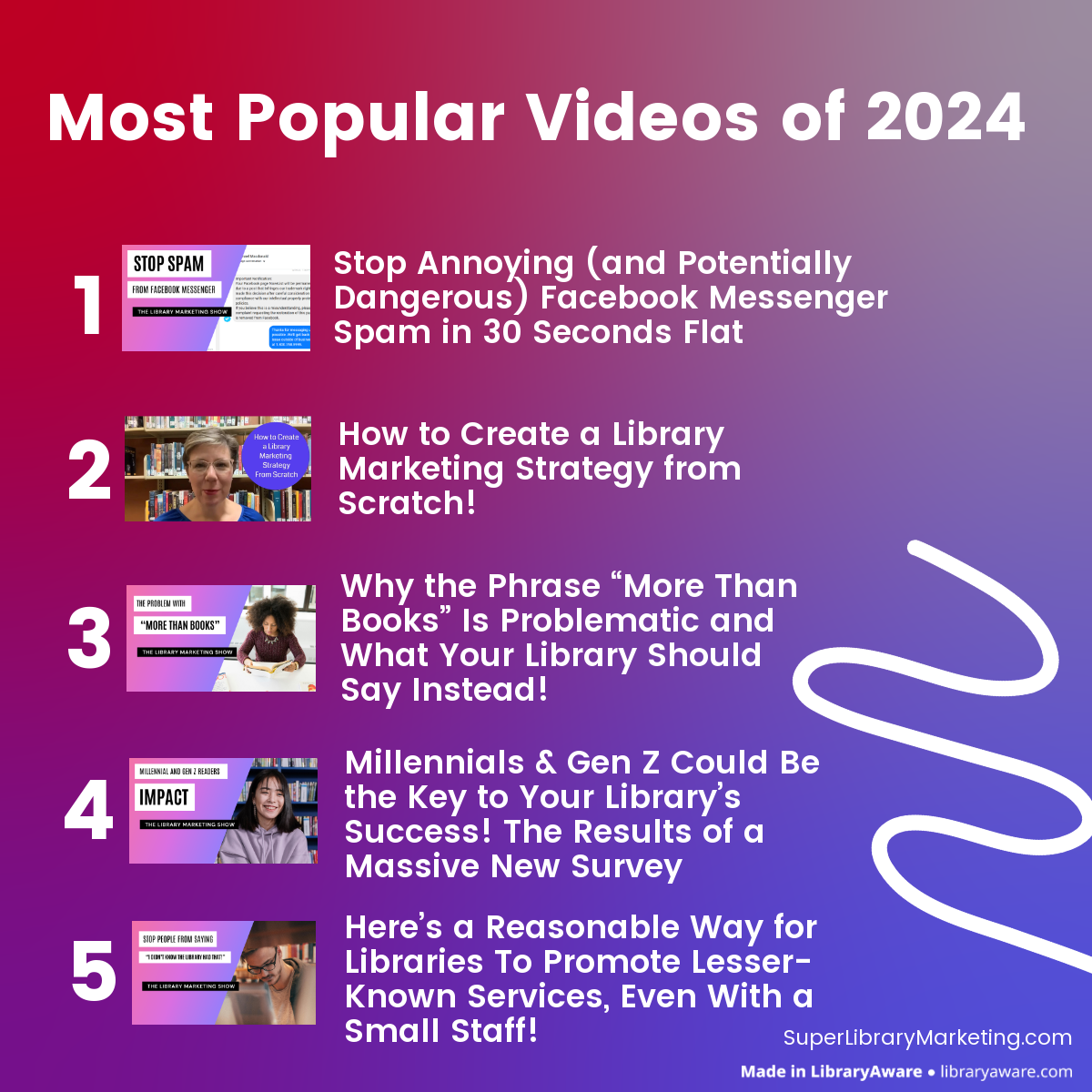
This holiday week, I wanted to ensure you are set up for success in promoting your library in 2025. These are the most popular Super Library Marketing posts from the past year that you may have missed. (We’re all so busy!)
Most Popular Super Library Marketing Articles of 2024
I hope you are looking forward to 2025 as much as I am. We’ll be tackling new library marketing and promotion subjects. Plus I have lots of library profiles on the calendar. You’ll be hearing advice from libraries just like yours. As always, I welcome your suggestions about topics you want to cover. Happy New Year!!
Subscribe to this blog and you’ll receive an email whenever I post. To do that, enter your email address and click on the “Follow” button in the lower left-hand corner of the page. You can also follow me on the following social media platforms:
Photo courtesy Cincinnati and Hamilton County Public Library
Amanda Weakley was pursuing a master’s degree in English when a comment from a professor changed the course of her career.
“I took an elective in Library Science,” recalls Amanda. “The class went well, and the professor commented that I would be a great librarian. Shortly after that, I noticed a vacancy at a local library and applied. Once I started working in libraries, I knew it was where I wanted to be.”
Amanda grew up in Rappahannock County, Virginia, located in the foothills of the Blue Ridge Mountains. She’s been a cardholder of the Rappahannock County Library since she was a preschooler.
Now she serves as director of the library, where she started working 14 years ago. Rappahannock County Library is a small, rural library that serves a population of just over 7,000 people.
“Currently, we have 3.5 FTE employees, me included, so we all do a bit of everything,” explains Amanda. “If there is an idea, we work together to see it through, usually a person or two handling every detail from planning to presentation and assessment. It is a lot of work, but the reward of successful library services and programs is immeasurable.”
With such a small staff, the library must get the most out of every tactic they use to promote their library. Rappahannock County excels in two areas: their word-of-mouth promotions and their partnership promotions.
Partnership marketing involves collaborating with other organizations, businesses, or influencers in the community to achieve mutual goals. Word-of-mouth marketing is all about building a buzz through community members, staff, and volunteers. It encourages people to spread positive stories, experiences, and testimonials about the library.
Staff members are often the key to both strategies. They are trained to spread news about new services and upcoming events and look for partnership opportunities.
“It really is a way of optimizing resources,” says Amanda. “Especially with a small staff and a small community, it helps to have as many happy patrons as possible and community partners advocating for you and spreading your news. We have friends of friends, clients, and members of partner organizations attending our events, using, and recommending our materials and services.”
“For as long as I have worked in libraries, and even prior, my focus has been on positive experiences and connections. I want everyone to have a positive experience or association with the library, be it through participating in a program, staff interaction with individuals, or staff collaboration with community partners.”
“We know people talk, so let’s give them wonderful things to say about the library and library staff! In a small community, I think word travels faster, and our organic tactics have evolved into strategic decisions.”
Amanda says libraries of all sizes should focus on what they do best in their community. Then, build and maintain healthy relationships with patrons and community partners around those key resources.
And don’t be surprised if it takes time to see the results from word of mouth and partnership marketing.
“There is a reality that you can work hard to get the word out and make connections, but there will always be people who will not receive your message,” explains Amanda. “It’s frustrating when you do everything to share information and someone says, ‘I did not know you offered that!’”
“If you have the opportunity, talk to the person, and see where they seek or find out information. Learn from each interaction and try to meet people where they are with a positive library or library staff experience. After a positive experience, your mentions will stand out and have more impact.”
The strategy’s success is easy to see if you look at Rappahannock County Library’s Facebook page. They are often tagged in photos and posts by their partnership organizations. That gives their library exposure to a whole new audience of potential patrons.
“We want our patrons and partners to tell people about us, send people our way, and even send us or our services to people. It’s a cycle of working for people, and if all goes well, they seem to work for us by continuing to market for us without even realizing it!”
Subscribe to this blog and you’ll receive an email whenever I post. To do that, enter your email address and click on the “Follow” button in the lower left-hand corner of the page. You can also follow me on the following social media platforms:
Photo courtesy Cincinnati and Hamilton County Public Library
I’ll never forget the first time I spoke in front of a community group on behalf of the library.
I was a nervous mess. The pressure was high. So much was riding on my five minutes in front of this group. I wanted to connect with my audience, transfer some of my passion for the library to their souls, and inspire them to action.
A community presentation is a unique opportunity to talk directly about the value of your library. What you say in those moments will stick with people longer than any flyer or sign ever will. But for maximum impact, you must take a strategic approach to your presentation.
And, although I know that five minutes doesn’t seem like a lot of time, it is! If you don’t believe me, stop reading this blog, set a five-minute timer, and just sit there with your eyes closed trying to predict when the timer will ring.
Five minutes is a LOT of time. And you can do a lot in five minutes!
Here are seven tips to make any presentation engaging and impactful. Scroll down to see a sample outline I’ve created to walk you through creating a presentation that hits the mark, even when you only have five minutes to share.
Refer to the library as “your library.”
Many people in your audience may haven’t visited or used the library in a long time. They may not think of the library as belonging to the community, and they certainly won’t think of the library as belonging to them personally.
So, in your presentation, refer to “your library” as many times as makes sense. This is a subtle way to let your audience know that the success of the library affects everyone in the room.
Start with a hook.
You want your audience to be interested and attentive, and the best way to do that is to start right off, not by introducing yourself, but with a surprising fact or statistic about your library.
For example, “Your library sees about 20,000 people who come into the physical building every year—that’s enough to fill our high school football stadium four times over! I’m Jane Doe, and I’m here to show you how your support of the library impacts those 20,000 people.”
You could also begin with a short, compelling story about how the library positively impacted someone in the community.
For example, “I want to begin by introducing you to Susan. Susan was laid off about 6 months ago, after spending more than 20 years at her company. She came to your library for help finding a new job. We spent time updating her resume, searching for jobs that fit her experience, and practicing interview techniques. Susan landed a new job and is now making more money than she was at her former position, all thanks to the staff at your library.”
Choose one main message and repeat it throughout the presentation.
It will be tempting to try and talk about everything the library has to offer during your five minutes. However, listing all library services will overwhelm and confuse your audience. Instead, focus on one message you want this audience to remember.
For example, if you are speaking to the school PTA, you will want to focus your message on resources available to students and parents to help with schoolwork. Your main message would be: “Your public library takes the stress out of schoolwork.”
Or, if your library is getting ready for a major construction project, you’ll want to talk about how the renovations or new construction will provide better service to the community. Your main message would be: “These new library spaces will be vibrant, accessible places where everyone in our community can thrive.”
Whatever your main message is, try to work that into your presentation at least three times. Repeating it will help it stick in the minds of your audience.
Use visual aids.
You can put together a short slide deck to help drive home your key message. Be sure to keep your slide text short. Add infographics, photos, or short video clips that reinforce your message.
If the room setup does not include a screen for a slideshow, bring handouts with you! Add your key message points to the top of the handout, and then some visuals like charts, photos, or infographics.
Add an interactive element.
You may be tempted to talk for your entire five-minute slot. But your audience is more likely to remember what you say if you involve them in the presentation in some way.
Launch a poll. Several free sites like Slido and Mentimeter let you embed a poll question in your slide deck with a QR code. Or just ask for a show of hands.
You could also ask a question of your audience, like, “How many of you have visited our library in the past month? What is the first thing you remember seeing when you walked into the building?”
Or try a mini-activity. For example, you could ask everyone to take out a piece of paper and write down as many library services as they can think of in 30 seconds.
End with a call to action.
Give your audience something to do after your presentation. You can invite them to visit the library for a special prize. You can ask for volunteers or donations. One library staff member I’ve spoken with did a presentation on intellectual freedom and handed out talking points, encouraging the audience to use them in conversation with friends at family.
Practice your speech.
A practice session or two can help identify parts of your speech that are less engaging and can ensure you stay within your time limit.
Ask a few coworkers to play the audience and then ask them for feedback on your presentation. Or record yourself giving your speech so that you can evaluate the timing, pace, and content.
Sample Outline for a Five-Minute Presentation
To help get you started, I’ve created this outline template for a community presentation. By following this structure, you can deliver an engaging and persuasive message about the benefits of the library within a short time frame.
Introduction (30 seconds)
Start with a hook: Share a surprising fact about your library or a testimonial or patron story.
Main Message (3 minutes)
State the main message you want this audience to remember.
Talk about the service you are highlighting.
Share how this service impacts your community, and how the community would be impacted if the service were NOT available.
Engagement (1 minute)
Ask rhetorical questions.
Insert an interactive element.
Conclusion (30 seconds)
Call to action: Leave your audience with a task that reinforces your key message.
Subscribe to this blog and you’ll receive an email whenever I post. To do that, enter your email address and click on the “Follow” button in the lower left-hand corner of the page. You can also follow me on the following social media platforms:
Photo courtesy Cincinnati and Hamilton County Public Library
A few weeks ago, I received a question from a reader.
The email read, “My library has recently dealt with many unexpected closures and disruptions in service. Our AC went down during a heatwave, our drive-thru will be closed for three days due to road repair, our parking lot was closed for resealing, our meeting rooms are short on tables due to some faulty wheels, our entrance was temporarily closed due to construction, our catalog will be down due to a migration, our elevator is on the fritz… and the list goes on!”
“Our staff always want to make sure that patrons are informed and prepared for what to expect when they arrive, but I’ve been concerned about balancing our messaging.”
Ensuring your community has updates on broken equipment or services that are unavailable while continuing your normal promotions highlighting the library’s value is a common challenge. For my library marketing friends who are dealing with hurricanes, construction projects, unexpected power outages, and more, I’ve created this guide with recommendations on how to manage these situations.
Tip #1: Prioritize critical messages.
If your library is facing significant disruptions that impact a large number of patrons (e.g., catalog downtime, major entrance closures,), use all your available channels (website, social media, emails, texts, signs, etc.) to inform your patrons.
As you craft your messaging, be certain to use clear, conversational text. Give easy, step-by-step instructions for navigating these disruptions. And, always be sure to include a phone number or email where community members can ask further questions.
Let your community know how long the disruption will last. And promise to provide further updates. Your goal is to minimize situations where unexpected surprises could cause frustration or inconvenience.
Here’s a great example from Delaware County District Library, which sent an email to let people know its locations will close for a staff training day.
Tip #2: Use targeted messaging for less critical issues.
For less critical issues (like broken equipment or minor repairs), an “Out of Order” sign on the affected item may be sufficient. If it’s a piece of equipment in your MakerSpace, and you have emails for community members who have reserved the equipment, a quick email letting them know it’s unavailable is warranted.
You could also use your website or digital signage within the library to let patrons know about the disruption as they arrive at the branch.
Tip #3: Have lots of disruptions? Consider bundling your messages.
If you’re facing a situation like my reader where you have multiple outages, consider bundling updates. A weekly update post on social media or an email summarizing all current disruptions will inform your community without inundating them with multiple messages.
Tip #4: Create a “Service Alerts” section on your website.
A landing page where notifications about all service alerts are located makes it easy to keep all information about potential disruptions in one place. Like Vancouver Public Library, you can train your community members to look there for updates and point to this section when creating email or social media messages about new disruptions.
Tip #5: Ensure staff have messaging for in-person interactions.
Make sure you take the time to give your library’s front-line staff up-to-date information so they can proactively inform patrons and suggest alternatives when disruptions affect a visit. This helps staff manage patron expectations. It also empowers staff and makes them feel more confident as they interact with community members.
Tip #6: Consider adding humor to your messaging.
Humor can be an effective way to soften the impact of negative news, like service disruptions, without downplaying their importance. It can also make your messaging feel more approachable and lessen frustration.
For example, instead of a straightforward “The elevator is out of order,” try: “Our elevator decided to take a break—stairs are getting their time to shine!” Or, if your catalog is down, you could say “Our catalog is taking a nap for maintenance. It’ll wake up refreshed and ready soon!”
You can also use funny visuals, as Orkney Library did when they were forced to close an hour early for a whole week.
Finally, try pairing your disruption message with a positive point. For example, “Our entrance is blocked due to construction, but we’ve still got an open door to great reads.”
Tip #7: Pay attention to your community’s response to the disruption.
As with any library communications situation, pay attention to feedback from your community members regarding your communication strategy. You’re striking the right balance if patrons feel well-informed without being overwhelmed. If they complain that they’re getting too many or insufficient messages, adjust accordingly.
Although disruptions are not ideal for your community and your marketing, you will learn things about your audience! For example:
How do patrons use the library? Disruptions can reveal patterns of library use. For example, if many patrons express frustration over catalog downtime, it indicates that digital access is a high priority. Alternatively, if they’re more concerned about space (like meeting room availability), it shows how much they rely on physical spaces. You can use this information to inform future marketing.
Which channels work best for communication? Analyze how patrons respond to disruption notices. Do they respond more to messages sent via social media, emails, or to messages delivered in person? This can tell you which communication channels are most effective for your library’s audience.
Subscribe to this blog and you’ll receive an email whenever I post. To do that, enter your email address and click on the “Follow” button in the lower left-hand corner of the page. You can also follow me on the following social media platforms:
Photo courtesy Cincinnati and Hamilton County Public Library
When Jennifer Fermino graduated from college with a B.A. in English, she needed help figuring out how to put together a resume that would land her a job in communications. She found that help at what was then the New York Public Library’s Mid-Manhattan Library (now the Stavros Niarchos Foundation Library).
“It was an invaluable resource for a young person who really didn’t know what she was doing or how to translate any of her job skills, which was then primarily waitressing and nannying, into the career path I was aiming for,” recalls Jennifer. “I would also add I am in good company: President Obama also credits the Stavros Niarchos Foundation Library with helping him get his first job.”
And now, 20 years later, after stints as a reporter for the New York Post and the New York Daily News, as well as PR agencies and as Communications Director for the New York City Council, Jennifer works for NYPL as Vice President for Communications and Marketing. She’s been at her dream job for about a year and a half.
“It’s amazing to work for a system that serves three boroughs in the greatest city in the world (Manhattan, the Bronx, and Staten Island),” enthuses Jennifer. “We have 92 locations and there is never a dull day.”
Jennifer and a team of nearly 30 people run all marketing and promotions for the library. And her first 18 months on the job were, shall we say, a trial by fire.
New York City Mayor Eric Adams proposed huge cuts to the library’s budget earlier this year… $58.3 million to be exact… that would have forced NYPL to dramatically reduce hours. The budget cuts also threatened the library’s budget for books, programs, and maintenance. Prior cuts, enacted in late 2023, forced all NYPL branches to close on Sundays.
Soon after these new cuts were announced, NYPL, along with the Brooklyn and Queens Public Libraries, launched a massive campaign to show the importance of the city’s three libraries. And New Yorkers, as well as library lovers from across the country (myself included) jumped in to show their support.
For months, I was served a social media post from NYPL every time I went online, on all channels. It felt like a coordinated, consistent effort to keep reminding people of the threat of the cuts. And that’s why I reached out to Jennifer. I wanted to know how her team managed the campaign.
“It was a sustained effort to tap into the goodwill that people have for libraries and keep the cuts front and center,” says Jennifer. “I give huge credit to Victoria Reis, our social media manager, who is creative and has an understanding of both online culture and our audience.”
“We began repurposing the famous “This is fine’ meme with our mascot Patience and it was an immediate hit with our followers. People really connected to the campaign, and the message – that we already lost Sunday service and were in danger of losing more – resonated.”
“The reaction kept growing and growing. Towards the end of the campaign, one of our memes – again a repurposing, this time of the “girl explaining” meme, went over the top viral. Last I looked it had over 7M views on X (Twitter).”
The team included messaging on other channels as well and worked hard to stay coordinated.
“Special shoutout to our talented Managing Editor Katherine Ward, whose job was to keep it all together for us,” declares Jennifer.
The team coordinated messaging using four main tactics:
Their NYPL Connect newsletter, which I encourage any library or NYC lover to sign up for, as well as regular reminders of the cuts on our home page.
Letter writing stations in branches in which patrons could easily write city leaders to support libraries.
Rallies of supporters at City Hall that the press was invited to cover.
And, as mentioned, a fun, creative social strategy.
“We honestly didn’t know what was going to happen – everyone was hopeful but on pins and needles,” remembers Jennifer. “Reporters started calling me saying they had sources saying we would be saved, but I refused to believe it until it was official. People were congratulating us, but I felt like it was jinxing us. It took a bit for me to finally accept that it was over.”
“Thankfully, the Mayor has a history of supporting libraries, and we are grateful that he funded us. We also had the City Council, including Speaker Adrienne Adams, firmly in our corner throughout.”
“But I can say that our campaign engaged New Yorkers and showed how much people love their libraries, which is so important in the budget process.”
While they fought the budget cuts, NYPL’s marketing team had other promotions to balance.
“We had launched our “Books for All” campaign celebrating the freedom to read and standing against book bans right before the cuts were enacted,” explains Jennifer. “We continued that campaign all year long because the issue is of such importance to us.”
“We also just finished our ‘Summer at the Library’ campaign with Brooklyn and Queens to promote reading and education city-wide during the summer break for schools. Although not technically part of the advocacy campaign, efforts like this help show why funding libraries is so important.”
“We are always exchanging ideas and talking about how to engage New Yorkers,” says Jennifer. “It is a great relationship. We are partners throughout the advocacy campaign and continue to do great work together.”
“In fact, we are planning a national Freedom To Read Day of Action on Oct. 19 with Brooklyn and Queens, as well as the American Library Association, Unite Against Book Bans, and the Association for Rural and Small Libraries to stand against censorship. We have many libraries already signed up and invite everyone to join us.”
Subscribe to this blog and you’ll receive an email whenever I post. To do that, enter your email address and click on the “Follow” button in the lower left-hand corner of the page. You can also follow me on the following social media platforms:
It’s been a while since I’ve seen a print news magazine from a library. And this one was so good, I had to reach out to the editor, Karen Jensen, the library’s Community Liaison. She and several other employees manage all the marketing and public relations for the library. Karen also oversees grants and volunteers and is the liaison for all six of the library’s Friends groups.
A native of Valparaiso, Indiana, Karen graduated from Ball State University with a liberal arts degree. After college, she worked for a large radio station in the Midwest as a copywriter. She also took on a variety of jobs within the equine industry. Her love of horses was fed by her childhood library trips.
“I was a horse-crazy little girl (who grew to be a horse-crazy adult) and was so completely drawn to Marguerite Henry’s Misty of Chincoteague, King of the Wind,and Walter Farley’s books, The Black Stallion,” remembers Karen. “Books were some of my favorite gifts as a child and adolescent and my nose was buried beneath the pages much of the time. The rest of my leisure time was spent in the barn with my beloved horses!
Her passion for horses and a business prospect brought her to Ocala, Florida where she worked primarily within the public and nonprofit sectors before joining the library in 2009.
“The first issue of our quarterly WORDS magazine was in the spring of 2009 before I joined the library system,” recalls Karen. “I arrived in time to spearhead the fall issue and have served as the magazine’s editor since that time.”
“The magazine provides a central information source for all events, and updates on library information and resources, in both print and digital formats. It offers a professional means for sharing information with elected officials, community partners, and a myriad of other groups and individuals with whom we all come in contact.
-Karen Jensen
“Although by no means our only method of communicating with the public, it is a key reference point for all staff when working within our community.”
Words has evolved from its original eight pages to its current 20 pages and is funded entirely by the Friends of the Ocala Public Library. Work on each issue starts six months before the publishing date.
“There is a creative meeting with managers and supervisors quarterly where we establish the theme and content for the next issue,” explains Karen. “Upon the selection of the theme and content, I will seek volunteer writers from within our library staff, as well as within the community.”
Words is unlike other library newsletters, in that it’s a balanced mix of in-depth stories and library promotion. The issue I received included a patron interview on fall traditions, a piece on a historic tourist destination, and a preview of an upcoming library program featuring a chef from the World Equestrian Center. It’s informative, educational, entertaining, and beautifully designed.
“The number of print copies has always been small, with a current print quantity of 4,500 for three issues and 5,000 for the summer issue for nine library locations,” says Karen. “In addition to the small print quantity, the library system uses a mail management system (LibraryAware) to disseminate monthly updates to more than 80,000 patrons in Marion County.”
I’m not surprised to learn that Words is a hot commodity for patrons.
“We hear from patrons and community members asking, ‘When is the next issue coming out?’” explains Karen. “And, as with many print magazines, there are always special favorites that really resonate within our community. Typically, it is themes about natural resources in our county or other highlights. People really love learning about their community and we certainly want that to include their public library!”
“We now have very few remaining print copies at the end of each quarter and typically run out before the end of the quarter at our larger branch locations. We do, as supplies allow, take print copies to outreach events, but more than likely have a flyer with the QR code and how to sign up to receive a copy available at tabling events.”
“Our library system administration and staff love the magazine and even when it is an add-on to workloads, are so very proud of the final result. And there is really nothing to compare with receiving an email from a community partner, an elected official, or a mom of three who says, ‘I just love Words!’”
Karen’s advice for any library looking to start a news magazine
Tip #1: Start with a plan.
Establish goals, audiences, what is to be accomplished, and by whom, early on.
Factor in how you will measure your outcomes. This is really such an important part of any public relations/communication efforts. How will you know if this is a cost-effective endeavor? What is the ROI?
How often will the newsletter be published?
Who will the editor be?
Who will manage the production?
What are the costs associated with the news magazine production and how will the costs be covered?
Tip #2: Determine what combination of formats is going to work best for your audiences.
If cost is a factor, digital format will be the most realistic.
Explore a mail management platform that will work for your community of patrons. We selected LibraryAware and it has really helped to expand the footprint far beyond the print or website reach.
Subscribe to this blog and you’ll receive an email whenever I post. To do that, enter your email address and click on the “Follow” button in the lower left-hand corner of the page. You can also follow me on the following social media platforms:
Photo courtesy Cincinnati and Hamilton County Public Library
I was scrolling through LinkedIn when a post by a librarian named Kaitlyn Carpenter, who works at a high school in Houston, Texas caught my attention. She said:
“One of my favorite things that Houston Independent School District library services implemented this year has been our monthly infographics! I love digging into data and understanding trends in my library like:
Wednesdays are always our busiest days.
Ninth and 10th graders are often the most likely to visit the library.
Comparing how circulation fluctuates throughout the school year.”
“Infographics like these allow libraries to market to their school and district to show impact! I have made it a part of my practice to include marketing images and graphics in every weekly eNews that goes out.”
Kaitlyn knows the power of infographics
The content management company Marq.com has compiled a ton of research on the value of infographics. Among their findings:
About 90 percent of the information transmitted to the brain is visual. Infographics are a perfect way to turn static, boring information into visuals. And that’s important because…
People remember 65 percent of information when it’s paired with an image. In contrast, they remember just 10 percent when they hear it or read it without an image.
Most libraries use infographics to share statistics, like summer reading participation and impact. But your library can use an infographic to demonstrate much more than numbers!
10 innovative ways to use infographics in your library marketing
Storytelling
Use infographics to tell a story about a patron’s journey and how the library affected their life. The visuals can depict all portions of the story.
You can introduce your patron as a main character. Show the problem they face. Illustrate the solution available at the library. And then end with graphics that show how your patron’s life was impacted by their interaction with the library.
Explain Your Strategic Plan
An infographic is an engaging way to easily explain the complex information contained in most library strategic plans.
You’ll want to start with an overview of your mission and vision, followed by specific goals and the steps to achieve them. Use graphics to demonstrate the timeline for the planned work.
Want to share powerful quotes about the importance of a library program or service? Include testimonials from patrons and community members in your infographic. This adds some humanity to the data.
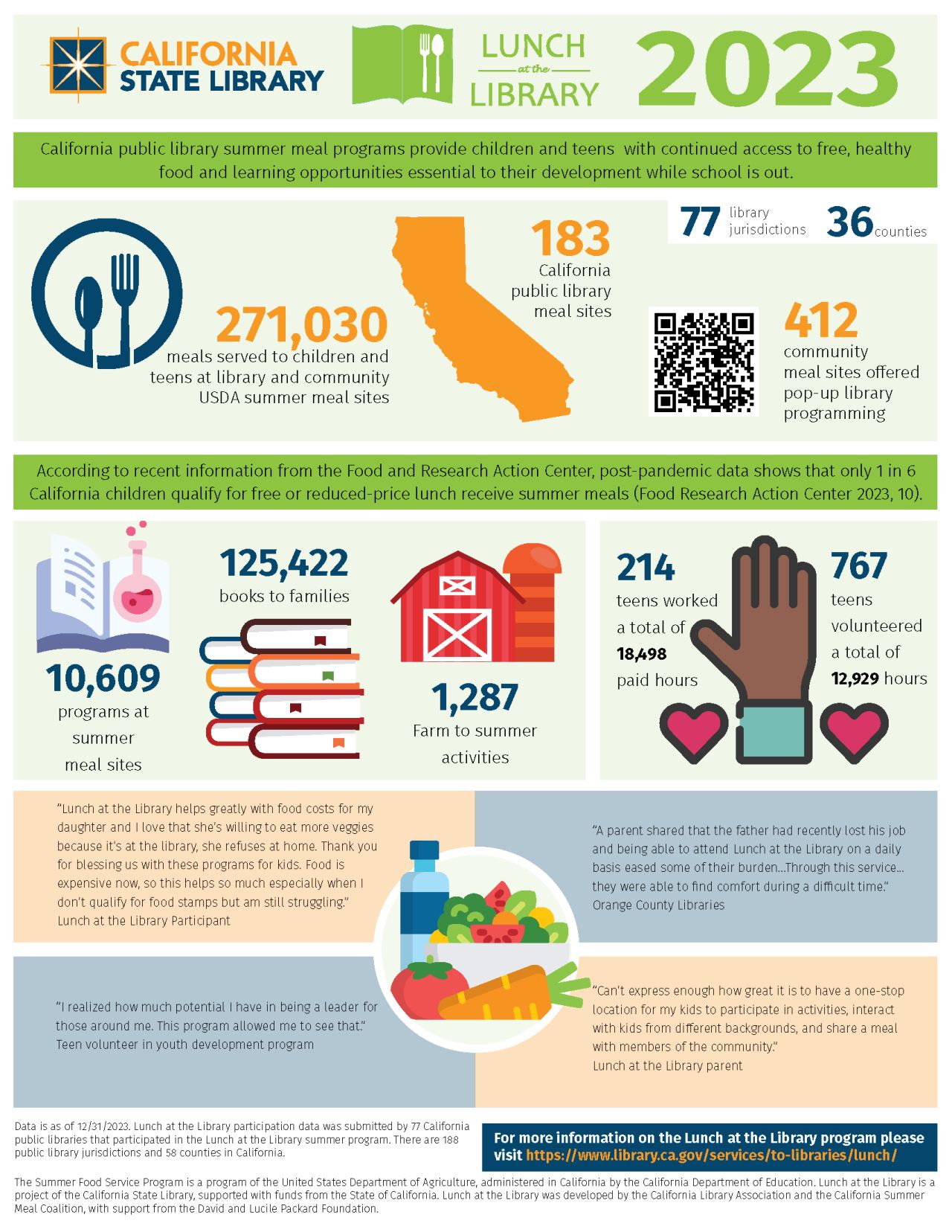
California State Library added testimonials to their infographic explaining the impact of free lunch services.
Tutorials
We know some community members have difficulty using library resources like databases or vendor apps. (Remember how many people struggled with the Libby App?) Some members of the public may find long, text-based tutorials to be to complex.
You can turn those text instructions into a visual how-to guide to help community members ingest the information. Here’s a fun, two-page infographic from Falvey Library at Villanova University. It explains everything a student needs to know about the library as they start a new school year.
Compare and Contrast
Instead of just sharing statistics, use an infographic to compare metrics before and after library interventions. The visuals go a long way to clearly illustrating the impact of your library work.
You can also use an infographic to explain why library services are superior to other resources.
Arkansas River Valley Library System’s infographic shows the free library services that can replace paid subscription services.
Service Bundles
Create a flowchart showing how a patron uses multiple services.
For example, your patrons may start by visiting your library’s website, where they sign up for a cooking program. When they get to the branch to attend the program, they may pick up a cookbook from a book display. Inside the cookbook, they may find a bookmark promoting the library of things.
An infographic illustration of that patron journey helps explain the interconnectedness of library services to board members, lawmakers, and potential partners.
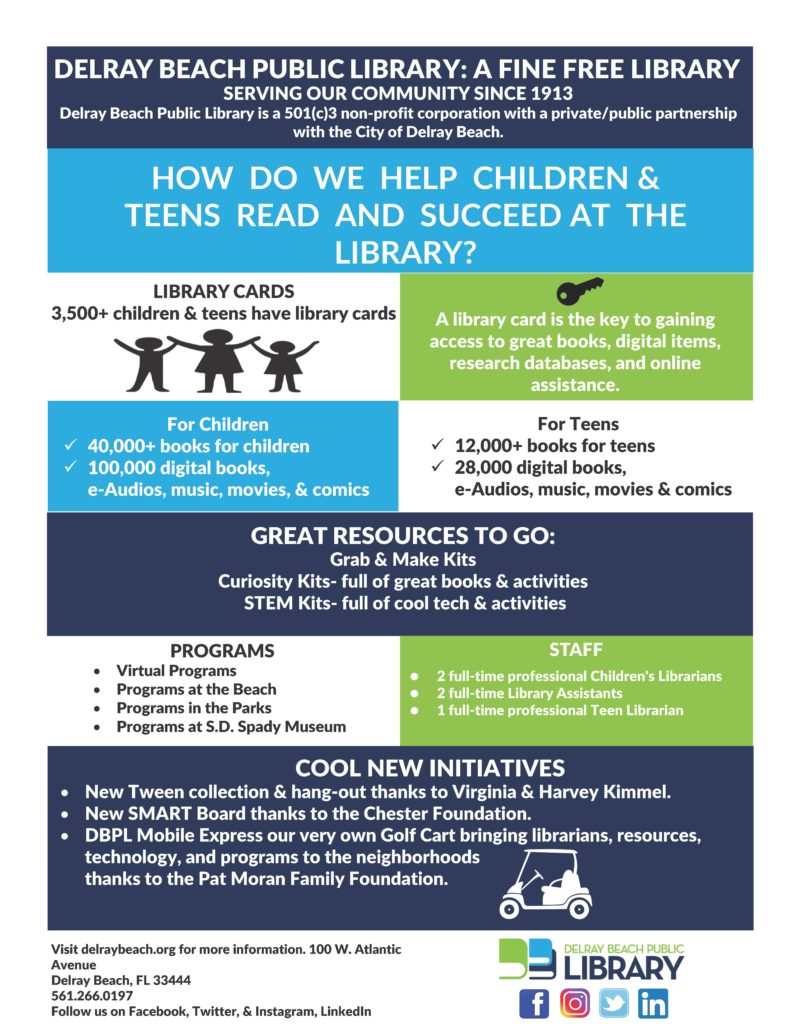
Delray Beach Public Library explains the interconnectedness of its services in this infographic.
Visualizing Partnerships
Use an infographic to show how the library collaborates with other local organizations, schools, and businesses. This will demonstrate how the library actively engages with the community, which builds trust and awareness. It can also highlight additional services and programs available through these partnerships.
Here’s a great example from the Tampa Bay Library Consortium explaining how the Institute of Museum and Library Services Funds help Florida library programs.
Library Accessibility
Your library can use an infographic to illustrate how the library makes resources accessible to different demographics. This includes children, seniors, and non-English speakers.
For example, if your library knows that 95 percent of seniors who attend tech skills programs learn to use tech fluently, you can demonstrate that with graphics.
Bonus tip: For accessibility of your infographic, create a downloadable alt-text document for the infographic. This allows people who use screen readers to consume the infographic. Here’s an example from EBSCO. Scroll to the bottom of the illustration and you’ll see the prompt to download the alt-text version of this infographic.
Environmental Impact
Show the library’s efforts in sustainability and green initiatives. Use visuals to demonstrate eco-friendly programs, such as recycling, energy-saving measures, and community gardening projects.
If your library has undergone a renovation or built a new building and you’re Leed-certified, use an infographic to show your community how that designation saves money and the planet.
Volunteer Contributions
Infographics easily explain the impact of volunteers on a library. The visuals can help you clearly show the number of volunteer hours. They also illustrate the types of activities volunteers assist with. Additionally, they convey the value volunteers add to the library.
Need help creating your infographic?
I am not an artist. I can barely draw stick figures. So creating an infographic is daunting to me. This post explains the process I use to plan and create an infographic.
Hey library marketing friends: I’m teaching a pre-conference workshop at LMCC this year with my amazing coworker Caleigh Haworth. It’s all about marketing your collection. Registration is open now.
Subscribe to this blog and you’ll receive an email whenever I post. To do that, enter your email address and click on the “Follow” button in the lower left-hand corner of the page. You can also follow me on the following social media platforms:
About 10 miles north of the northernmost coast of Scotland lay an archipelago or chain of islands called Orkney. The islands surround Neolithic sites dating back 5,000 years with tall sandstone cliffs and colonies of seals. Archeological evidence shows that humans have lived on the island for nearly 9,000 years.
That’s where John Peterson lives and works. He has managed social media for Orkney Library & Archive since 2017.
The library is one of the oldest public libraries in Scotland, dating back to 1683. These days, the Orkney library has two physical locations, a mobile library, and serves a population of about 22,000 people.
“Orkney is a very rural community with a lot of farming and agriculture,” explains John. “And of course, we’re an island so we’re surrounded by the sea and have a lot of maritime history, particularly from the 20th Century and the World Wars.”
The Orkney library may be remote, but it has fans worldwide. In fact, one of my readers nominated this library for a profile, saying “I love their use of social media and how they got such a small library on the world map.”
“We’re a very small organization and so we don’t have a marketing team or anything like that,” says John. “We just try to share what we’re doing with our followers on social media and have a bit of fun as we go along.”
“We use social media as a way of sharing what’s happening in the library and the archive and what we do every day. It’s a good way of showing off Orkney and what it is to be a library and archive service in the 21st century.”
“It has its challenges sometimes but it’s probably still our favourite as a way of telling stories and making fun posts or threads,” explains John. “For us, it has been a great way of communicating an idea with a few words and pictures. Our Twitter following is approximately 4 times the entire population we serve.”
“Instagram is our newest platform, but it has a growing audience, and we get a lot of nice feedback.”
“The platforms work differently, so we often have to tweak the posts slightly to suit each. Often, we post on Twitter first and then on to the other two platforms.”
When John sees a particularly effective post, he builds on that success by sharing the same kind of content his audience is responding to. But he admits that, like most of you, he’s sometimes baffled by what does and doesn’t work!
“We post different kinds of content,” explains John. “But they usually involve books, archives, or old photographs.”
Today is #TolkienReadingDay so we're in the hobbit of letting folk boromir #Tolkien Books than usual. We're not being smaug but we're a library and it's good to shire. So come along and baggins yourself some books. 📚
“Sometimes a post takes off far better than you expected and other times a post that you thought was interesting or funny doesn’t get much engagement. There is a whole load of reasons for that and it’s important not to get too disheartened if something doesn’t work.”
“Of course when a post doesn’t work it could be that the idea wasn’t good or wasn’t communicated well enough. But often it is just a case of timing – wrong time, wrong day, it didn’t get the retweets to send it further across the platform, etc. You could post the same post at two different times and get totally different responses.”
Try to post good content and try to post regularly – but not too much. Not every post can be funny or interesting. But try to make sure that some of them are so people have a reason to follow you.
Try to make it interesting. Don’t just do what everyone else is doing, and don’t rely on sharing content from other accounts.
Try to write your own stuff and find your own voice.
Pay attention to what works for you and then do more of it. Listen to feedback, good and bad – it’ll help you to do more of what people like and less of what they don’t.
Don’t be controversial and try to avoid politics.
Concentrate on what makes your library or organization different from everyone else and try to use those things to build your own presence and identity.
Look around you. Spot opportunities for good content. The more you do it the easier it gets.
Find some libraries on social media and follow them, no matter where they are in the world. They don’t have to be the famous places you’re always hearing about to be worth following. Anybody can be worth following if they post good, interesting content – even small local libraries on remote islands. Find some libraries and archives, museums and galleries, and give them a follow. You’ll be glad you did.
In one of our archive strong rooms there is a shelf. The shelf does not contain the most exciting or interesting item in the archive but it does contain something amazing.
Subscribe to this blog and you’ll receive an email whenever I post. To do that, enter your email address and click on the “Follow” button in the lower left-hand corner of the page. You can also follow me on the following social media platforms:
Photo courtesy Cincinnati and Hamilton County Public Library
The first thing I do when I visit my parents is greet their dogs. The second thing is to look for my list.
My parents are aging, so I like to help with things they can no longer do. I wash windows, weed the flower beds, and sew on loose buttons. As I work through the list, I get a certain satisfaction in checking things off.
Lists have always been a part of my life. My mother wrote a daily list for when I got home from school. Feed the dogs. Make a salad. Start your homework. It’s almost as if she thought I wouldn’t know what to do with myself if I didn’t have a list to follow.
And she was right. I now make lists for everything. Lists for packing. Lists for groceries. Lists of tasks I need to complete during the workday. Gift lists at the holidays.
Lists help you focus and prioritize. So, when one of my readers asked for a list of the ten best tips and practices for library marketing, I dug in. (Imagine me cracking my knuckles, blowing on my fingers, and setting my fingers on the keyboard here.)
Top Ten Tips for Library Marketing and Promotions
#1: Send email to your community.
Email is the most effective marketing tactic. You don’t have to battle algorithms. And 99 percent of people with an email address read their email daily, usually first thing in the morning.
Starting a consistent library email program can be intimidating. But I put it at the top of the list because it’s the best use of your time.
You can start small by sending a newsletter. Work your way up to targeted email segments, where you’ll be sending shorter, more focused messages to specific groups of people. Don’t worry that you’re leaving people out with more niche emails… you are not.
#2: Post no more than once a day on your social media channels.
Social media for libraries works to create brand awareness and affinity. But they’re also ruled by algorithms that determine who sees your posts. The algorithms value quality posts, not quantity. So, posting often does nothing to boost your reach. Once a day is plenty.
Make a schedule to create quality posts and give your social media feeds consistency (which the algorithms love). For example:
Monday: Promote an item in your collection.
Tuesday: Share a video.
Wednesday: Ask a question.
Thursday: Promote a program.
Friday: Share something about a library staff member or something behind the scenes of library work.
Saturday: Promote a service, like your seed library, a database, streaming videos, or your MakerSpace.
Sunday: Share something funny, inspiring, or thoughtful about the joy of reading or the importance of intellectual freedom.
Each year, beginning in November, I publish a best practices guide for each of the major social media channels. To see the guides, type the name of the platform you want to research in the homepage search bar.
#3: Put a bookmark in every hold and checkout that leaves your library.
Your collection is a marketing tactic! No library visitor should ever leave the building without a piece of promotional material.
To get started, pick three areas of focus for your bookmarks. Make one bookmark for each of your three focus promotions. For example:
A booklist
An online item like streaming music
A recurring program.
Teach staff to add a bookmark to every hold and checkout. They use context clues to decide which of your three focused promotional bookmarks will resonate most with each library visitor.
#4: Write a general marketing script and have staff recite or read it before every program.
Your programs are also a marketing tactic. Use the first minute of each program as a “housekeeping moment”, so share a marketing message to this captive audience.
The message should be short, 3-4 sentences. And it should be tailored to the audience.
Here’s an example. Let’s say your library just purchased a set of after-hours holds lockers. You want people to use them. You can create a script for staff to read before programs.
For children’s programs your script might say:
“Hello everyone! I wanted to let you know about a new service we have at the library – our after-hours holds lockers. You can pick up your reserved books and materials anytime, even when the library is closed. It’s a convenient way to get the books your family needs, on your schedule!”
For adult programs, your script might say:
“Hello everyone! Before we begin, I want to tell you that our library now has after-hours holds lockers. Maybe you saw them as you walked in: they’re just to the right of the front doors. You can pick up your reserved books and materials at any time, even outside of our regular hours. So if you work a late shift or you’re going to have a particularly busy day and can’t get to the library before we close, you can still get your books!”
#5: Talk to one community group every month.
Reach out to the Kiwanis Club, Chamber of Commerce, Junior League, and local professional groups. Ask for five minutes during their next meeting to talk about what is available at the library and to sign up members for a library card.
#5: Analyze your promotional metrics each month.
Schedule 30 minutes once a month to look at the past month’s performance on social media, email, and your website.
Watch for trends. Did your social media impressions spike this month? What may have caused that? Did your email open rate plummet? Take a look at the emails you were sending to determine what may have caused the dip. Did attendance skyrocket at your monthly book club after you posted an Instagram Reel promoting it? Do more Instagram Reels!
This work will help you spot issues and opportunities. You can replicate the things that your audience responds to. And you can stop doing the things that don’t work for your audience, and have the data to back up your decision! It’s time well spent.
#6: Create an editorial calendar for the next 6-12 months.
Planning your promotional schedule gives you time to thoughtfully create your promotions and get approvals. Plus, you can share your plans with your coworkers and supervisors, so everyone at the library knows what’s been marketed and when.
Schedule your emails, when you’ll change your website graphics, your book displays… even the signs in your library lobby.
Some of this planning will be easy. You know when summer reading, Library Workers Week, National Library Card Signup Month, back-to-school, and holiday events happen.
Leave space in your calendar for those unexpected things that come up. If your director announces his or her retirement, your building needs renovations, or your library buys a new database… you’ll have space in your calendar to accommodate those promotions.
#7: Ask for time at the next all-staff meeting to discuss library marketing.
One of the most common things library marketers struggle with is their coworkers. They don’t understand how promotions work!
Transparency is always a good idea. You want everyone, from the front-line staff to your senior staff, to understand what you’re doing and why you’re doing it.
Talk about your goals. Talk about how you work to accomplish them, and why you use certain marketing channels for certain promotions. Then, share successes to show that your efforts are working and share failures to drive home the point that marketing is an experiment and you’re always learning.
The media is an audience you must court, like any other target audience! The easier you make their job, the more positive press coverage your library will enjoy.
I used to work as a television news producer and I have many friends still in the business. Here are the top six tips they give for garnering press coverage for your library. Here are more tips from another former journalist turned library marketer.
And, I hope you’re planning to attend the 2024 Library Marketing and Communications Conference because this is the focus of my session this year! I’ll be moderating a panel with three former journalists turned library marketers who will share their top tips for building positive relationships with your local media.
#9: Start a blog.
A blog is one of the best ways to share information about the library and drive visitors to your website. It allows your library to tell your story, create brand awareness, and promote your library to your audience for free, without having to deal with the rules of someone else’s platform.
Marketing is changing all the time. You can keep up with the latest social media news and marketing tips by dedicating time to this work.
Hey library marketing friends: Remember, every promotion you put out into the world can spark a lifelong love of reading in someone. Your work makes a difference!
Subscribe to this blog and you’ll receive an email whenever I post. To do that, enter your email address and click on the “Follow” button in the lower left-hand corner of the page. You can also follow me on the following social media platforms:







 Super Library Marketing: Practical Tips and Ideas for Library Promotion