Search

Super Library Marketing: Practical Tips and Ideas for Library Promotion

Tag

marketing libraries

Grow Your Libraryโ€™s Online Presence and Rank Higher in AI Searches With These Tips

Photo courtesy Cincinnati and Hamilton County Public Library

Key Takeaways:

  1. AI is changing how people search, and libraries are seeing a drop in website traffic as a result.
  2. Simple formatting changes like clear titles, bullet points, and question-based headings can help your content appear in AI summaries.
  3. Add credibility cuesย like staff names, job titles, and internal and external links to boost your siteโ€™s authority with AI and search engines.

Have you noticed a slight change in the blog posts here? Most now include a list of three quick takeaways at the top. Hereโ€™s why I started doing this, and why your library should consider it too.

AI impacts website traffic

A few months ago, I attended a webinar featuring three of the leading experts on Search Engine Optimization, or SEO. SEOย isย the practice of improving a website’s visibility and authority in organic search results to attract more visitors.ย 

But AI has introduced a new wrinkle in SEO.

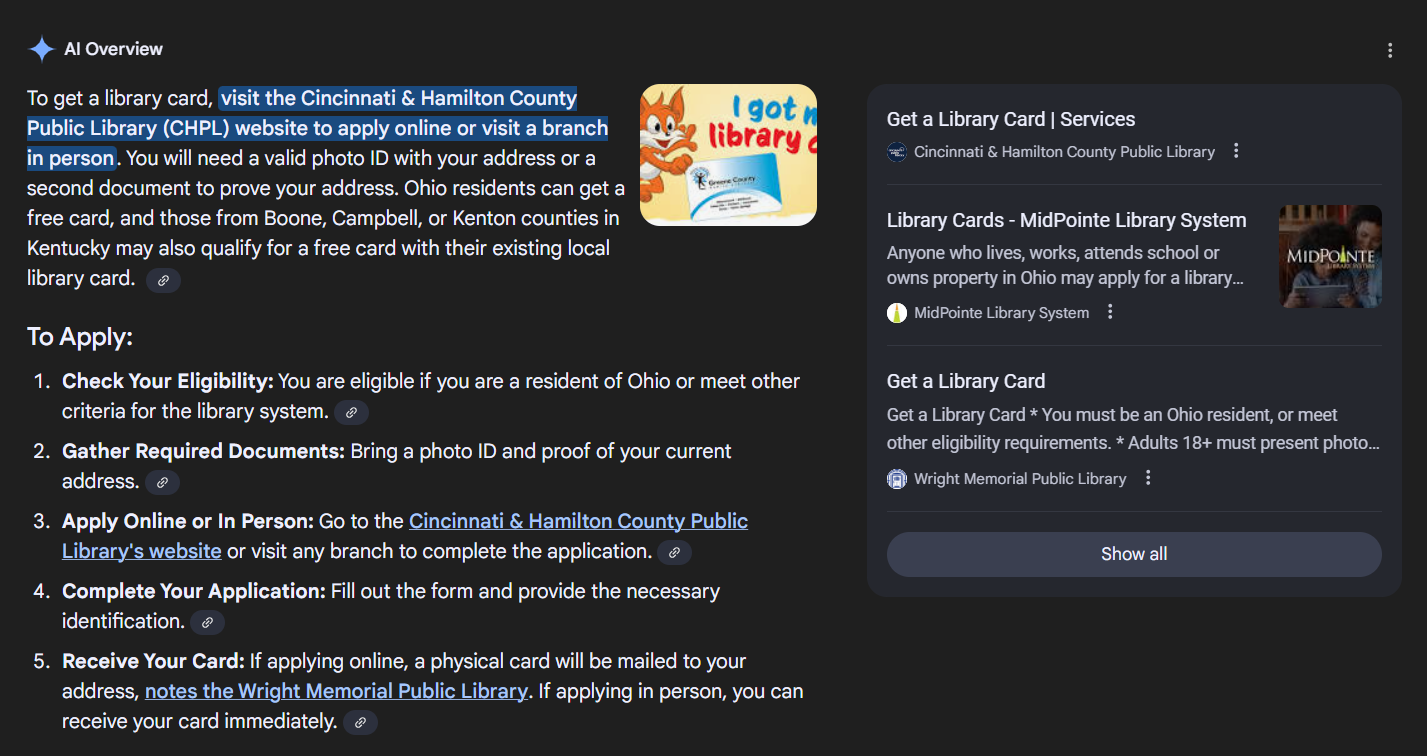
In May 2024, Google introducedย AI Overviewsย (formerly called AI Summaries). These appear at the top of search results and provide a summarized answer to a userโ€™s search, often pulled from multiple sources.

An example of an AI Overview for the search, “How can I get a library card?”

Once AI Overviews were introduced, searchers stopped clicking through to a website because their question was fully answered by the AI Overview. As a result, many libraries (and other websites, including this one) noticed a decrease in their organic web traffic.

In addition, a survey by Adobe Express says 25 percent of people use ChatGPT as their first choice for search over Google. Gen Z is particularly drawn to AI as a search engine. That likely means the popularity of using AI for search will continue to rise.

What does all this mean for your library?

Youโ€™ll need to adjust the way you structure your libraryโ€™s website and blog to surface more often in AI searches and to show up in the AI Overview. Itโ€™s not as difficult as it sounds. Here are the changes Iโ€™ve implemented. I recommend you try these and monitor your web traffic over several months to see if the changes make an impact.

Titles should be clear, not clever.

Tell readers exactly what theyโ€™ll find on the page. For example:

Author Visit

  • โŒ Clever Title: โ€œAn Evening of Literary Magicโ€
  • โœ… Clear Title: โ€œMeet Author Jasmine Guillory at the Library โ€“ October 24โ€

Why it works: The clear title includes the type of event, the authorโ€™s name, and the date. Those are the keywords that AI tools and search engines can easily match with user queries.

Craft Program

  • โŒ Clever Title: โ€œGet Your Glue On!โ€
  • โœ… Clear Title: โ€œFall Craft Workshop for Teens โ€“ Make Your Own Bookmarksโ€

Why it works: It specifies the audience (teens), the season, and the activity.

Educational Workshop

  • โŒ Clever Title: โ€œBrain Boost Bonanzaโ€
  • โœ… Clear Title: โ€œFree SAT Prep Workshop for High School Studentsโ€

Why it works: It uses direct language that matches what a student or parent might search for, like โ€œSAT prepโ€ or โ€œhigh school test help.โ€

Wellness Event

  • โŒ Clever Title: โ€œZen in the Stacksโ€
  • โœ… Clear Title: โ€œFree Yoga Class at the Library โ€“ All Levels Welcomeโ€

Why it works: It clearly states what the event is, where itโ€™s happening, and who can attend.

Include a bullet list of key takeaways or what youโ€™ll learn at the top of the page.

This helps both readers and AI quickly understand the content. Try this on blog postsย andย key webpages.

Hereโ€™s how you might structure key takeaways at the top of a library card sign-up page.

  • A library card is free to all residents of Tree County.
  • Applicants need to fill out a form and have one document with proof of residence. The form can be sent to the library via email or presented at any library location.
  • Applications presented in person will be processed immediately. Applications sent via email will take 1-2 days to process.
  • Once an application is accepted, youโ€™ll be given a card, which you will you to check out items, reserve meeting rooms, and register for programs.

Use well-structured headings.

Phrase them as questions, when possible, like:

  • How do I get a library card?
  • How can I reserve a meeting room?

Here’s an example of how I did this in a post for NoveList.

Include the right keywords.

Ask ChatGPT to provide you with a list of keywords or frequent questions around your topic. You can also search for your topic on Google and look at the โ€˜People Also Askโ€™ section. The website Answer the Public can provide you with some frequently asked questions as well.

Structure your content with bullets, steps, or lists.

Clean formatting makes it easier for AI to scan and summarize your content. You’ve probably noticed this post has been full of bullets and lists. That’s intentional! The bonus benefit is that it makes your blog and website easier to read.

Write in natural, conversational language.

Avoid jargon. Focus on being clear and helpful. Remember that searchers will not use jargon to look for answers to questions that may lead them to your library. Try to imagine what your community would put into the search bar, and then use those words in your blog or landing page.

When possible, include a staff memberโ€™s name and job title on a page.

AI looks for expertise or credentials when scanning pages. This is easy for a blogโ€ฆ just include the name of the author and their title in the post. For a landing page, consider adding a line like this: โ€œNeed help signing up? Email Maria Lopez, Library Services Manager, with 15+ years of experience helping patrons, at mlopez@treelibrary.org.โ€

Ask your partners to link to your website and blog.

When other trusted sites link to your content, it signals credibility to AI and search engines.

Use internal links whenever possible.

Link to related blog posts or pages on your site to help AI understand your contentโ€™s structure and relevance. That has the added benefit of keeping people on your page longer, which improves your trust and credibility to Google and AI, which means you’ll show up in search more often!

Try to stay within best practice lengths for word count.

BlueHost.com says for blogs, the ideal range is between 1,500 and 2,500 words. This gives readers comprehensive coverage of a topic. Itโ€™s also easier to include keywords and internal links for longer posts.

Butโ€ฆ hereโ€™s something to remember: Google and AI tools prioritize quality over length (and so do most readers!) Donโ€™t try padding your posts, as that can hurt your ranking.

Neil Patel, who is a trusted expert on SEO, says that for landing pages, word count isnโ€™t a direct ranking factor. Rather, you should focus on the userโ€™s experience and provide enough information for a community member to act.

Has your library’s website traffic taken a hit? Are you using any other methods to drive more traffic to your library’s website? Let me know in the comments.


Need more inspiration?

Google Ad Grants Improve Your Libraryโ€™s Chances of Being Found in Search: How To Apply and Manage This Incredible Opportunity

Subscribe to this blog, and youโ€™ll receive an email whenever I post. To do that, enter your email address and click on the โ€œFollowโ€ button in the lower left-hand corner of the page. You can also follow me on the following social media platforms:
Why Print Marketing Still Works for Libraries… and How to Prove It!

Photo courtesy Cincinnati and Hamilton County Public Library

Quick Summary

  1. Print marketing is not dead. When used strategically, it helps libraries cut through digital noise and even strengthens digital marketing.
  2. Measure return on investment of print marketing with opt-ins, QR codes, custom trackable links, and interactive prompts.
  3. Repurpose print content across social, blogs, and email to extend its reach and prove its impact.

Every day, I run with anticipation to the mailbox.

I can’t help myself. As a member of Gen X, snail mail was a significant part of my life when I was growing up. A letter or postcard from a family member or friend brought me such joy. We had phones, of course, but no social media. So if a friend went on vacation, I couldn’t follow each step of their journey on Instagram.

I also love mail because it’s physical. There is something about the feel of paper in your hands that adds to the joy of reading. It’s why I prefer print books to eBooks.

And I know that digital correspondence is also permanent, but there is something different about a stash of letters, held together with ribbon or string, kept to be read again years later.

What does any of this have to do with library marketing?

The 10th Annual Super Library Marketing survey closed a few weeks ago. I’m analyzing the results now and will publish the full report on January 5, 2026.

But one theme has emerged already: Library promotions are getting lost in the constant digital noise.

I work with hundreds of libraries worldwide every day at NoveList. They’re all facing this struggle. And some are beginning to lean on print to cut through the noise.

That’s because print still matters when itโ€™s intentional, measurable, and audience-focused.

Print is not dead. Itโ€™s strategic!

It might feel old-fashioned or even risky to invest staff time and budget in print. After all, email and social media offer instant metrics and quick reach. But hereโ€™s the truth: Print has never been more valuable.

Now, I realize this statement may come as a surprise. Readers of this blog know how much I value email marketing. It is, hands down, the most effective use of your marketing time.

But clever library marketers know that there are some audiences we cannot reach with email. Print helps you connect the dots between those groups. It can spark attention in people who might otherwise overlook your digital promotions. And it can deepen the relationship with those who are already engaged with your library.

Imagine this: Youโ€™ve been on a storeโ€™s email list for years, eagerly clicking through their sales messages. Then one day, a coupon shows up in your mailbox. Suddenly, the brand feels even more present, more valuable, and youโ€™re more likely to act on the next email, too. (BTW, this example is born of my own experience with Bath and Body Works!) And it works because…

Print doesnโ€™t replace digital marketing; it amplifies it.

How do you know if your print marketing is working?

Hereโ€™s the challenge I’ve always faced with print marketing: How do you prove that it’s effective? How do you know itโ€™s worth the investment? Because, let’s face it, print can be costly.

Here are five concrete ways you can measure the effectiveness of print marketing at your library.

1. Start with an opt-in model for longer print publications.

Many libraries print thousands of copies of their print newsletter or magazine. Then they send them out to all the people living in their service area. They might also send copies home with each child in their school district.

I totally understand that strategy. But it’s akin to sending un-targeted email messages. If someone isn’t already engaged with the library, the sad truth is they may throw that print piece in the trash. That’s a waste of money for the library and a waste of time for you.

A better approach is to ask readers to opt in to the publication. There are a couple of ways to do this.

  • Ask people to sign up either when they sign up for a library card or through an email campaign.
  • Send your print publication to anyone who donates to your library’s fundraising groups.
  • Put copies out in your branches. You can also distribute copies to partner organizations with locations that have a lot of foot traffic, like museums and theaters. Be sure to include a QR code so those new audiences can sign up to receive their own copies at home.

2. Make your print marketing interactive.

Ask readers to post a social media comment on a story or an event in your print publication. This works really well for print calendars and fliers.

Add a unique hashtag to the piece, and ask people to use it when they post their comment. Then count how many comments you receive.

You can also ask readers to send an email with an answer to a special prompt, like, “Which storytime is your child’s favorite?” Create a special inbox to receive comments from your print publications. Then you can count the number of emails you receive.

3. Use custom trackable links.

When I worked at the Cincinnati and Hamilton County Public Library, I used Bit.ly to create special trackable links for our website. With a free Bit.ly account, you can edit the back half of a link and then track how many people click on it. This makes it easy to see which traffic is coming directly from your print marketing.

4. Add QR codes.

Add a QR code to your print piece, then track how many scans you get. One library marketer I spoke with takes this a step further by creating a different QR code for each poster, depending on where itโ€™s displayed. That way, she can compare engagement across different locations or departments!

Pro tip: This strategy works for all your libraryโ€™s print pieces, from bookmarks to event flyers. If you ever feel like youโ€™re doing too much print marketing, the data you collect from trackable links and QR codes can help you make the case for (or against) continuing.

5. Repurpose your content across other channels.

Save time and amplify your content by repurposing stories from your magazine or newsletter into social posts, blog articles, or email content. If those repurposed pieces perform well digitally, itโ€™s another signal that your print marketing is resonating.

When I worked at the library, many of the stories we published in our quarterly newsletter or on our blog were repurposed in this way. This helped us to get more traction for the stories and gave us another way to measure whether the story is interesting to our audience.

This trick can also help your community to learn that you have print promotions and give you a reason to solicit sign-ups for the print version!

How is your library using print marketing?

Iโ€™d love to hear how your library is using print. Share your experiences in the comments below.


Need more inspiration?

Libraryโ€™s Print Magazine Is a Community Must-Read! Here Is Their Secret Formula.

Subscribe to this blog, and youโ€™ll receive an email whenever I post. To do that, enter your email address and click on the โ€œFollowโ€ button in the lower left-hand corner of the page. You can also follow me on the following social media platforms:
March Meowness: How Cat Photos Forgave Library Fees and Won Hearts Worldwide

Photo courtesy Cincinnati and Hamilton County Public Library

When she was growing up in Leicester, Massachusetts, Linnea Sheldon found the library to beโ€ฆ boring.

โ€œWhile I enjoyed reading and admired the librarians, the library itself didnโ€™t feel very exciting,โ€ confesses Linnea. โ€œToday, libraries are dynamic community hubs offering so much more than books, and I love that part of my job is sharing these opportunities with the community. When people say, โ€˜I didnโ€™t know the library did that,โ€™ I can truly relate.”

Now, in her role as Community Relations and Communications Manager for the Worcester Public Library, Linnea works hard to make sure her community finds the library to be exciting and dynamic. Sheโ€™s a team of one, communicating to a city of more than 210,000 residents across seven branches and two bookmobiles. She does receive generous help from library staff with tasks like social media posts, flyer design, calendar postings, and more.

And the library is vital to this city. Linnea says nearly 20 percent of her community lives in poverty. So, when she was approached in 2023 about offering a fee forgiveness program, she was fully supportive.

โ€œWe had many kids who went home before the pandemic and left books behind in schools,โ€ explains Linnea. โ€œWe also have a growing population of unhoused individuals in our community, and we were finding that we were losing patrons because they had lost or damaged items on their accounts.โ€

 โ€œFrom a marketing standpoint, I knew that the right hook was key for an initiative like this to succeed. I also knew I would have no budget. My goal was to come up with something fun and easy enough that people would not only want to participate but would also want to tell their friends and family about.โ€

Linnea, who is a self-professed โ€œcat person,โ€ decided to lean into her love for felines to create her campaign, which she called March Meowness. The premise was simple: People could trade cat photos for fee forgiveness.

โ€œWe began planning in the fall of 2023 and chose March 2024 because there werenโ€™t any competing campaigns planned,โ€ explains Linnea. โ€œThe actual marketing push happened just a week before launch. With limited time and resources, I created our collateral and focused on social media, signage, and email as our primary channels.โ€

โ€œAnother pivotal decision was to pitch the story to the media before we launched it ourselves. Local outlets loved the playful concept, and the first article went live within the hour. Even press outlets in Boston picked up the story, and from there it snowballed. By the time we officially launched on our website and social media, we already had significant buzz and community interest.โ€

Linnea says the community response far exceeded the libraryโ€™s expectations. Worcester Public Library decided to launch the promotions a few days early, at the end of February. Patrons were thrilled to be welcomed back in such a fun, positive way.

โ€œWhat surprised us most was that even people without fees wanted to participate,โ€ says Linnea. โ€œMany people asked if their cat photos could be applied toward another community memberโ€™s account, a generous show of support that really embodied the spirit of the campaign.โ€

The library displayed submissions on a โ€œcat wall,โ€ and soon cat photos started arriving from across the country. After the story was picked up by The New York Times, it spread internationally, and the library was suddenly receiving cat pictures from all over the world.

โ€œThe volume was incredible, and staff from across departments volunteered to help,โ€ recalls Linnea. โ€œWe developed a workflow: Some saved the photos, others responded to emails, others formatted and printed the pictures, and still others hung them on the wall.โ€

โ€œOur circulation staff cleared fees for patrons, and my director and I fielded multiple media requests every day. It was an all-hands-on-deck effort, and while it was exhausting, it was also one of the most energizing experiences weโ€™ve ever had at a library.โ€

Besides the multitude of patrons whose fees were forgiven, the campaign led to some incredible marketing results. Those included:

  • 10.7 percent increase in physical visits
  • 9.2 percent rise in circulation
  • 10.2 percent increase in new library card registrations when compared to the previous month.
  • 46 percent increase in website traffic
  • 244 percent increase in engaged Facebook users.
  • 120 percent increase in Instagram interactions
  • 16 percent increase in TikTok followers from the previous month.

โ€œWe also tracked over 500 media stories on March Meowness,โ€ shares Linnea. โ€œNBC Nightly News with Lester Holt even came to our library to shoot a story.โ€

โ€œBut the real impact was seen when you look at how our patrons were helped. Staff successfully unblocked 930 patron accounts during the campaign, while the Library Board of Directors later approved the forgiveness of an additional 3,787 accounts due to the success of the campaign.โ€

This past June, Linnea and her library received a John Cotton Dana Award for the campaign. Thatโ€™s how I first heard about it. Sitting at the award ceremony, I can tell you there was nary a dry eye in the room when Linnea described the outpouring of cat photos from people around the world, eager to help her community reconnect with their library.

And itโ€™s no surprise that Linnea and the library repeated the campaign this year, with a few adjustments.

โ€œWe knew nothing could match the scale and virality of the original campaign,โ€ explains Linnea. โ€œThis year, we launched March Meowness 2.0: Marchier and Meowier. For every cat photo donated to our cat wall, the Worcester Public Library Foundation pledged $1 toward our summer reading programming.โ€

โ€œThe response was wonderful, we received 2,500 photos, and once again, community members came out to see the cat wall grow. We also introduced a new element: a cat mascot with a community naming contest, which resulted in the winning name Whooskers.โ€

โ€œWhile this yearโ€™s campaign was more localized and didnโ€™t capture the international attention of the first, our community was still excited for its return and embraced it as a fun, meaningful way to support the library and one another.โ€

โ€œOne of the best outcomes of this campaign was the way it allowed staff to connect with patrons and the community in an entirely new way. Library work can be particularly challenging. We deal with serious issues every day and support people in deeply meaningful but often difficult ways. March Meowness brought a sense of lightness and joy.โ€

โ€œThe initiative also opened incredible doors for our library and for me personally. In the past year, we have received more awards than at any other time in our organizationโ€™s history. The campaign has connected me with library marketers across the country and strengthened relationships within my own community in ways I never imagined possible.โ€

And when sheโ€™s not creating award-winning campaigns, Linnea says she looks to other libraries, nonprofits, large companies, and this blog (thank you!) to stay on top of trends and get creative ideas.

โ€œIโ€™m subscribed to a wide range of email marketing lists, Iโ€™m a regular social media user, and I follow marketing and nonprofit influencers on LinkedIn,โ€ shares Linnea. โ€œI also make a point to research the campaigns and libraries that win marketing awards each year. Itโ€™s inspiring to see the creativity and innovation happening across the field.”

Harris County Public Library was one of the first libraries that really stood out to me on social media; they showed me that taking a slightly unconventional approach could actually expand your reach.โ€

For a library looking to launch a campaign like March Meowness, Linnea has four key pieces of advice.

  1. Always start with your patrons. This campaign may have been fun and lighthearted, but it grew directly out of a real need identified by our New Users Task Force. Our community needed a fee forgiveness program to remove barriers to access. Without that foundation, the idea wouldnโ€™t have resonated the way it did.
  2. Lean into what makes your library unique. For us, it was cats. We were already known for our cat memes, and many staff (me included) are passionate cat lovers. That authenticity made the campaign feel natural and genuine, which helped it connect with people.
  3. Remember that making marketing fun can actually make your job easier. While responding to the overwhelming interest took a lot of work, the creative and promotional side of the campaign was surprisingly simple. Of course, not every initiative lends itself to this kind of playful approach, but finding ways to add a little fun to a program or campaign benefits both patrons and staff.
  4. It helps immensely to have supportive colleagues and leadership. Over the years, Iโ€™ve built strong relationships with staff and with our Executive Director, who is always willing to try new and creative ideas. That trust and openness were critical in bringing March Meowness to life.

Need more inspiration?

How One Library Marketer Played an April Foolsโ€™ Prank On Her Communityโ€ฆ and Got Incredible Reach on Social Media!

Subscribe to this blog, and youโ€™ll receive an email whenever I post. To do that, enter your email address and click on the โ€œFollowโ€ button in the lower left-hand corner of the page. You can also follow me on the following social media platforms:

LAST CHANCE to Participate in The 2025 State of Library Marketing Survey

I’ve decided to leave the 2025 State of Library Marketing Survey open for a few more days. I know you are busy. It only takes about 5-7 minutes to complete. Iโ€™d be grateful if you could also share it with anyone at your library who works on promotions, regardless of their job title. The new deadline for completing the survey is Tuesday, September 23, at 11:59 a.m. ET.

Iโ€™ll publish the results on January 5, 2026. Thank you for being part of this amazing community.

Take the 2025 State of Library Marketing Survey


Subscribe to this blog and youโ€™ll receive an email whenever I post. To do that, enter your email address and click on the โ€œFollowโ€ button in the lower left-hand corner of the page. You can also follow me on the following social media platforms:
Be Heard: The 2025 Super Library Marketing Reader Survey Is Open

Photo courtesy Public Library of Cincinnati and Hamilton County
Photo courtesy Cincinnati and Hamilton County Library

Take the 2025 Super Library Marketing Reader Survey

This year marks the 10th anniversary of the Super Library Marketing Reader Survey. Over the past decade, library marketing has grown and changed in exciting ways, and so have the questions in this survey. And since I canโ€™t visit every library (as much as Iโ€™d love to!), this survey helps me understand whatโ€™s working for libraries, whatโ€™s challenging them, and whatโ€™s next.

Your responses will shape the blog posts, videos, and presentations I create over the next year. The survey takes about 5-7 minutes. Iโ€™d be so grateful if youโ€™d also share it with anyone at your library who works on promotions, whether or not โ€œmarketingโ€ is in their job title.

Iโ€™ll publish the results on January 5, 2026. Thank you for being part of this amazing community.

Take the 2025 Super Library Marketing Reader Survey


Subscribe to this blog and youโ€™ll receive an email whenever I post. To do that, enter your email address and click on the โ€œFollowโ€ button in the lower left-hand corner of the page. You can also follow me on the following social media platforms:
The Secret to Library Instagram Success? Start With the Story, Not the Promo

Photo courtesy Cincinnati and Hamilton County Public Library

Key Takeaways

  1. Start with a video concept, not a promotion. Focus on an engaging idea first, then connect it back to library services. This approach makes Reels feel authentic rather than like an advertisement.
  2. Keep production simple and relatable. Using an iPhone, a tripod, and free tools like CapCut or Instagramโ€™s Edits app creates approachable videos that audiences find more trustworthy than overly polished content.
  3. Engagement matters more than views. The most successful Reels spark conversation, shares, and community pride. Your library wants impact that goes beyond vanity metrics.

Emily Bradshaw was a book lover from an early age.

โ€œSome of my favorite library memories were from the Scholastic Book Fairs at school,โ€ Emily recalls. โ€œOur school librarians did such a great job getting us excited about books, and the book fairs were the pinnacle of that excitement.โ€

Emily, who grew up in the far southwest suburbs of Chicago, came to work in a library in a roundabout way. First, she became a high school English teacher. Then, she got her MLIS. She spent about five years as a Reference Librarian whose โ€œother duties as assignedโ€ included marketing. Marketing was her favorite part of the job, so she started to look for marketing-specific library jobs.

Thatโ€™s how, three years ago, she landed a job as the Content Coordinator at Helen Plum Library in Lombard, Illinois. Among her responsibilities is the libraryโ€™s Instagram account

Now, hereโ€™s something I probably shouldnโ€™t confess. But I want to be fully transparent.

I love scrolling Instagram. But Iโ€™m finding that itโ€™s tough for one person working in a remote office to create engaging content, particularly videos, for Instagram.  (Know your weaknesses, dear readers!)

A few months ago, after watching hilarious/inspiring/creative posts on the Helen Plum account, made by Emily, I emailed her and begged her for help. She looked at the account I am trying to build and sent me a list of tips. (Thank you!)

Then, I asked her if she would also share her expertise with my readers. Here is her interview. Scroll to the end for the tips Emily shared with me for making engaging, effective Instagram Reels.

What inspired you to start creating Instagram videos for Helen Plum Library?

I started at Helen Plum in September of 2022, and short-form video was quickly becoming the most popular form of social media, so I knew we had to start consistently making videos. My job includes the management of our social accounts, so I always just considered it a regular part of my job from the beginning.

How do you decide what content to feature in your videos? 

I always start with a video concept instead of starting with a promotional need (with a few exceptions). Maybe this is a hot take (and perhaps a difficult argument to make to your admin), but I find that starting with โ€œHow can we promote XYZ serviceโ€ usually results in less engaging, less effective content.

If you flip the order and start with a video concept, then try to make it relevant to your services and organizational mission, the promotional aspect will follow.

The few times Iโ€™m asked to promote a specific program or service, I spend a lot of time thinking about how I can make it engaging and not appear โ€œpromotional,โ€ because no one likes being advertised to.

-Emily Bradshaw

For instance, this videoโ€™s concept started with an audio clip I liked from BBCโ€™s The One Show of Harlen Coben discussing the benefits of reading. The original video went viral, and I thought it was a compelling audio clip to use over shots of our collection. I didnโ€™t start with โ€œhow can I promote our collection,โ€ but this video does promote our collection by nature.

What tools or apps do you use to film and edit your videos?

I film on an iPhone, which works well for the persona we present on social media. Weโ€™re a mid-sized, friendly hometown public library, not filmmakers or professional advertisers. So I donโ€™t want our videos to look overly produced or fancy. I honestly think having an overly polished look for Reels puts people off since it makes you look less relatable and more like an ad.

I also use a basic tripod. You should always use a tripod for stationary shots. You may not realize how big a difference it makes until you see it.

For audio, I use lapel mics for on-camera speaking if itโ€™s appropriate for the video. To record voiceovers, weโ€™re lucky enough to have a recording booth in our makerspace. But before we had that, the voice memos app on my iPhone worked just fine!

Editing tools depend on how complex the video is. If itโ€™s simple, I use the Edits mobile app, which is Instagramโ€™s answer to CapCut. If the video requires more labor-intensive editing, I use the free desktop version of CapCut because editing on a tiny phone screen gets difficult. After Iโ€™m finished in CapCut, I still use Edits to add captions, audio, or other features before posting to Instagram.

Adam Moserri has said that Instagram is giving a slight boost right now to Reels that use Edits, so I take advantage of that. (Aside: everyone should follow Adam on Instagram โ€“ he is constantly giving updates on Instagram tools, algorithms, and more!)

Do you use a script or storyboard before filming, or is it more spontaneous?

It depends: the more complex the video, the more thorough my planning. For shorter, simpler videos, the storyboard just lives in my head. For others, I simply write down a list of shots I need.

If Iโ€™m doing a voiceover video, I write a script and a shot list to go with it. And for the most complex videos, I have a detailed outline of shots, timing, which people are in which shots, etc.

But sometimes the result is a bit different than my original plan. I always film more than I need so that while Iโ€™m editing, I have options for what works best.

How do you get your coworkers excited about participating in videos?  

This is a common struggle. From my experience, if you start making engaging content that people enjoy, your coworkers will earn your trust and become more comfortable. When I started two and a half years ago, I was on my own, but now that we have a booming Instagram account, I have coworkers asking to be in videos!

It takes time, but that time pays off. If youโ€™re still on your own, there are a lot of ways to make videos without coworker participation, such as POV (point of view) videos.

What types of videos have gotten the most engagement from your audience?

Our most engaging videos have messages that resonate with readers or library lovers. Readers are passionate and want to share that passion, so they share these types of videos with their friends and followers.

An example is our video about โ€œreading what you enjoyโ€ rather than what anyone thinks you should be reading. And more recently, with libraries in the U.S. under funding threats, this video about how we provide free services resonated so much that James Patterson posted it to his feed.

Other types of videos that get lots of engagement include anything humorous (see our spoof of The Bear) and anything in which viewers can share their own opinions. Our series of โ€œReal Librarians Rating Fictional Librariansโ€ has the most fun and lively comments sections of any videos Iโ€™ve ever posted, with folks debating the merits of favorite (and not-so-favorite) librarians from pop culture.

How do you measure the success of your videos? 

The number of views is the first thing I measure since itโ€™s what Instagram measures before anything else. However, I still consider many of our lower-view videos successes based on comments and shares.

For instance, I expect videos that are more specific to our local community to get fewer views simply because they are targeted to a smaller population to begin with (like our Lilac Time video). So, with those, I look at the number of comments and shares.

I have also been asked if weโ€™ve seen an impact on our local community. Since weโ€™ve had so much success, do our videos reach actual cardholders, or is the reach too broad? The answer is yes, we are reaching our community. We regularly receive comments at our service desks about how much our patrons enjoy our videos.

How do you stay inspired and avoid burnout when creating content regularly?

I get inspired by other content creators across many industries. I do a lot of scrolling. I save videos that inspire me into an โ€œIdeasโ€ collection on our account, so I have a trove of inspiration there if I need it. These not only include libraries, but also other reader-related accounts โ€” Bookstagram influencers, publishers, etc. โ€” as well as other companies and organizations I follow, especially local ones (all our Chicago-area museums, DuPage County Forest Preserve, etc.).

What advice would you give to a library just starting to create short-form videos for social media?

Scroll. Get a pulse on whatโ€™s happening in your content area and in your local community. Then try participating in a trend that you can make relevant to your organization and your target audience. Trends are easy and low-pressure, and they are good starter videos to try if youโ€™re a beginner developing filming and editing skills.

Once you start to feel comfortable with simple videos, donโ€™t be afraid to try your own original content ideas. Your library is unique, so show off whatโ€™s unique about it.

-Emily Bradshaw

This is easier said than done, of course, and like anything, it takes time and persistence. But originality will take you to the next level. Try new things, and donโ€™t take yourself too seriously.

Emilyโ€™s 6 tips for creating Reels

  1. Using sound bites from Bookstagram creators helps me save time and can have powerful effects. No audio to edit! Here’s an example.
  2. For many videos in which I appear, itโ€™s just me and a tripod with no other people to help (hereโ€™s an example of that.) I typically hide an earbud in my ear if I’m lip-syncing or have the audio playing on a separate device nearby.
  3. Creating a video clip content bank of reusable B-roll is incredibly useful in a pinch! I have about two dozen various shots of our adult stacks alone. Batch-filming can also help if you have the time to block out for shooting a bunch of stuff all at once to use later.
  4. Consistent scheduling: I post one video per week for Helen Plum Library, which works for me. Typically, Iโ€™m working on next weekโ€™s video the week before, so Iโ€™m always one week ahead. I find this to be the perfect balance of making sure I have something lined up while still being timely and flexible enough for the content to vibe with the current social media climate.
  5. One of the most valuable things to me is literally scrolling through Instagram and saving videos that inspire me. It also helps me to see what works and what doesnโ€™t.
  6. If youโ€™re looking to expand your audience, I recommend using trial Reels, which will share out your Reel only to non-followers and give you insights. Then you can decide whether to share it with your followers after 24 hours.

Need more inspiration?

Should You Start an Instagram Account at Your Library Just for Teens? Hereโ€™s the Pros and Cons List.

Subscribe to this blog, and youโ€™ll receive an email whenever I post. To do that, enter your email address and click on the โ€œFollowโ€ button in the lower left-hand corner of the page. You can also follow me on the following social media platforms:
How Storytelling Is Revolutionizing One Libraryโ€™s Video Strategy

Photo courtesy of Cincinnati and Hamilton County Public Library

Itโ€™s not surprising that Tina Walker Davis and her communications team at Deschutes Public Library in Bend, Oregon, have a robust and interesting video strategy for YouTube. Tina, who grew up in the San Francisco Bay area and graduated from Washington State University, has a previous career as a television anchor and reporter.

โ€œI left journalism to go into marketing and communications and owned my own marketing business for 10 years until I made the financially disastrous decision to open an independent bookstore,โ€ explains Tina. โ€œWhile the bookstore didnโ€™t pan out, it did enmesh me in the literary community here, including the library system.โ€

Tina took a job at the library in 2012 in event planning and coordination. Now sheโ€™s Communications Manager for the library. She manages four people, including a Graphic Design Coordinator and Dana Oโ€™Connell, Keifer McCool, and Michael Rivera, who are all Digital Communications Coordinators.

โ€œMichael almost exclusively does video work, and Dana and Kiefer both manage social media,โ€ says Tina. โ€œDana also does all of our Spanish-language communications. Iโ€™ve told the team many times that Iโ€™ve never worked with such a collaborative group.โ€

โ€œWe have bi-weekly brainstorming sessions that are so fun. Thereโ€™s no agenda. Itโ€™s just a time for us to come together and talk about what weโ€™re seeing, what weโ€™re excited about, and generally throw some spaghetti at the wall. A lot of our best content was conceptualized in those brainstorming meetings.โ€

Deschutes Public Libraryโ€™s YouTube channel was already up and running when Tina began her job. At first, Tinaโ€™s team used it to share story time videos and videos of their marquee events, as well as a Why We Love the Library series in 2016 and 2017. At the end of 2019, they had 265 subscribers.

Then COVID hit. Like most libraries, Deschutes Public Library pivoted to online programs and saw its subscriber count grow to 14,500 at the time of this writing.

When Tina hired Michael in 2022, he โ€œbrought a wealth of professional video production experienceโ€”just phenomenal skills in shooting and editing, but also a fantastic eye and ear for storytelling,โ€ exclaims Tina.

โ€œThe first video he did for us was promoting our Summer with the Library program, and I knew immediately that we were going places with our videos. He started another Why We Love the Library series, with this video being one of my absolute favorites.โ€

โ€œI donโ€™t know if itโ€™s my background in journalism, but Iโ€™ve always believed in the power of stories to do the work that we can sometimes struggle to do in marketing.โ€

โ€œWe can run ads telling people how great the library is, but itโ€™s so much more impactful when it comes from real people who truly believe in the power of libraries to change lives.โ€

-Tina Walker Davis

Dana says the libraryโ€™s strategy, when it comes to producing videos for YouTube, is to strike a balance between the information the community needs to know about the library and fun or trending content.

โ€œEveryone who comes into the library has a story,โ€ explains Dana. โ€œSome of our human-interest pieces come from referrals by our public services staff, in the form of kudos from our online web form, or a chance meeting while in one of our branches.โ€

โ€œStaff, volunteers, and customers offer the chance to talk about the library in a unique voice where we arenโ€™t necessarily promoting a product or service. For me, itโ€™s about having a touch point with a customer and listening to what excites them about the library; no two answers are the same.โ€

โ€œOne thing we do every time someone is interviewed for a video, regardless of the topic, is to ask, โ€˜Why are libraries important?โ€™โ€ adds Tina. โ€œThe answer to that question is evergreen. We can pull the answer and use it along for a series of shorts, turn it into a graphic quote for social, or string together several answers for a stand-alone piece.โ€

Dana and Kiefer shoot and edit the short-form, vertical format for Instagram, Facebook, TikTok, and YouTube shorts. Michael uses videography equipment to do the longer-form and documentary-style videos.

โ€œBut rarely do they work alone,โ€ explains Tina. โ€œTheyโ€™re writing together, and often Dana or Kiefer will act as Michaelโ€™s grip during shoots and take care of the interview portions. Michael is definitely a dedicated videographer, but itโ€™s truly a team effort between the three of themโ€”and itโ€™s magical.โ€

All videos from Deschutes Public Library have captions for accessibility and clarity. They also have video thumbnails featuring a branded, consistent look. That helps to capture the attention of scrollers while making sure viewers know this content comes from the library.

โ€œWhen I choose the image(s), Iโ€™m looking for a visually pleasing frame that tells the viewer just enough to pique their interest without giving away too much of the story,โ€ reveals Michael. โ€œThe best images will also have some clean space in the frame that the title will naturally fall into.โ€

โ€œThe title in the thumbnail usually doesnโ€™t match the video title, and thatโ€™s on purpose.ย The main title is always clear and matter-of-fact, while the thumbnail title often uses one of the most impactful quotes in the story.ย The key here is to be concise to maximize the size of the text in the frame, so the titles are usually no more than six words.โ€

Deschutes Public Library doesnโ€™t rely on pure chance to get views on its videos. They promote them!

โ€œOur flagship eNewsletter has 55,000 subscribers, and weโ€™ll sometimes link to videos from the newsletter,โ€ says Tina. “We embed some videos on our website. In particular, weโ€™ve used our videos on our website to help inform the public about our bond projects.โ€

โ€œI also do some paid promotion of videos on YouTube, Facebook, and Instagram if I can see that a monetary ad boost is needed and will help us really target our Deschutes County residents.โ€

โ€œSo, with all that said, our investment in YouTube as a platform was very organic. It started slowly, but we saw real growth. But nothing happens on YouTube alone in terms of storytelling. Anything that is shared there is also pushed out on Instagram and Facebook, and some also make their way to TikTok if theyโ€™re humorous or have that viral potential.โ€

Tina and her team say the videos help boost awareness of the library and its services, and theyโ€™ve received a wealth of positive community feedback.

โ€œOur recent viral video โ€” where our director, Todd Dunkelberg, is giving a Gen Z-inspired tour of the new Redmond Library โ€” was a great community experience. Between Facebook, Instagram, TikTok, and YouTube, we are now close to 5 million views on that video. But what I loved seeing was locals commenting amongst folks from across the country and the world โ€” the locals took so much pride in claiming the library as their own (โ€˜Thatโ€™s MY library!โ€™).โ€

โ€œAnd Todd became a little local celebrity after it, with folks coming up to him in the community and telling him how much they loved the video. We immediately jumped on the โ€˜Slayโ€™ and โ€˜So Juliaโ€™ lines and created stickers with the characters Todd points to in the video, and those were really popular with our customers.โ€

For inspiration, Tina and her team often look inside and outside the library world.

โ€œIโ€™m guilty of being an Instagram reels scroller,โ€ confesses Tina. โ€œMy brain often goes to, โ€˜Could we put a spin on that?’ Often in our brainstorming sessions, weโ€™ll bring forward videos that weโ€™ve seen over the past two weeks, share them with the team, and see if thereโ€™s something we can do along those lines.โ€

โ€œLibrary systems are really growing into their own niche on social. Theyโ€™re funny, sometimes irreverent. People really enjoy watching library folks, who are perhaps historically thought of as buttoned up, be funny.โ€

– Tina Walker Davis

Tina says the key factors in the success of the libraryโ€™s video marketing strategy are her talented team and library leadership that believes in the power of communication.

โ€œI know that for a lot of libraries across the county, being able to spend this kind of time on video work is an absolute luxury,โ€ says. Tina. โ€œI feel very fortunate to not only have the trust from our leadership to do that work, but also lucky to work with a team of communications professionals who are passionate about the work and the message.โ€

โ€œThe goal is to remind our customers, the taxpayers who make the libraryโ€™s work possible, that the library is here for them, in whatever way they may need, from checking out a book to finding a job. Weโ€™re here to meet people where they are and make their lives better.โ€


Need more inspiration?

From Shelves to Screens: How an Academic Librarian Captures Student Narratives for Libraryย Marketing

Subscribe to this blog, and youโ€™ll receive an email whenever I post. To do that, enter your email address and click on the โ€œFollowโ€ button in the lower left-hand corner of the page. You can also follow me on the following social media platforms:
8 Must-Know Library Marketing Tips To Kickstart Your Success for the Rest of the Year

Photo courtesy Cincinnati and Hamilton County Public Library

We are now firmly in the second half of the calendar year. I don’t know about you, but when I worked in a library, this was the time I usually started to “drag” a little. I was tired and uninspired. (Hey, that rhymes!) I needed a little boost… someone to remind me to focus on what was important.

I’m here for you. These are the eight things I want you to focus on as you move into the next six months. This is also a great post to share with new hires who work on library promotions. The eight principles listed below are the most valuable tips I can offer to help you center your work and find direction.

And I’m curious… do you think I missed anything in this list? Add your guiding principles to the comments!

8 Tips to Focus Your Library Promotions

1.  Plan ahead โ€” donโ€™t just react.

This is my number one tenet because so many of the library staff members I work with say they feel like order takers! They are asked by different departments and branches to promote the things that are important to those people, which allows no time to create a strategic library marketing calendar or campaign that supports the libraryโ€™s overall goals.

Effective marketing is proactive, not reactive. You want your promotions to be holistic, covering all the channels where your target audience is located (see item #4). List the goals you want to achieve over the next six months, and create holistic campaigns. Before you know it, youโ€™ll have a full editorial calendar.

And I know this might sound scary, but be transparent. Share your calendar with the rest of your coworkers. Inform them of the overall goals and provide them with regular updates on the content you share and the results you are achieving. At the end of the year, let everyone know how you did.

This will help educate your coworkers about marketing! Many of them probably think marketing is reactive. They donโ€™t know how much planning and coordination go into an effective campaign.

2. Promote the benefits, not the features.

Listen, I know this one is hard. But your community is looking for a solution to their problems.

So instead of saying, โ€œUse our personalized reader recommendation serviceโ€, highlight how your service solves real problems, like helping readers to find the right books for them (because, letโ€™s be honest, there are SO many good books out there!), or helping readers who feel like theyโ€™re stuck in a rut, reading the same things over and over again.

You want your readers to think of the library, not Google or Goodreads, as the best place to find a book.

3. Tell more stories of how the library impacts lives.

User-centered storytelling, like Loyola Marymountโ€™s Library Fans video series, connects emotionally with users and shows the libraryโ€™s impact on real lives. These stories are more memorable than stats or service lists.

Storytelling helps your community to see how others are using the library and imagine how they might use the library too!

4. Meet your audience where they are.

Use the channels your patrons prefer. And remember, you donโ€™t have to be on every channel. You just need to be on the right ones.

The channels you choose should match the preferences of your primary audience segments.

  • Teens and college students? Think TikTok and YouTube Shorts.
  • Parents and caregivers? Facebook groups and email are the best way to reach this audience.
  • Adults over age 65? In-person outreach and local newspapers or printed newsletters can be most effective.

Most importantly, donโ€™t try to build an audience on the channels your patrons donโ€™t use. How do you know which channels your audience prefers? Use metrics (see #8) and surveys to pinpoint where your energy will be best spent.

5. Consistency builds brand recognition and affinity.

At the Fourth of July parade two weeks ago, I instantly recognized the libraryโ€™s entry coming down the street, even without my glasses. How? The color scheme of their banner and vehicle! (As an aside, I was sitting right in front of one of the branches, and the cheering that rose from the crowd when the library drove by warmed my heart.)

You can have the same impact. Use your brand logos, color palettes, and tone across channels. Patrons should instantly recognize your library’s content, whether itโ€™s on a digital sign, flyer, or Instagram Story.

I know this seems like a constraint to some of my more creative readers, but the discipline pays off with instant brand recognition.

Beyond your brand colors and logo, remember to name your services clearly and tie all services to your library (e.g., โ€œConsumer Reports from Maple Tree Libraryโ€).

6. Empower your advocates.

Your best marketing tool might be your most loyal library users. Feature them in campaigns and encourage user-generated content. When your superfans talk about how much they love the library and how it impacts their lives, people will listen!

Encourage staff to promote programs on their own social media (with branded templates or messaging prompts).

And provide your Friends group or foundation with a marketing kit: shareable graphics, key talking points, and event blurbs.

7. Always be repurposing.

Library marketers are asked to create a lot of content! Just like you may do in your home, you can reuse and recycle some of that content to help ease your workload and ensure your best content is seen on multiple channels. You can do that by:

  • Repurposing blog posts, newsletters, and program guides into social media snippets, videos, or infographics. Share this content with local media and community partners.
  • Turning book displays into short videos for social media by adding trending audio and creative elements like stickers.
  • Clipping moments from author talks or storytimes for Instagram Stories, YouTube Shorts, or TikTok videos.
  • Breaking down long blog posts into carousel posts or pull quotes for your homepage, digital signs, or social media posts.

8. Measure what matters.

Your metrics are key to guiding your marketing strategy. And listen, Iโ€™m the first person to admit I can easily go down the rabbit hole of data and measure everything.

But my boss coaches me to only spend time measuring the things I need to help make the decisions that will guide my future library marketing actions. That means I donโ€™t obsess over likes and followers.

Instead, I track engagement metrics like watch time on videos, shares of social media posts, and read time on blog articles. I also urge you to use UTM codes like Bit.ly and Google Analytics to track campaign sources, so you know which channels are driving traffic to your library and which pieces of content resonate most with your community.


Need more inspiration?

How Libraries Can Get Better Press Coverage: Real Tips From Former Journalists

Subscribe to this blog, and youโ€™ll receive an email whenever I post. To do that, enter your email address and click on the โ€œFollowโ€ button in the lower left-hand corner of the page. You can also follow me on the following social media platforms:

A WordPress.com Website.

Up ↑