Search

Super Library Marketing: Practical Tips and Ideas for Library Promotion

Tag

marketing libraries

Libraryโ€™s Print Magazine Is a Community Must-Read! Here Is Their Secret Formula.

Photo courtesy Cincinnati and Hamilton County Public Library

I’ve signed up for a lot of emails from libraries. A few weeks ago, an email hit my inboxโ€ฆ my first from this libraryโ€ฆ that made me sit up.

It was a link to a print news magazine called Words from Marion County Public Library System in Ocala, Florida.

Itโ€™s been a while since Iโ€™ve seen a print news magazine from a library. And this one was so good, I had to reach out to the editor, Karen Jensen, the libraryโ€™s Community Liaison. She and several other employees manage all the marketing and public relations for the library. Karen also oversees grants and volunteers and is the liaison for all six of the libraryโ€™s Friends groups.

A native of Valparaiso, Indiana, Karen graduated from Ball State University with a liberal arts degree. After college, she worked for a large radio station in the Midwest as a copywriter. She also took on a variety of jobs within the equine industry. Her love of horses was fed by her childhood library trips.

โ€œI was a horse-crazy little girl (who grew to be a horse-crazy adult) and was so completely drawn to Marguerite Henryโ€™s Misty of Chincoteague, King of the Wind, and Walter Farleyโ€™s books, The Black Stallion,โ€ remembers Karen. โ€œBooks were some of my favorite gifts as a child and adolescent and my nose was buried beneath the pages much of the time. The rest of my leisure time was spent in the barn with my beloved horses!

Her passion for horses and a business prospect brought her to Ocala, Florida where she worked primarily within the public and nonprofit sectors before joining the library in 2009.

โ€œThe first issue of our quarterly WORDS magazine was in the spring of 2009 before I joined the library system,โ€ recalls Karen. โ€œI arrived in time to spearhead the fall issue and have served as the magazineโ€™s editor since that time.โ€

โ€œThe magazine provides a central information source for all events, and updates on library information and resources, in both print and digital formats. It offers a professional means for sharing information with elected officials, community partners, and a myriad of other groups and individuals with whom we all come in contact.

-Karen Jensen

“Although by no means our only method of communicating with the public, it is a key reference point for all staff when working within our community.โ€

Words has evolved from its original eight pages to its current 20 pages and is funded entirely by the Friends of the Ocala Public Library. Work on each issue starts six months before the publishing date.

โ€œThere is a creative meeting with managers and supervisors quarterly where we establish the theme and content for the next issue,โ€ explains Karen. โ€œUpon the selection of the theme and content, I will seek volunteer writers from within our library staff, as well as within the community.โ€

Words is unlike other library newsletters, in that itโ€™s a balanced mix of in-depth stories and library promotion. The issue I received included a patron interview on fall traditions, a piece on a historic tourist destination, and a preview of an upcoming library program featuring a chef from the World Equestrian Center. Itโ€™s informative, educational, entertaining, and beautifully designed.

โ€œThe number of print copies has always been small, with a current print quantity of 4,500 for three issues and 5,000 for the summer issue for nine library locations,โ€ says Karen. โ€œIn addition to the small print quantity, the library system uses a mail management system (LibraryAware) to disseminate monthly updates to more than 80,000 patrons in Marion County.โ€

Iโ€™m not surprised to learn that Words is a hot commodity for patrons.

โ€œWe hear from patrons and community members asking, โ€˜When is the next issue coming out?โ€™โ€ explains Karen. โ€œAnd, as with many print magazines, there are always special favorites that really resonate within our community. Typically, it is themes about natural resources in our county or other highlights. People really love learning about their community and we certainly want that to include their public library!โ€

โ€œWe now have very few remaining print copies at the end of each quarter and typically run out before the end of the quarter at our larger branch locations. We do, as supplies allow, take print copies to outreach events, but more than likely have a flyer with the QR code and how to sign up to receive a copy available at tabling events.โ€

โ€œOur library system administration and staff love the magazine and even when it is an add-on to workloads, are so very proud of the final result. And there is really nothing to compare with receiving an email from a community partner, an elected official, or a mom of three who says, โ€˜I just love Words!โ€™โ€   

Karen’s advice for any library looking to start a news magazine

Tip #1: Start with a plan.

  • Establish goals, audiences, what is to be accomplished, and by whom, early on.
  • Factor in how you will measure your outcomes. This is really such an important part of any public relations/communication efforts. How will you know if this is a cost-effective endeavor? What is the ROI?
  • How often will the newsletter be published?
  • Who will the editor be?
  • Who will manage the production?
  • What are the costs associated with the news magazine production and how will the costs be covered?

Tip #2: Determine what combination of formats is going to work best for your audiences.

  • If cost is a factor, digital format will be the most realistic.
  • Explore a mail management platform that will work for your community of patrons. We selected LibraryAware and it has really helped to expand the footprint far beyond the print or website reach.

P.S. You might also find this helpful

Library Cracks the Code on How To Tell Stories to Stakeholders: They Use Email! Hereโ€™s How Their Targeted Newsletter Works

Subscribe to this blog and youโ€™ll receive an email whenever I post. To do that, enter your email address and click on the โ€œFollowโ€ button in the lower left-hand corner of the page. You can also follow me on the following social media platforms:

10 New Infographic Ideas To Prove the Value and Power of Your Library

Photo courtesy Cincinnati and Hamilton County Public Library

I was scrolling through LinkedIn when a post by a librarian named Kaitlyn Carpenter, who works at a high school in Houston, Texas caught my attention. She said:

“One of my favorite things that Houston Independent School District library services implemented this year has been our monthly infographics! I love digging into data and understanding trends in my library like:

  • Wednesdays are always our busiest days.
  • Ninth and 10th graders are often the most likely to visit the library.
  • Comparing how circulation fluctuates throughout the school year.”

“Infographics like these allow libraries to market to their school and district to show impact! I have made it a part of my practice to include marketing images and graphics in every weekly eNews that goes out.”

Kaitlyn knows the power of infographics

The content management company Marq.com has compiled a ton of research on the value of infographics. Among their findings:

  • About 90 percent of the information transmitted to the brain is visual. Infographics are a perfect way to turn static, boring information into visuals. And thatโ€™s important becauseโ€ฆ
  • People remember 65 percent of information when itโ€™s paired with an image. In contrast, they remember just 10 percent when they hear it or read it without an image.

Most libraries use infographics to share statistics, like summer reading participation and impact. But your library can use an infographic to demonstrate much more than numbers!

10 innovative ways to use infographics in your library marketing

Storytelling

Use infographics to tell a story about a patron’s journey and how the library affected their life. The visuals can depict all portions of the story.

You can introduce your patron as a main character. Show the problem they face. Illustrate the solution available at the library. And then end with graphics that show how your patron’s life was impacted by their interaction with the library.

Explain Your Strategic Plan

An infographic is an engaging way to easily explain the complex information contained in most library strategic plans.

You’ll want to start with an overview of your mission and vision, followed by specific goals and the steps to achieve them. Use graphics to demonstrate the timeline for the planned work.

Here’s a great example from the Winnipeg Public Library and another from my former employer, The Public Library of Cincinnati and Hamilton County. When I worked at the library, we used this infographic to explain the strategic pillars to staff and to the public.

Testimonials and Quotes

Want to share powerful quotes about the importance of a library program or service? Include testimonials from patrons and community members in your infographic. This adds some humanity to the data.

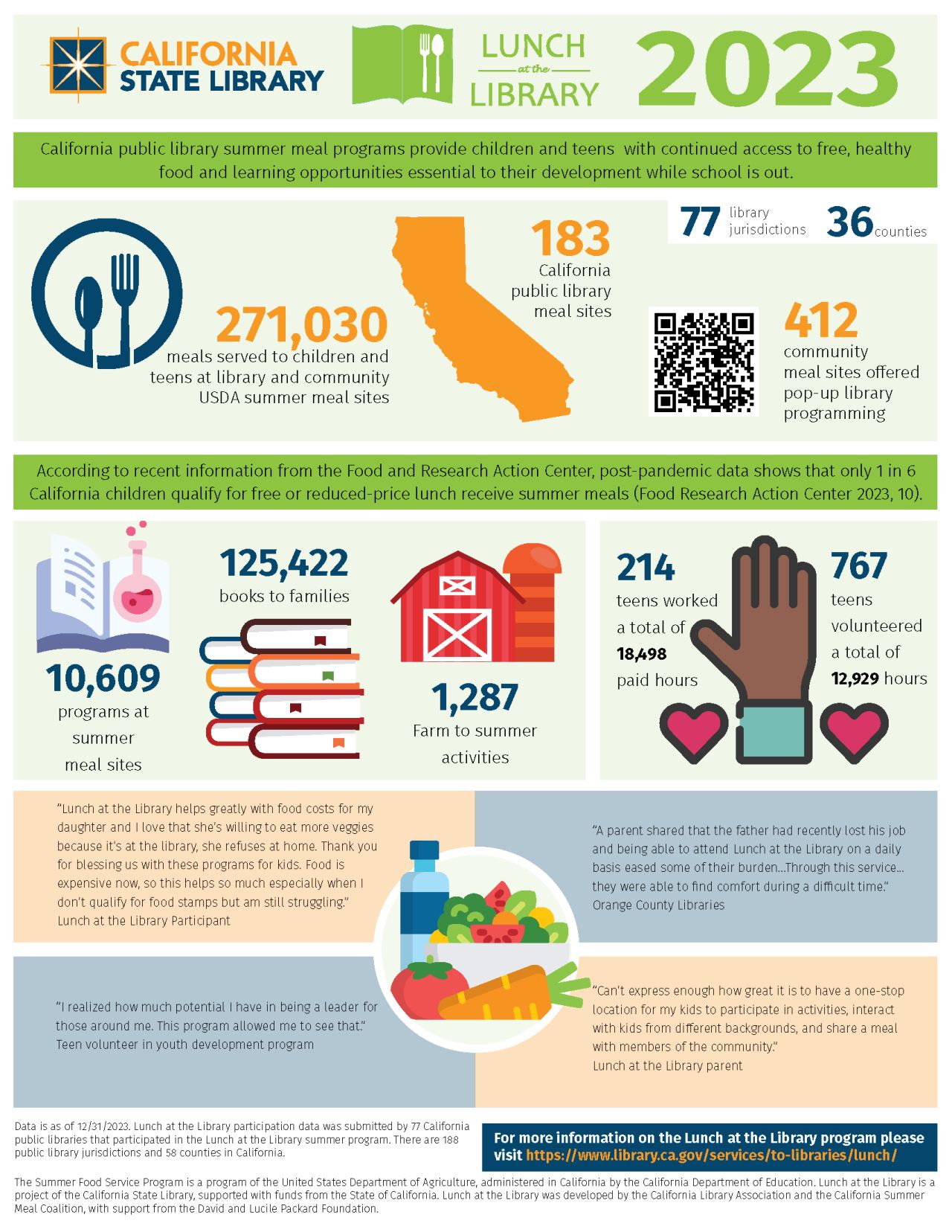
California State Library added testimonials to their infographic explaining the impact of free lunch services.

Tutorials

We know some community members have difficulty using library resources like databases or vendor apps. (Remember how many people struggled with the Libby App?) Some members of the public may find long, text-based tutorials to be to complex.

You can turn those text instructions into a visual how-to guide to help community members ingest the information. Here’s a fun, two-page infographic from Falvey Library at Villanova University. It explains everything a student needs to know about the library as they start a new school year.

Compare and Contrast

Instead of just sharing statistics, use an infographic to compare metrics before and after library interventions. The visuals go a long way to clearly illustrating the impact of your library work.

You can also use an infographic to explain why library services are superior to other resources.

Arkansas River Valley Library System’s infographic shows the free library services that can replace paid subscription services.

Service Bundles 

Create a flowchart showing how a patron uses multiple services.

For example, your patrons may start by visiting your libraryโ€™s website, where they sign up for a cooking program. When they get to the branch to attend the program, they may pick up a cookbook from a book display. Inside the cookbook, they may find a bookmark promoting the library of things.

An infographic illustration of that patron journey helps explain the interconnectedness of library services to board members, lawmakers, and potential partners.

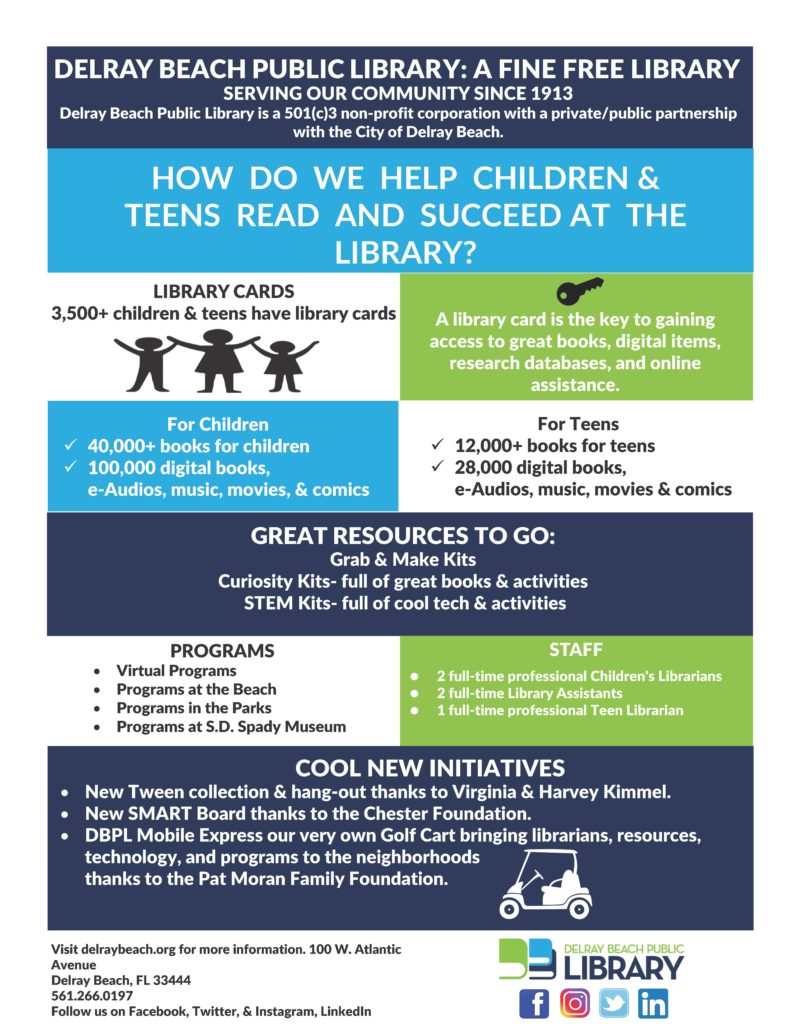
Delray Beach Public Library explains the interconnectedness of its services in this infographic.

Visualizing Partnerships

Use an infographic to show how the library collaborates with other local organizations, schools, and businesses. This will demonstrate how the library actively engages with the community, which builds trust and awareness. It can also highlight additional services and programs available through these partnerships.

Here’s a great example from the Tampa Bay Library Consortium explaining how the Institute of Museum and Library Services Funds help Florida library programs.

Library Accessibility

Your library can use an infographic to illustrate how the library makes resources accessible to different demographics. This includes children, seniors, and non-English speakers.

For example, if your library knows that 95 percent of seniors who attend tech skills programs learn to use tech fluently, you can demonstrate that with graphics.

Bonus tip: For accessibility of your infographic, create a downloadable alt-text document for the infographic. This allows people who use screen readers to consume the infographic. Hereโ€™s an example from EBSCO. Scroll to the bottom of the illustration and youโ€™ll see the prompt to download the alt-text version of this infographic.

Environmental Impact

Show the libraryโ€™s efforts in sustainability and green initiatives. Use visuals to demonstrate eco-friendly programs, such as recycling, energy-saving measures, and community gardening projects.

If your library has undergone a renovation or built a new building and you’re Leed-certified, use an infographic to show your community how that designation saves money and the planet.

Volunteer Contributions

Infographics easily explain the impact of volunteers on a library. The visuals can help you clearly show the number of volunteer hours. They also illustrate the types of activities volunteers assist with. Additionally, they convey the value volunteers add to the library.

Need help creating your infographic?

I am not an artist. I can barely draw stick figures. So creating an infographic is daunting to me. This post explains the process I use to plan and create an infographic.

Hey library marketing friends: I’m teaching a pre-conference workshop at LMCC this year with my amazing coworker Caleigh Haworth. It’s all about marketing your collection. Registration is open now.


P.S. You might also find this helpful

The Top 13 Places To Find Library Content To Share When Youโ€™re Tired and Overworked (Bookmark This Post!)

Subscribe to this blog and youโ€™ll receive an email whenever I post. To do that, enter your email address and click on the โ€œFollowโ€ button in the lower left-hand corner of the page. You can also follow me on the following social media platforms:

How One Library Marketer Transformed a Library Website: See the Stunning Before and After!

Photo courtesy Cincinnati and Hamilton County Public Library

Some of Megan Brattonโ€™s favorite memories were made at the Forsyth County Public Library in Winston Salem, North Carolina.

โ€œI went to a new concept charter school in downtown Winston Salem that was housed in the basement of an office building,โ€ explains Megan. โ€œThe school didnโ€™t have many amenities, like a gym or library.โ€

โ€œThis meant that we got to go on regular walking field trips to the main branch of the Forsyth County Public Library. We even got to decorate our own cotton tote bags to use carting our book finds back and forth. My dad worked in an office downtown and would often pop into the school or library for fun surprise visits.โ€

Megan went on to work in corporate marketing before getting her MLIS from the University of Denver. She initially intended to work in an academic setting but was more interested in the public library world. She ended up at the Natrona County Library in March of 2019, working as a part-time Childrenโ€™s Librarian.

โ€œI found it truly astonishing what all public libraries were able to do for their communities in response to immediate needs and in anticipation of future needs,โ€ recalls Megan. โ€œNo other large organization can pivot and change that quickly. Plus, they were doing it all for free and for everyone.โ€

โ€œAs a marketer, I realized there was a major need here. Public libraries are these bastions of creativity, advancement, support, and acceptance, but not enough people know about these free services. I wanted to find a way to put my skillset to use promoting public libraries, and it wasnโ€™t long after I started working at Natrona County Library that their marketer decided to move on to new ventures. In October of 2019, I stepped into my current role as head of Marketing and PR.โ€

Natrona County is the second-most populous county in Wyoming, with 80,000 residents. The library has a main branch in downtown Casper and a branch about 40 miles away in a small town called Edgerton. They also have a bookmobile.

Megan says nearly a third of Natrona County residents have an active library card, and the library enjoys high visitor and circulation rates and robust program attendance. That may be due in part to the work Megan has done in marketing.

At her library, Megan is a team of one, overseeing all social media, public relations, website development and management, advertising, graphic design, and branding.

โ€œI do ask that our programmers and other library staff try to keep a โ€˜marketing mindsetโ€™ to help capture photographs at programs or throughout the library space that could be used for social media,โ€ shares Megan. โ€œI am all about efficiencies and delegation, so I have licensed programs like LibraryAware and Canva which come pre-populated with professional-looking templates that staff can use to make their own bookmarks, flyers, signs, handouts, and more.โ€

I reached out to Megan after seeing the Natrona County Libraryโ€™s website. Itโ€™s clean and modern, with a thoughtful layout and what I can only describe as a โ€œcoolโ€ vibe. I told Megan it doesnโ€™t really look like a typical library website.

โ€œThe website (as I inherited it) was broken and battered. It had been built before mobile devices were a thing,โ€ recalls Megan. โ€œWe needed to start fresh with a ‘mobile first’ mindset, simplify the navigation structure, integrate new event software that made our program calendar more visually appealing, and incorporate a blog to position ourselves as thought leaders in our community and the larger Wyoming library community.โ€  

A screenshot of the Natrona County’s website homepage before the rebuild.

Megan partnered with a local creative agency on the website rebuild in 2021, thanks to the generous support of her library Foundation.

โ€œBecause of my extensive web background, we had an unusual arrangement where I worked side-by-side with their web guy as we built it out,โ€ explains Megan. โ€œAs you know, library websites have a LOT of pages, which can make a new website a costly build. Because I was able to tackle about 75 percent of the pages (using templates, structures, and design influence from the agency-built pages) myself, it cut the cost in half, which is how we ended up with such a professional-looking website on a public library budget.โ€

Natrona County Library’s website includes real photos of the library, conversational language, call to action buttons, and their newsletter signup is right on the home page.

For some libraries, the website can be a point of contention: everyone has different opinions about what should be featured on the homepage and drop-down menus. Megan needed to make decisions based on her knowledge of her customers. Later, analytics let her know if her instincts were correct.

โ€œThere are a couple of items that live in multiple places in the menu, like the Bookmobile, to accommodate multiple thought processes or visitor types,โ€ explains Megan. โ€œMy goal, ultimately, is to put things that make the most sense to our staff, because they are the ones referencing the pages the most.โ€

โ€œBut we are all in agreement that the most important pieces of information are to be at the very top of the homepage. Static across the entire site is the search functionality for our catalog, log-in to oneโ€™s account, library hours, and our phone number. I treat our website like a database in that sense.โ€  

โ€œAnecdotally, and through analytics, weโ€™ve come to realize that our patrons donโ€™t spend a whole lot of time on our website. They mostly come for hours, contact information, and to get to our catalog. They may also enter through digital ads, social media, or from other places directly to landing pages, but donโ€™t tend the linger.โ€

The website is also the home of Natrona County Public Libraryโ€™s blog, Library Stories.

โ€œOur blog is a byproduct of our bygone print newsletter,โ€ explains Megan. โ€œIt was important to me that we have a way to not only highlight that content for larger audiences but also share it differently, as blog articles can be interacted with much differently than print pieces.

โ€œThe blog is a great place to put press releases or share important library updates without building individual landing pages that disappear over time. Depending on the content, I do find that the blog articles drive traffic, especially if the blog article is about the library itself.”

“For example, we shared a press release about a recent exploration of a bank building as a potential new location for the library, and it got a lot of visitors (as well as a lot of commentary on social media). The same thing happened when we increased the number of security guards and shared that information with the community.”

“The blog is an excellent resource for the media and can be a great way to remind our community of our policies, procedures, and things like funding sources, as these are things that seem to come up often in social dialogue.โ€

Megan says if your library is considering a website refresh, make sure you make that digital space as welcoming and friendly as your physical locations.

โ€œAlso, when youโ€™re talking to your staff, stakeholders, and patrons about the library website, they have no idea that there is often a difference between your website and your catalog,โ€ adds Megan. โ€œI realize that some libraries have their site and catalog combined, but that is not the case for us.โ€

โ€œOur website is built on WordPress, and our catalog is through ByWater Solutionsโ€™ Aspen. We also have integrations with LibCal for our event calendar, room booking, appointments, and Library of Things. Patrons have no idea that these are all separate things, and a patron can shut down during conversation if you start talking about them as such.”

“Thatโ€™s why it was super important that all these disparateโ€“but integratedโ€“sites feel cohesive so that patrons and end users donโ€™t even realize when theyโ€™re navigating away from one and can easily and seamlessly navigate back to where they came from.โ€

You can read more about the rebuild of the Natrona County Library website here.

Hey library marketing friends: Every promotion you create brings the joy of your library to someone new. That’s something to be proud of!


P.S. You might also find this helpful

Google Does It Again! What New Changes in Search Ranking Mean for the Discoverability of Your Libraryโ€™s Website

Subscribe to this blog and youโ€™ll receive an email whenever I post. To do that, enter your email address and click on the โ€œFollowโ€ button in the lower left-hand corner of the page. You can also follow me on the following social media platforms:
8 Key Pieces of Social Media Marketing Advice From a Library Marketer Who Works at One of Scotlandโ€™s Oldest Public Libraries!

Photo courtesy Cincinnati and Hamilton County Public Library

About 10 miles north of the northernmost coast of Scotland lay an archipelago or chain of islands called Orkney. The islands surround Neolithic sites dating back 5,000 years with tall sandstone cliffs and colonies of seals. Archeological evidence shows that humans have lived on the island for nearly 9,000 years.

Thatโ€™s where John Peterson lives and works. He has managed social media for Orkney Library & Archive since 2017.

The library is one of the oldest public libraries in Scotland, dating back to 1683. These days, the Orkney library has two physical locations, a mobile library, and serves a population of about 22,000 people.

โ€œOrkney is a very rural community with a lot of farming and agriculture,โ€ explains John. โ€œAnd of course, weโ€™re an island so weโ€™re surrounded by the sea and have a lot of maritime history, particularly from the 20th Century and the World Wars.โ€

The Orkney library may be remote, but it has fans worldwide. In fact, one of my readers nominated this library for a profile, saying โ€œI love their use of social media and how they got such a small library on the world map.โ€  

โ€œWeโ€™re a very small organization and so we donโ€™t have a marketing team or anything like that,โ€ says John. โ€œWe just try to share what weโ€™re doing with our followers on social media and have a bit of fun as we go along.โ€

โ€œWe use social media as a way of sharing whatโ€™s happening in the library and the archive and what we do every day. Itโ€™s a good way of showing off Orkney and what it is to be a library and archive service in the 21st century.โ€

Orkney Library posts on Facebook, Instagram, and X (formerly known as Twitter). Of the three, John says X is the most effective way to reach his audience.

โ€œIt has its challenges sometimes but itโ€™s probably still our favourite as a way of telling stories and making fun posts or threads,โ€ explains John. โ€œFor us, it has been a great way of communicating an idea with a few words and pictures. Our Twitter following is approximately 4 times the entire population we serve.โ€

โ€œInstagram is our newest platform, but it has a growing audience, and we get a lot of nice feedback.”

“The platforms work differently, so we often have to tweak the posts slightly to suit each. Often, we post on Twitter first and then on to the other two platforms.โ€

When John sees a particularly effective post, he builds on that success by sharing the same kind of content his audience is responding to. But he admits that, like most of you, heโ€™s sometimes baffled by what does and doesnโ€™t work!

โ€œWe post different kinds of content,โ€ explains John. โ€œBut they usually involve books, archives, or old photographs.โ€

 โ€œSometimes a post takes off far better than you expected and other times a post that you thought was interesting or funny doesnโ€™t get much engagement. There is a whole load of reasons for that and itโ€™s important not to get too disheartened if something doesnโ€™t work.โ€

โ€œOf course when a post doesnโ€™t work it could be that the idea wasnโ€™t good or wasnโ€™t communicated well enough. But often it is just a case of timing โ€“ wrong time, wrong day, it didnโ€™t get the retweets to send it further across the platform, etc. You could post the same post at two different times and get totally different responses.โ€

John’s Advice for Social Media Marketing

  1. Try to post good content and try to post regularly โ€“ but not too much. Not every post can be funny or interesting. But try to make sure that some of them are so people have a reason to follow you.
  2. Try to make it interesting. Donโ€™t just do what everyone else is doing, and donโ€™t rely on sharing content from other accounts.
  3. Try to write your own stuff and find your own voice.
  4. Pay attention to what works for you and then do more of it. Listen to feedback, good and bad โ€“ itโ€™ll help you to do more of what people like and less of what they donโ€™t.
  5. Donโ€™t be controversial and try to avoid politics.
  6. Concentrate on what makes your library or organization different from everyone else and try to use those things to build your own presence and identity.
  7. Look around you. Spot opportunities for good content. The more you do it the easier it gets.
  8. Find some libraries on social media and follow them, no matter where they are in the world. They donโ€™t have to be the famous places youโ€™re always hearing about to be worth following. Anybody can be worth following if they post good, interesting content – even small local libraries on remote islands. Find some libraries and archives, museums and galleries, and give them a follow. Youโ€™ll be glad you did.

Johnโ€™s final piece of advice: donโ€™t take your libraryโ€™s social media work too seriously.

โ€œThatโ€™s what itโ€™s all about โ€“ having fun, having a passion for what youโ€™re doing, and sharing it with the world.โ€  


P.S. You might also find this helpful

A Reader Asked for My Ultimate Top Ten Tips for the Most Effective Library Marketing Possible: Hereโ€™s the List

Subscribe to this blog and youโ€™ll receive an email whenever I post. To do that, enter your email address and click on the โ€œFollowโ€ button in the lower left-hand corner of the page. You can also follow me on the following social media platforms:
A Reader Asked for My Ultimate Top Ten Tips for the Most Effective Library Marketing Possible: Hereโ€™s the List

Photo courtesy Cincinnati and Hamilton County Public Library

The first thing I do when I visit my parents is greet their dogs. The second thing is to look for my list.

My parents are aging, so I like to help with things they can no longer do. I wash windows, weed the flower beds, and sew on loose buttons. As I work through the list, I get a certain satisfaction in checking things off.

Lists have always been a part of my life. My mother wrote a daily list for when I got home from school. Feed the dogs. Make a salad. Start your homework. Itโ€™s almost as if she thought I wouldnโ€™t know what to do with myself if I didnโ€™t have a list to follow.

And she was right. I now make lists for everything. Lists for packing. Lists for groceries. Lists of tasks I need to complete during the workday. Gift lists at the holidays.

Lists help you focus and prioritize. So, when one of my readers asked for a list of the ten best tips and practices for library marketing, I dug in. (Imagine me cracking my knuckles, blowing on my fingers, and setting my fingers on the keyboard here.)

Top Ten Tips for Library Marketing and Promotions

#1: Send email to your community.

Email is the most effective marketing tactic. You donโ€™t have to battle algorithms. And 99 percent of people with an email address read their email daily, usually first thing in the morning.

Starting a consistent library email program can be intimidating. But I put it at the top of the list because it’s the best use of your time.

You can start small by sending a newsletter. Work your way up to targeted email segments, where you’ll be sending shorter, more focused messages to specific groups of people. Don’t worry that you’re leaving people out with more niche emails… you are not.

Coming soon: a new course on email marketing from Learn with NoveList taught by yours truly. It’ll be part of the staff subscription plan.

#2: Post no more than once a day on your social media channels.

Social media for libraries works to create brand awareness and affinity. But they’re also ruled by algorithms that determine who sees your posts. The algorithms value quality posts, not quantity. So, posting often does nothing to boost your reach. Once a day is plenty.

Make a schedule to create quality posts and give your social media feeds consistency (which the algorithms love). For example:

  • Monday: Promote an item in your collection.
  • Tuesday: Share a video.
  • Wednesday: Ask a question.
  • Thursday: Promote a program.
  • Friday: Share something about a library staff member or something behind the scenes of library work.
  • Saturday: Promote a service, like your seed library, a database, streaming videos, or your MakerSpace.
  • Sunday: Share something funny, inspiring, or thoughtful about the joy of reading or the importance of intellectual freedom.

Each year, beginning in November, I publish a best practices guide for each of the major social media channels. To see the guides, type the name of the platform you want to research in the homepage search bar.

#3: Put a bookmark in every hold and checkout that leaves your library.

Your collection is a marketing tactic! No library visitor should ever leave the building without a piece of promotional material.

To get started, pick three areas of focus for your bookmarks. Make one bookmark for each of your three focus promotions. For example:

  • A booklist
  • An online item like streaming music
  • A recurring program.

Teach staff to add a bookmark to every hold and checkout. They use context clues to decide which of your three focused promotional bookmarks will resonate most with each library visitor.

#4: Write a general marketing script and have staff recite or read it before every program.

Your programs are also a marketing tactic. Use the first minute of each program as a “housekeeping moment”, so share a marketing message to this captive audience.

The message should be short, 3-4 sentences. And it should be tailored to the audience.

Here’s an example. Let’s say your library just purchased a set of after-hours holds lockers. You want people to use them. You can create a script for staff to read before programs.

For children’s programs your script might say:

“Hello everyone! I wanted to let you know about a new service we have at the library โ€“ our after-hours holds lockers. You can pick up your reserved books and materials anytime, even when the library is closed. Itโ€™s a convenient way to get the books your family needs, on your schedule!”

For adult programs, your script might say:

“Hello everyone! Before we begin, I want to tell you that our library now has after-hours holds lockers. Maybe you saw them as you walked in: they’re just to the right of the front doors. You can pick up your reserved books and materials at any time, even outside of our regular hours. So if you work a late shift or you’re going to have a particularly busy day and can’t get to the library before we close, you can still get your books!”

#5: Talk to one community group every month.

Reach out to the Kiwanis Club, Chamber of Commerce, Junior League, and local professional groups. Ask for five minutes during their next meeting to talk about what is available at the library and to sign up members for a library card.

#5: Analyze your promotional metrics each month.

Schedule 30 minutes once a month to look at the past monthโ€™s performance on social media, email, and your website.

Watch for trends. Did your social media impressions spike this month? What may have caused that? Did your email open rate plummet? Take a look at the emails you were sending to determine what may have caused the dip. Did attendance skyrocket at your monthly book club after you posted an Instagram Reel promoting it? Do more Instagram Reels!

This work will help you spot issues and opportunities. You can replicate the things that your audience responds to. And you can stop doing the things that don’t work for your audience, and have the data to back up your decision! It’s time well spent.

#6: Create an editorial calendar for the next 6-12 months.

Planning your promotional schedule gives you time to thoughtfully create your promotions and get approvals. Plus, you can share your plans with your coworkers and supervisors, so everyone at the library knows whatโ€™s been marketed and when.

Schedule your emails, when you’ll change your website graphics, your book displays… even the signs in your library lobby.

Some of this planning will be easy. You know when summer reading, Library Workers Week, National Library Card Signup Month, back-to-school, and holiday events happen.

Leave space in your calendar for those unexpected things that come up. If your director announces his or her retirement, your building needs renovations, or your library buys a new databaseโ€ฆ youโ€™ll have space in your calendar to accommodate those promotions.

Here’s more advice on creating an editorial calendar.

#7: Ask for time at the next all-staff meeting to discuss library marketing.

One of the most common things library marketers struggle with is their coworkers. They donโ€™t understand how promotions work!

Transparency is always a good idea. You want everyone, from the front-line staff to your senior staff, to understand what youโ€™re doing and why youโ€™re doing it.

Talk about your goals. Talk about how you work to accomplish them, and why you use certain marketing channels for certain promotions. Then, share successes to show that your efforts are working and share failures to drive home the point that marketing is an experiment and youโ€™re always learning.

Here’s a great example of one library marketer who built advocates and allies inside his library.

#8: Follow best practices for press coverage.

The media is an audience you must court, like any other target audience! The easier you make their job, the more positive press coverage your library will enjoy.

I used to work as a television news producer and I have many friends still in the business. Here are the top six tips they give for garnering press coverage for your library. Here are more tips from another former journalist turned library marketer.

And, I hope you’re planning to attend the 2024 Library Marketing and Communications Conference because this is the focus of my session this year! I’ll be moderating a panel with three former journalists turned library marketers who will share their top tips for building positive relationships with your local media.

#9: Start a blog.

A blog is one of the best ways to share information about the library and drive visitors to your website. It allows your library to tell your story, create brand awareness, and promote your library to your audience for free, without having to deal with the rules of someone elseโ€™s platform.

And, frankly, it’s fun! But it can be difficult to get a blog off the ground. It took me five years to launch a blog at my former library. Now, I’m running the blog at my day job at NoveList. Here are all the things I’ve learned about blogging from those experiences.

#10: Set aside 20 minutes a week to learn.

Marketing is changing all the time. You can keep up with the latest social media news and marketing tips by dedicating time to this work.

Hey library marketing friends: Remember, every promotion you put out into the world can spark a lifelong love of reading in someone. Your work makes a difference!


P.S. You might also find this helpful

Library Cracks the Code on How To Tell Stories to Stakeholders: They Use Email! Hereโ€™s How Their Targeted Newsletter Works

Subscribe to this blog and youโ€™ll receive an email whenever I post. To do that, enter your email address and click on the โ€œFollowโ€ button in the lower left-hand corner of the page. You can also follow me on the following social media platforms:

Library Cracks the Code on How To Tell Stories to Stakeholders: They Use Email! Hereโ€™s How Their Targeted Newsletter Works

Photo courtesy Cincinnati and Hamilton County Public Library

During the pandemic, Claudine Bennet was stuck at home, and trying to adjust to her new role as External Relations Manager at Dayton Metro Library, she came up with a fun game.

โ€œAt the time, I had a map next to my desk at home,โ€ remembers Claudine. โ€œI would glance up and see a city and boom! I was searching for their website and social media presence.”

“Not only did I learn a lot about what libraries across the country were doing during a pivotal time in our country, but it helped to affirm we were on the right track with our strategy.โ€

Claudine has come a long way from her childhood days spent in the basement of the Peru Free Library in upstate New York.

โ€œThe childrenโ€™s section felt like a magical hide-out,โ€ recalls Claudine. โ€œAdults were never in that space (a paradise for a kid!) and I could read and look at all the books I wanted!โ€

Nowadays, Claudine oversees media relations and marketing for DML, located in south central Ohio. The system has 17 physical branches, 350,000 active card holders, and a service population of 533,892 residents.

A few months ago, Claudine contacted me to nominate her library for kudos on The Library Marketing Show. She wanted to share a newsletter her library sends to lawmakers and legislators.

Claudine and the External Relations (ER) team realized they needed such a newsletter in 2023.

โ€œNews releases in the local media, flyers in branches, our website and social media platforms โ€“ those are great ways to get information out,โ€ explains Claudine. โ€œWe also have a general digital newsletter that reaches more than 65,000 subscribers. But those methods are broad brushstrokes.โ€

โ€œWhen Austin Railey III joined DML as the new Government Relations and Advocacy Director we started brainstorming how we could strategically tell our stories to decision-makers. After weighing the pros and cons of various methods, we decided the most targeted and economically efficient way was through a quarterly email.โ€

Claudine says the newsletter, Beyond Books, is a collaborative effort. Her department works with others to select stories that reflect how the library collaborates on community initiatives such as economic and workforce development, building regional partnerships, and creating innovative services and programs of value to all community members.

โ€œThe stories we tell in Beyond the Books arenโ€™t about the who, what, when, and where of events and programs, but about the why,โ€ says Claudine. โ€œWhy did we create a program? Why is the program or service helping our patrons? Why should it receive support? Why is DML a valued community partner?โ€

โ€œWe always put photos in the newsletter also. Reading a story is great, but seeing the story is incredibly valuable too!โ€

Claudine says the audience for this specific newsletter is a curated list of 200 elected officials and government sector leaders. DML tailors the information to reflect the topics of utmost importance to these readers.

โ€œBecause the topics are relevant to the readers and we limit the content to two to three stories, it is an easy and digestible way for elected officials and community leaders to stay connected with how the Dayton Metro Library is achieving its mission, vision, and values,โ€ asserts Claudine.

The collaboration involved in Beyond Books is key to its success.

โ€œWhen looking for communication solutions for a niche audience, bring everyone to the table,โ€ advises Claudine.

โ€œFor myself and my team, it is incredibly helpful to understand what is trying to be communicated, to whom, and why. Those answers will help to identify which communication tool we need to optimize and what information should be shared.โ€

โ€œOnce that is explained and expectations are established for everyone, the creativity flows! Now, as a team, we often suggest stories for Books and Beyond because we understand what we are trying to achieve.โ€

Claudineโ€™s team is also working on a new branding campaign called Free to Belong. Working with a nationally recognized local advertising agency, the library sought input from staff and the public about its brand and marketing tools. The new campaign is in its second phase. The library will release television commercials, social media spots, print and radio ads, and billboards.

โ€œThe second set of spots cement DML as a destination where everyone is valued,โ€ explains Claudine. โ€œThey will feature the library meeting people where they are, including the Bookmobile at festivals and our library tent at special events such as the annual Pride celebration in Dayton.”

“The spots will also feature members of marginalized communities as they use library resources including collections and technology. Everyone needs to see themselves in our spaces!โ€

When sheโ€™s looking for inspiration, Claudine turns her eyes to other libraries in the Buckeye State.

โ€œLibraries in Ohio are incredibly inventive and impactful in their marketing efforts,โ€ says Claudine. โ€œIโ€™m always inspired by what they are doing!”

“Weโ€™ve created a state-wide committee of library communications and marketing professionals, and we share our “aha” moments, ideas, resources, challenges, and successes. I have learned that libraries are truly a profession that subscribes to the philosophy of โ€˜When one rises, we all rise.โ€™โ€

Hey library marketing friends: Your work is important and you are making a difference. Keep it up, you’re doing great!


P.S. You might also find this helpful

Finding the Perfect Name for a Library Program: A Checklist and Tips for Using AI

Subscribe to this blog and youโ€™ll receive an email whenever I post. To do that, enter your email address and click on the โ€œFollowโ€ button in the lower left-hand corner of the page. You can also follow me on the following social media platforms:

Finding the Perfect Name for a Library Program: A Checklist and Tips for Using AI

Photo courtesy Cincinnati and Hamilton County Public Library

One of the hardest tasks in library marketing is naming programs and events.

The name of a program can significantly impact attendance. The name must capture attention. It needs to be clear and memorable. And it needs to be discoverable for community members searching online.

In this post, Iโ€™ve created a checklist. Under each point on the checklist, Iโ€™ll give you an example of how to use AI tools like ChatGPT, CoPilot, Perplexity, and Gemini to check that your library program name meets the criteria.

If youโ€™ve already come up with a name, you can check your choice against each of these considerations. If youโ€™re beginning from nothing and have no clue what to name your program, use this checklist to find the best name and drive lots of attendance!

Checklist for Naming Your Library Program

โœ”๏ธRelevance

The name of your library program should accurately reflect the program’s or event’s content and purpose. It should give attendees a clear idea of what to expect.

Example

I asked Googleโ€™s Gemini: โ€œI am putting together an early literacy library program. In this program, babies and caregivers can read books together, but the babies are encouraged to move around during the reading time. I want to name the program “Young and Restless”. Is that a relevant program name?”

Geminiโ€™s answer

“Young and Restless” might not be the best fit for an early literacy program.

“Young and Restless” is the title of a soap opera, and the connotation leans more towards drama and adult themes. It doesn’t immediately convey the idea of early literacy. While “restless” could be seen as a playful reference to a baby’s energy, it might also suggest a negative connotation of being unable to focus.

Here are some alternative program names that better capture the essence of your program:

  • “Wiggle While We Read”
  • “Rhyme Time & Playtime”
  • “Storytime on the Move”
  • “Littlest Learners & Lively Laps”
  • “Bookworms in Motion”

โœ”๏ธAppeal

The name must attract your target audience. Consider that people often scroll online and when they read print. Your library program name must stand out from other programs or events in your community.

Example

I asked Perplexity: โ€œI am putting together a library program where crocheters of all skill levels can come to work on their projects, give help to others, and get help building their skills. I want to call it Hooked on Crochet. Does that program name have enough appeal to capture attention?โ€

Perplexityโ€™s answer

The name “Hooked on Crochet” for your library program has several appealing qualities that could help capture attention:

Pros:

  • The name plays on the double meaning of the word “hooked,” referring both to the crochet hook used in the craft and the idea of being enthusiastically engaged or “hooked” on crocheting.
  • The alliteration and rhyming nature of the name make it catchy and easy to remember, which is essential for a program name to stand out.
  • By not specifying skill levels in the name, it implies that the program is open to crocheters of all abilities, from beginners to experts.
  • The word “hooked” has a positive connotation, suggesting a passionate interest or enjoyment in crocheting, which could resonate with enthusiasts of the craft.

Potential Cons

  • While wordplay can be effective, some may find the “hooked” pun a bit overused or clichรฉd in the context of crocheting.
  • The name may be too specific to crochet and could potentially exclude other fiber arts or crafts that you might want to incorporate in the future.

โœ”๏ธClarity

The name should be easy to understand and remember. Youโ€™ll want to avoid complex, obscure, or cutesy names that might confuse people.

Example

I asked ChatGPT: โ€œI am organizing a library program where people can bring a plant to swap and learn about composting, and sustainable gardening. There will also be crafts and games. This program is for all ages. Can you help me come up with a name that clearly states what will happen at my program?โ€   

ChatGPT’s answer

That sounds like a fantastic and engaging program! For a name that captures the essence of your event while being concise and appealing, consider the following options:

  1. “Sustainable Garden Swap & Fun Day”
  2. “Green Thumb Plant Swap and Activities”
  3. “Eco-Friendly Garden Day”
  4. “Plant Swap and Garden Fun”
  5. “Sustainable Gardening Fair”

โœ”๏ธLength

The name should be short and concise. Long names can be difficult to remember and may be difficult to fit on your marketing materials.

Example

I asked ChatGPT: โ€œI am putting together a library program at an academic library. The program will be interactive and will help students to better understand the databases and research resources available to them at the library. I want to call the program Interactive Workshop on the Integration of Research and Retrieval Skills, but my manager thinks that name is too long. Is it too long?โ€

ChatGPTโ€™s answer

Yes, “Interactive Workshop on the Integration of Research and Retrieval Skills” is quite long for a program name. It might be better to shorten it to make it more concise and easier for students to remember. Here are a few shorter alternatives:

  • “Research Skills Workshop”
  • “Interactive Research and Retrieval Workshop”
  • “Library Research Skills Workshop”
  • “Research Resources Workshop”
  • “Effective Research Techniques Workshop”

โœ”๏ธAccessibility

The name of your library program must not exclude any potential participants.

Example

I came up with a name for a technology program called โ€œAdvanced Technological Workshop for Digital Natives.โ€ I asked ChatGPT to evaluate the accessibility of the name.

ChatGPTโ€™s answer

โ€œAdvanced Technological Workshop for Digital Natives.โ€ is an inaccessible library program name for several reasons.

Community members might interpret the term โ€œDigital Nativesโ€ to mean only younger people who they assume are highly proficient with technology. This excludes older adults or those without regular access to technology. Itโ€™s also a very obscure term. Did these people live in the digital world?? 

The term “Advanced” might also deter people who do not consider themselves advanced in technology from attending, even if they are interested in learning more about it!

And the whole tone of the name is very formal, academic, and intimidating.

โœ”๏ธSearchability

Many of your community members are looking for help online. You want your program name to come up in search! So be sure to include keywords that people might use in search.

Example

I asked Copilot: โ€œI have a library program named “Opera Appreciation.” Are there any keywords or phrases that I need to add to the program name or description to make this more discoverable in search?โ€

Copilotโ€™s answer

Certainly! To make your โ€œOpera Appreciationโ€ program more discoverable, consider incorporating relevant keywords and phrases in the program name or description. Here are some suggestions:

  1. Opera: This will directly associate your program with the art form.
  2. Music Appreciation: This can help convey the educational aspect and attract those interested in learning about this genre.
  3. Classical Music: Opera is a subset of classical music, so including โ€œclassical musicโ€ in your programโ€™s description can broaden its reach.
  4. Arias: Highlight that your program explores opera ariasโ€”the beautiful solo pieces performed by singers. Mentioning โ€œariasโ€ can attract opera enthusiasts.
  5. Composer Names: Incorporate the names of renowned opera composers.

P.S. You might also find this helpful

A Guide to Uncovering the Best Channel To Message Hard To Reach Target Audiences Using ChatGPT

Subscribe to this blog and youโ€™ll receive an email whenever I post. To do that, enter your email address and click on the โ€œFollowโ€ button in the lower left-hand corner of the page. You can also follow me on the following social media platforms:

Time Well Spent: How One Library Marketing Team Analyzes Metrics and Uses That Data To Prove Their Value

Ann Malthaner spent her childhood visiting the library where she now works, Stow-Munroe Falls Public Library.

โ€œMy office is where the Children’s Department used to be,โ€ recalls Ann. โ€œWhen I started working here 18 years ago, some of the librarians from my childhood still worked here, and I remember feeling excited to meet them on my first day, almost as if I were meeting celebrities.โ€

โ€œI consider myself very lucky that I have been able to work in a library. Itโ€™s not hard to market a product you love.”

Ann is the libraryโ€™s Marketing and Public Relations Manager. Her team includes a full-time graphic designer, a part-time writer, and an assistant.  Her library has one location, which has a distinct benefit, according to Ann.

โ€œItโ€™s very easy to get information and collaborate with co-workers,โ€ she notes. โ€œI work closely with our director, and fortunately, our library did a strategic plan two years ago. It was quite a process, but it has made my job easier in that there is a clear path forward with our marketing efforts.โ€

Ann is a rare library marketer in that she and her team have been tracking metrics on her library promotions for nearly two decades!

โ€œThe metrics we gather have evolved over time with the advancements in technology,โ€ explains Ann. โ€œWe are now able to gather more information about the tools we use to achieve our marketing goals. And the dashboards on targeted emailing, social media performance, and Google Analytics are very telling.โ€

That data not only informs the promotions that Ann and her colleagues create, but it also helps stakeholders to understand the value and impact of their library marketing.

โ€œWe share these reports with the Board of Trustees monthly to inform them about our work and how we make data-driven decisions,โ€ says Ann. โ€œThis helps them better understand our department’s operations.โ€

โ€œI used these reports to justify my departmentโ€™s size and marketing efforts. Our reports also include the number of printed brochures, rack cards, bookmarks, and more we produce. I used this information to advocate for adding an electric trimmer, folder, banner printer, and our departmentโ€™s industrial copier. I was able to justify these purchases when I compared them to outside costs and estimated saved staff time.โ€

Her team uses many tools to create reports and analyze monthly metrics, including their email dashboard, social media scheduling platform, and website analytics dashboard. The whole process takes about 8 hours from start to finish.

โ€œYou might think that sounds like a lot, but this is time and effort thatโ€™s well spent,โ€ states Ann. โ€œWe analyze the results and plan our path forward with this information. We can see whatโ€™s working and just as importantly, whatโ€™s not. We can quickly adjust to make our time more productive and impactful.โ€ย 

โ€œEvery time your leadership team reads these, you are documenting the value of what you are doing. Their importance cannot be overstated.โ€

Those metrics come in handy as Ann plans marketing for the rest of the year. Her library recently purchased a bookmobile and is creating a new Outreach department.

โ€œOur department is responsible for creating the bookmobile wrap, which is fun!โ€ exclaims Ann. โ€œWe are in the process of a massive parking lot reconfiguration and addition. And we are also doing a tear out and reconfiguration of our circulation department.โ€

โ€œKeeping our customers informed and up to date with these changes has been our first priority. And itโ€™s our 100th anniversary this year. We have our work cut out for us!โ€

For inspiration, Ann just keeps her eyes open all the time.

โ€œIโ€™m always looking for great design and marketing,โ€ says Ann. โ€œItโ€™s all around us! And thereโ€™s some bad stuff too. The trick is how to incorporate the good in your library efforts.โ€


P.S. You might also find this helpful

A Message for You and Your Supervisor on the Most Difficult, Complicated, and Important Step in Library Marketing

Subscribe to this blog and youโ€™ll receive an email whenever I post. To do that, enter your email address and click on the โ€œFollowโ€ button in the lower left-hand corner of the page. You can also follow me on the following social media platforms:
โฑ๏ธ7 Time-Saving Tips for Anyone Looking To Create High-Quality Library Marketing Emails That People Will Read!

Photo courtesy Cincinnati and Hamilton County Public Library

Last week, we discussed the pros and cons of email marketing automation. If your library chooses a program that requires a more hands-on approach to email marketing, this post is for you. These time-saving tips will let you create high-quality emails that resonate with your audience without spending all day on your emails. (Although, how fun would that be?!)

Time-saving Tip #1: Use templates.

This is the most effective way to save time when creating library marketing emails. If your email program doesnโ€™t offer templates and you must make them yourself, hereโ€™s how to do it.

Decide on your buckets.

What kind of emails does your library need to send? Look at your library’s overall strategic goals and your marketing goals. Then, break your emails down into categories, like this:

  • Promote programs
  • Promote the collection
  • Promote services that bring people into our physical branches
  • Announcements like holiday closures, new services, renovations, service outages, etc.
  • Email to donors and legislators

Create one template for each category.

The ideal template will have sections with space for text, an image, and a call to action button. Here’s a great example of a library marketing email from Eisenhower Public Library made from a template.

Populate and send.

When it comes time to send the email, make a copy of your template. Insert the copy, images, and appropriate call to action, and hit send!

Time-saving Tip #2: Keep your emails short.

Emails that include no more than 4 topics perform best. If you have more to say, you can always send another email!

Keep the text in your email to a minimum. Think of your text as a tease. You want to write 1-3 enticing lines that compel your recipient to do something, like register for a program or put a book on hold.

Time-saving Tip #3: Target your messages to specific audiences.

It takes time to write copy thatโ€™s generic enough to appeal to everyone in your community. By comparison, itโ€™s easier and faster to write text and find images when you know exactly what your audience is looking for in your library emails.

And, by targeting your message, you are more likely to say something that matters significantly to your cardholders, which makes them more likely to act, which makes your email more successful!

Targeted email marketing for libraries is effective because it serves the right message to the right group of people. And it works for all kinds of messages.

Also, your library should make your emails opt-in. This ensures your emails are going to community members who want your content.

Time-saving Tip #4: Let the robots help you with your subject line.

You should never rely on Artificial Intelligence tools like ChatGPT to do all the work for you when it comes to library email marketing. But they are a great starting point! Instead of staring at the wall trying to brainstorm ideas for the best subject line, ask the AI to get you started.

To show you, I ran this example using Microsoft’s Copilot.

Once you have a place to start, you can tweak the subject line to match the tone of your library. Move, change, or remove the suggested emoji. And then, run the subject line through one of the free analyzers below. Each has its own algorithm for predicting the success of a subject line. But all will help you get to a subject line that works for your target audience.

Time-saving Tip #5: Plan as much as humanly possible.

Plan your email campaigns in advance using an editorial calendar. This helps you stay organized and maintain consistency.

And, if you know ahead of time when you are sending emails, you can set aside time in advance to create them and get them approved. Have a few spare minutes at the beginning or end of your shift? Work on emails coming up in the next few months!

Time-saving Tip #6: Reuse and repurpose.

You donโ€™t have to reinvent the wheel every time you create an email. If you wrote a social media post or a blog that did really well, steal the text you’ve already written and insert it into your email. Use the same image or graphics, sized correctly for your email of course, and hit send!

Time-saving Tip #7: Watch your metrics.

If you take an hour each month to analyze the performance of your library emails, youโ€™ll soon start to get a clear picture of what works for your audiences. That will make you more efficient as you create your emails. You wonโ€™t waste time creating emails that your recipients wonโ€™t read.

Did I miss any tips? Let me know in the comments!


P.S. You might also find this helpful

Library Marketer Shares Her Ingenious Trick for Making Sure Her Community Sees Her Social Media Posts

Subscribe to this blog and youโ€™ll receive an email whenever I post. To do that, enter your email address and click on the โ€œFollowโ€ button in the lower left-hand corner of the page. You can also follow me on the following social media platforms:

A WordPress.com Website.

Up ↑