Search

Super Library Marketing: Practical Tips and Ideas for Library Promotion

Tag

marketing plan

How To Create a Marketing Plan for an Entire Year Even if Your Libraryโ€™s Strategic Plan Sucks or Is Non-Existent!

Photo courtesy Cincinnati and Hamilton County Public Library

This week, Iโ€™ll be able to see the worldโ€™s largest bottle of catsup. (Ketchup? Catsup? Is there a difference?)

When I learned that Iโ€™d be speaking at Reaching Forward South in Collinsville, Illinois, I Googled the area. Thatโ€™s how I discovered the city is home to a 170-foot water tower shaped like a catsup bottle that just happens to be on the National Registry of Historic Places. Itโ€™s even got its own website and fan club.

If youโ€™re like me, you do some strategic planning when you go on a trip. You decide to rent a vehicle or research public transportation. You purchase airline or train tickets and book a hotel. You pick restaurants to sample and decide which tourist attractions you’ll visit.

Some people just land in a city and let fates carry them where they may. (No shade from me. You do you!) I prefer planning because I donโ€™t want to risk seeing or experiencing the best the area has to offer.

A plan, on vacation or in the library, sets clear goals and outcomes. It ensures your time, money, and energy are spent on the most valuable things. It gives you direction and purpose.

Marketing for a library works best when the promotions are tied to a library’s overall strategic plan. But that’s not always as easy as it sounds.

What is the difference between a strategic plan and a marketing plan?

A strategic plan defines targets and objectives for the entire library organization, including facilities, human resources, reader services, youth services, outreach, and more.

A marketing plan outlines your initiatives to support your libraryโ€™s strategic plan. It clearly defines the collection items, programs, and services youโ€™ll promote, who youโ€™ll target, and how youโ€™ll target them to reach your library’s overall goals.

In a perfect world, every library would have a strategic plan with clearly defined objectives and goals that are specific, measurable, actionable, relevant, and timely (SMART).

But…

If your library lacks a strategic plan, has a strategic plan that’s very vague without clear goals, or is in the middle of creating one (that can be a lengthy process), you may feel stuck and directionless. How do you know what you should be promoting?

What to do when you have very little direction

You can ask your library director or board of directors what they want to accomplish. Without a strategic plan as a guide, you must understand the director’s and the board’s goals.

Even basic statements like “We want to increase program attendance by 25 percent” or “We want to make sure every child has a library card” will guide your marketing.

If you don’t feel comfortable approaching senior leadership, ask your supervisor to step in. Stress the importance of a cohesive plan for moving forward in all areas of your library. This really is the cornerstone of your work.

Once you know the goals of your library, itโ€™s time to create your marketing plan. 

Step 1: Define your marketing goals. 

Lay out exactly how youโ€™ll help those overall library goals be reached.

For example, letโ€™s say your library has a goal to partner with schools to ensure all third graders in your town are reading at grade level. Your marketing goal might be:

Increase the participation in our library’s 3rd-grade reading program by 25 percent within the next 12 months, as measured by the number of 3rd-grade students enrolled and actively engaging with the program materials and resources.

Step 2: Write down what you know about the community you serve.

Marketers call this a โ€œsituation analysis.โ€ This will give you a starting point for your strategy.ย Ask yourself:

  • What does your typical cardholder do with their card?
  • Where do they live?
  • How do they view your competitors?
  • How does your library currently fulfill a unique position in your community?

Step 3: Create a list of all your tactics and assets. 

Write down all the channels you use to promote your library. This list should include everyย social media platform you use, every website your library owns, and every print publication you send out, plus emails, print collateral, influencers, in-person events, press releases, podcasts, and videos.

Step 4: Set goals for each tactic and asset. 

Letโ€™s say one of your goals is to make sure job seekers in your community use career resources at the library. And letโ€™s say you have a print newsletter that you send every quarter to all the residents of your community.

Look at the specific marketing goal you created in step one. Underneath that, you might write:

โ€œIn each issue of our newsletter, we will feature a cardholder who used our libraryโ€™s services to advance their own career, such as by taking our GED course or using our online job resume builder. Weโ€™ll do at least one story on library work as a career. Every quarter, weโ€™ll highlight a service or program that will help our cardholders reach their career goals.โ€

Step 5: Populate an editorial calendar for the next 12 months.   

Now itโ€™s time to plan content topics and themes for each month that will work to reach your goals. Planning a calendar for a full year makes it easy to coordinate promotions across channels. And it will help your supervisor and coworkers to understand what you’ll be doing, when, and why.

You may end up moving things around as you go through the year. That’s okay!

Step 6:  Measure success and failure. 

Accurately document the results of every promotion you do. This will help you to adjust your strategy next year.

Sometimes you wonโ€™t have a clear understanding of whatโ€™s working and whatโ€™s not working until you see the actual results in numbers on a paper in front of your nose.

One final note of encouragement

Don’t be discouraged if you don’t reach all of your goals. Marketing is an experiment. Sometimes the stuff you do will work, sometimes it wonโ€™t. Donโ€™t repeat the things that donโ€™t work! Spend more energy on the things that do work.


P.S. You might also find this helpful

Branding for Your Library: Stand Out From the Crowd With Smart, Strategic Placement of Your Brand

Subscribe to this blog and youโ€™ll receive an email whenever I post. To do that, enter your email address and click on the โ€œFollowโ€ button in the lower left-hand corner of the page. You can also follow me on the following social media platforms:


 

Small but Mighty: The 6-Step Plan To Promote Your Library When You Have a Tiny Staff

Photo courtesy Public Library of Cincinnati and Hamilton County

The house I grew up in was surrounded by cornfields.

The nearest town was four miles away. It featured a grain elevator, a tiny country store, a barber shop, and a post office. A traffic light was installed after a tractor damaged the bridge from the town to the surrounding area.

Photo of the old bridge, courtesy BridgeHunter

Iโ€™m a product of small-town America. So small towns fascinate me. So do small libraries.

According to the Institute of Museum and Library Services’ annual Public Library Survey,  57 percent of libraries in the United States have five or fewer staff members. 27 percent have one or fewer full-time employees!

If you are working in a small library, you are doing everything, from working with readers to cleaning the bathrooms. Promoting your library is likely just one more thing on your to-do list, something youโ€™ll get to if you get time.

But of course, we want people in our community to use our library. We need them to use it. So how do you market your library when you are pressed for time or staff resources?

Marketing is really not a job for one person. But that’s the reality for so many of my readers.

So here are the very focused, strategic steps you should take to consistently and effectively promote your library if you are working alone or with a tiny staff.

Set one, SMART goal.

You will need to be hyper-focused in your promotional efforts. Pick one thing you want to work on. Then set a Specific, Measurable, Attainable, Relevant, and Time-bound goal for that work.

The village of Wayne, Ohio has a population of about 900 people. It is very much like the small town I grew up in, with one notable exception: it has a library!

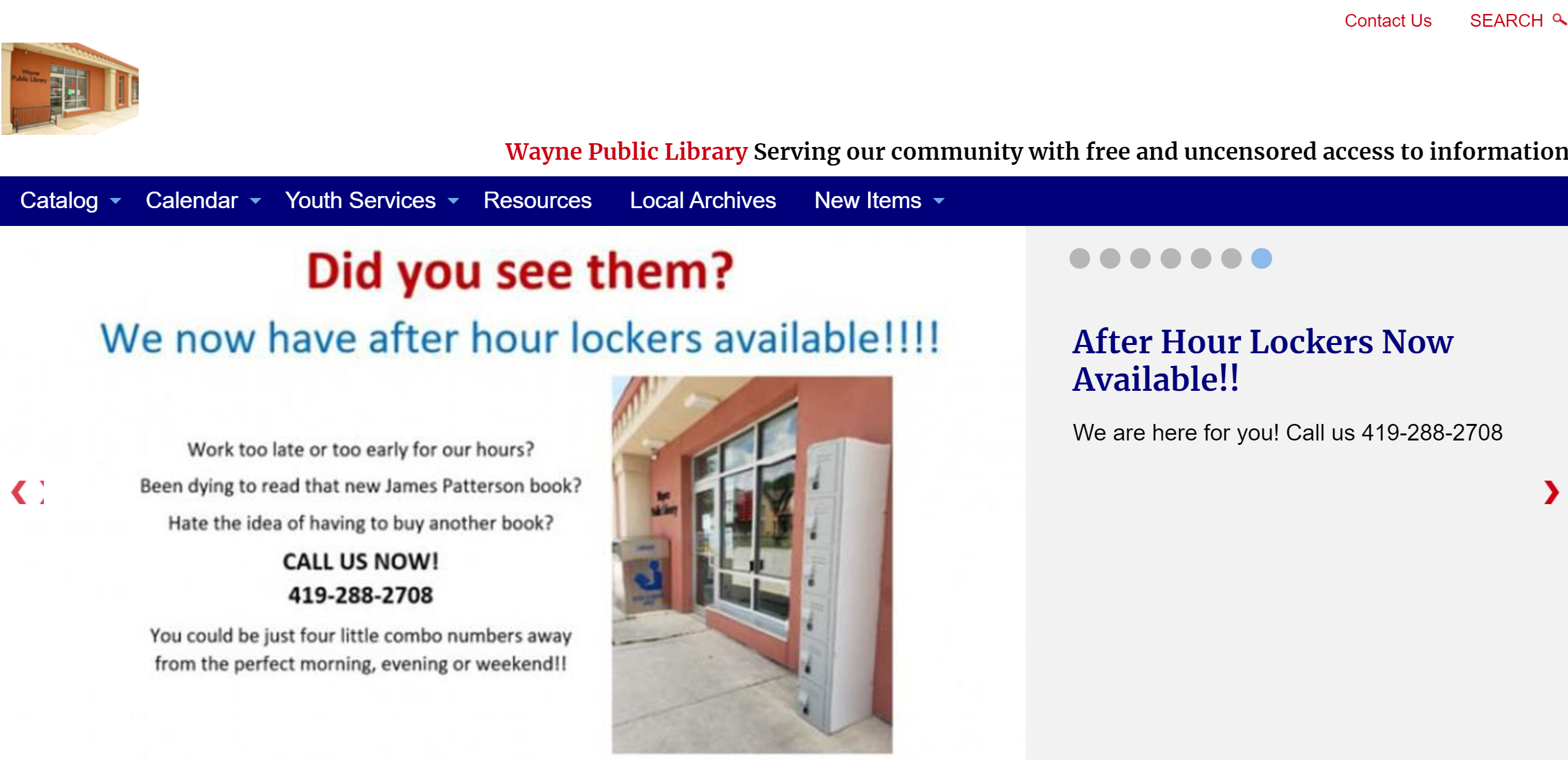
Driving through town a few weeks ago, I noticed the library has purchased an outdoor locker so patrons can pick up holds when the library isnโ€™t open. They want people to use the locker, of course. So, they’ll want to promote it.

I don’t know anyone on the 7-person staff of the Wayne Library. But, if I were working with them, I would encourage them to set a SMART goal like this:

We will get 30 people a month to request their holds pickup via the outdoor locker. Weโ€™ll do this by promoting the locker on our website and by specifically asking patrons if theyโ€™d prefer to pick up their holds via the locker when we place holds for them. This goal is important because it will prove the value of this investment and will increase circulation. Weโ€™ll track and record the total the number of locker users at the end of each month.

You can see this goal contains specific numbers. It sets the context for why this promotion is important. And it lays out how the staff will measure success.

A SMART goal will help you organize your promotions and keep you accountable. It will give you a sense of direction for your work.

Focus on tactics that work best to reach small communities.

Make a list of all the ways you can promote your library: your website, email lists, social media, in-person interactions, print, partners, signsโ€ฆ etc. Then take a highlighter and pick the 2-3 things that work best for your community. Those are the tactics you should use to reach your SMART goal.

Every library community is different. And small libraries often find promotional success in places that are different from their larger counterparts.

For example, if your library is located by a major road, use outdoor signage to attract the attention of passing motorists. If your school is a significant community hub, ask teachers to send home promotional bookmarks and fliers in kidsโ€™ backpacks. If your town has a little restaurant where residents come for breakfast every Saturday, ask the restaurant owners to give out a promotional print piece like a bookmark or flier with the check.

Wayne Public Library uses its website to promote its lockers.

Live and die by an editorial calendar.

An editorial calendar will help you decide what, where, and when to publish. After those decisions are made, the editorial calendar will help you assign tasks and keep up to date on deadlines.

First, youโ€™ll create your calendar. Then youโ€™ll decide how to populate it with content that will ensure you reach your promotional goals.

Repurpose content.

When your staff is small, youโ€™ll need to work smarter, not harder. A smart way to maximize your time and efforts is by repurposing content.

Repurposing content is the act of finding new ways to recycle your existing content. Itโ€™s basically taking one piece of content, say an email newsletter, and re-formatting it for different mediums like social media, a blog post, and an email

You can do this with any piece of content, from your website graphics to your annual report. Break the content down into pieces and spread them across all your available platforms. In this way, you can make sure everyone in your community sees your message. You also can make sure the work you are doing right now will have maximum impact.

Here’s an example of how to do it.

Schedule ahead as much as you can.

Technology can be your best friend if you are working on promotion all by yourself. Schedule your emails, blog posts, and social media posts as far in advance as possible.

There are several great social media schedulers that have free plans. This post is an excellent list of each of those options.

For blogs, I recommend WordPress. You can get a free account and you can schedule posts to go out whenever you like. Plus, patrons who follow your blog will get an automatic email every time you post. That means you donโ€™t have to create an email to let them know youโ€™ve published new content.

You will have to invest in an email platform. But once you do, you can create and schedule emails to go out to your patrons as far in advance as you like.

Learn from larger libraries but don’t compare your success.

The success or failure of a library’s marketing has nothing to do with the size of its staff. In fact, I would argue it might be easier for a small library to create successful library promotions.

Small libraries have more freedom to experiment. Their staff tends to be personally connected with patrons. They have a deeper understanding of what their community wants and needs from their library.

So, follow those large library systems on social media. Sign up for their emails. Look at their websites. Visit large libraries when you travel. Make a list of ideas that you want to try at your smaller library.

But remember, the key to success is a library’s ability to connect with its own community. Any library can do that, no matter how large or small the staff.

I was recently the guest on a new podcast called Library Marketing for Library Marketers. Listen to that episode here.


More Advice

Is Your Small Library Competing with a Bigger, Neighboring Library? This Episode is For You!

Plan for Library Marketing Success! How To Create an Effective Marketing Plan No Matter the Size of Your Library (Plus a Free Downloadable Template!)

Subscribe to this blog and youโ€™ll receive an email every time I post. To do that, enter your email address and click on the โ€œFollowโ€ button in the lower left-hand corner of the page.

Plan for Library Marketing Success! How To Create an Effective Marketing Plan No Matter the Size of Your Library (Plus a Free Downloadable Template!)

Photo Courtesy Public Library of Cincinnati and Hamilton County

The first time I went to a conference, I made a plan.

I decided which sessions I would attend weeks before the conference began. I studied the floor map of the convention center so I could plot the best way to get from room to room. I made a list of local restaurants and tourist attractions within walking distance of my hotel so that I could make the most of my free time.

Am I bonkers? Nope. I am a planner.

A plan provides a guide for action. It ensures goals are met and time and resources are used wisely.

There are times when spontaneity is called for. But library marketing is not one of them. A marketing plan is key for the success of any type of library promotion.

What exactly is a library marketing plan?

A library marketing plan is a tool you use to help to achieve your library’s overall goals. It lays out the steps involved in getting a promotion out into the world. It helps you decide how and when promotional work will be done for a pre-determined time in a specific way.

A library marketing plan also ensures everyone knows the end goal of your marketing efforts. It sets deadlines. It keeps people accountable. And it clarifies how you will measure your results.

You don’t need a plan for everything you promote at your library. You do need a plan if you are creating a campaign that lasts for more than several weeks.

How to put your marketing plan together

Scroll down to the bottom of this post for a list of free project planning websites. They will help you with the execution of your plan. At the bottom of this post, you’ll also find a customizable template to download. It’s based off the library marketing plan spreadsheet I used for years.

Know the thing you are promoting inside and out.

Be sure you can answer every single question about the thing you are promoting. You must become an expert on the event, service, or item you will promote.

Ask yourself, what problem will this solve for my patrons? How easy is it to use? What are the features that canโ€™t be found at any of my competitors?

Clearly define your end goal.

Use the SMART goal framework to ensure you and your co-workers know exactly what you are aiming to achieve. SMART goals are specific, measurable, attainable, relevant, and timely.

So, if you are looking to increase brand awareness, set an actual, measurable end goal like: “Within the next 6 months, we want 50 percent of residents living within a 30-mile radius of our Main Library to know that we have renovated the building and to be able to name at least one new service available at the library.”

Determine your target audience.

Many library marketers say their target audience is “our cardholders.” Be more specific.

Ask yourself:

  • Which cardholders?
  • How old are they?
  • How often do they use the library?

Fill out your picture of your target audience with as many demographic characteristics as you can. This gives you and everyone working on the plan a picture of who you are trying to reach.

Analyze your competitors.

Research anyone providing a similar program, service, or product. Ask:

  • What are they doing well?
  • What are they doing poorly?
  • What are the things that differentiate your library from their business?

These are your marketing advantages. You can use this information to create messaging that tells your target audience why they should use your library service, instead of a competitor.

Create the message.

Get the message or elevator pitch for your promotion set. It’s the most important part of your plan. You need it to create all the tactics you will use to promote your library.

Choose your tactics.

Go through all the available channels at your disposal for marketing and decide which ones will work best to reach your end goals.

You do not have to use everything that’s available to you. Sometimes, a video will work well and sometimes an email will do a better job. Not every promotion needs print materials, a press release, or a digital sign.

You know best how your target audience reacts to each tactic and which will bring you the best results. If you have a budget, decide how you’ll spend it during this step.

Set the schedule.

Every library has a different approach to its promotional schedule. I am a fan of tiered distribution of marketing. The approach takes advantage of a consumer cycle of excitement. Here’s how it works:

  • Release one or two promotional tactics at the beginning of your promotional cycle, like a social media post and a press release. The promotion gets some play, and excitement builds in the consumer base. It gets shared and people talk about itโ€ฆ and then the excitement dies out.
  • Release the second tactic, like an email, and the people who see the email get excited and start talking about it and sharing it, and then their excitement dies out.
  • Release a video, and that builds excitement and gets shared, and the excitement then dies out. And so on!

When you use the tiered distribution approach, you get a longer promotional thread. Your promotions will be more successful because the excitement around them builds over time, not in one big burst.

It is also easier on the person running the marketing! It gives you a small break in between each tactic and creates time for you to measure the success of each tactic individually.

Assign tasks.

Delegate jobs and deadlines for appropriate staff. If you need help from another library department, assign their deadline now so they have plenty of time to get you the information you need.

Measure results.

Don’t forget to measure and record the reaction to each piece of your marketing plan. Analyze what worked and what did not, so you can put that knowledge to use next time.

Free or cheap project management solutions

Clickup: the free plan will work for small libraries. The unlimited plan is very affordable and would work well for medium to large libraries.

SmartSheet: their lowest plan tier is a little more expensive than ClickUp but has more integrations.

Asana: this is what my employer NoveList uses. It makes is easy to assign tasks and deadlines.

Marketing plan template

I’ve created a customizable marketing plan spreadsheet. It includes my suggestions for the timing of promotional tactics for an event or service promotion.

You can delete or add columns based on the tactics available to your library and the size of your library. Download it here.


Related Advice

What the Heck Is the Difference Between Library Statistics and Marketing Metrics? Hereโ€™s the Full Explanation and Why They Are BOTH Important!

Planning for Magic! How To Keep Your Eyes (and Your Schedule) Open for Unexpected Library Promotional Opportunities

Subscribe to this blog and youโ€™ll receive an email every time I post. To do that, enter your email address and click on the โ€œFollowโ€ button in the lower left-hand corner of the page.

Prioritize! How to Decide Where To Spend Library Marketing Time and $$$

The Library Marketingโ€‹โ€‹โ€‹โ€‹โ€‹โ€‹โ€‹โ€‹ Show, Episode 104

Watch Now

In this episode, I answer a question from Tovah Anderson about how to decide how much time and money should be spent on the three buckets of library marketing: programs, services, and the collection.

Kudos in this episode go to the Monroe County Public Library for their new testing kitchen.

Do you have a suggestion for a topic for a future episode? Want to nominate someone for kudos? Let me know in the comments. And subscribe to this series to get a new video tip for libraries each week.

Thanks for watching!

A WordPress.com Website.

Up ↑