Search

Super Library Marketing: Practical Tips and Ideas for Library Promotion

Tag

social media marketing

The 2026 Guide to Facebook for Libraries: New Tips to Boost Reach and Visibility

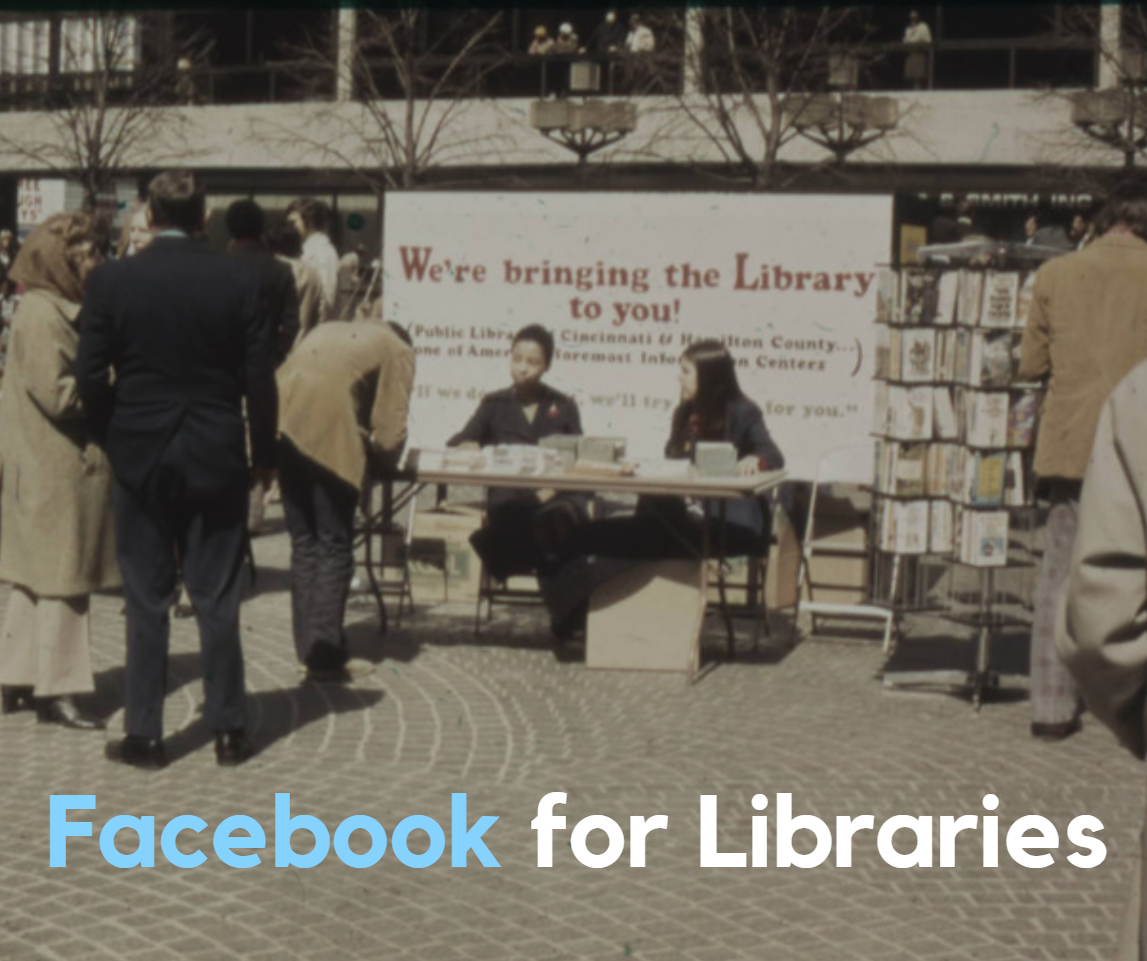
Two women in pantsuits sitting at a table outdoors on Fountain Square in Cincinnati in the 1970s, selling books.
Photo courtesy of the Cincinnati and Hamilton County Public Library

This is the final portion of the 2026 series of library social media guides. In addition to this post, be sure to bookmark these updated guides:

Facebook for libraries

Once again, Facebook remains the single most popular social media platform for libraries, but only by a fraction! According to the 2025 Super Library Marketing Survey, 95 percent of libraries use Facebook for promotions. Libraries use Instagram at nearly the same rate.

Statistically, this makes sense. Facebook is the largest social media platform in the world by number of users. And every day, about 69 percent of those users check their Facebook feed.

How are people using Facebook right now?

Here are some statistics from Demandsage.

  • The average Facebook session length is approximately 10 minutes and 12 seconds.
  • Most Facebook users are male.
  • Most Facebook users in the U.S. (nearly 99 percent) use the mobile version of the platform. That statistic rose by 16 percentage points this year! So, as you create Facebook content, assume everyone who sees your libraryโ€™s Facebook posts is doing so on a mobile device.
  • The largest segment of Facebook users is aged 25 to 34 years. Facebook has a reputation as a social media platform for older generations, which makes this stat somewhat surprising. However…
  • Facebook users aged 55 to 64 years spend the most time on Facebook, an average of 45 minutes a day. I think younger generations are looking at content, but not engaging with it. (This opinion is based on the use of Facebook by my own Gen Z daughters.)

How much success can libraries expect to see on Facebook?

Facebook has, by far, the lowest engagement rate of any of the social media platforms we’ve covered in the series. In fact, these rates are shockingly low.

I want you to look at this list of engagement statistics from Demandsage and really consider whether your time is well-spent when you post on Facebook.

  • Facebook Reels have an average fan engagement rate of 0.26 percent.
  • Images or photos get an average engagement rate of 0.24 percent.
  • A plain status update with text, no video, or no photo gets an average engagement rate of 0.12 percent.
  • And posts that include a link get an average engagement rate of 0.06 percent. OUCH.

Why is the engagement so low? Among the reasons is the motivation of the users: Nearly 75 percent of Facebook users say they use the platform primarily to message their friends and family.

The Facebook Algorithm for 2026

Here are the ranking signals Facebook uses to decide who sees your posts, according to Followeran. These are quite different from other platforms.

  • Facebook AI: As much as half of a user’s feed now features โ€œrecommendedโ€ content from creators or Pages they donโ€™t follow, chosen by Facebookโ€™s AI based on their interests and engagement behavior.
  • Deep conversations: The algorithm heavily favors content that sparks exchanges between users. It also looks to boost posts with longer, more considered reactions. Simple likes and short comments no longer drive reach.
  • Time spent: The algorithm will show your content to more people if the post requires users to spend time reading comments, scrolling through a carousel, or finishing a video. Longer sessions boost its distribution.
  • Video: Facebook still prioritizes short-form video formats (Reels, Facebook Live, Stories), followed by carousels and native videos. Posting consistently also helps, as newer content tends to perform better.
  • Original content: Reposts, duplicate content, or AI-generated content will be penalized with suppressed reach.

Here are 4 ways to get the best organic reach for your libraryโ€™s Facebook account in 2026

#1: Optimize for AI recommendations.

Half of all Facebook feed content now contains posts from pages that the user does not follow. Those recommendations are sourced by Facebook’s AI. The good news is that your library can reach new audiences without paid ads if you play by the algorithm’s rules.

Make sure you create original posts with strong potential for engagement. For example, ask your audience a question. You can also put book covers in a carousel of photos and encourage people to swipe through to the end.

Avoid duplicating or reposting content from other people or organizations. That’s a bummer, because many libraries repost their partner organizations’ content or content from publishers to save time. It’s okay to share that content on your Stories. But for your feed and Reels, make sure your posts are original works from your library account.

#2: Design your posts to maximize dwell time

I know many libraries post a graphic of their event calendar or a graphic promoting an upcoming program to Facebook. And if you’ve been wondering why those posts aren’t getting engagement, this is why. Facebook wants to keep people on the platform as long as possible. And those posts don’t help them achieve that goal.

Every time you post to Facebook, ask yourself, “How can I keep my users engaged longer?” You’ll want to use formats that encourage people to scroll, read, or watch to the end.

What do you do about promoting your programs? Share the graphic and program details on Stories or make a Reel about the program.

To share your calendar and get better results, ask people to sign up for a monthly email to receive a downloadable version. That’s a win for your library’s Facebook account and for your patrons, who will have a copy they can refer to all month long.

#3: Work on building early momentum for posts.

Posts that gain traction in the first 24 to 48 hours are rewarded by the Facebook algorithm. Look at your insights and post when your audience is most active. If your post starts to get comments, make sure you reply as quickly as possible (within 24 hours) to keep engagement flowing.

You can also try to drive traffic to your Facebook feed from your monthly email newsletter. Here’s how:

  • Post something fun and engaging on the day before your newsletter goes out. This “something” should be a piece of content that is NOT in your email newsletter. For example, you can post a carousel of photos of new books that just arrived at your library. Ask people to vote in the comments for the book they’re most excited to read.
  • In your email newsletter, write a tease that suggests people will be missing something if they don’t head over to your Facebook page to check out the post! For the example above, you could say, “Want to see which new arrival everyone is excited to read? Head to our Facebook page to cast your vote before the big reveal!”
  • Wait 1-2 days after your email newsletter goes out to post anything new on your Facebook page so your email users can find your teaser content easily. Or, if you must post more content, pin the teaser post to your profile for 1-2 days.

#4: Lean on authenticity and hyperlocality.

Meta rewards pages that post content that is clearly not generated by AI. This is where libraries can shine! Share patron stories, staff picks, book recommendations, and other highlights that show your library is a vital part of your community. Be sure to use your town or city’s name in the post and write the copy to show that your library is integrated into the community.

When to post on Facebook

Hootsuite says the best time to post is early morning,ย between 5 a.m. and 8 a.m., local time.

How often should you post to Facebook?

  • Post to the Facebook Feed 3-5 times each week.
  • Post at least one slide to Facebook Stories every day.
  • Post a Facebook Reel once a week.

P.S. Want more help?

Can Facebook Events Increase Your Program Attendance? How To Decide if Itโ€™s Worth the Effort

Subscribe to this blog, and youโ€™ll receive an email whenever I post. You can also follow me on the following social media platforms:
Thereโ€™s New Advice for Libraries About Posting to Social Media butโ€ฆ Should You Actually Take It?๐Ÿค”

Watch Now

The Library Marketing Show, Episode 176: A marketing agency has done the research and is unveiling the best days and times to post on social media. But is this the advice your library has been searching for? Or will you end up being less successful on social media if you take it?

We’ll unpack the results and how to interpret them in this episode.

Kudos in this episode go to the Milton Public Library.

Do you have a suggestion for a topic for a future episode? Want to nominate someone for kudos? Let me know in the comments.

And subscribe to this series to get a new weekly video tip for libraries.

Thanks for watching!


Subscribe to this blog and youโ€™ll receive an email whenever I post. To do that, enter your email address and click on the โ€œFollowโ€ button in the lower left-hand corner of the page.

Is This the Beginning of the End for Social Media Marketing at Your Library? 4 Ways To Prepare Now!

Watch the video

The #LibraryMarketing Show, Episode 175: Is this the end of social media marketing for libraries?? I know that’s a scary thought. (But, is it really?) There are signs that social media, in general, is not holding the audience’s attention as it once did. And that’s bad news for your library marketing.

In this episode, I’ll share my predictions and the four things you can do right now to move away from dependence on social media to promote your library.

Kudos in this episode go to the Cobb County Public Library.

Do you have a suggestion for a topic for a future episode? Want to nominate someone for kudos? Let me know in the comments.

Thanks for watching!


Subscribe to this blog and youโ€™ll receive an email whenever I post. To do that, enter your email address and click on the โ€œFollowโ€ button in the lower left-hand corner of the page.

YouTube Adds Handles and TikTok Launches Photo Mode: Here Are the Top Social Media Headlines for Libraries!

The Library Marketingโ€‹โ€‹โ€‹โ€‹โ€‹โ€‹โ€‹โ€‹ Show, Episode 164: Click the video link above to hear about the top two social media headlines for libraries.

YouTube channels are getting their own handles. And TikTok fires back at Instagram with a new feature. Let’s talk about how these changes will impact library marketing and promotions.

Kudos in this episode go to Amanda Menneto of the Clifton Park-Halfmoon Public Library. Watch the video to see why she’s being recognized.

Do you have a suggestion for a topic for a future episode? Want to nominate someone for kudos? Let me know in the comments.

And subscribe to this series to get a new weekly video tip for libraries.

Thanks for watching!


Subscribe to this blog and youโ€™ll receive an email whenever I post. To do that, enter your email address and click on the โ€œFollowโ€ button in the lower left-hand corner of the page.

Is Instagram’s Chronological Feed Returning? The Top Social Media Headlines for Libraries!

Watch Now

The Library Marketingโ€‹โ€‹โ€‹โ€‹โ€‹โ€‹โ€‹โ€‹ Show, Episode 124

In this episode, I’ll share the latest social media headlines for December 2021 and talk about how this news will impact your work in library marketing and promotion.

Kudos in this episode goes to the Delaware County District Library for their awesome selection and marketing of board games for checkout.

Do you have a suggestion for a topic for a future episode? Want to nominate someone for kudos? Let me know in the comments.

And subscribe to this series to get a new video tip for libraries each week. Thanks for watching!


Subscribe to this blog and youโ€™ll receive an email every time I post. To do that, enter your email address and click on the โ€œFollowโ€ button in the lower left-hand corner of the page.

My Most Controversial Episode Ever: Should Libraries Quit Facebook?!

Watch Now

The Library Marketingโ€‹โ€‹โ€‹โ€‹โ€‹โ€‹โ€‹โ€‹ Show, Episode 120

In this episode, I’ll lay out a three-point argument for why it may be time for libraries to consider moving away from posting on Facebook. I know this feels likes it’s in opposition to my post about Facebook best practices, but hear me out.

I know you’ll have a lot to say about this topic, so share your thoughts in the comments.

Kudos in this episode goes to Morrisson-Reeves library. Watch the episode to see why they’re being recognized.

Do you have a suggestion for a topic for a future episode? Want to nominate someone for kudos? Let me know in the comments. And subscribe to this series to get a new video tip for libraries each week.

Thanks for watching!


Subscribe to this blog and youโ€™ll receive an email every time I post. To do that, enter your email address and click on the โ€œFollowโ€ button in the lower left-hand corner of the page.

Conquering Social Media for Your Library: The Seven Decisions You Need To Make Before You Create Your Next Post!

Photo courtesy Public Library of Cincinnati and Hamilton County

I love libraries. I work with libraries. I talk to library staff every single day. I like, share, and comment on library social media posts.

But every time I open my app for any of the platforms, I NEVER see content from libraries.

Why?

The odds are never in our favor, thanks to algorithms.

Itโ€™s a daily battle that libraries face. Social media is free and easy.

But itโ€™s also not free and easy.

Itโ€™s incredibly, insanely difficult to figure out what works on social media when the rules are constantly changing. If you donโ€™t have time or staff to keep up, it can be exhausting and demoralizing.

But like it or not, libraries must use social media to promote their services, collection, and events. We must do our best to work with the algorithms, for better or worse.

Starting next week, Iโ€™ll begin my annual six-part series laying out best practices for the top platforms used for promotion by libraries.

I chose these platforms because of a survey you, dear readers, so graciously answered. Nearly 300 library staffers let me know which social media platforms your library uses for promotion.

Before the platform best practice series begins, itโ€™s important to set your library up for success by creating a social media style guide.

This is different than a social media policy, which lays out guidelines for how your staff will use social media to communicate with the public and sets rules for how the community interacts with you and others on your libraryโ€™s social media accounts.

A social media style guide will ensure your posts are clear and consistent, no matter what platform you post on. It will take the guesswork out of many aspects of posting and make your work more efficient.

A social media style guide has seven parts. Here are the key decisions you should make now to ensure future success on social.

Make a list of all your social media accounts

Include your libraryโ€™s handle on each platform. This will give you get a clear picture of the naming conventions youโ€™ve used for your accounts.

Are the names consistent across channels? If not, choose a style and note it in your style guide.

Then, the next time a new social media platform is launched, you can claim and name your new account in a way that will make it easily discoverable for your existing fans.

Identify your libraryโ€™s demographics for each platform.

Look at the insights for each of the platforms. Who is interacting with your posts? Your audience will be different for every platform. Make a list of the different audiences.

Because of the algorithms, you have very little control over who sees your post on any given platform. But you can get to know your available audiences and create content that will engage them.

If you are struggling with time management and you want to cut down on the number of social media posts you do, you can look at your lists of demographics. Identify the platforms with the audiences that will help you achieve your overall library and marketing goals. Post to those platforms and put the rest on hold.

Create a mission statement for each platform.

Look at your libraryโ€™s goals for the year and what you know about each platform. Then write a one or two sentence mission statement for each of the social media platforms, lining up your libraryโ€™s goals with the currently available audience for that platform.

For example:

  • LinkedIn: Discover career advice, business tips, and free resources that will help you succeed at work.
  • Twitter: Get regular updates on our collection, library events, and the literary and entertainment world.
  • Instagram: Photos tell the libraryโ€™s story, one snapshot at a time.

These platform-specific mission statements, combined with the demographics you identified in the previous step, will help you visualize your audience every time you post. Youโ€™ll be able to connect with them because youโ€™ll know who they are, and what they expect from you.

Decide the voice and tone youโ€™ll use for each platform.

You want to use the same language and tone across platforms for consistency. The goal is to make sure your audience recognizes your posts no matter which platform they are on. Some things to consider include:

  • Whether your library will use formal or conversational text.
  • The words, phrases, and names that are specific to your library and can be used in posts. For instance, does your Maker Space or your Bookmobile have a specific branded name? Include that in your list.
  • Make a list of the acronyms your library commonly uses internally, along with the full spelled-out versions of what they stand for. Decide whether itโ€™s appropriate to use the acronyms on each social channel, or if the full terms should be used.
  • Include parameters for inclusive language that will be standard for your library. For example, will your library remove the use of pronouns to be inclusive to all genders? How will you refer to people living with disabilities?

Choose an expert to make grammar and punctuation choices for you.

You can define whether youโ€™ll use an existing style guide, like the Associated Press Stylebook or the Chicago Manual of Style. Or you may decide to rely on add-ons like Grammarly.

This decision will take the guesswork out of your libraryโ€™s use of serial commas, headline capitalization, dash style, dates and times, and more.

Define the aesthetics.

This section will lay the groundwork for the visual portion of your posts. Decisions to be made here include:

  • Will you use your library’s defined brand colors?
  • Which fonts will your library use in images, cover photos, and for short-form social media posts like Instagram Stories and Reels?
  • How will your libraryโ€™s logo be used on social media? Will it be used as the profile photo for your platforms? Can it be added to images? If so, where will it be placed and how large should it be?
  • Will youย use emojis, GIFs, and memes? Which ones? How many? On what channels? How often?
  • Will you include a call to action in every post? What kinds of action words will you use in your call to action?
  • How often will you include links in your posts? Will you use a URL shortener?
  • Which hashtags will you use? How many hashtags are acceptable on each platform?
  • Will your library use filters and effects in your posts?

Formalize curation

Your library can share the blog posts, infographics, case studies, and interesting posts created by other organizations on your platforms. This is a great way to add value for your available social media audiences without creating new content of your own. Some key decisions to make around curated content include:

  • Which sources will your library share from?
  • Which sources will you not share from?
  • How will you cite third-party content?

You May Also Want to Read These Articles

Three Design Tips For Creating Beautiful Social Media Graphics for Your Library

Why Itโ€™s OKAY for Your Library To Pull Back on Posting on a Social Media Platform!

Subscribe to this blog and youโ€™ll receive an email every time I post. To do that, enter your email address and click on the โ€œFollowโ€ button in the lower left-hand corner of the page.

Twitter Changes Their Image Policy, New Instagram Trends, and the Best Times to Post on Each Platform!

Watch Now

The Library Marketingโ€‹โ€‹โ€‹โ€‹โ€‹โ€‹โ€‹โ€‹ Show, Episode 96

In this episode, we’ll go through the latest updates for social media platforms and what they mean for libraries.

This month’s headlines include a change in Twitter’s image cropping policy, a new report on Instagram use, and another new report that lays out the “alleged” best times to post on each social media platform. Watch the video to find out why I believe libraries should take this third report with a grain of salt!

Kudos go to the Coralville Public Library. Watch the video to find out why a fellow viewer nominated them for mention in this episode.

Do you have a suggestion for a topic for a future episode? Want to nominate someone for kudos? Let me know in the comments. And subscribe to this series to get a new video tip for libraries each week.

Thanks for watching!

Angelaโ€™s latest book reviews

Think Again: The Power of Knowing What You Donโ€™t Know by Adam Grant

Mediocre: The Dangerous Legacy of White Male America by Ijeoma Oluo

New Research on Social Media Use Plus Updates on YouTube and Facebook for Libraries!

Angela Hursh episode of the Library Marketing Snow on social media.

Watch Now

The Library Marketingโ€‹โ€‹โ€‹โ€‹โ€‹โ€‹ Show, Episode 92

In this episode, we’ll go through the three big new stories on social media that impact your library work. This includes new Pew Research on social media use, YouTube’s overview on how it recommends videos to viewers, and a new feature for Facebook posts.

Kudos in this episode go to the Siouxland Libraries for their new library card designs.

Do you have a suggestion for a topic for a future episode? Want to nominate someone for kudos? Let me know in the comments. And subscribe to this series to get a new video tip for libraries each week.

Thanks for watching!

A WordPress.com Website.

Up ↑