In this post, you’ll learn:
- Why listening is often more valuable than launching something new.
- How to build the systems, messaging, and processes that make library marketing more effective.
- How to see your library with fresh eyes even if you’ve worked there for years.
When I started my current library marketing leadership role at the Cincinnati and Hamilton County Library this past March, I had a plan.
Actually, that’s not entirely true.
I had a list of things I thought needed attention. I had ideas. I had opinions. I had years of experience.
But I also knew I was walking into an organization that existed long before me, had been through a tumultuous six years, and will face tough challenges in the not-so-distant future.
So I made a decision. For the first few weeks, I just listened.
And looking back, it was probably the most important thing I did.
Start With People, Not Projects
The temptation in a new leadership role is to make your mark immediately. You want to launch something. Reorganize something. Fix something.
Resist the urge.
Before I touched processes or strategy, I sat down with every member of my team and with every member of senior leadership for one-on-one conversations. I asked questions like:
- What do you spend most of your time doing?
- What part of your job do you enjoy most?
- What are you exceptionally good at?
- What drains your energy?
- What skills do you wish you had more opportunities to use?
- What gets in the way of doing great work?
I wasn’t looking for complaints. I was looking for opportunities, gaps, and patterns. And those things started emerging quickly.
Some people were doing work they loved. Others had talents that weren’t being fully utilized. Some responsibilities seemed to belong to multiple people. Other responsibilities didn’t seem to belong to anyone.
That information was incredibly valuable. It became a roadmap to set up a foundation for success.
Build a Team Map
One thing I’ve learned over the years is that organizational charts don’t tell you much.
A job description tells you what someone is supposed to do. A conversation tells you what they actually do.
As I talked with my staff, I started mapping the team. I asked myself:
- Who are the strongest writers?
- Who can manage projects?
- Who understands data?
- Who has strong design skills?
- Who is great at relationships and collaboration?
Just as importantly, I looked for gaps. Specifically, I pinpointed the skills that were missing, areas that seemed underdeveloped, and places where work was getting bogged down or stopped altogether.
I wasn’t trying to evaluate people. I was trying to understand the system.
Before you can build a stronger team, you have to understand the team you actually have.
Define the Real Problems
As I observed the department and reviewed existing work, I noticed something that I’ve seen in other organizations too.
People were working incredibly hard. But they were often operating without shared expectations, messaging, or processes.
Projects moved through different review paths depending on who was involved. Marketing requests arrived in different formats. Staff made decisions based on their own understanding of priorities.
Nobody was doing anything wrong. The team simply lacked some foundational systems. That realization shaped my plan for moving forward.
Map Out Your Priorities
Once I had a clear picture of my team and the larger organization they worked in, I worked on identifying and prioritizing what I needed to do. I created what I call my “Post-It Pyramid of Priorities.”
I wrote down the foundational tasks I needed to tackle, one on each Post-It. Then I arranged them in a pyramid, with the tasks I needed to complete at the top. (Groundbreaking, right?)
I put tasks that were interrelated into a line to signal to myself that I needed to work on them simultaneously.
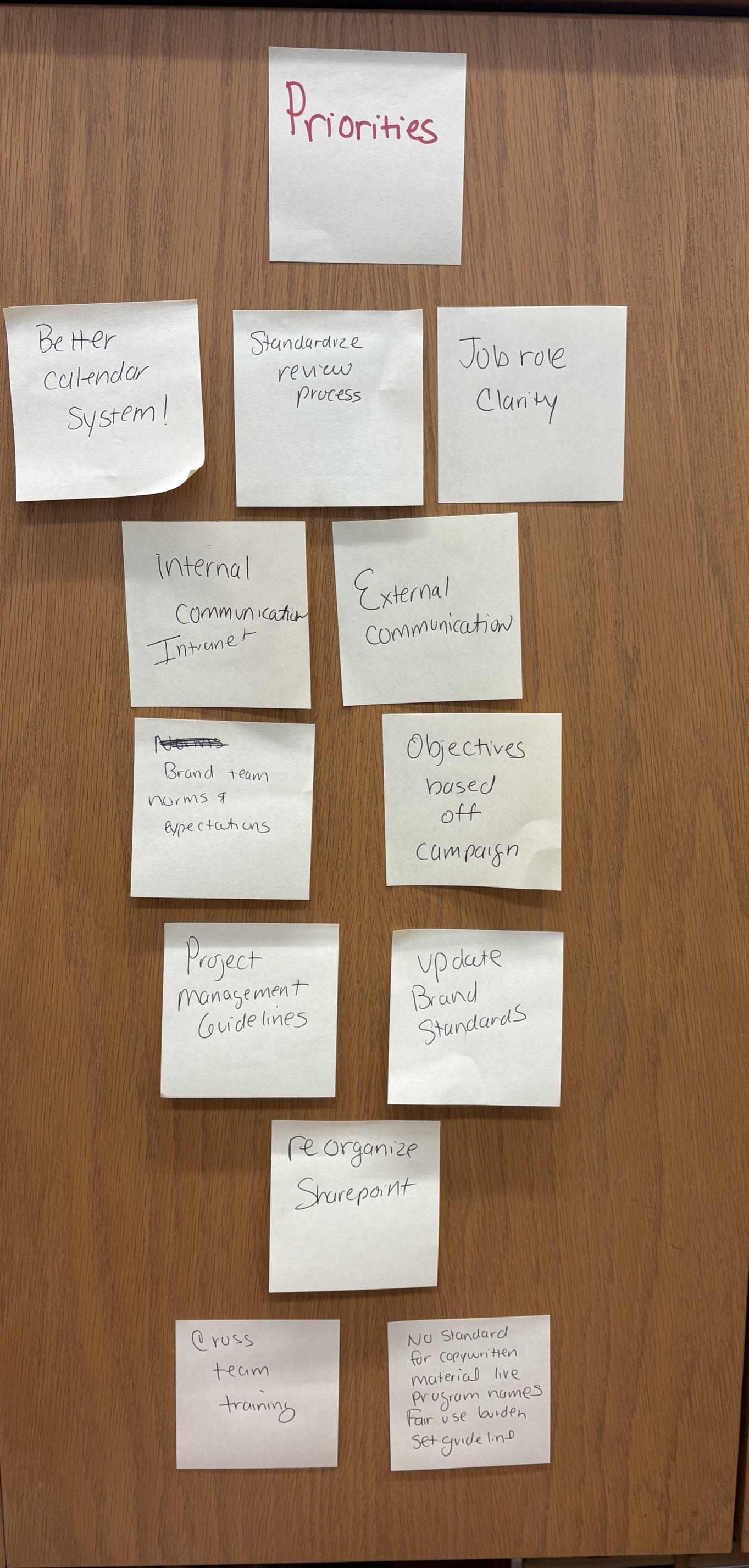
Using Post-Its makes it easy for me to move and change my priorities as conditions change.
Establish Your Messaging Foundation
One of the biggest priorities during those first 90 days was working through messaging.
What exactly were we trying to say about the library? More importantly, were we all saying the same thing?
Libraries are wonderful at promoting programs, events, and services. We are less consistent when it comes to communicating our larger value.
Ask staff members why the library matters and you might get a bunch of different answers.
- Some will talk about books.
- Some will talk about literacy.
- Some will talk about technology.
- Some will talk about community.
None of those answers are wrong.
But if your organization wants to build trust, recognition, and support, there needs to be some shared understanding of the bigger story you’re telling.
In my next post on July 27, I’ll go more in-depth to show you how our library determined a messaging focus and how we’re executing it.
Create a Strategy People Can Actually Use
The word “strategy” seems to scare people. I think it’s because most strategies are created by senior leadership, who then pass them down to the staff without taking the time to get buy-in. (This happens at for-profit companies too!)
I wasn’t interested in creating a document that nobody would read. I wanted a framework that would help people make decisions.
- Who are we trying to reach?
- What behavior are we trying to influence?
- What organizational goals are we supporting?
- How do our messages connect to those goals?
- How should different channels work together?
Once you have the answers to those questions, you can create a simple strategic framework that you and your staff can follow for the next year.
Standardize the Review Process
When organizations don’t have a clear review process, everyone creates their own.
One project gets five rounds of edits. Another gets none. One person is included in decisions. Another is surprised at the last minute.
Over time, that creates frustration for everyone!
So we built a standard review structure. It helps me and my marketing manager to, well, manage projects!
We worked together to decide:
- Who reviews what.
- When they review it.
- What kind of feedback they’re responsible for providing.
- What final approval looks like.
The result is more consistency, fewer surprises, and much less confusion.
Focus on Culture, Not Just Process
The systems matter. The strategy matters. The messaging matters. But the biggest adjustment we need to make is cultural.
Instead of asking, “Can we promote this?” I’m prompting my staff to start asking, “What are we trying to accomplish?”
Instead of thinking about outputs, we are thinking about outcomes. Instead of automatically saying yes to every request, we started discussing priorities. (That is a biggie!)
It definitely is a mindset change. It won’t happen overnight, and you’ll face some bumps and pushback along the way. But getting yourself and your team to work these questions into your daily thought process will lead to better results.
What I Didn’t Do
Here’s what I did not do in my first 90 days!
- I didn’t reorganize the team.
- I didn’t launch a huge new campaign.
- I didn’t overhaul every process.
- I didn’t try to solve every problem.
New leaders sometimes feel pressure to demonstrate value immediately.
Ironically, one of the most valuable things you can do is slow down. Ask questions. Gather information. Build trust.
What If You’re Not New?
You don’t have to start a new job to use this approach.
In fact, if you’ve been at your library for years and feel like you’re stuck, this mindset can be even more valuable.
One of the advantages of being new is that you notice things everyone else has stopped seeing. You ask questions because you genuinely don’t know the answers. You challenge assumptions because you haven’t inherited them yet.
After you’ve been somewhere for a while, it’s easy to accept the way things are simply because “that’s how we’ve always done it.”
So borrow a trick from your first-day self.
Schedule listening meetings with colleagues you don’t work with regularly. Ask people what gets in the way of doing great work. Map your team’s strengths and gaps again. Follow a marketing request from start to finish as if you’ve never seen the process before.
Sometimes the biggest breakthroughs come from looking at familiar problems with fresh eyes.
Want more help?
The Real Difference Between Marketing and Promotion and Why It Matters for Your Library’s Success
Subscribe to this blog, and you’ll receive an email whenever I post. To do that, enter your email address and click on the “Follow” button in the lower left-hand corner of the page. You can also follow me on the following social media platforms:


