
I started this blog six years ago. Can you believe it?
When I published my first post, I really had one goal: To help other library workers. I believed that sharing tips, strategies, ideas, and best practices for library marketing would strengthen the whole library industry and help secure the future of libraries.
I still believe that.
And we’ve come a long way in library marketing. Many libraries are promoting their collection and services in ways they would have never imagined six years ago. They’re focused on strategy and innovation. They’re not afraid to try new things. They’re experimenting. They’re putting cardholders first.
Library marketing no longer stinks! Now it’s time to advance library marketing to the next level. Here are the four things libraries should do now to move successfully into the future.
Put your collection front and center on your website.
When I visit a library website, the first thing I notice is how prominently they promote their books, movies, and streaming content. When I must search for these things, it causes me real grief. It’s like going to the grocery store and finding the milk and eggs hidden in a back room accessible only to the most intrepid shoppers.
Most of the folks who interact with your library online are there for the collection. If you don’t believe me, check your website statistics. Look at Google Analytics. I’ll bet you the most visited pages of your website are the homepage, your catalog, and any page that showcases your collection items.
Don’t hide your collection on your website.
If you have a personalized reading recommendation service, put it right in the middle of your homepage. If you have reading recommendation newsletters, put your opt-in link right in the middle of your homepage. Post about your collection on social media at least 50 percent of the time.
Books are your brand. If your library wants to have a part in making the world more informed, more educated, and more empathetic, put your collection right where people can find it on your website.
Shift your energy from library programs to library services.
I have shared many conversations in the past few years with library workers who express frustration over program promotion.
This reached a fever pitch in 2020, as the pandemic forced programs to move online. Library workers couldn’t measure attendance as they once did. And attendance and registration numbers dropped off.
The frustration is palpable. We put all this work into quality programs, and no one shows up. Doesn’t that bother anyone else? Why are we doing this?
Libraries need to have a hard conversation with themselves. Programming gets too much emphasis in libraries.
We should spend our energy instead on developing and promoting our unique services, like homework help, adult education courses, genealogy research, and small business support.
No one else in our community does these things for free. They are so important to our communities. These are the hidden treasures of libraries. And they are underused because people don’t know they exist.
So, let’s spend this year shifting our focus to strategically and systematically promoting these services. Add mentions of these services in your email newsletters. Post about these services on social media at least 25 percent of the time.
And use those precious in-person interactions to market your services. If you see someone picking up curbside items on topics like career, education, or family history, let the patron know about the appropriate matching service.
Use data to make current library cardholders happy.
Many libraries spend an awful lot of time focused on trying to get new customers. But once a person signs up for a library card, we take it for granted that this cardholder will use their card again.
It takes a lot of time and energy to get a cardholder signed up in the first place. That time and energy is better spent working to make current library users realize everything their magical library card can offer them. Because what would you rather have… lots of library cardholders or lots of library users?
This year, I want libraries to spend less time chasing new cardholders and more time gathering data about our current cardholders. Then target current cardholders with marketing messages that keep them coming back to the library.
We can create surveys to gather demographic data and psychographic data. Then we can use that data to ask ourselves: what do our current cardholders want and need from us? Focus on those things this year for maximum effectiveness in your library marketing.
Make it easier for people to use your library.
Let’s be honest: people must clear a lot of hurdles to use the library.
It’s hard to get a library card. Community members must provide proper identification. If they apply online, they must show up at a branch to claim their card, often within a specific amount of time. I was reminded of this just a few days ago, when I received this Tweet.
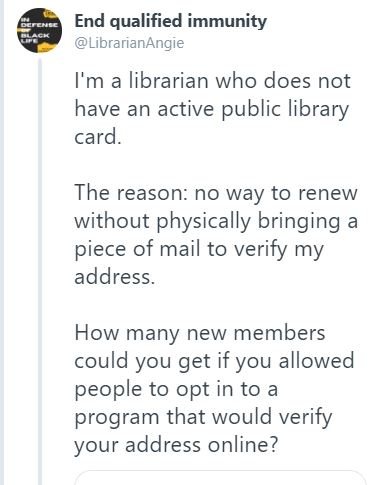
Library users also must have separate logins and passwords to use services like Hoopla, Overdrive, Kanopy, and Freegal.
And if cardholders don’t return items on time, they get fined. If a library user accumulates too many fines, they lose the ability to use their card.
All these things may seem like little inconveniences. But it is these little hurdles that stand in the way of advancing our libraries in the future.
I know some of these hurdles are not the fault of the library. We’re often at the mercy of our vendors. But our communities don’t know that and, frankly, I don’t think it matters. People expect easy access to library services. And they receive easy and convenient services from other companies.
Libraries need to make a concerted and deliberate effort to make it easier for people to use the library in 2021. We’ll have to do this to compete with convenient services that threaten to take away our market share.
First, let’s fix the things that are in our control. We can make it easy for anyone to get a library card online without ID. And we can eliminate fines and fees that serve as a barrier to many of our patrons.
Next, let’s band together to demand vendors create integration that allows library users to access their services from our website with one-step authentication: their library card number. Demanding this change as an industry will be one of the best ways to advocate on behalf of our cardholders this year.
You may also like these posts
The New Year is Here! Here are Five Things for Your Library to Promote in 2021.
Zoom Fatigue is RUINING My Library Programming! How the Heck Should Libraries Deal With That?
Latest Book Reviews
The Invisible Life of Addie Larue by VE Schwab
Find more 60-second Book Reviews here.
Subscribe to this blog and you’ll receive an email every time I post. To do that, click on the “Follow” button in the bottom left-hand corner of the page. Connect with me on YouTube, Twitter, Instagram, and LinkedIn.
 Super Library Marketing: Practical Tips and Ideas for Library Promotion