Angela Hursh leads an outstanding team of marketing and training professionals at NoveList, a company dedicated to helping libraries reach readers. A 2023 Library Journal Mover & Shaker, she has also created courses on LearnwithNoveList.com designed to help library staff learn how to create effective marketing. Before her job at NoveList, Angela led the content marketing team for the Public Library of Cincinnati and Hamilton County. She also has more than 20 years of experience as an Emmy-award-winning broadcast TV journalist.
A fascinating new report may help your library decide which social media platforms you should use to post content specifically aimed at your youngest readers! We’ll break down the topline results and talk about how to take advantage of this new data in this episode of The Library Marketing Show.
Plus we’ll give kudos to a library mentioned on a major national comedy show… and they didn’t even plan this press!
Do you have a suggestion for a topic for a future episode? Want to nominate someone for kudos? Let me know here. And thanks for watching!
Subscribe to this blog and you’ll receive an email whenever I post. To do that, enter your email address. Then click on the “Follow” button in the lower left-hand corner of the page. You can also follow me on the following social media platforms:
Photo courtesy Cincinnati and Hamilton County Public Library
When Jennifer Fermino graduated from college with a B.A. in English, she needed help figuring out how to put together a resume that would land her a job in communications. She found that help at what was then the New York Public Library’s Mid-Manhattan Library (now the Stavros Niarchos Foundation Library).
“It was an invaluable resource for a young person who really didn’t know what she was doing or how to translate any of her job skills, which was then primarily waitressing and nannying, into the career path I was aiming for,” recalls Jennifer. “I would also add I am in good company: President Obama also credits the Stavros Niarchos Foundation Library with helping him get his first job.”
And now, 20 years later, after stints as a reporter for the New York Post and the New York Daily News, as well as PR agencies and as Communications Director for the New York City Council, Jennifer works for NYPL as Vice President for Communications and Marketing. She’s been at her dream job for about a year and a half.
“It’s amazing to work for a system that serves three boroughs in the greatest city in the world (Manhattan, the Bronx, and Staten Island),” enthuses Jennifer. “We have 92 locations and there is never a dull day.”
Jennifer and a team of nearly 30 people run all marketing and promotions for the library. And her first 18 months on the job were, shall we say, a trial by fire.
New York City Mayor Eric Adams proposed huge cuts to the library’s budget earlier this year… $58.3 million to be exact… that would have forced NYPL to dramatically reduce hours. The budget cuts also threatened the library’s budget for books, programs, and maintenance. Prior cuts, enacted in late 2023, forced all NYPL branches to close on Sundays.
Soon after these new cuts were announced, NYPL, along with the Brooklyn and Queens Public Libraries, launched a massive campaign to show the importance of the city’s three libraries. And New Yorkers, as well as library lovers from across the country (myself included) jumped in to show their support.
For months, I was served a social media post from NYPL every time I went online, on all channels. It felt like a coordinated, consistent effort to keep reminding people of the threat of the cuts. And that’s why I reached out to Jennifer. I wanted to know how her team managed the campaign.
“It was a sustained effort to tap into the goodwill that people have for libraries and keep the cuts front and center,” says Jennifer. “I give huge credit to Victoria Reis, our social media manager, who is creative and has an understanding of both online culture and our audience.”
“We began repurposing the famous “This is fine’ meme with our mascot Patience and it was an immediate hit with our followers. People really connected to the campaign, and the message – that we already lost Sunday service and were in danger of losing more – resonated.”
“The reaction kept growing and growing. Towards the end of the campaign, one of our memes – again a repurposing, this time of the “girl explaining” meme, went over the top viral. Last I looked it had over 7M views on X (Twitter).”
The team included messaging on other channels as well and worked hard to stay coordinated.
“Special shoutout to our talented Managing Editor Katherine Ward, whose job was to keep it all together for us,” declares Jennifer.
The team coordinated messaging using four main tactics:
Their NYPL Connect newsletter, which I encourage any library or NYC lover to sign up for, as well as regular reminders of the cuts on our home page.
Letter writing stations in branches in which patrons could easily write city leaders to support libraries.
Rallies of supporters at City Hall that the press was invited to cover.
And, as mentioned, a fun, creative social strategy.
“We honestly didn’t know what was going to happen – everyone was hopeful but on pins and needles,” remembers Jennifer. “Reporters started calling me saying they had sources saying we would be saved, but I refused to believe it until it was official. People were congratulating us, but I felt like it was jinxing us. It took a bit for me to finally accept that it was over.”
“Thankfully, the Mayor has a history of supporting libraries, and we are grateful that he funded us. We also had the City Council, including Speaker Adrienne Adams, firmly in our corner throughout.”
“But I can say that our campaign engaged New Yorkers and showed how much people love their libraries, which is so important in the budget process.”
While they fought the budget cuts, NYPL’s marketing team had other promotions to balance.
“We had launched our “Books for All” campaign celebrating the freedom to read and standing against book bans right before the cuts were enacted,” explains Jennifer. “We continued that campaign all year long because the issue is of such importance to us.”
“We also just finished our ‘Summer at the Library’ campaign with Brooklyn and Queens to promote reading and education city-wide during the summer break for schools. Although not technically part of the advocacy campaign, efforts like this help show why funding libraries is so important.”
“We are always exchanging ideas and talking about how to engage New Yorkers,” says Jennifer. “It is a great relationship. We are partners throughout the advocacy campaign and continue to do great work together.”
“In fact, we are planning a national Freedom To Read Day of Action on Oct. 19 with Brooklyn and Queens, as well as the American Library Association, Unite Against Book Bans, and the Association for Rural and Small Libraries to stand against censorship. We have many libraries already signed up and invite everyone to join us.”
Subscribe to this blog and you’ll receive an email whenever I post. To do that, enter your email address and click on the “Follow” button in the lower left-hand corner of the page. You can also follow me on the following social media platforms:
Subscribe to this blog and you’ll receive an email whenever I post. To do that, enter your email address. Then click on the “Follow” button in the lower left-hand corner of the page. You can also follow me on the following social media platforms:
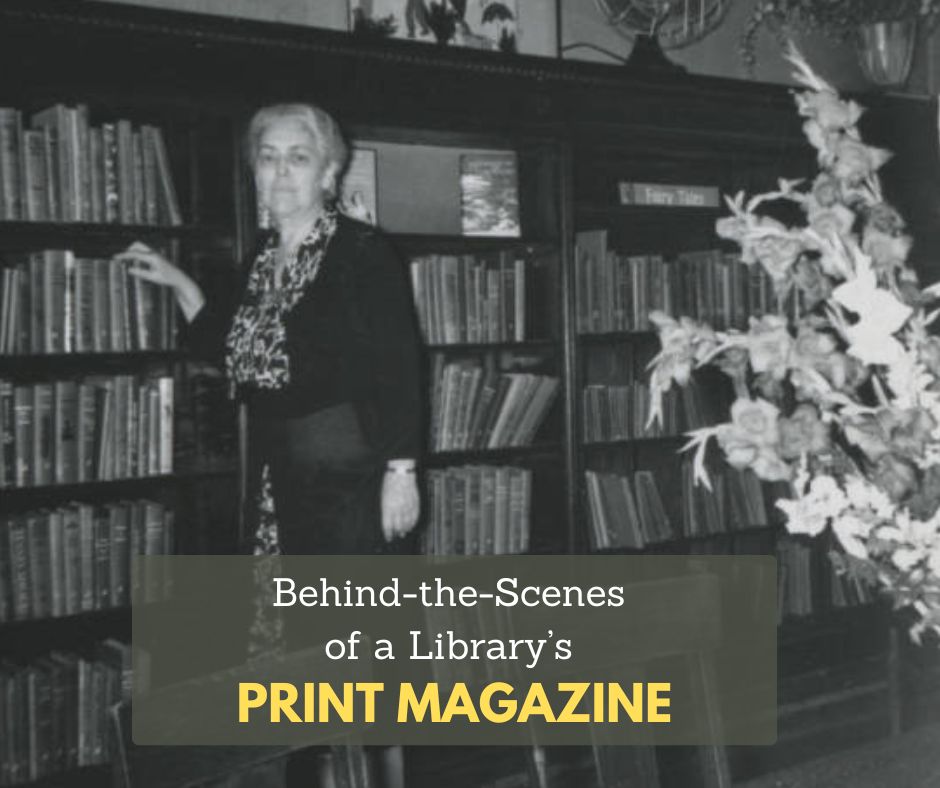
It’s been a while since I’ve seen a print news magazine from a library. And this one was so good, I had to reach out to the editor, Karen Jensen, the library’s Community Liaison. She and several other employees manage all the marketing and public relations for the library. Karen also oversees grants and volunteers and is the liaison for all six of the library’s Friends groups.
A native of Valparaiso, Indiana, Karen graduated from Ball State University with a liberal arts degree. After college, she worked for a large radio station in the Midwest as a copywriter. She also took on a variety of jobs within the equine industry. Her love of horses was fed by her childhood library trips.
“I was a horse-crazy little girl (who grew to be a horse-crazy adult) and was so completely drawn to Marguerite Henry’s Misty of Chincoteague, King of the Wind,and Walter Farley’s books, The Black Stallion,” remembers Karen. “Books were some of my favorite gifts as a child and adolescent and my nose was buried beneath the pages much of the time. The rest of my leisure time was spent in the barn with my beloved horses!
Her passion for horses and a business prospect brought her to Ocala, Florida where she worked primarily within the public and nonprofit sectors before joining the library in 2009.
“The first issue of our quarterly WORDS magazine was in the spring of 2009 before I joined the library system,” recalls Karen. “I arrived in time to spearhead the fall issue and have served as the magazine’s editor since that time.”
“The magazine provides a central information source for all events, and updates on library information and resources, in both print and digital formats. It offers a professional means for sharing information with elected officials, community partners, and a myriad of other groups and individuals with whom we all come in contact.
-Karen Jensen
“Although by no means our only method of communicating with the public, it is a key reference point for all staff when working within our community.”
Words has evolved from its original eight pages to its current 20 pages and is funded entirely by the Friends of the Ocala Public Library. Work on each issue starts six months before the publishing date.
“There is a creative meeting with managers and supervisors quarterly where we establish the theme and content for the next issue,” explains Karen. “Upon the selection of the theme and content, I will seek volunteer writers from within our library staff, as well as within the community.”
Words is unlike other library newsletters, in that it’s a balanced mix of in-depth stories and library promotion. The issue I received included a patron interview on fall traditions, a piece on a historic tourist destination, and a preview of an upcoming library program featuring a chef from the World Equestrian Center. It’s informative, educational, entertaining, and beautifully designed.
“The number of print copies has always been small, with a current print quantity of 4,500 for three issues and 5,000 for the summer issue for nine library locations,” says Karen. “In addition to the small print quantity, the library system uses a mail management system (LibraryAware) to disseminate monthly updates to more than 80,000 patrons in Marion County.”
I’m not surprised to learn that Words is a hot commodity for patrons.
“We hear from patrons and community members asking, ‘When is the next issue coming out?’” explains Karen. “And, as with many print magazines, there are always special favorites that really resonate within our community. Typically, it is themes about natural resources in our county or other highlights. People really love learning about their community and we certainly want that to include their public library!”
“We now have very few remaining print copies at the end of each quarter and typically run out before the end of the quarter at our larger branch locations. We do, as supplies allow, take print copies to outreach events, but more than likely have a flyer with the QR code and how to sign up to receive a copy available at tabling events.”
“Our library system administration and staff love the magazine and even when it is an add-on to workloads, are so very proud of the final result. And there is really nothing to compare with receiving an email from a community partner, an elected official, or a mom of three who says, ‘I just love Words!’”
Karen’s advice for any library looking to start a news magazine
Tip #1: Start with a plan.
Establish goals, audiences, what is to be accomplished, and by whom, early on.
Factor in how you will measure your outcomes. This is really such an important part of any public relations/communication efforts. How will you know if this is a cost-effective endeavor? What is the ROI?
How often will the newsletter be published?
Who will the editor be?
Who will manage the production?
What are the costs associated with the news magazine production and how will the costs be covered?
Tip #2: Determine what combination of formats is going to work best for your audiences.
If cost is a factor, digital format will be the most realistic.
Explore a mail management platform that will work for your community of patrons. We selected LibraryAware and it has really helped to expand the footprint far beyond the print or website reach.
Subscribe to this blog and you’ll receive an email whenever I post. To do that, enter your email address and click on the “Follow” button in the lower left-hand corner of the page. You can also follow me on the following social media platforms:
Can your library go viral? It is possible… if you create the right kind of content. We’re going to dive into the psychology of emotion and its impact on the effectiveness of social media in this episode of the Library Marketing Show.
Plus, we’ll give kudos to a library that created a video highlighting their most popular and fun resources!
Do you have a suggestion for a topic for a future episode? Want to nominate someone for kudos? Let me know here. And thanks for watching!
Subscribe to this blog and you’ll receive an email whenever I post. To do that, enter your email address. Then click on the “Follow” button in the lower left-hand corner of the page. You can also follow me on the following social media platforms:
This is a hot topic for many of my viewers. I have six tips for you, plus three things working against you that make this work harder in this The Library Marketing Show episode. This episode is a bit longer than normal but it’s worth it!
Plus we’ll give kudos to a library that did something very smart to get lots of press coverage for a recent event.
Do you have a suggestion for a topic for a future episode? Want to nominate someone for kudos? Let me know here. And thanks for watching!
Subscribe to this blog and you’ll receive an email whenever I post. To do that, enter your email address. Then click on the “Follow” button in the lower left-hand corner of the page. You can also follow me on the following social media platforms:
Does your library need to delete old events from your Facebook account? It’s a great question that came in from a viewer. I’ve got three questions to ask yourself before you hit the “delete” button in this episode.
Plus we’ll give kudos to a library with a fantastic YouTube short that puts a library spin on an iconic sporting event.
Do you have a suggestion for a topic for a future episode? Want to nominate someone for kudos? Let me know here. And thanks for watching!
Subscribe to this blog and you’ll receive an email whenever I post. To do that, enter your email address. Then click on the “Follow” button in the lower left-hand corner of the page. You can also follow me on the following social media platforms:
Subscribe to this blog and you’ll receive an email whenever I post. To do that, enter your email address. Then click on the “Follow” button in the lower left-hand corner of the page. You can also follow me on the following social media platforms:
Photo courtesy Cincinnati and Hamilton County Public Library
I was scrolling through LinkedIn when a post by a librarian named Kaitlyn Carpenter, who works at a high school in Houston, Texas caught my attention. She said:
“One of my favorite things that Houston Independent School District library services implemented this year has been our monthly infographics! I love digging into data and understanding trends in my library like:
Wednesdays are always our busiest days.
Ninth and 10th graders are often the most likely to visit the library.
Comparing how circulation fluctuates throughout the school year.”
“Infographics like these allow libraries to market to their school and district to show impact! I have made it a part of my practice to include marketing images and graphics in every weekly eNews that goes out.”
Kaitlyn knows the power of infographics
The content management company Marq.com has compiled a ton of research on the value of infographics. Among their findings:
About 90 percent of the information transmitted to the brain is visual. Infographics are a perfect way to turn static, boring information into visuals. And that’s important because…
People remember 65 percent of information when it’s paired with an image. In contrast, they remember just 10 percent when they hear it or read it without an image.
Most libraries use infographics to share statistics, like summer reading participation and impact. But your library can use an infographic to demonstrate much more than numbers!
10 innovative ways to use infographics in your library marketing
Storytelling
Use infographics to tell a story about a patron’s journey and how the library affected their life. The visuals can depict all portions of the story.
You can introduce your patron as a main character. Show the problem they face. Illustrate the solution available at the library. And then end with graphics that show how your patron’s life was impacted by their interaction with the library.
Explain Your Strategic Plan
An infographic is an engaging way to easily explain the complex information contained in most library strategic plans.
You’ll want to start with an overview of your mission and vision, followed by specific goals and the steps to achieve them. Use graphics to demonstrate the timeline for the planned work.
Want to share powerful quotes about the importance of a library program or service? Include testimonials from patrons and community members in your infographic. This adds some humanity to the data.
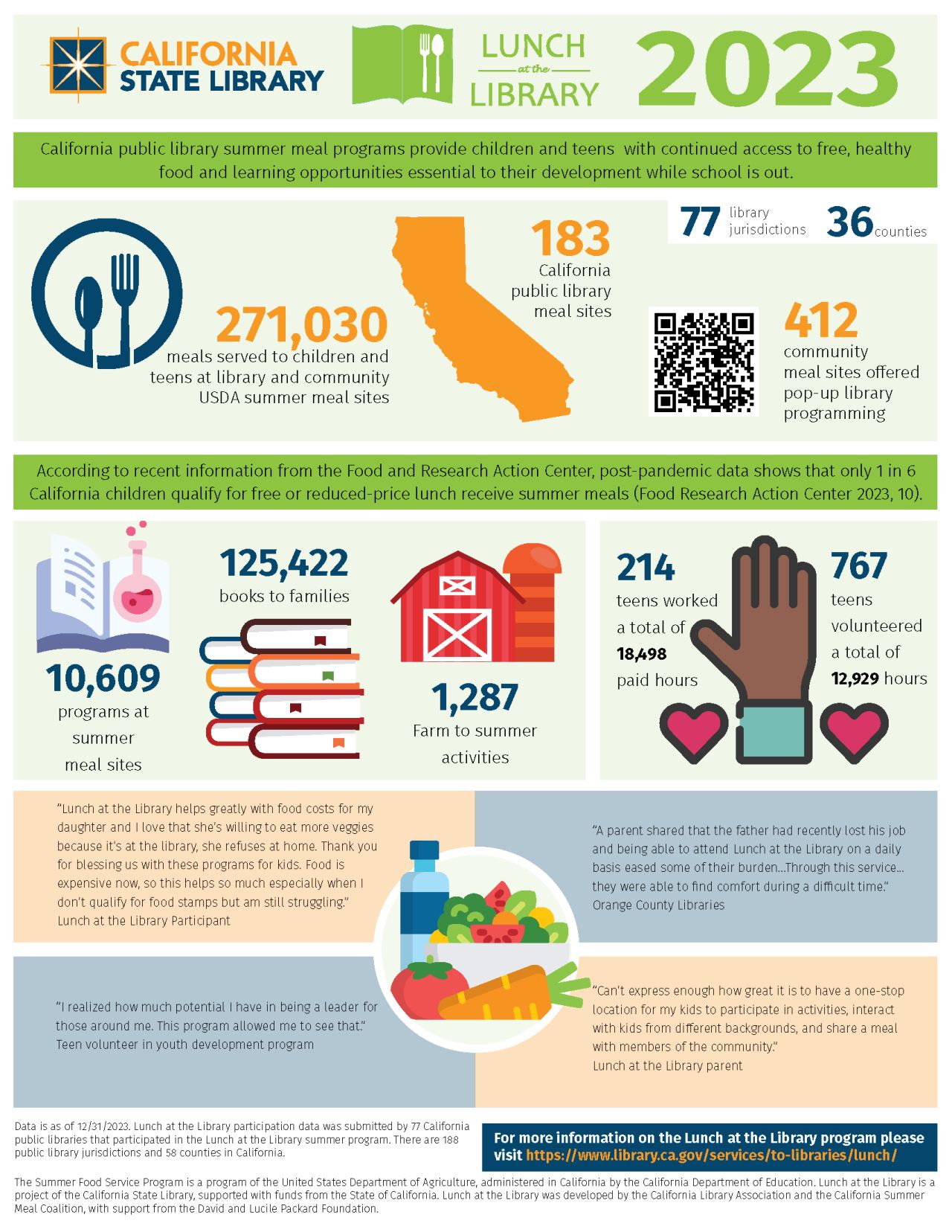
California State Library added testimonials to their infographic explaining the impact of free lunch services.
Tutorials
We know some community members have difficulty using library resources like databases or vendor apps. (Remember how many people struggled with the Libby App?) Some members of the public may find long, text-based tutorials to be to complex.
You can turn those text instructions into a visual how-to guide to help community members ingest the information. Here’s a fun, two-page infographic from Falvey Library at Villanova University. It explains everything a student needs to know about the library as they start a new school year.
Compare and Contrast
Instead of just sharing statistics, use an infographic to compare metrics before and after library interventions. The visuals go a long way to clearly illustrating the impact of your library work.
You can also use an infographic to explain why library services are superior to other resources.
Arkansas River Valley Library System’s infographic shows the free library services that can replace paid subscription services.
Service Bundles
Create a flowchart showing how a patron uses multiple services.
For example, your patrons may start by visiting your library’s website, where they sign up for a cooking program. When they get to the branch to attend the program, they may pick up a cookbook from a book display. Inside the cookbook, they may find a bookmark promoting the library of things.
An infographic illustration of that patron journey helps explain the interconnectedness of library services to board members, lawmakers, and potential partners.
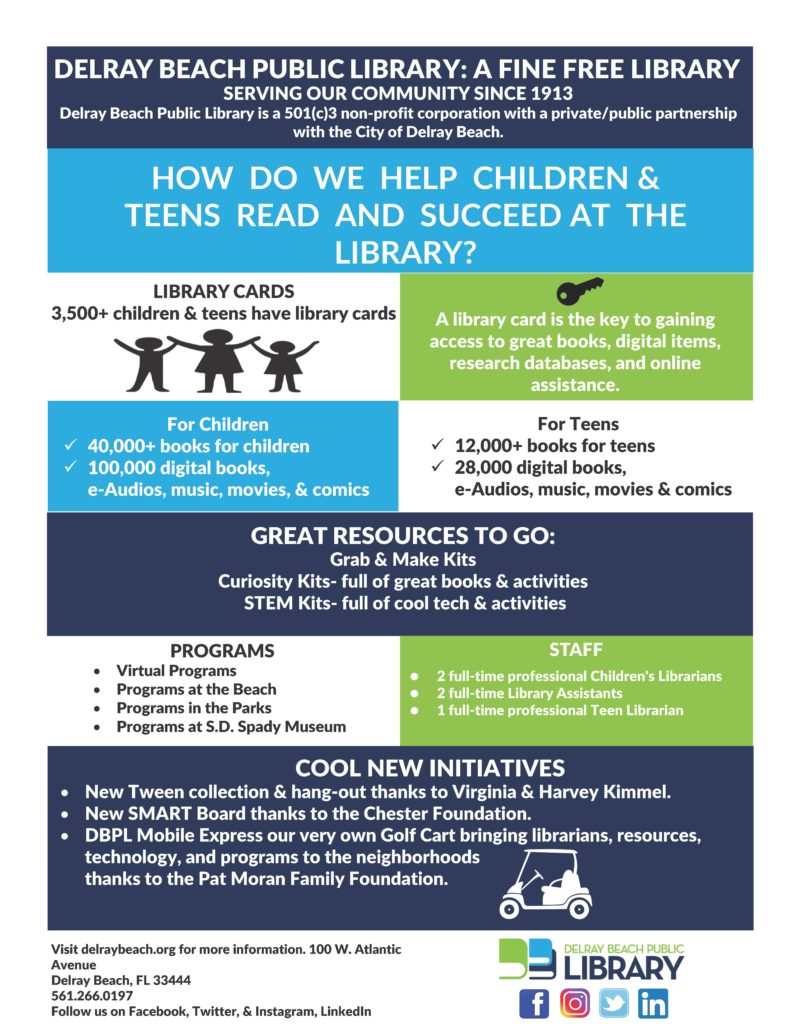
Delray Beach Public Library explains the interconnectedness of its services in this infographic.
Visualizing Partnerships
Use an infographic to show how the library collaborates with other local organizations, schools, and businesses. This will demonstrate how the library actively engages with the community, which builds trust and awareness. It can also highlight additional services and programs available through these partnerships.
Here’s a great example from the Tampa Bay Library Consortium explaining how the Institute of Museum and Library Services Funds help Florida library programs.
Library Accessibility
Your library can use an infographic to illustrate how the library makes resources accessible to different demographics. This includes children, seniors, and non-English speakers.
For example, if your library knows that 95 percent of seniors who attend tech skills programs learn to use tech fluently, you can demonstrate that with graphics.
Bonus tip: For accessibility of your infographic, create a downloadable alt-text document for the infographic. This allows people who use screen readers to consume the infographic. Here’s an example from EBSCO. Scroll to the bottom of the illustration and you’ll see the prompt to download the alt-text version of this infographic.
Environmental Impact
Show the library’s efforts in sustainability and green initiatives. Use visuals to demonstrate eco-friendly programs, such as recycling, energy-saving measures, and community gardening projects.
If your library has undergone a renovation or built a new building and you’re Leed-certified, use an infographic to show your community how that designation saves money and the planet.
Volunteer Contributions
Infographics easily explain the impact of volunteers on a library. The visuals can help you clearly show the number of volunteer hours. They also illustrate the types of activities volunteers assist with. Additionally, they convey the value volunteers add to the library.
Need help creating your infographic?
I am not an artist. I can barely draw stick figures. So creating an infographic is daunting to me. This post explains the process I use to plan and create an infographic.
Hey library marketing friends: I’m teaching a pre-conference workshop at LMCC this year with my amazing coworker Caleigh Haworth. It’s all about marketing your collection. Registration is open now.
Subscribe to this blog and you’ll receive an email whenever I post. To do that, enter your email address and click on the “Follow” button in the lower left-hand corner of the page. You can also follow me on the following social media platforms:



 Super Library Marketing: Practical Tips and Ideas for Library Promotion