Angela Hursh leads an outstanding team of marketing and training professionals at NoveList, a company dedicated to helping libraries reach readers. A 2023 Library Journal Mover & Shaker, she has also created courses on LearnwithNoveList.com designed to help library staff learn how to create effective marketing. Before her job at NoveList, Angela led the content marketing team for the Public Library of Cincinnati and Hamilton County. She also has more than 20 years of experience as an Emmy-award-winning broadcast TV journalist.
FYI: The Super Library Marketing Guide to Social Media in 2026 launches on November 17. Be sure to sign up for emails so you don’t miss a single section.
Does it ever feel like you’re chasing every new marketing trend that pops up? 🐿️
New platforms, new tools, changing audience habits — it never ends! But here’s the good news: you don’thave to chase every shiny thing to be an effective library marketer.
In this week’s episode of The Library Marketing Show, I’ll show you how to stay focused, strategic, and ahead of the curve, without losing your mind.
Do you have a suggestion for a future episode’s topic? Do you want to nominate someone for kudos? Let me know here.
We’re just eight weeks away from a brand-new year, which means it’s officially prediction season!
Every marketing guru seems to have a list of what’s coming next, but don’t worry — I did the homework for you. I went through 36 predictions for social media in 2026, and in this episode of The Library Marketing Show, I’m breaking down the top five that actually matter for libraries.
FYI: The Super Library Marketing Guide to Social Media in 2026 launches on November 17. Be sure to sign up for emails so you don’t miss a single section.
Plus, I received a kudos nomination for more than a dozen libraries that collaborated on a huge project. You’ll want to hear about that.
Do you have a suggestion for a future episode’s topic? Do you want to nominate someone for kudos? Let me know here.
Photo courtesy Cincinnati and Hamilton County Public Library
Key Takeaways:
Local business partnerships drive library engagement: By collaborating with local businesses during Library Card Sign-up Month, St. Johns County Public Library expanded its reach and boosted card sign-ups, proving that community-driven campaigns can significantly increase library visibility and impact.
Simple tools and clear communication fuel success: The library’s use of a streamlined online sign-up form, ready-to-use promotional materials, and consistent email updates made it easy for businesses to participate and promote the initiative.
It led to year-round advocacy from partners: What began as a one-month campaign evolved into a lasting network of support.
“One of my favorite places was the library,” recalls Alex. “I have so many fond memories of going there with my mom, then wandering over to the used bookstores on Beach Street to see what treasures we could find. Those visits really shaped my love of libraries and books from an early age.”
“In middle school, I joined the Turtle Patrol through the library with my mother, and it turned out to be a lot of fun,” says Hana. “That experience wouldn’t have been possible without the library.
Now, both women work at St. Johns County Public Library. Alex as Community Engagement Coordinator and Hana as Marketing Coordinator. The duo manages partnerships, campaigns, print promotions, digital marketing, and more. Along with a third coworker, they form the Marketing and Engagement Department at the library, helping with promotions at six branches and two bookmobiles.
“We’re a very community-driven organization, and I believe all of us genuinely see our community members as partners,” says Alex.
I reached out to Alex and Hana because of their unique approach to Library Card Sign-up Month. They go a step beyond the usual “sign up for a library card” campaign and get local businesses to throw their support behind the library by offering discounts to library card holders all month.
Alex and Hana confess they got the idea from the North Little Rock Library System in Arkansas, which helped them figure out the logistics of the campaign before they tried it for the first time in 2024.
“It took us a little over two months to bring in all of the participating businesses for this year’s Community Connections,” explains Alex.
“Our approach was straightforward: we reached out by email, phone calls, and in-person visits, and we leaned on relationships our staff already had with local business owners. We also made it as easy as possible to sign up by creating a simple online form.”
“It also creates a win-win. Our cardholders discover great local spots, and businesses get extra visibility. It’s about extending the library experience beyond our buildings and into everyday life.”
The campaign took a lot of coordination. Hana laid out the full plan, channel by channel:
Social Media: “We focused heavily on social media, especially Facebook and Instagram, because we knew that is where much of our audience already spends time. We highlighted both the value of a library card and the benefit of supporting local businesses through Community Connections.”
Ads: “To build awareness, we launched a month-long ad campaign and distributed printed flyers to participating businesses and community organizations. We also used Peachjar to reach families directly by sending digital flyers to parents of Pre-K through 5th-grade students across the county.”
Local media: “We sent out two press releases in partnership with our Office of Public Affairs team. One encouraged businesses to join the Community Connections program, and the other, during Library Card Sign-Up Month, highlighted the campaign and featured our partners.”
New cardholders: We also created a welcome campaign for new library cardholders, which included a full list of participating businesses as a thank-you and an incentive to explore their community.”
Local officials: “We held a proclamation ceremony and shared updates with our local officials to amplify awareness and community pride.”
Hana says that to keep communication smooth and consistent with their many business partners, she and Alex send regular email updates with key dates, promotional materials the partners can share, and reminders about ways to get involved. Many of the businesses also helped spread the word through their own social media and storefront signage.
The library proved you can build momentum with a campaign like this, year over year. In the first year, the library had 34 businesses on board. This year, that number doubled to 68 businesses. The library also saw an 8.5 percent increase in card sign-ups over the first year of the campaign.
“From the first year to this year, the main change was confidence,” reflects Alex. “In year one, we were pitching a brand-new idea and asking businesses to take a chance. This year, we could point to the success of the program, share the number of partners from last year, and show how much visibility participating businesses received. That made the ‘ask’ more compelling and helped the program grow.
“We also noticed that the businesses were much more engaged this year. One of the big differences was that we created a digital folder with ready-to-use social media images and sample copy. That simple resource made it easier for businesses to spread the word, and we saw them sharing and promoting the partnership more actively than before.”
But great campaign success is measured in more than just concrete numbers. Hana says they used several success measures when reflecting on the success of the campaign, including feedback from businesses and patrons.
For example, a local ice cream company said, “We are thrilled to partner with the St. Johns County Library and to tap into the creativity of their incredible staff! Just like books spark joy and imagination, we can’t wait to bring their flavor ideas to life with an ice cream collaboration the entire community can celebrate and enjoy!”
If you’re thinking this might be something you want to do next year for Library Card Signup Month, Alex advises you keep the process simple for the businesses that partner with you.
“A short online form and clear instructions go a long way,” says Alex. “Also, don’t be afraid to make the ask! Many businesses are excited for opportunities to connect with the community; they just need to know how.”
“This initiative has created a network and year-round advocacy for both the library and local businesses to support each other,” adds Hana.
“The Community Connections initiative is making an impact much bigger than we could have ever imagined. At the heart of it all is our local community, and we’re so excited to explore partnerships beyond Library Card Sign-up Month.
-Hana Tucker
And if they could do anything differently? “It would be to set earlier deadlines for print materials and communicate those clearly from the start,” confesses Alex. “Last-minute details are always tricky to manage. But overall, the program works because it’s a true win-win: libraries promote local businesses, and businesses help celebrate the power of a library card.”
Are you tired of being blamed for low program attendance?
You’re not alone. Many library marketers struggle to balance program promotion with broader library advocacy — and it can feel impossible to do both well.
One of my viewers recently asked for help with this exact challenge, so in this episode of The Library Marketing Show, we’re tackling it head-on.
You’ll learn how to strike the right balance between promoting events and promoting your library’s overall value without feeling like you’re constantly falling short.
Do you have a suggestion for a future episode’s topic? Do you want to nominate someone for kudos? Let me know here.
Subscribe to this blog, and you’ll receive an email whenever I post. To do that, enter your email address. Then, click the “Follow” button in the lower left-hand corner of the page. You can also follow me on the following social media platforms:
You know the line: Why go to the library? Everything’s free online. Well, today we’re calling that bluff.
Because spoiler alert — everything is not free online, and your library has way more to offer than people realize, as you well know!
In this episode of The Library Marketing Show, I’ll share fun and creative ways to bust that myth and build a campaign that showcases the real magic of the library.
Do you have a suggestion for a future episode’s topic? Do you want to nominate someone for kudos? Let me know here.
Subscribe to this blog, and you’ll receive an email whenever I post. To do that, enter your email address. Then, click the “Follow” button in the lower left-hand corner of the page. You can also follow me on the following social media platforms:
Photo courtesy Cincinnati and Hamilton County Public Library
Key Takeaways:
AI is changing how people search, and libraries are seeing a drop in website traffic as a result.
Simple formatting changes like clear titles, bullet points, and question-based headings can help your content appear in AI summaries.
Add credibility cues like staff names, job titles, and internal and external links to boost your site’s authority with AI and search engines.
Have you noticed a slight change in the blog posts here? Most now include a list of three quick takeaways at the top. Here’s why I started doing this, and why your library should consider it too.
AI impacts website traffic
A few months ago, I attended a webinar featuring three of the leading experts on Search Engine Optimization, or SEO. SEO is the practice of improving a website’s visibility and authority in organic search results to attract more visitors.
But AI has introduced a new wrinkle in SEO.
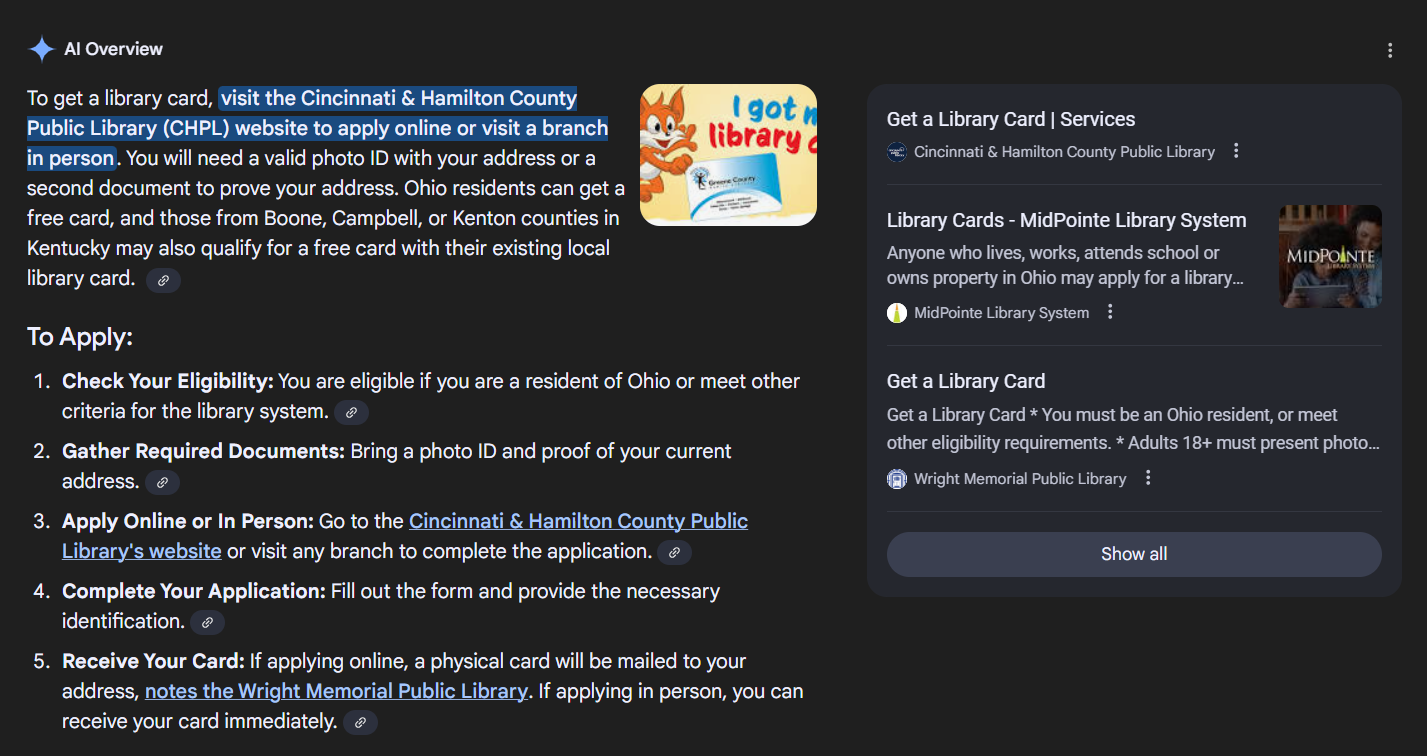
In May 2024, Google introduced AI Overviews (formerly called AI Summaries). These appear at the top of search results and provide a summarized answer to a user’s search, often pulled from multiple sources.
An example of an AI Overview for the search, “How can I get a library card?”
Once AI Overviews were introduced, searchers stopped clicking through to a website because their question was fully answered by the AI Overview. As a result, many libraries (and other websites, including this one) noticed a decrease in their organic web traffic.
In addition, a survey by Adobe Express says 25 percent of people use ChatGPT as their first choice for search over Google. Gen Z is particularly drawn to AI as a search engine. That likely means the popularity of using AI for search will continue to rise.
What does all this mean for your library?
You’ll need to adjust the way you structure your library’s website and blog to surface more often in AI searches and to show up in the AI Overview. It’s not as difficult as it sounds. Here are the changes I’ve implemented. I recommend you try these and monitor your web traffic over several months to see if the changes make an impact.
Titles should be clear, not clever.
Tell readers exactly what they’ll find on the page. For example:
Author Visit
❌ Clever Title:“An Evening of Literary Magic”
✅ Clear Title:“Meet Author Jasmine Guillory at the Library – October 24”
Why it works: The clear title includes the type of event, the author’s name, and the date. Those are the keywords that AI tools and search engines can easily match with user queries.
Craft Program
❌ Clever Title:“Get Your Glue On!”
✅ Clear Title:“Fall Craft Workshop for Teens – Make Your Own Bookmarks”
Why it works: It specifies the audience (teens), the season, and the activity.
Educational Workshop
❌ Clever Title:“Brain Boost Bonanza”
✅ Clear Title:“Free SAT Prep Workshop for High School Students”
Why it works: It uses direct language that matches what a student or parent might search for, like “SAT prep” or “high school test help.”
Wellness Event
❌ Clever Title:“Zen in the Stacks”
✅ Clear Title:“Free Yoga Class at the Library – All Levels Welcome”
Why it works: It clearly states what the event is, where it’s happening, and who can attend.
Include a bullet list of key takeaways or what you’ll learn at the top of the page.
This helps both readers and AI quickly understand the content. Try this on blog posts and key webpages.
Here’s how you might structure key takeaways at the top of a library card sign-up page.
A library card is free to all residents of Tree County.
Applicants need to fill out a form and have one document with proof of residence. The form can be sent to the library via email or presented at any library location.
Applications presented in person will be processed immediately. Applications sent via email will take 1-2 days to process.
Once an application is accepted, you’ll be given a card, which you will you to check out items, reserve meeting rooms, and register for programs.
Ask ChatGPT to provide you with a list of keywords or frequent questions around your topic. You can also search for your topic on Google and look at the ‘People Also Ask’ section. The website Answer the Public can provide you with some frequently asked questions as well.
Structure your content with bullets, steps, or lists.
Clean formatting makes it easier for AI to scan and summarize your content. You’ve probably noticed this post has been full of bullets and lists. That’s intentional! The bonus benefit is that it makes your blog and website easier to read.
Write in natural, conversational language.
Avoid jargon. Focus on being clear and helpful. Remember that searchers will not use jargon to look for answers to questions that may lead them to your library. Try to imagine what your community would put into the search bar, and then use those words in your blog or landing page.
When possible, include a staff member’s name and job title on a page.
AI looks for expertise or credentials when scanning pages. This is easy for a blog… just include the name of the author and their title in the post. For a landing page, consider adding a line like this: “Need help signing up? Email Maria Lopez, Library Services Manager, with 15+ years of experience helping patrons, at mlopez@treelibrary.org.”
Ask your partners to link to your website and blog.
When other trusted sites link to your content, it signals credibility to AI and search engines.
Use internal links whenever possible.
Link to related blog posts or pages on your site to help AI understand your content’s structure and relevance. That has the added benefit of keeping people on your page longer, which improves your trust and credibility to Google and AI, which means you’ll show up in search more often!
Try to stay within best practice lengths for word count.
BlueHost.com says for blogs, the ideal range is between 1,500 and 2,500 words. This gives readers comprehensive coverage of a topic. It’s also easier to include keywords and internal links for longer posts.
But… here’s something to remember: Google and AI tools prioritize quality over length (and so do most readers!) Don’t try padding your posts, as that can hurt your ranking.
Neil Patel, who is a trusted expert on SEO, says that for landing pages, word count isn’t a direct ranking factor. Rather, you should focus on the user’s experience and provide enough information for a community member to act.
Has your library’s website traffic taken a hit? Are you using any other methods to drive more traffic to your library’s website? Let me know in the comments.
Subscribe to this blog, and you’ll receive an email whenever I post. To do that, enter your email address and click on the “Follow” button in the lower left-hand corner of the page. You can also follow me on the following social media platforms:
April 2026 might sound far off, but big accessibility changes are coming — and they’ll directly affect how you market your library.
The new regulations aren’t just a compliance issue; they’re an opportunity to make your marketing better for everyone. Yet, I’m not seeing many libraries getting ahead of this.
So in this episode of The Library Marketing Show, let’s talk about what’s changing, why it matters, and what you should be doing right now.
Plus, I’ll give kudos to a library with a one-of-a-kind video for National Library Card Sign-up Month.
Do you have a suggestion for a future episode’s topic? Do you want to nominate someone for kudos? Let me know here.
Subscribe to this blog, and you’ll receive an email whenever I post. To do that, enter your email address. Then, click the “Follow” button in the lower left-hand corner of the page. You can also follow me on the following social media platforms:
Subscribe to this blog, and you’ll receive an email whenever I post. To do that, enter your email address. Then, click the “Follow” button in the lower left-hand corner of the page. You can also follow me on the following social media platforms:
Photo courtesy Cincinnati and Hamilton County Public Library
Quick Summary
Print marketing is not dead. When used strategically, it helps libraries cut through digital noise and even strengthens digital marketing.
Measure return on investment of print marketing with opt-ins, QR codes, custom trackable links, and interactive prompts.
Repurpose print content across social, blogs, and email to extend its reach and prove its impact.
Every day, I run with anticipation to the mailbox.
I can’t help myself. As a member of Gen X, snail mail was a significant part of my life when I was growing up. A letter or postcard from a family member or friend brought me such joy. We had phones, of course, but no social media. So if a friend went on vacation, I couldn’t follow each step of their journey on Instagram.
I also love mail because it’s physical. There is something about the feel of paper in your hands that adds to the joy of reading. It’s why I prefer print books to eBooks.
And I know that digital correspondence is also permanent, but there is something different about a stash of letters, held together with ribbon or string, kept to be read again years later.
What does any of this have to do with library marketing?
The 10th Annual Super Library Marketing survey closed a few weeks ago. I’m analyzing the results now and will publish the full report on January 5, 2026.
But one theme has emerged already: Library promotions are getting lost in the constant digital noise.
I work with hundreds of libraries worldwide every day at NoveList. They’re all facing this struggle. And some are beginning to lean on print to cut through the noise.
That’s because print still matters when it’s intentional, measurable, and audience-focused.
Print is not dead. It’s strategic!
It might feel old-fashioned or even risky to invest staff time and budget in print. After all, email and social media offer instant metrics and quick reach. But here’s the truth: Print has never been more valuable.
Now, I realize this statement may come as a surprise. Readers of this blog know how much I value email marketing. It is, hands down, the most effective use of your marketing time.
But clever library marketers know that there are some audiences we cannot reach with email. Print helps you connect the dots between those groups. It can spark attention in people who might otherwise overlook your digital promotions. And it can deepen the relationship with those who are already engaged with your library.
Imagine this: You’ve been on a store’s email list for years, eagerly clicking through their sales messages. Then one day, a coupon shows up in your mailbox. Suddenly, the brand feels even more present, more valuable, and you’re more likely to act on the next email, too. (BTW, this example is born of my own experience with Bath and Body Works!) And it works because…
Print doesn’t replace digital marketing; it amplifies it.
How do you know if your print marketing is working?
Here’s the challenge I’ve always faced with print marketing: How do you prove that it’s effective? How do you know it’s worth the investment? Because, let’s face it, print can be costly.
Here are five concrete ways you can measure the effectiveness of print marketing at your library.
1. Start with an opt-in model for longer print publications.
Many libraries print thousands of copies of their print newsletter or magazine. Then they send them out to all the people living in their service area. They might also send copies home with each child in their school district.
I totally understand that strategy. But it’s akin to sending un-targeted email messages. If someone isn’t already engaged with the library, the sad truth is they may throw that print piece in the trash. That’s a waste of money for the library and a waste of time for you.
A better approach is to ask readers to opt in to the publication. There are a couple of ways to do this.
Ask people to sign up either when they sign up for a library card or through an email campaign.
Send your print publication to anyone who donates to your library’s fundraising groups.
Put copies out in your branches. You can also distribute copies to partner organizations with locations that have a lot of foot traffic, like museums and theaters. Be sure to include a QR code so those new audiences can sign up to receive their own copies at home.
2. Make your print marketing interactive.
Ask readers to post a social media comment on a story or an event in your print publication. This works really well for print calendars and fliers.
Add a unique hashtag to the piece, and ask people to use it when they post their comment. Then count how many comments you receive.
You can also ask readers to send an email with an answer to a special prompt, like, “Which storytime is your child’s favorite?” Create a special inbox to receive comments from your print publications. Then you can count the number of emails you receive.
3. Use custom trackable links.
When I worked at the Cincinnati and Hamilton County Public Library, I used Bit.ly to create special trackable links for our website. With a free Bit.ly account, you can edit the back half of a link and then track how many people click on it. This makes it easy to see which traffic is coming directly from your print marketing.
4. Add QR codes.
Add a QR code to your print piece, then track how many scans you get. One library marketer I spoke with takes this a step further by creating a different QR code for each poster, depending on where it’s displayed. That way, she can compare engagement across different locations or departments!
Pro tip: This strategy works for all your library’s print pieces, from bookmarks to event flyers. If you ever feel like you’re doing too much print marketing, the data you collect from trackable links and QR codes can help you make the case for (or against) continuing.
5. Repurpose your content across other channels.
Save time and amplify your content by repurposing stories from your magazine or newsletter into social posts, blog articles, or email content. If those repurposed pieces perform well digitally, it’s another signal that your print marketing is resonating.
When I worked at the library, many of the stories we published in our quarterly newsletter or on our blog were repurposed in this way. This helped us to get more traction for the stories and gave us another way to measure whether the story is interesting to our audience.
This trick can also help your community to learn that you have print promotions and give you a reason to solicit sign-ups for the print version!
How is your library using print marketing?
I’d love to hear how your library is using print. Share your experiences in the comments below.
Subscribe to this blog, and you’ll receive an email whenever I post. To do that, enter your email address and click on the “Follow” button in the lower left-hand corner of the page. You can also follow me on the following social media platforms:
 Super Library Marketing: Practical Tips and Ideas for Library Promotion