You know the line: Why go to the library? Everything’s free online. Well, today we’re calling that bluff.
Because spoiler alert — everything is not free online, and your library has way more to offer than people realize, as you well know!
In this episode of The Library Marketing Show, I’ll share fun and creative ways to bust that myth and build a campaign that showcases the real magic of the library.
Do you have a suggestion for a future episode’s topic? Do you want to nominate someone for kudos? Let me know here.
Subscribe to this blog, and you’ll receive an email whenever I post. To do that, enter your email address. Then, click the “Follow” button in the lower left-hand corner of the page. You can also follow me on the following social media platforms:
Photo courtesy Cincinnati and Hamilton County Public Library
Where I live, the air is thick and humid right now, the fault of something called “corn sweat.” That’s the process of corn plants releasing moisture into the atmosphere through transpiration, similar to how humans sweat. My friend from my TV days, meteorologist John Gumm, says the corn crop in my area is releasing billions of gallons of water daily. Fun, right?
To cool off, I swim laps at the local YMCA. And underwater, I have a lot of time to think. Lately, I’ve been using that time to figure out how to help my library friends prepare for what will come when the weather turns cooler.
In the United States, the full ramifications of the loss of the Institute of Museum and Library Services and its funding will hit in September. For libraries in Canada, the United Kingdom, Australia, and New Zealand, funding cuts and intellectual freedom challenges are making work more difficult and threatening the core mission of libraries.
Longtime readers may already know that I’m not the kind of person who says, “There’s nothing I can do about it” very often. Action is how I deal with my anxiety. So, here’s the plan of library marketing action for the coming months.
The Big Problems We Face
Library marketers face a lot of obstacles. But in the coming months, the big threats are:
Decline or elimination of funding for libraries, which leads to…
No money for marketing or promotions, which impacts the effectiveness of our marketing, making it seem like marketing is no longer valuable. That often leads to…
Hiring freezes or the elimination of dedicated library marketing staff, which leads to…
Less use of the library, which leads to…
More funding cuts and library closures.
We do not want to get caught in that vicious circle.
What Library Marketers Need to Do
1. Lead with your value.
As we face the prospect of shrinking budgets and rising scrutiny, your library’s value must be front and center. And you must create a plan that communicates that value clearly and consistently, not just during certain times of the year like Library Works Week or National Book Month, but all year long.
Use every channel you have to reinforce how your library improves lives. Share patron success stories, promote your most-used services, and highlight how your library supports literacy, learning, and community connection.
2. Focus on the most cost-effective promotions.
We still have a good many low-cost, high-impact channels for promotions. But focus is the key.
This fall, I want my library marketing friends to spend their time and precious money on the following:
Email marketing: This is still one of the most effective tools for engagement. Targeted, opt-in messages are the most effective means of communication, with no algorithm to circumvent. So, get a plan together to grow your subscriber list now. And, as you put your emails together, think of them as a conversation between you and your audience. Try to keep your messages short and enticing. And offer your email recipients a way to email you back with feedback and questions. It will make them feel valued, and that feedback will make your messages stronger and more effective.
Collection marketing: Books are the heart of what you do. And we know most people come to the library for the collection. Don’t shy away from books! They’re your brand. Promote your books, databases, and digital resources through curated lists, displays, and themed promotions.
Strategic partnerships: Work with local organizations to amplify your reach without spending more money. Partnerships can take time to cultivate, but the investment is worth it. Your partners can strengthen your library’s offerings and give you access to audiences you’ve never reached before.
Organic social media: I put this last because of my mixed feelings about it. Social media effectiveness overall is declining. But posts that tell stories, highlight staff, or have some kind of interactive element like a poll or question, do boost visibility. So don’t use your social media accounts to highlight programs. I know that’s going to be upsetting to some readers, but the data shows it doesn’t work. Instead, think of your social media as an effective way to build relationships and reinforce your library’s personality.
3. Make it easy for new users to engage.
The moment someone signs up for a library card is critical for library marketing. It’s your first chance to make a good impression and use that person’s “new cardholder” status to convert them to a lifelong fan! You should:
Create a “New Here?” section on your website with the same information as the email series.
In those emails and on that website section, highlight services that are easy to access and immediately useful, like eBooks, streaming movies or music, or personalized reading recommendations.
4. Empower your front-line staff.
Your staff are your best ambassadors. Train them to talk about services, recommend materials, and encourage sign-ups for newsletters or events. Give them talking points so they can highlight personalized services like readers’ advisory, chat reference, and book bundles. These human touches build loyalty and word-of-mouth buzz and reinforce the message that your library is filled with helpful people.
5. Track what matters — and act on it.
No more excuses… stop doing what doesn’t work, even if it’s something you’ve always done. That means:
If your supervisor pushes back, ask them to message me. Seriously.
6. Experiment.
All marketing is an experiment. And some people shy away from experimentation during tough times. But now is the perfect time to try innovative approaches!
Try sending your videos in an email to see if you get more views.
Launch a blog or podcast.
Pilot a new format for your newsletter.
Test a new tone or voice in your messaging.
7. Streamline your approval process.
If internal red tape is slowing you down, advocate for a more efficient workflow. There are a lot of things you can do to make the approval process less painful,
Use templates to speed up content creation.
Set clear deadlines and expectations.
Build trust with leadership by showing how faster approvals lead to better results.
What are you doing to prepare your library and yourself for the challenges ahead? Let me know in the comments.
Subscribe to this blog, and you’ll receive an email whenever I post. To do that, enter your email address and click on the “Follow” button in the lower left-hand corner of the page. You can also follow me on the following social media platforms:
Photo courtesy Cincinnati and Hamilton County Public Library
Kelly Rembert grew up in rural Wisconsin but went to Detroit after college.
“Growing up, I visited the library regularly but never thought of working there,” confesses Kelly. “I loved the books and looking at the displays. In college, I studied journalism and German. ”
“After college, I was working as a secretary at a bank ‑ which wasn’t for me – and read an article about how a bunch of librarians would be hitting retirement age soon. It was a lightbulb moment. I realized that I like working with people and I like books, so I enrolled in library school a few weeks later at Wayne State University.”
Kelly now works as an Outreach Librarian for Southfield Public Library, which is located in a suburb of Detroit. The library has an individual location serving 80,000 residents.
Kelly started soon after the ribbon was cut on a new building, some 21 years ago. She’s part of the Community Outreach department, which oversees the library’s marketing, promotion, exhibits, and large programs. In addition to Kelly, the department has a full-time intern, a part-time graphic artist, and a part-time assistant.
One day, Kelly was attending a webinar when she got a big idea for a publicity campaign called 30 Days of Savings.
“I wanted a way to call attention to all the great things the library can do to help save patrons money and time, especially with the high inflation cutting into our paychecks. We decided to highlight one library program or service each day.”
-Kelly Rembert
“We came up with ideas and taglines. We fought against our wordy librarian tendencies and kept the tagline short and simple.”
“We highlighted services that fit the day. For example, Election Day was ‘Learn from History: Study the Past to Define the Future.’ The Saturday after Thanksgiving was ‘Stream Movies: Save on Streaming’, where we highlighted free movies on Hoopla and Kanopy.”
Though the planning process began in June, the library decided to launch 30 Days of Savings in November. They put all the information into a spreadsheet which included the message idea, the tagline, and the URL to be used by patrons.
From there, the library’s graphic artist produced graphics to use in print, on the website, and on social media.
In October, Kelly and her team created the website, got all the social media posts scheduled, and printed out signs and a large calendar. Before they knew it, it was November, time to launch the campaign!
“First thing each morning, the savings of the day were posted on Facebook and Instagram and highlighted on our website,” explains Kelly. “The savings item was also added daily to a large calendar located in our lobby. A special e-newsletter was sent at the beginning of the month to highlight the 30 Days of Savings program, and the daily savings items were featured in our weekly e-newsletters.”
“Information about the campaign was also sent to our local schools and some of them shared it with their students. Additionally, we sent out information to our elected officials and key community contacts and it was featured in the weekly Lathrup Village e-newsletter, which is our contract community.”
The month passed quickly and soon it was December. Kelly and her team were eager to analyze the results of their campaign.
“We looked at our statistics to find out if the campaign was a success,” says Kelly. “We compared our web views in October, before the campaign, to our numbers in November and each page view went up. The 30-day webpage was viewed over 1,300 times and we had almost 1,600 clicks from our e-newsletters.”
Putting the campaign together took thought and planning but no outright costs. Since the parameters are now set up, continuing the program will be easy.
“We plan to repeat this each April and November,” comments Kelly. “We will highlight the services we didn’t fit into November and repeat some programs and services again. This is a great way to draw attention to some of our lesser-known services.”
She gives your library full permission to replicate the 30 Days of Savings.
“I hope that other libraries will gain inspiration from this and put their own spin on it,” declares Kelly. “What benefits one library benefits us all.”
Subscribe to this blog and you’ll receive an email whenever I post. To do that, enter your email address and click on the “Follow” button in the lower left-hand corner of the page. You can also follow me on the following social media platforms:
Photo courtesy Cincinnati and Hamilton County Public Library
I’ll never forget the first time I spoke in front of a community group on behalf of the library.
I was a nervous mess. The pressure was high. So much was riding on my five minutes in front of this group. I wanted to connect with my audience, transfer some of my passion for the library to their souls, and inspire them to action.
A community presentation is a unique opportunity to talk directly about the value of your library. What you say in those moments will stick with people longer than any flyer or sign ever will. But for maximum impact, you must take a strategic approach to your presentation.
And, although I know that five minutes doesn’t seem like a lot of time, it is! If you don’t believe me, stop reading this blog, set a five-minute timer, and just sit there with your eyes closed trying to predict when the timer will ring.
Five minutes is a LOT of time. And you can do a lot in five minutes!
Here are seven tips to make any presentation engaging and impactful. Scroll down to see a sample outline I’ve created to walk you through creating a presentation that hits the mark, even when you only have five minutes to share.
Refer to the library as “your library.”
Many people in your audience may haven’t visited or used the library in a long time. They may not think of the library as belonging to the community, and they certainly won’t think of the library as belonging to them personally.
So, in your presentation, refer to “your library” as many times as makes sense. This is a subtle way to let your audience know that the success of the library affects everyone in the room.
Start with a hook.
You want your audience to be interested and attentive, and the best way to do that is to start right off, not by introducing yourself, but with a surprising fact or statistic about your library.
For example, “Your library sees about 20,000 people who come into the physical building every year—that’s enough to fill our high school football stadium four times over! I’m Jane Doe, and I’m here to show you how your support of the library impacts those 20,000 people.”
You could also begin with a short, compelling story about how the library positively impacted someone in the community.
For example, “I want to begin by introducing you to Susan. Susan was laid off about 6 months ago, after spending more than 20 years at her company. She came to your library for help finding a new job. We spent time updating her resume, searching for jobs that fit her experience, and practicing interview techniques. Susan landed a new job and is now making more money than she was at her former position, all thanks to the staff at your library.”
Choose one main message and repeat it throughout the presentation.
It will be tempting to try and talk about everything the library has to offer during your five minutes. However, listing all library services will overwhelm and confuse your audience. Instead, focus on one message you want this audience to remember.
For example, if you are speaking to the school PTA, you will want to focus your message on resources available to students and parents to help with schoolwork. Your main message would be: “Your public library takes the stress out of schoolwork.”
Or, if your library is getting ready for a major construction project, you’ll want to talk about how the renovations or new construction will provide better service to the community. Your main message would be: “These new library spaces will be vibrant, accessible places where everyone in our community can thrive.”
Whatever your main message is, try to work that into your presentation at least three times. Repeating it will help it stick in the minds of your audience.
Use visual aids.
You can put together a short slide deck to help drive home your key message. Be sure to keep your slide text short. Add infographics, photos, or short video clips that reinforce your message.
If the room setup does not include a screen for a slideshow, bring handouts with you! Add your key message points to the top of the handout, and then some visuals like charts, photos, or infographics.
Add an interactive element.
You may be tempted to talk for your entire five-minute slot. But your audience is more likely to remember what you say if you involve them in the presentation in some way.
Launch a poll. Several free sites like Slido and Mentimeter let you embed a poll question in your slide deck with a QR code. Or just ask for a show of hands.
You could also ask a question of your audience, like, “How many of you have visited our library in the past month? What is the first thing you remember seeing when you walked into the building?”
Or try a mini-activity. For example, you could ask everyone to take out a piece of paper and write down as many library services as they can think of in 30 seconds.
End with a call to action.
Give your audience something to do after your presentation. You can invite them to visit the library for a special prize. You can ask for volunteers or donations. One library staff member I’ve spoken with did a presentation on intellectual freedom and handed out talking points, encouraging the audience to use them in conversation with friends at family.
Practice your speech.
A practice session or two can help identify parts of your speech that are less engaging and can ensure you stay within your time limit.
Ask a few coworkers to play the audience and then ask them for feedback on your presentation. Or record yourself giving your speech so that you can evaluate the timing, pace, and content.
Sample Outline for a Five-Minute Presentation
To help get you started, I’ve created this outline template for a community presentation. By following this structure, you can deliver an engaging and persuasive message about the benefits of the library within a short time frame.
Introduction (30 seconds)
Start with a hook: Share a surprising fact about your library or a testimonial or patron story.
Main Message (3 minutes)
State the main message you want this audience to remember.
Talk about the service you are highlighting.
Share how this service impacts your community, and how the community would be impacted if the service were NOT available.
Engagement (1 minute)
Ask rhetorical questions.
Insert an interactive element.
Conclusion (30 seconds)
Call to action: Leave your audience with a task that reinforces your key message.
Subscribe to this blog and you’ll receive an email whenever I post. To do that, enter your email address and click on the “Follow” button in the lower left-hand corner of the page. You can also follow me on the following social media platforms:
There is a phrase that pops up quite frequently in library marketing which has bothered me for quite some time: “More than books.” Other than a few people I work with at NoveList, I thought I was the only person who felt this way. But I’m not! A librarian wrote an eloquent piece about it this week, and we’ll talk about it in this episode of The Library Marketing Show.
Plus kudos go to a library for their perfect response when trolls took over a Facebook post about their in-library Pride Month display.
Do you have a suggestion for a topic for a future episode? Want to nominate someone for kudos? Let me know here. And thanks for watching!
Subscribe to this blog and you’ll receive an email whenever I post. To do that, enter your email address and click on the “Follow” button in the lower left-hand corner of the page. You can also follow me on the following social media platforms:
Photo courtesy Cincinnati and Hamilton County Public Library
Five years ago, I was listening to an episode of a library podcast about Google Ad Grants, which offers $10,000 monthly advertising credit to qualified nonprofits. Thousands of nonprofits use the program. You apply once, and the grant continues indefinitely.
Wow!
Many libraries have taken advantage of this program since it was launched in 2004. Some of those libraries collaborate with a company called Koios, currently run by Maggie Carson and Peter Velikonja.
Koios is a member of Google’s Certified Ad Grant Professionals group, which has been vetted by Google to manage ad grants. It is the only member of this group specializing in public libraries.
Koios has successfully applied for and managed Google Ad Grants for public libraries since 2017. That grant money has been used to promote catalog items, educational resources, passport services, business and career resources, summer reading programs, and more.
“Library marketing professionals know that different online audiences are reached in different ways,” says Peter. “Advertising with Google reaches everyone. That makes it the best way to reach new people, including, critically, the underserved.”
Peter says paid search using a Google Ad Grant may represent 25 percent or more of a library’s overall website traffic, depending on the size of the library’s service population.
“Ads appear at the top of search results – where they are most likely to be seen,” explains Peter. “Since libraries are trusted institutions, people are more likely to click on an ad for a library than a commercial ad.”
“At an average of $2 to $3 per click, a library can potentially bring about 4,000 visitors per month to its website, mostly new people who were not necessarily thinking of a library but were searching for something. It presents a library with an opportunity to show up at the right time with the right information, to the right person.”
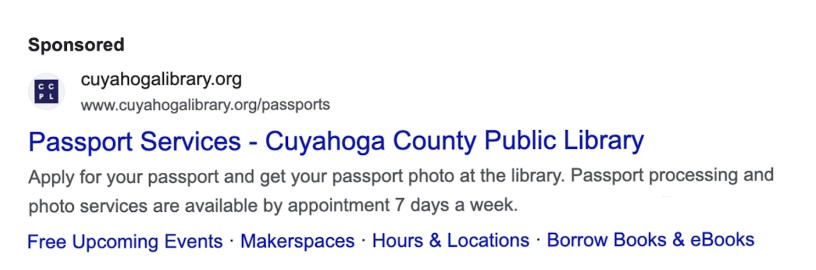
A sample Google ad for Passport Services at Cuyahoga County Public Library in Ohio.
And what does Google get out of this deal?
“Google’s primary motivation, we believe, is to perform a social good by helping nonprofits,” says Maggie. “But the program also helps Google fill unused advertising space. It’s like having an empty billboard – better to put something up for free than to leave it blank and potentially leave the impression that the space is not valued.”
“First, you create a Google for Nonprofits account,” explains Maggie. “Google will verify your foundation or friend’s group nonprofit status through their partnering organization, Percent, after which you can submit an Ad Grants application. The process generally takes a couple of days or a week. For libraries that would like help applying, Koios will gladly guide you for free.”
Google Ad Grants are not competitive grants, but there are some details and requirements to be aware of.
“Nonprofits with 501(c)3 status are eligible, so a library should apply through their Friends or Foundation,” suggests Maggie. “Google will also review the library’s website for quality and security issues; it will reject websites that are not https-enabled or do not meet their quality standards.”
Once a library is accepted, someone from the library will need to do ongoing research and keep up to date on compliance.
“Google’s policies require active management of advertising accounts, which means they expect you to check the account at least once per month,” explains Maggie. “Google has a set of policies to follow, and they regularly issue updates to these policies or create new ones.”
According to Peter, it takes some ingenuity and persistence to get the full value from an Ad Grant. Google says the average spent is only 17 percent of the full value of the grant. Google does offer some automated options for account management, which may be the best choice for busy staff. Koios can also manage the grant.
“First, we apply for an Ad Grant on behalf of a public library,” says Peter. “It is not complicated, but we have experience working out glitches that may come up in the application process.”
“Then we set up the Google Ads account that comes with the grant – we do all that for free because we want libraries to use the resource, whether we are involved or not. After that, a library can manage the account themselves, or we can do it for a yearly fee.”
“Most libraries choose to have us manage the account because we can exercise it more fully. We promote a library’s online catalog, which contains hundreds of thousands of terms and concepts that can match the words and phrases people search for. It’s a sort of Big Data capability libraries don’t usually have.”
Topeka & Shawnee County Public Library GA4 Web Traffic Acquisition Data, March 2024
Like most library vendors, Koios prices its services by the size of a library’s service population.
“Given the potential of receiving up to $120,000 per year in advertising credit, our subscription fee presents an excellent return on investment,” declares Maggie.
A screenshot of the Koios member dashboard for Barrie Public Library in Ontario, Canada, showing a 30-day view of 18 active campaigns.
If you’re interested in learning more about Koios and Google Ad Grants, email Maggie and Peter at info@koios.co.
Subscribe to this blog and you’ll receive an email whenever I post. To do that, enter your email address and click on the “Follow” button in the lower left-hand corner of the page. You can also follow me on the following social media platforms:
Photo courtesy Cincinnati and Hamilton County Public Library
When Donna Forbis graduated from the 8th grade, her parents gifted her a 10-speed bike. Her mother decided she was old enough to ride to the Peoria Public Library‘s Lakeview branch.
“Back then, kids were not allowed in the adult stacks, so I was limited to my ‘side’ of the library,” remembers Donna. “I was very short (under 5′ tall), so even as a teen, I still looked like a kid. My ventures into the adult stacks would sometimes draw ‘looks’ from other patrons, but the library staff knew I was in search of mysteries I had not yet read!”
Donna’s love of the library never abated. She now works for the Illinois Prairie District Public Library. The library is small, with rural and suburban areas covering a service population of about 25,000 residents.
“We have fewer than 25 staff members (including our Director) servicing our six branches,” explains Donna. “Many staff members do double- or sometimes triple-duty.”
“My official title is Marketing & Events Coordinator, but I am also the branch manager for our Germantown Hills branch. I oversee all adult programming at our branches, and I coordinate with our Youth Services Librarian/Assistant Director on teen programming. I am responsible for creating nearly all of our promotional materials. What I don’t generate myself is usually shared with me to make sure it fits our style and brand before being shared with the world.”
It’s a lot of work, and Donna’s library still struggles to reach community members, especially regarding their programs and events. But Donna’s library is doing something that seems old-school yet innovative: A wall calendar!
“The idea for the wall calendar came from our Director,” explains Donna. “Several area outlets like banks and stores used to offer free wall calendars to their customers, but the practice has dropped off in recent years. While the world might be more comfortable with digital calendars, many patrons still want a wall calendar. Since the banks were not offering free calendars anymore, we decided to fill that void.”
“With a wall calendar, we can promote the library every day for a full year inside our patrons’ homes. We want our patrons to think of us as their go-to for research and resources, educational and entertainment opportunities, and a central community gathering spot. The calendar is a daily reminder that we are here for our neighbors.”
Donna and the rest of the library staff spent about three months working on the format and layout for the 8.5″ x 11″ wall calendar.
“The first version was nothing more than a stack of stapled papers, with notes on each page of a suggested layout,” recalls Donna. “Then I created an initial mock-up of the calendar in MS Publisher and shared it with our Director for critique. From her feedback, I shifted some photos around, added, and subtracted date-specific holidays, and determined what other information we wanted to include.”
“One topic of discussion was whether to have the library info pages at the beginning of the calendar or the end. My logic was, that if the info pages were at the end, behind the December calendar, they would be accessible to users all year long without taking the calendar off the wall.”
The final calendar is a mix of fun content and library news. You can see it here.
“Our calendar is set up to highlight our branches, reading challenges, and some of our evergreen programming,” says Donna. “We also provide ways to connect with the library through a page filled with links and QR codes to get to our website, catalog, calendar, reading challenge platform, and social media channels.”
The library printed 725 copies and distributed them beginning the week before Christmas. Calendars were available at each branch and through some of the library’s community partners, including nursing homes and daycare centers.
Donna also promoted the availability of the calendars through the library’s regular marketing channels. And until just a few weeks ago, she posted a notice of the calendar’s availability in every library email newsletter. They managed to hand out nearly all their copies.
“We are very pleased with how it came out, and our patrons have been very appreciative,” remarks Donna. “When looking at it from a cost-benefit analysis, we spent a little under $2300 (plus shipping) for the calendars. That equates to roughly $200 per month in advertising spread across our community for a full year. And it is in a form that our patrons want and need. Even on a tight marketing budget, the expense was worth it.”
If Donna does the calendar again for 2025, she says she’ll have the final design done by Thanksgiving, so patrons have a longer window of time to pick one up.
And where will her next great library marketing idea come from?
“Inspiration can come from anywhere,” declares Donna. “I maintain connections with other library marketers through the Library Marketing Book Club, the regional Heart of Illinois Library Marketing networking group, and professional groups like the Illinois Library Association’s Marketing Forum.”
“One of my all-time favorite pieces of library marketing came from the Invercargill (New Zealand) City Library back in 2017, which was 2 years before I became a library marketer! They did a parody of a Hollywood Reporter magazine cover featuring the Kardashian clan at the height of their Keeping Up with the Kardashians fame. When I look at it today, I still laugh!”
“I keep an eye on what advertisers in other industries are doing through organizations like Adweek, HubSpot, and other marketing tracking organizations. If someone on one of those platforms is writing or commenting about a particular piece of advertising, it may be worth noting.”
“As far as other libraries go, I am awed daily by my peers! Because of my ‘solo marketer’ limitations, whenever I see a library with a catchy video on TikTok, Reels, or Shorts, I am completely jealous! There are not enough hours in the day for me to learn how best to shoot and edit videos, get them uploaded, and do it regularly to build and maintain a following and get all my other stuff done!”
Donna has a piece of advice for anyone working on library marketing.
“Regardless of the situation, whether you have a program or promotion you want to try, need money or materials, or anything else – If you don’t ask, the answer will always be ‘No.’”
“People generally want to be helpful and be of service, but often they don’t know the best way to do it. Tell others what you need and ask them for their help, and you might be surprised at the answer, even for the ‘impossible’ ask!”
Subscribe to this blog and you’ll receive an email whenever I post. To do that, enter your email address and click on the “Follow” button in the lower left-hand corner of the page. You can also follow me on the following social media platforms:
Photo courtesy Cincinnati and Hamilton County Public Library
Becky Denes grew up on the shores of Lake Erie and spent her formative years in the main branch of the Lorain Public Library System. She recalls hunting for new books, playing Oregon Trail and Where in the World is Carmen Sandiego on the PCs, researching local legends, and scrolling through microfilm for fun.
“As a twelve-year-old, I was even lucky enough to attend the dedication of the Toni Morrison Room at the branch,” remembers Becky. “I met Ms. Morrison, and she signed my mom’s copy of Beloved. For those who don’t know, she was born and raised in Lorain.”
Becky is now a reference specialist at the Amherst Public Library in Northern Ohio. And like many of you, her job includes library promotion.
“I am a one-person PR department,” explains Becky. “I oversee our community engagement, social media, most publications, and other marketing and public relations duties.”
“I post to Facebook and Instagram, typically 5 – 10 posts per week just depending on what we have going on, usually no more than 1 or 2 posts per day. I look at our social media accounts as an avenue for advertising, so most of our posts are program and event promotion and photos, and promotion of our eMedia and materials.”
I met Becky at the Library Marketing and Communications Conference in 2023. She went to the microphone at the end of a session and revealed the secret way she ensures her social media posts are seen by more people in her community.
She uses email.🤯
Becky got the idea to share Amherst Public Library’s social media post by email during the pandemic.
“When we closed at the beginning of the COVID pandemic in mid-March of 2020, like many other library marketers, our social media accounts became my main focus and were our primary form of communication with the public,” recalls Becky. “I did send out email updates as well, but day-to-day, I was posting multiple things on social media on a morning/afternoon/evening schedule.”
“Within the first week or two of this, one of our staff members reached out to me and asked how people who don’t have social media accounts would be able to follow along. This gave me the idea for the Weekly Roundup.”
I’ll be honest: I was flabbergasted by this idea. It never occurred to me to send an email of social media posts to library community members. But it turned out to be a highly effective marketing method for Becky.
“I sent out the first issue of the Weekly Roundup on April 4, 2020,” explains Becky. “It’s going on for almost four years now. It’s scheduled to send every Saturday morning at 8 am, with a two-week hiatus during the winter holidays.”
“The email includes anything that was posted on our social accounts for the week ahead that isn’t time-sensitive like program reminders the day before or the day of a program, for example.”
Becky says the emails are an effective way to reach people in her community of 33,000 residents.
“One of our former board members mentioned to me that several people have told her that they look forward to receiving them,” shares Becky. “Recently, one of my regular patrons asked me if I was the one who sent the emails and told me how much she likes the Weekly Roundup because she doesn’t use Facebook and it’s an easy way to keep up with what we’re doing.”
In addition to the ongoing social media email, this year Becky is considering a rebrand, including a style guide for her small library. She draws on other library marketers for inspiration.
“One of my favorite ideas came from Instagram, where a library that was closed for construction used the phrase, ‘Pardon our progress’”, says Becky. “I used the tagline for our expansion and renovation project that started a few months later in the summer of 2021. I really liked it because, as I told staff and colleagues, our expansion and renovation were something to celebrate, not something to apologize for.”
“While there are some best practices for library marketing, there’s no one-size-fits-all solution! What works for my community might not work for another, and vice versa. The best advice that I can give to anyone is to just try things to see what works.”
Subscribe to this blog and you’ll receive an email whenever I post. To do that, enter your email address and click on the “Follow” button in the lower left-hand corner of the page. You can also follow me on the following social media platforms:
They’re big and bold. They promise your library continuous exposure to a diverse audience. And… they’re expensive. Are billboards actually a good use of your limited library marketing budget?
I’ll lay out the pros and cons of billboard advertising for libraries in this episode.
Plus, kudos go to a library that received media coverage for bringing back a popular program.
Do you have a suggestion for a topic for a future episode? Want to nominate someone for kudos? Or do you want me to come and speak at your event? Let me know here. And thanks for watching!
Subscribe to this blog and you’ll receive an email whenever I post. To do that, enter your email address and click on the “Follow” button in the lower left-hand corner of the page. You can also follow me on the following social media platforms:




 Super Library Marketing: Practical Tips and Ideas for Library Promotion