Search

Super Library Marketing: Practical Tips and Ideas for Library Promotion

Category

AI and ChatGPT

How To Use ChatGPT To Build Target Personas and Hit the Mark ๐ŸŽฏEvery Time With Your Library Promotions

Photo courtesy Cincinnati and Hamilton County Public Library

Terrance is a senior in high school, with a bright future ahead of him.

Heโ€™s gregarious, curious, and extroverted. He lives with his dad and two younger siblings. His dad is managing to make ends meet, but there isn’t a lot of money left over for things like vacations or extra-curricular activities.

Terrance doesnโ€™t have a car, but heโ€™s been using public transportation all his life. He really wants to go to college. Heโ€™d be the first in this family to go. But the application, the financial aid paperwork, interviewing, and essay writing required for admission feels overwhelming to him.

Terrance isnโ€™t a real kidโ€ฆ not exactly. He was a target persona I built when I worked at a library.

Terrance was based on real teens who used our library. And when I read that description, I could clearly see Terrance in my mind. (I still can–can you?) More importantly, I could find the words I needed to say in library promotions that would reach Terrance.

Terrance helped me figure out how to create effective library promotions.

What is a target persona and why do we need them?

A target persona is a fictional profile of a person who represents one of your key target audience groups, based on the characteristics of your community members.

Target personas help us get granular about our target audience. Getting granular helps us create promotions that let our community members know that we see and hear them.

Simply put, we can use target personas to create marketing that convinces those community members to use the library. 

A target persona is not supposed to detail one specific person. It should never be based on one specific individual. Itโ€™s a composite sketch, like Terrance, that should reflect most people it is supposed to represent.

How to build target personas for your library

Your community members can be broken down into core segments, or groups, based on their wants, motivations, and the problems they need your library’s help to solve. Those are your target personas.

The number of target personas your library will need will depend entirely on your library’s strategic goals and your marketing goals. Some libraries only need 2 or 3 target personas. Some will need more.

The first thing your library will do is gather demographic information about the community or target group for which you are building a persona. You may do this by researching census data or other data available from your city or town government. Settle on a general answer to these questions:

  • Age range
  • Income
  • Education level
  • Living situation (Married, single, living with multiple generations in one house, living in an apartment, unhoused, etc.)
  • Transportation situation (Do they have their own car or do they use public transit?)
  • Current library usage

Then you want to add depth to your persona. Write down answers to these questions:

  • Their motivations.  Are they career or money-motivated? Are they family-focused?
  • Their attitudes. Can you identify their perspective on social issues like environmental welfare, human rights, or intellectual freedom?
  • Their pain points: What problems are they looking to solve?
  • Their aspirations for the future.
  • The activities they participate in, both inside and outside of the library.
  • Their religious and political affiliation.   

Using ChatGPT to create target personas

Once you have gathered as much information as you can on your target audience by answering the questions above, itโ€™s time to create your target persona. ChatGPT can help you get started.

Let’s say you want to build a target persona for someone who might use your library’s small business center.

Put all the information you have on your target persona together in a description and feed it into ChatGPT like this:

โ€œPretend you are a marketer. Build me a target audience persona for a person who is in their mid-50s, who was laid off from the job they held for more than 20 years. This person has always wanted to start their own business, and they figure now is the time. But they do not have a business or marketing degree, and they have very little money. They are single and are living off savings now. They do have a bachelor’s degree in English. They have their own car. They use the library to check out books about once a month. They could use library resources to help them start their small business.โ€

ChatGPT generated a target persona for “John Anderson, a resilient midlife entrepreneur on a mission!” ChatGPT assigned characteristics that I hadn’t considered, like tech savviness and media consumption.

Here’s the rest of the ChatGPT-generated target persona for John Anderson.

Goals and Motivations

  • Fulfilling a lifelong dream of starting his own business.
  • Achieving financial stability and independence.
  • Creating a legacy and finding personal fulfillment through his work.

Challenges

  • Limited budget and financial resources.
  • Lack of formal education in business and marketing.
  • Navigating the challenges of entrepreneurship later in life.

 Hobbies and Interests

  • Enjoys reading, especially classic literature and business-related books.
  • Values community engagement and local events.
  • Appreciates the arts and cultural activities.

 Media Consumption

  • Relies on traditional media like newspapers and local community bulletins.
  • Limited online presence and social media usage.
  • Listens to podcasts or watches videos for learning and entertainment.

 Tech Savviness

  • Basic computer skills but may need assistance with advanced online tools.
  • Open to learning and adapting to technology for business purposes.

 Values

  • Values hard work, perseverance, and integrity.
  • Desires to make a positive impact on the local community.
  • Values practical and actionable advice.

 How the Library Can Help

  • Access to beginner-friendly business books and resources to guide him through the basics of entrepreneurship.
  • Workshops and one-on-one assistance on creating a business plan, marketing on a budget, and utilizing digital tools.
  • Free or low-cost online courses for building essential business skills.
  • Networking events to connect with local entrepreneurs and mentors.

ChatGPT also said, “Understanding John’s unique situation and tailoring library resources to cater to his specific needs will be crucial. Marketing messages should focus on the practicality, accessibility, and community support the library provides for someone like John as he takes the leap into entrepreneurship.”

If I worked at a library, I qould take this ChatGPT generated persona and add or subtract the things that apply to my community.

Are personas too generalized?

There is nothing that replaces a personal conversation with a community member. But it is physically impossible to talk to everyone who lives in your service area.

Personas allow us to find the commonalities of the different segments of our audience. This exercise will lead you to create promotional items that connect with your target audience.

Your target personas will likely change over time. They may be different for different programs or goals that your library is trying to reach. Thatโ€™s okay! Your target personas should be like your library: adaptable, flexible, and able to change to meet the needs of your community.

But by having defined target personas, you are better equipped with the insights needed to build an experience that consistently and efficiently speaks to your patrons as individuals โ€“ with content thatโ€™s super relevant to them.


More advice

The Top 7 Tips for Library Emails That Are Guaranteed To Appeal to Millennials and Gen Z Readers

Subscribe to this blog and youโ€™ll receive an email whenever I post. To do that, enter your email address and click on the โ€œFollowโ€ button in the lower left-hand corner of the page. You can also follow me on the following social media platforms:
Is Artificial Intelligence a Threat to Your Job in Library Promotions? An Expert Explains Why Itโ€™s Not Time To Freak Out

Watch this episode now

#LibraryMarketing Show, episode 203

Is Artificial Intelligence (AI) a threat to your job as a library marketer? It’s a serious question I’ve been pondering for a while. I turned to someone I truly admired for advice and we’ll unpack what she has to say about AI and promoting your library in this episode.

Plus weโ€™ll give kudos to someone doing great work in library marketing. And this week, it’s a surprising choice!

Do you have a suggestion for a topic for a future episode? Want to nominate someone for kudos? Let me know here.

Thanks for watching!


Miss last week’s episode? No worries!

Will I see you soon?

Subscribe to this blog and youโ€™ll receive an email whenever I post. To do that, enter your email address and click on the โ€œFollowโ€ button in the lower left-hand corner of the page. You can also follow me on the following social media platforms:
Putting ChatGPT to The Test: Will It Help Your Library With Promotions? Plus A Free Spreadsheet of Prompts To Get You Started!

Photo courtesy Cincinnati and Hamilton County Public Library

When I was a kid, I always wanted a robot.

I blame The Jetsons. They made robots look fun and practical. I imagined my robot would do my chores for me and leave me more time to read.

Itโ€™s not exactly the same thing, but I must admit I am having some fun playing with ChatGPT. It canโ€™t clean my house or weed my flower bed. But it does make the work of library promotion easier, as you saw in last week’s post.

How to use ChatGPT 

ChatGPT isnโ€™t going to do all the work for you. And itโ€™s not perfect. But it can save you time. It can also help when you just aren’t feeling very creative.

Here are some basic tips that I gained from playing around with the tool.

  • Be as clear and specific as possible about what you want it to generate. For example, if you want the text to be a certain length, tell the tool.
  • Use conversational language like how you would speak or write.
  • Before giving it a prompt, ask the tool to take on a specific role. “Act like a social media specialist.”
  • If you have examples of the type of content you want ChatGPT to generate, provide them as part of your prompt.
  • If you aren’t satisfied with what the tool generates, you can ask it to try again. If it appears to get stuck, you can type in “Keep going” and it will continue. You can train it to generate more accurate responses by providing feedback. 

ChatGPT for Library Promotions Spreadsheet

Libraries love to share resources with each other. And I love that about libraries.

So, as I was writing this series, I thought it would be a good idea to start a spreadsheet where any library using ChatGPT could record their prompts. Then, if you ever want to use ChatGPT but don’t know what to ask it, you can refer to this shared spreadsheet!

I’ve divided the spreadsheet into categories: social media, website, blog posts, videos, emails, print materials, ads, annual reports, and other promotions.

Anyone can add or take a prompt anytime. I hope you find it to be helpful! Here’s the spreadsheet of ChatGPT prompts for library promotions.

Using ChatGPT for real-world library promotions

I asked a group of library marketers to share how theyโ€™re using ChatGPT. When they didn’t provide a direct example, I tested the application to see what results I would get for each task. As you’ll see, the results were varied.

To write letters and blog posts

The director of the Bibliotech Library used ChatGPT to write a letter to her patrons. She called the results โ€œโ€ฆa little genericโ€”but also shocking and a little creepy.โ€

To improve video scripts

To test this, I took the transcript of my intro from the May 10th episode of The Library Marketing Show and asked ChatGPT to make it โ€œmore interesting and succinct.โ€ Here are the results:

Are you making a big mistake with your library’s email marketing? It’s not too late to fix it! In this episode of The Library Marketing Show, we’ll explore a tweet from marketing expert Jay Acunzo, who suggests that we focus more on making our email content valuable rather than just growing our subscriber list. Let’s take a closer look at how we can ensure that the emails we send are truly worth sending.

I’m curious about which intro is more interesting to you! Let me know in the comments.

Social media posts

One library staffer said, โ€œIt gives me a starting place, and then I make it my own. I view it as a beginner writer and then Iโ€™m the final content creator and editor.”

I did my own experiment, asking ChatGPT to write a LinkedIn post promoting a webinar on the fantasy genre of books. Hereโ€™s what it came up with.

This post ended up getting the least number of impressions, likes, and comments of any of my LinkedIn posts in the past two weeks. I think that’s because it didn’t sound like me. Also, I’ve noticed ChatGPT is a little obsessed with emojis. I love emojis, but it likes to insert them in every sentence.

Ideas for blog posts

I asked ChatGPT to give me an idea for a blog post that would convince someone to donate to the library. It gave me a title and an entire outline!

Title: “Why Your Donation to Our Library Matters: Supporting the Heart of Our Community”

Introduction: Our library is a cornerstone of our community, providing access to books, educational resources, and community events. However, like many libraries, we rely on donations from our patrons and supporters to continue offering these vital services. In this blog post, we’ll explore why your donation to our library matters, and how it can help support the heart of our community.

Body:

1. Supporting literacy and education – Donating to our library means supporting literacy and education in our community. Your donation helps us to purchase new books, e-books, and audiobooks that educate and inspire people of all ages. Additionally, your donation can help us offer programs that support early literacy, such as storytimes, summer reading programs, and after-school homework help.

2. Creating a community hub – Our library is more than just a place to check out books. It’s a community hub that offers a range of services and resources, from free Wi-Fi and computer access to community events and meeting spaces. Your donation helps us to maintain and improve these services, ensuring that our library remains a welcoming and inclusive space for everyone.

3. Fostering lifelong learning – Our library is a place where people of all ages can learn new skills and discover new interests. From book clubs and writing workshops to coding classes and maker spaces, your donation helps us offer a wide variety of programs that foster lifelong learning and personal growth.

Conclusion: Donating to our library isn’t just about supporting a building or an institution. It’s about supporting the heart of our community – a place that provides access to knowledge, resources, and community events that bring us all together. Your donation helps us to continue offering these vital services, ensuring that our library remains a vibrant and vital part of our community for generations to come. Thank you for your support!

I found this answer to be pretty great. The only thing it’s missing is a patron-as-hero story, which would give the reader the chance a real-world example and build empathy. But this answer would be very helpful as a starting point.

Tag lines for book displays

I asked ChatGPT to create a tagline for a book display about the coronation of King Charles. Here are the results:

1. “The dawn of a new era: Explore the history of King Charles’ coronation.”

2. “Long live the king: Discover the story behind Charles’ ascension to the throne.”

3. “A royal affair: Step back in time to witness the coronation of King Charles.”

4. “From ceremony to history: Uncover the significance of King Charles’ coronation.”

5. “Crowning glory: Explore the pomp and circumstance of King Charles’ coronation ceremony.

This is a good example of the time limitations of ChatGPT. Because its data feed only extends to 2021, it assumed I was referring to King Charles I or King Charles II.

Training announcements

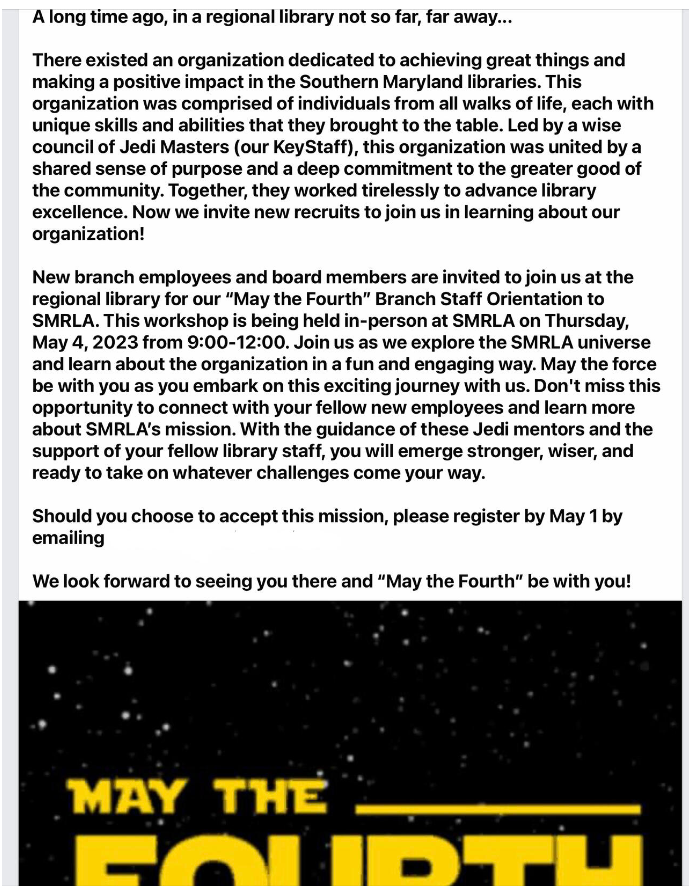
A library staffer told me that she asked ChatGPT to give her an announcement like the Star Wars opening scrawl. Here is the result:

Subject lines for email

I asked ChatGPT to write a subject line for an email about how to use ChatGPT for library promotions. Here is the result:

Revolutionize Your Library Promotion Efforts with ChatGPT: Here’s How.

I ran this subject line through Sharethrough’s Headline Analyzer. It got an average score. But it would be a good starting point if you were looking for ideas.

Data analysis

I entered this prompt into ChatGPT: “I sent an email to 2,516 people. It had a 56% open rate and a 13% click rate. 10 people checked out books they saw in the email and 14 signed up for programs. Is that good?” The application said:

Based on the information provided, it looks like your email campaign had a successful engagement rate.

The 56% open rate indicates that more than half of the people who received your email were interested enough to open it and see what it contained.

The 13% click rate means that of those who opened the email, a good portion clicked on a link within the email to learn more or take some sort of action.

With 10 people checking out books and 14 signing up for programs, it appears that your email had a direct impact on some people’s engagement with your library.

I agree with ChatGPT’s assessment.


More Advice

8 Secrets to Writing Irresistible, Must-Open Library Email Subject Lines PLUS 6 Free Tools To Ensure Success!

Subscribe to this blog and youโ€™ll receive an email whenever I post. To do that, enter your email address and click on the โ€œFollowโ€ button in the lower left-hand corner of the page. You can also follow me on the following social media platforms:

What Is All the Fuss About ChatGPT? An Introductory Guide for Using AI in Library Promotions

Photo courtesy Cincinnati and Hamilton County Public Library

In my freshman year of college, a woman came to my Intro to Communications class to talk about the future of the Internet.

She told us that someday, the internet would keep track of our previous searches and purchases. She predicted that we would see ads for products and be offered discounts based on our search and purchase history.

I remember being simultaneously awed, intrigued, and scared by this vision of the future. Iโ€™m having that same feeling lately as I read and learn more about ChatGPT.

It’s likely your news and social media feeds have been filled with chatter about Chat Generated Paragraph Techniques or ChatGPT. Launched six months ago, itโ€™s become the center of every tech article and philosophical debate.

What is ChatGPT?

ChatGPT is an advanced natural language processing tool that provides text or information to a user based on prompts.

Itโ€™s different from a chatbot in that it can remember past conversations and provide more sophisticated answers as it โ€œlearns.โ€ It allows users to provide follow-up corrections. It can reject inappropriate prompts and, allegedly, it can admit its mistakes. 

ChatGPT is free for now. There is a Plus version that promises to be โ€œavailable when demand is high,โ€ โ€œfaster response speedโ€, and โ€œpriority access to new features.โ€ It costs $20 a month.

Testing ChatGPT

I recently started playing with ChatGPT.

The very first prompt I gave it was What is library marketing? Here is the response.

Library marketing refers to the strategies and activities that libraries use to promote their services, collections, and programs to their target audience, which could be the local community or a specific group of users. The aim of library marketing is to increase the usage and visibility of library resources and services by building relationships with patrons, increasing awareness of library offerings, and creating engagement with library users.

Library marketing may involve a range of activities, such as creating promotional materials such as flyers, brochures, and newsletters, organizing events and programs, creating social media campaigns, developing partnerships with local organizations, and conducting outreach to underserved or marginalized communities. The goal is to reach potential users where they are, whether that be online or in person, and to communicate the value and relevance of the library’s offerings. By using effective marketing strategies, libraries can attract new users, retain existing patrons, and ultimately improve the overall impact of the library in the community.

ChatGPT

It’s a bit professorial but accurate.

Next, I asked ChatGPT to give me a social media post that would convince teenagers to participate in my libraryโ€™s summer reading program.

Hang on to your hats, folks.

Attention all teenagers! ๐Ÿ“ข๐Ÿ“š๐ŸŒž

Are you ready for an exciting summer filled with adventure, knowledge, and prizes? Join our library’s summer reading program and discover the joy of reading! ๐Ÿ“–๐ŸŒŸ

Not only will you get access to a wide variety of books and resources, but you’ll also have the chance to win awesome prizes for reaching your reading goals! ๐ŸŽ๐Ÿ†

Plus, reading is the perfect way to unwind, escape into different worlds, and improve your vocabulary and critical thinking skills. ๐Ÿง ๐Ÿ’ญ

So, what are you waiting for? Sign up for our summer reading program today and let the fun begin! ๐ŸŽ‰๐ŸŒž๐Ÿ“š #SummerReading #LibraryLove #TeenReads

ChatGPT

Itโ€™s long. And why so many emojis??

I donโ€™t think Iโ€™ve ever heard a teen use the word โ€œaccess.โ€

And, in my experience, anytime you say, โ€œAttention all teenagersโ€, teens immediately run for the exits. So, it’s not perfect. That’s because it’s not human. And there are other problems with ChatGPT.

Downsides of ChatGPT

There are limitations and concerns about ChatGPT. Some are disturbing, especially for libraries. 

  • It may generate incorrect information.
  • It may occasionally produce harmful instructions or biased content.
  • It also has limited knowledge of the world and events after 2021. That’s because the original data feed provided by its creators happened that year. 

One major concern for libraries

For libraries, there is also a privacy concern.

In its privacy policy, Open AI, the creators of ChatGPT, say the application may collect personal information from your messages, any files you upload, and any feedback you provide. Conversations may be reviewed by OpenAI to improve the chat. This article has more information on the potential privacy and security risks.

There is also a healthy debate happening now about whether Google will penalize online content creators, including library websites and blogs, for using machine-generated text.

Google can detect website copy and blog posts that may contain ChatGPT content. They use machine learning algorithms (ironic!) to detect text patterns that are indicative of AI content.

Under current guidelines, Google considers AI content to be โ€œspammyโ€. Specifically, its guidelines say โ€œโ€ฆcontent thatโ€™s been generated programmatically without producing anything original or adding sufficient value: instead, that itโ€™s been generated for the primary purpose of manipulating search rankings and not helping users.โ€

There does not appear to be a penalty at this time from Google for using ChatGPT to help with social media posts, emails, or ads.

So, should libraries use ChatGPT?

ChatGPT canโ€™t replace people (at least, not yet). The tool canโ€™t strategize or empathize. And it doesnโ€™t know the human experience of your cardholders.

But it can save you time. It can jumpstart the creative process and help you move past writer’s block.

And many library marketers are beginning to experiment with ChatGPT.

Ready to learn more? Read this post!


More Advice

But Iโ€™m Not a Writer! 10 Free Tools To Help You With Library Blog Posts, Speeches, Emails, and More.

Subscribe to this blog and youโ€™ll receive an email whenever I post. To do that, enter your email address and click on the โ€œFollowโ€ button in the lower left-hand corner of the page. You can also follow me on the following social media platforms:

A WordPress.com Website.

Up ↑