Search

Super Library Marketing: Practical Tips and Ideas for Library Promotion

Category

Google

Accessibility Is Good Marketing: Why Libraries Must Start WCAG 2.2 Prep Now

Watch this video now

#LibraryMarketingShow, episode 310

April 2026 might sound far off, but big accessibility changes are coming โ€” and theyโ€™ll directly affect how you market your library.

The new regulations arenโ€™t just a compliance issue; theyโ€™re an opportunity to make your marketing better for everyone. Yet, Iโ€™m not seeing many libraries getting ahead of this.

So in this episode of The Library Marketing Show, letโ€™s talk about whatโ€™s changing, why it matters, and what you should be doing right now.

Plus, I’ll give kudos to a library with a one-of-a-kind video for National Library Card Sign-up Month.

Do you have a suggestion for a future episode’s topic? Do you want to nominate someone for kudos? Let me know here.

Thanks for watching!โ€‚

P.S.: If you wish, you may download a transcript of this episode.


Miss the last episode? No worries!

Say hello at these future conference appearances!

Subscribe to this blog, and youโ€™ll receive an email whenever I post. To do that, enter your email address. Then, click the โ€œFollowโ€ button in the lower left-hand corner of the page. You can also follow me on the following social media platforms:

๐Ÿ’ŒEasy and Inexpensive Ideas To Show Appreciation to Your Library Patrons

Watch this video now

#LibraryMarketingShow, episode 309

A viewer wants to show appreciation to their library patrons. How can you do this on a budget while still making your community members feel special?

I’ll share some really quick and creative ways to show your community members that you appreciate them in this episode of The Library Marketing Show!

Plus, I’ll share kudos for a library whose short-form video has received tens of thousands of views and tell you why this video was so successful.

Do you have a suggestion for a future episode’s topic? Do you want to nominate someone for kudos? Let me know here.

Thanks for watching!โ€‚

P.S.: If you wish, you may download a transcript of this episode.


Miss the last episode? No worries!

Will I see you soon?

Subscribe to this blog, and youโ€™ll receive an email whenever I post. To do that, enter your email address. Then, click the โ€œFollowโ€ button in the lower left-hand corner of the page. You can also follow me on the following social media platforms:

The Secret To Stock Photos That Actually Work for Your Library Promotions

Watch this video now

#LibraryMarketingShow, episode 308

Are you looking to increase clicks on your library’s emails, social media, and websites? The secret may be the faces that you choose in your promotions!

In this episode of The Library Marketing Show, I’ll reveal the one thing that makes stock photos actually work… and this is backed by science.

Plus, I’ll give kudos to a library that started a basic service but promoted it in a not-so-basic way!

Do you have a suggestion for a future episode’s topic? Do you want to nominate someone for kudos? Let me know here.

Thanks for watching!โ€‚

P.S.: If you wish, you may download a transcript of this episode.


Miss the last episode? No worries!

Will I see you soon?

Subscribe to this blog, and youโ€™ll receive an email whenever I post. To do that, enter your email address. Then, click the โ€œFollowโ€ button in the lower left-hand corner of the page. You can also follow me on the following social media platforms:

How To Make Your Library Content More Helpful and Rank Higher on Google!

Watch this video now

#LibraryMarketingShow, episode 307

Is your libraryโ€™s online content working as hard as it could? Google has released some guidelines to help you create content thatโ€™s not only helpful for your patrons but also gets noticed by search engines, including Google, of course!

I’ll break down the latest advice in this episode of The Library Marketing Show.

Plus, we’ll share kudos with a library that went above and beyond on social media!

Do you have a suggestion for a future episode’s topic? Do you want to nominate someone for kudos? Let me know here.

Thanks for watching!โ€‚

P.S.: If you wish, you may download a transcript of this episode.


Miss the last episode? No worries!

Will I see you soon?

Subscribe to this blog, and youโ€™ll receive an email whenever I post. To do that, enter your email address. Then, click the โ€œFollowโ€ button in the lower left-hand corner of the page. You can also follow me on the following social media platforms:

๐ŸŒGoogle Does It Again! What New Changes in Search Ranking Mean for the Discoverability of Your Library’s Website

Watch this video now

#LibraryMarketing Show, episode 237

Google is at it again!

The engineers at the search engine recently changed the way that they rank websites and search to make internet searching easier for the user. But that’s going to have some implications for your library.

Don’t panic! We’ll go through the changes and what they mean for your library’s website in this episode.

Plus, kudos go to a library that sent its annual report to a media outlet and got positive press coverage with an unbeatable headline.

Do you have a suggestion for a topic for a future episode? Want to nominate someone for kudos? Let me know here. And thanks for watching!โ€‚


Miss the last episode? No worries!

Will I see you soon?

Subscribe to this blog and youโ€™ll receive an email whenever I post. To do that, enter your email address and click on the โ€œFollowโ€ button in the lower left-hand corner of the page. You can also follow me on the following social media platforms:

How Your Library Can Use Google Ad Grants to Supercharge Your Website and Reach a Huge Untapped Audience

Note: A newly updated version of this blog post is now published. Read it here.

Five Insider Tricks To Improve Your Library’s Voice Search Ranking

One of my most vivid class memories from college happened during my freshman year. A woman visited our communications class to talk about this new thing sweeping the nation: the internet. She said that someday companies would be able to send us information on any product or service we could ever want or need, based on our previous purchases or on search.

Was she psychic? Nope. She was forward-thinking.ย The internet, and later the introduction of smartphones, caused a huge shift in the way libraries interact with cardholders. And now, we’re about to enter another era of technology change. We’ll need to re-evaluate how we interact with cardholders. Because voice search is going to change everything.

My library is now dabbling in this technology. We created an Alexa skill that allows cardholders to do some very basic things: find out what’s going on at a branch or ask about our hours of operation. But that’s only the tip of the iceberg when it comes to voice search.

At Content Marketing World 2018, I attended a session led by Courtney Cox, who is manager of Digital Marketing at Children’s Health. She talked with us about the Google Search box. You’re probably familiar with it. It looks like this:

The answer box is text-based but it’s an important key to getting your library information in front of cardholders doing keyboard-based search inquires AND those using voice search options like Alexa or Suri. How is the answer box connected to voice search? Cox explains that voice search technology reads whatever answer appears first in the Google search. So, if you’re in the answer box, you are in first position and you get read by the voice search technology. That means if you live in the second or third results on Google, you won’t get read out. EVERYTHING ELSE underneath the answer box is ignored. There’s no glory in second place.

Wow. That’s depressing.

Comscore estimates that by 2020, half of all web browsing sessions will be done without a screen. So, what’s a library to do? Here are five steps to take now to move your library into the first position on Google search. These tips will increase the chances that your library will appear in the answer box and connect with more users.

Keyword research: Cox says you need to do real-world keyword research. That means you can use online tools like those I talked about in this post. But you must also talk to customers, face-to-face. Talk to front-line staff. Talk to the call center staff. Find out what customers are saying when they ask questions. What specific words or phrases do they use? Then start incorporating that language into your web content, social content, and all your marketing messages.

Competitor research: Cox suggests you do periodic searches for competing services offered by Amazon, your local bookstore, and online databases. What phrases and words do they use? How long, in words and characters, are their answers? Do they use bulleted lists, tables, or graphics to convey information to their customers?ย  What aren’t they doing well? All of these questions will inform you as you write searchable text for your website. You should feel free to copy what others are doing well. You can improve on what your competitors are doing poorly! You don’t need a big budget to write more searchable content.

Stop dictating your own content. Cox says we all need to stop brainstorming internally about what you want to write about. Start focusing on what your customers want. We must be answering the questions our customers have.

Create a FAQ page on your library website. Make the page easy to find and promote it throughout the web with blog posts, social media, emails… every marketing method at your disposal. The more people who go to the FAQ page, the higher the search ranking for that page will be, and the more quickly you’ll get into the answer box.

Re-purposeย your content–with a purpose. Many libraries are creating videos for marketing purposes (HOORAY!). Now it’s time to take those videos and make them work to improve your search position. Take each of your videos and turn it into text. Post the text on your library blog and promote it in other ways. The more eyes that read the content in its written form, the more likely it is that the content will make its way into the answer box!

We’ve got our work laid out for us. After the conference, I started doing random searches to see where my library shows up in the answer box–and when it doesn’t. In some ways, we’re doing okay.
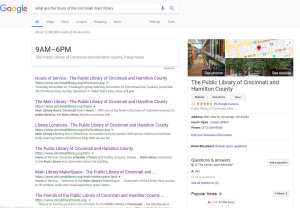
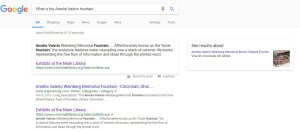
And in some ways, we have a lot of work to do.

So I’ll be looking for ways to make these five pieces of advice work in my content. And I’ll be paying more attention to the words we use on the website, making them local and specific. I’ll start thinking about what people will say when they use voice search to ask questions about my library. I’ll check these searches again in a few months to see how I’m doing. I urge you to do the same!

Subscribe to this blog and youโ€™llย receiveย an emailย every time I post. To do that, click on โ€œFollowโ€ button in the bottom left-hand corner of the page. Connect with me on Twitter,ย Snapchat, and LinkedIn.ย I talk about library marketing on all those platforms!

A WordPress.com Website.

Up ↑