I have a bummer of a report to share with you today. However, it’s imperative because it may impact the way you use your library’s social media accounts to promote other content offerings from your library.
Buckle up! We will dive into that in this episode of The Library Marketing Show.
Plus, kudos go to a library that uses email to show off its accomplishments and prove its value to key stakeholders.
Do you have a suggestion for a topic for a future episode? Want to nominate someone for kudos? Let me know here. And thanks for watching!
Subscribe to this blog and you’ll receive an email whenever I post. To do that, enter your email address and click on the “Follow” button in the lower left-hand corner of the page. You can also follow me on the following social media platforms:
The engineers at the search engine recently changed the way that they rank websites and search to make internet searching easier for the user. But that’s going to have some implications for your library.
Don’t panic! We’ll go through the changes and what they mean for your library’s website in this episode.
Plus, kudos go to a library that sent its annual report to a media outlet and got positive press coverage with an unbeatable headline.
Do you have a suggestion for a topic for a future episode? Want to nominate someone for kudos? Let me know here. And thanks for watching!
Subscribe to this blog and you’ll receive an email whenever I post. To do that, enter your email address and click on the “Follow” button in the lower left-hand corner of the page. You can also follow me on the following social media platforms:
Photo courtesy Cincinnati and Hamilton County Public Library
This week, I’ll be able to see the world’s largest bottle of catsup. (Ketchup? Catsup? Is there a difference?)
When I learned that I’d be speaking at Reaching Forward South in Collinsville, Illinois, I Googled the area. That’s how I discovered the city is home to a 170-foot water tower shaped like a catsup bottle that just happens to be on the National Registry of Historic Places. It’s even got its own website and fan club.
If you’re like me, you do some strategic planning when you go on a trip. You decide to rent a vehicle or research public transportation. You purchase airline or train tickets and book a hotel. You pick restaurants to sample and decide which tourist attractions you’ll visit.
Some people just land in a city and let fates carry them where they may. (No shade from me. You do you!) I prefer planning because I don’t want to risk seeing or experiencing the best the area has to offer.
A plan, on vacation or in the library, sets clear goals and outcomes. It ensures your time, money, and energy are spent on the most valuable things. It gives you direction and purpose.
Marketing for a library works best when the promotions are tied to a library’s overall strategic plan. But that’s not always as easy as it sounds.
What is the difference between a strategic plan and a marketing plan?
A strategic plan defines targets and objectives for the entire library organization, including facilities, human resources, reader services, youth services, outreach, and more.
A marketing plan outlines your initiatives to support your library’s strategic plan. It clearly defines the collection items, programs, and services you’ll promote, who you’ll target, and how you’ll target them to reach your library’s overall goals.
In a perfect world, every library would have a strategic plan with clearly defined objectives and goals that are specific, measurable, actionable, relevant, and timely (SMART).
But…
If your library lacks a strategic plan, has a strategic plan that’s very vague without clear goals, or is in the middle of creating one (that can be a lengthy process), you may feel stuck and directionless. How do you know what you should be promoting?
What to do when you have very little direction
You can ask your library director or board of directors what they want to accomplish. Without a strategic plan as a guide, you must understand the director’s and the board’s goals.
Even basic statements like “We want to increase program attendance by 25 percent” or “We want to make sure every child has a library card” will guide your marketing.
If you don’t feel comfortable approaching senior leadership, ask your supervisor to step in. Stress the importance of a cohesive plan for moving forward in all areas of your library. This really is the cornerstone of your work.
Once you know the goals of your library, it’s time to create your marketing plan.
Step 1: Define your marketing goals.
Lay out exactly how you’ll help those overall library goals be reached.
For example, let’s say your library has a goal to partner with schools to ensure all third graders in your town are reading at grade level. Your marketing goal might be:
Increase the participation in our library’s 3rd-grade reading program by 25 percent within the next 12 months, as measured by the number of 3rd-grade students enrolled and actively engaging with the program materials and resources.
Step 2: Write down what you know about the community you serve.
Marketers call this a “situation analysis.” This will give you a starting point for your strategy. Ask yourself:
What does your typical cardholder do with their card?
Where do they live?
How do they view your competitors?
How does your library currently fulfill a unique position in your community?
Step 3: Create a list of all your tactics and assets.
Write down all the channels you use to promote your library. This list should include every social media platform you use, every website your library owns, and every print publication you send out, plus emails, print collateral, influencers, in-person events, press releases, podcasts, and videos.
Step 4: Set goals for each tactic and asset.
Let’s say one of your goals is to make sure job seekers in your community use career resources at the library. And let’s say you have a print newsletter that you send every quarter to all the residents of your community.
Look at the specific marketing goal you created in step one. Underneath that, you might write:
“In each issue of our newsletter, we will feature a cardholder who used our library’s services to advance their own career, such as by taking our GED course or using our online job resume builder. We’ll do at least one story on library work as a career. Every quarter, we’ll highlight a service or program that will help our cardholders reach their career goals.”
Step 5: Populate an editorial calendar for the next 12 months.
Now it’s time to plan content topics and themes for each month that will work to reach your goals. Planning a calendar for a full year makes it easy to coordinate promotions across channels. And it will help your supervisor and coworkers to understand what you’ll be doing, when, and why.
You may end up moving things around as you go through the year. That’s okay!
Step 6: Measure success and failure.
Accurately document the results of every promotion you do. This will help you to adjust your strategy next year.
Sometimes you won’t have a clear understanding of what’s working and what’s not working until you see the actual results in numbers on a paper in front of your nose.
One final note of encouragement
Don’t be discouraged if you don’t reach all of your goals. Marketing is an experiment. Sometimes the stuff you do will work, sometimes it won’t. Don’t repeat the things that don’t work! Spend more energy on the things that do work.
Subscribe to this blog and you’ll receive an email whenever I post. To do that, enter your email address and click on the “Follow” button in the lower left-hand corner of the page. You can also follow me on the following social media platforms:
Algorithm changes are an inevitable part of library social media. Normally, those changes spell bad news for libraries. But…
LinkedIn just changed its algorithm and those changes are good news for libraries! (Yippee!) I’ll outline the three new and improved LinkedIn algorithm changes and how they will positively impact your library’s posts in this episode.
Plus, kudos go to a library that brought a bunch of libraries together to create a viral video for Read Across America.
Do you have a suggestion for a topic for a future episode? Want to nominate someone for kudos? Let me know here. And thanks for watching!
Subscribe to this blog and you’ll receive an email whenever I post. To do that, enter your email address and click on the “Follow” button in the lower left-hand corner of the page. You can also follow me on the following social media platforms:
Photo courtesy Cincinnati and Hamilton County Public Library
When Donna Forbis graduated from the 8th grade, her parents gifted her a 10-speed bike. Her mother decided she was old enough to ride to the Peoria Public Library‘s Lakeview branch.
“Back then, kids were not allowed in the adult stacks, so I was limited to my ‘side’ of the library,” remembers Donna. “I was very short (under 5′ tall), so even as a teen, I still looked like a kid. My ventures into the adult stacks would sometimes draw ‘looks’ from other patrons, but the library staff knew I was in search of mysteries I had not yet read!”
Donna’s love of the library never abated. She now works for the Illinois Prairie District Public Library. The library is small, with rural and suburban areas covering a service population of about 25,000 residents.
“We have fewer than 25 staff members (including our Director) servicing our six branches,” explains Donna. “Many staff members do double- or sometimes triple-duty.”
“My official title is Marketing & Events Coordinator, but I am also the branch manager for our Germantown Hills branch. I oversee all adult programming at our branches, and I coordinate with our Youth Services Librarian/Assistant Director on teen programming. I am responsible for creating nearly all of our promotional materials. What I don’t generate myself is usually shared with me to make sure it fits our style and brand before being shared with the world.”
It’s a lot of work, and Donna’s library still struggles to reach community members, especially regarding their programs and events. But Donna’s library is doing something that seems old-school yet innovative: A wall calendar!
“The idea for the wall calendar came from our Director,” explains Donna. “Several area outlets like banks and stores used to offer free wall calendars to their customers, but the practice has dropped off in recent years. While the world might be more comfortable with digital calendars, many patrons still want a wall calendar. Since the banks were not offering free calendars anymore, we decided to fill that void.”
“With a wall calendar, we can promote the library every day for a full year inside our patrons’ homes. We want our patrons to think of us as their go-to for research and resources, educational and entertainment opportunities, and a central community gathering spot. The calendar is a daily reminder that we are here for our neighbors.”
Donna and the rest of the library staff spent about three months working on the format and layout for the 8.5″ x 11″ wall calendar.
“The first version was nothing more than a stack of stapled papers, with notes on each page of a suggested layout,” recalls Donna. “Then I created an initial mock-up of the calendar in MS Publisher and shared it with our Director for critique. From her feedback, I shifted some photos around, added, and subtracted date-specific holidays, and determined what other information we wanted to include.”
“One topic of discussion was whether to have the library info pages at the beginning of the calendar or the end. My logic was, that if the info pages were at the end, behind the December calendar, they would be accessible to users all year long without taking the calendar off the wall.”
The final calendar is a mix of fun content and library news. You can see it here.
“Our calendar is set up to highlight our branches, reading challenges, and some of our evergreen programming,” says Donna. “We also provide ways to connect with the library through a page filled with links and QR codes to get to our website, catalog, calendar, reading challenge platform, and social media channels.”
The library printed 725 copies and distributed them beginning the week before Christmas. Calendars were available at each branch and through some of the library’s community partners, including nursing homes and daycare centers.
Donna also promoted the availability of the calendars through the library’s regular marketing channels. And until just a few weeks ago, she posted a notice of the calendar’s availability in every library email newsletter. They managed to hand out nearly all their copies.
“We are very pleased with how it came out, and our patrons have been very appreciative,” remarks Donna. “When looking at it from a cost-benefit analysis, we spent a little under $2300 (plus shipping) for the calendars. That equates to roughly $200 per month in advertising spread across our community for a full year. And it is in a form that our patrons want and need. Even on a tight marketing budget, the expense was worth it.”
If Donna does the calendar again for 2025, she says she’ll have the final design done by Thanksgiving, so patrons have a longer window of time to pick one up.
And where will her next great library marketing idea come from?
“Inspiration can come from anywhere,” declares Donna. “I maintain connections with other library marketers through the Library Marketing Book Club, the regional Heart of Illinois Library Marketing networking group, and professional groups like the Illinois Library Association’s Marketing Forum.”
“One of my all-time favorite pieces of library marketing came from the Invercargill (New Zealand) City Library back in 2017, which was 2 years before I became a library marketer! They did a parody of a Hollywood Reporter magazine cover featuring the Kardashian clan at the height of their Keeping Up with the Kardashians fame. When I look at it today, I still laugh!”
“I keep an eye on what advertisers in other industries are doing through organizations like Adweek, HubSpot, and other marketing tracking organizations. If someone on one of those platforms is writing or commenting about a particular piece of advertising, it may be worth noting.”
“As far as other libraries go, I am awed daily by my peers! Because of my ‘solo marketer’ limitations, whenever I see a library with a catchy video on TikTok, Reels, or Shorts, I am completely jealous! There are not enough hours in the day for me to learn how best to shoot and edit videos, get them uploaded, and do it regularly to build and maintain a following and get all my other stuff done!”
Donna has a piece of advice for anyone working on library marketing.
“Regardless of the situation, whether you have a program or promotion you want to try, need money or materials, or anything else – If you don’t ask, the answer will always be ‘No.’”
“People generally want to be helpful and be of service, but often they don’t know the best way to do it. Tell others what you need and ask them for their help, and you might be surprised at the answer, even for the ‘impossible’ ask!”
Subscribe to this blog and you’ll receive an email whenever I post. To do that, enter your email address and click on the “Follow” button in the lower left-hand corner of the page. You can also follow me on the following social media platforms:
You’re not imagining it: Engagement on Instagram Reels is going DOWN. And it’s happening not only to libraries but to content creators from all industries. What is going on?! And is there anything we can do to reverse this trend? We’ll dive into it in this episode of the Library Marketing Show.
Plus, kudos go to a library that’s been doing something that received coverage on a national television news program.
Do you have a suggestion for a topic for a future episode? Want to nominate someone for kudos? Let me know here. And thanks for watching!
Subscribe to this blog and you’ll receive an email whenever I post. To do that, enter your email address and click on the “Follow” button in the lower left-hand corner of the page. You can also follow me on the following social media platforms:
Photo courtesy Cincinnati and Hamilton County Public Library
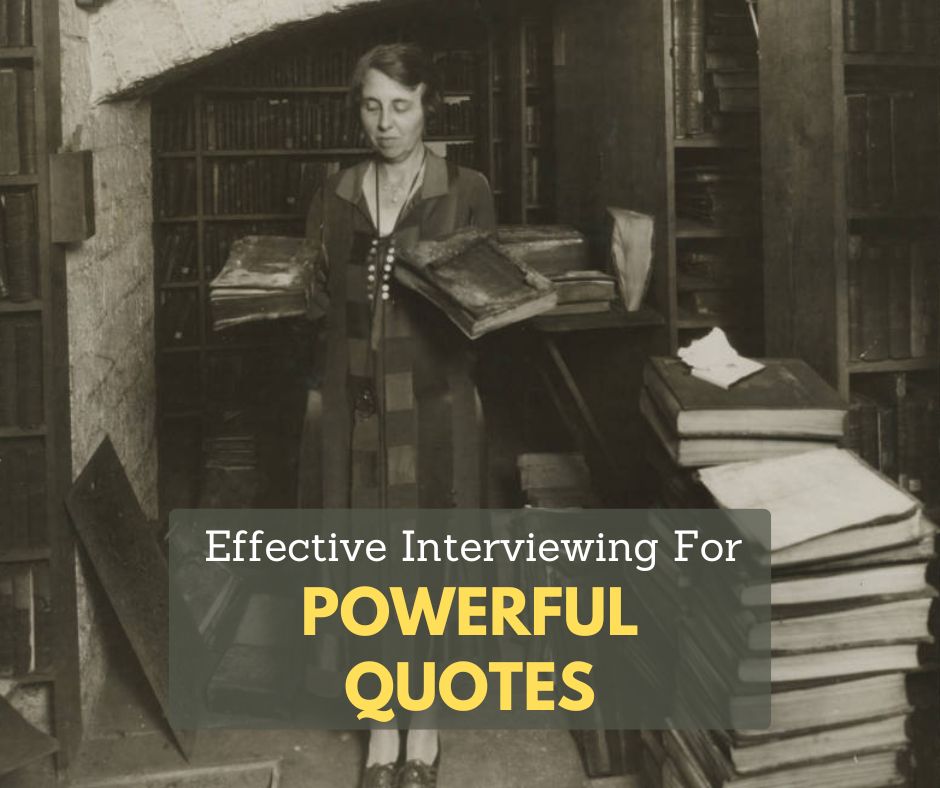
Interviewing a stranger about their library experience is intimidating for many people. If the thought of having an intentional conversation to elicit a sound bite you can use in a blog, video, social media post, press release, or other content sounds daunting, the post is for you.
Why a powerful quote is important.
Your audience wants to hear directly from the people impacted by your library’s work. Whether that is your staff, director, board members, or patrons, a good quote can drive home your work’s value.
A quote can convey passion or a strong point of view. It can turn a story about statistics or complicated concepts into something understandable and relatable. A quote can also establish an emotional connection with the reader or viewer.
And, if your goal is to catch the attention of local media, a good quote can make your press release, blog post, or email stand out. Because…
The media knows when your quote is fake.
I worked in a local television newsroom for nearly 20 years before I became a library marketer. And I’m here to tell you… journalists can tell when you’ve made up a quote for a press release.
I understand why it happens. Your director or coworkers may tell you they trust you to put words in their mouths. It seems less time-consuming than doing an interview.
But the media can tell when you’re making it up. That’s why an interview, however short, is key to getting an authentic quote. So here are tips to make the interview process smooth and successful.
Prepare as much as possible.
If you are interviewing a co-worker, a board member, or the director of your library, take a few moments to see if there is any documentation that gives you clues about their background. Search their LinkedIn profile and board minutes. Do a Google search to see if they’ve ever done an interview. You may learn new facts about them and their speaking style.
Think about how you might structure your piece before you even write it.
That structure may lead you to questions to ask.
For example, readers may notice that I often start library profiles on this blog with some facts about my subject’s life before they worked in marketing. I ask people to tell me about their childhood library and their work before libraries, to build the scene and give a deep background on my subject. Use this technique for any interview leading to a blog post, social media post, or video.
If you are interviewing to get a quote for a press release, I suggest writing the press release before doing the interview. Leave spaces where a quote or two would grab the media’s attention and add context and emotion to the story you’re trying to pitch. Now you’re ready to write your questions.
Craft targeted questions that elicit insightful responses.
Use simple sentences and language.
Add intention to your questions. If you want someone to share a firsthand experience or observation, craft your sentence to gently lead your interviewee to that answer.
Ask open-ended questions. If you must ask a yes or no question, follow up with “Why?” to give your subject the nudge to elaborate.
Still stuck? Use your tools. ChatGPT can help you craft questions for your interview.
To show how this works, I typed into ChatGPT: “I am interviewing my library director about a new partnership that will help community members land a job or advance their careers. Can you give me some sample questions I might use to get a good quote?”
Here is the list of questions ChatGPT gave me.
Can you please provide an overview of the new partnership aimed at helping community members with job placement and career advancement?
What motivated the library to pursue this partnership?
How do you envision this partnership benefiting members of our community?
Could you elaborate on the specific resources or services that will be made available through this partnership?
In what ways will the library be collaborating with the partner organization to deliver these resources and services effectively?
How will the library measure the success of this partnership in terms of its impact on community members?
Are there any demographics or groups within the community that stand to benefit most from this initiative?
How does this partnership align with the library’s broader mission and goals?
Can you share any success stories or examples of how similar partnerships have been effective in other communities?
What steps will the library take to ensure that community members are aware of and can easily access the resources and services offered through this partnership?
That is a huge list! It’s a great start. All I would need to do is go through and tweak the questions to match the tone I want to set and to sound more like something I would say.
Now comes the fun part: the interview!
6 tips for conducting the interview
#1: Record the conversation.
#2: Talk a little about yourself to get the conversation started.
#3: Ask an easy first question to calm everyone’s nerves.
#4: Encourage elaboration on interesting points.
#5: Let the person talk. Don’t be afraid of silence.
#6: Paraphrase or summarize key points to nudge the interviewee towards a quotable response.
Subscribe to this blog and you’ll receive an email whenever I post. To do that, enter your email address and click on the “Follow” button in the lower left-hand corner of the page. You can also follow me on the following social media platforms:
Managing social media for a library is hard enough without trolls commenting on your promotional posts. But it does happen! So…
How do you handle it when someone hijacks the comment section of your library’s social media posts? I have some advice for you in this Library Marketing Show episode.
Plus, kudos go to a library that’s been doing something fun and unusual for more than 20 years to promote their collection!
Do you have a suggestion for a topic for a future episode? Want to nominate someone for kudos? Let me know here. And thanks for watching!
Subscribe to this blog and you’ll receive an email whenever I post. To do that, enter your email address and click on the “Follow” button in the lower left-hand corner of the page. You can also follow me on the following social media platforms:
Photo courtesy Cincinnati and Hamilton County Public Library
Growing up in Columbia, Missouri, Lili Pangborn visited her local library nearly every day after school.
“The library staff quickly began to recognize me,” recalls Lili. “They would offer to help me with homework or chat about whatever books I was reading at the time. I feel like this willingness to help others is common among library staff; libraries truly are a special place for community collaboration!”
Lili still spends nearly every day at the library. She’s now the Communications Coordinator at the Newberry Library, a non-circulating research and cultural archive library in Chicago.
The library has a diverse collection of rare books, manuscripts, maps, and secondary literature that can help researchers interpret and understand original source materials. It also offers programs and exhibits.
Lili works with the Director of Communications and two graphic designers to promote the Newberry.
“Much of our marketing is focused on promoting our public events,” explains Lili. “We frequently collaborate with the Public Programs, Adult Education, and Exhibitions departments to develop marketing strategies specific to each team’s needs.”
“I believe that to successfully promote our institution, it is imperative to fully understand all aspects of how the library functions. For that reason, I try to maintain working relationships with colleagues across all departments at the Newberry, even those with whom we don’t work as closely.”
Lili’s library is quite different from that of most of my readers, as are her marketing goals.
“As an independent library that is free and open to the public, of course, our overarching goal is to get people in the doors, engaging with the collection, learning, reading, and discussing,” says Lili. “However, unlike school and public libraries, our focus isn’t necessarily on literacy or early childhood education.”
“We are non-circulatory, which means library users cannot take collection items out of the library. Because of that, we aim to promote how users near and far can engage with the Newberry and promote the message that our collection is for everyone, not just scholars or research fellows at the library.”
“There are so many ways our collection can benefit personal or professional work, so one goal is to make sure our audience is aware of our collection specialties and how they can be utilized.”
“For example, if you are from Chicago and want to learn more about your neighborhood or a certain Chicago event, we have tons of materials on Chicago history, culture, and political movements. If you are curious about the Indigenous communities local to your area, we have a wide breadth of materials from various regions across the American continents. Or, say you are interested in building your family tree, the Newberry has a slew of materials relevant to genealogic research, not just Chicago specific!”
“Many of our audience members are interested in learning from the items in our collection but are not interested in conducting formal research. So, we also want to make sure people know about the wide breadth of opportunities available to engage with the collection in a less formal setting, through our public programs, adult education classes, and exhibitions.”
I came to know of the Newberry Library through one of my readers, who mentioned that they admired the Newberry’s Instagram account. Indeed, it’s a history and book lovers’ dream, with lots of photos and videos featuring historic books, albums, documents, and more.
Lili shares social media posting duties with the Director of Communications, Bob Dolgan.
“We prioritize Instagram, Facebook, and Twitter, though we also have content on YouTube, Vimeo, and Threads,” says Lili. “Because each platform functions differently, I try to tailor the media we share accordingly.
“For example, because Instagram is visually oriented, I’ve found that our audience responds positively when we exhibit unique and interesting items from our collection in a visually appealing way.”
“Facebook is a text- and link-oriented site, we focus more on sharing relevant articles, blog posts, and events. Due to the character limit, Twitter falls somewhere in the middle, and YouTube is primarily used as a hosting site for free recordings of our public programs and video tours of our exhibitions.”
The Newberry also has an amazing blog, Source Material, which features in-depth articles about interesting sections of the Newberry’s collection.
Lili says Source Material is a collaboration between departments. She’s never at a loss for blog ideas and sometimes gets to author the articles. For example, Lili wrote this piece about the five most-requested collection items of 2023, which was a huge hit with readers.
“We try to schedule blog posts according to relevant dates or events at the Newberry, which allows us to cross-market each item,” explains Lili. “This is usually in the form of email campaigns and social media posts.”
“Our audience loves to learn more about the behind-the-scenes work at the Newberry and are curious about new ways they can engage with our collection. Our blog posts help inspire this!”
The Newberry also has very clear and recognizable branding. The font, the clean outline of their website, and the images they choose all convey that old-world, historical collections connection but in a modern way.
“I think that sometimes, even if people understand the value of studying the humanities, they struggle to connect that value to their everyday lives,” says Lili.
“As a humanities research institution, a goal of ours has always been to show how the study of art, music, literature, cartography, and history can inform our understanding of the contemporary world.”
“Our website and social media are often people’s first impression of the Newberry, so we want our online presence to reflect that.”
Lili says the communications team at the Newberry is focused in 2024 on positioning the Newberry collection and staff as resources to the community.
“However, I personally admire the Milwaukee Public Library’s media presence,” says Lili. “They do such a wonderful job of tying traditional library goals to lighthearted contemporary media trends. This strategy seems crucial, given the current movement focused on defunding public libraries and limiting access to certain books/subjects. I also love the way they continuously engage with their community members, especially the younger generation of library users.”
Subscribe to this blog and you’ll receive an email whenever I post. To do that, enter your email address and click on the “Follow” button in the lower left-hand corner of the page. You can also follow me on the following social media platforms:


 Super Library Marketing: Practical Tips and Ideas for Library Promotion
Hijacked! 2 Tips for Responding When Trolls Comment On Your Library Social Media Accounts
Watch this video now
#LibraryMarketing Show, episode 234
Managing social media for a library is hard enough without trolls commenting on your promotional posts. But it does happen! So…
How do you handle it when someone hijacks the comment section of your library’s social media posts? I have some advice for you in this Library Marketing Show episode.
Plus, kudos go to a library that’s been doing something fun and unusual for more than 20 years to promote their collection!
Do you have a suggestion for a topic for a future episode? Want to nominate someone for kudos? Let me know here. And thanks for watching!
Miss the last episode? No worries!
Will I see you soon?
Subscribe to this blog and you’ll receive an email whenever I post. To do that, enter your email address and click on the “Follow” button in the lower left-hand corner of the page. You can also follow me on the following social media platforms:
Share this: