Subscribe to this blog and you’ll receive an email whenever I post. To do that, enter youremail address and click on the “Follow” button in the lower left-hand corner of the page. You can also follow me on the following social media platforms:
Photo courtesy Cincinnati and Hamilton County Public Library
A few months ago while at a conference, Meghan McCorkell, got the email of a lifetime. The chief of Marketing, Communications, and Strategy for the Enoch Pratt Free Library, she called back to Baltimore and put her team on speaker phone.
Meghan was delivering great news: her team won the coveted Library Marketer of the Year award from Library Journal.
“We all jumped around excited (them in the office and me in a hotel lobby),” recalled Meghan. “More than anything I am so proud that we won as a team. We had to keep it a secret for about two months. So that was challenging.”
Meghan’s road to award-winning library marketer began in the 7th grade when she volunteered to shelve books for her hometown library, the Brielle Public Library on the Jersey Shore. Little did she know that years later, after a successful career as an Emmy-award-winning television journalist, she would assemble a team and lead the marketing for the vibrant Enoch Pratt Free Library.
“I love being surrounded by creative people, who all think differently than me,” explained Meghan. “I’m constantly blown away by the ideas that bubble up from our team. Six years ago, the Pratt didn’t have a marketing department. With support from the CEO, we built it.”
“The Print & Design studio was originally part of the Programming department, with four talented designers, Katherine Marmion, Eric Archibald, Jamillah Abdul-Saboor, and Jack Young. The studio was reorganized into a new marketing department.”
“We hired Andrew Klein to oversee the robust work that department does, as well as to lead the revamp of our Compass magazine. Our social media manager, Vianey Becerra, was made full-time, and translation duties were added because Vianey is bilingual.”
“A few years in, as we built out our email marketing strategy we brought on Ashley Barnes, a digital marketing strategist. And finally, I advocated for a photographer/videographer position. John Cassini was a former news photographer, so given our skill sets together the Pratt now has its own full-service production studio.”
Like many libraries, Enoch Pratt really had a challenging time communicating with patrons during the Covid lockdown because of the digital divide. Nearly 40 percent of Baltimore residents had no access to a computer or Wi-Fi at the time lockdown began.
“When we knew we’d have to close library doors, we started working nonstop to figure out how we’d serve the customers who rely on us,” remembered Meghan. “We started trying new things to see what worked.”
“We used census data to send targeted postcards with QR codes and unique URLs in communities where internet in households was unreliable. We let them know about device lending and our free outdoor Wi-Fi. We geofenced those communities and pushed targeted ads that looked like those postcards.”
“We sent targeted emails based on location and library usage trends to customers. We were specific in how we reached people, who we were trying to reach, and measuring what was successful.”
“That all may sound pretty complicated and expensive, but targeting that way actually really cuts down on the cost. If you can mine the data and figure out who needs to hear your message, you can send 5,000 postcards instead of 50,000.”
Once the doors of Enoch Pratt reopened, the team faced a huge challenge: rebuilding cardholder usage.
“It was a daunting task,” admitted Meghan. “We define active cardholders as customers that used the library in the past year. During COVID we lost more than half of those cardholders. But we learned a lot of lessons along the way too, and we doubled down on what worked.”
“Pre-pandemic we sent around 5-6 emails a month. That expanded massively as we launched more regular campaigns and saw success.”
“Today, we send anywhere between 35-40 targeted emails a month to different audiences, have an unsubscribe rate of less than 1 percent, and regular open rates close to the 50 percent mark.”
“Our print publication, the Compassused to be a 16-page list of programs. Over the past 4 years, we’ve expanded to a 24-page magazine that tells the library’s story. Staff across the library also stepped up with dynamic programs and services responding to community needs. Last week, we hit 3,000 more active cardholders than our pre-pandemic high. So, we’ve climbed the mountain.”
Reflecting on the work, and her team, Meghan clearly gives credit for their LJ win to her team, whom she says make it a joy to come to work. They even came up with a creative approach to their award photo shoot.
“Library Journal let us take our own picture for the feature, and of course, we couldn’t give them something normal,” exclaimed Meghan. “The Brady Bunch style photo perfectly captures the spirit of everyone on the team. We shared a behind-the-scenes video on the Pratt’s Instagram page of our photo shoot.”
Though Meghan has a wealth of riches in her large and talented team, she still faces struggles in terms of budget. Many of the tactics her team uses to reach cardholders can be replicated by smaller libraries.
“My advice would be to look at low to no-cost tactics,” explained Meghan. “I think targeted emails can really change the game.”
“Start a sign-up list at your library for people interested in kids’ events. Create a really specific monthly email for that audience and keep an eye on how it performs and if it’s achieving your goals of getting more people through the doors. That’s how we started our email strategy. Then we were able to leverage the success of those lists to convince our Board that we could be more successful with fancy software.”
“I also think you should try things, and if they don’t work, let them go. Just because things have always been done a certain way doesn’t mean you should keep doing it. Try new things. Fail. Try more things.”
Meghan’s team is now focusing on cardholder retention and data collection.
“I don’t like throwing spaghetti at a wall and seeing if it sticks,” said Meghan. “I want to run measurable marketing campaigns the whole way through.”
“We’ve got some fun upcoming projects like our Macy’s-style winter windows that have become a Baltimore tradition thanks to our amazing graphic design team. We’ve got some challenges too including messaging out a Master Facilities plan and a series of upcoming renovation projects. Our designer Eric is probably already stressing the design of next year’s Summer Break Baltimore shirt! His design this year has been directly cited by customers for a 36 percent increase in program participation. (no pressure, Eric!)”
When she needs inspiration, Meghan looks at the work of other library marketers.
“I’ve made amazing friends in library marketing. I send them emails and say ‘What do you think about this’ all the time. The environment is so collaborative.”
“For inspiration, I’m often looking at other industries and seeing how we could adapt ideas from there. Right now, I’m in love with our Library Card Sign-up Month video campaign. That was born out of a brainstorming session with our whole team. Our graphic designer Katherine said, ‘What about those annoying lawyer commercials?’ That idea led to a 3-video campaign that is becoming wildly popular on social media. We even have it running on a TV station and in a movie theater now.” (Here are the videos: Lawyer Commercial, Car Commercial, Pharma Commercial.)
Meghan wants my readers to know that, although she’s had a lot of success in her current role, there was a time not too long ago when she was uncertain. For support, she turned to you… the community of library marketing professionals!
“Six years ago, I felt like I was just figuring out what the heck I was doing in a new career,” remembered Meghan. “One of the things that helped was finding the community of people in this field.”
“Library marketers are really collaborative and we’re all facing the same challenges. I love hearing from colleagues who want more info on going fine-free, or major renovations. I reach out to friends in the field to talk about ideas. From this blog to social media groups, and conferences, there is a sea of people out there all rooting for each other to succeed. Go find them!”
Subscribe to this blog and you’ll receive an email whenever I post. To do that, enter your email address and click on the “Follow” button in the lower left-hand corner of the page. You can also follow me on the following social media platforms:
Photo courtesy Cincinnati and Hamilton County Public Library
This week I want you, my dear reader, to make me a promise.
Please, for the love of all that is wonderful and majestic about libraries, add one critical step to your library marketing and promotions.
I want you to start setting goals.
Now, I know this may make you sigh/scream/cry/get angry at me. I know you are incredibly busy. I know you are trying your best every day to create effective library promotions. And I want you to have ALL the success possible.
Which is why I am asking this tiny but incredibly important thing of you.
Goals are an absolute necessity for library marketing success. Full stop.
And they will make your work EASIER for you. I promise.
Why you should set goals for your library promotions
Goals will help you:
Focus your efforts, allowing you to measure your progress and determine whether your promotions are successful.
Establish priorities so you can show your supervisors, your co-workers, your community, your donors, and yourself where your energy is best spent.
Stay motivated. Goals will help you identify your successful promotions so you can repeat them and create more success!
Reach your library’s overall strategic goals more quickly.
Where to start with goal setting for library promotions
Your marketing goals should align with and support your library’s overall strategic goals.
For example, let’s say your library’s strategic plan includes an objective to improve the kindergarten readiness of children in your service area. A goal you could set for your library marketing is:
To increase the circulation of our library’s picture book collection.
But that goal isn’t quite good enough. To turn this from an okay goal to an effective, meaningful marketing goal, you have to add two things:
A number to reach for
A time frame for reaching your goal.
Here’s your new, more meaningful goal:
To increase circulation of our library’s picture book collection by at least 10 percent before June 30, 2024.
Here’s another example from a real library. The Buda Public Library’s strategic plan includes this objective: “Create and circulate Maker Kits, for wider accessibility of the library’s technological resources.”
Their library will likely do all sorts of things to promote the Maker Kits: emails, social media posts, bookmarks, and more.
A meaningful goal they can (and should!) set is:
To get 100 checkouts of our library’s Maker Kits in a 12-month period.
See how easy that is?
The most important thing to remember about goal setting for library marketing is to define what you want to do specifically.
Do you want to increase circulation? By how much? And in what time frame?
Are you looking to boost the use of a certain part of your collection, like your digital materials? By how much? And by when?
Are you trying to get more people to participate in your event? What percentage increase in attendance do you wish to achieve in what amount of time?
You can set both long-term and short-term goals for library marketing success. A long-term goal might be to get 500 downloads of your library’s new app by December 31st. A short-term goal might be to increase Kanopy streams by 25 percent before the end of the month.
One important question to ask yourself
A key element of library marketing goal setting is to make sure your goal is realistic. If your goal is too far-fetched, you and your coworkers may end up feeling demoralized when you fail to achieve it.
For example, if you try to double traffic to your library website in a month, you are likely setting yourself up for failure. Instead, ask yourself this question when you are setting goals: Is this goal ambitious AND achievable?
The final step
Once you’ve set a goal, write it down. Why? Studies show the most successful people write their goals down on paper!
Subscribe to this blog and you’ll receive an email whenever I post. To do that, enter your email address and click on the “Follow” button in the lower left-hand corner of the page. You can also follow me on the following social media platforms:
Subscribe to this blog and you’ll receive an email whenever I post. To do that, enter youremail address and click on the “Follow” button in the lower left-hand corner of the page. You can also follow me on the following social media platforms:
Photo courtesy Cincinnati and Hamilton County Public Library
Terrance is a senior in high school, with a bright future ahead of him.
He’s gregarious, curious, and extroverted. He lives with his dad and two younger siblings. His dad is managing to make ends meet, but there isn’t a lot of money left over for things like vacations or extra-curricular activities.
Terrance doesn’t have a car, but he’s been using public transportation all his life. He really wants to go to college. He’d be the first in this family to go. But the application, the financial aid paperwork, interviewing, and essay writing required for admission feels overwhelming to him.
Terrance isn’t a real kid… not exactly. He was a target persona I built when I worked at a library.
Terrance was based on real teens who used our library. And when I read that description, I could clearly see Terrance in my mind. (I still can–can you?) More importantly, I could find the words I needed to say in library promotions that would reach Terrance.
Terrance helped me figure out how to create effective library promotions.
What is a target persona and why do we need them?
A target persona is a fictional profile of a person who represents one of your key target audience groups, based on the characteristics of your community members.
Target personas help us get granular about our target audience. Getting granular helps us create promotions that let our community members know that we see and hear them.
Simply put, we can use target personas to create marketing that convinces those community members to use the library.
A target persona is not supposed to detail one specific person. It should never be based on one specific individual. It’s a composite sketch, like Terrance, that should reflect most people it is supposed to represent.
How to build target personas for your library
Your community members can be broken down into core segments, or groups, based on their wants, motivations, and the problems they need your library’s help to solve. Those are your target personas.
The number of target personas your library will need will depend entirely on your library’s strategic goals and your marketing goals. Some libraries only need 2 or 3 target personas. Some will need more.
The first thing your library will do is gather demographic information about the community or target group for which you are building a persona. You may do this by researching census data or other data available from your city or town government. Settle on a general answer to these questions:
Age range
Income
Education level
Living situation (Married, single, living with multiple generations in one house, living in an apartment, unhoused, etc.)
Transportation situation (Do they have their own car or do they use public transit?)
Current library usage
Then you want to add depth to your persona. Write down answers to these questions:
Their motivations. Are they career or money-motivated? Are they family-focused?
Their attitudes. Can you identify their perspective on social issues like environmental welfare, human rights, or intellectual freedom?
Their pain points: What problems are they looking to solve?
Their aspirations for the future.
The activities they participate in, both inside and outside of the library.
Their religious and political affiliation.
Using ChatGPT to create target personas
Once you have gathered as much information as you can on your target audience by answering the questions above, it’s time to create your target persona. ChatGPT can help you get started.
Let’s say you want to build a target persona for someone who might use your library’s small business center.
Put all the information you have on your target persona together in a description and feed it into ChatGPT like this:
“Pretend you are a marketer. Build me a target audience persona for a person who is in their mid-50s, who was laid off from the job they held for more than 20 years. This person has always wanted to start their own business, and they figure now is the time. But they do not have a business or marketing degree, and they have very little money. They are single and are living off savings now. They do have a bachelor’s degree in English. They have their own car. They use the library to check out books about once a month. They could use library resources to help them start their small business.”
ChatGPT generated a target persona for “John Anderson, a resilient midlife entrepreneur on a mission!” ChatGPT assigned characteristics that I hadn’t considered, like tech savviness and media consumption.
Here’s the rest of the ChatGPT-generated target persona for John Anderson.
Goals and Motivations
Fulfilling a lifelong dream of starting his own business.
Achieving financial stability and independence.
Creating a legacy and finding personal fulfillment through his work.
Challenges
Limited budget and financial resources.
Lack of formal education in business and marketing.
Navigating the challenges of entrepreneurship later in life.
Hobbies and Interests
Enjoys reading, especially classic literature and business-related books.
Values community engagement and local events.
Appreciates the arts and cultural activities.
Media Consumption
Relies on traditional media like newspapers and local community bulletins.
Limited online presence and social media usage.
Listens to podcasts or watches videos for learning and entertainment.
Tech Savviness
Basic computer skills but may need assistance with advanced online tools.
Open to learning and adapting to technology for business purposes.
Values
Values hard work, perseverance, and integrity.
Desires to make a positive impact on the local community.
Values practical and actionable advice.
How the Library Can Help
Access to beginner-friendly business books and resources to guide him through the basics of entrepreneurship.
Workshops and one-on-one assistance on creating a business plan, marketing on a budget, and utilizing digital tools.
Free or low-cost online courses for building essential business skills.
Networking events to connect with local entrepreneurs and mentors.
ChatGPT also said, “Understanding John’s unique situation and tailoring library resources to cater to his specific needs will be crucial. Marketing messages should focus on the practicality, accessibility, and community support the library provides for someone like John as he takes the leap into entrepreneurship.”
If I worked at a library, I qould take this ChatGPT generated persona and add or subtract the things that apply to my community.
Are personas too generalized?
There is nothing that replaces a personal conversation with a community member. But it is physically impossible to talk to everyone who lives in your service area.
Personas allow us to find the commonalities of the different segments of our audience. This exercise will lead you to create promotional items that connect with your target audience.
Your target personas will likely change over time. They may be different for different programs or goals that your library is trying to reach. That’s okay! Your target personas should be like your library: adaptable, flexible, and able to change to meet the needs of your community.
But by having defined target personas, you are better equipped with the insights needed to build an experience that consistently and efficiently speaks to your patrons as individuals – with content that’s super relevant to them.
Subscribe to this blog and you’ll receive an email whenever I post. To do that, enter your email address and click on the “Follow” button in the lower left-hand corner of the page. You can also follow me on the following social media platforms:
I know, we haven’t even gotten to Halloween yet. But guess what??
TikTok has released its holiday shopping guide for marketers! And although this guide was created for shops and profit brands, there were a lot of really great tips in here that you can use at your library. Let’s dig into the guide in this episode.
Plus someone will receive kudos!
Do you have a suggestion for a topic for a future episode? Want to nominate someone for kudos? Let me know here. Thanks for watching!
(P.S. Here is the guide mentioned in this episode, no email required!)
Subscribe to this blog and you’ll receive an email whenever I post. To do that, enter youremail address and click on the “Follow” button in the lower left-hand corner of the page. You can also follow me on the following social media platforms:
Photo courtesy Cincinnati and Hamilton County Public Library
Last week, we went over the Marketing Rule of 7 and how consistent messaging delivered many times over multiple channels will lead to promotional success.
But that does NOT mean you must create 500 versions of every promotion you do. PHEW!
So, let’s talk about the easiest way to make the Marketing Rule of 7 happen within the constraints of working in a library. We do that by repurposing our content.
Repurposing content
Repurposing content is the practice of reusing elements of existing content to expand that content’s reach.
Repurposing content makes it easy to fulfill the Marketing Rule of 7 because you don’t need to write every post, shoot every video, and design every infographic from scratch.
Instead, you can use a piece of new content as the basis for lots of other content.
Why repurpose your content?
Your community is diverse. Their preferred methods of receiving information are diverse.
Some of them are visiting your website every day for updates. Some are seeing your social media posts. Some are waiting for your next email to hit their inbox. And some are fans of your Reels, TikTok, or YouTube videos.
Re-purposing content helps you reach more people on the channels they prefer efficiently, so you can go do all the other things you need to do in a day!
I repurpose this blog every week. (Did you notice?!) Here’s how I do it.
I pull out a few lines, usually from the first one-third of the post. I may use the lines exactly as they are in the post. Or I might rearrange them, adding more humor or emojis… things I wouldn’t necessarily do in my blog post.
Then I take those lines and I post them across my social media channels and in my emails.
I also take parts of a post and use them in other posts, especially if these are key points I really want you to remember. For example, I strongly believe books are your library’s brand. And I say so… often!
Sometimes, I take parts of my blogs and use them in presentations. I also turn them into an infographic or a 60-second video.
How will this work at your library?
Let’s say you’ve created an infographic to communicate the value of your library in the past year. We know infographics are a great way to present those statistics and give a whole picture of your library’s contribution.
But infographics take time to build. And some people will still need those stats broken down for them, piece by piece, in order to comprehend their meaning.
So you can take each of the points on that infographic and create separate social media posts. This really helps your audience digest the information.
Those separate pieces of breakout information can also serve as a springboard for your library to write blog posts or longer social media posts specifically diving into those key stats and what they mean for your community.
Choose three of the facts on the infographic. Pick a staff member who loves being on camera and ask them to create a 60-second Reel or TikTok video using trending audio and creative elements to explain this serious subject: the value proposition of your library.
Need more help figuring out how to make this work at your library? I created a 4-step guide for you!
Easy 4-step guide to repurposing content
Let’s say your library is publishing a promotional blog post about Book Club Kits. It might look like this.
Get Convenient, Easy Help Leading Your Next Book Club
Are you someone who enjoys discussing books, sharing insights, and hearing different perspectives on a story? Or maybe you’ve been thinking about starting a book club but don’t know where to begin. Well, look no further! Our Book Club Kits are designed to bring people together through the power of literature, and here’s why you should definitely consider checking one out:
Diverse Selection: Our Book Club Kits include a wide range of titles covering various genres, themes, and authors. Whether you prefer classics, contemporary fiction, non-fiction, or even a mix of everything, we have something for everyone. From thought-provoking novels to inspiring memoirs, our collection is carefully curated to spark engaging discussions.
Convenience: Starting and maintaining a book club can be challenging, especially when it comes to sourcing multiple copies of the same book. With our Book Club Kits, we’ve taken care of that for you! Each kit includes multiple copies of the featured book, making it easy for your group to access and read the same title simultaneously.
Discussion Guides: To facilitate meaningful conversations, our kits come with discussion guides. These guides provide questions, prompts, and talking points to help guide your book club discussions, ensuring that everyone gets a chance to share their thoughts and insights.
Cost-Effective: Participating in a book club can sometimes become costly when you have to purchase multiple copies of a book. With our Book Club Kits, you can enjoy reading and discussing a wide variety of books without breaking the bank. It’s a budget-friendly way to explore new literary horizons.
Community Building: Book clubs provide an excellent opportunity to meet new people, make friends, and engage in lively conversations. By checking out one of our Book Club Kits, you can be a part of a vibrant community of readers right here in your own neighborhood.
Flexibility: Whether you prefer in-person meetings or virtual gatherings, our Book Club Kits are designed to accommodate your preferred format. You can use them to start a club with friends, family, or even coworkers, making it easy to connect with others over a shared love of reading.
You can use that post as a base for repurposing.
Step one:Write a two-line version of your blog post.
This is going to be the mini-version of your post… the elevator pitch, so to speak.
For this example, I would say:
Book Club Kits from the library make it easy, convenient, and cost-effective to start a book club. The library provides free book copies and discussion guides that allow everyone to participate and build community.
Step two:Promote in your emails.
Add your two-line version of the blog post to your newsletter and any other email you send over the course of the next month, with a link to the full post.
Step three:Share on your social channels.
Post your two-line version of the blog and include a link to the full post in the comments of your social media post. (Here’s why you want to put it in the comments instead of the post.)
Keep the momentum going on different social media channels by creating more two-line versions of your blog. For example, during week one, post this to Instagram and Facebook:
Book Club Kits from the library make it easy, convenient, and cost-effective to start a book club. The library provides free book copies and discussion guides that allow everyone to participate and build community.
In week two, post a new two-line version on Instagram, Facebook, and LinkedIn:
Book Club Kits from the library bring people together through the power of literature. The curated kits are convenient and flexible to help any book club leader.
On week three, you put another two lines on Facebook, LinkedIn, and X:
Meet new people, make friends, and engage in lively conversations about books without breaking the bank. Check out the free library’s Book Club Kits.
And so on. Mix it up to make it sound like new content while driving home the key points you wish to make.
Step four: Use the promotional message on print promotions.
Create a bookmark, flier, and sign, with your favorite two-line pitch from your blog post. Include a QR code linking to the blog post.
Place the bookmarks and fliers in every hold or checkout. Place your sign on a display of books that have been assembled into book club kits.
Re-purposing all content
You can do this with any piece of content, from podcasts to press releases. Break the content down into pieces and spread them across all your available platforms.
In this way, you can make sure everyone in your community sees your message. You also can make sure the work you are doing right now will have maximum impact.
The added benefit to re-purposing: more data.
It won’t take long for you to learn where your audience is getting news about the library. If you notice that engagement is high on one marketing channel, you will know which channel to start with when you are promoting your library.
Subscribe to this blog and you’ll receive an email whenever I post. To do that, enter your email address and click on the “Follow” button in the lower left-hand corner of the page. You can also follow me on the following social media platforms:
Photo courtesy Cincinnati and Hamilton County Public Library
A few weeks ago, I walked through my neighborhood listening to the Library Marketing for Library Marketers podcast. Katie Rothley was interviewing a woman named Sarah Tolle, who manages content for a large Canadian agency. And Sarah said something that literally stopped me in my tracks.
“People take comfort in hearing the same story repeatedly. They like knowing that they know the story and that they understand you. And they anticipate the ending. “
-Sarah Tolle, content director for Black and White Zebra.
I was standing there on the sidewalk, staring at a squirrel gathering nuts from the front yard of an indiscriminate house, and I thought, HOLY SMOKES, this woman is dropping some truth bombs.
Sarah was talking about the value of a consistent message. The timing of this episode could not have been more perfect. In my day job, I’ve been spending a lot of time thinking about how library marketers can get the most bang for their buck.
Many of the libraries I work with are struggling to figure out how to do three big things:
Drive more visitors to their buildings
Get higher attendance at their programs
Get their cardholders to use their cards more often.
They’re working alone or with a small team, with very little money, and very little time. It’s an impossible formula.
Except, as Audrey Hepburn once said, “Nothing is impossible. Even the word itself says, ‘I’m possible.'”
And the secret to success may be found in the form of a marketing axiom that’s nearly 100 years old.
The Marketing Rule of 7
The Marketing Rule of 7 was developed by the movie industry in the 1930s. Studio bosses discovered that a certain amount of advertising and promotion was required to compel someone to see a movie.
It takes time and consistent marketing to make people aware of your library. One message, delivered on one platform, one time, is not going to be enough. We must work to make sure people are familiar with our library.
Now, I know what you are thinking. The Marketing Rule of 7 makes sense. But it’s also in complete contradiction to another marketing fact that is entirely a product of the digital age.
The Reality of Content Shock
Marketing expert Mark Shaffer, author of more than 12 books on marketing, defines Content Shock as “the phenomenon when exponentially increasing amounts of content intersect with our limited human capacity to consume it.”
In other words, there’s too much stuff to read and not enough time to read it. (Are we talking about my inbox or my TBR? Or both?)
So how do we square both marketing truths? And how do we figure out a way forward so we can reach the goals of our library marketing?
First, the number 7 in the Marketing Rule of 7 is an arbitrary number. It could take somebody more than seven times the exposure before they become a loyal library user. Or maybe it will only take five times. Or two times.
Don’t focus so much on the number. Focus on the consistent message.
Because when your audience is overloaded with content, sharing one, consistent message, repeatedly, will break through.
Political candidates know this is true. When they’re trying to get elected or whip up support for a bill, they come up with a main message. They repeat it everywhere: on fliers, social media, in interviews with the press, in speeches, etc. They do this because they know they must repeat the message to make sure their constituents hear and understand it.
How to Create a Consistent Message
Let’s say you work for a high school library and your goal is to get more kids to check out books to read for pleasure (because, let’s be honest, most kids do not find reading Catcher in the Rye all that pleasurable).
First, write a few lines that succinctly encapsulate the message you want to get across.
Read something for once just for fun! The library is filled with books that won’t give you class credit but will take you on an adventure you’ll never forget.
Now, use those two lines across your promotions: on bookmarks, posters, displays, and in morning announcements. Repeat it to kids who wander into the library looking for something to read. Do it all year long. By the end of the year (and probably sooner), the message will have sunk into the kids. That’s consistent messaging.
Next week: I’ll give you a four-step plan for repurposing any piece of content you create across multiple channels without losing your consistent, core message. (Yes, it can be done!)
Subscribe to this blog and you’ll receive an email whenever I post. To do that, enter your email address and click on the “Follow” button in the lower left-hand corner of the page. You can also follow me on the following social media platforms:
Photo courtesy Cincinnati and Hamilton County Public Library
Jenie Lahmann’s parents were DIYers before it was in style.
Growing up in Richmond, Indiana—”a fun midwestern town with rich history and endless green spaces to explore”, her family made weekly visits to Morrisson-Reeves Library (MRL) to indulge their need to craft and create.
“Dad would go to the Do-It-Yourself section and Mom would get cookbooks and the latest Erma Bombeck writings,” recalls Jenie. “My brother Pat and I were off to explore the shelves in the Children’s Department. We always left the library with an armful of books.”
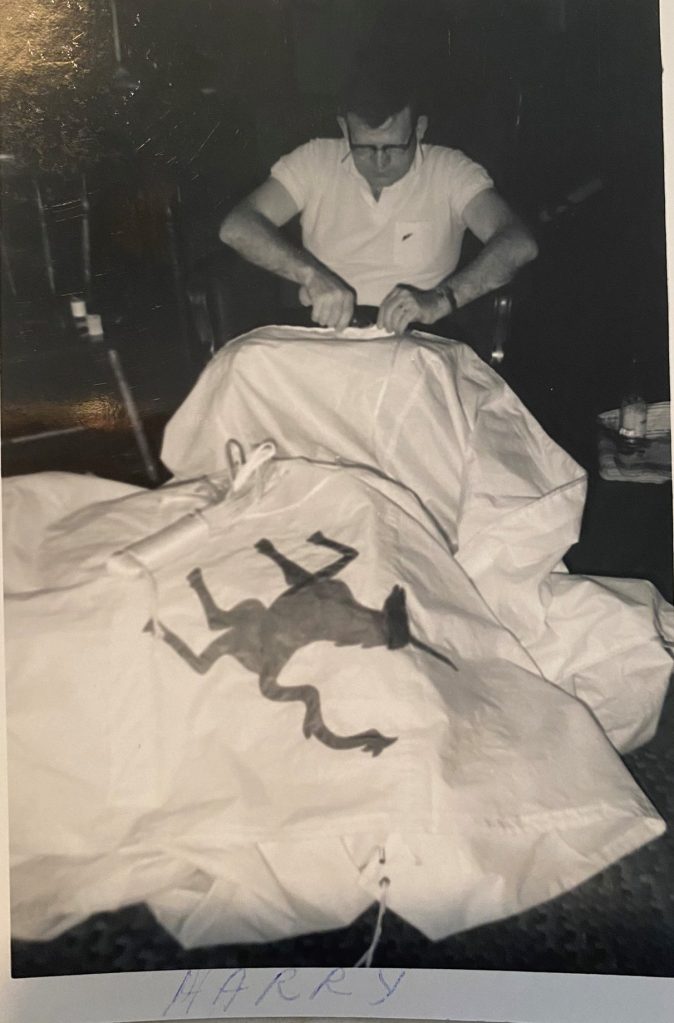
“My father was a self-taught craftsman and could build anything. He drew plans for making a sailboat from library books and reference librarian’s tips. From concept to completion, he used the library every step of the way. He even sewed the sails with help from Mom’s sewing talents. It’s incredible what you can learn from the library!”
The infamous sailboat
Jenie’s dad making sails
Jenie started working at the library in high school, following in her big brother’s footsteps. She spent a year as a shelver. Then a manager started to mentor her on print promotion. “We created bookmarks, booklets, and other helpful printed tools for patrons before the age of library digitization,” explains Jenie.
“The first day, I was so nervous I fainted in her office, and we formed a strong friendship after that. She trained me in using all the printing machines and developed a trained eye for layout and design.”
Jenie now works as Marketing and Communications Manager for the library. This year, she co-led a team of five people during a major project: a survey of their community.
MRL was looking for data to help the library create a five-year strategic plan. They included lots of questions that are standard for libraries. But Jenie says they really wanted to get to the root of what motives their community members.
“We dug deeper and asked what services they enjoyed, and how their experience was when they walked through the door,” elaborates Jenie. “We want to see how we can improve our services to best meet our changing community’s needs and to help enrich their lives.”
“We asked them to prioritize a list of eight services we are thinking of adding or expanding upon. We asked them to rate what type of programs they wanted to see, what made them happy to use the library, and what didn’t work for them.”
MRL partnered with a local business consulting company to help them formulate the survey. Library staff met over the course of 6 weeks and looked at previous library surveys to determine which questions to ask. They added specific questions based on how often the community members used the library.
“It was difficult to formulate the questions while keeping in mind the end goal of having data we could use to formulate the BIG Strategic Plan,” confesses Jenie.
Jenie was kind enough to share the final survey with us.
The library released the survey into the world for a three-week stretch, accompanied by a carefully orchestrated plan to ensure they got the survey in front of as many community members as possible.
“First, we created a landing page on the library’s website,” explains Jenie. “It was the hub for all the content and links. Consistent graphics and wording were used.”
“We talked on radio programs, developed videos, e-newsletters, postcards with QR codes, and social media campaigns. We had staffers reach out to their contacts to ask them to fill out the survey personally.”
“The survey was also offered in Spanish. We canvased apartments, churches, and social groups too.”
MRL had a goal of 500 responses. But get this: they more than doubled their response rate goal, gathering 1,104 survey responses! About 11 percent of responses came from paper copies. The rest were filed online through a Survey Monkey page.
However, the survey wasn’t the only tactic MRL used to make decisions for their strategic plan. Along with their business consulting firm partner, MRL conducted focus groups. They gathered teens, parents of teens, preschooler parents, senior citizens, community influencers, community partners, and potential community partners.
These small groups gave robust input that was combined with the survey data to give the library an overarching sense of what their community wants and needs from the library.
“It was enlightening news that our regular library users love us,” exclaims Jenie. “We heard from many people who said they don’t know about library services beyond books and storytimes.”
“We heard that many people get their library info from e-mailed newsletters. Many people suggested that we needed to improve our message through marketing. Tough news to hear for me, but we see it as an opportunity to grow and reach people in new ways.”
“The main interests in the library were gathering spaces, a small business resource center, performing arts, and DIY maker spaces. People may not have access to these free services elsewhere and seek the library for these things.”
“A big surprise was about weeding. Many patrons don’t know how or why we weed books from the library. We use library standards for weeding, but we’ll need to do a better job of explaining that to our patrons.”
Jenie says if she could do anything differently, it would be to make the survey shorter. MRL’s questions took 15 minutes to complete.
Her advice for any library looking to conduct a community-wide survey such as this is to define your end goal. “Spend time formulating your questions for the outcome data you are seeking,” advises Jenie.
“Having a few narrative data entry questions and the rest with a rating scale can prove to make the data processing task easily graphed or charted to show trends and outcomes. Test the digital survey on mobile, desktop, and other digital devices.”
Jenie and the folks at MRL are now discussing a campaign idea they got from the survey, as well as an origin story campaign, asking library users to explain why they use the library, with a superhero theme.
Subscribe to this blog and you’ll receive an email whenever I post. To do that, enter your email address and click on the “Follow” button in the lower left-hand corner of the page. You can also follow me on the following social media platforms:




 Super Library Marketing: Practical Tips and Ideas for Library Promotion