Search

Super Library Marketing: Practical Tips and Ideas for Library Promotion

Category

library marketing advice

Library Conferences Need More Marketing Sessions! 5 PLA Attendees Explain Why a Focus on Promotions is Critical Right Now [ARTICLE]

Photo courtesy the Cincinnati and Hamilton County Public Library

Iโ€™ve spent days trying to land on the right words to describe the amazing week Iโ€™ve just had.

I attended my first Public Library Association conference this past week in Portland, Oregon. It was glorious, wonderful, exhilarating, inspiring, transformative… and about 100 other adjectives.

Honestly, I felt like a kid attending her first week at a new school.

The sessions at PLA were mainly focused on equity, diversity, and inclusion practices. We also heard from experts about fighting censorship and first amendment challenges.

These are incredibly important and urgent problems facing the library industry. But there was a huge piece of the puzzle missing from the session offerings at PLA, and other library conferences Iโ€™m planning to attend this year.

Marketing and promotion are a critical part of all the work we do to be inclusive and to protect intellectual freedom. We need more library conference sessions that provide tips and inspiration for library promotion.

Megan Bratton, Marketing and PR manager for Natrona County Library, agrees. โ€œIt would be more valuable than most people realize,โ€ she told me in between sessions at PLA. โ€œLibraries do so much across so many spectrums and for so many demographics. It touches literally everyone in the community.โ€

We must make sure people know that our spaces, programs, and collections are open to all. We must share the message that we support EDI practices in our hiring process, collection development, and creation of services.

And to protect our libraries in the fight against censorship, we must do promotions to clearly explain the policies we put in place to ensure intellectual freedom is secure.

Marketing is an essential part of this work. Itโ€™s the job of everyone working at the library. And every library conference needs a marketing track.

The new friends I made a PLA agree with me. They shared a list of marketing struggles theyโ€™re facing that could be addressed through promotional-based sessions at library conferences.

Amy Cantley, assistant branch manager at Seminole County Public Library says she struggles to get information about her libraryโ€™s services to people outside of her buildingโ€™s wall. โ€œWe do social media promotion,โ€ she explained. โ€œHowever, we donโ€™t do any outside promotion beyond that. So, unless youโ€™re on our website on our social media channels youโ€™re not hearing about it.โ€

Lisa Plath of Collierville Burch Library says her library does a great job of marketing her collection to current cardholders. So, this year, sheโ€™s focusing on expanding her libraryโ€™s message.

Lisa says she is working on โ€œโ€ฆ getting the word out to people who donโ€™t use the library so that they know all the good we have to offer. The people who do use the library, knowing what we offer besides the books they come in to check out.โ€

Megan Maurer of Scenic Regional Library faces a similar challenge. She struggles with โ€œ… promoting things that people traditionally think about the library, but we donโ€™t necessarily do a good job of reminding people we have. We donโ€™t promote our collections or our databases.โ€

Katie Rothley of Northville District Library has seen the effectiveness of good storytelling in the for-profit marketing sector. She wants to replicate that for her library.

โ€œI really want to tell a story about each service, but I want it to be a story of the person (who)โ€ฆ was able to solve the problem by using a library resource,โ€ Katie said. โ€œConnecting with people with stories is the most effective way to spread awareness and increase empathy and prove effectiveness so I want to figure out a concise formula so I can do that. I want to connect with people emotionally and feel empowered in their own life.โ€

As for Megan of Natrona County Library, she says she would like to see more library conference sessions on creating messages and convincing everyone on her library staff to share them. โ€œEveryone in your organization should be sharing the same story,โ€ she observed. โ€œLibraries are very narrative-driven, and everyone needs to be speaking the same language. But people donโ€™t understand the value of marketing until the marketing doesnโ€™t do something they want it to… like their program doesnโ€™t get enough attendees.โ€

There is a demand for answers to these big marketing hurdles libraries are facing today. Library conferences need to add more sessions focused on promotion to their agenda. A marketing track should be part of every library conference.

Marketing courses are typically not included in most library degree programs. Library staff needs help with marketing. Itโ€™s critical to our industryโ€™s strength and survival.

So, I hope library conference organizers will take note and actively seek out more promotional-based sessions to add to their agendas. There are a lot of libraries of all sizes and shapes doing great promotions. Iโ€™d love to see more of these folks sharing their advice and stories at library conferences.

Do you agree? What is your favorite library conference? Share your thoughts in the comments.


You May Also Want to Read These Posts

I Went to My First In-Person Conference in 19 Months: Here Are the 7 Most Relevant Marketing Lessons I Learned and What They Mean for Libraries

5 Surprisingly Easy Ways to Write Email Subject Lines That People Actually WANT toย Read

Latest Book Review

All the Feels by Olivia Dade

Subscribe to this blog and youโ€™ll receive an email every time I post. To do that, enter your email address and click on the โ€œFollowโ€ button in the lower left-hand corner of the page.

Your Library’s Website is Important! How to Use This Crucial Piece of Real Estate for Marketing. [VIDEO]

Watch Now

The Library Marketingโ€‹โ€‹โ€‹โ€‹โ€‹โ€‹โ€‹โ€‹ Show, Episode 135

In this episode, I’ll answer a question from Laurie at Ellsworth Public Library. She asked, “Are websites an important cog in the machine of library marketing?”

Kudos in this episode go to the Orange County Library System. Watch the video to see why they are being recognized.

Do you have a suggestion for a topic for a future episode? Want to nominate someone for kudos? Let me know in the comments. And subscribe to this series to get a new video tip for libraries each week.

Thanks for watching!


Subscribe to this blog and youโ€™ll receive an email every time I post. To do that, enter your email address and click on the โ€œFollowโ€ button in the lower left-hand corner of the page.

The Divide and Conquer Method of Library Marketing: How to Realistically Reach Your Library Promotional Goals Without Losing Your Ever-Loving Mind [ARTICLE]

Photo courtesy Cincinnati and Hamilton County Public Library

Have you been in the grocery store cereal aisle lately?

Recently I had a craving for yogurt topped with cereal as a snack. So, I went to the store with the simple plan of buying a box of cereal.

Did you know the average grocery store carries nearly 300 types of cereal? The cereal in my store takes up the length of an ENTIRE AISLE.

Holy Cheerios, Batman.

There is such a thing as too many choices.

When youโ€™re faced with a wide range of selections, you can end up feeling paralyzed and unable to decide. Or, worse yet, you make a decision that turns out to be the wrong one because there were too many factors to take into consideration.

I sometimes feel the same way about working in library marketing.

Many of us have too much work to do. We have multiple goals we are trying to reach. And all that work makes it impossible to do anything well. It’s no wonder our promotions fail. We need to focus on focusing.

Now thatโ€™s youโ€™ve created a promotional strategy and youโ€™ve set up a promotional calendar, you may be tempted to try a whole bunch of new promotional ideas all at once.

But for true library promotional success, you’ll need to pace yourself. You want to be deliberate, intentional, and thoughtful about the library promotions you put out into the world.

Easier said than done, right?

So how do you create your promotions, track the results, and not lose your mind?

By using something I like to call โ€œthe divide and conquer approach.โ€

Iโ€™ve put together a three-step process to help you manage your workflow. This simple plan will help make sure your time is spent wisely. It will ensure you have the time to create your promotions and check the results so you can ensure that youโ€™re reaching your promotional goals.

This method will make your marketing goals feel more manageable to you. You won’t get overwhelmed. And you’ll be able to spend time creating and tracking promotions to make sure the work you’re doing is effective.

Tackle one goal at a time.

People often sing the praises of multitasking, but any time management expert will tell you it kills productivity and leads to burnout.

Instead, you’ll want to prioritize your library marketing goals. Decide which is the most important by asking yourself one simple question: ย Which goal will have the most positive impact on your library? Thatโ€™s the one you should focus on.

This laser focus will actually allow you to reach ALL of your library promotional goals faster. When you focus fully on one goal, you can learn valuable lessons about your community and how they respond to your promotions on your available channels. And those lessons will make it easier for you to reach your future goals.

As you work towards your goal, youโ€™ll learn along the way which work, which donโ€™t, and how to carry them out effectively. You can use this valuable knowledge for future goals.

Create an action plan with list of tasks you need to complete to reach your goal.

In this step, you’ll very specifically lay out what needs to be done to reach your goal. This will make the final goal seem less overwhelming. It will also help you to gauge how much time you need to set aside each day to work on your promotions.

Let’s say that your priority goal is to increase the number of people who come to visit a physical library space. Your initial task list might look something like this.

  • Create a weekly email to promote a service that’s only available inside a library branch.
  • Create one Instagram and Facebook story per week to highlight a service that’s only available inside a library branch.
  • Create two social media posts per week on Facebook, Instagram, and Twitter to promote one in-person event.
  • Create a video that shows people coming into a library branch, focused on the physical space as a place of community and social interaction.

Now that you have your initial list of tasks, you can divide each task further into two or three smaller action items.

For example, your initial task of creating two social media posts per week on Facebook, Instagram, and Twitter to promote one in-person event can be accomplished by making a smaller action item list like this:

  • Choose events (consult with programming department)
  • Write post text
  • Create images
  • Schedule posts

Set a firm timeline for reaching your overall goal. Assign deadlines for each item on the task lists.

For our example, we may decide that we are going to work for the next two months on increasing in-person visits to the library.

Now, we can take our lists of tasks and set deadlines for when each of these tasks needs to be completed and released out into the world. Those deadlines will help you reach your target efficiently by assigning a timeframeโ€”a start and end dateโ€”to every step in the process.

This “divide and conquer” approach gives you and your co-workers a chance to merge this new way of thinking and the new workload into your schedule without stress. It will make it easier to measure results.


Related Posts

How to Create a Social Media Strategy That Actually Works

Call It What It Is: Toledo Public Library Explains Their New Brand Strategy

Subscribe to this blog and youโ€™ll receive an email every time I post. To do that, enter your email address and click on the โ€œFollowโ€ button in the lower left-hand corner of the page.

Help Your Community Understand a Crisis: 3 Tips To Thoughtfully Address World Events With Library Promotions [VIDEO]

Watch Now

The Library Marketingโ€‹โ€‹โ€‹โ€‹โ€‹โ€‹โ€‹โ€‹ Show, Episode 134: This episode was born out of a desire to help libraries address the war in Ukraine and other major world events.

There are 3 ways your library can provide context, resources, and support when a crisis breaks out at home or abroad. I’ll outline those tips.

Do you have a suggestion for a topic for a future episode? Want to nominate someone for kudos? Let me know in the comments. And subscribe to this series to get a new video tip for libraries each week.

Thanks for watching!


Subscribe to this blog and youโ€™ll receive an email every time I post. To do that, enter your email address and click on the โ€œFollowโ€ button in the lower left-hand corner of the page.
The Magic Secret To Create Effective Library Marketing: How To Set Up Your Libraryโ€™s Promotional Calendar!

Photo courtesy Cincinnati and Hamilton County Public Library

Now that youโ€™ve created a library promotional strategy, itโ€™s time to take the next step. And that is to create a calendar for all your library promotions.

Three main reasons a library promotional calendar is important

A promotional calendar is vital to success. This is especially true in an organization with many contributors and stakeholders, like a library.

Hereโ€™s why youโ€™ll want to have a promotional calendar, even if your team of content creators or contributors is small.

  • It helps you stay organized and focused on the goals you set as part of your promotional strategy.
  • It helps you to keep track of holidays, seasonal library and literary events, and major annual promotions like summer reading.
  • It keeps everyone at your library up to date on your promotional plans.

How to set up your libraryโ€™s promotional calendar

Scroll down to the bottom of this post for my recommendations of three free calendar templates that you can use to create your libraryโ€™s promotional calendar.

No matter which template you choose, the calendar should be shareable. This will ensure the contributors at your library can see all future promotional plans. It will also make it easy for contributors to add comments and ideas.

Once you choose a template and a location where it will “live,” set up the columns to track the important pieces for library marketing. Your calendar should include spaces to track these things:

  • The name of the event or service you wish to promote
  • The date of the event or service launch if the service is new. If it’s an existing service, you can leave this space blank.
  • The start and end date of the promotion
  • The type of content. For example, blog post, video, etc.
  • The channel(s) in which the promotional content will be published. For example: email, social media platform, digital signs, etc.
  • The topic. For example: you may have two promotions for summer reading. One could be planned for two weeks before summer reading begins with the purpose of promoting registration. Later in the summer, you may launch a second promotion marking the halfway point and encouraging readers to log their reading hours. The “topics” for these two promotions could be “Registration Push” and “Halfway Check-in.”
  • Due dates
  • The date and time for publishing the content
  • The person in charge of each promotion
  • Follow-through. This column is where you will note if the content was published according to schedule or if there were delays. Tracking follow-through will help you spot hurdles in the process of creating and approving promotions, which will lead to more efficient planning of promotions in the future.
  • Links to promotions after they are published. This will be helpful for those times when you’ll need to find and analyze a promotion after itโ€™s out in the world.
  • Success measurements. List the data you gather after the promotion is published to measure engagement and effectiveness. Tracking your promotional success will help you spot the topics, formats, and publishing platforms that yield the best results for your library.

How your promotional calendar will improve your library marketing

The Marketing Rule of 7 states that a prospect needs to hear or see the advertiserโ€™s message at least seven times before theyโ€™ll buy that product or service.

For your library, the Marketing Rule of 7 means itโ€™s important to publish content on various platforms and in multiple formats. This will allow your library to reach your entire target audience.

Your promotional calendar will help you make those decisions by having a list of your channels all in one spot. Your calendar will also help you to spot effective ways to re-purpose your content.

For example, letโ€™s say you created an infographic demonstrating the value of summer reading in preventing the loss of literary skills. Initially, you planned to post the infographic to Instagram.

Using your promotional calendar, it may occur to you that the infographic would be a great starter for a blog post on the dangers of the โ€œsummer slide.โ€ Then, you realize you can promote that blog post and infographic in your next library e-newsletter.

The library promotional calendar helps you to see all your promotions and create a holistic campaign. It can help you decide if you have enough resources to focus on the platforms where your target audience is most likely to see your content.

Use your calendar to prioritize your most important channels. Focus on creating high-quality content instead of aimlessly posting on all available platforms.

Your calendar can also help you set deadlines. You’ll quickly learn how often you can realistically create and release new promotions.

Finally, your library promotional calendar will help you spot the busiest times for your library before they sneak up on you. It will help you plan for those busy times. You’ll be able to ensure that the promotional creation process is finished well before the publishing date!

What to include in your library promotional calendar

  • Holidays, especially ones that affect your libraryโ€™s service hours like Independence Day and Veterans Day.
  • Local holidays. For example, where I live in Cincinnati, Ohio, opening day for the Cincinnati Reds is a holiday.
  • Literary holidays such as Library Lovers Day or Audiobook Appreciation Month.
  • Seasons, like back to school or graduation.
  • Promotions tied to popular culture, like the Superbowl and the Olympics.
  • Building openings/renovations
  • New service releases
  • Summer Reading
  • Author events
  • Fundraising opportunities, like Giving Tuesday and National Library Week.
  • Patron stories
  • Interesting or funny details about your library.
  • Evergreen content, like collection promotion.

Three free promotional calendar templates

Some of these websites make you an offer to try their product, but you can still get these calendars without making a purchase.

  • Smartsheet: I recommend the Marketing Campaign Calendar Template.
  • Aha: I recommend the Integrated Calendar
  • Search Engine Journal: This is a template set up in Google Docs, with instructions on how to copy it for your libraryโ€™s use.

You May Also Want to Read These Posts

Library Blogs are the Best! How to Use Your Website to Amplify Your Library Marketing Message on Your Own Terms

Want To Improve Your Productivity and Feel Pride in Your Work? Here Are the 7 Essential Habits of Highly Effective Library Marketers.

Latest Book Review

Small Pleasures” by Clare Chambers

Subscribe to this blog and youโ€™ll receive an email every time I post. To do that, enter your email address and click on the โ€œFollowโ€ button in the lower left-hand corner of the page.

5 Surprisingly Easy Ways to Write Email Subject Lines That People Actually WANT to Read

Courtesy Cincinnati Public Library

First impressions are important.

The subject line of your library marketing email is your first chance to communicate the value of your email to the person receiving it. It may be your ONLY chance to get someone’s attention to engage with the promotional content you’ve worked so hard to create.

A good subject line will drive people to open the email, read whatโ€™s inside, and take action. That will lead to an increase in the use of your library. And that’s the whole point, right??ย  ย 

A bad subject line can lead your email to be marked as spam, which will affect your sender reputation. In fact,ย according to the marketing agency Convince and Convert, 69 percent of email recipientsย report email as spam based solely on the subject line.

Thatโ€™s why I think your subject line might be the most important part of your library marketing email.

I want you to spend the most time thinking about that section. Be very intentional about what you say in the subject line.

There are five best practices to help you create engaging subject lines. Scroll down for some more free tools to help you to test your subject line before you hit “send”.

Tip #1: Use brackets or parentheses in your subject line.

You want your emails to stand out in the inbox. The easiest way is to use these two punctuation symbols as part of your email subject line.

Worldata is a company that analyzes email marketing campaigns and provides free industry metrics based on that data. Their data shows using either brackets or parentheses in your subject line boosts open rates by 31 percent.

That’s because these punctuation marks subconsciously draw the eye to whatever is within the brackets.ย And that small detail can be enough to entice them to open the email.

Some examples are:

  • “Welcome back to the library! (We missed you.)”
  • “Your Library Giving Day donation will be doubled with a matching gift. (Today only!)”
  • “Homework is hard. We can help. [FREE VIDEO].”

Tip #2: Try using all caps on important words in your subject line.

World Data says that including words in all caps in your subject line can increase your open rate by as much as 14 percent.

You should, however, make sure that you use this technique sparingly. Pick one important word to capitalize. It should be a word that you know will call attention to your email when someone is scrolling through their inbox.

Some examples are:

  • “Fans of James Patterson have the chance to talk to the author IN PERSON next Thursday.”
  • “Your resume needs some SERIOUS help. Let your library make it irresistible.”
  • “Being stuck inside on a rainy day with the kids is TORTURE. Get some museum passes from the library and go exploring!

Don’t capitalize your entire headline. You’ll risk making your email recipients feel like you’re yelling at them.

Tip #3: Don’t spell out numbers. 

Yesware, a business communication company, analyzed 115 million emails and found that email open and reply rates are higher when a number is present in the subject line. (For example, “5” instead of “Five”.)

World Dataโ€™s surveys back up that claim. They found that putting a number in the subject line can increase your open rate by as much as 21 percent.

Numerals in your subject line will get your emails noticed. It also saves you in the character count.

For more of a boost, start your subject line with a number. (Example: “5 Great Ways to Get Free Homework Help from Your Library”). Doing that can increase open rates by as much as 18 percent, according to World Data.

Tip #4: Use the “F” word (I meanโ€ฆ Free!) and other power words. 

World Data says spam filters no longer filter out emails with the word free in the subject line.

Their study shows that including the word in the subject line can increase open rates by 37 percent. Plus, there is data to suggest that “free” produces an emotional charge in us.ย 

Speaking of emotion, there are lots of other words you can use in your subject line to get a response. Data shows email recipients respond to subject lines that convey urgency, curiosity, excitement, and joy.

Here is a starter list of words that World Data says are proven to do well in email marketing. Challenge yourself to add one of these words to the emails you send to your library community.

  • Amazing
  • Ultimate
  • Important
  • Challenging
  • Surprising
  • Best
  • Secret
  • Exact
  • Last Chance
  • Now
  • Final
  • Official
  • Free

Tip #5: Use words your audience will understand. 

Drop the acronyms and library industry jargon like periodicals, database, interlibrary loan, reference, serial, audiovisual, abstract, or resource. Use words that regular people understand–magazines, music, online classes, and helpful information.

Avoid reference to a vendor service like Overdrive, Hoopla, Freegal, BookFlix, Zinio, etc. As far as your cardholders are concerned, all material comes from the library.  

If you are using email to promote one of these services, like Overdrive, your subject line could say, “Free e-books are now available at your library!” You can mention the vendor in the body text of the email.

Free tools to make your headlines irresistible

When I craft an email, I spend a lot of time thinking about the subject line. Sometimes I think about it for days.

I use a couple of online headline analyzers. These free online tools all work pretty much the same way. You put your headline in and you get a score, plus tips on how to improve them. My favorites are:

The higher the score, the better your chances of getting people to open the email. I always shoot for a score above 70

I ran the headline for this post through the three analyzers, as if it were an email subject line. Sharethrough gave me a 71, Advanced Marketing Institute gave me a 73.3, and Subject Line gave me a 75. Those are good scores, so I would likely use this headline as a subject line in an email.


You Might Also Want to Read These Posts

Attention! Hereโ€™s How to Write Headlines That People Simply Canโ€™t Ignore for Any Piece of Content

6 Super Easy Tricks to Make Your Library Emails Stand Out in the Inbox AND Get Great Results

Latest Book Review

“You Can’t Be Serious” by Kal Penn

Should You Delete Old Library Blog Posts? A Viewer Questioned Answered!

Watch Now

The Library Marketingโ€‹โ€‹โ€‹โ€‹โ€‹โ€‹โ€‹โ€‹ Show, Episode 131

In this episode, I’ll answer a viewer question from Hannah at the Johnson City Public Library. She asks, “What criteria would you use to justify retiring/making ‘private’ old blog posts?”

Kudos in this episode go to the Mary Wood Weldon Memorial Public Library. Watch the video to find out why they’re being recognized.

Do you have a suggestion for a topic for a future episode? Want to nominate someone for kudos? Let me know in the comments. And subscribe to this series to get a new video tip for libraries each week.

Thanks for watching!


Subscribe to this blog and youโ€™ll receive an email every time I post. To do that, enter your email address and click on the โ€œFollowโ€ button in the lower left-hand corner of the page.

Does Your Community Feel Welcome At Your Library? Why Inclusive Language Is a Critical Part of Your Promotions.

Photo courtesy Public Library of Cincinnati and Hamilton County

“Language is one of the most important parts of any culture.  It is the way by which people communicate with one another, build relationships, and create a sense of community.”

Kelsey Holmes, Greenheart Club Program Assistant.

One of the ways we can best make all our community members feel welcome and safe is to use inclusive language in our library marketing and promotions.

What is inclusive language?

The University of Oregon has the best definition of inclusive language that Iโ€™ve found. In their editorial guidelines, they say โ€œFor communication to be effective, it needs to appropriately address all audiences for which it is intended. Inclusive language acknowledges diversity, conveys respect to all people, is sensitive to differences, and promotes equitable opportunities.โ€

Why inclusive language is important to your library

When your library uses inclusive language in print and digital marketing materials, on your website, and in conversation at the front desk, you are fulfilling the library’s core mission. You are giving people the signal that your library is a safe space. ย ย 

A lack of inclusivity reflects negatively on your library and values. It affects library staff morale. Worst of all, it can hurt the communityโ€™s perception of your library, affecting donations and fundraising efforts.

You must make time to check all your promotions for inclusive language. Every email, social media post, blog post, digital sign, bookmark, and brochure must be examined. You must make sure you arenโ€™t excluding someone in your patron base.

The latest on inclusive language

Inclusive language changes and evolves.โ€‚Since this post was originally published, I’ve written an update on the NoveList blog which you can read here.


You May Also Want to Read These Posts

Give Your Digital Library Marketing an Accessibility Overhaul and Make Access to Your Library TRULY Open and Equal for All. Hereโ€™s Your Starter Kit.

How to Convince Your Library Staff That Library Marketing Materials MUST Be Accessible!

Subscribe to this blog and youโ€™ll receive an email whenever I post. To do that, enter your email address and click on the โ€œFollowโ€ button in the lower left-hand corner of the page.
14 Completely Random and Free Tools You Need in Your Life To Make Your Library Promotional Work Easier

Photo courtesy Public Library of Cincinnati and Hamilton County

My mother believes the old-fashioned way is the best way to do most things.

She prefers mixing cookie dough with a spoon rather than using her KitchenAid mixer. She likes wrapping gifts with paper rather than using gift bags. She hangs her towels on the clothesline in the summer, rather than using the dryer.

Iโ€™m the complete opposite. If there is an easier way to do my household and cooking chores, I’m in. Give me all the gadgets. Hand me the tools. Machines are my friends.

For the past few months, Iโ€™ve been collecting a list of tools for those of us working in library promotion. They will help your library with video production, social media, writing, and content creation. Best of all, they are all free.

Iโ€™m listing the first 13 tools in alphabetical order. And I’ve included one bonus tool at the end of the list. Itโ€™s not related to marketing. However, it is the coolest thing since sliced bread.

Have a tool that you use to make your work easier? Let me know in the comments.

Animoto

Animoto is an online video maker that makes it easy to create videos for your website or social media. The free account lets you edit on a desktop or a mobile device at 720p quality with 50 music tracks, three fonts, 30 color swatches, unlimited sharing on social platforms. There is a watermark on the videos.

For libraries that can afford it, the basic package, at $96 a year, removes the watermark, gives you unlimited downloads, and increased your video quality to 1080p.

Bitly.com

This is my go-to URL shortener. Iโ€™ve had a free account for years. It helps me to track all the clicks on different platforms, including email and social media. That’s an important step to make sure you track the effectiveness of your marketing.

You can make 100 links a month with the free account, and you can customize the back half of your URL. For libraries that can afford it, the basic package is $348 a year and includes branded links and QR codes.

Calendly  

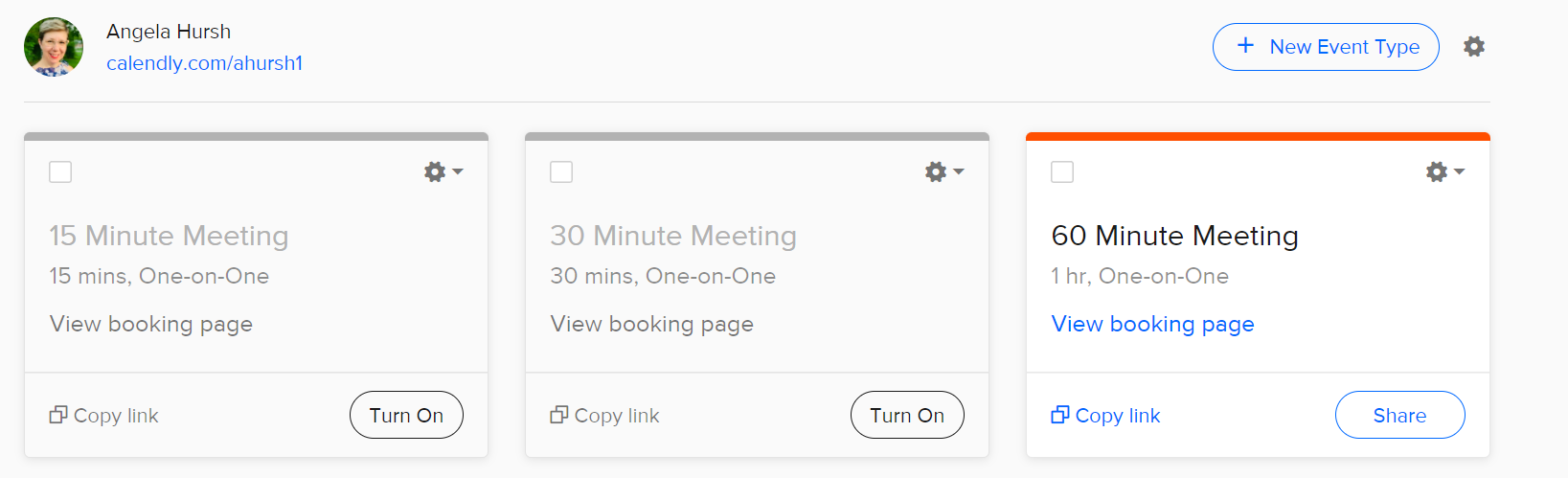
Whenever I need to schedule a meeting with someone who doesn’t work for my company, I use Calendly. It’s easy to integrate it with your calendar and a host of other apps, including Zoom. I cannot tell you the number of back and forth emails this tool has saved me!

Calendly also allows you to create rules for when someone can claim a block of your time. For instance, if you know youโ€™ll be working the checkout desk every day from 12-1 p.m., you can block that off. You can also embed the link in your emails.

The free account only lets you share one length of meeting at a time (15, 30, or 60 minutes) but switching back and forth between the types is easy. You just flip a switch, share the link with the person you need to meet with, and you’re done!

I can switch between these three meeting lengths easily, depending on the circumstance.

Coolers

Coolers is a color scheme generator that lets you explore and test thousands of color palettes for your print and digital graphic design projects. Itโ€™s saved me a ton of time. And it helps me, the girl with no artistic abilities, to make sure everything I create looks beautiful.

You can save palettes, create a collage, or find colors from photos. It also has settings for color blindness and a built-in contrast checker for accessibility.   

Emojipedia

This is my favorite place to find free emojis for any social media post and email. Itโ€™s easy to search. Once you find what you want, just copy, and paste and youโ€™re done.

Emojis are a great way to catch the attention of your social media followers. They also work great in emails. ๐Ÿ˜‰

Eventbrite  

If your libraryโ€™s calendar is unreliable or if Facebook events arenโ€™t generating registrations for you, Eventbrite is a great option.

You can use it for free when your event is free (as most library events are). Plus, thereโ€™s a mobile app to help you manage registrations. And you get listed on Eventbrite and its partner sites, which can increase the reach of your programs.  

Font Pair

I cannot, for the life of me, match fonts when making graphics. This site is a lifesaver.

Once you find a base font that you love, use this site to identify matching fonts for sub-headers and smaller text. I used this site when I revamped Super Library Marketing to be more accessible.

Giphy

Giphy lets you create animated video GIFs and GIF slideshows with captions. You can get your GIFs in a variety of formats or as stickers.

A new feature lets you create custom backgrounds for online video conferencing. How cool would it be to have a moving library background for your next program?

Grammarly

My life has been changed since I started using this tool. The free version is perfectly wonderful for checking your written work for common and complex grammatical mistakes, spanning everything from subject-verb agreement to article use to modifier placement.

If you use Chrome, download the extension. With that, Grammarly can check everything you type in real-time, from emails to blog posts to social media posts.

Icecream Screen Recorder 

I donโ€™t know why but finding an easy and free way to screen record is hard. I finally found this site when a vendor I work with used it to send me a screen recording explaining how to fix a technical issue.

You can record your whole screen or crop to just one area. You can even annotate with text, arrows, and shapes. There are mouse effects! And you can trim your recording.

SnapWidget  

SnapWidget allows you to display your Facebook, Twitter, YouTube, and Instagram photos in collage format on your website or blog. The free plan gives you unlimited widgets that refresh every 15 minutes.

Trello

Project management is a pain. When I worked at the Public Library of Cincinnati and Hamilton County, this was the tool we used to coordinate projects across teams.

Itโ€™s easy and intuitive to use. There are boards, lists, and cards that enable your organization to prioritize your most important projects. Everything is drag and drop and shareable.

The free account gives you 10 boards, unlimited storage, custom backgrounds and stickers, an activity log, and the ability to assign team members and set due dates. It was plenty for my team and we never had to upgrade to a paid plan.

Wakelet 

This free resource lets you capture, organize, and share multi-media resources with anyone. Save lists, do research, bookmark websites, and curate content for your newsletters, social media posts, and more.

Bonus tool

Resume Generator 

This tool will not make your life in marketing better (unless you are looking for a better job!) But it was made by a librarian at the Allen County Public Library, and it is remarkably helpful for your patrons.

Simply fill in all the appropriate information that you would put into a resume, press a button, and viola. It’s not fancy but it certainly makes a professional and polished resume. Seriously, how cool is this?

I made this fake resume in five minutes!.


You May Also Want to Read These Posts

Two New Tools That Will Help You Write Better Library Promotional Copy!

Nine Free Online Writing Tools To Help Add Clarity and Creativity to Your Writing Every Day!

Subscribe to this blog and youโ€™ll receive an email every time I post. To do that, enter your email address and click on the โ€œFollowโ€ button in the lower left-hand corner of the page.

A WordPress.com Website.

Up ↑