You may wonder, is it possible to over-communicate with my patrons?
Can you send too many emails, do too many social media posts, and put up too many posters and flyers in your library?
There are some telltale signs that you’re overdoing it! I have four tips to help you determine if you are flooding your community with too many messages in this Library Marketing Show episode.
Plus kudos go to a library that received press coverage for the return of a long overdue book with a funny note inside!
Do you have a suggestion for a topic for a future episode? Want to nominate someone for kudos? Let me know here. And thanks for watching!
Subscribe to this blog and you’ll receive an email whenever I post. To do that, enter your email address and click on the “Follow” button in the lower left-hand corner of the page. You can also follow me on the following social media platforms:
I have a bummer of a report to share with you today. However, it’s imperative because it may impact the way you use your library’s social media accounts to promote other content offerings from your library.
Buckle up! We will dive into that in this episode of The Library Marketing Show.
Plus, kudos go to a library that uses email to show off its accomplishments and prove its value to key stakeholders.
Do you have a suggestion for a topic for a future episode? Want to nominate someone for kudos? Let me know here. And thanks for watching!
Subscribe to this blog and you’ll receive an email whenever I post. To do that, enter your email address and click on the “Follow” button in the lower left-hand corner of the page. You can also follow me on the following social media platforms:
Photo courtesy Cincinnati and Hamilton County Public Library
Five years ago, I was listening to an episode of a library podcast about Google Ad Grants, which offers $10,000 monthly advertising credit to qualified nonprofits. Thousands of nonprofits use the program. You apply once, and the grant continues indefinitely.
Wow!
Many libraries have taken advantage of this program since it was launched in 2004. Some of those libraries collaborate with a company called Koios, currently run by Maggie Carson and Peter Velikonja.
Koios is a member of Google’s Certified Ad Grant Professionals group, which has been vetted by Google to manage ad grants. It is the only member of this group specializing in public libraries.
Koios has successfully applied for and managed Google Ad Grants for public libraries since 2017. That grant money has been used to promote catalog items, educational resources, passport services, business and career resources, summer reading programs, and more.
“Library marketing professionals know that different online audiences are reached in different ways,” says Peter. “Advertising with Google reaches everyone. That makes it the best way to reach new people, including, critically, the underserved.”
Peter says paid search using a Google Ad Grant may represent 25 percent or more of a library’s overall website traffic, depending on the size of the library’s service population.
“Ads appear at the top of search results – where they are most likely to be seen,” explains Peter. “Since libraries are trusted institutions, people are more likely to click on an ad for a library than a commercial ad.”
“At an average of $2 to $3 per click, a library can potentially bring about 4,000 visitors per month to its website, mostly new people who were not necessarily thinking of a library but were searching for something. It presents a library with an opportunity to show up at the right time with the right information, to the right person.”
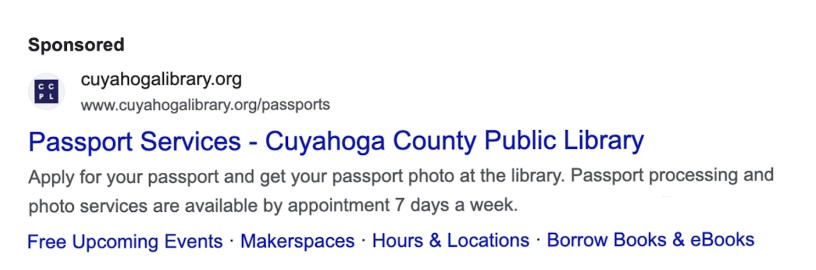
A sample Google ad for Passport Services at Cuyahoga County Public Library in Ohio.
And what does Google get out of this deal?
“Google’s primary motivation, we believe, is to perform a social good by helping nonprofits,” says Maggie. “But the program also helps Google fill unused advertising space. It’s like having an empty billboard – better to put something up for free than to leave it blank and potentially leave the impression that the space is not valued.”
“First, you create a Google for Nonprofits account,” explains Maggie. “Google will verify your foundation or friend’s group nonprofit status through their partnering organization, Percent, after which you can submit an Ad Grants application. The process generally takes a couple of days or a week. For libraries that would like help applying, Koios will gladly guide you for free.”
Google Ad Grants are not competitive grants, but there are some details and requirements to be aware of.
“Nonprofits with 501(c)3 status are eligible, so a library should apply through their Friends or Foundation,” suggests Maggie. “Google will also review the library’s website for quality and security issues; it will reject websites that are not https-enabled or do not meet their quality standards.”
Once a library is accepted, someone from the library will need to do ongoing research and keep up to date on compliance.
“Google’s policies require active management of advertising accounts, which means they expect you to check the account at least once per month,” explains Maggie. “Google has a set of policies to follow, and they regularly issue updates to these policies or create new ones.”
According to Peter, it takes some ingenuity and persistence to get the full value from an Ad Grant. Google says the average spent is only 17 percent of the full value of the grant. Google does offer some automated options for account management, which may be the best choice for busy staff. Koios can also manage the grant.
“First, we apply for an Ad Grant on behalf of a public library,” says Peter. “It is not complicated, but we have experience working out glitches that may come up in the application process.”
“Then we set up the Google Ads account that comes with the grant – we do all that for free because we want libraries to use the resource, whether we are involved or not. After that, a library can manage the account themselves, or we can do it for a yearly fee.”
“Most libraries choose to have us manage the account because we can exercise it more fully. We promote a library’s online catalog, which contains hundreds of thousands of terms and concepts that can match the words and phrases people search for. It’s a sort of Big Data capability libraries don’t usually have.”
Topeka & Shawnee County Public Library GA4 Web Traffic Acquisition Data, March 2024
Like most library vendors, Koios prices its services by the size of a library’s service population.
“Given the potential of receiving up to $120,000 per year in advertising credit, our subscription fee presents an excellent return on investment,” declares Maggie.
A screenshot of the Koios member dashboard for Barrie Public Library in Ontario, Canada, showing a 30-day view of 18 active campaigns.
If you’re interested in learning more about Koios and Google Ad Grants, email Maggie and Peter at info@koios.co.
Subscribe to this blog and you’ll receive an email whenever I post. To do that, enter your email address and click on the “Follow” button in the lower left-hand corner of the page. You can also follow me on the following social media platforms:
The engineers at the search engine recently changed the way that they rank websites and search to make internet searching easier for the user. But that’s going to have some implications for your library.
Don’t panic! We’ll go through the changes and what they mean for your library’s website in this episode.
Plus, kudos go to a library that sent its annual report to a media outlet and got positive press coverage with an unbeatable headline.
Do you have a suggestion for a topic for a future episode? Want to nominate someone for kudos? Let me know here. And thanks for watching!
Subscribe to this blog and you’ll receive an email whenever I post. To do that, enter your email address and click on the “Follow” button in the lower left-hand corner of the page. You can also follow me on the following social media platforms:
Photo courtesy Cincinnati and Hamilton County Public Library
This week, I’ll be able to see the world’s largest bottle of catsup. (Ketchup? Catsup? Is there a difference?)
When I learned that I’d be speaking at Reaching Forward South in Collinsville, Illinois, I Googled the area. That’s how I discovered the city is home to a 170-foot water tower shaped like a catsup bottle that just happens to be on the National Registry of Historic Places. It’s even got its own website and fan club.
If you’re like me, you do some strategic planning when you go on a trip. You decide to rent a vehicle or research public transportation. You purchase airline or train tickets and book a hotel. You pick restaurants to sample and decide which tourist attractions you’ll visit.
Some people just land in a city and let fates carry them where they may. (No shade from me. You do you!) I prefer planning because I don’t want to risk seeing or experiencing the best the area has to offer.
A plan, on vacation or in the library, sets clear goals and outcomes. It ensures your time, money, and energy are spent on the most valuable things. It gives you direction and purpose.
Marketing for a library works best when the promotions are tied to a library’s overall strategic plan. But that’s not always as easy as it sounds.
What is the difference between a strategic plan and a marketing plan?
A strategic plan defines targets and objectives for the entire library organization, including facilities, human resources, reader services, youth services, outreach, and more.
A marketing plan outlines your initiatives to support your library’s strategic plan. It clearly defines the collection items, programs, and services you’ll promote, who you’ll target, and how you’ll target them to reach your library’s overall goals.
In a perfect world, every library would have a strategic plan with clearly defined objectives and goals that are specific, measurable, actionable, relevant, and timely (SMART).
But…
If your library lacks a strategic plan, has a strategic plan that’s very vague without clear goals, or is in the middle of creating one (that can be a lengthy process), you may feel stuck and directionless. How do you know what you should be promoting?
What to do when you have very little direction
You can ask your library director or board of directors what they want to accomplish. Without a strategic plan as a guide, you must understand the director’s and the board’s goals.
Even basic statements like “We want to increase program attendance by 25 percent” or “We want to make sure every child has a library card” will guide your marketing.
If you don’t feel comfortable approaching senior leadership, ask your supervisor to step in. Stress the importance of a cohesive plan for moving forward in all areas of your library. This really is the cornerstone of your work.
Once you know the goals of your library, it’s time to create your marketing plan.
Step 1: Define your marketing goals.
Lay out exactly how you’ll help those overall library goals be reached.
For example, let’s say your library has a goal to partner with schools to ensure all third graders in your town are reading at grade level. Your marketing goal might be:
Increase the participation in our library’s 3rd-grade reading program by 25 percent within the next 12 months, as measured by the number of 3rd-grade students enrolled and actively engaging with the program materials and resources.
Step 2: Write down what you know about the community you serve.
Marketers call this a “situation analysis.” This will give you a starting point for your strategy. Ask yourself:
What does your typical cardholder do with their card?
Where do they live?
How do they view your competitors?
How does your library currently fulfill a unique position in your community?
Step 3: Create a list of all your tactics and assets.
Write down all the channels you use to promote your library. This list should include every social media platform you use, every website your library owns, and every print publication you send out, plus emails, print collateral, influencers, in-person events, press releases, podcasts, and videos.
Step 4: Set goals for each tactic and asset.
Let’s say one of your goals is to make sure job seekers in your community use career resources at the library. And let’s say you have a print newsletter that you send every quarter to all the residents of your community.
Look at the specific marketing goal you created in step one. Underneath that, you might write:
“In each issue of our newsletter, we will feature a cardholder who used our library’s services to advance their own career, such as by taking our GED course or using our online job resume builder. We’ll do at least one story on library work as a career. Every quarter, we’ll highlight a service or program that will help our cardholders reach their career goals.”
Step 5: Populate an editorial calendar for the next 12 months.
Now it’s time to plan content topics and themes for each month that will work to reach your goals. Planning a calendar for a full year makes it easy to coordinate promotions across channels. And it will help your supervisor and coworkers to understand what you’ll be doing, when, and why.
You may end up moving things around as you go through the year. That’s okay!
Step 6: Measure success and failure.
Accurately document the results of every promotion you do. This will help you to adjust your strategy next year.
Sometimes you won’t have a clear understanding of what’s working and what’s not working until you see the actual results in numbers on a paper in front of your nose.
One final note of encouragement
Don’t be discouraged if you don’t reach all of your goals. Marketing is an experiment. Sometimes the stuff you do will work, sometimes it won’t. Don’t repeat the things that don’t work! Spend more energy on the things that do work.
Subscribe to this blog and you’ll receive an email whenever I post. To do that, enter your email address and click on the “Follow” button in the lower left-hand corner of the page. You can also follow me on the following social media platforms:
Algorithm changes are an inevitable part of library social media. Normally, those changes spell bad news for libraries. But…
LinkedIn just changed its algorithm and those changes are good news for libraries! (Yippee!) I’ll outline the three new and improved LinkedIn algorithm changes and how they will positively impact your library’s posts in this episode.
Plus, kudos go to a library that brought a bunch of libraries together to create a viral video for Read Across America.
Do you have a suggestion for a topic for a future episode? Want to nominate someone for kudos? Let me know here. And thanks for watching!
Subscribe to this blog and you’ll receive an email whenever I post. To do that, enter your email address and click on the “Follow” button in the lower left-hand corner of the page. You can also follow me on the following social media platforms:
You’re not imagining it: Engagement on Instagram Reels is going DOWN. And it’s happening not only to libraries but to content creators from all industries. What is going on?! And is there anything we can do to reverse this trend? We’ll dive into it in this episode of the Library Marketing Show.
Plus, kudos go to a library that’s been doing something that received coverage on a national television news program.
Do you have a suggestion for a topic for a future episode? Want to nominate someone for kudos? Let me know here. And thanks for watching!
Subscribe to this blog and you’ll receive an email whenever I post. To do that, enter your email address and click on the “Follow” button in the lower left-hand corner of the page. You can also follow me on the following social media platforms:
Photo courtesy Cincinnati and Hamilton County Public Library
Interviewing a stranger about their library experience is intimidating for many people. If the thought of having an intentional conversation to elicit a sound bite you can use in a blog, video, social media post, press release, or other content sounds daunting, the post is for you.
Why a powerful quote is important.
Your audience wants to hear directly from the people impacted by your library’s work. Whether that is your staff, director, board members, or patrons, a good quote can drive home your work’s value.
A quote can convey passion or a strong point of view. It can turn a story about statistics or complicated concepts into something understandable and relatable. A quote can also establish an emotional connection with the reader or viewer.
And, if your goal is to catch the attention of local media, a good quote can make your press release, blog post, or email stand out. Because…
The media knows when your quote is fake.
I worked in a local television newsroom for nearly 20 years before I became a library marketer. And I’m here to tell you… journalists can tell when you’ve made up a quote for a press release.
I understand why it happens. Your director or coworkers may tell you they trust you to put words in their mouths. It seems less time-consuming than doing an interview.
But the media can tell when you’re making it up. That’s why an interview, however short, is key to getting an authentic quote. So here are tips to make the interview process smooth and successful.
Prepare as much as possible.
If you are interviewing a co-worker, a board member, or the director of your library, take a few moments to see if there is any documentation that gives you clues about their background. Search their LinkedIn profile and board minutes. Do a Google search to see if they’ve ever done an interview. You may learn new facts about them and their speaking style.
Think about how you might structure your piece before you even write it.
That structure may lead you to questions to ask.
For example, readers may notice that I often start library profiles on this blog with some facts about my subject’s life before they worked in marketing. I ask people to tell me about their childhood library and their work before libraries, to build the scene and give a deep background on my subject. Use this technique for any interview leading to a blog post, social media post, or video.
If you are interviewing to get a quote for a press release, I suggest writing the press release before doing the interview. Leave spaces where a quote or two would grab the media’s attention and add context and emotion to the story you’re trying to pitch. Now you’re ready to write your questions.
Craft targeted questions that elicit insightful responses.
Use simple sentences and language.
Add intention to your questions. If you want someone to share a firsthand experience or observation, craft your sentence to gently lead your interviewee to that answer.
Ask open-ended questions. If you must ask a yes or no question, follow up with “Why?” to give your subject the nudge to elaborate.
Still stuck? Use your tools. ChatGPT can help you craft questions for your interview.
To show how this works, I typed into ChatGPT: “I am interviewing my library director about a new partnership that will help community members land a job or advance their careers. Can you give me some sample questions I might use to get a good quote?”
Here is the list of questions ChatGPT gave me.
Can you please provide an overview of the new partnership aimed at helping community members with job placement and career advancement?
What motivated the library to pursue this partnership?
How do you envision this partnership benefiting members of our community?
Could you elaborate on the specific resources or services that will be made available through this partnership?
In what ways will the library be collaborating with the partner organization to deliver these resources and services effectively?
How will the library measure the success of this partnership in terms of its impact on community members?
Are there any demographics or groups within the community that stand to benefit most from this initiative?
How does this partnership align with the library’s broader mission and goals?
Can you share any success stories or examples of how similar partnerships have been effective in other communities?
What steps will the library take to ensure that community members are aware of and can easily access the resources and services offered through this partnership?
That is a huge list! It’s a great start. All I would need to do is go through and tweak the questions to match the tone I want to set and to sound more like something I would say.
Now comes the fun part: the interview!
6 tips for conducting the interview
#1: Record the conversation.
#2: Talk a little about yourself to get the conversation started.
#3: Ask an easy first question to calm everyone’s nerves.
#4: Encourage elaboration on interesting points.
#5: Let the person talk. Don’t be afraid of silence.
#6: Paraphrase or summarize key points to nudge the interviewee towards a quotable response.
Subscribe to this blog and you’ll receive an email whenever I post. To do that, enter your email address and click on the “Follow” button in the lower left-hand corner of the page. You can also follow me on the following social media platforms:
Managing social media for a library is hard enough without trolls commenting on your promotional posts. But it does happen! So…
How do you handle it when someone hijacks the comment section of your library’s social media posts? I have some advice for you in this Library Marketing Show episode.
Plus, kudos go to a library that’s been doing something fun and unusual for more than 20 years to promote their collection!
Do you have a suggestion for a topic for a future episode? Want to nominate someone for kudos? Let me know here. And thanks for watching!
Subscribe to this blog and you’ll receive an email whenever I post. To do that, enter your email address and click on the “Follow” button in the lower left-hand corner of the page. You can also follow me on the following social media platforms:




Hijacked! 2 Tips for Responding When Trolls Comment On Your Library Social Media Accounts
Watch this video now
#LibraryMarketing Show, episode 234
Managing social media for a library is hard enough without trolls commenting on your promotional posts. But it does happen! So…
How do you handle it when someone hijacks the comment section of your library’s social media posts? I have some advice for you in this Library Marketing Show episode.
Plus, kudos go to a library that’s been doing something fun and unusual for more than 20 years to promote their collection!
Do you have a suggestion for a topic for a future episode? Want to nominate someone for kudos? Let me know here. And thanks for watching!
Miss the last episode? No worries!
Will I see you soon?
Subscribe to this blog and you’ll receive an email whenever I post. To do that, enter your email address and click on the “Follow” button in the lower left-hand corner of the page. You can also follow me on the following social media platforms:
Share this: