In this episode, I answer a viewer question from Natasha Buran of Thousand Oaks Library. She asked, “I was curious if you’ve seen other libraries use ‘Revue’ – Twitter’s newsletter tool for writers and publishers. I thought it would be interesting to add monthly programs or resources and pin it to our profile. I haven’t seen libraries use this feature before and thought I’d ask.”
I gave my answer in the video. This is just my opinion of course!
Kudos in this episode go to the Topeka-Shawnee County Public Library. They recently opened a resource center for community members without a computer or internet access.
Do you have a suggestion for a topic for a future episode? Want to nominate someone for kudos? Let me know by clicking on the feedback button. And subscribe to this series to get a new video tip for libraries each week.
This is the 100th episode of the Library Marketing Show. It’s a celebration of YOU… the person who does marketing and promotions at your library.
I think you are amazing and awesome, and I’m sharing the five reasons why library marketing is the best job at the library.
And Kudos in this episode go to… you! Thank you for your comments, feedback, ideas, and support. The library marketing community is gracious and warm and wonderful, and I’m proud to be a part of it.
Do you have a suggestion for a topic for a future episode? Want to nominate someone for kudos? Let me know in the comments. And subscribe to this series to get a new video tip for libraries each week.
Thanks for watching!
Subscribe to this blog and you’ll receive an email every time I post. To do that, click on the “Follow” button in the bottom left-hand corner of the page.
In this episode we cover three top social media stories that affect library marketing.
The stories includes a Twitter function allows you to un-tag your library from a thread, a story about how Instagram is testing “fanclub” stories, and news about a new Facebook features that tests public comments on Facebook stories.
Kudos goes to Karen Jensen of Teen Librarian Toolbox for speaking out against the narrative of “the library is more than just books!”
Do you have a suggestion for a topic for a future episode? Want to nominate someone for kudos? Let me know in the comments. And subscribe to this series to get a new video tip for libraries each week.
Subscribe to this blog and you’ll receive an email every time I post. To do that, click on the “Follow” button in the bottom left-hand corner of the page.
In this episode, I’ll explain what an email drip campaign is, why you might want to use a drip campaign for library promotions, and then HOW to actually put the campaign together!
Kudos goes to Barbara Swinn of York Libraries for her British Empire Medal!
Do you have a suggestion for a topic for a future episode? Want to nominate someone for kudos? Let me know in the comments. And subscribe to this series to get a new video tip for libraries each week.
Thanks for watching!
Subscribe to this blog and you’ll receive an email every time I post. To do that, click on the “Follow” button in the bottom left-hand corner of the page. Connect with me on YouTube, Twitter, Instagram, Goodreads, andLinkedIn.
I mean, you might as well ask me to explain the meaning of life. (I’m kidding. Please don’t ask me that question.)
There are two ways to define engagement in your library promotional efforts.
Transactional Engagement
One way to talk about engagement in library marketing is solely centered on numbers.
How many likes, shares, comments, and direct messages do your social media posts get? What is the open and click through rate of your emails? How many people signed up to attend your program based on the flyer you slipped into their checkout? How many people used a database after you mentioned it at your last program?
These hard numbers are measurable and easy to explain. They demonstrate that your community sees your marketing. They take an action.
Transactional engagement is data that proves people are interacting with your library marketing.
Relationship Engagement
But engagement cannot, and should not, be solely defined by the hard numbers. It must also be the ongoing relationship building that your library does with patrons.
People may be opening your emails and clicking on your social media posts. They’re checking out books and using your services.
But more importantly, how do they feel about your library long term?
Engagement must involve building a deeper relationship with your patrons over time. When that happens, the relationship will manifest itself in ways that go beyond hard numbers.
This is the real value of your library. Your cardholders will not only use the library more, but they’ll also donate more, volunteer more, speak out to support you more often, and influence others to use the library.
If this relationship building has not been in your list of priorities, you’re not alone. A study by Chief Marketing Officer found that most marketers fail to nurture long-term relationships. Instead, they focus more on the transactional nature of engagement.
That’s because transactional engagement is easy to measure. You can take those metrics to your supervisor and to the board. You can prove what you’re doing is effective. And you can feel good about your work.
It’s far more difficult to explain to your library administrators and stakeholders that you are building a lifelong emotional connection and loyalty with your community. It is hard to convince them that this is important. It’s also difficult to measure this work.
And building relationships doesn’t happen overnight. Libraries may feel they don’t have the luxury of devoting time to this work.
But we must. And we must do that right now.
Why this is the moment to focus on relationship building
Libraries are at a crossroads. I cannot stress this strongly enough: as we emerge into the post-pandemic world, we should not go back to doing things the way we were doing them before the crisis.
Libraries were already facing budget cuts, apathy, and accusations of irrelevancy. And that was before the pandemic forced us into lockdown and severed tenuous ties with our community by physically separating us from our customers.
The pandemic forced us to take our service models in a whole new direction. We proved that we can pivot.
We should use this opportunity to move our marketing in a new direction too. We cannot let the fear of doing something different keep us from making the bold changes needed to move into a real position of success.
Libraries should use this time to turn their sights on building loyalty. We’re going to need it to survive in the post-pandemic world.
Relationship engagement is the key. When we focus on building loyalty, we’ll learn more about our communities. We can put those discoveries to use to create services that actually solve problems. We can provide the services our community needs, not the services we *think* they need.
Yes, I know this sounds a little aspirational and far-fetched
Now, when I gave this answers to the folks who asked me do define engagement, I could see the look of skepticism on the faces of some of my peers. And I understand why.
We are just coming out a major life changing event. Most libraries think they must be solely focused on trying to get their circulation and usage numbers back up to pre-pandemic levels.
But I think this is a chance to do something bigger. This moment is an opportunity that comes once in a lifetime.
Library staffers often seek to find the deeper meaning of the work they are doing. They want to know that their jobs are having an impact on the community. If we focus on building sustainable relationships of loyalty and trust with our community, staff will feel like they are contributing to the library’s overall goals in a meaningful way.
How does relationship building work in a real library?
Let’s say your library does personalized reading suggestions. Staff members may view their work as transactional. A reader asks for a suggestion and answers a few questions. The library staffer sends them a list of suggested books based on their reading preferences. Interaction complete.
To turn this from solely a transactional interaction to a relationship building interaction, the library staff member could write a personal email or note to the reader, to explain why they chose these particular books. A few weeks later, the staff member could reach out to the reader to ask for their thoughts about the selections. Did they like them? Which books did they check out? Did they learn anything new about what they like to read?
This interaction takes longer but it’s more meaningful. It shows that the library cares about the person and strives to provide the best customer service possible. And that’s how you build loyalty in your community.
Here are more ideas that will help you take transactional library interactions and turn them into relationship building engagement.
By the way, this weekend, I heard someone say they believe the meaning of life is for us to help each other get to wherever we are going next.
That view has a connection to the work you do at your library, don’t you agree?
Subscribe to this blog and you’ll receive an email every time I post. To do that, click on the “Follow” button in the bottom left-hand corner of the page. Connect with me on YouTube, Twitter, Instagram, Goodreads, andLinkedIn.
In this episode, I’ll address a post I saw recently on the Libraries and Social Media Facebook page. A library staffer shared their plans to pull back on the amount of posts they are doing on Twitter. There was a bit of debate among the members about whether that was a good idea.
Kudos go to the San Marcos Public Library for their Breakfast Club inspired photo shoot.
Do you have a suggestion for a topic for a future episode? Want to nominate someone for kudos? Let me know in the comments. And subscribe to this series to get a new video tip for libraries each week.
Here is something I’ve noticed in my conversations with library staff over the past six months.
Staff share a profound feeling of separation from their communities. They’ve been working for more than a year without the normal interactions with the public. And that has led to increased anxiety about whether things will ever return to normal.
The big questions I’m getting are: How long will it take before circulation returns to normal? How long will it take before program attendance is back to where it was before the pandemic?
I can’t answer those questions. I’m not sure anyone credibly can.
But what I can do is help you to rebuild use of your library through marketing and promotions.
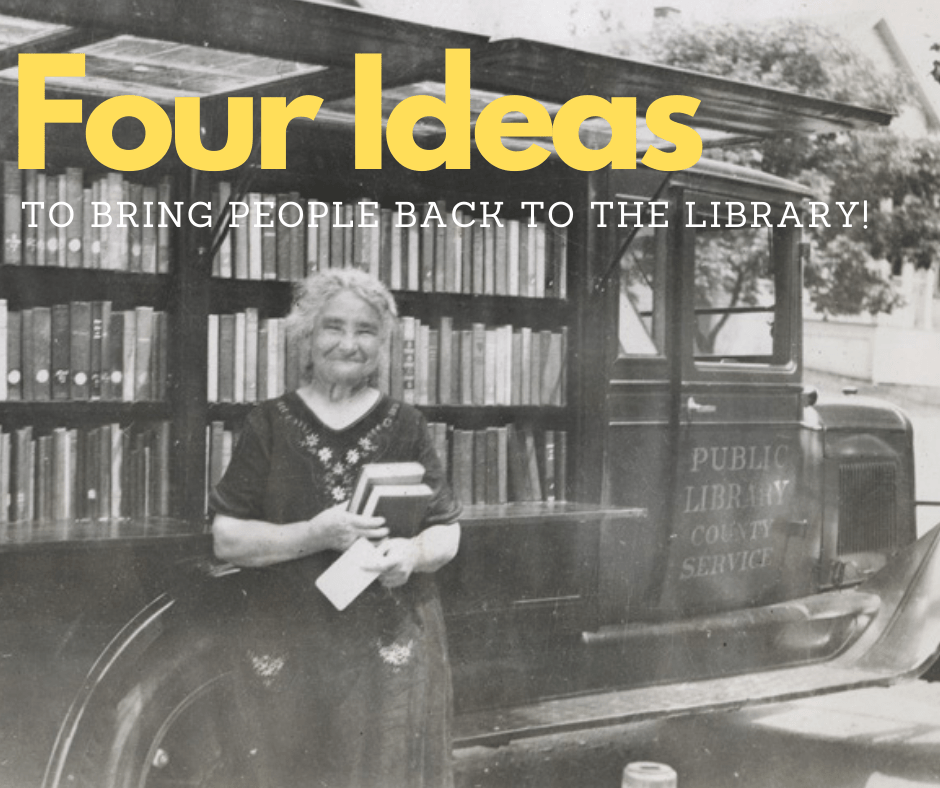
Here are four ideas that libraries can strategically use to bring people back to the library, re-engage cardholders, and get new community members to use the library.
Renew everyone’s library cards automatically and incentivize people to use them. Then, use that interaction to re-connect.
If you have a system where cards need to be renewed, a blanket automatic renewal is a great promotional tactic. Automatic renewal of library cards is a customer service best practice. And doing so right now, when we are coming off more than a year of service limitations, is strategically smart.
If your senior leaders have concerns about a blanket renewal, ask them to read Cordelia Anderson’s book. It explains the advantages of this action.
The next step is to gather prizes from partners, like you would for summer reading. Let people know they’ll be entered into a drawing to win a prize if they use their card. If they check out a book or use an online resource, they can fill out an entry. If your priorities are to drive attendance at in-person programs or to get people to physically come into a branch, you can tell people they get two entries in the drawing!
Once they come back, make sure you do everything you can to re-connect with these cardholders. Have your staff do three things with every person they interact with.
Get their email address.
Get them to self-identify their interests. Are they looking for help solving a particular problem, like finding a job? Are they looking for books for entertainment and relaxation? Ask your public to name at least one topic they would want more information about.
Give them a print piece of marketing material to encourage further use of the library. Don’t let them leave this interaction without something in their hands. Remind them that the library is open and actively providing service to your community again.
Rebuild a sense of community.
One of the things that library users said they missed most during the pandemic was social interaction. This is another opportunity for libraries to rebuild.
Rather than re-starting our one-off programs, let’s spend our energy putting together programs that everyone can participate in. Wider-ranging programs, which focus on getting large groups people to do an activity together, help to build a sense of community.
One idea: everyone reads the same book, or watches the same movie, or listens to the same piece of music. Then, your library creates ways for your community to share their thoughts and experiences around that group activity.
Another idea: ask your patrons to share their pandemic stories. Encourage them to share how they survived their time in lockdown, what they learned, and how the experience changed them.
Let the public know you’ll be posting their contribution on a special landing page of your website, and sharing them through social media and in email. You can even print short versions of the stories on a bookmark, which you’ll slip into holds and checkouts to encourage other library users to share their stories.
Finally, hold an event where people can have the chance to read their stories to an audience.
A shared experience builds community. And a community that feels connected to your library, and to each other, will keep coming back to use your services.
Use your virtual programs and videos to encourage your community to expand their library use.
Since the beginning of the pandemic, libraries have embraced livestream and video programming. Now we can use the platforms and audiences we have built for promotions.
Do a livestream from inside your building. Show your audience one thing they can do in your library that they haven’t been able to use since the building was closed or operating under limited services. Save the video and repost it later for on-demand viewing.
Do a livestream where the community can ask questions about the library… an “ask me anything” type event. During your livestream, be sure to mention programs or services that may be interesting to those asking questions.
It’s like working the front desk: people ask questions and you provide the answers. You’ll be demonstrating your staff’s expertise and reminding people that the library is there to help.
Buy two kinds of social media ads.
We know social media algorithms do not work in favor of organic posts. Use some of your budget to circumvent the system by purchasing ads.
Your ad approach can have two methods. One ad should focus on followers. They don’t necessarily see your posts because of the algorithm. But a purchased ad will make sure you are in their feeds. Use the ad to alert them to your expanded changes in service.
The other ad should be focused on people who aren’t library users or followers. You can even split this audience into people you think might be interested in coming into a branch versus people who might want to use digital resources. Social media platforms do a great job of helping you to target specific audiences with your ads.
Spend $25 and see what kind of results you get. If you have more money, use the data you’ve received from this smaller test to run larger, longer ads.
Subscribe to this blog and you’ll receive an email every time I post. To do that, click on the “Follow” button in the bottom left-hand corner of the page. Connect with me on YouTube, Twitter, Instagram, Goodreads, andLinkedIn.
In this episode, we’ll go through the latest updates for social media platforms and what they mean for libraries.
This month’s headlines include a change in Twitter’s image cropping policy, a new report on Instagram use, and another new report that lays out the “alleged” best times to post on each social media platform. Watch the video to find out why I believe libraries should take this third report with a grain of salt!
Kudos go to the Coralville Public Library. Watch the video to find out why a fellow viewer nominated them for mention in this episode.
Do you have a suggestion for a topic for a future episode? Want to nominate someone for kudos? Let me know in the comments. And subscribe to this series to get a new video tip for libraries each week.
A picture is worth a thousand words. That’s so true in marketing.
The visual you choose to accompany your promotions can make all the difference. The quality of that image may determine whether a person engages with your content… or moves on.
Most libraries don’t have a budget to hire a photographer for every campaign or marketing initiative. They may not have a graphic designer to create illustrations. So, they rely on free stock photos and art to create promotional material that looks professional and modern.
But libraries must navigate the tricky legal maze of copyright issues associated with images, icons, and photos.
The basics of copyright laws
Unless you have a stock photo subscription, your library should use images in the Public Domain or images that are covered by Creative Commons.
Public Domain: If a photo of image is in the public domain, that means the creator has dedicated the work to the public domain by waiving all his or her rights to the work worldwide under copyright law, including all related and neighboring rights, to the extent allowed by law. You can copy, change, distribute and perform the work, even for commercial purposes, all without asking permission.
Creative Commons: Anyone can then use the work in any way and for any purpose, including commercial purposes, subject to other laws and the rights others may have in the work or how the work is used.
This post gives a thorough explanation of copyright issues surrounding stock photos in particular.
Finding the right image for your library promotions
Your library can purchase a stock photo subscription. But, if you are working with a limited budget, there are many websites where you can find high quality, free stock photos. That’s where this list comes in handy.
I based my list on a couple of factors.
Websites where finding a photo or illustration is easy.
Websites where you don’t need an account to download photos or images.
Websites that had photos and/or art of subjects that pertain to libraries, like books, reading, and diverse populations.
I have provided a brief explanation of the copyright licensing for these websites. But, to fully protect yourself and your library, read the license requirements for each site thoroughly before you download.
The complete list of ten free stock photo websites for libraries
Creative Commons: This site is dedicated contains the most diverse selection of shots I’ve seen on a free photo site to date, with more than 500 million photos available. You can search by license so you can be sure to get the photos that you can use in any situation with or without attribution, according to your preferences. You can also search by the sources, and by the way in which you wish to use the photos. Attribution is required for most photos.
Freepik: Freepik has a limited number of free photos for download. You can use them for commercial or personal projects and in digital or printed media. Attribution is required.
Gratisography: This site contains a limited number of free photos and vectors. They are bright and eye-catching, even whimsical. It’s divided into easy-to-understand search categories. You can use the photos for personal and commercial projects including advertising campaigns, websites, blogs, and social media. Attribution is required.
Negative Space: Another site under Creative Commons with full use of photos for commercial purposes. Their photos are organized into collections for easy searching. They have plenty of photos of books and readers.
Pexels: A great site containing lots of high-quality photos and videos. They’re all free to use on your website, blog or app, in print materials, on social media, and in ads. Attribution is not required. You can modify the photos and videos.
Pixabay: The site contains 2.3 million free images and royalty free stock photos as well as free illustrations, vectors, videos, and music. You can download and modify content for commercial or non-commercial use without attribution. You cannot use the content for any products for sale, like t-shirts or other library merchandise.
Reshot: You can use any of the 25,000 photos and icons from this website for social media, online ads, education, commercial, and editorial projects for free. No attribution is required. Photos are searchable by orientation.
Stockvault: This site offers more than 138,000 free photos. You can search by license, but there are plenty of free photos for libraries licensed as Creative Commons CCo, which means you can use the works for personal, education, and commercial purposes without attribution.
Vecteezy: This website contains free vectors, photos, and videos. There are premium pieces for purchase, but their selection of free art is great. I like the modern feel of the work on this site. You can search by orientation, image style, number of people or age of people in the photo, and the composition of the photo (head shots, full body, etc.). Attribution is required and there are limits to the ways in which you can use the art under the free license.
Unsplash: An amazing site with a huge selection of high-resolution photos. Their license allows you to download and use the photos for free for commercial and non-commercial purposes. No permission is needed, although attribution is appreciation.
Subscribe to this blog and you’ll receive an email every time I post. To do that, click on the “Follow” button in the bottom left-hand corner of the page. Connect with me on YouTube, Twitter, Instagram, Goodreads, andLinkedIn.