I have a hot take on marketing and programming. They are two completely different things. But confusion over the roles is making it difficult for many libraries to do effective marketing.
I’m going to defend my hot take and give you some guidance on why this distinction is important in this episode of The Library Marketing Show.
Plus, we’ll give kudos to a library for their series of onboarding emails and the brilliant way they get people to sign up for targeted email marketing.
Do you have a suggestion for a topic for a future episode? Do you want to nominate someone for kudos? Let me know here. Thanks for watching!
Subscribe to this blog, and you’ll receive an email whenever I post. To do that, enter your email address. Then, click the “Follow” button in the lower left-hand corner of the page. You can also follow me on the following social media platforms:
Photo courtesy Cincinnati and Hamilton County Public Library
One of the hardest tasks in library marketing is naming programs and events.
The name of a program can significantly impact attendance. The name must capture attention. It needs to be clear and memorable. And it needs to be discoverable for community members searching online.
In this post, I’ve created a checklist. Under each point on the checklist, I’ll give you an example of how to use AI tools like ChatGPT, CoPilot, Perplexity, and Gemini to check that your library program name meets the criteria.
If you’ve already come up with a name, you can check your choice against each of these considerations. If you’re beginning from nothing and have no clue what to name your program, use this checklist to find the best name and drive lots of attendance!
Checklist for Naming Your Library Program
✔️Relevance
The name of your library program should accurately reflect the program’s or event’s content and purpose. It should give attendees a clear idea of what to expect.
Example
I asked Google’s Gemini: “I am putting together an early literacy library program. In this program, babies and caregivers can read books together, but the babies are encouraged to move around during the reading time. I want to name the program “Young and Restless”. Is that a relevant program name?”
Gemini’s answer
“Young and Restless” might not be the best fit for an early literacy program.
“Young and Restless” is the title of a soap opera, and the connotation leans more towards drama and adult themes. It doesn’t immediately convey the idea of early literacy. While “restless” could be seen as a playful reference to a baby’s energy, it might also suggest a negative connotation of being unable to focus.
Here are some alternative program names that better capture the essence of your program:
“Wiggle While We Read”
“Rhyme Time & Playtime”
“Storytime on the Move”
“Littlest Learners & Lively Laps”
“Bookworms in Motion”
✔️Appeal
The name must attract your target audience. Consider that people often scroll online and when they read print. Your library program name must stand out from other programs or events in your community.
Example
I asked Perplexity: “I am putting together a library program where crocheters of all skill levels can come to work on their projects, give help to others, and get help building their skills. I want to call it Hooked on Crochet. Does that program name have enough appeal to capture attention?”
Perplexity’s answer
The name “Hooked on Crochet” for your library program has several appealing qualities that could help capture attention:
Pros:
The name plays on the double meaning of the word “hooked,” referring both to the crochet hook used in the craft and the idea of being enthusiastically engaged or “hooked” on crocheting.
The alliteration and rhyming nature of the name make it catchy and easy to remember, which is essential for a program name to stand out.
By not specifying skill levels in the name, it implies that the program is open to crocheters of all abilities, from beginners to experts.
The word “hooked” has a positive connotation, suggesting a passionate interest or enjoyment in crocheting, which could resonate with enthusiasts of the craft.
Potential Cons
While wordplay can be effective, some may find the “hooked” pun a bit overused or clichéd in the context of crocheting.
The name may be too specific to crochet and could potentially exclude other fiber arts or crafts that you might want to incorporate in the future.
✔️Clarity
The name should be easy to understand and remember. You’ll want to avoid complex, obscure, or cutesy names that might confuse people.
Example
I asked ChatGPT: “I am organizing a library program where people can bring a plant to swap and learn about composting, and sustainable gardening. There will also be crafts and games. This program is for all ages. Can you help me come up with a name that clearly states what will happen at my program?”
ChatGPT’s answer
That sounds like a fantastic and engaging program! For a name that captures the essence of your event while being concise and appealing, consider the following options:
“Sustainable Garden Swap & Fun Day”
“Green Thumb Plant Swap and Activities”
“Eco-Friendly Garden Day”
“Plant Swap and Garden Fun”
“Sustainable Gardening Fair”
✔️Length
The name should be short and concise. Long names can be difficult to remember and may be difficult to fit on your marketing materials.
Example
I asked ChatGPT: “I am putting together a library program at an academic library. The program will be interactive and will help students to better understand the databases and research resources available to them at the library. I want to call the program Interactive Workshop on the Integration of Research and Retrieval Skills, but my manager thinks that name is too long. Is it too long?”
ChatGPT’s answer
Yes, “Interactive Workshop on the Integration of Research and Retrieval Skills” is quite long for a program name. It might be better to shorten it to make it more concise and easier for students to remember. Here are a few shorter alternatives:
“Research Skills Workshop”
“Interactive Research and Retrieval Workshop”
“Library Research Skills Workshop”
“Research Resources Workshop”
“Effective Research Techniques Workshop”
✔️Accessibility
The name of your library program must not exclude any potential participants.
Example
I came up with a name for a technology program called “Advanced Technological Workshop for Digital Natives.” I asked ChatGPT to evaluate the accessibility of the name.
ChatGPT’s answer
“Advanced Technological Workshop for Digital Natives.” is an inaccessible library program name for several reasons.
Community members might interpret the term “Digital Natives” to mean only younger people who they assume are highly proficient with technology. This excludes older adults or those without regular access to technology. It’s also a very obscure term. Did these people live in the digital world??
The term “Advanced” might also deter people who do not consider themselves advanced in technology from attending, even if they are interested in learning more about it!
And the whole tone of the name is very formal, academic, and intimidating.
✔️Searchability
Many of your community members are looking for help online. You want your program name to come up in search! So be sure to include keywords that people might use in search.
Example
I asked Copilot: “I have a library program named “Opera Appreciation.” Are there any keywords or phrases that I need to add to the program name or description to make this more discoverable in search?”
Copilot’s answer
Certainly! To make your “Opera Appreciation” program more discoverable, consider incorporating relevant keywords and phrases in the program name or description. Here are some suggestions:
Opera: This will directly associate your program with the art form.
Music Appreciation: This can help convey the educational aspect and attract those interested in learning about this genre.
Classical Music: Opera is a subset of classical music, so including “classical music” in your program’s description can broaden its reach.
Arias: Highlight that your program explores opera arias—the beautiful solo pieces performed by singers. Mentioning “arias” can attract opera enthusiasts.
Composer Names: Incorporate the names of renowned opera composers.
Subscribe to this blog and you’ll receive an email whenever I post. To do that, enter your email address and click on the “Follow” button in the lower left-hand corner of the page. You can also follow me on the following social media platforms:
Photo courtesy Cincinnati and Hamilton County Public Library
On my first day working in a library, I was handed a calendar of library events. “Here is everything that happens during the library year. You’ll learn what to expect pretty quickly and how to plan to market each of these events as they rotate in the library calendar.”
My first thought was, “Holy cow, that’s a lot to promote. There are multiple events happening nearly every day of the year.”
And there was one other potential problem that I didn’t dare say aloud.
While I’ve been a voracious user of library collections all my life, I had never attended a library program outside of taking my kids to storytime when they were little. How was I going to convince someone else to go to one??
Programs at any library, whether public, academic, special, or school are considered a core service. Every library strategic plan includes some language pledging to provide programming to fill a gap in the needs of the community.
In my work at NoveList, the amount and variety of programs I’ve seen promoted each year is astounding. There is something for everyone. So…
Why do libraries struggle so much trying to get people to attend these programs?
Here’s what I’ve learned.
The libraries that get a lot of people to attend their programs focus on providing high-quality programs that meet specific community needs at a time and place most convenient for their patrons. They require registration, and they go out of their way to remind registrants to attend.
Many of you are worried about program attendance. For most libraries, it just has not returned to levels seen before the pandemic. In fact, many of you mentioned in the latest Super Library Marketing survey that you particularly struggle to promote adult programming.
So how do we increase program attendance?
I work with a lot of libraries. The ones that are successfully driving program attendance are doing three specific things.
Fewer overall programs
More quality, community-focused programs
More efficient and effective marketing
Your target audiences respond more to your marketing when you are promoting fewer, high-quality programs that meet their needs. And your marketing will be more effective with focus and a little help from friends. It’s truly that simple.
Take these four steps to boost library program attendance.
Ask cardholders what kinds of programs they need.
Conduct a two-question survey to ask your cardholders what they want to do or learn at the library. Resist the urge to ask more questions! You can always conduct a larger survey later.
This survey has a singular focus: to give you a sense of what interests the community.
Ask your community members to choose categories of programs that would be valuable and interesting to them.
Ask your community members about the format: How long do they want your programs to be? And where do they want it to be?
You may learn that programs at a certain branch would be more convenient for your community. You may discover that the weekdays are inconvenient for your community members. You may learn that your adult community members want you to schedule adult programs at the same time as your children’s programming so they don’t have to get a babysitter.
Research events at related organizations in your community.
Avoid creating programs at your library that compete with other organizations for time and attention.
For instance, if your branch is near a community center that’s already hosting a bunch of knitting and crafting events or groups, then your knitting and crafting programs will be in direct competition.
Instead, create programs that complement what other organizations are doing.
For example, your library might start a knitting or crafting-themed book club where participants read books related to knitting, crafting, or fiber arts. Then you can approach the community center and ask them to help you promote that program to their knitting program attendees!
Gather email addresses and send attendance reminders.
Walk-ins for programs are great. But, requiring registration allows your library to ask for an email address. Then, you can send program reminders like this one from Iredell County Public Library.
Remind your attendees twice, once one week before the program and once within 24 hours of when the program is going to happen.
Partner to create and market your programming.
My library partnered with a local organization to teach workforce development skills to single parents. We also partnered with a local brewery to do a program on home brewing techniques. Both programs filled up fast (the brewery actually ran out of tables!)
Later, my library created a set of programs with an organization that teaches young girls how to do computer coding. And guess what? Registration was full!
I confess I did a bare minimum amount of marketing for all three programs. The partner organizations did most of the heavy lifting. You’ll get more people to attend (and have less promotional work to do yourself) because your partner organizations can and will share your marketing materials.
Subscribe to this blog and you’ll receive an email whenever I post. To do that, enter your email address and click on the “Follow” button in the lower left-hand corner of the page. You can also follow me on the following social media platforms:
Fact: the effectiveness of social media in promoting your library’s programs, services and collection is declining.
But that is not a reason for despair. One of the best minds in marketing says there is a way to turn your one-off, in-person library events into effective marketing. The idea is brilliant and pretty easy to pull off.
Get the scoop in this episode of The Library Marketing Show. Plus, we’ll give away kudos to a library that did something spectacular and innovative using its Maker Space!
Do you have a suggestion for a topic for a future episode? Want to nominate someone for kudos? Let me know here.
Subscribe to this blog to receive an email whenever I post. To do that, enter youremail address and click on the “Follow” button in the lower left-hand corner of the page. You can also follow me on the following social media platforms:
Do you have a suggestion for a topic for a future episode? Want to nominate someone for kudos? Let me know in the comments.
Thanks for watching!
Subscribe to this blog and you’ll receive an email whenever I post. To do that, enter your email address and click on the “Follow” button in the lower left-hand corner of the page. You can also follow me on the following social media platforms:
Photo courtesy Cincinnati and Hamilton County Public Library
There’s nothing wrong with tooting your own horn.
A few months ago, I received an email from a library marketer nominating her library system for recognition in the “Kudos” segment on The Library Marketing Show. This particular project was so good, that it deserves an entire post.
Rebecca Kilde is the communication and marketing coordinator for IFLS Library System in western Wisconsin. She’s been with the system for five years and has a background in graphic design.
IFLS Library System covers ten counties with 53 libraries, mostly small, rural libraries. The libraries she served were facing a problem.
“My librarians were telling me that their visits weren’t bouncing back up to pre-pandemic levels,” recalled Rebecca. “There was some general confusion about whether libraries were even open.”
Rebecca Kilde, IFLS Library System
“Our libraries were open during almost all the last two and a half years and were important resources for some people in our communities. We didn’t want anyone to miss out on getting support from the library. We wanted our funding bodies to get that message as well.”
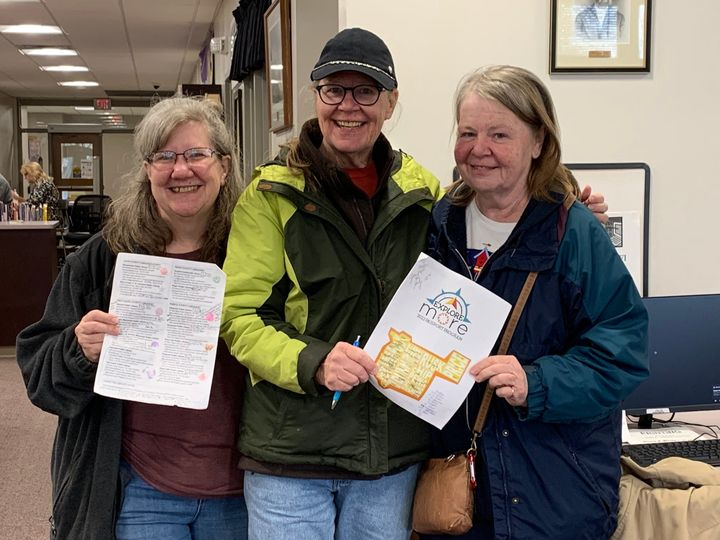
In the fall of 2021, Rebecca and her colleagues decided to explore a passport program system-wide. This program’s goal was to get people back into the library after the pandemic as well as educate people about the scope of their consortium services and benefits.
The idea was simple. All the libraries in the system had to have passports and entry forms available and a staff person to stamp passports and collect entry forms.
Setting a goal for any type of promotion is incredibly important to success. Rebecca had three things she wanted to accomplish.
First, Rebecca wanted patrons to experience the benefits of a library card firsthand. “We wanted to show how easy it is to check out and return items throughout our system,” she said. “We also wanted to send a clear message: Libraries are open, and libraries are fun!”
“Our app is new and includes navigation to all our locations in one handy spot, so this was a good opportunity to promote that. For our libraries, we wanted to increase circulation and engagement. A significant factor in support for library funding is having interacted with a librarian, so we built that in. We wanted people to engage with one of our wonderful librarians.”
Rebecca put her background in graphic design to work, creating a logo, a public-facing landing page on the system website, the passport, and marketing collateral.
“We printed enough for each library to get 25 passports,” explained Rebecca. “(We) sent them through courier as a kit that included a little rubber stamp, a stamp pad, signage, and a master sheet to make entry forms.”
Rebecca worked diligently to provide direction, content, and encouragement to her libraries. Each month, she emailed a marketing toolkit to all the participating libraries. The toolkit contained everything the libraries needed: a focused message; four social media posts with suggested messaging; updated posters; ideas from libraries, and comments from participants.
Some of the libraries took the passport program idea and ran with it. “Ellsworth handed out a water bottle with a bag of fun things that included a goat-milk soap sample from a local producer,” said Rebecca. “Clear Lake created prizes and a drawing of their own for their cardholders; Somerset ran out of their fun swag bags. Lots of libraries created great displays.”
The program was an outstanding success. Rebecca told me that over the course of the program, which ran from April 4 to July 15, participating libraries handed out more than 1500 passports and recorded more than 2800 stamps. Each of those stamps counts as one visit to the library. Nine people visited all 52 libraries!
Participating libraries saw robust circulation of travel-related items featured in library displays. Most libraries invited passport visitors to participate in other activities, like a scavenger hunt for kids in River Falls or library bingo in Menomonie. And they were able to identify some library super fans, who may become influencers in a future campaign.
Rebecca credits several factors for the success of the program, including timing and collaboration. “People were ready to go out and explore,” she explained. “And this was NOT a top-down promotion. It was library-driven the whole way.”
Rebecca has one final piece of advice for libraries looking to put together a successful program. Simplicity is key, she said. “We’re looking for ways to expand what the program offers without requiring a lot of extra work.”
Subscribe to this blog and you’ll receive an email every time I post. To do that, enter your email address and click on the “Follow” button in the lower left-hand corner of the page.
The Library Marketing Show, Episode 146: In this episode, we’ll answer a question from a viewer.
They want to know how far in advance to start promoting their library programs on social media. I’ll share some tips to help you find the “sweet spot” for your library audience.
Kudos in this episode go to the Ann Arbor Public Library. Watch the video to see why they’re being recognized.
Do you have a suggestion for a topic for a future episode? Want to nominate someone for kudos? Let me know in the comments. And subscribe to this series to get a new video tip for libraries each week.
Thanks for watching!
Subscribe to this blog and you’ll receive an email every time I post. To do that, enter your email address and click on the “Follow” button in the lower left-hand corner of the page.
In this episode, I’ll answer a question from Dianne at the Pottsboro Area Public Library. She has been trying to drive attendance to her library events using Facebook events. It’s not working. So she wondered what else she can do?
Kudos in this episode go to the Nashua Public Library. Watch the video to find out why they’re being recognized.
Do you have a suggestion for a topic for a future episode? Want to nominate someone for kudos? Let me know in the comments. And subscribe to this series to get a new video tip for libraries each week.
Thanks for watching!
Subscribe to this blog and you’ll receive an email every time I post. To do that, enter your email address and click on the “Follow” button in the lower left-hand corner of the page.
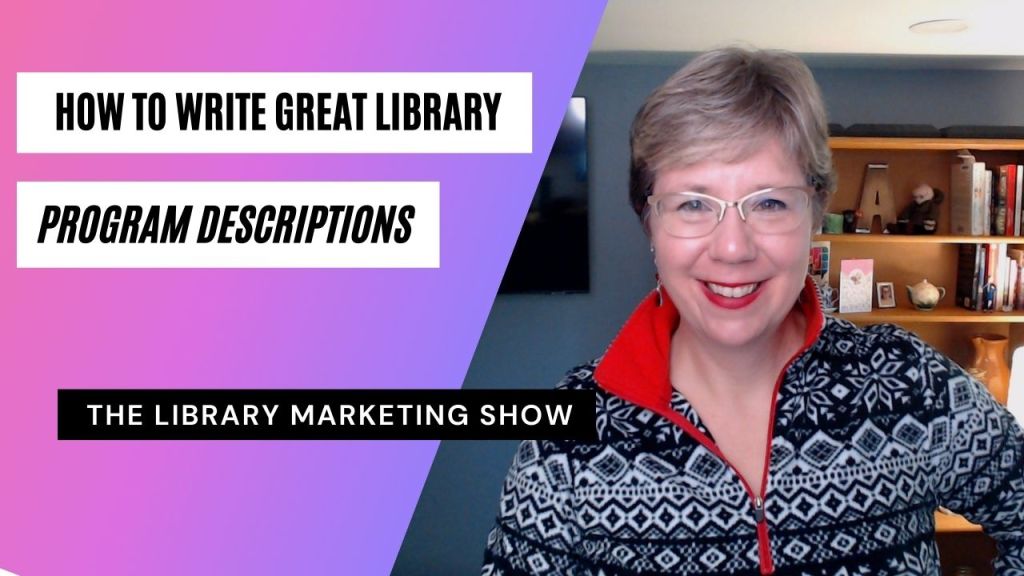
In this episode, I’ll answer a question from Leica who works at the Romeo District Library in Michigan. She said, “Would love some further suggestions for varying program descriptions, including making them more lively!” Thank you for the question, Lieca.
You can ask a question or nominate a library for kudos here.
Kudos in this episode goes to the Webster Parish Libraries. Watch the episode to find out why they’re being recognized.
Subscribe to this series to get a new video tip for libraries each week. Thanks for watching!
Subscribe to this blog and you’ll receive an email every time I post. To do that, enter your email address and click on the “Follow” button in the lower left-hand corner of the page.




 Super Library Marketing: Practical Tips and Ideas for Library Promotion