Search

Super Library Marketing: Practical Tips and Ideas for Library Promotion

Category

Signage

The Four Library Marketing Myths That Need to Die RIGHT NOW!

One of my staffers wrote a post for our Library’s blog recently about common library myths. You can read it here. That post got me to thinking about library marketing myths, and how library marketing professionals can “bust” them. Here are my top four choices.

My library marketing video/blog post/article needs to be short because people will only consume “snackable content.” This one is really prevalent for all kind of companies and institutions, and it’s so, so wrong!

At the beginning of 2019, I started to write longer blog posts. Did you notice?? I went from 500-700 words to between 1000 and 1500 words.

And what happened? My site stats jumped. Already in October of 2019, I’ve exceeded the number of views and visitors for the site in 2018. I’ve had twice the number of people reading each post as I did in 2018.

When you write long form, more people will read your posts. People stay on the site longer. They read multiple posts. This is also true for longer blogs written for our library’s website.

I made the switch to longer posts because I’d read a lot of research about long form content and its benefits. It’s not easy. I spend more time on each post. I have to do more research. I have to be careful not to add words or sentences just to fill this imaginary word count goal in my head. It’s sometimes difficult. But it’s worth it.

The smart people at a company call serpIQ did a study of the average length of the content in the top ten results of search queries. The company found that the top-rated posts usually were more than 2,000 words long.

If your post is written well, helpful, educational, interesting, and builds interest or suspense, people will stay on your site longer. This will boost your library’s web page rankings in Google and drive more traffic to your site. Long form content also builds trust in the authority of your library. There’s no downside to longer pieces.

The only exception to this myth is email. The text inside mail marketing messages should be short, because evidence shows people will not read emails that are longer than 200 words (sorry, fans of the newsletter). Your short email can and should link to a longer piece but the actual text body itself should be 50-200 words max.

A high open rate is the best way to tell that my library email marketing is successful. So many libraries focus on high open rates for their emails. It’s sometimes hard to contradict that measure. But I’m going to do it because I want your work to matter. And if your open rates are high, you may still be failing at email marketing. Hear me out.

Open rates do mean something. They are a sign of customer loyalty. A high open rate means that your cardholders are eager to see what you’ve sent them. And that’s good. You are writing compelling email subject lines (Good job, you!). You have a loyal and eager audience.

But it’s what happens AFTER your cardholders open your email that counts. If your click-thru rate is low, you’ll know the content you are sending to your cardholders isn’t what they want.

The higher the click-thru rate is, the more excited I get. It means that my cardholders opened an email, saw something they liked, and acted!

Most of the time, my library emails direct cardholders to do one of two things: click a link for a specific item in our collection or go to the event calendar where they can register or put an upcoming event on their calendar.

If a cardholder takes one of those actions is a huge victory. It gives me data about what that particular cardholder is interested in. And I can use that information to craft future emails that are also compelling for that cardholder.

As happy as I get over a high email click-thru rate, a high conversion rate is the most accurate way to measure email effectiveness. It is the percentage of people who take an action after clicking through.

For example, let’s say 100 people click-through to look at a book I promote by email. If 50 of those 100 people put the book on hold, my conversion rate is 50 percent.

Conversion rate is the gold standard for the success of any email campaign. Your goal should always be to get people to act!

I need to grow my Twitter/Facebook/Pinterest followers. I’m not saying that a huge social media following wouldn’t be nice. But in the age of algorithms, it’s not as important as it once was.

What you really want is a large audience of ENGAGED followers. You don’t just want people to see your posts. You want them to compel people to take an actual: like, share, subscribe, comment, post emojis, and generally jump up and down virtually.

It’s kind of like speaking at a conference. You might be thrilled at the prospect of talking to a huge group of people. But it’s disheartening if half of your audience is yawning or looking at their phones. It’s much more meaningful to speak in front of a small room of people who are riveted by what you have to say.

I don’t care how many followers my library has on any social account. I want to see people engage with our content. Focus on actions and not the number of followers.

If you need to tell your cardholder something, just make a sign. No one reads signs. Seriously, we just don’t. I lead the team that makes signs at my library FOR A LIVING and I don’t read them.

Too many signs in a branch, particularly in a small location, can create clutter and confusion. And too much signage can annoy your cardholders, particularly if most of your signs are bombarding them with marketing messages.

Just as white space works to create breadth and depth for a website or a graphic, well-spaced signage in a branch creates flow. About 75 percent of the signs in your library locations should be wayfaring only, directing cardholders to important service points in the building. The other 25 percent can be selective marketing–promoting services and items that are of interest to your cardholders.

Don’t rely on signs to convey everything you want to tell the customer. Hire staff who are willing to speak with customers and show customers where items are located.

Do you have a myth you encounter in your work? Let me know about it, and how you’re busting it in the comments.

Subscribe to this blog and you’ll receive an email every time I post. To do that, click on “Follow” button in the bottom left-hand corner of the page. Connect with me on YouTube, Twitter, Instagram, and LinkedIn.
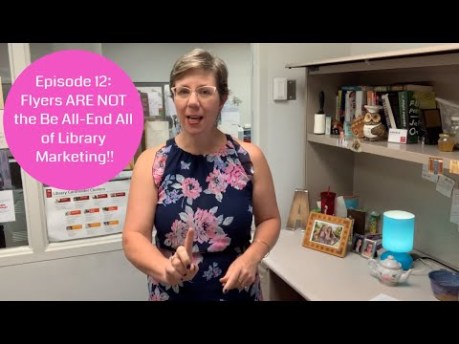
The Library Marketing Show Episode 12: How to Convince People that Flyers ARE NOT the Be All, End All of Library Marketing!!

Watch Now

In this episode, we’ll answer a reader question from Jenny at the Redwood City Public Library about how to address that age-old complaint: WHY CAN’T I HAVE MORE FLYERS? FLYERS ARE AMAZING! from your fellow library staff and how to convince them that digital promotions are worth time and effort. Thanks for the question, Jenny!

You can submit a question or a discussion topic by going to this page and filling out the form.

Also Kudos to Stark County Library in Canton, OH –find out why I think they’re amazing.

And a book review of “Calypso” by David Sedaris PLUS find out which book I couldn’t finish and why!

Stay in Touch

I’m speaking at two conferences this fall and you can register for both on the Upcoming Events page. I just finished the slides for OLC! I’m really excited about that one. Details about the talks at both conferences are on the page and more events are coming soon!

Have an idea for the next Library Marketing Live Show? Submit it now.

Subscribe to this blog and you’ll receive an email every time I post. To do that, click on “Follow” button in the bottom left-hand corner of the page. Connect with me on Twitter, Instagram, and LinkedIn.  

Five Excellent Ways To Improve Every Sign in Your Library

I have a love/hate relationship with library signage.

Part of my job as a marketing professional in a major metropolitan public library is to conduct signage evaluations and to make changes or improvements to the signs in our 41 locations. As a customer, I know how helpful the right kind of signage can be, and my perspective as a customer helps me to understand the importance of the task. But to be honest, it’s probably one of my least favorite job requirements. That’s because I’ve found that signs seem like a simple thing but are, in truth, very complicated. My coworkers and my cardholders have passionate feelings about them.

Good signage serves as a silent employee to draw cardholders to your location, direct traffic inside your building, and answer basic customer questions. Signs can actually be a part of your library’s overall strategy and should certainly be worked into your marketing strategy each year. Ask yourself: What are your library’s overall goals, and how can signs help to meet those goals?

The task of tackling your library’s signage is much easier when you have brand specifications documented. The color, size, and language should be consistent throughout the building and multiple locations. Once you have that document created and have decided how signage will help you to execute your library’s goals, here are five tips to keep in mind as you work on signage for each building.

Tip #1: Less is more. Too many signs in a branch, particularly in a small location, can create clutter and can actually cause confusion. And too much signage can actually annoy your cardholders, particularly if most of your signs are bombarding them with marketing messages. Just as white space works to create breadth and depth for a website or a graphic, well-spaced signage in a branch creates flow. About 75 percent of the signs in your library locations should be wayfaring only–directing cardholders to important service points in the building. The other 25 percent can be selective marketing–promoting services and items that are of interest to your cardholders or that might be of interest to them, based on their patterns of checkout.

Tip #2: Match the signage display to the user of each physical space. Make sure that in your children’s area, the signs, shelves, and computers are all lowered to be a child’s level. Create larger signs for the section that holds your large print items. Place teen signs where the teens hang out, like near charging stations or computers. Use a combination of large and small signs to blend with the space requirements in your library and to keep your signage from becoming monotonous, without being overpowering.  Use a bold font and keep colors and designs simple.

Tip #3: Your library materials make the best displays. Use them instead of signs. Think about how your local bookstore will display books. They often turn them front-facing. Why? Book covers are a visual cue and publishers spend thousands of dollars creating beautiful and eye-catching covers. Use these designs to create a visually pleasing display instead of a sign. A good display will not even need a sign–it should be obvious to the cardholder what you are trying to market to them.

Tip #4: Use customer-friendly, positive language. Cardholders prefer conversational language in all our marketing, so it makes sense to incorporate that into your signage. Some examples are:

Replace self-check or circulation with checkout.

Replace reference with information.

Replace periodicals with magazines.

Replace juvenile with children’s and teens.

I know this is controversial but I’m saying it anyway. Drop the Dewey decimal system from your end panels and arrange your fiction and nonfiction items alphabetically. And incorporate positive language into your signs. Don’t tell customers what they can’t do. Rather, tell them what they can do or how they can enjoy a particular space or item in the collection.

Tip #5: Don’t forget the signs on the outside of your building. Your main sign should say LIBRARY in large letters. Save the actual name of the building, particularly if it’s a long name, for smaller letters by the door. Make sure your open and close times are large and clear and in an easy to spot location. The same goes for the signage for any outdoor services like book drops or drive-thru windows. Make sure the signs are as large as is allowed by your local government.

Bonus tips: Don’t rely on signs to convey everything you want to tell the customer. Hire staff who are willing to speak with customers and show customers where items are located with patience and kindness. And set a schedule for re-evaluating and refreshing your signage–once a year, if you can handle it.

Subscribe to this blog and you’ll receive an email every time I post. To do that, click on “Follow” button on the bottom left-hand corner of the page. Connect with me on Twitter and Snapchat–it’s where I talk about library marketing! I’m @Webmastergirl. I’m also on LinkedInInstagram and Pinterest. Views in this post are my own and do not represent those of my employer.

A WordPress.com Website.

Up ↑