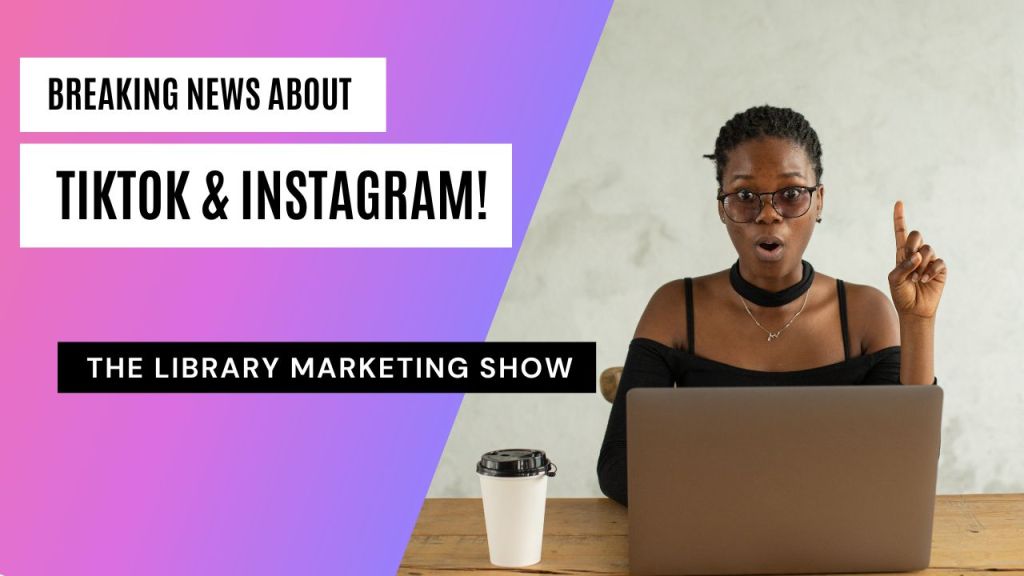
The Library Marketing Show, Episode 169: We have news that could have an impact on your library’s social media strategy.
First, TikTok is testing audience insights, which give you a deeper look into your audience. We’ll talk about the features that could be a regular part of your data very soon.
Plus a new study from Pew Research Center uncovers how teens view social media use. And there are lots of takeaways for libraries.
Do you have a suggestion for a topic for a future episode? Want to nominate someone for kudos? Let me know in the comments.
And subscribe to this series to get a new weekly video tip for libraries.
Thanks for watching!
Subscribe to this blog and you’ll receive an email whenever I post. To do that, enter your email address and click on the “Follow” button in the lower left-hand corner of the page.
The Library Marketing Show, Episode 168: This episode is another must-watch for any library that posts on Twitter.
Elon Musk’s takeover of the social media platform has thrown Twitter into chaos. And many libraries are seriously thinking about deactivating their accounts.
I’ll share three things to consider before you make that decision. PLUS: I’ll share an alternative to deactivating your Twitter account.
Do you have a suggestion for a topic for a future episode? Want to nominate someone for kudos? Let me know in the comments.
And subscribe to this series to get a new weekly video tip for libraries.
Thanks for watching!
Subscribe to this blog and you’ll receive an email whenever I post. To do that, enter your email address and click on the “Follow” button in the lower left-hand corner of the page.
The Library Marketing Show, Episode 167: This episode is a must-see for any library that posts on Twitter.
Elon Musk’s takeover of the social media platform has put accounts at risk. I’ll explain the threat and the four steps your library can take right now to reduce the chances your library’s account will be cloned or hacked.
Do you have a suggestion for a topic for a future episode? Want to nominate someone for kudos? Let me know in the comments. And subscribe to this series to get a new weekly video tip for libraries.
Thanks for watching!
Subscribe to this blog and you’ll receive an email whenever I post. To do that, enter your email address and click on the “Follow” button in the lower left-hand corner of the page.
The Library Marketing Show, Episode 166: This episode is all about click-thru rates for digital promotions!
This topic was suggested by a viewer named Lily who says, “We have a super high open rate and super low click-through rate. Could you talk CTRs?” I sure can!
Do you have a suggestion for a topic for a future episode? Want to nominate someone for kudos? Let me know in the comments. And subscribe to this series to get a new weekly video tip for libraries.
Subscribe to this blog and you’ll receive an email whenever I post. To do that, enter your email address and click on the “Follow” button in the lower left-hand corner of the page.
The Library Marketing Show, Episode 165: I need your library’s help forcing a change that will make social media more accessible to everyone.
I’ll explain why your library should use camel case hashtags and how you can join the movement to make camel case the default option for all social media platforms.
Do you have a suggestion for a topic for a future episode? Want to nominate someone for kudos? Let me know in the comments.
And subscribe to this series to get a new weekly video tip for libraries.
Thanks for watching!
Subscribe to this blog and you’ll receive an email whenever I post. To do that, enter your email address and click on the “Follow” button in the lower left-hand corner of the page.
In this episode, I have three whopper social media headlines to share.
First, there is new insight into the Facebook and Instagram algorithm. What does this mean for your library? We’ll talk it through.
The second headline is making me reconsider the advice I give to libraries. And the third piece of news is about a change that will make it easier for you to make your library promotions accessible.
Want to learn how to transcend social media algorithms? I’ve launched a self-paced course called Conquering Social Media: A Strategy for Libraries. And readers of my blog can use the discount code SUPERLIBRARYMARKETING at checkout to get 20 percent off!
Do you have a suggestion for a topic for a future episode? Want to nominate someone for kudos? Let me know in the comments.
And subscribe to this series to get a new weekly video tip for libraries.
Thanks for watching!
Subscribe to this blog and you’ll receive an email whenever I post. To do that, enter your email address and click on the “Follow” button in the lower left-hand corner of the page.
In this episode of The Library Marketing Show, I’ll answer a question from the viewer about sharing original content from other creators on social media.
This viewer asked for clarification on the correct online etiquette for sharing content, specifically cartoons or memes, from another page. I have two tips that worked for me when I worked in a library plus advice from experts.
Kudos in this episode go to Saul Hernandez of the Charlotte Mecklenburg Public Library.
Do you have a suggestion for a topic for a future episode? Want to nominate someone for kudos? Let me know in the comments.
And subscribe to this series to get a new weekly video tip for libraries.
Thanks for watching!
Subscribe to this blog and you’ll receive an email whenever I post. To do that, enter your email address and click on the “Follow” button in the lower left-hand corner of the page.
In this episode, I will share four major social media headlines for libraries. These pieces of news apply to any library using TikTok or Instagram, and they could have major implications for your library’s promotions–in a positive way!
Kudos in this episode go to Berkley Library. Watch the video to see why they’re being recognized.
Do you have a suggestion for a topic for a future episode? Want to nominate someone for kudos? Let me know in the comments.
And subscribe to this series to get a new weekly video tip for libraries.
Thanks for watching!
Subscribe to this blog and you’ll receive an email every time I post. To do that, enter your email address and click on the “Follow” button in the lower left-hand corner of the page.
Photo courtesy Cincinnati and Hamilton County Public Library
In my many years of personal and professional social media use, I’ve never gone viral.
Until two weeks ago.
My brief moment in the sun came out of nowhere. And it was so crazy that I wanted to dissect it, to see if there was any lesson I could share with my library friends.
Experimenting with Instagram Reels
For the past few months, I’ve been experimenting with Reels so that I can give the best advice possible to libraries.
I started by creating my own original Reels. I shared recipes, book reviews, and homages to my co-worker. The results were nothing to write home about. I got a couple hundred views and a few likes for each video.
Then I changed focus. I decided to share my favorite genre of TikTok videos. These videos feature lots of home organization gadgets and cleaning products in action. They’re soothing to watch and usually contain some oddball element, like a fake plastic spider in the rice container!
I screen-record these videos. Then, I re-upload them on Instagram with my own narration, pointing out the things I love. I use similar captions and hashtags for every video. Sometimes I add emojis to the caption. I also add close-captioning to all the videos, using Instagram’s in-app creator tool.
Hitting the jackpot
On Sunday, August 14, at 3:30 p.m., I uploaded one such Reel.
This was the fourth Reel in my experiment. The most popular of the last three Reels got 4500 views and 26 likes.
But for some reason, this Reel was magic.
It received 1800 views in the first 20 minutes and a constant stream of likes. It was so wild that I took a screen recording of the notification stream.
Then I looked again at the views 40 minutes after I posted the video, and my jaw dropped.
22,000 views.
For a brief moment, I felt like that most popular girl at the dance.
But it was over as quickly as it started. 60 minutes after I posted my Reel, the notifications abruptly stopped. And the view count halted.
Understanding the Instagram Reels algorithm
The first step in the journey to dissect the success of this Reel is to understand the Instagram algorithm.
The main goal of Instagram Reels is to entertain. As a result, many of the videos that show up in a follower’s feed are from accounts they don’t follow.
And that’s certainly true with my Reel. Nearly all the likes I received from my Reel were from non-followers. Instagram was showing my Reel to those people because the algorithm predicted that my content would entertain them enough that they would watch all the way through and like or comment on the video.
These predictions are called ranking signals. They are part of every social media platform’s algorithm. The ranking signals for Instagram Reels are:
Recent user activity: Instagram predicts which Reels its users will find engaging by comparing new content with the kind of Reel a user has most recently liked, shared, or commented on.
Interaction history: If an Instagram user interacts with an account, Instagram will continue to show them content from that account, even if they aren’t a follower of that account.
Reel information: Signals about the content elements in a Reel, including the audio, hashtags, and keywords in the caption, help Instagram decide who to serve the Reel to.
Information about the poster: Instagram serves Reels from accounts that post consistent, entertaining videos.
Other factors that can impact the engagement of your library’s Reels
There are a number of things your library can do to try and boost the reach of your Instagram Reels.
Post at the right time
Since interactions are a strong ranking factor in the Instagram algorithm, you need to get as many likes and comments as possible within the first few seconds of posting your content. That’s why it’s important to catch your followers when they’re the most active on the platform.
The perfect timing will be different for every library. Check your Instagram insights to see when your audience is most likely to be using Instagram.
Carefully consider your caption
Write captions that give context or tell a story about your Reel. Consider a longer caption to boost the time people spend interacting with your posts as they read your caption.
Add one or two hashtags to your caption. Hashtags are an important ranking signal as they help the algorithm to understand what content is contained in your Reel.
Finally, add emojis to capture the attention of scrollers.
Interesting content outweighs expert advice on length
Experts say the optimum length of an Instagram Reel is 7 to 15 seconds. However, my viral Reel was much longer, at several minutes.
I’ve been experimenting with Instagram Reels length. I’ve found that length really doesn’t matter, so long as your video is interesting.
Really, it was just plain dumb luck
It’s most likely that my experience had nothing to do with my skill on Instagram. In fact, I’m sure of it.
Going viral on social media is like winning the lottery. You can plan and strategize and spend lots of time creating great content. And you may never go viral. That’s okay!
Going viral will bring you fame and brand recognition in markets outside of your service area. But that won’t increase your circulation or program attendance.
Your library’s goal should not be to go viral. Rather, create engaging content that speaks to YOUR audience and aligns with your library’s overall goals.
Final results and what I learned
In the two weeks since I posted my Reel, it’s received nearly 23,000 views and 609 likes. I got about 15 new followers from the Reel.
I have not seen a substantial increase in the number of visits to my blog. And I’ve got no website traffic or purchases for my day job at NoveList.
So, while it was exciting and interesting, my viral Reel did nothing to help me reach my strategic goals.
And that’s the most important thing to remember about social media. You can’t control who sees your library’s content. But you can create engaging posts aligned with your library’s goals.
Want to learn how to transcend algorithms and get the best results for your library’s social media promotions? I’ve created a self-paced course to help you reach your goals.
Subscribe to this blog and you’ll receive an email every time I post. To do that, enter your email address and click on the “Follow” button in the lower left-hand corner of the page.