Search

Super Library Marketing: Practical Tips and Ideas for Library Promotion

Category

Storytelling

Five Creative Ideas to Help You Beat the Blues, Get Inspired, and Create Amazing Library Marketing Campaigns Again!

It is hard to believe that in a building filled with the stories, a library marketer would need inspiration.

But alas, we are human. And sometimes we get stuck in a rut.

Library marketers are expected to be energetic and enthusiastic at all times. We must come to all meetings and be able to give a list on the fly of exciting and innovative ideas for promoting major developments and smaller decisions that affect the everyday cardholders.

I don’t know about you, but sometimes, I just too plain exhausted to be the marketing superwoman. The busyness of the library summer reading season seems to melt every year into the busyness of fall. There is little time to rest. And exhaustion makes it even more difficult to find creative inspiration.

We struggle to inspire our cardholders, both old and new. We want our customers to use our collection and enjoy our services every day, but we can’t seem to figure out a way to make them act. The tried and true methods of marketing no longer work and we’re frustrated, angry, and frankly, a little worried.

Here’s what I do when I find myself stuck in a marketing rut.

Define your workflow and make it the law of your marketing landscape. A defined outward-facing workflow sounds like the opposite of a creative endeavor. But in reality, it creates space for you to think. It ensures that you have time to be thoughtful so you can develop and deliver a quality product.

Set an expectation about who will manage workflow. That means all marketing requests go through one person on your team. That person is responsible for looking at the request and determining if it fits into the library’s overall strategic goals. That person sets clear expectations and goals for each project. That person communicates a plan of action based on realistic timelines and due dates.

Let me tell you: a defined workflow is a lifesaver. It reduces stress and anxiety for everyone on your team. When your staff understands what is expected of them, they can focus on the creative parts of the job.

If you are new to your library, it will take time to get a smooth workflow in place. Be patient with yourself and with others. Keep reinforcing your expectations. Eventually, your coworkers will be on board with you, especially when they start to see results.

Be generous with positive reinforcement. Positive reinforcement always creates an emotional experience for individuals or a team working together. Don’t just say, “Well done.” Write a note or a card praising specific actions or portions of work. Give yours staff unexpected breaks: team lunches and surprise treats can lift the spirit of your team and re-energize them.

Use your staff’s strengths to create passion for the work. I highly recommend that you invest in the Gallup Strengths Finders test. It gives you incredible and nuanced insight into yourself and your staff members. It shows you how to recognize the strengths of your team members and how to actually manage them to put those strengths to good use. You can find the book by Tom Rath at Walmart and Target for about $15. It includes a code that each team member uses to take the test online.

Through the Gallup process, I discovered my team members have a strong capacity for collaboration. This wasn’t much of a surprise to me. But the book also gave me suggestions for how to actually use that desire for collaboration to the advantage of my library. It also gave me greater insight and empathy for team members who prefer to work alone or who seem resistant to change. I can assign tasks to the best person for each job. It’s really changed the dynamics of my staff and made work easier for everyone.

Observe your customers. It helps me just to take a walk around the library or to visit the branches. I pretend to be browsing the books but really, I’m watching the way the cardholders browse the shelves, interact with staff, work the self-checkout machines and use the public computers. Do they look for a map? Do they look confused? Are they drawn to a particular book display? Do they linger over the new books or do they dash in for their holds and dash out? What questions do they ask? How do people actually move through the branch?

Observing the behavior of customers inside the library can give you an idea of what visitors love and what problems they encounter during their interaction with your system. Then, you can focus on creating new marketing ideas that spotlight the things your cardholders love, and answer the questions they have.

You can also observe online visitors. Spend some time poking around Google Analytics. Figure out which pages get the most visitors. Look for the pages where visitors stay for the longest period of time. Look for the landing pages with a high bounce rate. Page views and read time will help you focus effort on improving the customer experience for your website.

Check your statistics.  Our library makes circulation and programming stats available on our intranet. This little piece of data inspires me to find ways to help make their interaction with the library more worthwhile.

Sometimes a surprising trend emerges and that gives me a creative marketing idea. Sometimes a service takes a dip in usage, and it becomes clear that we need to shift our marketing focus to re-educating the public about that service. Data is such a valuable inspirational tool. Use whatever stats you can get your hands on!

More inspiration

11 Powerful Quotes for Marketing Inspiration

5 Ted Talks for Marketing Inspiration

Need Marketing Inspiration? It’s All Around You!

Subscribe to this blog and you’ll receive an email every time I post. To do that, click on “Follow” button in the bottom left-hand corner of the page. Connect with me on YouTube, Twitter, Instagram, and LinkedIn.  And check my list of upcoming events so we can connect.
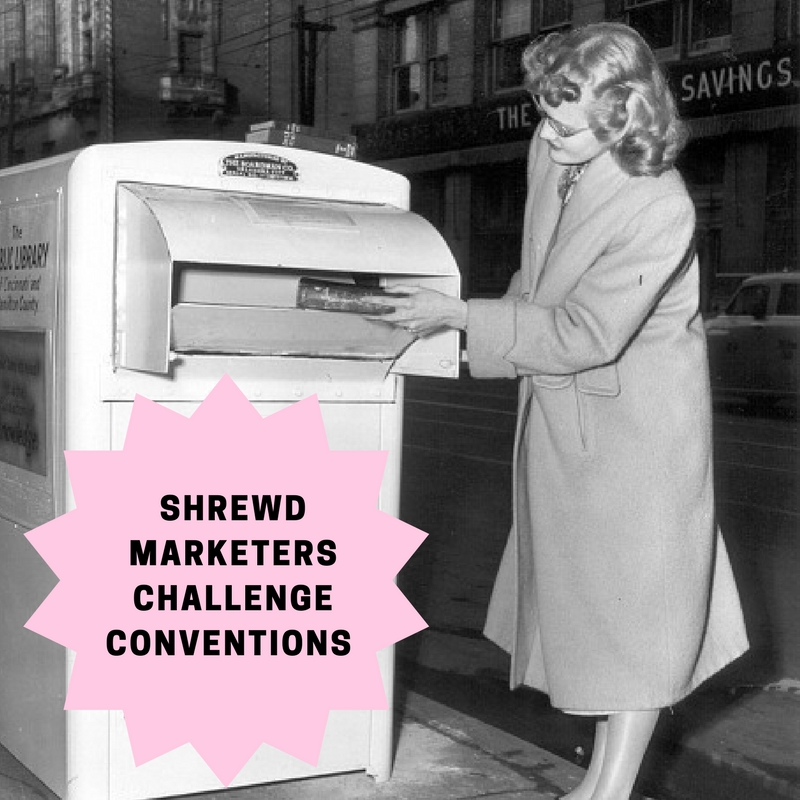
Shrewd Marketers Challenge Conventions. So Should We!

I’ve thought a lot lately about how to approach library marketing in a new and fresh way. As my library creates and executes our strategy for summer reading, I am looking at each tactic and wondering if we can improve the marketing of this legendary initiative. According to the American Library Association, summer reading programs began in the 1890s as a way to encourage school children, particularly those in urban areas and not needed for farm work, to read during their summer vacation, use the library, and develop the habit of reading. That’s a long time to be marketing a program and I think the industry might be a bit stuck in terms of how we do it.

For inspiration, I’ve looked over notes from a session I attended at Content Marketing World. It was led by Doug Kessler, co-founder and creative director of Velocity Partners, a B2B marketing agency with offices in the U.S. and England. Doug’s session was inspiring. It was titled Exceptional Content–Challenging the Invisible Conventions of Marketing. I printed out my notes and have read them through each morning, then thinking about the points he made every time I need a brain break.

Kessler focused his session on a concept he calls invisible conventions. We have so many invisible conventions in libraries. These are the ideas and practices that library staffers hold as traditional and unchangeable. If you hear someone say, “But we’ve always done it that way”, you know you’re talking about their invisible conventions. Invisible conventions are powerful.  Kessler says they guide and constrain us without us even knowing it.

We do need conventions.  But we don’t need to be slaves to convention. Kessler says it’s our job as marketers to expose the hidden conventions in our institution and play with them. Libraries can’t be precious about their conventions because your cardholders aren’t.  Conventions are a signal to your cardholders that marketing is involved–even if you’re trying to be sneaky about it. Your customers are smart, and they’ll put up their defense barriers.

Think about how you respond to marketing messages for invisible conventions. We’ve all developed a sense of when the pitch is coming and we run the other way! You don’t want to turn off your cardholders–you want to inspire them. But if you hang on to your invisible conventions for safety, you’ll never move forward in the marketing of your library.

Challenging your invisible conventions isn’t going to make you very popular, Kessler warns. And that’s okay. Your administration, leaders of other departments, even fellow librarians may have a strong reaction when you decide to challenge conventions. They are more comfortable with traditional marketing practices and they want you to create pieces that make them feel comfortable. Be strong. Take the long view. Persuade your co-workers that change is necessary and that safe marketing isn’t going to cut it with your cardholders. Your job is not to make everyone else in the library happy. Your job isn’t to make friends with everyone in you work with. Your job is to serve your cardholders, and you can only do that when you put your cardholders first. If that means you need to throw convention out the window, then it’s the best move. Don’t second guess yourself. When your instincts as a marketer tell you that something needs to change, you are right. Change it.

I’m reminded of advice I heard from another Content Marketing World speaker, Amanda Todorovich of the Cleveland Clinic. She confessed she’s made some people at the hospital unhappy with her relentless focus on the customer. She has a strategy and she often says “no” to people who want her to do conventional marketing. That means there are some folks she works with who don’t like her. Amanda is okay with that because she realizes her job is to serve the patients, not her co-workers. I draw inspiration from her attitude when I’m faced with having a difficult conversation with a co-worker. You can too! (Read my post about Amanda here.)

So how do you turn conventional marketing on its head? By doing more content marketing. Kessler says, thanks to the companies who came before us, the public knows marketing messages are often filled with compulsive and shameless lies (thanks, cigarette companies). Traditional marketing is all about the brand: a one-sided sales message.  Content marketing, by contrast, is all about the audience. Content marketing rewards libraries for telling the truth. It’s focused on utility–how can we best help our cardholders. It delivers value, builds trust, and it gives our cardholders the power!

Kessler left me with a final thought: unconventional marketing can lead to great stories. Be straight, simple, conversational, and relevant. You will change hearts and minds.

Subscribe to this blog and you’ll receive an email every time I post. To do that, click on “Follow” button on the bottom left-hand corner of the page. Connect with me on Twitter and Snapchat–it’s where I talk about library marketing! I’m @Webmastergirl. I’m also on LinkedInInstagram and Pinterest. Views in this post are my own and do not represent those of my employer.

Four Instant Ways to Improve the Most Valuable Page on Your Library Website

I find lately that I’m obsessed of late with library web pages. I’ve set aside time every week to look at how different libraries around the world set up their websites. What do library’s feature or highlight their homepage? How robust is their search engine? What’s in their drop-down menu? How is their library staff set up?

That last question usually ends with me scrolling through a library’s “About Us” page. And it’s there that I really get a sense of that organization, how it views itself, and how it views its relationship to its cardholders. This research brought me recently to this conclusion: Most libraries, including mine, need to update their About Us page.

Your library’s About Us page can be a gateway to all kinds of traffic to your website. Perhaps your analytics show that you aren’t getting any visits to that section of your website and therefore, you might think you don’t need to mess with it. But if you want to increase your market penetration or if you are considering any campaigns or direct marketing messages to increase the number of cardholders you serve, you’re going to want a kick a** About Us page. Likewise, if your library is in the midst of a levy campaign or waging any kind of battle with your city or county over funding, hours, or locations, your About Us page could help you in that battle. And that page will need to look inspire to win new users and funding.

The concept of a revolutionary change in the way About Us web pages are written and formatted is something that gets a lot of discussion in marketing circles for major brands. I hear it all the time at Content Marketing World. Many big companies have moved away from a traditional approach–a long and wordy mission statement in non-conversational language that usually includes goals which have no meaning to the customer. They’re writing in a conversational tone, including specific calls to action for customers, and striving for full transparency. They’re using their About Us page to connect with potential customers, build trust, and communicate what their brand stands for and what the customer can expect from a relationship with that brand. And I think it’s about time for the library world to get on board.

Chicago Public Library’s page is minimalist with clear language and an easy-to-navigate menu.

We should transform our About Us pages into something that really has meaning to our community. This is the web page where decisions are made by all of your stakeholders. You want the page to make potential cardholders feel “at home” and community leaders understand what it is that your library does and why it’s vital.

Here are four ways to transform your About Us page from an abstract section of your website into an amazing marketing tool.

Focus on the cardholder. Here’s a thought that many libraries have a hard time grasping: your About Us page isn’t actually about you. It’s about your cardholders. What is it that your library can do for the cardholder? Take your mission, vision, and values statement, which is likely written in lofty language, and rewrite it in a conversational tone. Or drop it from the page altogether! I know that’s a controversial standpoint but if your mission, vision, values statement is written with a bureaucratic bent, it won’t have any meaning to anyone outside your organization. Instead, think of your About Us page as a conversation between you and a non-library user. How would you, in normal conversation, tell someone about all the things your organization does? That’s what your About Us page should say. You might also take the opportunity to answer the most frequent questions your library gets from new cardholders.

I love how the Columbus Public Library answers the #1 most frequent question right on their About Us page.

Tell your Library’s story. Whether your library has been around for decades or is newly formed, there’s a fantastic story about its birth and its longevity. Tell it on your About Us page, in a paragraph, with inspiring and optimistic language. Keep your bragging to a minimum. If your library has won many awards, you can mention them briefly and put them into the context of how that award translates to better service for your cardholders.

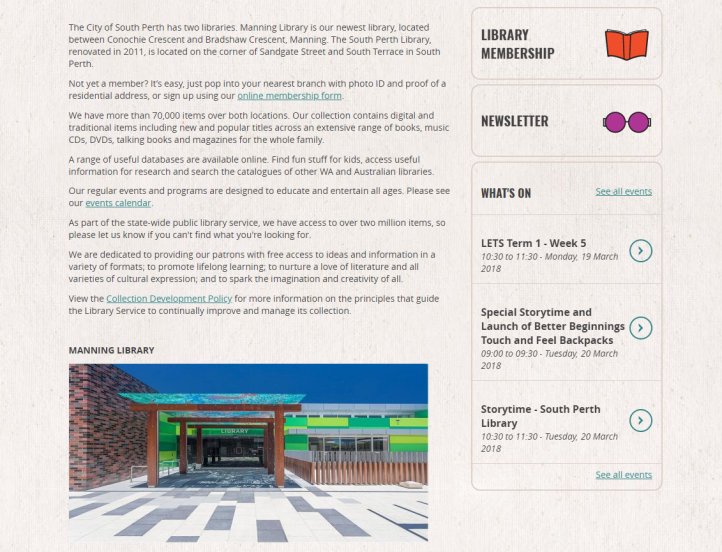
The Perth, Australia library’s About Us page includes all the essentials-how to get a card, sign up for a newsletter, and what is happening today at the library.

Less is more. Many libraries, including mine, have a long list of accomplishments and sub-headers on their About Us page. My library has 19 clickable sub-links!  Pare it down. White space is good. Pick the five most important things you’d want people to know and move the rest to another section of your website. Remember, your About Us page isn’t really about you… it’s about your cardholder. What are the five things a person would need to know to convince them to get a library card or to give you more money?

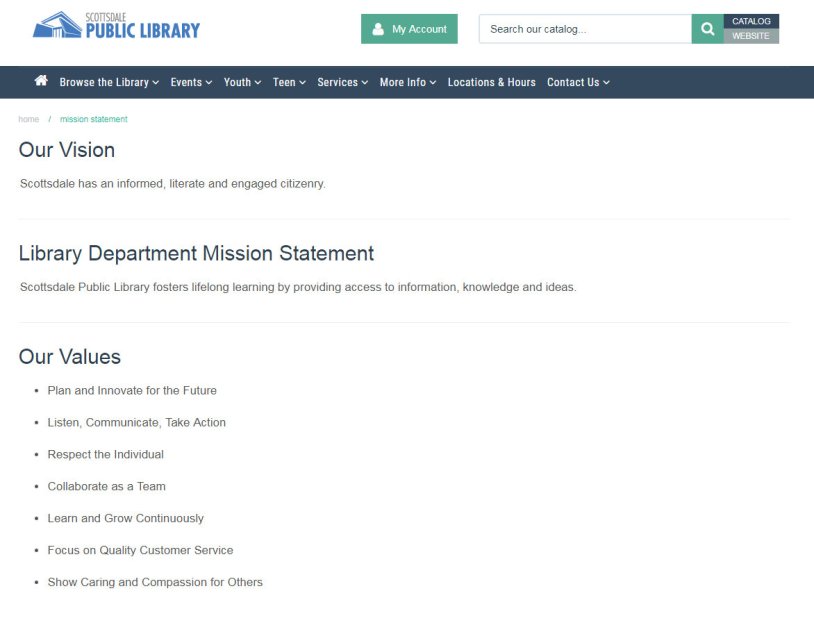
The Scottsdale, Arizona library takes a minimalist approach and it works!

Visuals are key.  Great, high-resolution photos that show people using your library and the workers who man the buildings are essential. Photos of faces are scientifically proven to be a more effective communication tool that text. Bold, easy to read fonts and primary colors work best for communicating ideas and drawing the eye to the page. Keep text to a minimum and pare down to five concepts that will tell your story.

I like how the Toledo Public Library’s page is heavy on visuals and includes easy-to-navigate sub links written in plain language.

Subscribe to this blog and you’ll receive an email every time I post. To do that, click on “Follow” button on the bottom left-hand corner of the page. Connect with me on Twitter and Snapchat–it’s where I talk about library marketing! I’m @Webmastergirl. I’m also on LinkedInInstagram and Pinterest. Views in this post are my own and do not represent those of my employer.

Manipulating Cardholder Feelings to Get Results

A cardholder recently leveled an accusation against my marketing department for making her feel all the feels.

Here’s the brief story: our library is trying to raise money for a facilities plan. We have several Carnegie-era branches that are not yet accessible to those with disabilities. So we’ve started a content marketing campaign to educate our cardholders and the residents of our service area about the problem, as we will be asking them for money to fund the facilities plan. In our first video portion of the campaign, we interviewed a veteran who cannot get into the library branch in his neighborhood.

When we released the video, one of the viewers sent us a message. She said, “How dare you  manipulate my emotions and try to make me feel sorry for this guy.” I think this person was trying to make us feel guilty for marketing to her.

Sorry, not sorry.

Emotional marketing is effective. We have seen it work time and again for our library and other libraries. You may remember the story of the Leeds Library campaign, which used story-driven emotional marketing to change that community’s perception of the modern library and its value. Leeds won an award for their campaign, and one judge commented, “We loved the application of real-life, personal journeys to draw on the emotions, capture the imagination and change the perceptions of the audience.”

Effective marketing appeals to emotions, not logic, reason, or even facts. This is particularly effective in the world now, where social media algorithms are cutting into our organic reach. If we want better unpaid reach, we need to constantly engage our audience. To constantly engage our audience, we need them to take an action on every post. To get them to take action, we need to motivate them through emotion.

Research from the Institute of Neuroscience and Psychology at the University of Glasgow, published in Current Biology, says humans really feel just four basic emotions: happy, sad, afraid/surprised, and angry/disgusted. The kind of messages that get us engagement are all based on these basic emotions. When you feel happy or angry, you want to share that emotion with others in your social network. When you feel sad, you empathize with the subject your sadness and feel a motivation to help ease their suffering. When you are afraid, you want to take action to ease your fear.

Your most loyal cardholders are likely already emotionally connected to your brand, particularly if you work in a school or public library. The people who already use your library on a regular basis know it’s value. I bet you have superfans, and you know who they are. So what do you do with all that emotion? How do you make it work in your library’s marketing?

Ask loyal customers to share their stories with you. Conduct interviews with those passionate customers by email or on video and use those answers in many ways. Video marketing is the best way to capture emotion. There is no substitute for talking to someone on camera, for hearing their voice and seeing their facial expressions as they talk about your library. You don’t need fancy equipment. Pull out your cell phone, have them stand facing a window or head outside for a few minutes to take advantage of the natural light, and then ask them some emotionally charged questions about their library experience.

What is your favorite library memory?

Tell me about how the library has changed your life.

How would you feel if the library suddenly closed tomorrow?

If a  neighbor asked you to describe how you feel about the library, what would you say?

Ask your staff to share their stories with you. The next time you’re at an all-managers meeting, visiting another branch, or enjoying lunch with a fellow employee, ask them about life in their branch. Ask them to describe their customers. Inevitably, they’ll have one or two specific examples of people who have an unbridled enthusiasm for their location, or whom the branch staff has helped with a specific problem. Once again, pull out your phone, find some good lighting, and ask open-ended questions like:

How did that request by that cardholder make you feel?

Tell me how the situation was resolved.

Did you worry about how you would handle that request?

What is your relationship with the customer now?

And for good measure, I always ask, What compelled you to look for work in a library?

You can post these emotional marketing videos as a whole edited piece or in sections. You can turn the quotes into a printed piece for your newsletter or email list. You can create digital slides or posters in your branches using the quotes. My library used this tactic last year for a series of videos we called Customer Impact stories. We posted them on YouTube and on Facebook and is was one of our first pieces of video content marketing. The audience and our staff LOVED them. We broke them down and used them in our Library Links publication and in other ways, and they prompted more customers and staff to come forward with more amazing stories. It wasn’t hard and it didn’t take a long time to put together. It was effective. Score!

Adding emotional marketing to your regular promotional schedule keeps your cardholders engaged and feeling all the feels whenever they think of your library. It’s not something to apologize for. It’s something to be proud of.

Subscribe to this blog and you’ll receive an email every time I post. To do that, click on “Follow” button on the bottom left-hand corner of the page. Connect with me on Twitter and Snapchat–it’s where I talk about library marketing! I’m @Webmastergirl. I’m also on LinkedInInstagram and Pinterest. Views in this post are my own and do not represent those of my employer.


Library Marketing Secrets You Can Steal From General Electric

The woman who manages marketing at one of the biggest companies in the United States–and perhaps the world–made a huge impression on me at Content Marketing World. Linda Boff is Chief Marketing Officer at General Electric. You might think a huge brand like GE would be mired in traditional marketing practices and have nothing to teach us about agility and experimentation. You would be wrong.

Boff has led the company into a new realm of marketing, using tactics that libraries have access to, like podcasts and Facebook Live. Her focus is storytelling–finding the stories within your company and sharing them with your audience. She insists you don’t need a big budget to do what she’s doing. She’s a dynamic speaker and her presentation was one of the more memorable moments in the two-day conference because I ended up coming away with so many ideas for my library marketing. I left the room excited and energized!

Boff says there are five reasons to tell your library’s story: To sell (library translation: improve circulation, visits, and attendance), to inspire, to explain strategy, to reach audiences, and to educate. She told the audience that the success of GE with storytelling relies on a simple formula: Be first on platforms + activate unlikely audiences + find the human in the digital times. She laid out exactly what she means in her main brand storytelling tips.

Know who you are. GE embraces its nerd identity. The company produced a series of videos showcasing its nerd employees. They are professionally produced but you can do the same thing using your iPhone. Remember, it’s the story that’s important–not the production value of your video. In fact, our library produced a similar series of videos back in April for National Library Workers Week. We shot everything on a DSLR camera and edited it using free software available on the internet. Our fans–and our employees–loved the videos.

Identify your secret sauce. What is your tone? How do you come to life? Every brand has to figure out what this means to them. This next part is going to sound really familiar. GE has had to fight to be relevant, contemporary, relatable, and modern. Everyone knows who GE was in the company’s past. Everyone is familiar with GE’s legacy. Boff said one of her marketing goals is to teach people what GE is in the present.  To do this, Boff recommends you need to “show up as a person”–in other words, use real and personal stories about your workers to put a face to your company’s name. GE went to its employee’s children to ask them what their parents do. They told stories and drew pictures explaining their parent’s work. Then GE took those pieces and used them internally and externally. You can see some of those stories here.

 Find unexpected audiences. At South by Southwest, GE created a BBQ incubation area. They set up a BBQ smoker and had data scientists on hand to smoke the meat with exact precision so it came out right every time. They also had their scientists use data to make BBQ sauce, and they let people taste the sauce while hooked up to a scanner so they could see what their brain responded to via scan. Then took the super smoker to college campuses, so instead of the tent and handouts, they had this cool interactive centerpiece. I think that idea could translate for libraries too. Instead of just having a table at events, let’s bring MakerSpace equipment and traveling library collections so people can interact with our “products.”

Experiment early, experiment often. When a new social media platform or technology emerges, don’t hesitate–jump on board quickly and learn all you can about it, says Boff. The cost barrier to entry is always very low at the beginning of any new trend and the audience has no expectations about what you can or should produce. Boff says it’s important to be on the playing field and really skin your knees; you can’t just read about new trends. I really took this point to heart. We now have permission to move forward on new trends–let’s embrace it!

Good content speaks for itself. Boff and her team created GE Podcast Theater. They create long-form, lightly branded podcasts that are full content marketing platforms. GE’s “The Message” podcast was named as one of the New York Times 11 Fiction Podcasts Worth Listening To and was in the #1 spot on iTunes after its release.  Boff says if you are putting great stories out into the world, they’ll do their own marketing with their amazing content.

Stories are right under your nose: The hardest thing is finding stories to tell. GE works had to find stories reach customers, investors, thought leaders, media, AND employees. I’ve talked about finding stories in the library on this blog before in this article and this article. We should always be looking to connect with narratives that inspire all of those audiences. I really loved how Boff emphasized storytelling as a way to grow employee pride. At GE they do this through a YouTube series called In the Wild. It’s entertaining and engaging. Libraries could imitate that on a smaller scale. In fact, my library did that using a GoPro camera! We did time-lapse videos of various jobs and departments in the library and posted them on our YouTube channel. Those videos had more than a thousand views total and continue to draw new people to our YouTube content.

Subscribe to this blog and you’ll receive an email every time I post. To do that, click on “Follow” button on the bottom left-hand corner of the page. Connect with me on Twitter and Snapchat–it’s where I talk about library marketing! I’m @Webmastergirl. I’m also on LinkedIn, Instagram and Pinterest. Views in this post are my own and do not represent those of my employer.

A WordPress.com Website.

Up ↑