Search

Super Library Marketing: Practical Tips and Ideas for Library Promotion

Category

Website

Grow Your Libraryโ€™s Online Presence and Rank Higher in AI Searches With These Tips

Photo courtesy Cincinnati and Hamilton County Public Library

Key Takeaways:

  1. AI is changing how people search, and libraries are seeing a drop in website traffic as a result.
  2. Simple formatting changes like clear titles, bullet points, and question-based headings can help your content appear in AI summaries.
  3. Add credibility cuesย like staff names, job titles, and internal and external links to boost your siteโ€™s authority with AI and search engines.

Have you noticed a slight change in the blog posts here? Most now include a list of three quick takeaways at the top. Hereโ€™s why I started doing this, and why your library should consider it too.

AI impacts website traffic

A few months ago, I attended a webinar featuring three of the leading experts on Search Engine Optimization, or SEO. SEOย isย the practice of improving a website’s visibility and authority in organic search results to attract more visitors.ย 

But AI has introduced a new wrinkle in SEO.

In May 2024, Google introducedย AI Overviewsย (formerly called AI Summaries). These appear at the top of search results and provide a summarized answer to a userโ€™s search, often pulled from multiple sources.
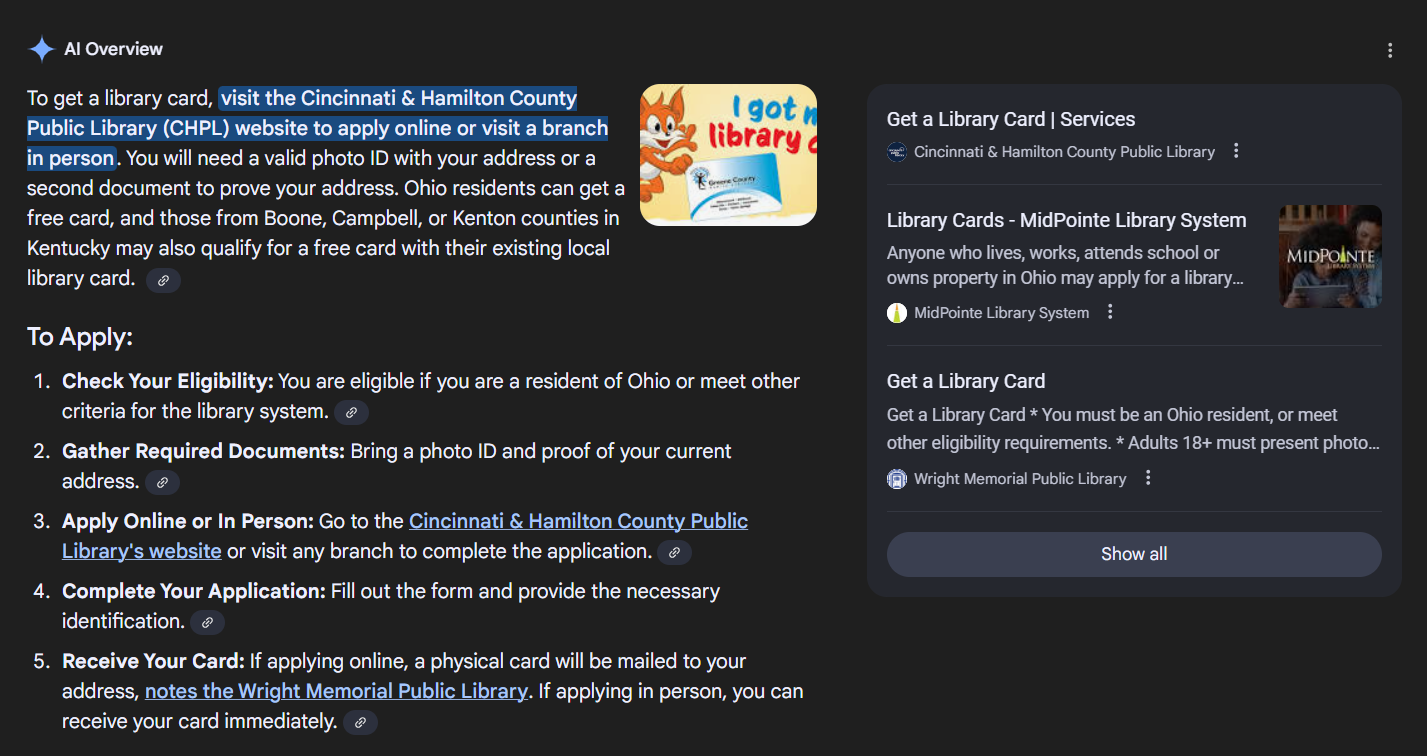
An example of an AI Overview for the search, “How can I get a library card?”

Once AI Overviews were introduced, searchers stopped clicking through to a website because their question was fully answered by the AI Overview. As a result, many libraries (and other websites, including this one) noticed a decrease in their organic web traffic.

In addition, a survey by Adobe Express says 25 percent of people use ChatGPT as their first choice for search over Google. Gen Z is particularly drawn to AI as a search engine. That likely means the popularity of using AI for search will continue to rise.

What does all this mean for your library?

Youโ€™ll need to adjust the way you structure your libraryโ€™s website and blog to surface more often in AI searches and to show up in the AI Overview. Itโ€™s not as difficult as it sounds. Here are the changes Iโ€™ve implemented. I recommend you try these and monitor your web traffic over several months to see if the changes make an impact.

Titles should be clear, not clever.

Tell readers exactly what theyโ€™ll find on the page. For example:

Author Visit

  • โŒ Clever Title: โ€œAn Evening of Literary Magicโ€
  • โœ… Clear Title: โ€œMeet Author Jasmine Guillory at the Library โ€“ October 24โ€

Why it works: The clear title includes the type of event, the authorโ€™s name, and the date. Those are the keywords that AI tools and search engines can easily match with user queries.

Craft Program

  • โŒ Clever Title: โ€œGet Your Glue On!โ€
  • โœ… Clear Title: โ€œFall Craft Workshop for Teens โ€“ Make Your Own Bookmarksโ€

Why it works: It specifies the audience (teens), the season, and the activity.

Educational Workshop

  • โŒ Clever Title: โ€œBrain Boost Bonanzaโ€
  • โœ… Clear Title: โ€œFree SAT Prep Workshop for High School Studentsโ€

Why it works: It uses direct language that matches what a student or parent might search for, like โ€œSAT prepโ€ or โ€œhigh school test help.โ€

Wellness Event

  • โŒ Clever Title: โ€œZen in the Stacksโ€
  • โœ… Clear Title: โ€œFree Yoga Class at the Library โ€“ All Levels Welcomeโ€

Why it works: It clearly states what the event is, where itโ€™s happening, and who can attend.

Include a bullet list of key takeaways or what youโ€™ll learn at the top of the page.

This helps both readers and AI quickly understand the content. Try this on blog postsย andย key webpages.

Hereโ€™s how you might structure key takeaways at the top of a library card sign-up page.

  • A library card is free to all residents of Tree County.
  • Applicants need to fill out a form and have one document with proof of residence. The form can be sent to the library via email or presented at any library location.
  • Applications presented in person will be processed immediately. Applications sent via email will take 1-2 days to process.
  • Once an application is accepted, youโ€™ll be given a card, which you will you to check out items, reserve meeting rooms, and register for programs.

Use well-structured headings.

Phrase them as questions, when possible, like:

  • How do I get a library card?
  • How can I reserve a meeting room?

Here’s an example of how I did this in a post for NoveList.

Include the right keywords.

Ask ChatGPT to provide you with a list of keywords or frequent questions around your topic. You can also search for your topic on Google and look at the โ€˜People Also Askโ€™ section. The website Answer the Public can provide you with some frequently asked questions as well.

Structure your content with bullets, steps, or lists.

Clean formatting makes it easier for AI to scan and summarize your content. You’ve probably noticed this post has been full of bullets and lists. That’s intentional! The bonus benefit is that it makes your blog and website easier to read.

Write in natural, conversational language.

Avoid jargon. Focus on being clear and helpful. Remember that searchers will not use jargon to look for answers to questions that may lead them to your library. Try to imagine what your community would put into the search bar, and then use those words in your blog or landing page.

When possible, include a staff memberโ€™s name and job title on a page.

AI looks for expertise or credentials when scanning pages. This is easy for a blogโ€ฆ just include the name of the author and their title in the post. For a landing page, consider adding a line like this: โ€œNeed help signing up? Email Maria Lopez, Library Services Manager, with 15+ years of experience helping patrons, at mlopez@treelibrary.org.โ€

Ask your partners to link to your website and blog.

When other trusted sites link to your content, it signals credibility to AI and search engines.

Use internal links whenever possible.

Link to related blog posts or pages on your site to help AI understand your contentโ€™s structure and relevance. That has the added benefit of keeping people on your page longer, which improves your trust and credibility to Google and AI, which means you’ll show up in search more often!

Try to stay within best practice lengths for word count.

BlueHost.com says for blogs, the ideal range is between 1,500 and 2,500 words. This gives readers comprehensive coverage of a topic. Itโ€™s also easier to include keywords and internal links for longer posts.

Butโ€ฆ hereโ€™s something to remember: Google and AI tools prioritize quality over length (and so do most readers!) Donโ€™t try padding your posts, as that can hurt your ranking.

Neil Patel, who is a trusted expert on SEO, says that for landing pages, word count isnโ€™t a direct ranking factor. Rather, you should focus on the userโ€™s experience and provide enough information for a community member to act.

Has your library’s website traffic taken a hit? Are you using any other methods to drive more traffic to your library’s website? Let me know in the comments.


Need more inspiration?

Google Ad Grants Improve Your Libraryโ€™s Chances of Being Found in Search: How To Apply and Manage This Incredible Opportunity

Subscribe to this blog, and youโ€™ll receive an email whenever I post. To do that, enter your email address and click on the โ€œFollowโ€ button in the lower left-hand corner of the page. You can also follow me on the following social media platforms:
๐Ÿ“‚How a Simple Change to Your Libraryโ€™s Website Can Impact User Engagement

Watch this video now

#LibraryMarketing Show, episode 265

As you create content for your library’s website, there is one tiny feature you should consider: how do your links open? Are they in a new tab or open in the same window? This decision will impact the experience of anyone visiting your library’s online presence. I’ll give you my advice… and then tell you why you might want to ignore it (!) in this episode.

Plus we’ll give kudos to a library that has accomplished A LOT in the marketing space in a short time.

Do you have a suggestion for a topic for a future episode? Do you want to nominate someone for kudos? Let me know here. Thanks for watching!โ€‚

For a transcript of this episode, click here.


Miss the last episode? No worries!

Will I see you soon?

Subscribe to this blog and youโ€™ll receive an email whenever I post. To do that, enter your email address. Then click on the โ€œFollowโ€ button in the lower left-hand corner of the page. You can also follow me on the following social media platforms:

How One Library Marketer Transformed a Library Website: See the Stunning Before and After!

Photo courtesy Cincinnati and Hamilton County Public Library

Some of Megan Brattonโ€™s favorite memories were made at the Forsyth County Public Library in Winston Salem, North Carolina.

โ€œI went to a new concept charter school in downtown Winston Salem that was housed in the basement of an office building,โ€ explains Megan. โ€œThe school didnโ€™t have many amenities, like a gym or library.โ€

โ€œThis meant that we got to go on regular walking field trips to the main branch of the Forsyth County Public Library. We even got to decorate our own cotton tote bags to use carting our book finds back and forth. My dad worked in an office downtown and would often pop into the school or library for fun surprise visits.โ€

Megan went on to work in corporate marketing before getting her MLIS from the University of Denver. She initially intended to work in an academic setting but was more interested in the public library world. She ended up at the Natrona County Library in March of 2019, working as a part-time Childrenโ€™s Librarian.

โ€œI found it truly astonishing what all public libraries were able to do for their communities in response to immediate needs and in anticipation of future needs,โ€ recalls Megan. โ€œNo other large organization can pivot and change that quickly. Plus, they were doing it all for free and for everyone.โ€

โ€œAs a marketer, I realized there was a major need here. Public libraries are these bastions of creativity, advancement, support, and acceptance, but not enough people know about these free services. I wanted to find a way to put my skillset to use promoting public libraries, and it wasnโ€™t long after I started working at Natrona County Library that their marketer decided to move on to new ventures. In October of 2019, I stepped into my current role as head of Marketing and PR.โ€

Natrona County is the second-most populous county in Wyoming, with 80,000 residents. The library has a main branch in downtown Casper and a branch about 40 miles away in a small town called Edgerton. They also have a bookmobile.

Megan says nearly a third of Natrona County residents have an active library card, and the library enjoys high visitor and circulation rates and robust program attendance. That may be due in part to the work Megan has done in marketing.

At her library, Megan is a team of one, overseeing all social media, public relations, website development and management, advertising, graphic design, and branding.

โ€œI do ask that our programmers and other library staff try to keep a โ€˜marketing mindsetโ€™ to help capture photographs at programs or throughout the library space that could be used for social media,โ€ shares Megan. โ€œI am all about efficiencies and delegation, so I have licensed programs like LibraryAware and Canva which come pre-populated with professional-looking templates that staff can use to make their own bookmarks, flyers, signs, handouts, and more.โ€

I reached out to Megan after seeing the Natrona County Libraryโ€™s website. Itโ€™s clean and modern, with a thoughtful layout and what I can only describe as a โ€œcoolโ€ vibe. I told Megan it doesnโ€™t really look like a typical library website.

โ€œThe website (as I inherited it) was broken and battered. It had been built before mobile devices were a thing,โ€ recalls Megan. โ€œWe needed to start fresh with a ‘mobile first’ mindset, simplify the navigation structure, integrate new event software that made our program calendar more visually appealing, and incorporate a blog to position ourselves as thought leaders in our community and the larger Wyoming library community.โ€  

A screenshot of the Natrona County’s website homepage before the rebuild.

Megan partnered with a local creative agency on the website rebuild in 2021, thanks to the generous support of her library Foundation.

โ€œBecause of my extensive web background, we had an unusual arrangement where I worked side-by-side with their web guy as we built it out,โ€ explains Megan. โ€œAs you know, library websites have a LOT of pages, which can make a new website a costly build. Because I was able to tackle about 75 percent of the pages (using templates, structures, and design influence from the agency-built pages) myself, it cut the cost in half, which is how we ended up with such a professional-looking website on a public library budget.โ€

Natrona County Library’s website includes real photos of the library, conversational language, call to action buttons, and their newsletter signup is right on the home page.

For some libraries, the website can be a point of contention: everyone has different opinions about what should be featured on the homepage and drop-down menus. Megan needed to make decisions based on her knowledge of her customers. Later, analytics let her know if her instincts were correct.

โ€œThere are a couple of items that live in multiple places in the menu, like the Bookmobile, to accommodate multiple thought processes or visitor types,โ€ explains Megan. โ€œMy goal, ultimately, is to put things that make the most sense to our staff, because they are the ones referencing the pages the most.โ€

โ€œBut we are all in agreement that the most important pieces of information are to be at the very top of the homepage. Static across the entire site is the search functionality for our catalog, log-in to oneโ€™s account, library hours, and our phone number. I treat our website like a database in that sense.โ€  

โ€œAnecdotally, and through analytics, weโ€™ve come to realize that our patrons donโ€™t spend a whole lot of time on our website. They mostly come for hours, contact information, and to get to our catalog. They may also enter through digital ads, social media, or from other places directly to landing pages, but donโ€™t tend the linger.โ€

The website is also the home of Natrona County Public Libraryโ€™s blog, Library Stories.

โ€œOur blog is a byproduct of our bygone print newsletter,โ€ explains Megan. โ€œIt was important to me that we have a way to not only highlight that content for larger audiences but also share it differently, as blog articles can be interacted with much differently than print pieces.

โ€œThe blog is a great place to put press releases or share important library updates without building individual landing pages that disappear over time. Depending on the content, I do find that the blog articles drive traffic, especially if the blog article is about the library itself.”

“For example, we shared a press release about a recent exploration of a bank building as a potential new location for the library, and it got a lot of visitors (as well as a lot of commentary on social media). The same thing happened when we increased the number of security guards and shared that information with the community.”

“The blog is an excellent resource for the media and can be a great way to remind our community of our policies, procedures, and things like funding sources, as these are things that seem to come up often in social dialogue.โ€

Megan says if your library is considering a website refresh, make sure you make that digital space as welcoming and friendly as your physical locations.

โ€œAlso, when youโ€™re talking to your staff, stakeholders, and patrons about the library website, they have no idea that there is often a difference between your website and your catalog,โ€ adds Megan. โ€œI realize that some libraries have their site and catalog combined, but that is not the case for us.โ€

โ€œOur website is built on WordPress, and our catalog is through ByWater Solutionsโ€™ Aspen. We also have integrations with LibCal for our event calendar, room booking, appointments, and Library of Things. Patrons have no idea that these are all separate things, and a patron can shut down during conversation if you start talking about them as such.”

“Thatโ€™s why it was super important that all these disparateโ€“but integratedโ€“sites feel cohesive so that patrons and end users donโ€™t even realize when theyโ€™re navigating away from one and can easily and seamlessly navigate back to where they came from.โ€

You can read more about the rebuild of the Natrona County Library website here.

Hey library marketing friends: Every promotion you create brings the joy of your library to someone new. That’s something to be proud of!


P.S. You might also find this helpful

Google Does It Again! What New Changes in Search Ranking Mean for the Discoverability of Your Libraryโ€™s Website

Subscribe to this blog and youโ€™ll receive an email whenever I post. To do that, enter your email address and click on the โ€œFollowโ€ button in the lower left-hand corner of the page. You can also follow me on the following social media platforms:
Google Ad Grants Improve Your Libraryโ€™s Chances of Being Found in Search: How To Apply and Manage This Incredible Opportunity

Photo courtesy Cincinnati and Hamilton County Public Library

Five years ago, I was listening to an episode of a library podcast about Google Ad Grants, which offers $10,000 monthly advertising credit to qualified nonprofits. Thousands of nonprofits use the program. You apply once, and the grant continues indefinitely.

Wow!

Many libraries have taken advantage of this program since it was launched in 2004. Some of those libraries collaborate with a company called Koios, currently run by Maggie Carson and Peter Velikonja.

Koios is a member of Googleโ€™s Certified Ad Grant Professionals group, which has been vetted by Google to manage ad grants. It is the only member of this group specializing in public libraries.

Koios has successfully applied for and managed Google Ad Grants for public libraries since 2017. That grant money has been used to promote catalog items, educational resources, passport services, business and career resources, summer reading programs, and more.

โ€œLibrary marketing professionals know that different online audiences are reached in different ways,โ€ says Peter. โ€œAdvertising with Google reaches everyone. That makes it the best way to reach new people, including, critically, the underserved.โ€ 

Peter says paid search using a Google Ad Grant may represent 25 percent or more of a libraryโ€™s overall website traffic, depending on the size of the libraryโ€™s service population.

โ€œAds appear at the top of search results โ€“ where they are most likely to be seen,โ€ explains Peter. โ€œSince libraries are trusted institutions, people are more likely to click on an ad for a library than a commercial ad.โ€

โ€œAt an average of $2 to $3 per click, a library can potentially bring about 4,000 visitors per month to its website, mostly new people who were not necessarily thinking of a library but were searching for something. It presents a library with an opportunity to show up at the right time with the right information, to the right person.โ€

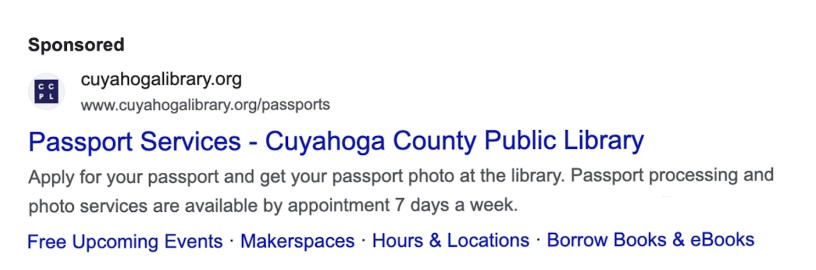
A sample Google ad for Passport Services at Cuyahoga County Public Library in Ohio.

And what does Google get out of this deal?

โ€œGoogleโ€™s primary motivation, we believe, is to perform a social good by helping nonprofits,โ€ says Maggie. โ€œBut the program also helps Google fill unused advertising space. Itโ€™s like having an empty billboard โ€“ better to put something up for free than to leave it blank and potentially leave the impression that the space is not valued.”

A library can apply online here.

โ€œFirst, you create a Google for Nonprofits account,โ€ explains Maggie. โ€œGoogle will verify your foundation or friend’s group nonprofit status through their partnering organization, Percent, after which you can submit an Ad Grants application. The process generally takes a couple of days or a week. For libraries that would like help applying, Koios will gladly guide you for free.”

Google Ad Grants are not competitive grants, but there are some details and requirements to be aware of.

โ€œNonprofits with 501(c)3 status are eligible, so a library should apply through their Friends or Foundation,โ€ suggests Maggie. โ€œGoogle will also review the libraryโ€™s website for quality and security issues; it will reject websites that are not https-enabled or do not meet their quality standards.โ€

Once a library is accepted, someone from the library will need to do ongoing research and keep up to date on compliance.

โ€œGoogleโ€™s policies require active management of advertising accounts, which means they expect you to check the account at least once per month,โ€ explains Maggie. โ€œGoogle has a set of policies to follow, and they regularly issue updates to these policies or create new ones.โ€

According to Peter, it takes some ingenuity and persistence to get the full value from an Ad Grant. Google says the average spent is only 17 percent of the full value of the grant. Google does offer some automated options for account management, which may be the best choice for busy staff. Koios can also manage the grant.

โ€œFirst, we apply for an Ad Grant on behalf of a public library,โ€ says Peter. โ€œIt is not complicated, but we have experience working out glitches that may come up in the application process.โ€

โ€œThen we set up the Google Ads account that comes with the grant โ€“ we do all that for free because we want libraries to use the resource, whether we are involved or not. After that, a library can manage the account themselves, or we can do it for a yearly fee.โ€

โ€œMost libraries choose to have us manage the account because we can exercise it more fully. We promote a libraryโ€™s online catalog, which contains hundreds of thousands of terms and concepts that can match the words and phrases people search for. Itโ€™s a sort of Big Data capability libraries donโ€™t usually have.โ€

Topeka & Shawnee County Public Library GA4 Web Traffic Acquisition Data, March 2024

Like most library vendors, Koios prices its services by the size of a libraryโ€™s service population.

โ€œGiven the potential of receiving up to $120,000 per year in advertising credit, our subscription fee presents an excellent return on investment,โ€ declares Maggie.

A screenshot of the Koios member dashboard for Barrie Public Library in Ontario, Canada, showing a 30-day view of 18 active campaigns.

If youโ€™re interested in learning more about Koios and Google Ad Grants, email Maggie and Peter at info@koios.co.


P.S. You might also find this helpful

The Clever yet Simple Trick One Library Marketer Uses To Remind Her Community of All Her Library Offers Every Day of the Year!

Subscribe to this blog and youโ€™ll receive an email whenever I post. To do that, enter your email address and click on the โ€œFollowโ€ button in the lower left-hand corner of the page. You can also follow me on the following social media platforms:
๐ŸŒGoogle Does It Again! What New Changes in Search Ranking Mean for the Discoverability of Your Library’s Website

Watch this video now

#LibraryMarketing Show, episode 237

Google is at it again!

The engineers at the search engine recently changed the way that they rank websites and search to make internet searching easier for the user. But that’s going to have some implications for your library.

Don’t panic! We’ll go through the changes and what they mean for your library’s website in this episode.

Plus, kudos go to a library that sent its annual report to a media outlet and got positive press coverage with an unbeatable headline.

Do you have a suggestion for a topic for a future episode? Want to nominate someone for kudos? Let me know here. And thanks for watching!โ€‚


Miss the last episode? No worries!

Will I see you soon?

Subscribe to this blog and youโ€™ll receive an email whenever I post. To do that, enter your email address and click on the โ€œFollowโ€ button in the lower left-hand corner of the page. You can also follow me on the following social media platforms:

๐Ÿš— 3 Easy and Proven Ways To Drive More Traffic to Your Library Website

Watch this video

The #LibraryMarketing Show, Episode 199

Your library’s website is more than a website. It’s actually a digital branch. And it’s an incredibly important way to drive people to your library and to help them find out about your services and items.

I have three big tips for you that you can implement to make your website more discoverable out there on the fast internet. And you do not have to be a fancy website developer to put these tips into practice!

Plus weโ€™ll give kudos to someone doing great work in library marketing.

Do you have a suggestion for a topic for a future episode? Want to nominate someone for kudos? Let me know here.

Thanks for watching!


Will I see you soon?

Subscribe to this blog and youโ€™ll receive an email whenever I post. To do that, enter your email address and click on the โ€œFollowโ€ button in the lower left-hand corner of the page. You can also follow me on the following social media platforms:

A WordPress.com Website.

Up ↑