Search

Super Library Marketing: Practical Tips and Ideas for Library Promotion

Facebook Does It Again! What the New Algorithm Changes Mean for Your Library

This week, Facebook announced it is making another change in the way the social media platform chooses to show content to its users. The big shift, as you likely know by now, is that Facebook will prioritize posts from friends and family in its news feed over public content from pages, like that of your library. In particular, the Facebook team will give top priority to posts that drive conversation between friends and family.

The announcement is causing consternation for many libraries, which rely heavily on organic, unpaid traffic for their promotional efforts. I honestly don’t know what the end effect will be. I have the same worries as most of my library colleagues. We’ve adjusted well since the last major algorithm change in 2015. So will we have to start over? In the wake of this announcement, I’ve wondered if the chicken comes before the egg. In other words, do our well-performing posts get more interaction because, prior to this week, Facebook has shown them to people in anticipation of interaction… or do they perform well because people are interacting with them? (Deep thoughts!!)

In the Facebook group, Libraries and Social Media, I asked social media marketers at libraries to comment on the change. Caleb Sheaffer of Shreve Memorial Library in Shreveport, LA said, “I never know what to expect until it actually happens. Right now, all the posts that perform well for our library are ones that have the most interaction anyway.”

Jennifer Redford from Boise, Idaho added, “I think that we’ll just need to focus more on writing and sharing great content. We’ve also started using events more and I wonder how that will be affected by the change.”

Finally, Molly Wetta, manager of the Santa Barbara Public Library, told me, “These announcements are pushing me to move forward more quickly with an idea I’ve had for a while. We’re experimenting with linked groups – I started one for youth services specific content, and we may also try one for smaller communities and branches within our system if this one is successful. The goals are to work more to create community connections in addition to marketing our events/services. I do love the events feature, and the notifications will hopefully be helpful but not intrusive. We’ll be sharing book recommendations and answering book-related questions, sharing early literacy tips and activities, and hopefully answering questions.”

The bottom line is that your library’s page may see your overall statistics drop. Your reach and referral traffic, your shares, and your comments may drop. MAY is the key word there. My overall impression of this change is that it will force library marketers to work smarter when using Facebook. All of the pointers in this recent article on Facebook still apply.

And now, more than ever, you must make sure your posts are really good. Share content from other sources related to books and literature–don’t just promote your own stuff, particularly on posts. Use events to promote your events. Ask questions. Create polls. And most importantly, shoot video. As we know, Facebook users respond in a big way to video. Facebook says live videos often lead to discussion among viewers and live videos get six times as many interactions as regular videos. So video marketing must be part of your plan.

You can also explain to your followers what is happening and ask them to choose to see your posts. People who want to see more posts from your library page can select See First in News Feed Preferences. You can also do what Molly’s library is doing and experiment with groups. One of my favorite Facebook pages did that this weekend and they put a little money behind it to make sure all their followers know about the move.
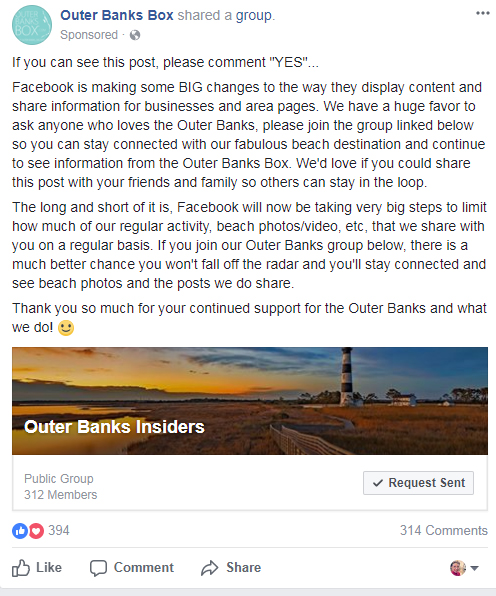
Finally, don’t bait people to interact with your posts. In this week’s announcement, Facebook made it very clear that they will penalize pages which use engagement bait, like. Use real questions and conversation starters. Read this article to see how to avoid engagement bait.

Here’s the thing to remember: posting content on Facebook is like building your house on rented land. It doesn’t belong to you and as much as it pains your library system when changes are made, there is little we can do about it. The big lesson is that we need to start relying on our own platforms and websites for promoting our programs and services. That means we should be building our own audience with blogs, podcasts, and other content delivery systems. We should be developing email subscriber lists so we can target and market to our specific library cardholders and give them the content they really want.

Facebook is great, but they’re not the only way to reach customers. Let’s make a concerted effort to start moving to other content delivery platforms where we have more control. Our fans are loyal and they’ll respond when we deliver content specifically targeted to them.

Subscribe to this blog and you’ll receive an email every time I post. To do that, click on “Follow” button on the bottom left-hand corner of the page. Connect with me on Twitter and Snapchat–it’s where I talk about library marketing! I’m @Webmastergirl. I’m also on LinkedInInstagram and Pinterest. Views in this post are my own and do not represent those of my employer.

The Best Library Customer Service Advice from an Expert

There is an undeniable connection between customer service and successful marketing and to ignore the role that a personal, caring interaction with a customer can have for your library is dangerous. Don’t take your customers for granted. Help them solve their problems–even when the problem is your library–and keep them loyal for a lifetime.

I started to really think about the role customer service plays in my library when I stumbled across a podcast a few years ago called Focus on Customer Service. Host Dan Gingiss interviewed marketers from brands which are known for outstanding customer service in the social media area. Those conversations are enlightening and, although the podcast is no longer in production, I would suggest you go back and listen to the archives. They’re really worth your time.

Meanwhile, Dan has gone on to write a new book, Winning at Social Customer Care: How Top Brands Create Engaging Experiences on Social Media. It is the best marketing book I’ve read recently. I reached out to Dan to ask him some specific advice about libraries and customer service and he was kind enough to give his advice.

Dan’s 20-year career has consistently focused on delighting customers, spanning multiple disciplines including social media, customer service, marketing, and digital customer experience. Dan has hands-on experience as an executive at multiple Fortune 300 companies, including as the Senior Director of Global Social Media at McDonald’s Corporation, the Head of Digital Marketing at Humana and the Head of Digital Customer Experience & Social Media at Discover Card. A frequent conference speaker, Dan holds a B.A. in psychology and communications from the University of Pennsylvania, and an M.B.A. in marketing and strategy from the Kellogg School of Management at Northwestern University. You can find him on Twitter at @dgingiss.

Libraries often do things by committees and many have a long and bureaucratic approvals process for everything, including responses to customer service issues. Can you tell us why libraries should consider empowering their employees to surprise and delight customers by resolving issues in a more expedient way?

What libraries — and all organizations — need to remember is that customers are comparing you to every other customer experience they have with companies. You’re not being compared to another library; rather, you are being compared with Amazon, Wendy’s, Zappo’s, and any other brand with which the customer has engaged recently. Customer expectations are higher than ever, and a speedy response has become table stakes to competing with other superior experiences.

Libraries have such meager budgets, and many focus solely on getting the most product (books) to customers as possible. They don’t want to spend any money on providing good customer service. There are a lot of products out there that can make it easier for libraries to enhance their customer service. If you had to pick one thing that libraries should spend money on to improve their customer service, what would it be (software? More agents? )

Self-service capabilities. Most customers are willing to pursue self-service solutions if they are available, and many even prefer it. In the case of libraries, this could be used both in person at computer terminals and online, where like other industries much of the customer interaction is now taking place. Considering that libraries are still physical structures and much of the experience is still enjoyed in person, it’s also critical that they hire friendly and helpful staff who are willing and able to help readers who have no idea how to navigate the archaic Dewey Decimal System, for example. (Think about how people search for things today; it certainly does not involve decimals!)

Training for customer care, particularly in social media, is not always a strong suit for libraries. They train mostly for front-line customer service. Can you explain the difference between training for front-line interactions with customers and online customer care, and why there is a value in providing specific training for online care?

First of all, it’s critical to remember that social media is still the “front line”. It’s just another channel in which your customers have chosen to engage. So just as you wouldn’t leave a Help Desk unattended or let the phone ring and ring, you also shouldn’t make people wait for answers on social media either. That said, there are some key training differences (explained in Chapter 7 of my book) between online and offline Customer Service agents. The two most notable are writing ability and social media platform knowledge. Agents must have good spelling and grammar, as mistakes cast a poor light on the organization, and they must have at least a working knowledge of each individual social media platform so they understand the culture, norms, and limitations.

I think community building is a good strategy for libraries to engage with cardholders and offer customer care. Based on your book, I assume you agree. Can you explain how building an online community might benefit an organization like a library which is looking to improve customer service?

Online communities are especially helpful in answering questions that are likely to recur over time. For example, I recently learned that libraries often have passes to local museums but that they are reserved quickly. I wanted to know the process of obtaining such a pass from my local library. While calling the library worked just fine, an online community could have provided the same answer without leveraging paid library staff. In addition, I’d point out that books, by their very nature, are community-building in that people love talking about their similar interests and experiences. So I think an online community hosted by a library could be very successful on several fronts.

What do you think the future looks like for customer service? Is there anything libraries should be considering as they plan for the future, so they can stay competitive with bookstores and offer excellent service to cardholders?

Libraries have a huge advantage over bookstores because they provide the product for free! If they were also to provide a consistently superior customer experience, the discussion in the media might not be about Amazon undercutting brick-and-mortar bookstores, but about how libraries are experiencing a great resurgence at the expense of Amazon! Like any industry, libraries must adapt to changing technology and customer expectations. In some ways, they have, like the availability of e-books, but I’ve never found those to be either marketed effectively or easy to use. Libraries should learn from for-profit businesses to become better marketers of what is already a competitive product, to draw in new card members but also to remind existing ones why they signed up in the first place.

Bonus Secret: Go to www.winningatsocial.com/discount, click on “Buy Now”, then enter the code “Winning” to get a signed copy of Dan’s book for the best available price.

Subscribe to this blog and you’ll receive an email every time I post. To do that, click on “Follow” button on the bottom left-hand corner of the page. Connect with me on Twitter and Snapchat–it’s where I talk about library marketing! I’m @Webmastergirl. I’m also on LinkedInInstagram and Pinterest. Views in this post are my own and do not represent those of my employer.

Library Marketing Secrets You Can Steal From General Electric

The woman who manages marketing at one of the biggest companies in the United States–and perhaps the world–made a huge impression on me at Content Marketing World. Linda Boff is Chief Marketing Officer at General Electric. You might think a huge brand like GE would be mired in traditional marketing practices and have nothing to teach us about agility and experimentation. You would be wrong.

Boff has led the company into a new realm of marketing, using tactics that libraries have access to, like podcasts and Facebook Live. Her focus is storytelling–finding the stories within your company and sharing them with your audience. She insists you don’t need a big budget to do what she’s doing. She’s a dynamic speaker and her presentation was one of the more memorable moments in the two-day conference because I ended up coming away with so many ideas for my library marketing. I left the room excited and energized!

Boff says there are five reasons to tell your library’s story: To sell (library translation: improve circulation, visits, and attendance), to inspire, to explain strategy, to reach audiences, and to educate. She told the audience that the success of GE with storytelling relies on a simple formula: Be first on platforms + activate unlikely audiences + find the human in the digital times. She laid out exactly what she means in her main brand storytelling tips.

Know who you are. GE embraces its nerd identity. The company produced a series of videos showcasing its nerd employees. They are professionally produced but you can do the same thing using your iPhone. Remember, it’s the story that’s important–not the production value of your video. In fact, our library produced a similar series of videos back in April for National Library Workers Week. We shot everything on a DSLR camera and edited it using free software available on the internet. Our fans–and our employees–loved the videos.

Identify your secret sauce. What is your tone? How do you come to life? Every brand has to figure out what this means to them. This next part is going to sound really familiar. GE has had to fight to be relevant, contemporary, relatable, and modern. Everyone knows who GE was in the company’s past. Everyone is familiar with GE’s legacy. Boff said one of her marketing goals is to teach people what GE is in the present.  To do this, Boff recommends you need to “show up as a person”–in other words, use real and personal stories about your workers to put a face to your company’s name. GE went to its employee’s children to ask them what their parents do. They told stories and drew pictures explaining their parent’s work. Then GE took those pieces and used them internally and externally. You can see some of those stories here.

 Find unexpected audiences. At South by Southwest, GE created a BBQ incubation area. They set up a BBQ smoker and had data scientists on hand to smoke the meat with exact precision so it came out right every time. They also had their scientists use data to make BBQ sauce, and they let people taste the sauce while hooked up to a scanner so they could see what their brain responded to via scan. Then took the super smoker to college campuses, so instead of the tent and handouts, they had this cool interactive centerpiece. I think that idea could translate for libraries too. Instead of just having a table at events, let’s bring MakerSpace equipment and traveling library collections so people can interact with our “products.”

Experiment early, experiment often. When a new social media platform or technology emerges, don’t hesitate–jump on board quickly and learn all you can about it, says Boff. The cost barrier to entry is always very low at the beginning of any new trend and the audience has no expectations about what you can or should produce. Boff says it’s important to be on the playing field and really skin your knees; you can’t just read about new trends. I really took this point to heart. We now have permission to move forward on new trends–let’s embrace it!

Good content speaks for itself. Boff and her team created GE Podcast Theater. They create long-form, lightly branded podcasts that are full content marketing platforms. GE’s “The Message” podcast was named as one of the New York Times 11 Fiction Podcasts Worth Listening To and was in the #1 spot on iTunes after its release.  Boff says if you are putting great stories out into the world, they’ll do their own marketing with their amazing content.

Stories are right under your nose: The hardest thing is finding stories to tell. GE works had to find stories reach customers, investors, thought leaders, media, AND employees. I’ve talked about finding stories in the library on this blog before in this article and this article. We should always be looking to connect with narratives that inspire all of those audiences. I really loved how Boff emphasized storytelling as a way to grow employee pride. At GE they do this through a YouTube series called In the Wild. It’s entertaining and engaging. Libraries could imitate that on a smaller scale. In fact, my library did that using a GoPro camera! We did time-lapse videos of various jobs and departments in the library and posted them on our YouTube channel. Those videos had more than a thousand views total and continue to draw new people to our YouTube content.

Subscribe to this blog and you’ll receive an email every time I post. To do that, click on “Follow” button on the bottom left-hand corner of the page. Connect with me on Twitter and Snapchat–it’s where I talk about library marketing! I’m @Webmastergirl. I’m also on LinkedIn, Instagram and Pinterest. Views in this post are my own and do not represent those of my employer.

The Most Exciting Library Marketing Lessons from Content Marketing World

The future of content marketing at your library is stories, videos, and making personal connections between your cardholders and your libraries. That’s the big takeaway for me from the year’s Content Marketing World, a giant marketing conference in Cleveland. I’ve just returned with a head full of ideas and heart full of energy. Rubbing elbows with 4,000 marketers bursting with love for the profession will do that to you.

At #CMWorld, I attended 15 sessions and learned a ton of new information which I will flesh out here over the course of the next several months. Some tips can be put into action immediately and some will need time for processing in my brain, as I work to figure out how to make them doable for libraries of all sizes, shapes, and missions.

Here are the main takeaways I received from 15 sessions with links so you can check out more of the speaker’s work and get started on transforming your own library marketing.

Linda Boff, Chief Marketing Officer at General Electric:  Stories are everywhere, right under your nose. Find and embrace them.

Jay Acunzo, host of the podcast Unthinkable:  Content marketing is about inspiring your true believers, not coercing the skeptics. (This was an ah-ha moment for me!)

Drew Davis, a former marketer, best-selling author, and speaker:  Audience retention is the true definition of video engagement. Stop trying to just get views and get audiences to watch your whole video!

Doug Kessler, creative director and co-founder of Velocity Partners: It’s our job as marketers to expose the hidden marketing conventions and turn them on their heads. In other words, conventional thinking will get you nowhere. Now is the time to be creative.

Ian Cleary, founder of Razorsocial: Be smart when you publish your content because if no one sees it, what’s the point? Use smart keywords, collaborate with influencers, and promote yourself. During this session, I realized I know nothing about web optimization!

Amanda Todorovich, Content Marketing Director at the Cleveland Clinic: Never be content. Measure and test and test again. Ask “what if” all the time.

Casey Neistat, YouTube star: Do what you can’t. Make it count. Follow your gut. Cut through the bullshit. Yes, I put that all in bold because IT’S IMPORTANT.

Colson Whitehead, author of The Underground Railroad and a bunch of other books, Pulitzer Price Winner, National Book Award Winner, etc., etc., etc. You know him, you work at a library: If you have ideas and you’re not sure you can pull them off, it’s ok to wait until you are actually ready. I’ll be honest, I don’t know if I agree with this but I’m going to think about it for a while.

Amy Schmittauer Landino, vlogger, author, and speaker: The secret to great video is asking yourself…would you share it?? Really?? Not just because you think everything you do is fantastic, but because what you do is actually fantastic.

Arnie Kuen, CEO of Vertical Measures: There is only a two percent chance your followers will see your organic post. (YIKES!)

Scott Stratten, author, speaker, blogger, podcaster, promoter of unconventional marketing. This was a session on public speaking: Tell a personal story but only if it makes a point. Respect the audience’s time.

Tamsen Webster, speaker, and producer of TEDx Cambridge, during the same session on public speaking: Go ask for the stage you deserve. The way to speak more is… to speak more.

Joseph Gordon-Levitt, actor and creator of hitRECord, an online collaboration and creation website for video, graphics, music, and more: Community, fair compensation, and collaboration are the future of content creation.

Joseph Gordon-Levitt

Jonathan Stanley, Executive Producer for Lowe’s: Test all the time on YouTube. Fail fast and learn fast. Don’t spend years scripting.

Michelle Park Lazette, Content Marketer for the Federal Reserve Bank of Cleveland: Deliver different! Try your best to produce the “okra breakfasts” of content. Okra breakfasts are content that is unexpected but delicious and filling!

Subscribe to this blog and you’ll receive an email every time I post. To do that, click on “Follow” button on the bottom left-hand corner of the page. Connect with me on Twitter and Snapchat–it’s where I talk about library marketing! I’m @Webmastergirl. I’m also on LinkedIn, Instagram and Pinterest. Views in this post are my own and do not represent those of my employer.


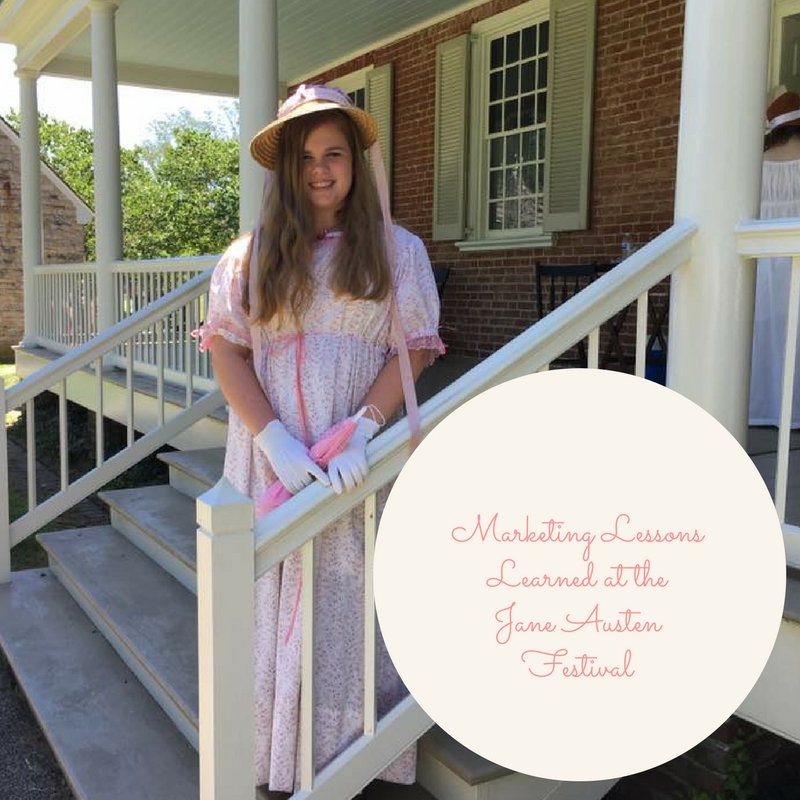
Three Marketing Lessons Learned at the Jane Austen Festival

I am a fan of Jane Austen. I don’t have to extol the virtues of the Regency-era authoress to you–you work in a library. But I do want to share an experience I had this weekend and the marketing lessons I learned from it.

For the fourth year, my daughter and I attended the Jane Austen Festival in Louisville, Kentucky. This is the largest Jane Austen festival in North America and it is amazing for many reasons. The dresses, the food, and the vendors are all amazing and period-authentic. But this year, I found that I was hyper-aware of the marketing aspects of the festival. This is the 9th year for the festival and they are doing everything right, in my opinion. Here are the three big marketing lessons I learned.

Build your fan base over time and don’t discount the wonderful ways they can market for you. They might not be “influencers” in the traditional marketing sense, but your loyal, adamant, and devoted fans are a powerful marketing tool. A group of people who love you and your products will do more free marketing for you than any ad you can ever buy.

The Jane Austen festival boasts thousands of attendees every year and although they do some promotional media on local newspapers, TV, and radio stations, I haven’t ever seen a single ad buy. They don’t need to. The event grew quickly through word-of-mouth. Jane fans tell other Jane fans, in person and online. At the afternoon tea, I spent half an hour giving a new attendee from Indiana the lowdown on what to see, which vendor tents to visit, and where to get a Regency-style outfit for next year. No one paid me! There’s just an excitement that’s contagious and that loyal fans want to share.

The Jane Austen Society of Louisville has a Facebook page with more than 1200 members, including myself. Only about 10 percent of those members belong to the society but everyone who likes the page will share news about the festival with friends across the world. And fans will share recommendations for costumers, tea merchants, and other vendors, providing business even after the three-day festival has ended.

In addition, festival organizers give a place online for fans to talk and post photos and videos after the event. The festival organizers and the smart vendors like and comment on those photos, making festival goers feel valued and special.

Creating an immersive experience leaves a lasting impression. From the moment you step onto the grounds of Locust Grove, you feel like you’ve been transported to Jane’s era. Many attendees dress in authentic Regency wear. People bring picnic baskets and full tea sets and eat on the lawn using authentic place settings and utensils–no plastic sandwich bags or paper napkins here. In a sea of brightly colored frocks, parasols, fichus, and top hats, you can’t help but feel like you’re part of Jane’s world and that leaves a lasting impression.

The festival organizers go out of their way to complete the immersive experience by handing out programs and putting up signs in hand drawn authentic regency font. I know it’s just a font but it sure does a lot to capture the mood! All the vendors set up their wares inside beautiful white tents and many will use signs that say “Bills of Credit Accepted” instead of the more modern credit card signs. It may sound insignificant but it’s those little touches that extend the mood of the festival and make it an enjoyable and memorable experience for all.

Content marketing works. The entire customer journey for the Jane Austen festival only lasts a month. Tickets don’t go on sale until about 45 days before the event. But the society spends the whole of the year prepping Jane fans by posting articles about Jane, talking about Austen spin-off books, sharing photos and videos about Jane Austen and the Regency era, and holding smaller events with the Jane Austen theme. All this Jane talk serves to educate potential festival goers about the era and the author and builds excitement for the main event.

Subscribe to this blog and you’ll receive an email every time I post. To do that, click on “Follow” button on the bottom left-hand corner of the page. Connect with me on Twitter and Snapchat–it’s where I talk about library marketing! I’m @Webmastergirl. I’m also on LinkedIn, Slideshare, Instagram and Pinterest. Views in this post are my own and do not represent those of my employer.
Lessons From The Greatest Press Release Ever Written!

4

When I left journalism for marketing, one of my big worries about switching careers centered on the dreaded press release. Organizations love writing and sending them. They’re usually glowing, self-congratulatory reports of amazing events, awards, and services. They make us feel productive, important, and authoritative.

But journalists hate them. They mock them. They look on most press releases as pretentious attempts at self-promotion by organizations with inflated egos. Most of the time, they file them in their assignment book and never look at them again. I know that’s probably not what you wanted to hear. I’m not trying to be mean. You deserve to know the truth because you work hard on those releases. It takes a lot of effort to write a release that makes all the invested parties happy and it takes forever to get them approved in the library bureaucracy. But they’re not an effective means of getting our message not–not in the current form, anyway.

I’m not saying we should ditch press releases. I’m pushing you to change the way you write your press release. Commit to writing in a way that will interest journalists and make them want to cover your library. Use storytelling techniques to turn our news into an irresistible story. That’s how we get more press coverage.

I found inspiration recently when I came across this amazing, astounding, awesome press release, sent out BY THE FEDERAL GOVERNMENT no less. The year was 1921 and the U. S. Department of Agriculture had spent nearly a decade and thousands of dollars trying to hunt down a destructive wolf.

A little background is necessary. I first heard this press release read aloud while listening to This American Life with Ira Glass. According to Glass, when settlers arrived in the American west, they killed off the animals that wolves used to feed on– bison, elk, and deer. The wolves starting killing livestock for food. That angered the settlers, so ranchers and the federal government set out to exterminate the wolves. Between 1883 and 1930, more than 80,000 wolves were killed. The government wanted to tell everyone what a good job they were doing and so they put out press releases. Like this one.

Read The Great Wolf is Killed

An amazing piece of press work, it contains four major lessons for libraries looking to write a better press release. If you want to draw journalists in, make them want to cover your library, and get you more press, here’s what you need to do.

      1. Write a story, not a bureaucratic diatribe. Journalists are an audience that you need to engage. They don’t respond to rhetoric and library jargon any more than a general audience does. They want a story, with emotion, drama, good guys, bad guys, and a plot. Write your release as if you are writing the real story for the publication which you are targeting. We know many newspapers and magazines lift copy right from the release–why not make it something they’ll really want to print? They’ll want something with a catchy headline and a story they can tease to their viewers to get them to watch/click/share.
      2. Ditch the dry, fact-based language and be a journalist. Get real quotes from the real stakeholders… stop making up quotes full of inspirational language that no one will really ever say in real life.  Journalists can see right through that. Interview the stakeholders and use their real words in your release.
      3. There is no right length. The wolf release is four pages and 1500+ words long. And it’s perfect. Write the story. If you have 1500 words and they’re riveting, a newsroom will read and print all 1500 words! Focus on writing great, not writing short.
      4. Spend some time coming up with a great headline. “World’s Greatest Animal Criminal is Dead” is a show-stopper. I usually brainstorm headlines in a word document… I just write freely until I’m clean out of ideas. Then I pick my favorite three or four and run them through the same tests I use when creating an email subject line. Then I sit on it awhile and think about it. Do the same with your press release headlines. This isn’t a throwaway task. It’s the first thing a journalist will see… it could be the catalyst for the final decision they make about your story. Don’t waste it!

Subscribe to this blog and you’ll receive an email every time I post. To do that, click on “Follow” button on the bottom left-hand corner of the page. Connect with me on Twitter and Snapchat–it’s where I talk about library marketing! I’m @Webmastergirl. I’m also on LinkedIn, Slideshare, Instagram and Pinterest. Views in this post are my own and do not represent those of my employer.

Why Libraries and Content Marketing Make the Perfect Couple: A Content Marketing Institute Interview

A crazy thing happened to me this week. Content Marketing Institute published a profile I did a few weeks ago with them. Each week, they highlight attendees of their big, fabulous Content Marketing World conference and I was lucky enough to be in the spotlight this year. Libraries and content marketing are the perfect combination!

You can read the interview here. Thanks CMI!

angelahurshmedal

Subscribe to this blog and you’ll receive an email every time I post. To do that, click on “Follow” button on the bottom left-hand corner of the page. Connect with me on Twitter and Snapchat–it’s where I talk about library marketing! I’m @Webmastergirl. I’m also on LinkedIn, Slideshare,  Instagram and Pinterest. Views in this post are my own and do not represent those of my employer.
Advice for Jedi Library Marketing from Luke Skywalker

hello-there

I was in the same room as Luke Skywalker.

When I heard Mark Hamill was keynoting Content Marketing World, I may or may not have squealed out loud. Repeatedly.

When he walked onto the stage, the energy in the room went up by about 1000 megawatts. 4000 marketers got to their feet and cheered. I could not post anything on social media for 20 minutes, there was such a drag on the WiFi from everyone else!

What the heck was Luke Skywalker doing at a marketing conference? Show business is all about marketing and actors are more than men and women who stand up in front of a camera and read lines. They have to know how to appeal to audiences through unique storytelling and emotional engagement. That’s the oldest and purest form of marketing.

Hamill is every bit as gracious as you would imagine. And he had five great insights that apply to library marketing.

Love your job or don’t do it. Mark Hamill loves making and marketing films. He told us about how he enjoyed coming to the publicity department to watch the studio create marketing materials to promote the Star Wars series. During the latest movie, he thought of new ways to market the movie on Twitter, including a funny incident where he promised to unveil the trailer for Star Wars: Episode VIII on a certain day. When the day arrived, he shared a video of his trailer… his dressing room trailer. “How they thought we’d have a trailer ready for a movie we hadn’t even begun to shoot yet, I don’t know,” said Hamill.  Hamill said he was fascinated by the creative process involved in marketing a movie series with super fans who salivate, analyze, memorize, and deconstruct every single line. He says that energy made the work he had to do on camera more exciting. When you love your job and you are passionate about it, your library will benefit. If you have the privilege of hiring staff, make sure they’re passionate and energetic too.

Don’t be afraid of change or learning new things.  George Lucas told Hamill, “The thing is, in show business, nobody knows anything. The business is always changing and evolving.” That’s true for libraries too and Hamill says that’s a confidence booster for all of us. You need tenacity in any business, including library marketing. Said Hamill, “Sometimes I think tenacity is more important as talent, or at least as important. Can you survive all the failures?” In the end, Hamill says you must believe in yourself, work hard, never give up, and you can do anything.

If you hit a creative wall, take a break from it. You don’t have to have all the answers all the time. The answers will come to you when you aren’t thinking about it. Try to imagine what people want, keeping in mind that those wants may be very different from what your library is planning to promote.  Your marketing should create an emotional response in your cardholders. If it isn’t doing that, go back to the drawing board and keep thinking! Hamill says he also always tries to find a way to re-purpose old ideas with his own lens. Everyone comes at things with a different perspective. Follow your instincts. Trust yourself.

Understand the different facets that go into your library’s operation and function. If you’ve never worked on the front line with staff, take a few hours to job shadow someone at a branch. When you have a chance to sit down with a senior leader, ask questions about their job, the concerns, their hopes, and the direction they want to see the library take. Hamill wants us to remember that what we do is composite art. Marketing isn’t a disconnected endeavor. It supports and is supported by countless other people within the library system. You’ll do your best work when you know how all the pieces fit together.

Know that you’ll never be satisfied. Just aim to be less dissatisfied. Your work will never be perfect. The best you can hope for is to improve with each promotion. You never know what great thing is waiting for you around the corner. Hamill left us with this parting thought: “I never expected to be in a galaxy far, far away as I rocket toward Social Security, that’s for sure.”

Subscribe to this blog and you’ll receive an email every time I post. To do that, click on “Follow” button on the bottom left-hand corner of the page. Connect with me on Twitter and Snapchat–it’s where I talk about library marketing! I’m @Webmastergirl. I’m also on LinkedIn, Slideshare,  Instagram and Pinterest. Views in this post are my own and do not represent those of my employer.

Did You Notice? This Website Has a Super New Name!

Ladies and gentleman, this week I made an important decision. I took a leap and decided to rebrand this website.

I have been thinking about you for months (were your ears burning?) I’ve been thinking about your jobs, your passion, your drive, your constraints, your strengths, your weaknesses, your fears, and your hopes. I have gone out of my way to talk to librarians, marketing directors, library directors, and cardholders. I have thought about what I hope to accomplish with these weekly posts and where I want the future of libraries and library marketing to go.

I decided that library marketers are superheroes. And you deserve an appropriate place to go online for advice, tips, fellowship, and encouragement.

And so, the new name of this website is:

SuperLibraryMarketing.com

superlibrarymarketing-com

When you type in this URL, I want you to think about yourself and your work the way I do.

You are super. You are awesome. You are heroes in a cynical, hustle-driven, no-holds-barred world.

This thing you do–library marketing–this is valuable work. And I hope you’ll find inspiration in each visit to this website.

I think you are super.

Subscribe to this blog and you’ll receive an email every time I post. To do that, click on “Follow” button on the bottom left-hand corner of the page. Connect with me on Twitter and Snapchat–it’s where I talk about library marketing! I’m @Webmastergirl. I’m also on LinkedIn, Slideshare,  Instagram and Pinterest. Views in this post are my own and do not represent those of my employer.


A WordPress.com Website.

Up ↑