Search

Super Library Marketing: Practical Tips and Ideas for Library Promotion

Tag

advice for library marketers

Five Insider Tricks To Improve Your Library’s Voice Search Ranking

One of my most vivid class memories from college happened during my freshman year. A woman visited our communications class to talk about this new thing sweeping the nation: the internet. She said that someday companies would be able to send us information on any product or service we could ever want or need, based on our previous purchases or on search.

Was she psychic? Nope. She was forward-thinking. The internet, and later the introduction of smartphones, caused a huge shift in the way libraries interact with cardholders. And now, we’re about to enter another era of technology change. We’ll need to re-evaluate how we interact with cardholders. Because voice search is going to change everything.

My library is now dabbling in this technology. We created an Alexa skill that allows cardholders to do some very basic things: find out what’s going on at a branch or ask about our hours of operation. But that’s only the tip of the iceberg when it comes to voice search.

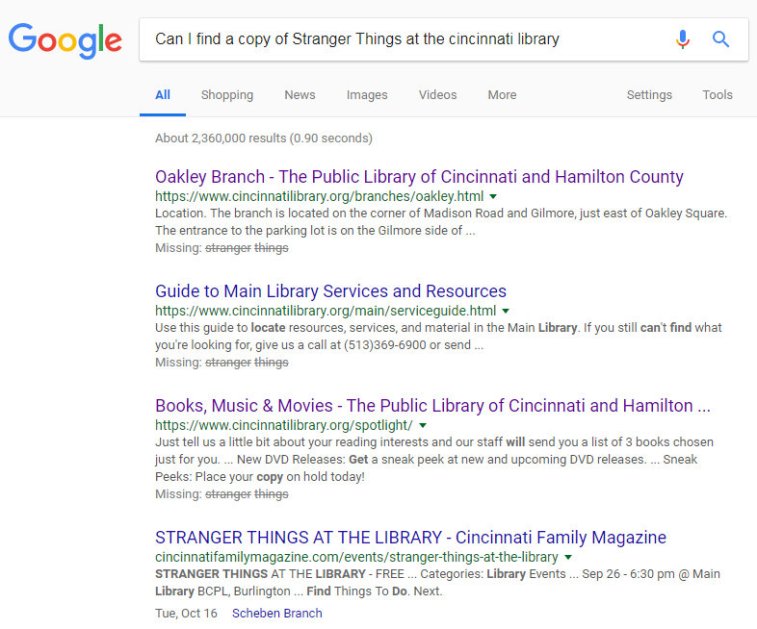
At Content Marketing World 2018, I attended a session led by Courtney Cox, who is manager of Digital Marketing at Children’s Health. She talked with us about the Google Search box. You’re probably familiar with it. It looks like this:

The answer box is text-based but it’s an important key to getting your library information in front of cardholders doing keyboard-based search inquires AND those using voice search options like Alexa or Suri. How is the answer box connected to voice search? Cox explains that voice search technology reads whatever answer appears first in the Google search. So, if you’re in the answer box, you are in first position and you get read by the voice search technology. That means if you live in the second or third results on Google, you won’t get read out. EVERYTHING ELSE underneath the answer box is ignored. There’s no glory in second place.

Wow. That’s depressing.

Comscore estimates that by 2020, half of all web browsing sessions will be done without a screen. So, what’s a library to do? Here are five steps to take now to move your library into the first position on Google search. These tips will increase the chances that your library will appear in the answer box and connect with more users.

Keyword research: Cox says you need to do real-world keyword research. That means you can use online tools like those I talked about in this post. But you must also talk to customers, face-to-face. Talk to front-line staff. Talk to the call center staff. Find out what customers are saying when they ask questions. What specific words or phrases do they use? Then start incorporating that language into your web content, social content, and all your marketing messages.

Competitor research: Cox suggests you do periodic searches for competing services offered by Amazon, your local bookstore, and online databases. What phrases and words do they use? How long, in words and characters, are their answers? Do they use bulleted lists, tables, or graphics to convey information to their customers?  What aren’t they doing well? All of these questions will inform you as you write searchable text for your website. You should feel free to copy what others are doing well. You can improve on what your competitors are doing poorly! You don’t need a big budget to write more searchable content.

Stop dictating your own content. Cox says we all need to stop brainstorming internally about what you want to write about. Start focusing on what your customers want. We must be answering the questions our customers have.

Create a FAQ page on your library website. Make the page easy to find and promote it throughout the web with blog posts, social media, emails… every marketing method at your disposal. The more people who go to the FAQ page, the higher the search ranking for that page will be, and the more quickly you’ll get into the answer box.

Re-purpose your content–with a purpose. Many libraries are creating videos for marketing purposes (HOORAY!). Now it’s time to take those videos and make them work to improve your search position. Take each of your videos and turn it into text. Post the text on your library blog and promote it in other ways. The more eyes that read the content in its written form, the more likely it is that the content will make its way into the answer box!

We’ve got our work laid out for us. After the conference, I started doing random searches to see where my library shows up in the answer box–and when it doesn’t. In some ways, we’re doing okay.

And in some ways, we have a lot of work to do.
So I’ll be looking for ways to make these five pieces of advice work in my content. And I’ll be paying more attention to the words we use on the website, making them local and specific. I’ll start thinking about what people will say when they use voice search to ask questions about my library. I’ll check these searches again in a few months to see how I’m doing. I urge you to do the same!

Subscribe to this blog and you’ll receive an email every time I post. To do that, click on “Follow” button in the bottom left-hand corner of the page. Connect with me on Twitter, Snapchat, and LinkedIn. I talk about library marketing on all those platforms!

The Best Advice for Library Marketing From CMWorld 2018

I wrote this post while sitting in my hotel room at the end of a week in Cleveland, Ohio at Content Marketing World. My brain is packed with ideas. My laptop battery is dead. Everywhere I look, I see orange. My iPhone says I’ve gotten about 13-15,000 steps a day and I didn’t even do my regular morning walk!

Content Marketing World was fantastic. I saw old friends and made new ones. And I’ve got plenty of new material to research and share with my fellow library marketers. But first, I want to share the quick takeaways from the presenters I saw. These are some pieces of advice that you can implement at your library right away.

Robert Rose, Chief Strategy Advisor, Content Marketing Institute: 38 percent of marketers have a documented content marketing strategy, according to the latest research from the Content Marketing Institute and Marketing Profs. That’s up a bit from 2017 but still not very high. Write down a content marketing strategy for your library. A written strategy helps remind you every day of what you are working on. It makes you accountable for results.

Joe Pulizzi, Founder, Content Marketing Institute: It only takes three things to be successful in your career. Step one is to write what you want to do. Set specific dates for when you will achieve those goals. And make sure you are serving others in your life.

Andrew Davis, Author, Brandscaping & Town, INC.: We are always told to keep our content short because our audience has the attention of a goldfish. QUIT BLAMING THE FISH. Our audience is capable of paying attention for as long as we can grab and hold their attention.

Michael Brenner, CEO, Marketing Insider Group, and Chief Marketing Officer, CONCURED: Marketing has a marketing problem. We are the cause of that problem because we create stuff that as consumers we wouldn’t consume, stuff no one wants.

Brian Massey, Conversion Scientist at Conversion Sciences: We must be aware of the bias we have for marketing tactics that have worked in the past. Data will tell you when something isn’t working. Listen to the data!

Cassandra Jowett, Director of Content Marketing, Pathfactory: Services like Netflix, Amazon, and Uber are influencing the way our buyers interact with companies. Everyone expects to have an on-demand experience in all aspects of their lives. We need to accommodate those demands.

Courtney Cox, Manager, Digital Marketing, Children’s Health: By 2020, 30 percent of web browsing sessions will be done without a screen. Voice search will dominate the way we gain information on the internet. That means if you live in the second or third result on Google Searches, you won’t get read out on any voice-activated device. We must place a priority on getting into that first position on Google.

Rachel Schickowski, Employee Engagement Manager, Rockwell Automation: Employee engagement should be a top priority at your library. When employees are engaged, they give a better experience to customers.

Ann Handley, Chief Content Officer, MarketingProfs: The most important part of the newsletter isn’t the news. The most important part is the letter. Editorial content performs way better than straight-up promotional mailings alone.

Dewitt Jones, photographer for National Geographic and other top publications: When passion and creativity exist, discipline and commitment are not an issue. Celebrate what is right with the world.

Kathleen Diamantakis, Managing Director, Strategy, T Brand, The NY Times: Cardholders are looking for something deeper and more meaningful when we engage with brands. They are discontent with content. There is an epidemic of meaninglessness in content.

Andrew and Pete, Founders, Andrew and Pete: There are always going to be bigger marketing teams out there that have bigger audiences, and that dominate search. They have giant budgets. Statistically speaking it’s impossible for your library to be the best. But there is another way to stand out. That’s by being better or different!

Jenny Magic, Senior Digital Strategist, Springbox: When you pitch a new idea or service to your co-workers, you can agree on how to move forward if you involve everyone in the process.  Redefine resistance as a positive thing. Dissent is a source of breakthroughs.

Tim Schmoyer, Founder, Video Creators: YouTube wants you to serve the right video to the right person at the right time. If you craft video content that does that, YouTube will elevate your video and more people will see it.

Margaret Magnarelli, Vice President, Marketing, Monster: In order to really engage our cardholders and get them to be loyal to us, we need to practice empathetic listening. It’s not that we shouldn’t use data to make informed decisions. But if we don’t combine facts with feelings, we’ll sacrifice relationships.

Tina Fey, Actress, Producer, Writer: Trust your gut. It’s always better to put it out there!

Subscribe to this blog and you’ll receive an email every time I post. To do that, click on “Follow” button in the bottom left-hand corner of the page. Connect with me on Twitter, Snapchat, and LinkedIn. I talk about library marketing on all those platforms!
The One Mistake Your Library Can Never Make On Social Media

I was riding furiously on my parent’s elliptical machine, trying to distract myself from the fact that I absolutely HATE exercise by scrolling through Facebook, when I came across a post that nearly made me fall off the machine.

It was on a politically charged page dedicated to libraries. And it advocated the use of clickbait for driving engagement. I won’t post the example this person used here. It was a provocative post but it wasn’t well-constructed. There was no image and no link for action. It was also posted by a librarian, not a library. I suspect he was just trying out the line on the fly to gauge the reaction. It doesn’t really matter what his motivation was or how it played with his audience. And to be fair, the post technically was not clickbait. Clickbait is the act of writing a headline or a post that over-promises, oversensationalizes or misrepresents whatever content you are linking to. The easiest clickbait headlines to spot are the ones that contain the words “You’ll never believe” or “What happened next will shock/embarrass/outrage you.”

What matters to me is the assertion that libraries need to resort to clickbait to get followers to like, comment, and share their posts. You absolutely do not. And in fact, you should avoid clickbait at all costs.

Listen, we’ve all fallen for clickbait headlines before. I am a sucker for those slideshow galleries of photographs that promise to show me something shocking or new about historical events.  But once you’ve scrolled through a gallery of 45 shots and realized you haven’t seen anything new or shocking, you leave mad and vow never to visit that particular website again. We do not want to cause anger, disappointment, and distrust in our users. Using clickbait in posts could do serious damage to your library’s reputation. As an arbiter and protector of truth in an era of attacks on facts, we need to hold ourselves and our social media accounts to a higher standard. Clickbait headlines might get you more initial clicks, but they won’t deepen the relationship your cardholders have with your library.

We’re all fighting to get noticed in each of social media platforms. Algorithm changes mean we have to craft every post to match the demands of that particular platform. It’s exhausting. The temptation to use a clickbait headline to get more engagement is real, and I understand why it might seem like a good option. But it is not. We are better than that.

Your cardholders are smart. Treat them as such. Speak conversationally and openly, but don’t be sensational. You’ll be rewarded by your fans in trust, loyalty, and respect. And those three things are way more valuable than any engagement numbers you might garner in the short-term thanks to clickbait.

Instead, follow these guidelines for creating headlines with examples from my library’s social media platforms. Kudos to my library’s social media team for their amazing work: Danielle, Lisa, Veronica, and Andrea!

  • Be inspirational

  • Use keywords

  • Answer questions

  • Promote facts and figures

Incorporate numbers when possible

Subscribe to this blog and you’ll receive an email every time I post. To do that, click on “Follow” button in the bottom left-hand corner of the page. Connect with me on Twitter, Snapchat, and LinkedIn. I talk about library marketing on all those platforms! 
 

How to Get Over Fear and Other Big Challenges to Library Marketing

When I was in first grade, I wanted to be famous. My big break arrived in the form of a school contest. The winner got to read a public service announcement about education on the radio. “IT HAS TO BE ME!!!” I exclaimed to my bewildered mother when I learned of the contest. She gently explained that I couldn’t win. She knew I faced a huge obstacle. I did not know (yet) how to read! The time between the contest announcement and the audition was short. How would I ever learn to read well enough to do it on the air? My mother is a very practical person. This was an insurmountable obstacle in her eyes.

I proved my mother wrong through sheer determination, and with a little help from the “Dick and Jane” series. I learned to read and won the contest! That was likely the first time I realized this powerful fact: there really isn’t any problem out there that can’t be solved.

20 years later, I found myself in a similar situation at my job as TV producer. The station suffered a huge power failure. The generators died. We had no way to get on the air. But failure was not an option and with airtime fast approaching, we came up with a plan. We would broadcast live from the parking lot using our live truck. It worked. We felt like heroes. Once again, I realized there was no problem that could not be solved.

We all face obstacles every day. Library marketing is not an easy job. You deal with deadlines, staffing issues, tiny budgets, and bureaucracy. Despite these obstacles, you make it work, day after day.  Your attitude plays a huge role in determining whether you overcome obstacles. Many of our problems are unique to this industry. Do. Not. Fear. You can find ways around anything. Here are some ideas to help.

The obstacle: there is never enough time. The library year is like the “lazy river” at my local YMCA; a constant, swirling flow of events that keeps pushing us forward. It takes some force to break free. When you’re under pressure to promote each big event, you may feel like you never have enough time to do anything well. All the emphasis is on the result and most people don’t give too much thought to the process.

The solution: Create a marketing strategy and STICK TO IT. The strategy must be clear, with expectations and goals set in writing. Get it approved by your supervisor and administrators. Explain it to staff. A strategy will help you stay laser-focused. Your marketing can be consistent. Library users will start to recognize the strategy of your organization without reading the mission statement. You’ll be able to accurately measure results. And, most important, you’ll be able to say “no” to promotions that don’t serve to drive your library’s overall strategic mission.

The obstacle: there is never enough money.  Budgets are a pain. Nothing can make you feel like you can’t reach your goals like facing the cold, hard reality of zero cash flow.

The solution: start small and partner up. Ask your administration for money to fund social media advertising. It’s cheaper than traditional ad buys. Your administrators might not realize how effective targeted social media ads can be. You can easily prove that you can make a good return on their investment. Look for partnership opportunities to promote more than the big programs. Create a standard agreement for media sponsorships of major programs, listing the action items your potential sponsors will fulfill and what benefits you can offer them in return. For every big program or marketing push, brainstorm partnership opportunities. For instance, my library uses partnerships for author events and to promote our collection.

The obstacle: too much work, too few people. Trying to take on a concerted, strategic marketing initiative can be overwhelming when you work alone. It’s a struggle just to keep up with the day-to-day stresses of social media, press, and meetings.

The solution: Ask for more help. You’ll find librarians who have an interest and skill in social media, writing, video, and design. Ask around and recruit those staff members to help you create content, with their supervisor’s permission of course. Ask for permission to engage an intern or two. Every organization has people with hidden talents!

The obstacle: There is never enough data about customers. This one sounds like the most difficult of the problems to solve but it’s actually one of the easiest. If your library isn’t already collecting data about your current customers, it should. I know libraries have a long and proud tradition of protecting the data and privacy of users and I respect that. I think there is a balance that can be struck. We can’t serve our cardholders well and point them in the direction of the items and services they need and want unless we know something about them. Collecting data on their card use preferences isn’t intrusive and I bet if you ask your cardholders, they’d confirm my assertion as long as we don’t share the data or lose it.

The solution: Ask, ask, and ask again. When people come to programs, hand them a three-question survey: How did you find out about this program? Do you have a library card already? What other kinds of things would you like to see at this library?  Create a new cardholder survey to gauge the interests of people just entering your library system. A yearly satisfaction survey for all cardholders is also necessary, particularly when you can take the results and split them into your different persona groups.

There are a number of software companies that can help you sort through cardholder use while masking the names of the actual items checked out by your cardholders, like Savannah by Orangeboy. From there, you can map your customer’s journey: When they get a card, how long does it take them to use it? Are they checking out books or using your digital collection or computers? Do they simply let it languish? Do you have some customers who got a card years ago, used it a specific way, and then stopped altogether? Do you have some customers who are making the transition from print items to digital materials? Do you have some customers who are only interested in one particular kind of item–DVDs, audio books, or computers? Break your customers into groups based on what they do with the card. Start creating pieces of content that target those groups.

The obstacle: fear. After five years of sharing library marketing information, this is still the biggest problem we face. Libraries are afraid of change AND afraid of failure. How many times have you heard someone in your library say, “But that’s the way we’ve always done it!” It’s the phrase I dread. It takes an enormous amount of effort and energy to change the minds of our fellow library staff members and our administration. It seems like it would just be easier to stay the course.

The solution: no one will die if you try something and it doesn’t work. It’s just marketing. Try stuff. Just try!  We have to remember our main goal–to get customers to move through the cardholder journey and engage with the library. Without that engagement, the people who argue that libraries are obsolete will win! We can’t have that. Do not be afraid. Marketing works best when you start small. Think of it like a staircase. On the bottom step, you make a small argument and you try a new thing. You see results. You report the results and chances are you’ll get to climb to the next step. If you fail, it’s just failure. No one dies. You stay on that step and you try something else! You’ll never get to the top of the stairs unless you try.

Subscribe to this blog and you’ll receive an email every time I post. To do that, click on “Follow” button in the bottom left-hand corner of the page. Connect with me on Twitter, Snapchat, and LinkedIn. I talk about library marketing on all those platforms! 

Inspiring Advice from Library Marketers Who Love Their Work

Every two years, my library holds staff development days. It’s a conference of sorts that lasts all day. The training focuses on one issue that generally affects our public library customers, like addiction, poverty, homelessness, and mental illness. I always learn something, even though I’m not a member of frontline staff. But this year, I was actually inspired while listening to the speakers. Their talks made me think about how the work of my marketing team affects the lives of our cardholders. During the closing session, I found myself writing part of this blog post on the back of a worksheet. It was a bit of advice and inspiration for myself… but then I got to thinking that I should share it here.

If you work in a public library, I bet you are as exhausted as I am after the long season of promotion leading up to summer reading. If you work in academia, the month or two before exams can feel like a marathon. Some elementary and secondary librarians are struggling just to make it to summer vacation. Six months into the year, we all feel a little worn down, don’t we? We need a reminder that our work is important. Here’s what I want you to know about the work you do.

Library marketing professionals are committed to cardholders. Every single marketer I’ve ever met in this space is thinking about the good of the cardholder over the good of anything else. I’m so proud of this profession!

The work you do feels small… but it’s a movement. We tend to think our work is not important. But we are part of a large social movement to make a real difference in the world. It feels normal and insignificant because we’ve done it for so long. It’s not normal or insignificant. You are heroes. You are amazing. Keep it up!

To recharge your batteries further, I asked for some advice from some fellow library marketing professionals. Here’s what they want you to think about as you head into the next six months

Amanda L. Goodman, Publicity Manager at Darien Library in Darien, Connecticut:  “Stay organized. Teach project management skills to colleagues that you work closely with. When you’re working on a big project with tight deadlines, it’s helpful when you’re all pulling together to get tasks accomplished on time. Schedule more time than you think you will need. Something else will always come up.”

Athens Miguel Moreno, Technology Manager at Glencoe Public Library in Glencoe, Illinois: “Organize your photos, whether on your phone or computer, make it easier on yourself to never have to hunt around for a good picture.”

Tanya Milligan, Project Librarian at Falkirk Library in the United Kingdom: “Always think of the needs, interests and wants of your users in everything you do. If you aren’t sure about their needs, interests and wants, then ask!”

Lori Juhlin, Library Director at Hawarden Public Library in Hawarden, Iowa: “Your frontline staff are your best marketers, because if someone receives great service, they may tell others, but even more so if they have a bad experience.”

Kristin Lauri Readel, Director, Frost Free Library in Marlborough, New Hampshire: “Double check dates & times with the correct calendar. Use Canva!”

Carol Eyman, Outreach Coordinator of the Nashua Public Library in Nashua, New Hampshire: “Find out what publicity is working and what’s not by adding a question in your online registration forms, how did you hear about this program?”

And a few more from yours truly: Make an effort to talk to staff. Ask the librarians about their jobs. Learn about the problems they deal with. Talk to customers! Strive to be a little uncomfortable in your work.  Push yourself a little. Make time to rest and be creative.

Subscribe to this blog and you’ll receive an email every time I post. To do that, click on “Follow” button on the bottom left-hand corner of the page. Connect with me on Twitter and Snapchat–it’s where I talk about library marketing! I’m @Webmastergirl. I’m also on LinkedInInstagram and Pinterest. Views in this post are my own and do not represent those of my employer.

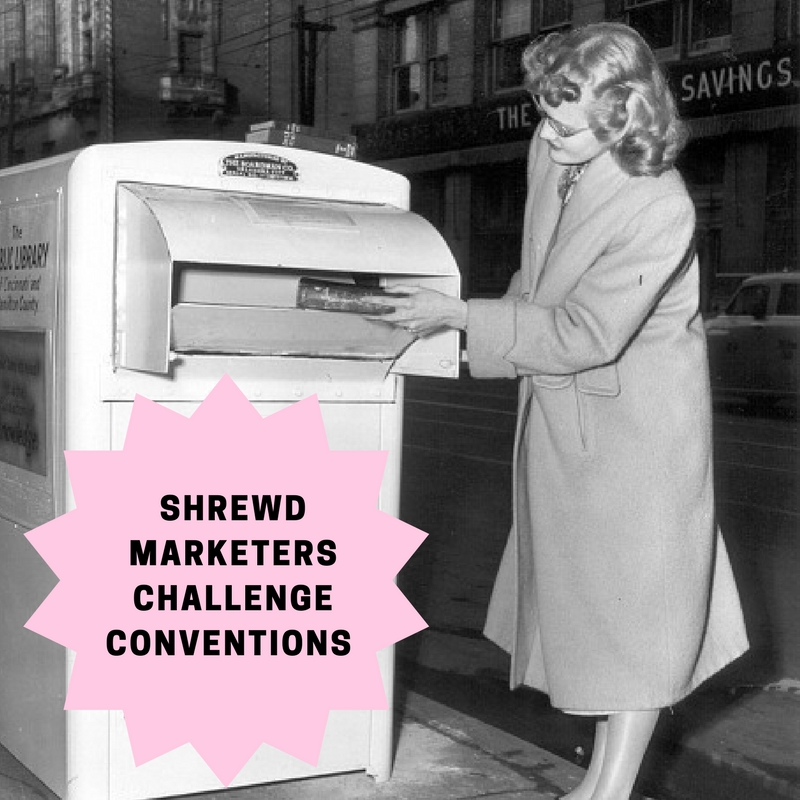
Shrewd Marketers Challenge Conventions. So Should We!

I’ve thought a lot lately about how to approach library marketing in a new and fresh way. As my library creates and executes our strategy for summer reading, I am looking at each tactic and wondering if we can improve the marketing of this legendary initiative. According to the American Library Association, summer reading programs began in the 1890s as a way to encourage school children, particularly those in urban areas and not needed for farm work, to read during their summer vacation, use the library, and develop the habit of reading. That’s a long time to be marketing a program and I think the industry might be a bit stuck in terms of how we do it.

For inspiration, I’ve looked over notes from a session I attended at Content Marketing World. It was led by Doug Kessler, co-founder and creative director of Velocity Partners, a B2B marketing agency with offices in the U.S. and England. Doug’s session was inspiring. It was titled Exceptional Content–Challenging the Invisible Conventions of Marketing. I printed out my notes and have read them through each morning, then thinking about the points he made every time I need a brain break.

Kessler focused his session on a concept he calls invisible conventions. We have so many invisible conventions in libraries. These are the ideas and practices that library staffers hold as traditional and unchangeable. If you hear someone say, “But we’ve always done it that way”, you know you’re talking about their invisible conventions. Invisible conventions are powerful.  Kessler says they guide and constrain us without us even knowing it.

We do need conventions.  But we don’t need to be slaves to convention. Kessler says it’s our job as marketers to expose the hidden conventions in our institution and play with them. Libraries can’t be precious about their conventions because your cardholders aren’t.  Conventions are a signal to your cardholders that marketing is involved–even if you’re trying to be sneaky about it. Your customers are smart, and they’ll put up their defense barriers.

Think about how you respond to marketing messages for invisible conventions. We’ve all developed a sense of when the pitch is coming and we run the other way! You don’t want to turn off your cardholders–you want to inspire them. But if you hang on to your invisible conventions for safety, you’ll never move forward in the marketing of your library.

Challenging your invisible conventions isn’t going to make you very popular, Kessler warns. And that’s okay. Your administration, leaders of other departments, even fellow librarians may have a strong reaction when you decide to challenge conventions. They are more comfortable with traditional marketing practices and they want you to create pieces that make them feel comfortable. Be strong. Take the long view. Persuade your co-workers that change is necessary and that safe marketing isn’t going to cut it with your cardholders. Your job is not to make everyone else in the library happy. Your job isn’t to make friends with everyone in you work with. Your job is to serve your cardholders, and you can only do that when you put your cardholders first. If that means you need to throw convention out the window, then it’s the best move. Don’t second guess yourself. When your instincts as a marketer tell you that something needs to change, you are right. Change it.

I’m reminded of advice I heard from another Content Marketing World speaker, Amanda Todorovich of the Cleveland Clinic. She confessed she’s made some people at the hospital unhappy with her relentless focus on the customer. She has a strategy and she often says “no” to people who want her to do conventional marketing. That means there are some folks she works with who don’t like her. Amanda is okay with that because she realizes her job is to serve the patients, not her co-workers. I draw inspiration from her attitude when I’m faced with having a difficult conversation with a co-worker. You can too! (Read my post about Amanda here.)

So how do you turn conventional marketing on its head? By doing more content marketing. Kessler says, thanks to the companies who came before us, the public knows marketing messages are often filled with compulsive and shameless lies (thanks, cigarette companies). Traditional marketing is all about the brand: a one-sided sales message.  Content marketing, by contrast, is all about the audience. Content marketing rewards libraries for telling the truth. It’s focused on utility–how can we best help our cardholders. It delivers value, builds trust, and it gives our cardholders the power!

Kessler left me with a final thought: unconventional marketing can lead to great stories. Be straight, simple, conversational, and relevant. You will change hearts and minds.

Subscribe to this blog and you’ll receive an email every time I post. To do that, click on “Follow” button on the bottom left-hand corner of the page. Connect with me on Twitter and Snapchat–it’s where I talk about library marketing! I’m @Webmastergirl. I’m also on LinkedInInstagram and Pinterest. Views in this post are my own and do not represent those of my employer.

Four Instant Ways to Improve the Most Valuable Page on Your Library Website

I find lately that I’m obsessed of late with library web pages. I’ve set aside time every week to look at how different libraries around the world set up their websites. What do library’s feature or highlight their homepage? How robust is their search engine? What’s in their drop-down menu? How is their library staff set up?

That last question usually ends with me scrolling through a library’s “About Us” page. And it’s there that I really get a sense of that organization, how it views itself, and how it views its relationship to its cardholders. This research brought me recently to this conclusion: Most libraries, including mine, need to update their About Us page.

Your library’s About Us page can be a gateway to all kinds of traffic to your website. Perhaps your analytics show that you aren’t getting any visits to that section of your website and therefore, you might think you don’t need to mess with it. But if you want to increase your market penetration or if you are considering any campaigns or direct marketing messages to increase the number of cardholders you serve, you’re going to want a kick a** About Us page. Likewise, if your library is in the midst of a levy campaign or waging any kind of battle with your city or county over funding, hours, or locations, your About Us page could help you in that battle. And that page will need to look inspire to win new users and funding.

The concept of a revolutionary change in the way About Us web pages are written and formatted is something that gets a lot of discussion in marketing circles for major brands. I hear it all the time at Content Marketing World. Many big companies have moved away from a traditional approach–a long and wordy mission statement in non-conversational language that usually includes goals which have no meaning to the customer. They’re writing in a conversational tone, including specific calls to action for customers, and striving for full transparency. They’re using their About Us page to connect with potential customers, build trust, and communicate what their brand stands for and what the customer can expect from a relationship with that brand. And I think it’s about time for the library world to get on board.

Chicago Public Library’s page is minimalist with clear language and an easy-to-navigate menu.

We should transform our About Us pages into something that really has meaning to our community. This is the web page where decisions are made by all of your stakeholders. You want the page to make potential cardholders feel “at home” and community leaders understand what it is that your library does and why it’s vital.

Here are four ways to transform your About Us page from an abstract section of your website into an amazing marketing tool.

Focus on the cardholder. Here’s a thought that many libraries have a hard time grasping: your About Us page isn’t actually about you. It’s about your cardholders. What is it that your library can do for the cardholder? Take your mission, vision, and values statement, which is likely written in lofty language, and rewrite it in a conversational tone. Or drop it from the page altogether! I know that’s a controversial standpoint but if your mission, vision, values statement is written with a bureaucratic bent, it won’t have any meaning to anyone outside your organization. Instead, think of your About Us page as a conversation between you and a non-library user. How would you, in normal conversation, tell someone about all the things your organization does? That’s what your About Us page should say. You might also take the opportunity to answer the most frequent questions your library gets from new cardholders.

I love how the Columbus Public Library answers the #1 most frequent question right on their About Us page.

Tell your Library’s story. Whether your library has been around for decades or is newly formed, there’s a fantastic story about its birth and its longevity. Tell it on your About Us page, in a paragraph, with inspiring and optimistic language. Keep your bragging to a minimum. If your library has won many awards, you can mention them briefly and put them into the context of how that award translates to better service for your cardholders.

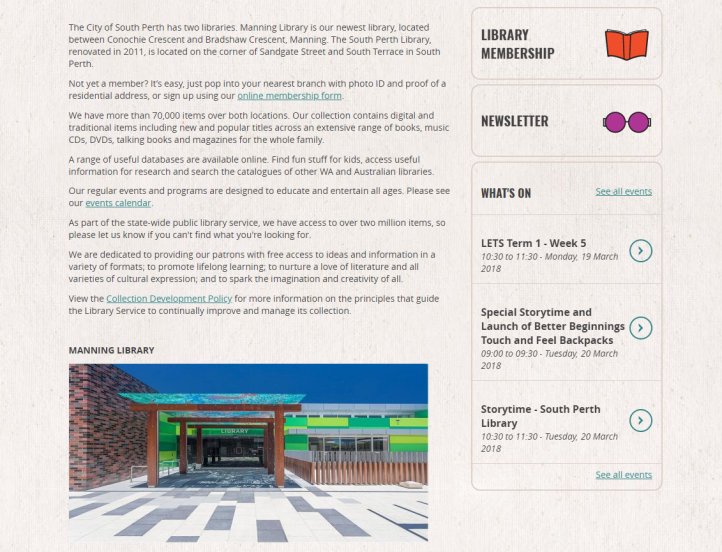
The Perth, Australia library’s About Us page includes all the essentials-how to get a card, sign up for a newsletter, and what is happening today at the library.

Less is more. Many libraries, including mine, have a long list of accomplishments and sub-headers on their About Us page. My library has 19 clickable sub-links!  Pare it down. White space is good. Pick the five most important things you’d want people to know and move the rest to another section of your website. Remember, your About Us page isn’t really about you… it’s about your cardholder. What are the five things a person would need to know to convince them to get a library card or to give you more money?

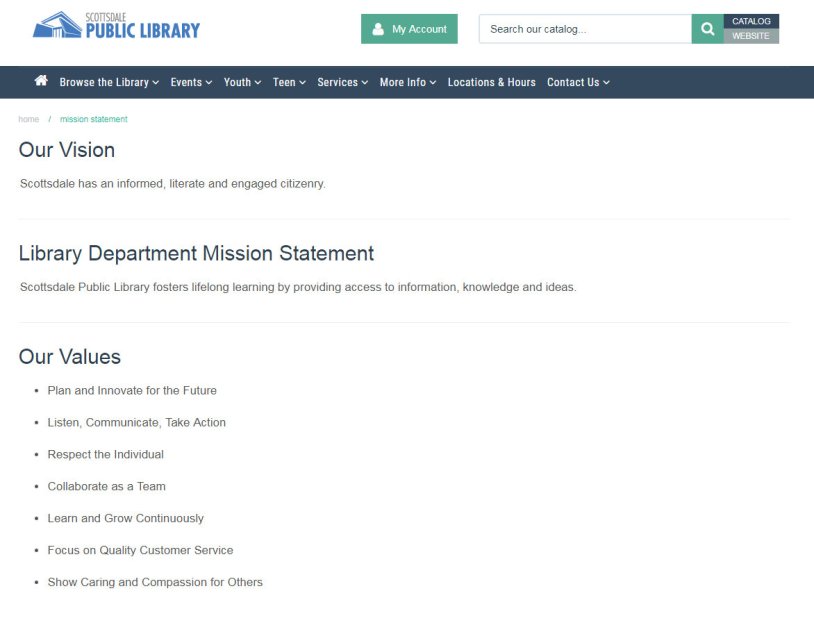
The Scottsdale, Arizona library takes a minimalist approach and it works!

Visuals are key.  Great, high-resolution photos that show people using your library and the workers who man the buildings are essential. Photos of faces are scientifically proven to be a more effective communication tool that text. Bold, easy to read fonts and primary colors work best for communicating ideas and drawing the eye to the page. Keep text to a minimum and pare down to five concepts that will tell your story.

I like how the Toledo Public Library’s page is heavy on visuals and includes easy-to-navigate sub links written in plain language.

Subscribe to this blog and you’ll receive an email every time I post. To do that, click on “Follow” button on the bottom left-hand corner of the page. Connect with me on Twitter and Snapchat–it’s where I talk about library marketing! I’m @Webmastergirl. I’m also on LinkedInInstagram and Pinterest. Views in this post are my own and do not represent those of my employer.

Library Marketing Secrets You Can Steal From General Electric

The woman who manages marketing at one of the biggest companies in the United States–and perhaps the world–made a huge impression on me at Content Marketing World. Linda Boff is Chief Marketing Officer at General Electric. You might think a huge brand like GE would be mired in traditional marketing practices and have nothing to teach us about agility and experimentation. You would be wrong.

Boff has led the company into a new realm of marketing, using tactics that libraries have access to, like podcasts and Facebook Live. Her focus is storytelling–finding the stories within your company and sharing them with your audience. She insists you don’t need a big budget to do what she’s doing. She’s a dynamic speaker and her presentation was one of the more memorable moments in the two-day conference because I ended up coming away with so many ideas for my library marketing. I left the room excited and energized!

Boff says there are five reasons to tell your library’s story: To sell (library translation: improve circulation, visits, and attendance), to inspire, to explain strategy, to reach audiences, and to educate. She told the audience that the success of GE with storytelling relies on a simple formula: Be first on platforms + activate unlikely audiences + find the human in the digital times. She laid out exactly what she means in her main brand storytelling tips.

Know who you are. GE embraces its nerd identity. The company produced a series of videos showcasing its nerd employees. They are professionally produced but you can do the same thing using your iPhone. Remember, it’s the story that’s important–not the production value of your video. In fact, our library produced a similar series of videos back in April for National Library Workers Week. We shot everything on a DSLR camera and edited it using free software available on the internet. Our fans–and our employees–loved the videos.

Identify your secret sauce. What is your tone? How do you come to life? Every brand has to figure out what this means to them. This next part is going to sound really familiar. GE has had to fight to be relevant, contemporary, relatable, and modern. Everyone knows who GE was in the company’s past. Everyone is familiar with GE’s legacy. Boff said one of her marketing goals is to teach people what GE is in the present.  To do this, Boff recommends you need to “show up as a person”–in other words, use real and personal stories about your workers to put a face to your company’s name. GE went to its employee’s children to ask them what their parents do. They told stories and drew pictures explaining their parent’s work. Then GE took those pieces and used them internally and externally. You can see some of those stories here.

 Find unexpected audiences. At South by Southwest, GE created a BBQ incubation area. They set up a BBQ smoker and had data scientists on hand to smoke the meat with exact precision so it came out right every time. They also had their scientists use data to make BBQ sauce, and they let people taste the sauce while hooked up to a scanner so they could see what their brain responded to via scan. Then took the super smoker to college campuses, so instead of the tent and handouts, they had this cool interactive centerpiece. I think that idea could translate for libraries too. Instead of just having a table at events, let’s bring MakerSpace equipment and traveling library collections so people can interact with our “products.”

Experiment early, experiment often. When a new social media platform or technology emerges, don’t hesitate–jump on board quickly and learn all you can about it, says Boff. The cost barrier to entry is always very low at the beginning of any new trend and the audience has no expectations about what you can or should produce. Boff says it’s important to be on the playing field and really skin your knees; you can’t just read about new trends. I really took this point to heart. We now have permission to move forward on new trends–let’s embrace it!

Good content speaks for itself. Boff and her team created GE Podcast Theater. They create long-form, lightly branded podcasts that are full content marketing platforms. GE’s “The Message” podcast was named as one of the New York Times 11 Fiction Podcasts Worth Listening To and was in the #1 spot on iTunes after its release.  Boff says if you are putting great stories out into the world, they’ll do their own marketing with their amazing content.

Stories are right under your nose: The hardest thing is finding stories to tell. GE works had to find stories reach customers, investors, thought leaders, media, AND employees. I’ve talked about finding stories in the library on this blog before in this article and this article. We should always be looking to connect with narratives that inspire all of those audiences. I really loved how Boff emphasized storytelling as a way to grow employee pride. At GE they do this through a YouTube series called In the Wild. It’s entertaining and engaging. Libraries could imitate that on a smaller scale. In fact, my library did that using a GoPro camera! We did time-lapse videos of various jobs and departments in the library and posted them on our YouTube channel. Those videos had more than a thousand views total and continue to draw new people to our YouTube content.

Subscribe to this blog and you’ll receive an email every time I post. To do that, click on “Follow” button on the bottom left-hand corner of the page. Connect with me on Twitter and Snapchat–it’s where I talk about library marketing! I’m @Webmastergirl. I’m also on LinkedIn, Instagram and Pinterest. Views in this post are my own and do not represent those of my employer.

A WordPress.com Website.

Up ↑