Library friends, we did it! We made it through 2025. We faced numerous issues and threats to libraries, yet we celebrated many triumphs. I’m proud of you. I’m proud of this community. And if no one has told you this lately, GOOD JOB YOU!
And now, we look forward to a new year and new chances to grow the connection between your library and your community.
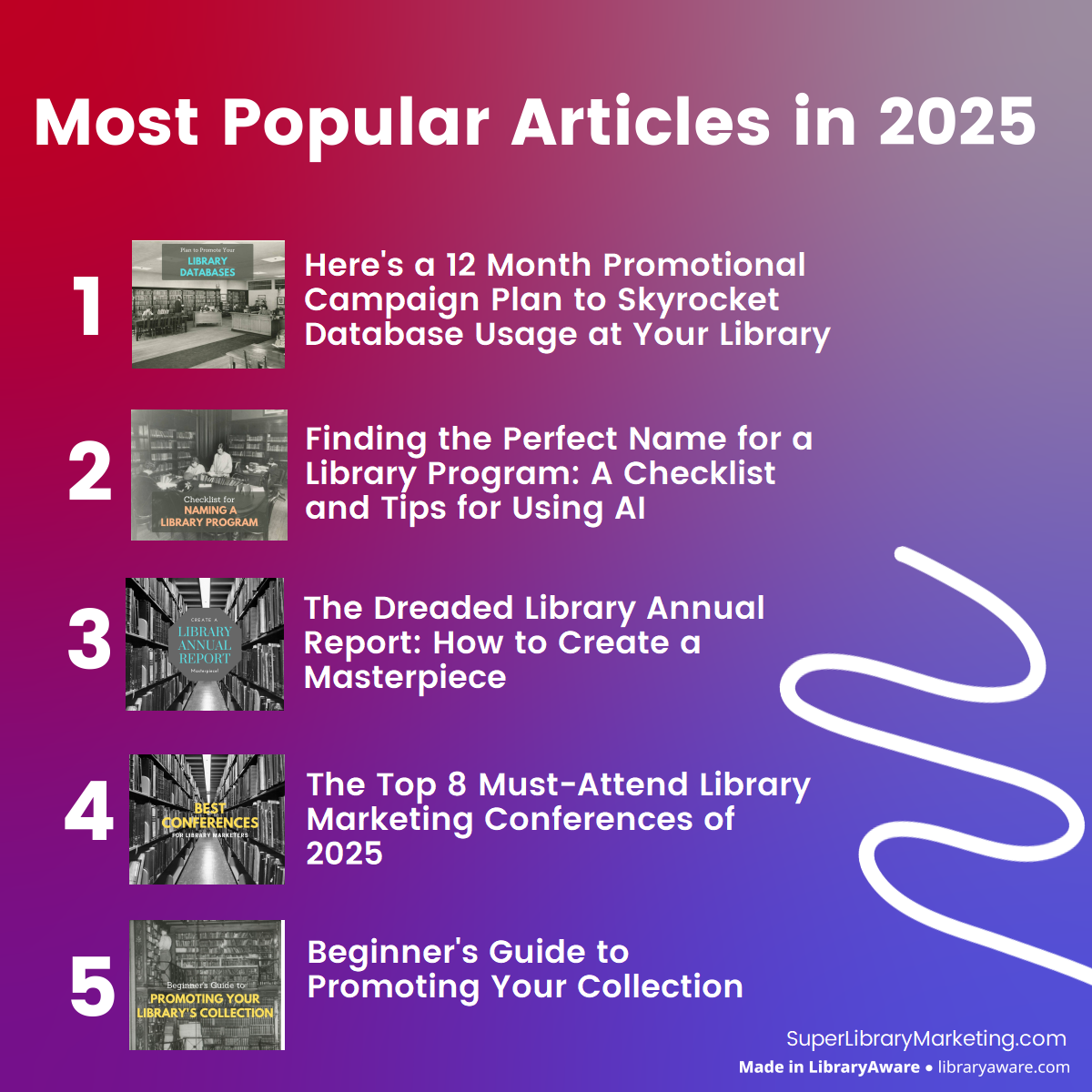
Want to make 2026 your best year yet? Let’s start by learning from the content your fellow library marketers found most helpful this year.
Most Popular Super Library Marketing Articles of 2025
I hope you are looking forward to 2026 as much as I am. My next post will be on Monday, January 5, when I’ll unveil the State of Library Marketing. I’ve got a calendar full of posts and videos featuring tips to make your work easier, as well as profiles of libraries to inspire you. Happy holidays!
FYI: The Super Library Marketing Guide to Social Media in 2026 launches on November 17. Be sure to sign up for emails so you don’t miss a single section.
Does it ever feel like you’re chasing every new marketing trend that pops up? 🐿️
New platforms, new tools, changing audience habits — it never ends! But here’s the good news: you don’thave to chase every shiny thing to be an effective library marketer.
In this week’s episode of The Library Marketing Show, I’ll show you how to stay focused, strategic, and ahead of the curve, without losing your mind.
Do you have a suggestion for a future episode’s topic? Do you want to nominate someone for kudos? Let me know here.
We’re just eight weeks away from a brand-new year, which means it’s officially prediction season!
Every marketing guru seems to have a list of what’s coming next, but don’t worry — I did the homework for you. I went through 36 predictions for social media in 2026, and in this episode of The Library Marketing Show, I’m breaking down the top five that actually matter for libraries.
FYI: The Super Library Marketing Guide to Social Media in 2026 launches on November 17. Be sure to sign up for emails so you don’t miss a single section.
Plus, I received a kudos nomination for more than a dozen libraries that collaborated on a huge project. You’ll want to hear about that.
Do you have a suggestion for a future episode’s topic? Do you want to nominate someone for kudos? Let me know here.
Photo courtesy Cincinnati and Hamilton County Public Library
Key Takeaways:
AI is changing how people search, and libraries are seeing a drop in website traffic as a result.
Simple formatting changes like clear titles, bullet points, and question-based headings can help your content appear in AI summaries.
Add credibility cues like staff names, job titles, and internal and external links to boost your site’s authority with AI and search engines.
Have you noticed a slight change in the blog posts here? Most now include a list of three quick takeaways at the top. Here’s why I started doing this, and why your library should consider it too.
AI impacts website traffic
A few months ago, I attended a webinar featuring three of the leading experts on Search Engine Optimization, or SEO. SEO is the practice of improving a website’s visibility and authority in organic search results to attract more visitors.
But AI has introduced a new wrinkle in SEO.
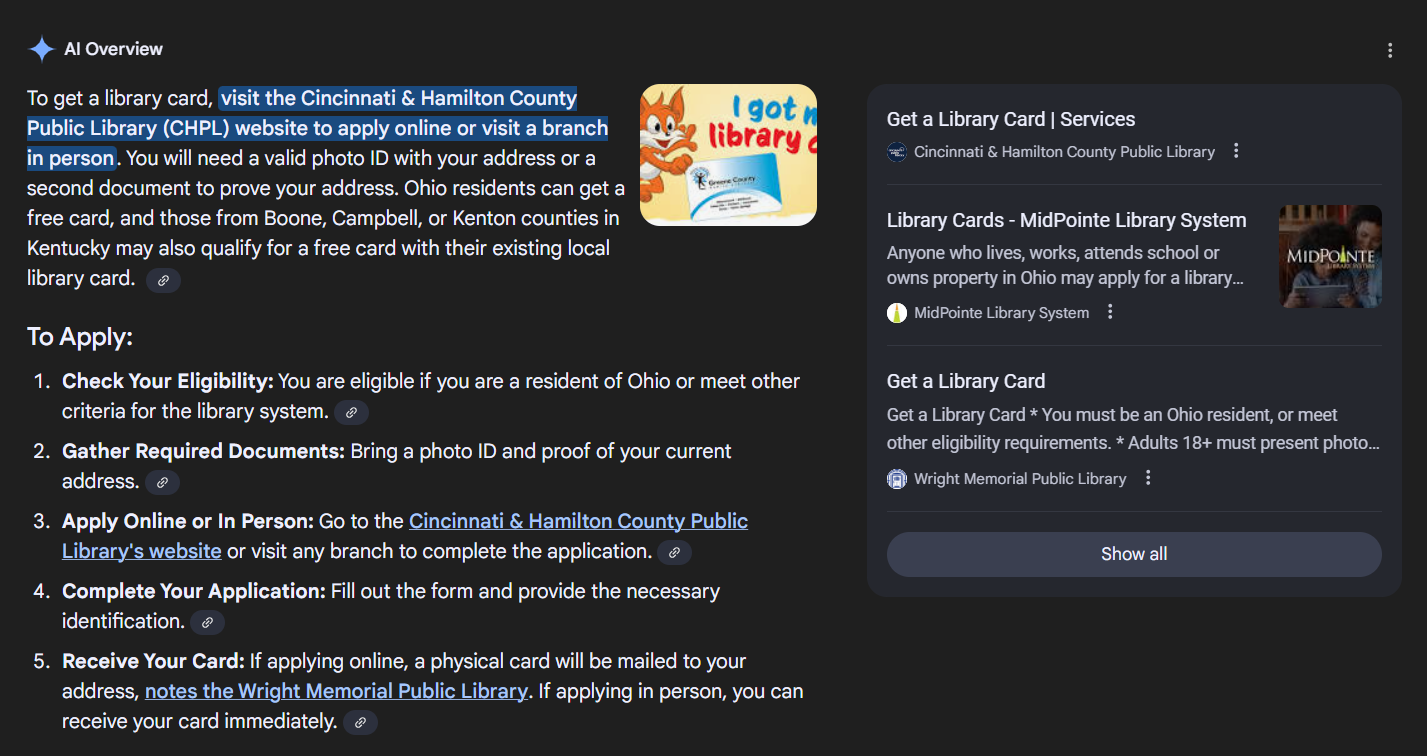
In May 2024, Google introduced AI Overviews (formerly called AI Summaries). These appear at the top of search results and provide a summarized answer to a user’s search, often pulled from multiple sources.
An example of an AI Overview for the search, “How can I get a library card?”
Once AI Overviews were introduced, searchers stopped clicking through to a website because their question was fully answered by the AI Overview. As a result, many libraries (and other websites, including this one) noticed a decrease in their organic web traffic.
In addition, a survey by Adobe Express says 25 percent of people use ChatGPT as their first choice for search over Google. Gen Z is particularly drawn to AI as a search engine. That likely means the popularity of using AI for search will continue to rise.
What does all this mean for your library?
You’ll need to adjust the way you structure your library’s website and blog to surface more often in AI searches and to show up in the AI Overview. It’s not as difficult as it sounds. Here are the changes I’ve implemented. I recommend you try these and monitor your web traffic over several months to see if the changes make an impact.
Titles should be clear, not clever.
Tell readers exactly what they’ll find on the page. For example:
Author Visit
❌ Clever Title:“An Evening of Literary Magic”
✅ Clear Title:“Meet Author Jasmine Guillory at the Library – October 24”
Why it works: The clear title includes the type of event, the author’s name, and the date. Those are the keywords that AI tools and search engines can easily match with user queries.
Craft Program
❌ Clever Title:“Get Your Glue On!”
✅ Clear Title:“Fall Craft Workshop for Teens – Make Your Own Bookmarks”
Why it works: It specifies the audience (teens), the season, and the activity.
Educational Workshop
❌ Clever Title:“Brain Boost Bonanza”
✅ Clear Title:“Free SAT Prep Workshop for High School Students”
Why it works: It uses direct language that matches what a student or parent might search for, like “SAT prep” or “high school test help.”
Wellness Event
❌ Clever Title:“Zen in the Stacks”
✅ Clear Title:“Free Yoga Class at the Library – All Levels Welcome”
Why it works: It clearly states what the event is, where it’s happening, and who can attend.
Include a bullet list of key takeaways or what you’ll learn at the top of the page.
This helps both readers and AI quickly understand the content. Try this on blog posts and key webpages.
Here’s how you might structure key takeaways at the top of a library card sign-up page.
A library card is free to all residents of Tree County.
Applicants need to fill out a form and have one document with proof of residence. The form can be sent to the library via email or presented at any library location.
Applications presented in person will be processed immediately. Applications sent via email will take 1-2 days to process.
Once an application is accepted, you’ll be given a card, which you will you to check out items, reserve meeting rooms, and register for programs.
Ask ChatGPT to provide you with a list of keywords or frequent questions around your topic. You can also search for your topic on Google and look at the ‘People Also Ask’ section. The website Answer the Public can provide you with some frequently asked questions as well.
Structure your content with bullets, steps, or lists.
Clean formatting makes it easier for AI to scan and summarize your content. You’ve probably noticed this post has been full of bullets and lists. That’s intentional! The bonus benefit is that it makes your blog and website easier to read.
Write in natural, conversational language.
Avoid jargon. Focus on being clear and helpful. Remember that searchers will not use jargon to look for answers to questions that may lead them to your library. Try to imagine what your community would put into the search bar, and then use those words in your blog or landing page.
When possible, include a staff member’s name and job title on a page.
AI looks for expertise or credentials when scanning pages. This is easy for a blog… just include the name of the author and their title in the post. For a landing page, consider adding a line like this: “Need help signing up? Email Maria Lopez, Library Services Manager, with 15+ years of experience helping patrons, at mlopez@treelibrary.org.”
Ask your partners to link to your website and blog.
When other trusted sites link to your content, it signals credibility to AI and search engines.
Use internal links whenever possible.
Link to related blog posts or pages on your site to help AI understand your content’s structure and relevance. That has the added benefit of keeping people on your page longer, which improves your trust and credibility to Google and AI, which means you’ll show up in search more often!
Try to stay within best practice lengths for word count.
BlueHost.com says for blogs, the ideal range is between 1,500 and 2,500 words. This gives readers comprehensive coverage of a topic. It’s also easier to include keywords and internal links for longer posts.
But… here’s something to remember: Google and AI tools prioritize quality over length (and so do most readers!) Don’t try padding your posts, as that can hurt your ranking.
Neil Patel, who is a trusted expert on SEO, says that for landing pages, word count isn’t a direct ranking factor. Rather, you should focus on the user’s experience and provide enough information for a community member to act.
Has your library’s website traffic taken a hit? Are you using any other methods to drive more traffic to your library’s website? Let me know in the comments.
Subscribe to this blog, and you’ll receive an email whenever I post. To do that, enter your email address and click on the “Follow” button in the lower left-hand corner of the page. You can also follow me on the following social media platforms:
I have a warning about how artificial intelligence may impact the performance of your social media platform metrics. We will get into it and what you should do to prepare for this disruption in this The Library Marketing Show episode.
Plus kudos go to a library with a staff member who is appearing on a popular Netflix show!
And I have a favor to ask: NoveList is doing a market survey on how libraries handle professional development training. Would you be willing to take the survey? It should take five minutes or less. Thank you!!
Do you have a suggestion for a topic for a future episode? Do you want to nominate someone for kudos? Let me know here. Thanks for watching!
Subscribe to this blog and you’ll receive an email whenever I post. To do that, enter your email address. Then click on the “Follow” button in the lower left-hand corner of the page. You can also follow me on the following social media platforms:
We know that it’s very important to strike the right tone with our library marketing and promotions. But when you’re creating a social media post, a flyer, or an email, how do you ensure your message resonates appropriately with your audience?
I have a little trick I’m going to show you in this episode of The Library Marketing Show.
Plus, I’m giving kudos to a library that was mentioned on the Kelly Clarkson show!
Do you have a suggestion for a topic for a future episode? Do you want to nominate someone for kudos? Let me know here. Thanks for watching!
Subscribe to this blog and you’ll receive an email whenever I post. To do that, enter your email address. Then click on the “Follow” button in the lower left-hand corner of the page. You can also follow me on the following social media platforms:
Artificial intelligence, or AI, has many implications for library marketing. And now, AI is changing how people search for your library on the internet. But…
There is one, relatively easy thing you can do to ensure people find your library when searching for it on ChatGPT, Google’s Perplexity, and Microsoft’s CoPilot. We’re going to get into it in this episode of The Library Marketing Show.
Plus we’ll give kudos to a library that’s cross-posting videos from one social media platform to another. Normally, this is a no-no but there is an exception… and this library is taking advantage of it!
Do you have a suggestion for a topic for a future episode? Want to nominate someone for kudos? Let me know here. And thanks for watching!
Subscribe to this blog and you’ll receive an email whenever I post. To do that, enter your email address and click on the “Follow” button in the lower left-hand corner of the page. You can also follow me on the following social media platforms:
Photo courtesy Cincinnati and Hamilton County Public Library
One of the hardest tasks in library marketing is naming programs and events.
The name of a program can significantly impact attendance. The name must capture attention. It needs to be clear and memorable. And it needs to be discoverable for community members searching online.
In this post, I’ve created a checklist. Under each point on the checklist, I’ll give you an example of how to use AI tools like ChatGPT, CoPilot, Perplexity, and Gemini to check that your library program name meets the criteria.
If you’ve already come up with a name, you can check your choice against each of these considerations. If you’re beginning from nothing and have no clue what to name your program, use this checklist to find the best name and drive lots of attendance!
Checklist for Naming Your Library Program
✔️Relevance
The name of your library program should accurately reflect the program’s or event’s content and purpose. It should give attendees a clear idea of what to expect.
Example
I asked Google’s Gemini: “I am putting together an early literacy library program. In this program, babies and caregivers can read books together, but the babies are encouraged to move around during the reading time. I want to name the program “Young and Restless”. Is that a relevant program name?”
Gemini’s answer
“Young and Restless” might not be the best fit for an early literacy program.
“Young and Restless” is the title of a soap opera, and the connotation leans more towards drama and adult themes. It doesn’t immediately convey the idea of early literacy. While “restless” could be seen as a playful reference to a baby’s energy, it might also suggest a negative connotation of being unable to focus.
Here are some alternative program names that better capture the essence of your program:
“Wiggle While We Read”
“Rhyme Time & Playtime”
“Storytime on the Move”
“Littlest Learners & Lively Laps”
“Bookworms in Motion”
✔️Appeal
The name must attract your target audience. Consider that people often scroll online and when they read print. Your library program name must stand out from other programs or events in your community.
Example
I asked Perplexity: “I am putting together a library program where crocheters of all skill levels can come to work on their projects, give help to others, and get help building their skills. I want to call it Hooked on Crochet. Does that program name have enough appeal to capture attention?”
Perplexity’s answer
The name “Hooked on Crochet” for your library program has several appealing qualities that could help capture attention:
Pros:
The name plays on the double meaning of the word “hooked,” referring both to the crochet hook used in the craft and the idea of being enthusiastically engaged or “hooked” on crocheting.
The alliteration and rhyming nature of the name make it catchy and easy to remember, which is essential for a program name to stand out.
By not specifying skill levels in the name, it implies that the program is open to crocheters of all abilities, from beginners to experts.
The word “hooked” has a positive connotation, suggesting a passionate interest or enjoyment in crocheting, which could resonate with enthusiasts of the craft.
Potential Cons
While wordplay can be effective, some may find the “hooked” pun a bit overused or clichéd in the context of crocheting.
The name may be too specific to crochet and could potentially exclude other fiber arts or crafts that you might want to incorporate in the future.
✔️Clarity
The name should be easy to understand and remember. You’ll want to avoid complex, obscure, or cutesy names that might confuse people.
Example
I asked ChatGPT: “I am organizing a library program where people can bring a plant to swap and learn about composting, and sustainable gardening. There will also be crafts and games. This program is for all ages. Can you help me come up with a name that clearly states what will happen at my program?”
ChatGPT’s answer
That sounds like a fantastic and engaging program! For a name that captures the essence of your event while being concise and appealing, consider the following options:
“Sustainable Garden Swap & Fun Day”
“Green Thumb Plant Swap and Activities”
“Eco-Friendly Garden Day”
“Plant Swap and Garden Fun”
“Sustainable Gardening Fair”
✔️Length
The name should be short and concise. Long names can be difficult to remember and may be difficult to fit on your marketing materials.
Example
I asked ChatGPT: “I am putting together a library program at an academic library. The program will be interactive and will help students to better understand the databases and research resources available to them at the library. I want to call the program Interactive Workshop on the Integration of Research and Retrieval Skills, but my manager thinks that name is too long. Is it too long?”
ChatGPT’s answer
Yes, “Interactive Workshop on the Integration of Research and Retrieval Skills” is quite long for a program name. It might be better to shorten it to make it more concise and easier for students to remember. Here are a few shorter alternatives:
“Research Skills Workshop”
“Interactive Research and Retrieval Workshop”
“Library Research Skills Workshop”
“Research Resources Workshop”
“Effective Research Techniques Workshop”
✔️Accessibility
The name of your library program must not exclude any potential participants.
Example
I came up with a name for a technology program called “Advanced Technological Workshop for Digital Natives.” I asked ChatGPT to evaluate the accessibility of the name.
ChatGPT’s answer
“Advanced Technological Workshop for Digital Natives.” is an inaccessible library program name for several reasons.
Community members might interpret the term “Digital Natives” to mean only younger people who they assume are highly proficient with technology. This excludes older adults or those without regular access to technology. It’s also a very obscure term. Did these people live in the digital world??
The term “Advanced” might also deter people who do not consider themselves advanced in technology from attending, even if they are interested in learning more about it!
And the whole tone of the name is very formal, academic, and intimidating.
✔️Searchability
Many of your community members are looking for help online. You want your program name to come up in search! So be sure to include keywords that people might use in search.
Example
I asked Copilot: “I have a library program named “Opera Appreciation.” Are there any keywords or phrases that I need to add to the program name or description to make this more discoverable in search?”
Copilot’s answer
Certainly! To make your “Opera Appreciation” program more discoverable, consider incorporating relevant keywords and phrases in the program name or description. Here are some suggestions:
Opera: This will directly associate your program with the art form.
Music Appreciation: This can help convey the educational aspect and attract those interested in learning about this genre.
Classical Music: Opera is a subset of classical music, so including “classical music” in your program’s description can broaden its reach.
Arias: Highlight that your program explores opera arias—the beautiful solo pieces performed by singers. Mentioning “arias” can attract opera enthusiasts.
Composer Names: Incorporate the names of renowned opera composers.
Subscribe to this blog and you’ll receive an email whenever I post. To do that, enter your email address and click on the “Follow” button in the lower left-hand corner of the page. You can also follow me on the following social media platforms:
I have a new trick that I use in my own workday for posting across multiple social media platforms. It helps me stay within best practices in terms of post length. And this is one of those instances in which the robots are very helpful!
I will show you exactly how I do this, in this episode.
Plus, kudos go to an academic library that uses Instagram Live to build excitement and engagement.
Do you have a suggestion for a topic for a future episode? Want to nominate someone for kudos? Let me know here. And thanks for watching!
Subscribe to this blog and you’ll receive an email whenever I post. To do that, enter your email address and click on the “Follow” button in the lower left-hand corner of the page. You can also follow me on the following social media platforms:


 Super Library Marketing: Practical Tips and Ideas for Library Promotion