Search

Super Library Marketing: Practical Tips and Ideas for Library Promotion

Tag

ALA

Valuable and Timely Advice for Marketing from 5 of the Top Minds in Library Promotion

Photo courtesy Public Library of Cincinnati and Hamilton County

My first American Library Association Annual Conference was a whirlwind.

I spent my time in DC searching for my people. You know them–the library staff members who are tasked with promoting their libraries.

It’s a job that you can’t really understand unless you’ve done it. And these five people have done it.

So, I asked them to share their best piece of advice for library promotion. And I got five amazing answers that I wanted to share with you.

Because, no matter where you are, and no matter what size library you work for, these nuggets of wisdom will inspire you. They will cause you to think deeply and intentionally about your work.

And best of all, they will reassure you that other library marketers share your worries, problems, and challenges. You, my friends, are not alone.

Advice from 5 staffers working in library marketing and promotions

George Williams, Media Relations Manager, DC Public Library

“The most important part of marketing is to remember that it is about the customer. Before deciding on a strategy or a tactic, there has to be a very clear understanding of who would be most interested in an author, book, database, product, or service. Think about what it will help a customer do and what would that mean for them.”

“Next, use that information to think through what message would resonate with that person, what is the best way to communicate that message, and when is the best time to share that message. For example, resume help, in a practical sense, helps someone update a document. But the function it serves is to help someone rebrand their career, find a better job, or end the frustration of not being called for an interview.”

“Using that insight can help you figure out a lot of ways to talk about a service that we offer every day, That could change the trajectory of a customer’s life. Building a communications plan from that insight creates a lot of opportunities beyond a flyer that says ‘resume help.'”

“Our goal is always to connect with our customers. Starting from their perspective in planning makes a huge difference.”

April Harder, Editorial Supervisor, Arlington Heights Memorial Library

โ€œIn light of the last few years and how difficult it has been for staff to adjust to changes, be flexible. Be willing to change your methods. And then be willing to change them back if things change again. That flexibility in how you are delivering your message and how people want to receive it is key.”

“Make sure everyone on your team is cross-trained and everyone can step in at any moment and help each other out. That support aspect is super important when youโ€™re making changes on the fly and adapting to how you deliver the message based on our changing times.โ€

Michelle Nogales, Librarian, Hayward Public Library.

โ€œA lot of our library workers in their silos in the library like to produce their own visuals for social media and my one piece of advice that Iโ€™m always giving them is a social media image is not a flyer. You donโ€™t need to get all the words on it, you donโ€™t need to get all the information on it, you just need a nice image.โ€

Mark Aaron Polger, Coordinator of Library Outreach and Associate Professor, College of Staten Island, City University of New York.

โ€œCreate a marketing plan to tackle specific library services and resources. Make it scalable and manageable. Set realistic, tangible, quantifiable goals.”

“Conduct market research before planning marketing activities. All your marketing initiatives should be informed by data. Donโ€™t assume or guess what your users want. Conduct market research to identify your segments and learn about your library community.

“When conducting market research, use primary sources to obtain original data about your library community. Supplement with secondary sources like census, survey data from Pew Research, and community survey data.”

“You canโ€™t market to everyone; be selected and specific. Your marketing should target specific segments of your library community. Those segments are identified in your market research.โ€

Jordan Reynolds, Marketing Coordinator, Saline County Library

โ€œGet involved in your community. Libraries are essential to the community, but too many people assume they are only there to provide books. We all know that is not the reality! From driver’s test assistance and notary services to free Wi-Fi and computer help, libraries provide so many beneficial opportunities for free! By getting involved in the community, not only are you able to get your name and services out there, but you’re showing that your library is a team player.”

“Small businesses and civic organizations around your community can offer volunteers, provide giveaway items, sponsor events, and so much more. Join the chamber(s), put library representatives in civic organizations, and show up in the community and they will show up for you.โ€

Do you have any advice to share with fellow library marketers? Add your thoughts in the comments section.


Read These Articles Too!

Library Conferences Need More Marketing Sessions! 5 PLA Attendees Explain Why a Focus on Promotions is Critical Right Now

The 9 Best Conferences in 2022 for Anyone Looking To Learn More About Library Promotions and Marketing

Latest Book Review

Crying in H Mart by Michelle Zauner

Subscribe to this blog and youโ€™ll receive an email every time I post. To do that, enter your email address and click on the โ€œFollowโ€ button in the lower left-hand corner of the page.
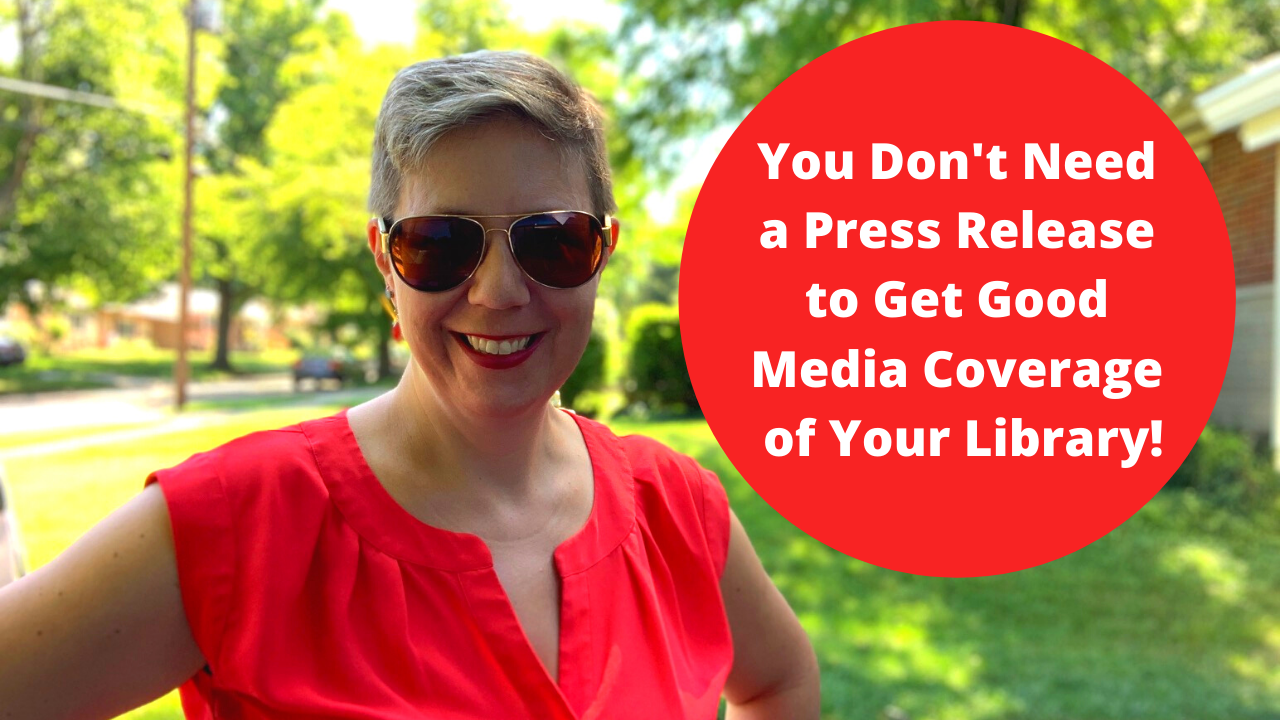
You Don’t Need a Press Release to Get Good Media Coverage of Your Library! Here’s the Secret Trick From a Former Journalist.

Watch Now

The Library Marketing Show, Episode 55

Angela used to work in a TV newsroom and at a library and she shares a secret for getting good press coverage for your library. It doesn’t involve writing a press release!

Also, a reader wants to know if YOU know of any cartoon artists doing library-specific drawings or memes to share on social media. If you do, let her know in the comments!

Also Kudos to the winners of the 2020 PR Xchange Award Winners!

What did you think of this episode? Are you struggling with marketing and promotion right now? Do you have an episode suggestion? Would you like to nominate someone for kudos? Let me know in the comments.

And subscribe to this series to get a new video tip for libraries each week! Thanks for watching.

Subscribe to this blog and youโ€™ll receive an email every time I post. To do that, click on the โ€œFollowโ€ button in the bottom left-hand corner of the page. Connect with me on YouTube, Twitter,ย Instagram, and LinkedIn.ย 

Five Relevant Library Marketing Lessons Learned at the American Library Association Annual Conference (#ALAVirtual20)

Photo Courtesy Public Library of Cincinnati and Hamilton County

At my former job at a large metropolitan public library, there was an unspoken rule when it came to library conferences. Librarians got first dibs on training money to attend. I thought that was totally fair. But I also found myself suffering from a serious case of envy every time I saw my coworkers headed to the airport for the American Library Association Annual (ALA) Conference, the Public Library Association (PLA) Conference, or our state library convention.

When I took my new job at NoveList earlier this year, one of the perks was knowing I would see my library friends again at these conferences. I would finally get to attend. I’d be one of the crowd! I’d be in on the action!

Alas, it was not meant to be (thanks, Coronavirus).ย So, my first ALA Annual turned out to be virtual. That had some advantages. On-demand video meant I could jam more sessions into a day. I could pause sessions to get a drink or take a bathroom break. I could leave sessions if I wanted to without worrying about embarrassing the panelists. And I could attend in my outdoor workspace.

It had some disadvantages too. I got more exhausted than normal. And boy, did I miss the personal interaction with librarians and library staff.

I did end up learning a lot. Here are my key library marketing takeaways from three days of sessions.

Good internal communication reduces workload and duplication of work.

We could all do with a little more internal communication and a less work.ย In the session Happy Together: Collaboration and Communication between IT and Technical Services, staff from the University of Washington Libraries shared the ways in which a concentrated effort on improving staff communications made their workday easier.

Good internal communication helped them to be less reactionary and more proactive. They were able to put the focus back on the customer, rather than always thinking about how the work was affecting staff.ย  They found it easier to remember why they wanted to work in a library and to stay excited and positive about their jobs. They felt more empathy for each other, which improved relationships between departments.

The panelists encouraged attendees to focus on their library’s strategic plan to find common ground with coworkers in different departments. They designated a “gatekeeper” or “key contact” for each department, so everyone would know who to go to if they had a question or suggestion.

Key quote: “Remember we are all on the same team even with different deadlines and project objectives.”ย 

Smart libraries use messaging to advocate for more funding.

Most library staff are under the presumption that the public knows their library is essential. They do not. And past perceptions of the library are a real hurdle. People imagine the library as it was 20 or 30 years ago and have no concept of how much it has changed.ย 

In the session, Advocating for your Library: The Eโ€™s of Libraries and Collecting Stories, Alan Fisher told attendees to use messaging to address those hurdles. He encouraged us to message around activities your supporters will want to fund like story times, meals for kids, and literacy programs. He also told attendees to be intentional about using common language so supporters can understand your message. Finally, he says libraries must make their message memorable.

Key quote: “Use messaging that affectively addresses the hurdles so people can understand that we are essential. Donโ€™t say everything you want to sayโ€ฆ say what THEY need to hear.”ย ย 

Libraries must share the monetary value of author events with publishers.ย 

Author events at libraries drive book sales. But publishers have no idea that we are helping them make money.

In the session, How to Measure the Value of Library Marketing on Book Sales and Discovery, Guy Gonzalez said most libraries work with authors, not publishers, to schedule events. As a result,ย  publishers are often unaware of library event’s positive impact on sales. The people who attend author events at their library are library borrowers who often also become book buyers. So, events are a unique marketing opportunity for the publisher.

Gonzalez encouraged libraries to track, measure, and communicate their full impact on book sales back to publishers. He encouraged attendees to develop a media kit that defines the audience of the event, and the actual monetary value of promotional platforms like email, social media, and press coverage. Once the event is over, send that data to the publisher directly.ย 

Key quote: “Author events are hyper-targeted with deep engagement. Don’t undervalue how much you provide.”

Library marketing must elevate ideas that can improve our society, not around ideology, but around purpose.

In the Presidential program, politician and author Stacey Abrams gave a remarkable and inspiring interview that covered voter suppression, the census, and the role of libraries in helping disenfranchised communities.

Abrams urged the audience to remember that libraries are essential because they are a trusted source of information. She said that libraries are a microcosm of America and are perfectly positioned to address the inequities that persist in the rest of society.

She also asked libraries to be intentional about placing themselves in the same space and in communion with those who need them the most. Finally, Abrams called on the library industry to name the barriers to diversity, to call them out, and to build strategies to overcome them.

The daughter of a librarian, Abrams slept in the stacks of the college library where her mother worked and often got in trouble with the librarians for checking out too many books! She shared the books she’s currently reading: Evicted by Matthew Desmond and Black Leopard, Red Wolf by Marlon James.

Key quote: “Advertise yourself. We take libraries for granted. We know they exist, but we rarely think about them.”ย 

Virtual story times may or may not violate copyright laws.

I attended the session, Trouble in Paradise: Are you violating copyright by using social media read alouds? hoping for clarification for my library clients. What I got was more confused, at no fault of the presenters. They did an excellent job laying out the many intepretations of copyright law.

Many publishers gave libraries permission to read their titles aloud at the beginning of the pandemic. That grace period ends tomorrow, June 30.

To help you decide what to do once that deadline passes, I suggest reading these two articles recommended by the session presenters: Online Story Time & Coronavirus: It’s Fair Use, Folks and Do Online Storytimes Violate Copyright?

The presenters suggested you post your virtual story time on YouTube but make the recording private. Your library can send a link to view the video to patrons, making it more a “classroom-type” setting which is not in violation of copyright. They also suggested adding a graphic to your virtual story times to warn viewers not to share or download and store your virtual story time.

Finally, the presenters asked attendees to remember that authors make their living from publishing books. Broadcasting the reading of a book, especially a picture book, is essentially giving the book away.

Key quote: “Fair use is not used to try and get around something. It’s in the law and it’s a right of users.”

You Might Also Find These Articles Helpful

Worries in the Library World: Here are Answers to Your Four Biggest Library Marketing Concerns Right Now!

How to Tackle Library Signage in a Pandemic and Make Visitors Feel Comfortable With Your New Rules

Latest Book Reviews

Year of Wonders by Geraldine Brooks

You Never Forget Your First: A Biography of George Washington by Alexis Coe

Find more 60-second Book Reviews here.

Subscribe to this blog and youโ€™ll receive an email every time I post. To do that, click on the โ€œFollowโ€ button in the bottom left-hand corner of the page. Connect with me on YouTube, Twitter,ย Instagram, and LinkedIn.ย 

A WordPress.com Website.

Up ↑