Search

Super Library Marketing: Practical Tips and Ideas for Library Promotion

Tag

Conferences

Library Promotion Mastery: Top 10 Tips You Need To Know for the New Year

This holiday week, I wanted to ensure you are set up for success in promoting your library in 2025. These are the most popular Super Library Marketing posts from the past year that you may have missed. (We’re all so busy!)

Most Popular Super Library Marketing Articles of 2024

#1: The 11 Best Conferences in 2024 for Anyone Looking To Learn More About Library Promotions and Marketing (and Some Are Completelyย Free!) Note: the 2025 version of this post will be published on March 3, 2025.

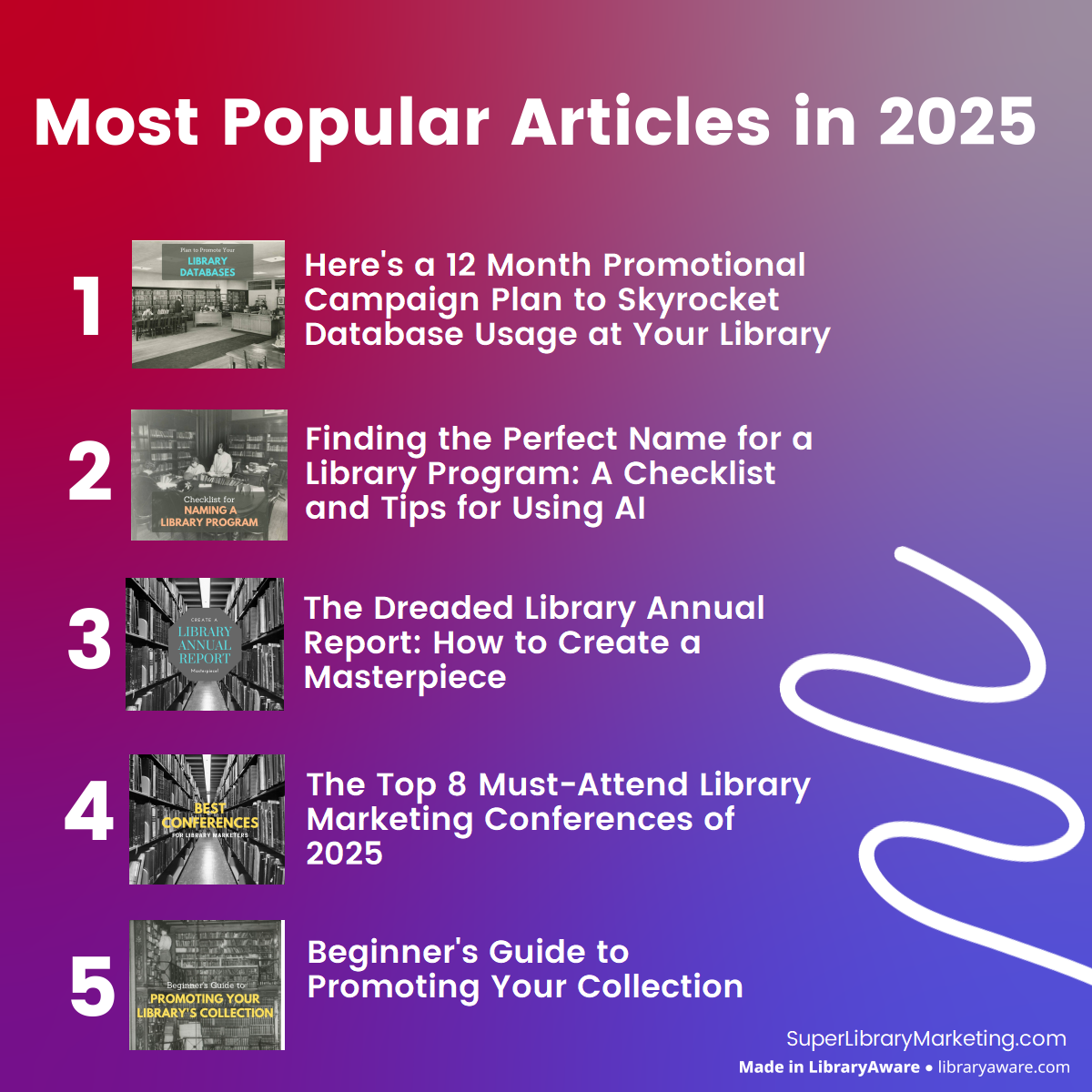
#2: The Dreaded Library Annual Report: How to Create a Masterpiece that Showcases Your Libraryโ€™s Value and Inspires Yourย Readers

#3: 5 Surprisingly Easy Ways to Write Email Subject Lines That People Actually WANT toย Read

#4: 10 New Infographic Ideas To Prove the Value and Power of Yourย Library

#5: 3 Library Marketing Experts Agree: Itโ€™s Time for Your Library To Abandonย Twitter

Top Episodes of The Library Marketing Show of 2024

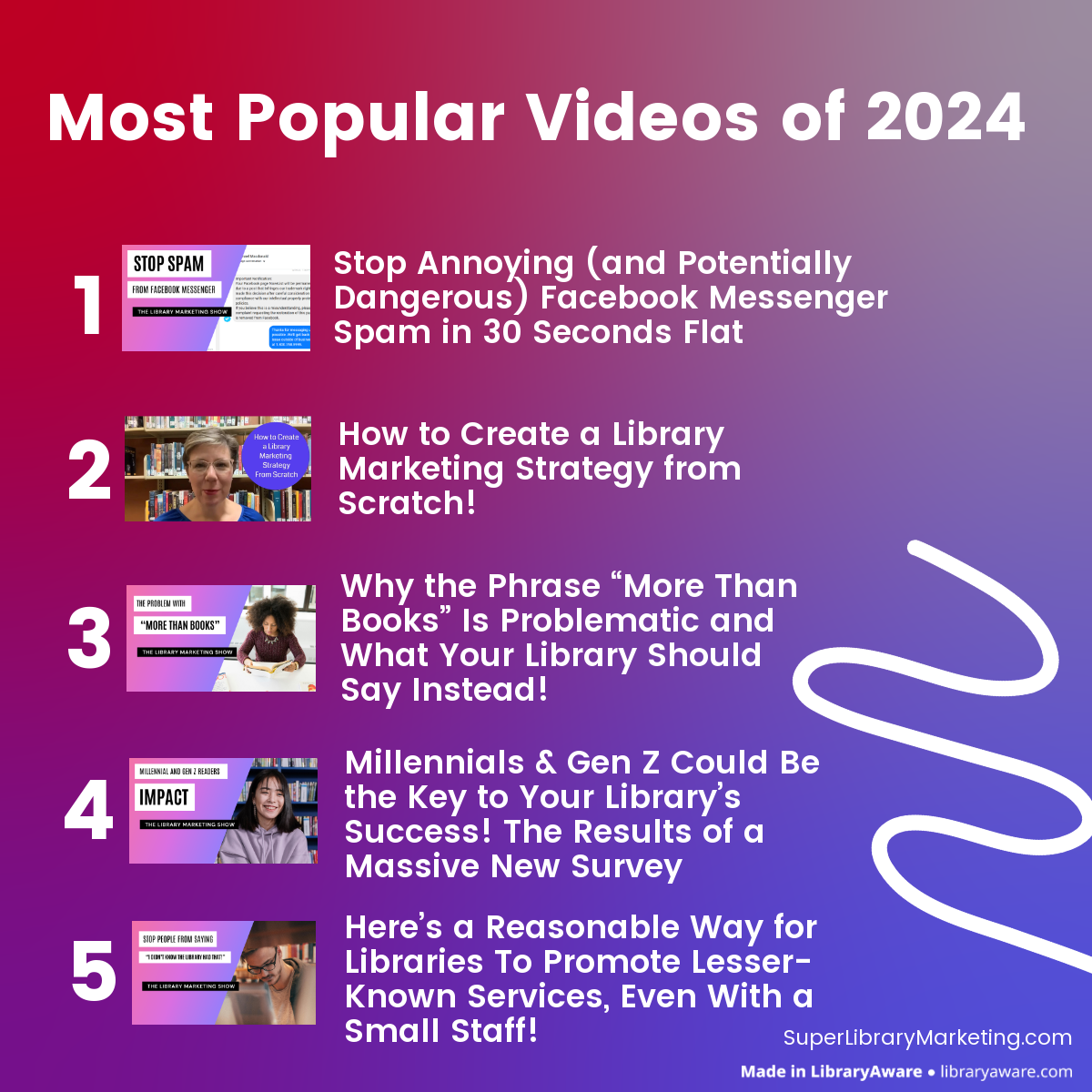
#1: Stop Annoying (and Potentially Dangerous) Facebook Messenger Spam in 30 Seconds Flat

#2: How to Create a Library Marketing Strategy from Scratch! (BTW: The episode is five years old!)

#3: ๐Ÿ˜–Why the Phrase โ€œMore Than Booksโ€ Is Problematic and What Your Library Should Say Instead!

#4: Millennials & Gen Z Could Be the Key to Your Libraryโ€™s Success! The Results of a Massive New Survey

#5: ย Hereโ€™s a Reasonable Way for Libraries To Promote Lesser-Known Services, Even With a Small Staff!

I hope you are looking forward to 2025 as much as I am. Weโ€™ll be tackling new library marketing and promotion subjects. Plus I have lots of library profiles on the calendar. You’ll be hearing advice from libraries just like yours. As always, I welcome your suggestions about topics you want to cover. Happy New Year!!


PS Want more help?

Beginnerโ€™s Guide to Promoting Your Collection: How to Get Started and Drive Circulation at Your Library

Subscribe to this blog and youโ€™ll receive an email whenever I post. To do that, enter your email address and click on the โ€œFollowโ€ button in the lower left-hand corner of the page. You can also follow me on the following social media platforms:

Valuable and Timely Advice for Marketing from 5 of the Top Minds in Library Promotion

Photo courtesy Public Library of Cincinnati and Hamilton County

My first American Library Association Annual Conference was a whirlwind.

I spent my time in DC searching for my people. You know them–the library staff members who are tasked with promoting their libraries.

It’s a job that you can’t really understand unless you’ve done it. And these five people have done it.

So, I asked them to share their best piece of advice for library promotion. And I got five amazing answers that I wanted to share with you.

Because, no matter where you are, and no matter what size library you work for, these nuggets of wisdom will inspire you. They will cause you to think deeply and intentionally about your work.

And best of all, they will reassure you that other library marketers share your worries, problems, and challenges. You, my friends, are not alone.

Advice from 5 staffers working in library marketing and promotions

George Williams, Media Relations Manager, DC Public Library

“The most important part of marketing is to remember that it is about the customer. Before deciding on a strategy or a tactic, there has to be a very clear understanding of who would be most interested in an author, book, database, product, or service. Think about what it will help a customer do and what would that mean for them.”

“Next, use that information to think through what message would resonate with that person, what is the best way to communicate that message, and when is the best time to share that message. For example, resume help, in a practical sense, helps someone update a document. But the function it serves is to help someone rebrand their career, find a better job, or end the frustration of not being called for an interview.”

“Using that insight can help you figure out a lot of ways to talk about a service that we offer every day, That could change the trajectory of a customer’s life. Building a communications plan from that insight creates a lot of opportunities beyond a flyer that says ‘resume help.'”

“Our goal is always to connect with our customers. Starting from their perspective in planning makes a huge difference.”

April Harder, Editorial Supervisor, Arlington Heights Memorial Library

โ€œIn light of the last few years and how difficult it has been for staff to adjust to changes, be flexible. Be willing to change your methods. And then be willing to change them back if things change again. That flexibility in how you are delivering your message and how people want to receive it is key.”

“Make sure everyone on your team is cross-trained and everyone can step in at any moment and help each other out. That support aspect is super important when youโ€™re making changes on the fly and adapting to how you deliver the message based on our changing times.โ€

Michelle Nogales, Librarian, Hayward Public Library.

โ€œA lot of our library workers in their silos in the library like to produce their own visuals for social media and my one piece of advice that Iโ€™m always giving them is a social media image is not a flyer. You donโ€™t need to get all the words on it, you donโ€™t need to get all the information on it, you just need a nice image.โ€

Mark Aaron Polger, Coordinator of Library Outreach and Associate Professor, College of Staten Island, City University of New York.

โ€œCreate a marketing plan to tackle specific library services and resources. Make it scalable and manageable. Set realistic, tangible, quantifiable goals.”

“Conduct market research before planning marketing activities. All your marketing initiatives should be informed by data. Donโ€™t assume or guess what your users want. Conduct market research to identify your segments and learn about your library community.

“When conducting market research, use primary sources to obtain original data about your library community. Supplement with secondary sources like census, survey data from Pew Research, and community survey data.”

“You canโ€™t market to everyone; be selected and specific. Your marketing should target specific segments of your library community. Those segments are identified in your market research.โ€

Jordan Reynolds, Marketing Coordinator, Saline County Library

โ€œGet involved in your community. Libraries are essential to the community, but too many people assume they are only there to provide books. We all know that is not the reality! From driver’s test assistance and notary services to free Wi-Fi and computer help, libraries provide so many beneficial opportunities for free! By getting involved in the community, not only are you able to get your name and services out there, but you’re showing that your library is a team player.”

“Small businesses and civic organizations around your community can offer volunteers, provide giveaway items, sponsor events, and so much more. Join the chamber(s), put library representatives in civic organizations, and show up in the community and they will show up for you.โ€

Do you have any advice to share with fellow library marketers? Add your thoughts in the comments section.


Read These Articles Too!

Library Conferences Need More Marketing Sessions! 5 PLA Attendees Explain Why a Focus on Promotions is Critical Right Now

The 9 Best Conferences in 2022 for Anyone Looking To Learn More About Library Promotions and Marketing

Latest Book Review

Crying in H Mart by Michelle Zauner

Subscribe to this blog and youโ€™ll receive an email every time I post. To do that, enter your email address and click on the โ€œFollowโ€ button in the lower left-hand corner of the page.

Library Conferences Need More Marketing Sessions! 5 PLA Attendees Explain Why a Focus on Promotions is Critical Right Now [ARTICLE]

Photo courtesy the Cincinnati and Hamilton County Public Library

Iโ€™ve spent days trying to land on the right words to describe the amazing week Iโ€™ve just had.

I attended my first Public Library Association conference this past week in Portland, Oregon. It was glorious, wonderful, exhilarating, inspiring, transformative… and about 100 other adjectives.

Honestly, I felt like a kid attending her first week at a new school.

The sessions at PLA were mainly focused on equity, diversity, and inclusion practices. We also heard from experts about fighting censorship and first amendment challenges.

These are incredibly important and urgent problems facing the library industry. But there was a huge piece of the puzzle missing from the session offerings at PLA, and other library conferences Iโ€™m planning to attend this year.

Marketing and promotion are a critical part of all the work we do to be inclusive and to protect intellectual freedom. We need more library conference sessions that provide tips and inspiration for library promotion.

Megan Bratton, Marketing and PR manager for Natrona County Library, agrees. โ€œIt would be more valuable than most people realize,โ€ she told me in between sessions at PLA. โ€œLibraries do so much across so many spectrums and for so many demographics. It touches literally everyone in the community.โ€

We must make sure people know that our spaces, programs, and collections are open to all. We must share the message that we support EDI practices in our hiring process, collection development, and creation of services.

And to protect our libraries in the fight against censorship, we must do promotions to clearly explain the policies we put in place to ensure intellectual freedom is secure.

Marketing is an essential part of this work. Itโ€™s the job of everyone working at the library. And every library conference needs a marketing track.

The new friends I made a PLA agree with me. They shared a list of marketing struggles theyโ€™re facing that could be addressed through promotional-based sessions at library conferences.

Amy Cantley, assistant branch manager at Seminole County Public Library says she struggles to get information about her libraryโ€™s services to people outside of her buildingโ€™s wall. โ€œWe do social media promotion,โ€ she explained. โ€œHowever, we donโ€™t do any outside promotion beyond that. So, unless youโ€™re on our website on our social media channels youโ€™re not hearing about it.โ€

Lisa Plath of Collierville Burch Library says her library does a great job of marketing her collection to current cardholders. So, this year, sheโ€™s focusing on expanding her libraryโ€™s message.

Lisa says she is working on โ€œโ€ฆ getting the word out to people who donโ€™t use the library so that they know all the good we have to offer. The people who do use the library, knowing what we offer besides the books they come in to check out.โ€

Megan Maurer of Scenic Regional Library faces a similar challenge. She struggles with โ€œ… promoting things that people traditionally think about the library, but we donโ€™t necessarily do a good job of reminding people we have. We donโ€™t promote our collections or our databases.โ€

Katie Rothley of Northville District Library has seen the effectiveness of good storytelling in the for-profit marketing sector. She wants to replicate that for her library.

โ€œI really want to tell a story about each service, but I want it to be a story of the person (who)โ€ฆ was able to solve the problem by using a library resource,โ€ Katie said. โ€œConnecting with people with stories is the most effective way to spread awareness and increase empathy and prove effectiveness so I want to figure out a concise formula so I can do that. I want to connect with people emotionally and feel empowered in their own life.โ€

As for Megan of Natrona County Library, she says she would like to see more library conference sessions on creating messages and convincing everyone on her library staff to share them. โ€œEveryone in your organization should be sharing the same story,โ€ she observed. โ€œLibraries are very narrative-driven, and everyone needs to be speaking the same language. But people donโ€™t understand the value of marketing until the marketing doesnโ€™t do something they want it to… like their program doesnโ€™t get enough attendees.โ€

There is a demand for answers to these big marketing hurdles libraries are facing today. Library conferences need to add more sessions focused on promotion to their agenda. A marketing track should be part of every library conference.

Marketing courses are typically not included in most library degree programs. Library staff needs help with marketing. Itโ€™s critical to our industryโ€™s strength and survival.

So, I hope library conference organizers will take note and actively seek out more promotional-based sessions to add to their agendas. There are a lot of libraries of all sizes and shapes doing great promotions. Iโ€™d love to see more of these folks sharing their advice and stories at library conferences.

Do you agree? What is your favorite library conference? Share your thoughts in the comments.


You May Also Want to Read These Posts

I Went to My First In-Person Conference in 19 Months: Here Are the 7 Most Relevant Marketing Lessons I Learned and What They Mean for Libraries

5 Surprisingly Easy Ways to Write Email Subject Lines That People Actually WANT toย Read

Latest Book Review

All the Feels by Olivia Dade

Subscribe to this blog and youโ€™ll receive an email every time I post. To do that, enter your email address and click on the โ€œFollowโ€ button in the lower left-hand corner of the page.

Six Tips to Make the Most of Your Online Experience During Virtual Conference Season

Man walking through the stacks. Photo courtesy The Public Library of Cincinnati and Hamilton County

In November 2019, a conference changed my life.

I attended the Library Marketing and Communications Conference in St. Louis, Missouri, where I met my future boss, Kathy Lussier of NoveList.

On the first day of the conference, we had breakfast together and started talking. And by the end of the conference, she was texting me a job opening that eventually led to my current position with NoveList.

Conferences can re-frame your professional life. You may find your next new job. You might make a new best friend. You may learn a skill that revolutionizes the way you do your job. At the very least, you’ll hear speakers who inspire, energize, and motivate you.

We’re heading into conference season and this year it’s all virtual. (The Library Advocacy and Funding Conference starts today–if you’re attending, send me a friend request!)

As I learned from attending the American Library Association conference in June, an in-person conference and a virtual conference are not the same.

But you can have a fantastic virtual conference experience with the right preparation. Here are the six things I recommend you do this year before you log on.

Get your Twitter and LinkedIn accounts ready

It’s imperative that you have a LinkedIn and Twitter profile, and that you use them to engage during a virtual conference.ย Networking is a big part of the conference experience. And since we can’t network in person, these two social media platforms are the easiest and safest way to interact with new friends.

There are several steps you should take to prep your profiles. Once the conference ends, you can always change your profile back!

On LinkedIn, check to make sure that your profile is set to “public.”ย  To do that, click on your settings and look under “privacy.” This step will make your profile easy to find, especially if you are in the market for a new job opportunity.

Customize your LinkedIn profile URL to include your first and last name. This will make your profile easier to find in search. You can also make this adjustment in settings.

On LinkedIn, ask co-workers, partners, and former colleagues for recommendations. This is especially important if you are job-hunting. You’ll want to give them some time to write their recommendation, so ask as soon as you register for a conference.

Make sure your photo on LinkedIn and Twitter looks as professional as possible and use the same photo for both platforms. LinkedIn says a professional photo will make visitors seven times more likely to visit your profile than picture-free profiles. You can take a great photo yourself! My LinkedIn profile photo is a selfie I took in the backyard at sunset on my iPhone in portrait mode.

Check your header image on both accounts. A meaningful image related to your professional experience can drive home who you are and what you do.

Edit your headlines and your personal details. Include a little about your work and what differentiates you from other people at the conference.

To boost search rankings on Google, include keywords that will appeal to your fellow attendees or the conference hashtag. I’ve also seen people temporarily change their Twitter Profile name to include the conference hashtag for the duration of a conference.

Clear your calendar

My coworkers and I agreed that we made a big mistake when we attended #ALAVirtual20. Most of us accepted meetings during the conference week, even though attending a meeting would interrupt our conference experience.

If you were attending a conference in another city, you would be unavailable for meetings. Adapt that mindset and be intentional about giving yourself the space to focus on your conference experience in a digital setting.

Now, during virtual conferences, I mark myself “out of office” on my Outlook calendar.ย  And I’m clearing my schedule of other busy work.

Take advantage of pre-recorded sessions

Most virtual conferences offer at least some, if not all, of their sessions on-demand. That can impact which sessions you consume.

For instance, this week’s #LAFCON is completely pre-recorded. In preparation, I went through the sessions and highlighted the ones I want to watch. Then I scheduled them, by name, into my work calendar in one-hour increments. That will help me keep track of my choices, watch sessions in an order that makes sense (I can do all the marketing track sessions back-to-back!) and help me stay focused.

Plan breaks

Of course, you know it’s exhausting to stare at the screen all day. At a real conference, you’d take a break to eat, use the restrooms, get coffee, tour the vendor booths, or maybe just chill for a bit. Try to mimic that self-care routine in a virtual world. Schedule those breaks into your calendar if you must.

Be patient with technology

If there’s one constant with the pandemic, it’s that every online event will experience technical difficulties. Many organizations are using streaming platforms for the first time. There may be bandwidth issues.

Be patient and polite. Before the conference begins, check to see where you can report technical issues or get assistance.

Follow the conference hashtag

This is a great way to get involved and tune in to conversations from your session and from sessions you couldn’t attend. It’s also a networking opportunity. Donโ€™t hesitate to reach out to folks if you liked what they had to say by replying, liking their Tweets, or retweeting them.

Join me at a conference

The event page has returned to the blog. If you’re attending a conference with me, please let me know so we can connect.

You might also find these posts helpful

Experts Reveal the Truth About What Your Library Needs to Do Now to Build Support for the Future

Five Relevant Library Marketing Lessons Learned at the American Library Association Annual Conference (#ALAVirtual20)

Latest Book Reviews

How to Be Heard: Secrets for Powerful Speaking and Listening by Julian Treasure

The Memory Keeper’s Daughter by Kim Edwards

Find more 60-second Book Reviews here.

Subscribe to this blog and youโ€™ll receive an email every time I post. To do that, click on the โ€œFollowโ€ button in the bottom left-hand corner of the page. Connect with me on YouTube, Twitter,ย Instagram, and LinkedIn.ย 

The Best Advice for Library Marketing From CMWorld 2018

I wrote this post while sitting in my hotel room at the end of a week in Cleveland, Ohio at Content Marketing World. My brain is packed with ideas. My laptop battery is dead. Everywhere I look, I see orange. My iPhone says I’ve gotten about 13-15,000 steps a day and I didn’t even do my regular morning walk!

Content Marketing World was fantastic. I saw old friends and made new ones. And I’ve got plenty of new material to research and share with my fellow library marketers. But first, I want to share the quick takeaways from theย presenters I saw. These are some pieces of advice that you can implement at your library right away.

Robert Rose, Chief Strategy Advisor, Content Marketing Institute: 38 percent of marketers have a documented content marketing strategy, according to the latest research from the Content Marketing Institute and Marketing Profs. That’s up a bit from 2017 but still not very high. Write down a content marketing strategy for your library. A written strategy helps remind you every day of what you are working on. It makes you accountable for results.

Joe Pulizzi, Founder, Content Marketing Institute: It only takes three things to be successful in your career. Step one is to write what you want to do. Set specific dates for when you will achieve those goals. And make sure you are serving others in your life.

Andrew Davis, Author, Brandscaping & Town, INC.:ย We are always told to keep our content short because our audience has the attention of a goldfish. QUIT BLAMING THE FISH. Our audience is capable of paying attention for as long as we can grab and hold their attention.

Michael Brenner, CEO, Marketing Insider Group, and Chief Marketing Officer, CONCURED: Marketing has a marketing problem. We are the cause of that problem because we create stuff that as consumers we wouldn’t consume, stuff no one wants.

Brian Massey, Conversion Scientist at Conversion Sciences: We must be aware of the bias we have for marketing tactics that have worked in the past. Data will tell you when something isn’t working. Listen to the data!

Cassandra Jowett, Director of Content Marketing, Pathfactory: Services like Netflix, Amazon, and Uber are influencing the way our buyers interact with companies. Everyone expects to have an on-demand experience in all aspects of their lives. We need to accommodate those demands.

Courtney Cox, Manager, Digital Marketing, Children’s Health: By 2020, 30 percent of web browsing sessions will be done without a screen. Voice search will dominate the way we gain information on the internet. That means if you live in the second or third result on Google Searches, you won’t get read out on any voice-activated device. We must place a priority on getting into that first position on Google.

Rachel Schickowski, Employee Engagement Manager, Rockwell Automation: Employee engagement should be a top priority at your library. When employees are engaged, they give a better experience to customers.

Ann Handley, Chief Content Officer, MarketingProfs:ย The most important part of the newsletter isn’t the news. The most important part is the letter. Editorial content performs way better than straight-up promotional mailings alone.

Dewitt Jones, photographer for National Geographic and other top publications: When passion and creativity exist, discipline and commitment are not an issue. Celebrate what is right with the world.

Kathleen Diamantakis, Managing Director, Strategy, T Brand, The NY Times: Cardholders are looking for something deeper and more meaningful when we engage with brands. They are discontent with content. There is an epidemic of meaninglessness in content.

Andrew and Pete, Founders, Andrew and Pete: There are always going to be bigger marketing teams out there that have bigger audiences, and that dominate search. They have giant budgets. Statistically speaking it’s impossible for your library to be the best. But there is another way to stand out. That’s by being better or different!

Jenny Magic, Senior Digital Strategist, Springbox:ย When you pitch a new idea or service to your co-workers, you can agree on how to move forward if you involve everyone in the process.ย  Redefine resistance as a positive thing. Dissent is a source of breakthroughs.

Tim Schmoyer, Founder, Video Creators:ย YouTube wants you to serve the right video to the right person at the right time. If you craft video content that does that, YouTube will elevate your video and more people will see it.

Margaret Magnarelli, Vice President, Marketing, Monster: In order to really engage our cardholders and get them to be loyal to us, we need to practice empathetic listening.ย Itโ€™s not that we shouldnโ€™t use data to make informed decisions. But if we donโ€™t combine facts with feelings, weโ€™ll sacrifice relationships.

Tina Fey, Actress, Producer, Writer:ย Trust your gut. Itโ€™s always better to put it out there!

Subscribe to this blog and youโ€™llย receiveย an emailย every time I post. To do that, click on โ€œFollowโ€ button in the bottom left-hand corner of the page. Connect with me on Twitter,ย Snapchat, and LinkedIn.ย I talk about library marketing on all those platforms!

Libraries Need to be Bolder, Braver: Lessons from a Writer

I’m a fan of Ann Handley… that’s not really a secret.

Handley is an inspiration because her approach to marketing centers onย creative writing. I spoke to her last year and she was kind enough to do an interview for this blog.

I saw Handley speak at Content Marketing World this year. Her message was full of great adviceย and there’s one point she made whichย bounced around in my head ever since it rolled off her tongue.

If the label fell off your product, would your audience still know it belongs to you?

I have looked at everything we do here at my library through new eyes in light of that question. And the honest answer is… no. I think that’s probably the case for most libraries and for most brands, quite frankly.

How do we make sure our writing and our content is truly ours? We’ve all heard experts tell us to “find and use your brand voice” but what does that really mean?

I think it’s particularly hard for a library. Marketing experts warn brands not toย try to be all things to all people–to find a niche audience. But that all-inclusiveness is at the core of every publicย library’s mission statement. We were built by everyone in the community and we serve everyone.

That doesn’t mean your institution can’t find and use itsย own unique voice.ย Your voice is aboutย whoย you are as a library, why you do what you do, and what your customers experience as they deal with your services and staff. Your voice reflects your culture and amplifies your story. It creates empathy in your cardholders and shows you care about them. Here are some tips from Handley’s talk.

handleyang

Don’t play it safe.ย Now, don’t get scared right off the bat. I know you are likelyย taxpayer-funded. You’re conscientious about everything, from how youย spend your money to how youย word your phrases. Handley isn’t asking you to be racy or provocative. She’s encouraging youย to move away from “library lingo”… to speak conversationally, using words that real people use and understand. She’s asking you to stop assuming your cardholders know about all the services your library offers, how to use them, and where to find help. She’s saying you should look for stories from inside your library and from your cardholders andย share those stories.

You don’t have to spend a ton of money to create engaging content. Handley says compelling content isย more about brains, hearts, and guts than budget. ย Handley told us the story of a family member and his quest for the perfect coozy. It led him to the companyย Freaker USA, which makes unique coozies. Check out their “about” page. No fancy talk, no lingo. I also love their FAQ page. It uses humor to gain interestย for a drink insulator. You have to admit that’s genius. ย And there’s no reason libraries can use that same approach to make their information more accessible.

Deep value makes your customers smart.ย Consider how your library is leading your community. How do you make the world a better place? Through questions like this, you’ll find storiesย that you can tell throughย heartfelt, engaging writing. Those stories nearly write themselves. And that’s the stuff your cardholders really want to hear about.

Finally, Handley encourages youย to disrupt your industry fairy tales. What is it that people think of when they think about your library? What stories and stereotypes has your organization perpetuated? When I tell people I work in a library, they ask me if I work in aย Carnegie-designed building full ofย women wearingย glassesย and sensible shoesย who are constantly telling people to be quiet. That’s so far from the truth! Today’sย libraries are noisy, creative, modern places.ย Let’s start telling those stories and bust those myths.

Subscribe to this blog and you’llย receiveย an emailย every time I post. To do that, click on “Follow” button on the bottom left-hand corner of the page. Connect with me on Twitter and Snapchat–it’s where I talk about library marketing! Iโ€™m @Webmastergirl.ย Iโ€™m also on LinkedIn, Slideshare, ย Instagramย and Pinterest.ย Views in this post are my own and do not represent those of my employer.

A WordPress.com Website.

Up ↑