Search

Super Library Marketing: Practical Tips and Ideas for Library Promotion

Tag

customer emails

Email is Not Dead! Here are Eight New Ways to Help You Get the Best Results With Your Library Email Marketing

I have a thing for email marketing.

I think it’s fun. I like trying to figure out all the pieces. Which subject line is best? To emoji or not to emoji? How much text? What should it say?  What kind of photo or graphic should I use? What’s the best call to action? Who should I send it to? On what day and at what time?

I love experiments. I love sending the message and then watching the results. How many people opened it? More importantly, how many people clicked on my call to action? MOST IMPORTANTLY, how many people did the thing I wanted them to do?

Maybe I just like convincing people to do stuff.

Email is not dead, at least not for libraries. People want to hear from us. They love free stuff and that’s basically all we have to offer! I send tens of thousands of emails a week to my cardholders (I live in a large county service area with nearly a million residents). My unsubscribe rate is zero percent. No kidding.

Email marketing truly is the most effective method of digital promotion for libraries. I use it whenever I can at my library because it gives the best return on my investment of time and money.

And because it’s the most effective digital tactic at my disposal, I spend an awful lot of time researching email marketing. I read a ton of blogs. I listen to a lot of podcasts. I comb surveys for insights that will make my emails better.

I’ve started a document where I keep a bunch of statistics and insights gleaned. I realized that I needed to share these insights with you. Email marketing could be your most valuable asset too. So here are the eight newest things I’ve learned about email marketing that will improve the work you’re doing at your library.

How cardholders look at your emails
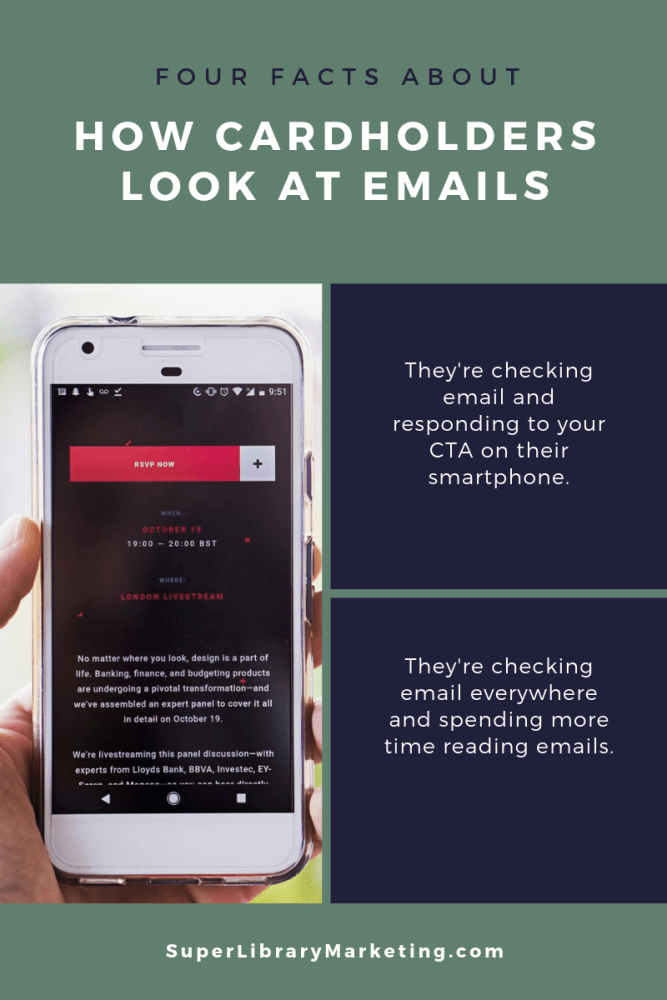
You’ve heard it before but I’ll say it again. You must make sure your emails are mobile-friendly and responsive. About 3 in 5 consumers check their email on the go. 75 percent of Americans say they use their smartphones most often to check email. (Blue Corona)

And you must assume your cardholders will use their phones to respond to your email call-to-action. 62 percent of email opens occur on mobile. Only 10 percent occur on desktop. That’s huge! (Adestra)

Your cardholders are checking their email literally everywhere. People admit to checking email while watching TV, in bed, on vacation, in the bathroom, while walking, during meals, during commuting, while talking, while working out, while driving, and while at a formal ceremony! (Adobe)

Your cardholders are spending more time reading emails. In the last decade, the amount of time people spent reading an email actually increased by 7 percent, to 11.1 seconds. (Litmus)

How to design the best library email
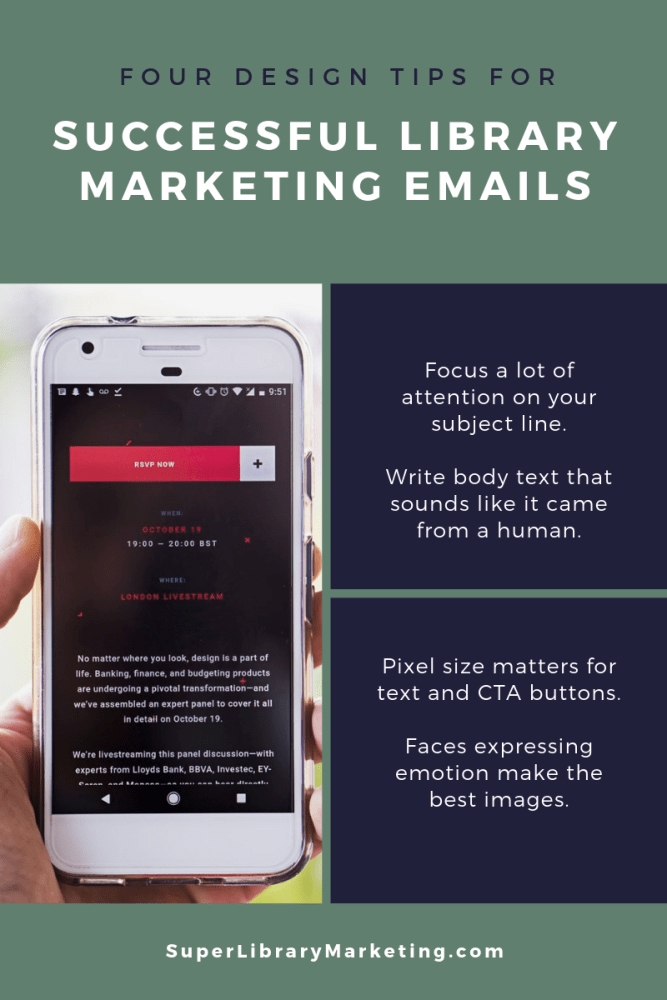
Your subject line is the most important part of your email. It gets your cardholders in the door, so to speak. Focus on sentiment by using emotional words. Use different words for different audiences. The subject line for a message you send to teens will be completely different from the message you send to parents. Make it simple and easy. However, length doesn’t matter anymore, so you can make your subject longer if you need too!

Write like a human and make sure everyone can read your text. For the text, speak conversationally. No industry-speak (words like periodicals are out!).You don’t have to convey all the information about your product or service or collection item in the body of the email. Get to the point and drive users to your website or another platform for more information. Avoid multi-colored fonts. Use fonts that are accessible, like Arial, Helvetica, Lucida Sans, Tahoma, and Verdana. (Bureau of Internet Accessibility).

Make your email design hard to ignore. Use a one-column layout so people can scroll easily. Make the text large! Headlines should be no smaller than 25 pixels, body text should be no smaller than 18 pixels.  Call to action buttons can be pretty huge– anywhere from 44 x 44 pixels to 72 x 72 pixels.

Images matter. Photos of real people, especially faces with emotional expressions, are best. But don’t be afraid to use gifs too!

Learn more about email marketing for libraries

The Step-by-Step Method for Figuring Out the Best Time to Send Library Marketing Emails and Why You Should Never Stop Experimenting!

The Tiny Little Mistakes That Ruin Your Library Marketing Emails AND How to Fix Them!

This Advice Will Boost Your Library Marketing Email Click-Thru Rates

Don’t forget to join us for the LIVE LIBRARY MARKETING TALK ON INSTAGRAM every Tuesday at noon ET. We’ll talk about library marketing topics for about 15 minutes each week. My handle is Webmastergirl. You can email questions and topic suggestions ahead of time. Just fill out this form.

And check out these upcoming events and webinars where we can connect and discuss library marketing. Registration links included.

Subscribe to this blog and you’ll receive an email every time I post. To do that, click on “Follow” button in the bottom left-hand corner of the page. Connect with me on Twitter, Instagram, and LinkedIn.  
I Asked a Podcast Host to Stop Interrupting His Guests. 😠 What His Reaction Can Teach Us About Library Customer Service.

A few weeks ago, I had an incredibly disappointing interaction with a man I’ve looked up to for ages. I’m not going to name him or his website in this post. But I’ve been listening to his podcasts for more than five years. I’ve sent staff to his conference. I’ve recommended his website and his materials here on the blog. I’ve met him in person. He was lovely to me.

But about a year ago, he started doing something that really upset me. He got into the habit of interrupting guests on his podcast. All. The. Time.

I’m a manager. I’ve been trying to foster better listening skills in myself and my staff.

It irked me that this person never let anyone finish a thought. It got so bad that he started cutting people off as they were explaining concepts and giving specific instructions on marketing tactics.

I decided to email him to ask him to stop interrupting his guests. I was as polite. I told him I loved his show and website. I said that I wished he would just let people finish their thoughts.

Here was his response:

Thanks for the feedback Angela. I pre-discuss with all of my guests that I often have questions and will likely stop people who are fast talkers and dig deeper. They all know I will do it. Indeed many of my listeners love that I do this. For example: ” I have to say that you have a special gift for asking great questions and making sure the audience can actually visualize the process & pin down your guest to clarify so we fully understand the material presented. It’s like you have a second sense for what we are thinking. I think of a question, and BAM!…you come in with the perfect question that was on my mind. (I don’t even know if I’m saying this right but I bet you know what I mean). I listen every day and look forward to the incredible, valuable and TIMELY nature of what you share. I’ve been a long-term fan of your blog for years and if anyone is seeking to stay current in what’s going on with everything related to social media marketing, you’d be crazy not to take advantage of this invaluable podcast. Thank you, for your gift of putting yourself in your audiences shoes and knowing how to get clarity from your guests. It’s truly an awareness most podcasters lack. Truly inspiring!”

So yes I understand that sometimes I interrupt guests but it really is by design to help make the show better AND the guests are fully in agreement that it’s okay for me to do it.

I NEVER intend for it to be rude EVER. I am actually friends with most of the guests that get on my show so I will reach out to them and see what they say. Thanks again for your perspective. 

There’s a lot to unpack here. In a nutshell, this was a defensive response. I didn’t feel heard. I didn’t feel acknowledged. I didn’t feel that this person was willing to do anything to address my complaint. The unattributed customer testimonial is self-important.

I ended up unsubscribing from the podcast.

And because I always try to learn from my experiences, I decided to use this exchange as a catalyst to think about the best way to respond to negative comments from library customers.

Libraries have it pretty easy. Most of our cardholders love us and rave about everything we do. It’s good to be loved.

But we do have our critics. They may post their comments online or in email. They may express their complaints to you in person at the front desk or at events.

Like this podcaster, your immediate reaction may be to go to defensive mode. You may feel the need to defend your library, its services, and practices. That’s a totally natural response.

But I want you to take a step back (and a big, deep breath) and find the opportunity in that negative comment. There are ways to response to customer feedback, even negative feedback, that acknowledge the complaint without damaging the relationship between your customer and your library.


Your response to complaints can also build credibility for your organization. And, because emotions are involved, it’s best to have a process in place beforehand so you can handle complaints professionally and swiftly. Here are your new best practices.

Don’t censor online comments. Unless the comment violates your social media or website standards of behavior in some grave way, don’t hide the comment and don’t want to respond negatively.

Respond as quickly as possible. It’s important to address the issue as soon as you can. The basic rule of thumb for businesses now is to respond to complaints within 60 minutes. I know that’s difficult for a lot of libraries, who struggle to balance staff work time in a 24-hour a day world. Make your best effort to respond to complaints quickly. Never let a complaint sit without an answer for more than 24 hours, even if that means you have to answer it on your off time.

Acknowledge the customer’s words and apologize. By simply telling your user that you hear what they are saying, and that you are sorry for the situation, you can diffuse a good deal of the anger or hurt that can be associated with a bad library experience. An apology is not a sign of guilt. It doesn’t mean that the complainer is right. Just saying, “I’ve been in situations like this before and it’s frustrating. I’m sorry this happened to you” can help to smooth the road for resolving the issue. It increases the likelihood that your complainer will leave the interaction with a renewed love for the library.

A co-worker asked me what I had hoped to hear from the podcast host I emailed. This was all he would have had to say to keep me as a fan and listener: “I’m sorry. I’ve been interrupted while speaking and it is frustrating. I’ll work on that.” 

If the problem cannot be solved easily, take it offline. Ask the cardholder for their email address so you can continue to resolve the complaint without doing so in front of an audience. “I’m sorry to hear you are having this problem. We want to make it right. Can I have your email so I can ask for more details about your experience? Then I can make sure your issue gets in front of the right person and is addressed.”

Realize that you cannot please everyone. Every once in a while, someone will complain about something and you will not be able to fix the problem. Apologize, explain your library’s side of the situation as best you can, and move on.

Don’t forget to join us for the LIVE LIBRARY MARKETING TALK ON INSTAGRAM every Tuesday at noon ET. We’ll talk about library marketing topics for about 15 minutes each week. My handle is Webmastergirl. You can email questions and topic suggestions ahead of time. Just fill out this form.

And check out these upcoming events and webinars where we can connect and discuss library marketing. Registration links included.

Subscribe to this blog and you’ll receive an email every time I post. To do that, click on “Follow” button in the bottom left-hand corner of the page. Connect with me on Twitter, Instagram, and LinkedIn.  

The Tiny Little Mistakes That Ruin Your Library Marketing Emails AND How to Fix Them!

NEW LIVE LIBRARY MARKETING SHOW ON INSTAGRAM! I’ve decided to try a new thing! I’ll be doing a live Instagram Q&A and discussion about Library Marketing. The sessions will be every Tuesday at noon ET (10 a.m. Central and 9 a.m. Pacific) beginning Tuesday, June 25. Join me to talk about library marketing topics for about 20 minutes each week. My handle is Webmastergirl. You can email questions and topic suggestions ahead of time. Just fill out this form below. See you there!

← Back

Thank you for your response. ✨

I get a lot of library marketing emails. I love to see what other systems are doing. So, I go to their websites and I see if I can get on their mailing lists! It’s fun and it helps me to find new things to promote and new ways to communicate with my audience.

I also get a first-hand look at some of the small boo-boos that other library marketers make in their emails. Email is hard. I’ve been doing email marketing for so long (feels like forever!) that I have made all of these mistakes myself! And I love email marketing, so I’m weirdly obsessed with learning about it. Some of the positive text and design choices that work for library marketing in other promotional pieces, like posters, flyers, websites, and blogs, do not work in email marketing.

The good news is that these little problems are easily fixed! Tiny adjustments in the text and design of your email can improve your click-through rates and effectiveness. Check this list against what you’re doing now and start reaping the benefits of improved email design!

Problem: too many images: A clean design is crucial to engagement. Too many images or too much text is off-putting to your email recipient.

The most common email programs like Yahoo and Outlook will NOT automatically download images. In fact, only Gmail downloads images automatically. With all other providers, the email recipient receiver must consciously click a prompt in order to download an image. That means if your image is conveying most of the key message in your email, your receiver likely won’t see it.  They will miss the information and the call to action, and your email is useless.

Solution: Create an email that is mainly text-based. I have found an 80-20 mix works best: 80 percent of my email is text, 20 percent is image-based. The image I use compliments the text. Its purpose is to create emotion or set the mood of the email. It’s there to inspire. It doesn’t convey key messages and it doesn’t contain the call to action.

Problem: too much text. An email that contains several long paragraphs of information is off-putting to recipients. It gives the impression that your email will take a long time to read.

The email scheduling platform Boomerang studied results of about 20 million emails sent using their software. They found that the optimal length of a marketing email is between 50 and 125 words. A study by Constant Contact of more than 2.1 million customers found emails with approximately 20 lines of text or 200 or so words had the highest click-through rates.

Excessive text can also send negative signals to spam filters. Too much text added to excessive punctuation or large images could keep your emails from ever arriving in an inbox.

Solution: Limit your email text to 200 words or less. The recipient should be able to read all the information in your email in about 15 seconds. If you have more information to share, use your call to action to indicate that there’s more to know about your subject. Then send your recipient to a landing page where they can get all the information they need.

Problem: Text that is too small. Keep in mind the growing number of people who will read your email on a mobile device. You want to make sure they can actually see your words. An 11 or 12 point font size is too small to be seen clearly on a screen.

Solution: Increase your text size.  Email font should never be below 18 point in size.  You should also use the bold option to make the most important information stand out.

Problem: Wishy-washy calls to action.  A compelling call to action is one of the best ways to increase the click-through rates of your library marketing. Some library marketing emails also contain too many CTAs.

Solution: Use positive, active language in your CTA. “Register” “Read This Book”, “Learn More”, “Join Us”, “Donate”, and “Get Started” are some of my favorites. I put my CTAs in a square red box that looks like a button to compel my recipients to click on them. I embed the CTA in my image as well and use the “alt text” to convey the CTA in case someone’s eye skims the email. I try to keep my CTAs to one per email.

One image, with the main text in bold at 18 point found. A few sentences and a clear call to action.

Problem: Ignoring mobile responsiveness.  Mobile opens accounted for 46 percent of all email opens according to the latest research from Litmus. If your emails aren’t optimized for mobile, you are missing a huge potential audience, particularly women and young people.

Solution: Optimize your emails for mobile to make them responsive. Most email marketing programs offer mobile responsive templates. My library uses Savannah by OrangeBoy. We switched to all responsive templates in January of this year. I’ve seen a nine percent increase in click-through rates. I count that as a win!

Problem: No system for proofing your emails in different kinds of email boxes. Your email design might look great in your creation software. But if you send it without testing it, you may find that your email becomes a kind of monster creature! It may show up a a jumbled mess of images and text. This happens because every email inbox will convert your email differently.

Solution: Test your email to make sure your message displays correctly for your recipients. Find people that you trust you have different providers… someone with Gmail, someone on Outlook, someone on Yahoo, and so on. Send them the message and ask them to check for warped images, font problems, and extra spaces.

Subscribe to this blog and you’ll receive an email every time I post. To do that, click on “Follow” button in the bottom left-hand corner of the page. Connect with me on Twitter, Instagram, and LinkedIn.  

How to Hook New Cardholders and Make Them Loyal with Email

We talk a lot about emailing our cardholders with information about new products, services, and collection items. But you can also use your email list in a powerful way to reach people who have just signed up for a library card.

Most libraries take a minimalist approach to “on-boarding” a new cardholder.  Once a person fills out a library card application, we hand them a card, a welcome brochure, and send them on their way. We’re friendly and we’re genuinely excited to welcome them to our system. But we make a mistake that’s common for a lot of businesses and organizations. We know our system inside and out and we often forget that our new cardholders know nothing about what we offer. We assume they can find their way to the things they need.

It’s important to help those cardholders learn to navigate the behemoth number of resources and items available at the library. A solid on-boarding campaign retains new cardholders and turns them into lifelong loyal users of the library. The first 90 days of a new library cardholder’s experience is crucial to determining their feelings of connection and loyalty to the library.

It also makes good business sense. Studies show it costs five times as much to gain a new customer than it does to retain them. A library marketer practicing good stewardship will want to do their best to keep new cardholders coming back to use the library.

The most effective way to on-board a new cardholder is through email marketing. Many libraries create a campaign with specific emails sent to new cardholders at a pre-determined pace. Those emails slowly introduce them to new features and inspire them to try out all the library has to offer. It’s easy to do this using some mail systems, like OrangeBoy and MailChimp.

My library has a 90 day on-boarding campaign set to run automatically through OrangeBoy. Creating it was a bit of process. But the effort was worth it. In addition to retaining customers, the on-boarding emails reduce unsubscribes for future targeted promotional emails. Here’s how we did it and what we learned about doing it well.

First, make a list of the services, events, and collection types that get the most use at your library. You’ll want to include information about the most popular features you offer in your emails to new cardholders.

Then, make a list of the services, events, and collection types that are interesting or unique to your library but don’t get a lot of use. These are the gold nuggets of your on-boarding campaign. You’ll have the attention of your new cardholder. The relationship is fresh. Why not use that to showcase the hidden treasures at your library.

Finally, create an outline of your campaign, mapping out each message, when it will be sent, and what it will say. Look at the two lists you’ve created and narrow your focus. Try to promote no more than four things per on-boarding message. You don’t want to overwhelm your new cardholder. Rather, you’ll want to introduce people to the library in small doses. Pick a theme for each message with a specific call to action. Keep the language simple, conversational, and free of industry jargon.

Create, test, and release the messages. This part took me nearly as long as creating the plan did! But you’re almost there.

Track results. Of course, you’ll want to use a Google URL tracker or Bitly link to see which services and items get the most interest from your new cardholders. You can also track unsubscribe rates, and if you have the ability to divide cardholders into clusters, you can see where your new cardholders land after they finish the on-boarding process.

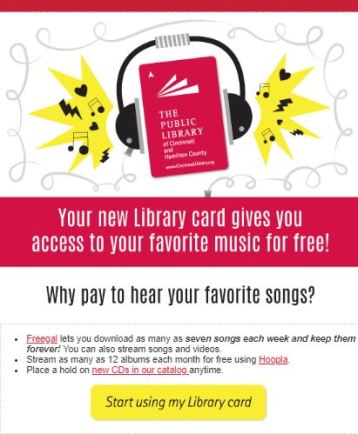
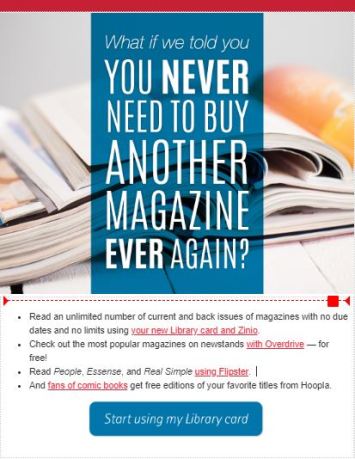
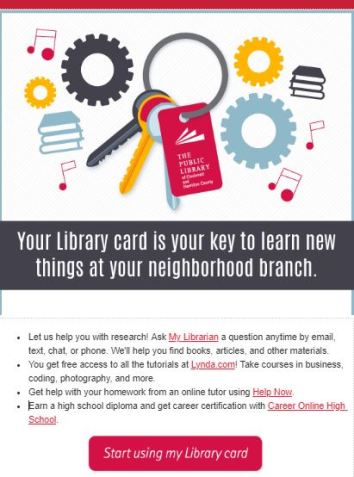
Here are a couple of examples of my library’s on-boarding emails so you can see what we do.

How do new cardholders react to these messages? They definitely don’t hate them. Our unsubscribe rate is 0%. We’re a large system and we’ve sent these for several years to thousands of new cardholders. Over the course of our campaign, we’ve had a couple of hundred people unsubscribe.

We send six emails over 90 days. The first email gets a lot of engagement, which is not a surprise.  The fifth email about using your neighborhood branch (see the image above) is the second most engaging email for us. Overall, about half of the new cardholders we sign up end up becoming loyal library customers. Most use our computers but the rest are checking out physical and digital items or using our MakerSpace.

If your library is doing something to on-board cardholders, I’d love to hear about it. Please take this poll and tell me about what you are doing in the comments.

Subscribe to this blog and you’ll receive an email every time I post. To do that, click on “Follow” button in the bottom left-hand corner of the page. Connect with me on Twitter, Snapchat, and LinkedIn. I talk about library marketing on all those platforms!


Avoid Email Vanity! Here Are the Results You Should Measure

I love email marketing. It’s one of the most effective tools in the modern library marketer’s toolbox. Emails are a direct way to interact with your cardholders and your community. They are easy to create. You can share stories, collection items, explain new services, and promote events directly with your audience. And library cardholders love getting emails from us. We don’t have to worry about unsubscribe rates the way other industries do.

Many libraries are now emailing their cardholders. And they’re reporting success with those campaigns. I’m so happy! But I’m also worried about something I hear often in conversation with other library marketers. I’m worried that we’re focused on the wrong measure of success–open rates. I’ve attended two events with other library marketers this summer. At both, there were deep and interesting discussions about success in email marketing. But at both events, the conversation about success centered on how to raise open rates.

Now, I have a confession to make. When I started targeted email marketing back in January of 2015, I was obsessed with my email open rates. And so were thousands of marketers in industries across the world. During my first trip to Content Marketing World, I attended several sessions on email marketing and every speaker mentioned open rates as a measure of success.

Open rates do mean something. They are a sign of customer loyalty. A high open rate means that your cardholders are eager to see what you’ve sent them. And that’s good. But it’s kind of like buying a house because it’s got a beautiful exterior. You may sign all the paperwork, open the front door and find all the walls are unfinished! Open rate is a vanity metric. It makes you feel good. But it’s what happens AFTER your cardholders open your email that counts.

I’m not suggesting you ignore open rates. They do give you information you can use to improve your emails. If your open rates are high, and your click-thru rates are low, you can be certain that you are writing compelling email subject lines (Good job, you!). You have a loyal and eager audience. But the content you are sending to your cardholders isn’t what they want. Now you can fix that problem!

Keep tabs on your open rate. But you should focus on two other valuable ways to really measure the success of your emails.

Click-through rates: The higher this number is, the more excited I get. It means that my cardholders opened an email, saw something they liked, and took an action! Most of the time, my library emails direct cardholders to do one of two things: click a link for a specific item in our collection or go to the event calendar where they can register or put an upcoming event on their calendar. Convincing a cardholder to take one of those actions is a huge victory. It also gives me data about what that particular cardholder is interested in. And I can use that information to craft future emails that are also compelling for that cardholder.

Conversion rates: A conversion rate is the most accurate way to measure email effectiveness. It is the percentage of people who take an action after clicking through an email. For example, let’s say 100 people click-through to look at a book I’ve promoted by email. If 50 of those 100 people put the book on hold, my conversion rate is 50 percent. Once I know what my average conversion rate is for a certain type of email, I can set goals to raise that conversion rate. I can  accurately compare my emails to one another.  I might see a high conversion rate for a certain genre of book and look for similar books to market to that cardholder. I might notice a spike in registration rates for a particular kind of program coming from an email and look for similar kinds of programs to market to my cardholders. Conversion rate is the most accurate measurement for determining the likes and dislikes of your cardholders.

For more on tracking the success of your email marketing, you can also read this article. And if you want to learn more about targeted email marketing and get more secrets for library email success, don’t forget the free webinar 

Subscribe to this blog and you’ll receive an email every time I post. To do that, click on “Follow” button in the bottom left-hand corner of the page. Connect with me on Twitter, Snapchat, and LinkedIn. I talk about library marketing on all those platforms!

A WordPress.com Website.

Up ↑