A few weeks ago, I heard a tip for writing email subject lines that made me equal parts excited and annoyed. Excited because it works. Annoyed because it’s so obvious in hindsight.
In this episode of The Library Marketing Show, I’m sharing the simple shift that can make your library emails more compelling and more likely to get opened!
Plus, the first kudos of the new year go to an academic library that managed to poke fun at AI and highlight the staff’s human expertise.
Do you have a suggestion for a future episode’s topic? Do you want to nominate someone for kudos? Let me know here.
Library friends, we did it! We made it through 2025. We faced numerous issues and threats to libraries, yet we celebrated many triumphs. I’m proud of you. I’m proud of this community. And if no one has told you this lately, GOOD JOB YOU!
And now, we look forward to a new year and new chances to grow the connection between your library and your community.
Want to make 2026 your best year yet? Let’s start by learning from the content your fellow library marketers found most helpful this year.
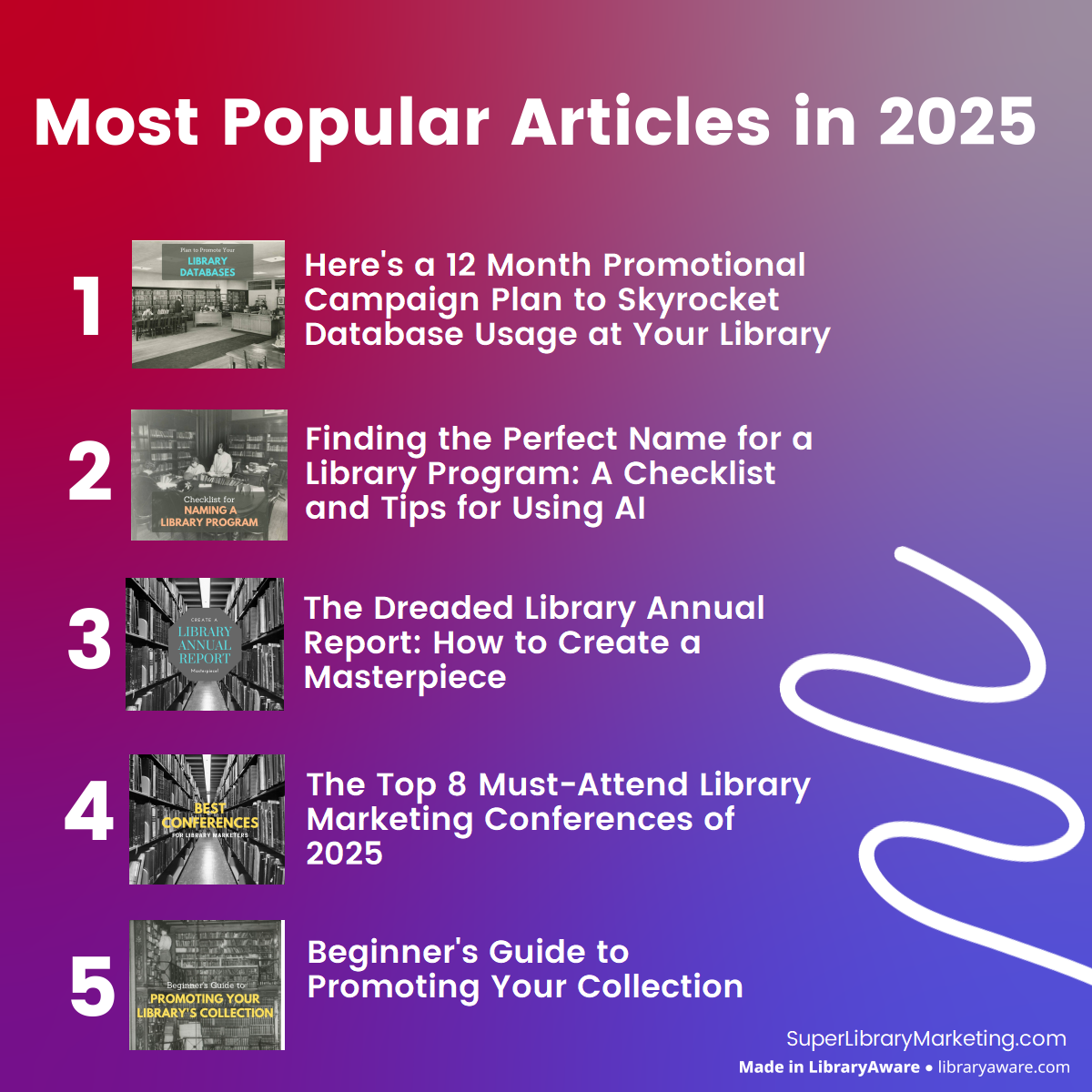
Most Popular Super Library Marketing Articles of 2025
I hope you are looking forward to 2026 as much as I am. My next post will be on Monday, January 5, when I’ll unveil the State of Library Marketing. I’ve got a calendar full of posts and videos featuring tips to make your work easier, as well as profiles of libraries to inspire you. Happy holidays!
Fans of this show know I’m a big believer in email as one of the most powerful tools in your library’s marketing toolbox.
Now, a brand-new survey is packed with insights to help you boost opens and clicks — and make your emails even more effective. But here’s the real headline: there’s one SUPER secret trick that top marketers use to dramatically improve results.
It’s surprisingly simple, requires no extra tools or tech, and you can start using it right away. I’ll reveal exactly what it is in this episode of The Library Marketing Show.
Plus, we’re giving kudos to a library that introduced a brilliantly-named new mascot.
Do you have a suggestion for a future episode’s topic? Do you want to nominate someone for kudos? Let me know here.
Subscribe to this blog, and you’ll receive an email whenever I post. To do that, enter your email address. Then, click the “Follow” button in the lower left-hand corner of the page. You can also follow me on the following social media platforms:
It goes against conventional wisdom, but your library’s newsletter might perform better if you send it on a weekend!
In this episode of The Library Marketing Show, we’ll discuss this, and I’ll give you three reasons why I think you should experiment with weekend emails.
Plus, we’ll give kudos to an individual library marketer profiled in their local newspaper.
And I have a favor to ask:
NoveList is doing a market survey on how libraries handle professional development training. Would you be willing to take the survey? It should take five minutes or less. Thank you!!
Do you have a suggestion for a topic for a future episode? Do you want to nominate someone for kudos? Let me know here. Thanks for watching!
Subscribe to this blog and you’ll receive an email whenever I post. To do that, enter your email address. Then click on the “Follow” button in the lower left-hand corner of the page. You can also follow me on the following social media platforms:
This holiday week, I wanted to ensure you are set up for success in promoting your library in 2025. These are the most popular Super Library Marketing posts from the past year that you may have missed. (We’re all so busy!)
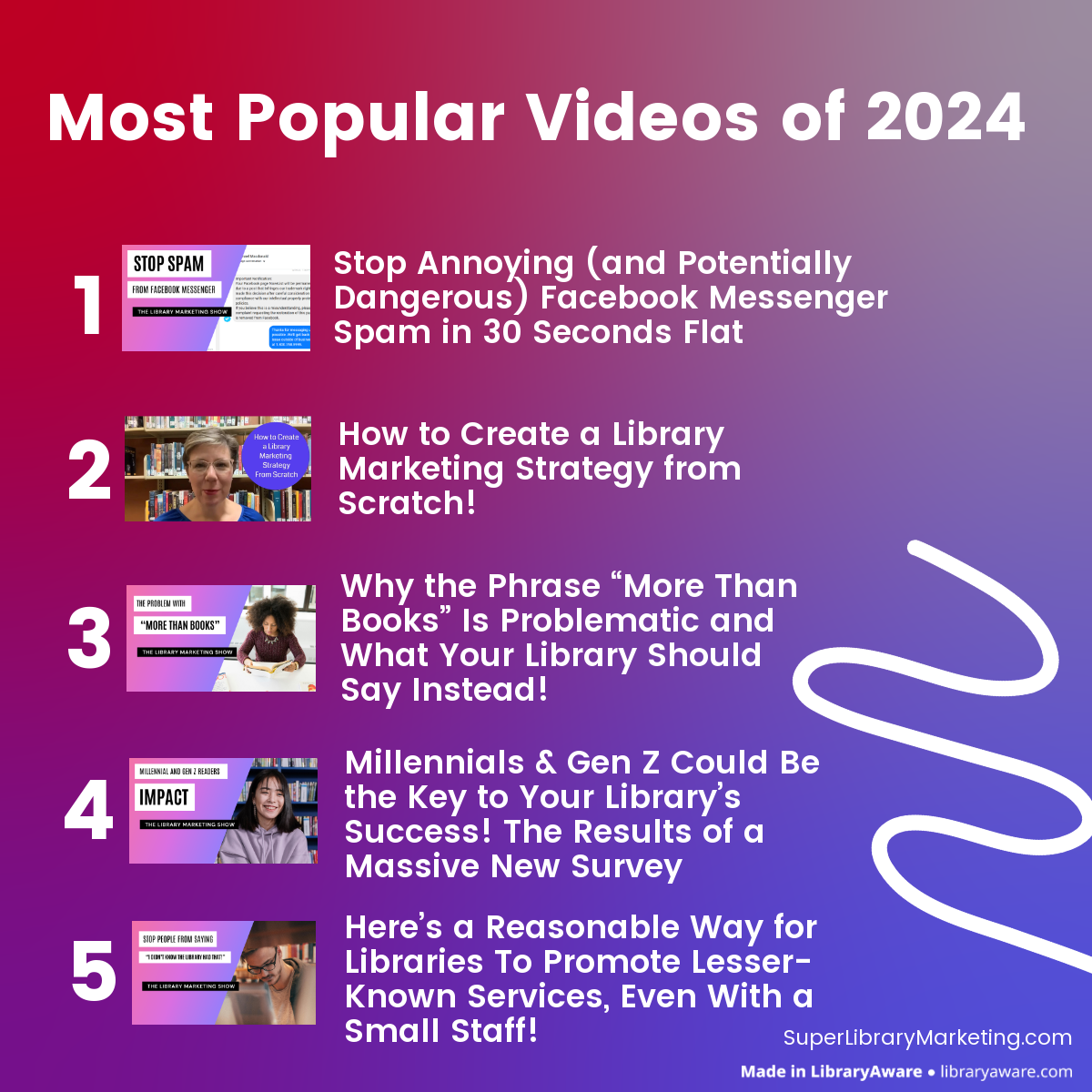
Most Popular Super Library Marketing Articles of 2024
I hope you are looking forward to 2025 as much as I am. We’ll be tackling new library marketing and promotion subjects. Plus I have lots of library profiles on the calendar. You’ll be hearing advice from libraries just like yours. As always, I welcome your suggestions about topics you want to cover. Happy New Year!!
Subscribe to this blog and you’ll receive an email whenever I post. To do that, enter your email address and click on the “Follow” button in the lower left-hand corner of the page. You can also follow me on the following social media platforms:
For the first time ever, libraries that email their community to promote their services have metric benchmarks!
I will discuss how this new report came about (spoiler alert: it was born out of my annoyance!) and how you can get your hands on it in this episode of The Library Marketing Show.
Plus we’ll give kudos to a library that reached a whole new audience to promote their collection.
Do you have a suggestion for a topic for a future episode? Do you want to nominate someone for kudos? Let me know here. Thanks for watching!
Subscribe to this blog and you’ll receive an email whenever I post. To do that, enter your email address. Then click on the “Follow” button in the lower left-hand corner of the page. You can also follow me on the following social media platforms:
There’s one teeny, tiny thing that you can do to make sure your library’s emails not only make it into the inbox of your recipients but also build a connection with the people who sign up for your emails. And it only takes you five seconds to take this step! I’m going to share that tip in this episode of the Library Marketing Show.
Plus we’ll give kudos to a library that gave us a master class in crisis communication.
Do you have a suggestion for a topic for a future episode? Want to nominate someone for kudos? Let me know here. And thanks for watching!
Subscribe to this blog and you’ll receive an email whenever I post. To do that, enter your email address. Then click on the “Follow” button in the lower left-hand corner of the page. You can also follow me on the following social media platforms:
Photo courtesy Cincinnati and Hamilton County Public Library
The first thing I do when I visit my parents is greet their dogs. The second thing is to look for my list.
My parents are aging, so I like to help with things they can no longer do. I wash windows, weed the flower beds, and sew on loose buttons. As I work through the list, I get a certain satisfaction in checking things off.
Lists have always been a part of my life. My mother wrote a daily list for when I got home from school. Feed the dogs. Make a salad. Start your homework. It’s almost as if she thought I wouldn’t know what to do with myself if I didn’t have a list to follow.
And she was right. I now make lists for everything. Lists for packing. Lists for groceries. Lists of tasks I need to complete during the workday. Gift lists at the holidays.
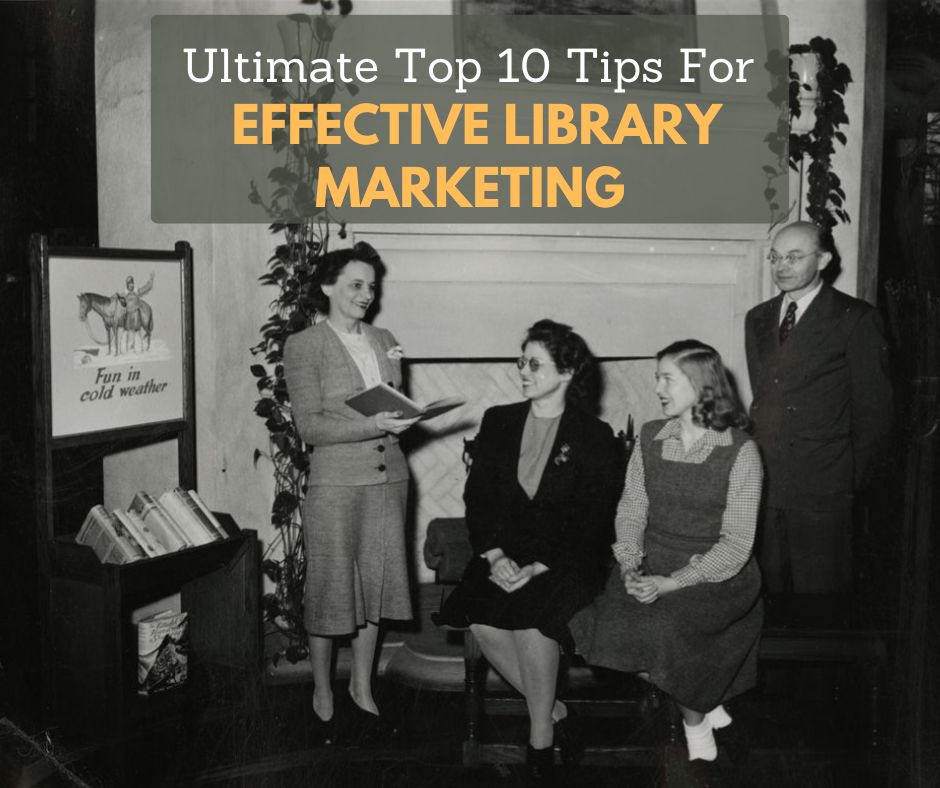
Lists help you focus and prioritize. So, when one of my readers asked for a list of the ten best tips and practices for library marketing, I dug in. (Imagine me cracking my knuckles, blowing on my fingers, and setting my fingers on the keyboard here.)
Top Ten Tips for Library Marketing and Promotions
#1: Send email to your community.
Email is the most effective marketing tactic. You don’t have to battle algorithms. And 99 percent of people with an email address read their email daily, usually first thing in the morning.
Starting a consistent library email program can be intimidating. But I put it at the top of the list because it’s the best use of your time.
You can start small by sending a newsletter. Work your way up to targeted email segments, where you’ll be sending shorter, more focused messages to specific groups of people. Don’t worry that you’re leaving people out with more niche emails… you are not.
#2: Post no more than once a day on your social media channels.
Social media for libraries works to create brand awareness and affinity. But they’re also ruled by algorithms that determine who sees your posts. The algorithms value quality posts, not quantity. So, posting often does nothing to boost your reach. Once a day is plenty.
Make a schedule to create quality posts and give your social media feeds consistency (which the algorithms love). For example:
Monday: Promote an item in your collection.
Tuesday: Share a video.
Wednesday: Ask a question.
Thursday: Promote a program.
Friday: Share something about a library staff member or something behind the scenes of library work.
Saturday: Promote a service, like your seed library, a database, streaming videos, or your MakerSpace.
Sunday: Share something funny, inspiring, or thoughtful about the joy of reading or the importance of intellectual freedom.
Each year, beginning in November, I publish a best practices guide for each of the major social media channels. To see the guides, type the name of the platform you want to research in the homepage search bar.
#3: Put a bookmark in every hold and checkout that leaves your library.
Your collection is a marketing tactic! No library visitor should ever leave the building without a piece of promotional material.
To get started, pick three areas of focus for your bookmarks. Make one bookmark for each of your three focus promotions. For example:
A booklist
An online item like streaming music
A recurring program.
Teach staff to add a bookmark to every hold and checkout. They use context clues to decide which of your three focused promotional bookmarks will resonate most with each library visitor.
#4: Write a general marketing script and have staff recite or read it before every program.
Your programs are also a marketing tactic. Use the first minute of each program as a “housekeeping moment”, so share a marketing message to this captive audience.
The message should be short, 3-4 sentences. And it should be tailored to the audience.
Here’s an example. Let’s say your library just purchased a set of after-hours holds lockers. You want people to use them. You can create a script for staff to read before programs.
For children’s programs your script might say:
“Hello everyone! I wanted to let you know about a new service we have at the library – our after-hours holds lockers. You can pick up your reserved books and materials anytime, even when the library is closed. It’s a convenient way to get the books your family needs, on your schedule!”
For adult programs, your script might say:
“Hello everyone! Before we begin, I want to tell you that our library now has after-hours holds lockers. Maybe you saw them as you walked in: they’re just to the right of the front doors. You can pick up your reserved books and materials at any time, even outside of our regular hours. So if you work a late shift or you’re going to have a particularly busy day and can’t get to the library before we close, you can still get your books!”
#5: Talk to one community group every month.
Reach out to the Kiwanis Club, Chamber of Commerce, Junior League, and local professional groups. Ask for five minutes during their next meeting to talk about what is available at the library and to sign up members for a library card.
#5: Analyze your promotional metrics each month.
Schedule 30 minutes once a month to look at the past month’s performance on social media, email, and your website.
Watch for trends. Did your social media impressions spike this month? What may have caused that? Did your email open rate plummet? Take a look at the emails you were sending to determine what may have caused the dip. Did attendance skyrocket at your monthly book club after you posted an Instagram Reel promoting it? Do more Instagram Reels!
This work will help you spot issues and opportunities. You can replicate the things that your audience responds to. And you can stop doing the things that don’t work for your audience, and have the data to back up your decision! It’s time well spent.
#6: Create an editorial calendar for the next 6-12 months.
Planning your promotional schedule gives you time to thoughtfully create your promotions and get approvals. Plus, you can share your plans with your coworkers and supervisors, so everyone at the library knows what’s been marketed and when.
Schedule your emails, when you’ll change your website graphics, your book displays… even the signs in your library lobby.
Some of this planning will be easy. You know when summer reading, Library Workers Week, National Library Card Signup Month, back-to-school, and holiday events happen.
Leave space in your calendar for those unexpected things that come up. If your director announces his or her retirement, your building needs renovations, or your library buys a new database… you’ll have space in your calendar to accommodate those promotions.
#7: Ask for time at the next all-staff meeting to discuss library marketing.
One of the most common things library marketers struggle with is their coworkers. They don’t understand how promotions work!
Transparency is always a good idea. You want everyone, from the front-line staff to your senior staff, to understand what you’re doing and why you’re doing it.
Talk about your goals. Talk about how you work to accomplish them, and why you use certain marketing channels for certain promotions. Then, share successes to show that your efforts are working and share failures to drive home the point that marketing is an experiment and you’re always learning.
The media is an audience you must court, like any other target audience! The easier you make their job, the more positive press coverage your library will enjoy.
I used to work as a television news producer and I have many friends still in the business. Here are the top six tips they give for garnering press coverage for your library. Here are more tips from another former journalist turned library marketer.
And, I hope you’re planning to attend the 2024 Library Marketing and Communications Conference because this is the focus of my session this year! I’ll be moderating a panel with three former journalists turned library marketers who will share their top tips for building positive relationships with your local media.
#9: Start a blog.
A blog is one of the best ways to share information about the library and drive visitors to your website. It allows your library to tell your story, create brand awareness, and promote your library to your audience for free, without having to deal with the rules of someone else’s platform.
Marketing is changing all the time. You can keep up with the latest social media news and marketing tips by dedicating time to this work.
Hey library marketing friends: Remember, every promotion you put out into the world can spark a lifelong love of reading in someone. Your work makes a difference!
Subscribe to this blog and you’ll receive an email whenever I post. To do that, enter your email address and click on the “Follow” button in the lower left-hand corner of the page. You can also follow me on the following social media platforms:
We are going to put a common library marketing fear to rest, once and for all.
Here’s the concern: Are you inadvertently leaving people behind when you target people with your email marketing? Let’s get into it in this episode of The Library Marketing Show.
Plus kudos go to a library that was the focus of a blog post by a local country radio station DJ!
Do you have a suggestion for a topic for a future episode? Want to nominate someone for kudos? Let me know here. And thanks for watching!
Subscribe to this blog and you’ll receive an email whenever I post. To do that, enter your email address and click on the “Follow” button in the lower left-hand corner of the page. You can also follow me on the following social media platforms:


 Super Library Marketing: Practical Tips and Ideas for Library Promotion