April 2026 might sound far off, but big accessibility changes are coming — and they’ll directly affect how you market your library.
The new regulations aren’t just a compliance issue; they’re an opportunity to make your marketing better for everyone. Yet, I’m not seeing many libraries getting ahead of this.
So in this episode of The Library Marketing Show, let’s talk about what’s changing, why it matters, and what you should be doing right now.
Plus, I’ll give kudos to a library with a one-of-a-kind video for National Library Card Sign-up Month.
Do you have a suggestion for a future episode’s topic? Do you want to nominate someone for kudos? Let me know here.
Subscribe to this blog, and you’ll receive an email whenever I post. To do that, enter your email address. Then, click the “Follow” button in the lower left-hand corner of the page. You can also follow me on the following social media platforms:
Subscribe to this blog, and you’ll receive an email whenever I post. To do that, enter your email address. Then, click the “Follow” button in the lower left-hand corner of the page. You can also follow me on the following social media platforms:
Are you looking to increase clicks on your library’s emails, social media, and websites? The secret may be the faces that you choose in your promotions!
In this episode of The Library Marketing Show, I’ll reveal the one thing that makes stock photos actually work… and this is backed by science.
Plus, I’ll give kudos to a library that started a basic service but promoted it in a not-so-basic way!
Do you have a suggestion for a future episode’s topic? Do you want to nominate someone for kudos? Let me know here.
Subscribe to this blog, and you’ll receive an email whenever I post. To do that, enter your email address. Then, click the “Follow” button in the lower left-hand corner of the page. You can also follow me on the following social media platforms:
Is your library’s online content working as hard as it could? Google has released some guidelines to help you create content that’s not only helpful for your patrons but also gets noticed by search engines, including Google, of course!
I’ll break down the latest advice in this episode of The Library Marketing Show.
Plus, we’ll share kudos with a library that went above and beyond on social media!
Do you have a suggestion for a future episode’s topic? Do you want to nominate someone for kudos? Let me know here.
Subscribe to this blog, and you’ll receive an email whenever I post. To do that, enter your email address. Then, click the “Follow” button in the lower left-hand corner of the page. You can also follow me on the following social media platforms:
Photo courtesy Cincinnati and Hamilton County Public Library
Five years ago, I was listening to an episode of a library podcast about Google Ad Grants, which offers $10,000 monthly advertising credit to qualified nonprofits. Thousands of nonprofits use the program. You apply once, and the grant continues indefinitely.
Wow!
Many libraries have taken advantage of this program since it was launched in 2004. Some of those libraries collaborate with a company called Koios, currently run by Maggie Carson and Peter Velikonja.
Koios is a member of Google’s Certified Ad Grant Professionals group, which has been vetted by Google to manage ad grants. It is the only member of this group specializing in public libraries.
Koios has successfully applied for and managed Google Ad Grants for public libraries since 2017. That grant money has been used to promote catalog items, educational resources, passport services, business and career resources, summer reading programs, and more.
“Library marketing professionals know that different online audiences are reached in different ways,” says Peter. “Advertising with Google reaches everyone. That makes it the best way to reach new people, including, critically, the underserved.”
Peter says paid search using a Google Ad Grant may represent 25 percent or more of a library’s overall website traffic, depending on the size of the library’s service population.
“Ads appear at the top of search results – where they are most likely to be seen,” explains Peter. “Since libraries are trusted institutions, people are more likely to click on an ad for a library than a commercial ad.”
“At an average of $2 to $3 per click, a library can potentially bring about 4,000 visitors per month to its website, mostly new people who were not necessarily thinking of a library but were searching for something. It presents a library with an opportunity to show up at the right time with the right information, to the right person.”
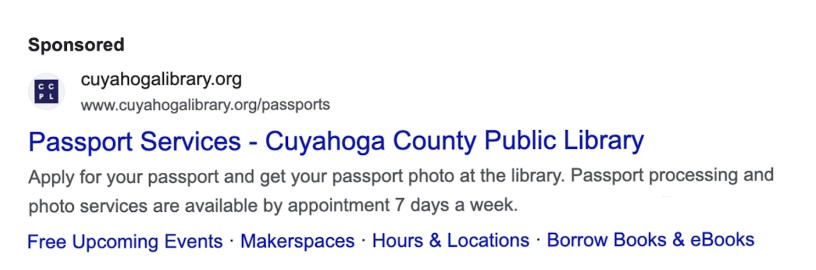
A sample Google ad for Passport Services at Cuyahoga County Public Library in Ohio.
And what does Google get out of this deal?
“Google’s primary motivation, we believe, is to perform a social good by helping nonprofits,” says Maggie. “But the program also helps Google fill unused advertising space. It’s like having an empty billboard – better to put something up for free than to leave it blank and potentially leave the impression that the space is not valued.”
“First, you create a Google for Nonprofits account,” explains Maggie. “Google will verify your foundation or friend’s group nonprofit status through their partnering organization, Percent, after which you can submit an Ad Grants application. The process generally takes a couple of days or a week. For libraries that would like help applying, Koios will gladly guide you for free.”
Google Ad Grants are not competitive grants, but there are some details and requirements to be aware of.
“Nonprofits with 501(c)3 status are eligible, so a library should apply through their Friends or Foundation,” suggests Maggie. “Google will also review the library’s website for quality and security issues; it will reject websites that are not https-enabled or do not meet their quality standards.”
Once a library is accepted, someone from the library will need to do ongoing research and keep up to date on compliance.
“Google’s policies require active management of advertising accounts, which means they expect you to check the account at least once per month,” explains Maggie. “Google has a set of policies to follow, and they regularly issue updates to these policies or create new ones.”
According to Peter, it takes some ingenuity and persistence to get the full value from an Ad Grant. Google says the average spent is only 17 percent of the full value of the grant. Google does offer some automated options for account management, which may be the best choice for busy staff. Koios can also manage the grant.
“First, we apply for an Ad Grant on behalf of a public library,” says Peter. “It is not complicated, but we have experience working out glitches that may come up in the application process.”
“Then we set up the Google Ads account that comes with the grant – we do all that for free because we want libraries to use the resource, whether we are involved or not. After that, a library can manage the account themselves, or we can do it for a yearly fee.”
“Most libraries choose to have us manage the account because we can exercise it more fully. We promote a library’s online catalog, which contains hundreds of thousands of terms and concepts that can match the words and phrases people search for. It’s a sort of Big Data capability libraries don’t usually have.”
Topeka & Shawnee County Public Library GA4 Web Traffic Acquisition Data, March 2024
Like most library vendors, Koios prices its services by the size of a library’s service population.
“Given the potential of receiving up to $120,000 per year in advertising credit, our subscription fee presents an excellent return on investment,” declares Maggie.
A screenshot of the Koios member dashboard for Barrie Public Library in Ontario, Canada, showing a 30-day view of 18 active campaigns.
If you’re interested in learning more about Koios and Google Ad Grants, email Maggie and Peter at info@koios.co.
Subscribe to this blog and you’ll receive an email whenever I post. To do that, enter your email address and click on the “Follow” button in the lower left-hand corner of the page. You can also follow me on the following social media platforms:
The engineers at the search engine recently changed the way that they rank websites and search to make internet searching easier for the user. But that’s going to have some implications for your library.
Don’t panic! We’ll go through the changes and what they mean for your library’s website in this episode.
Plus, kudos go to a library that sent its annual report to a media outlet and got positive press coverage with an unbeatable headline.
Do you have a suggestion for a topic for a future episode? Want to nominate someone for kudos? Let me know here. And thanks for watching!
Subscribe to this blog and you’ll receive an email whenever I post. To do that, enter your email address and click on the “Follow” button in the lower left-hand corner of the page. You can also follow me on the following social media platforms:
Angela talks about Google’s new Keen app, which appears to be a competitor for Pinterest. What does this new development mean? Does your library need to jump onboard?
Also Kudos to Kelly Passek, a school librarian in VA. She is delivering books to the kids in her district by drone.
What did you think of this episode? Are you struggling with marketing and promotion right now? Do you have a nominee for the Kudos segment? Drop a comment below!
And subscribe to this series to get a new video tip for libraries each week! Thanks for watching.


 Super Library Marketing: Practical Tips and Ideas for Library Promotion