Search

Super Library Marketing: Practical Tips and Ideas for Library Promotion

Tag

library brand

Viewer Question: Are Specialty Logos for Services a Good Idea? Here Are the Pros and Cons.

Watch this video now

#LibraryMarketing Show, episode 261

Does it make sense for your library to have separate logos for your main services? It’s a fascinating question sent in by a viewer. I will give you some things to think about before you create a new logo in this episode of the Library Marketing Show.

Plus we’ll give kudos to a library doing something exciting, educational, and informative this election cycle.

Do you have a suggestion for a topic for a future episode? Want to nominate someone for kudos? Let me know here. And thanks for watching!โ€‚

For a transcript of this episode, click here.


Miss the last episode? No worries!

Will I see you soon?

Subscribe to this blog and youโ€™ll receive an email whenever I post. To do that, enter your email address. Then click on the โ€œFollowโ€ button in the lower left-hand corner of the page. You can also follow me on the following social media platforms:

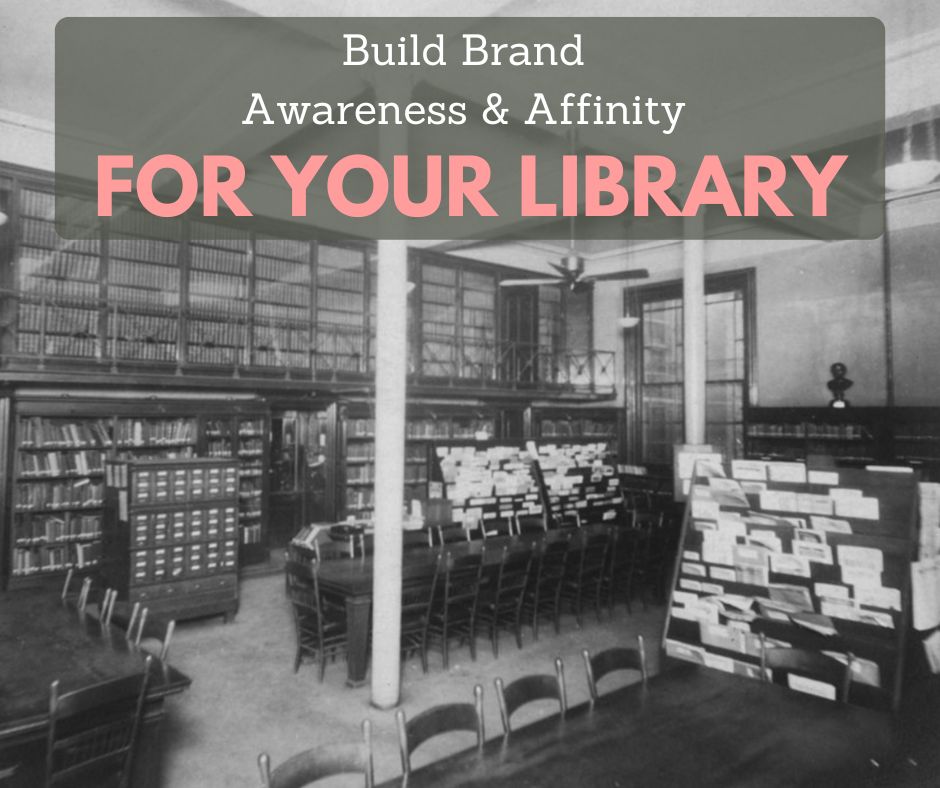
Marketing Done Differently: How To Use the Next Two Months To Build Library Brand Awareness and Affinity

Photo courtesy Public Library of Cincinnati and Hamilton County

My favorite library marketing season is about to begin.

The last two months of the year are when a library marketer must do in-depth work that will strengthen your libraryโ€™s position for the coming year.

Every other business and competitor will be ramping up their sales and discounts as we go into the holiday season. You may be worried that any promotions your library does will get lost in the shuffle.

You should be worried! According to Sprout Social, your audience receives about 2,477 messages per month from retailers between January through October. But in November and December, that number goes up 13 percent to 2,804 messages per month.

Thatโ€™s why I advocate pulling back on your โ€œregularโ€ push promotions during the last two months of the year. Instead, you can stand out by doing something different: focus on using this time to create a deeper connection with your community.

Youโ€™ll do that by strategically building library brand awareness and affinity.

What are brand awareness and brand affinity?

In its simplest terms, brand awareness is the extent to which your community can recall or recognize your library brand, no matter where they run across it. It means your community members know what you stand for and what you have to offer. Brand affinity, by contrast, is building an emotional connection between your library and your community.

Brand awareness and brand affinity are critically important to your library’s success. We want your community to recognize your content. And we want to create a lasting relationship between your library and your community.

When your library has strong brand awareness and brand affinity, your community members will choose to use your library over your competitors. Theyโ€™ll recommend your services to friends and family. And theyโ€™ll support you with funding and volunteerism.

In fact, a study from eMarketer showed that 64 percent of people cite brand values as the primary reason they have a relationship with a particular brand. (BTW, your library is a brand!)

Thatโ€™s why itโ€™s crucial to make brand awareness a top priority for your library marketing over the next two months. Here’s how to do that.

Step #1: Inform, educate, and entertain your community.

The most effective way to build brand awareness and affinity is to position your library as a place that adds value to your community. You do this by helping people solve problems. 

For this to work, youโ€™ll spend 8 weeks strategically educating and informing your audiences. This is called content marketing. It’s a strength that libraries have, and we don’t do this kind of marketing often enough.

Create and release a series of tips for your cardholders on how they can use your library to make their lives a little easier during the holiday. Brainstorm a list of ways your library helps ease the rush and craziness of the holiday season. Then decide on a sequence and schedule for releasing those ideas.

Create the promotional collateral to go with it: bookmarks, graphics for your website, email, social media, and short videos. Then, tell your cardholders you’re going to be helping them out this holiday. Reveal your plans and tell them exactly when you’ll be releasing each tip and on what platform. Create excitement and anticipation, then pay it off with your content.

Your tips can include:

  • Ideas for holiday gifts, recipes, and more–especially if they are literary-themed or items in your library of things that can be tested out before they make a purchase.
  • A special phone line or email inbox where you can take questions from community members who need help picking out a gift, cooking a big meal, or figuring out etiquette questions like which fork to use.
  • Curated lists of collection items for decorating, entertaining, wrapping gifts, and cooking.
  • A quick video tutorial on how to use their card to get free access to Consumer Reports.

Step #2: Promote your mission, vision, and values.

Libraries spend so much time marketing what we do that we donโ€™t often talk about why we do it. In fact, Iโ€™d argue that we take it for granted that our community members know the importance of our work. So, during your two-month brand awareness and affinity campaign, make it a point to talk and promote your libraryโ€™s mission, vision, and values.

Have a staff member or patrons (or both) write a blog post on the impact of the library. Here is a great example. Repurpose those stories for social media posts and print pieces like bookmarks featuring quotes from real-life library users.

You can gather patron stories by asking email subscribers to share how your libraryโ€™s work has impacted their lives. When I worked for the Cincinnati Library, I sent an email to a portion of my cardholder base and asked them to share such a story. Our library received more than 900 responses! I was then able to pick a few of the best stories. Those patrons were more than happy to share them with the world at large.

Step #3: Show the contrast between your library and your competitors.

Start checking your competitors’ websites and ads as soon as they begin their holiday marketing. Figure out what their offers are and how you can counteract those offers with free stuff!

Stark Library, Winnipeg Public Library, Monroe County Public Library, and Brown County Library all are great examples of how this can work.

Step #4: Showcase your staff.

Other companies have employees. Libraries have experts who truly care about the work they are doing and the impact they have on the community.

That’s why your staff is one of your most valuable resources. They are what makes your library stand out from your competitors. Spend the next two months making sure your community understands the value of your staff.

Interview staff about their work, and why they got into this industry. Ask them to share the story of a time when they helped a community member. Then share those stories on your blog, on social media, and in emails. The Lane Library at Stanford University is a great example of how to write a profile.

You can also ask staff members to name their favorite book of the year. Release that as a special end-of-the-year booklist. You can cross-promote these staff picks on your social platforms and include an email message to cardholders. Make sure you ask all staff members to participate… even the cleaning staff!

Step #5: Re-educate your cardholders about all your library has to offer.

Your library should create a series of emails sent to cardholders once a week for the next eight weeks. Those emails will re-introduce your cardholders to the best features of your library. It will inspire them to use their cards again.

To create this campaign, youโ€™ll make two lists. The first will be for the most popular resources at your library. This could include things like your Makerspace, popular storytimes, laptop terminals, or your extensive e-book collection.

Next, make a list of your libraryโ€™s hidden treasures. These may be items or services that you know will solve problems for your community. This list should include things that are unique to your library, like online Homework Help, your small business resources, your vast historical resources, or your Library of Things.

Finally, look at the two lists youโ€™ve created and narrow your focus. You want to highlight the best and most helpful things at your library without overwhelming your recipients. Choose to promote one resource from your list of popular items and one from your list of hidden library treasures for each of the emails you send.


More Advice

The Top Four Reasons To Use Content Marketing To Promote Your Library on Every Platform

Feeling Overworked? Thereโ€™s a Secret Trick to Get More Mileage Out of Your Library Marketing Content!

Subscribe to this blog and youโ€™ll receive an email every time I post. To do that, enter your email address and click on the โ€œFollowโ€ button in the lower left-hand corner of the page.

Branding for Your Library: Stand Out From the Crowd With Smart, Strategic Placement of Your Brand

Watch the Episode Now

The Library Marketingโ€‹โ€‹โ€‹โ€‹โ€‹โ€‹โ€‹โ€‹ Show, Episode 150

In this episode, we will answer a viewer’s question.

Margaret Luedke is Programs and Marketing Coordinator at Juneau Public Library in Juneau, AK. She writes, “I am new to library marketing and do not have a marketing background. My library did not have a marketing plan or brand style guide when I started so I am working to develop them now. I’ve found your guides on both topics very helpful! I wanted to ask though, how far do you suggest we take our branding?”

Kudos in this episode go to the winners of the Library Science Tuition Scholarship in Kentucky.

Do you have a suggestion for a topic for a future episode? Want to nominate someone for kudos? Let me know in the comments. And subscribe to this series to get a new video tip for libraries each week.

Thanks for watching!


Subscribe to this blog and youโ€™ll receive an email every time I post. To do that, enter your email address and click on the โ€œFollowโ€ button in the lower left-hand corner of the page.

6 Simple Steps to Create the Most Important Asset in Your Library Promotional Arsenal: A Powerful Library Brand Style Guide [ARTICLE]

Photo courtesy Cincinnati and Hamilton County Public Library

Every time I see a misaligned pink square on top of blue and white plaid, my heart skips a beat.

I realize that may be the weirdest sentence I’ve ever posted to this blog but hear me out.

I am a die-hard fan of Bath and Body Works.

The bath gels, the body lotions, the candles, the hand soap. There is a scent for every season, every mood, every situation.

No, they did not pay me to say this. (But if anyone from Bath and Body Works ever reads this blog, I am willing to work as an influencer.๐Ÿ˜Š)

Bath and Body Works has a strong, recognizable brand. They don’t want you to just buy their products one time. They want you to come back, again and again. They know a strong brand style that is recognizable across all platforms is key to creating a relationship with their customers.

You want that for your library. You want your community to recognize the promotional materials you make. When someone sees a sign or a social media post or a video, you want them to know that it comes from your library without having to see your libraryโ€™s name or logo anywhere in the brand.

Building a library brand takes consistency. And to remain consistent when multiple departments and staff members create graphics, social media posts, posters, and other promotional materials, your library needs to create a brand style guide.

A brand style guide will clearly define the look and tone of marketing materials. It saves staff time. It will be used by staff when creating graphics and writing text. Most importantly, it will ensure your libraryโ€™s marketing is recognizable.

Hereโ€™s a step-by-step guide for creating your library’s brand style guide. Scroll to the bottom of this post for examples of library brand style guidelines.

Grounding statements

Begin your document by centering your libraryโ€™s brand on the guiding principles of your organization. Remind your staff of your core mission. You want to explain the importance of this work and create buy-in for your style guide.

  • Set the tone with your mission, vision, and values statement.
  • Include a sentence or two that positions your libraryโ€™s strategy, personality, and customer service principles.
  • Define your libraryโ€™s personality. Do you want people to think of you as authoritative and resilient? Whimsical and conversation? Warm and welcoming?
  • List the perceptions your library is trying to avoid, like boring, traditional, formal, or pretentious.

Logo use

Emphasize the proper use of your logo across all platforms, including print and digital.

  • Define space rules, including the use of white space in relation to the logo.
  • Set the acceptable color variations for your logo.
  • List the minimum logo sizes, including pixels, print proportions, and aspect ratios.

Colors

Your color palette is the tangible component of your brand that people notice first. Color increases brand recognition up to 80 percent. Your colors also play a significant role in how your library’s brand is perceived.

  • Include the RGB, CMYK, Hex Code, and Pantone versions of your color palette.
  • List the shades of your color palette which are acceptable for use, including those variations required for accessibility on digital screens.
  • Include color contrast requirements for print and digital screens, keeping accessibility in mind.

Typography

Like color, the fonts your library chooses are a visual cue about your brand. Your fonts should tie all communications together, from your website to print promotions. It’s important to set clear guidelines for the use of fonts.

  • List the styles, sizes, and weights that can be used. Be sure to include instructions on acceptable fonts for headers, copy, and footers or fine print.
  • Include acceptable variations on fonts, if the font is unavailable in a particular piece of creative software.
  • Set guidelines concerning spacing to maintain a consistent style when font size changes.

Tone and text

This section is important to maintain a consistent brand through all the text written for your library promotions. These guidelines will ensure people recognize the copy is coming from your library, no matter who is doing the writing.

  • Outline your preferred word and sentence length. Shorter words and sentences are easier to read and will speed up the tempo of your message. Longer words and sentences will require your audience to do more in-depth thinking but may also be more nuanced.
  • List the jargon or library terms that staff members should use. This includes terminology for how you will refer to patrons, non-cardholders, staff, branches, and your branded names for services.
  • Determine the acceptable terminology for equity, diversity, and inclusion. Set guidelines for the use of gendered pronouns, ability, and references to racial and ethnic groups within your community.
  • Set your grammar guidelines. Will you use contractions? Will you allow prepositions? What grammar rules will you keep sacred, and which can be broken?

Images

In this section, youโ€™ll give anyone creating promotional materials for your library the rules they need to find graphics, photos, and artwork that represent your library.

  • Set standards for the proper size, style, and composition of images for social media, email, digital signs, print, video, and your libraryโ€™s website.
  • List approved image sources, including a list of websites that provide free stock photos and images. Here are ten websites to help build out your list.
  • Include clear guidelines on diversity representation to ensure staff use images that accurately represent your community.
  • Incorporate guidance on the use of graphics, GIFs, and memes.

Library Brand Style Guide Examples

Does your library have a brand style guide that you’re willing to share? Email ahursh@ebsco.com and I’ll add yours to the list.


Read These Articles Too!

Call It What It Is: Toledo Public Library Explains Their New Brand Strategy

How to Pick Amazing Library Marketing Swag That People Will Love AND Build Brand Awareness and Loyalty For Your Library!

Latest Book Review

The 1619 Project by Nikole Hannah-Jones

Subscribe to this blog and youโ€™ll receive an email every time I post. To do that, enter your email address and click on the โ€œFollowโ€ button in the lower left-hand corner of the page.

Libraries are Winning the Relevancy War! Why Now is the Perfect Time to Banish Your Fear and Promote Your Books

I have a confession to make.

For more than a year now, I’ve been amid an internal struggle that caused me some anguish. It started when I realized that I was hearing the same phrase from many administrators and staff in public libraries, both here in the U.S. and abroad.

Here’s what I kept hearing, over and over: In order to stay relevant, libraries must change completely.

The fear that the public perceives libraries as old-fashioned and unnecessary is not new. But it seemed to reach a kind of fever pitch last year. Everyone was writing about it. Everyone was talking about. There were whole conference sessions and webinars dedicated to library relevancy.

I thought maybe I was imagining it at first. So, I did what any normal person does when they’re looking for validation. I did a Google search.

I clicked on the first result, “library relevance.” There are 314 million results.

I understand why libraries are worried about relevancy. It’s the media narrative. (For a great perspective on that, read this fabulous opinion piece from Public Libraries Online). It’s also the argument made by those who want to cut funding and services for libraries.

But here’s the thing. The public at large doesn’t think libraries are irrelevant. In fact, they think quite the opposite.

I’m sure you saw the new Gallup poll released this past Friday (Jan. 24, 2020) that shows “Visiting the library remains the most common cultural activity Americans engage in, by far. The average 10.5 trips to the library U.S. adults report taking in 2019 exceeds their participation in eight other common leisure activities.”ย ย 

Public libraries have bought into the notion that we have a brand perception problem. But we don’t. We’re doing a great job. And people see it.

What we have is a fear problem. Public libraries are afraid to market the fact that they have books.

Why? Because they’re terrified that talking about our collection will reinforce a notion that libraries are a dusty, old, unsophisticated repository of classics. They may even believe that marketing the collection will distract people from the other great services that the library offers.

I vehemently disagree.

Libraries should market their collection. In fact, they should do a lot of collection marketing. Instead of limiting the conversation to non-collection services, libraries should expand the conversation to show the connection between the books, literacy, and all the other amazing work they do.

Your collection makes it possible for you to offer social services. Your collection makes it possible for you to create programming around workforce development. Your collection makes it possible for your library to offer support to educational institutions in your community. Your collection makes it possible for your library to be a thriving, open, welcoming, and inclusive public space.ย ย 

Literacy is tied, undeniably and inextricably, with all the things libraries do outside the realm of books.

Data tells us that most people who sign up for a library card do so to get free and open access to the collection. The collection is the gateway to get community members in the door of your library, where they’ll experience the other services you provide.

If you were to look at the Google Analytics data for your website, or the usage data provided by your library’s app developer, I’ll bet my bottom dollar that the number one activity for online use of your library is collection-based. That’s why your library spends most of its non-facility related, non-staff related budget on collections.

Studies of library usage by the Pew Research Institute shows that 66 percent of library cardholders use their card to check out items including books, magazines, CDs, and more. Only 17 percent of library cardholders say they use their card to attend programs, classes, or lectures.

People are still reading books. People believe libraries have transformed themselves into tech hubs. People see that libraries offer digital services. People hear about the social service help offered by libraries.ย Libraries are winning the relevancy war (good job, you!). The community knows and understands that we are more than a place for books. It’s why your library gets regular requests from organizations looking for a partner in important outreach work and advocacy.

The message is out there that libraries are more than books. But make no mistake, most of the folks who walk through your doors or interact with your library online, are there for the collection.

Before I was a library marketer, I worked as a television news producer. That means I put together each night’s newscast, decided which stories were told, in what order, and how they were told.

Every year, our news director would bring in a consulting firm to help us improve our shows and increase our viewership. I was proud of my work as a journalist. But when I was presented with the feedback from focus groups, it was clear that most viewers were watching my show for the weather. I spent a lot of time writing insightful, informed, well-sourced investigative pieces. But my viewers only wanted to know was whether it would rain the next day.

In television news, weather is king. In libraries, the collection is king. That’s why your library spends the majority of it’s non-staff and non-facility money on the collection.

Now, please understand me. I’m not saying you stop promoting your non-collection related activities. Far from it. Library programs and outreach nourish the soul of our community and offer cultural and educational opportunities for those who might not otherwise have access to them. And they must be given attention through marketing.

But don’t stop talking about your collection. Don’t hide your collection below the fold on your website. Mention your collection when you talk with the media. Write about your collection on your blog. Send emails to your cardholders with reading suggestions.

If we want to compete with Amazon, Audible, Netflix, Hulu, and other paid content providers, we must promote our main asset. If you want to attract new cardholders and keep the ones we have happy and using their library, market the collection. If you want to have a part in making the world more informed, more educated, and more empathetic, market the collection. Share this infographic to help spread the word!

Check the Upcoming Events page for a list of webinars and conferences where I’ll be next. Let’s connect! Plus, subscribe to this blog and youโ€™ll receive an email every time I post. To do that, click on the โ€œFollowโ€ button in the bottom left-hand corner of the page. Connect with me on YouTube, Twitter,ย Instagram, and LinkedIn.ย 

A WordPress.com Website.

Up ↑