Search

Super Library Marketing: Practical Tips and Ideas for Library Promotion

Tag

library email promotions

12 Super Easy and Incredibly Effective Ways To Get More People To Sign Up for Your Libraryโ€™s Email Subscriber Lists

Photo courtesy Public Library of Cincinnati and Hamilton County Digital Library.

For libraries large and small, public, private, and academic, there is but one powerful promotional tool that you can use to reach as many people as possible.

Itโ€™s an email.

When you have limited staff, limited time, and an audience that is scattered across a large geographic area or is not comfortable coming into the building, email is the most effective method of communication. 

And while the digital divide is still a very real and present problem for many communities, access to the internet is improving.

The latest Pew Research Center study released in August of this year shows that rural residents have seen a nine-percentage point rise in home broadband adoption in the last five years. 72 percent of rural Americans have high-speed internet access. Smartphone ownership also rose nine percentage points among rural residents in the past three years. 

Thatโ€™s a significant portion of your audience thatโ€™s reachable by email. 

And the beautiful part is when you build a subscriber list, itโ€™s all yours. No algorithm can touch it! 

Segmenting your audience by their self-identified interests is the most effective way to market your library by email. Once youโ€™ve created your segments, the next step is to build your subscriber lists. Thatโ€™s your golden ticket to promotional success.

Here are 12 super easy ways to do that. 

Sign up people whenever you interact with them. 

Iโ€™ve got a thing for candles that smell like baked goods.

Every single time I stock up at Bath and Body Works or Yankee Candle, I am asked for my email at checkout. And I always give it to the cashier.

Why? Because I know Iโ€™ll be sent coupons. This means Iโ€™ll be able to enjoy the scent of sugar cookies or freshly baked apples wafting through my house without having to turn on my oven.

Every time your library staff talks with a patron, whether itโ€™s by phone, chat, at the desk, or at outreach events, they should be asking for their email. Train staff to ask for email at every opportunity.

Create a form sign up for holds and self-service checkouts.ย 

Some of our patrons prefer not to interact with staff. They love self-service. They may dart in and out of your building to get their holds. (Thatโ€™s me!)

For these low-interaction patrons, create a form as a bookmark. Ask for the person’s name and email. If you have segmented email lists, you can ask them to check off the ones theyโ€™d like to subscribe to. They can return the form when they return their items. Or, even easierโ€ฆ

Add an opt-in page to your website. 

Your bookmark can simply include the URL to a landing page on your library website where people can opt-in to your segmented lists. You might also include a QR code that takes people directly to your opt-in page.

An opt-in page is also handy for the next four suggestions.

Ask staff to include a link to your opt-in page in their email signatures.

Library staff send a lot of emails to patrons, community members, presenters, and stakeholders. They can help build your subscriber lists by including a line with an embedded link to your opt-in page in their email signature.

Start an opt-in campaign.

Send an email to your current subscribers and ask them to opt-in to other segmented lists. You can also give them the option to opt-out of any lists they may not be interested in any longer.

It may seem counterintuitive to remove people from your email list to grow your email list. But your current email subscribers are more likely to engage with other lists.

Also, their interests may have changed since they signed up. Give them the chance to update their subscriptions. They’ll be more likely to engage with the emails you send to them.  

Cross-promote your least popular list to subscribers of your most popular lists.

Experiment with cross-promotion to give your least popular lists improved visibility. Include a few teaser lines in your email or e-newsletter and a link to sign up.

Promote your lists on your social media cover photos or headers.

Pick a list to promote by looking at the demographics for each of the social media platforms your library uses. Youโ€™ll be able to pinpoint which of your segmented lists will resonate the most with the followers of that platform.

Or you can highlight your opt-in page, where people can choose from all your lists. Then create a high-quality graphic and include instructions for signing up in the caption, and watch your list grow.

Share email previews on your libraryโ€™s social media accounts.

Sharing a portion of your emails or e-newsletters is a great way to attract your audiences and entice them to join your email list.

Doing this demonstrates the value of your library and your email messages. Community members will be more likely to sign up if you give them a preview of what youโ€™ll be sending them.

Promote your emails in your YouTube video descriptions.

Include a plug for your email lists every time you upload a video. One line at the beginning or end of your video description is all you need.

This is especially effective if you create a how-to video. Tell your viewers that they can sign up for more informative content and instruction by clicking the link in your description.

Promote your emails on your blog

For every blog post you publish, include a line that asks readers to sign up for one of your subscriber lists.

This works well when you match the content of the list with the content of your blog post.

Put the โ€œask lineโ€ somewhere in the first two-thirds of the blog post to catch readers who might not read your post all the way to the end.

Encourage subscribers to forward your emails.

Include social sharing buttons and an โ€œEmail to a Friendโ€ button in your emails. Also, at the bottom of your emails, include a โ€œSubscribeโ€ call to action with a link so that the people receiving the forwarded emails can easily opt-in too!

Send great content.

If your emails are informative and interesting, your library will get a reputationโ€ฆ a good one.

Your communications will be viewed as valuable. People will always look forward to receiving your emails. Theyโ€™ll be more likely to forward them to their friends, family, and co-workers. And this will help you to gather additional subscribers.


You Might Also Want to Read These Articles

Timing Is Everything: How To Determine the Perfect Day and Time To Send Library Emails

Looking for Guaranteed Email Marketing Success at Your Library? Here Are Four Essential Metrics To Track.

Subscribe to this blog and youโ€™ll receive an email every time I post. To do that, enter your email address and click on the โ€œFollowโ€ button in the lower left-hand corner of the page.
The Tiny Little Mistakes That Ruin Your Library Marketing Emails AND How to Fix Them!

NEW LIVE LIBRARY MARKETING SHOW ON INSTAGRAM! I’ve decided to try a new thing! I’ll be doing a live Instagram Q&A and discussion about Library Marketing. The sessions will be every Tuesday at noon ET (10 a.m. Central and 9 a.m. Pacific) beginning Tuesday, June 25. Join me to talk about library marketing topics for about 20 minutes each week. My handle is Webmastergirl. You can email questions and topic suggestions ahead of time. Just fill out this form below. See you there!

Go back

Your message has been sent

Warning
Warning
Warning
Warning
Warning

Warning.

I get a lot of library marketing emails. I love to see what other systems are doing. So, I go to their websites and I see if I can get on their mailing lists! It’s fun and it helps me to find new things to promote and new ways to communicate with my audience.

I also get a first-hand look at some of the small boo-boos that other library marketers make in their emails. Email is hard. I’ve been doing email marketing for so long (feels like forever!) that I have made all of these mistakes myself! And I love email marketing, so I’m weirdly obsessed with learning about it. Some of the positive text and design choices that work for library marketing in other promotional pieces, like posters, flyers, websites, and blogs, do not work in email marketing.

The good news is that these little problems are easily fixed! Tiny adjustments in the text and design of your email can improve your click-through rates and effectiveness. Check this list against what you’re doing now and start reaping the benefits of improved email design!

Problem: too many images: A clean design is crucial to engagement. Too many images or too much text is off-putting to your email recipient.

The most common email programs like Yahoo and Outlook will NOT automatically download images. In fact, only Gmail downloads images automatically. With all other providers, the email recipient receiver must consciously click a prompt in order to download an image. That means if your image is conveying most of the key message in your email, your receiver likely won’t see it.ย  They will miss the information and the call to action, and your email is useless.

Solution: Create an email that is mainly text-based. I have found an 80-20 mix works best: 80 percent of my email is text, 20 percent is image-based. The image I use compliments the text. Its purpose is to create emotion or set the mood of the email. It’s there to inspire. It doesn’t convey key messages and it doesn’t contain the call to action.

Problem: too much text. An email that contains several long paragraphs of information is off-putting to recipients. It gives the impression that your email will take a long time to read.

The email scheduling platform Boomerang studied results of about 20 million emails sent using their software. They found that the optimal length of a marketing email is between 50 and 125 words. A study by Constant Contact of more than 2.1 million customers found emails with approximately 20 lines of text or 200 or so words had the highest click-through rates.

Excessive text can also send negative signals to spam filters. Too much text added to excessive punctuation or large images could keep your emails from ever arriving in an inbox.

Solution: Limit your email text to 200 words or less. The recipient should be able to read all the information in your email in about 15 seconds. If you have more information to share, use your call to action to indicate that there’s more to know about your subject. Then send your recipient to a landing page where they can get all the information they need.

Problem: Text that is too small. Keep in mind the growing number of people who will read your email on a mobile device. You want to make sure they can actually see your words. An 11 or 12 point font size is too small to be seen clearly on a screen.

Solution: Increase your text size.ย ย Email font should never be below 18 point in size.ย  You should also use the bold option to make the most important information stand out.

Problem: Wishy-washy calls to action.ย  A compelling call to action is one of the best ways to increase the click-through rates of your library marketing. Some library marketing emails also contain too many CTAs.

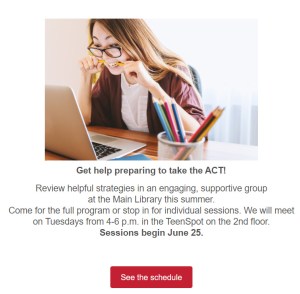
Solution: Use positive, active language in your CTA. “Register” “Read This Book”, “Learn More”, “Join Us”, “Donate”, and “Get Started” are some of my favorites. I put my CTAs in a square red box that looks like a button to compel my recipients to click on them. I embed the CTA in my image as well and use the “alt text” to convey the CTA in case someone’s eye skims the email. I try to keep my CTAs to one per email.

One image, with the main text in bold at 18 point found. A few sentences and a clear call to action.

Problem: Ignoring mobile responsiveness.ย  Mobile opens accounted for 46 percent of all email opens according to the latest research from Litmus. If your emails arenโ€™t optimized for mobile, you are missing a huge potential audience, particularly women and young people.

Solution: Optimize your emails for mobile to make them responsive. Most email marketing programs offer mobile responsive templates. My library uses Savannah by OrangeBoy. We switched to all responsive templates in January of this year. I’ve seen a nine percent increase in click-through rates. I count that as a win!

Problem: No system for proofing your emails in different kinds of email boxes. Your email design might look great in your creation software. But if you send it without testing it, you may find that your email becomes a kind of monster creature! It may show up a a jumbled mess of images and text. This happens because every email inbox will convert your email differently.

Solution: Test your email to make sure your message displays correctly for your recipients. Find people that you trust you have different providers… someone with Gmail, someone on Outlook, someone on Yahoo, and so on. Send them the message and ask them to check for warped images, font problems, and extra spaces.

Subscribe to this blog and youโ€™llย receiveย an emailย every time I post. To do that, click on โ€œFollowโ€ button in the bottom left-hand corner of the page. Connect with me on Twitter,ย Instagram, and LinkedIn. ย 
Powerful Things You Can Do to Convert Cardholders

This is the second in a two-part series on how to improve the metrics that really matter for library marketing emails. To read the first part on how to improve your library email click-thru rate, click here.

The other important metric to measure for email library marketing is the conversion rate. Conversion rate refers to the percentage of people who received the email AND end up taking an action, such as checking out an item, registering for or attending a program, or using an online service.

Conversion rate really is the gold standard for the success of any email campaign. Your goal should always be to get people to act!ย  For every email you send, you should be able to state in one sentence what it is you want email receivers to do when they read your email. Then you need to follow-up and track the results to see if your email led to the desired action. If it doesn’t, you need to adjust your email strategy.

Here are the tips I’ve discovered, through years of email marketing success and failure, that work to drive up the conversion rate.

Do deep research to find the right target audience.ย Sometimes it’s hard to pinpoint the best audience for your email. It takes a lot of research. But this is an incredibly important step.

My library recently sent an email to promote a service we’ve had for many years called Career Online High School. COHS is a course that helps people who never finished high school to get their diploma and career certification. Finding the right target audience for this message is problematic. My library doesn’t ask cardholders if they also have a high school diploma, a job, or any kind of career skills. My library also doesn’t keep anything more than superficial demographic statistics on the people who already graduated from the COHS program. I don’t really know who my prime audience would be. I can’t say with accuracy what motivates a person to take this 18-month course. So, I had to do some deeper research.

I found some local studies that laid out the high school diploma concentration in geographic regions inside my library’s service area. This helped me narrow the email audience down to a few neighborhoods within my county. I also asked staff to help me create a subjective profile of past COHS students. I asked the staff to guess at the COHS program applicants ages. I asked if the applicants identified the part of the city they live in. I asked if the applicants typically have a library card when they sign up, or if they have to get one (the service requires you to be a cardholder). Finally, I asked staff if the applicants ever talked about how they first heard about COHS. The staff helped me craft a cluster that I thought *might* work.

We sent this message to about 18 percent of our cardholder base. That’s a wide net. But it worked in this instance. Five percent of the people who opened and clicked on the message are now in the process of filling out applications and completing paperwork to join the class. I consider that a huge success! The staff who run the COHS program told me they were incredibly pleased with the number of new applicants.

Sometimes, your targeted email audience will be obvious. And sometimes you’ll have to ask some questions and dig around to determine your audience. Try not to guess. Base your decisions on the information available and you’ll find success.

Experiment to determine your goal conversion rate. When I started sending emails to my cardholders, I had no idea what success looked like. Through experimentation, I set a goal. Each email must create a ten percent or higher bump in circulation, program attendance, or usage. If the email falls short of these goals, it’s not worth my time or my cardholders’ time.

This isn’t an arbitrary number. It’s a number I’ve landed on after many emails and lots of calculations. For my library system, a ten percent increase in any one of these numbers is significant enough to warrant the effort it takes to create and send an eblast.

You’ll set your own optimum conversion rate. Your optimum rate will depend on the size of your cardholder base, your staff’s capacity to handle increased circulation, program attendance, and library visits, and your overall library goals. But you must have a goal.

Make your call to action clear and persuasive. You’ll notice the call to action on the Career Online High School email is very direct. When you create a call to action (CTA), say the words “I want to…” before the CTA. In the COHS email above, that sentence ends up being, “I want to apply to Career Online High School.”ย  If that sentence is short, direct, and easy to follow through on, you’ve got a good call to action. Some other good CTA’s are:

Register for this program.

Put this event on my calendar.

Place a hold on this book.

Get reading recommendations.

I think you get the picture. In my emails, I put the CTA inside a button or box so it draws the eye and is intuitive for clicking.

Change focus of your email from the library to your cardholder. To persuade cardholders to act on your emails, stop talking about how great the library service is and to instead talk about how it will change or improve the life of your customer. You can do this even with a simple collection-based email.

We do this with our book recommendation service. We might be tempted to say, “Our Librarians are book experts. We give the best reading recommendations anywhere!” And we do! But by slightly pivoting our message, we show how this service helps our cardholders. Our re-focused sentence is: “You’ve got a lot to do. Let us help you pick out a good book to read.”

See how subtle it is? But it really works. You’re just changing all the “we’s” in your copy to “you’s.” By pivoting the focus of the message from how great your library is to how much you can help the cardholders, you increase the chances that cardholder will take an action.

Include humans in your emails. When you create your email, using a photo that includes a human face or faces expressing an emotion. Your cardholders will look at the faces and identify with one. That face will humanize your message. They’ll be more likely to take an action. We use one or two human faces in most of our email marketing campaigns.

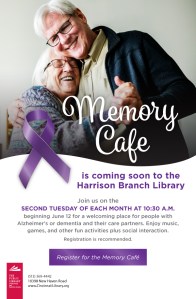
Now, there is some science to suggest that human faces negatively affect conversion rates, particularly if the faces don’t align with the email’s target audience. So, you must choose the photos carefully. For instance, this email promoting our Memory Cafe accurately represents the audience and the activities at the cafe (there is often dancing!). And it worked to drive people to this recurring program. If you make a thoughtful photo choice, you’ll see good results.

Subscribe to this blog and youโ€™llย receiveย an emailย every time I post. To do that, click on โ€œFollowโ€ button in the bottom left-hand corner of the page. Connect with me on Twitter,ย Snapchat, and LinkedIn.ย I talk about library marketing on all those platforms!

This Advice Will Boost Your Library Marketing Email Click-Thru Rates

A few months ago, I wrote a post about email vanity metrics. Those are the statistics like open rates that make us feel good. But if we’re being honest, they’re relatively meaningless.

The meaningful metrics like click-thru and conversion rates are harder to obtain and must be tied to your library’s overall strategy to provide any meaning. Humans naturally like doing the easy stuff! But it’s the hard metrics that make our work valuable and worthwhile.

So, I want to spend the next two posts sharing some of my strategies for improving your library email click-thru and conversion rates. I learned most of these tipsย through trial and error and a lot of failures. Remember that failure is okay! It teaches us lessons that lead to success.

This week we’ll focus on improving your click-thru rates. The click-thru rate is the percentage of people who, after opening your email, will click on a link. Here’s what I’ve learned about how to improve that rate.

Promote the best possible content. Don’t send an email to promote every program or service your library carries. Choose your promotions strategically.ย Put the best content into your emails to make it more likely that your cardholders will click on your links.

For collection-based marketing, make sure the books you choose to promote in your email are buzz-worthy, newer, have a great cover (you’d be surprised how much the cover art affects click-thru rates!). For program promotions, of course you’ll choose events that are fun and interesting. But the programs you promote through email should either in demand by your cardholders or unavailable at any other organization or community group in your area. If you are asked to promote new or existing services like databases, movie streaming platforms, or reading recommendation services, pick the best of parts of those services to promote. For example, I recently did a three-month series of emails promoting the Great Courses section of the Kanopy video platform. Instead of trying to promote the entire Great Courses section, I promoted three specific video series–yoga, family history research, and weight loss. Promoting parts of a service makes it easier to target your message. Speaking of which…

Target your message. Click-thru rates skyrocket when the message you send is targeted to the audience most likely to be interested in it. Sounds like common sense, yes? But I still hear from lots of libraries who are afraid to stop sending emails to all their cardholders. If you have the technology to segment your audience, you should do so. Try to target your email messages to about ten percent or less of your existing email list. Don’t worry if that number seems small. If that audience is getting an email about something they’re interested in. you’ll see results in big click thru rates and engagement.

Here’s my strongest example. A few months ago, my library started a short, monthly eNewsletter targeted specifically at young professionals. This newsletter goes to about 300 people once a month. For my library, an email sent to just 300 people is really tiny… that’s only about .10 percent of our total email list. But it pays off! This emailย gets huge engagement numbers because those 300 people are really, really interested in the contents of the email. In October, the click-thru rate was 37 percent. I wish all my emails were that successful.

Give yourself time to create and revise your emails. This is the maybe the most important step. Plan your email schedule as far in advance as possible. Set aside time to write the copy. Then, walk away.ย  Come back later-preferably another day-and look over your work. Revise it. Walk away again. Repeat this process until the copy and structure of your email is as good as it possibly can be. Too many of us (myself included) rush through the creative process.

If you recognize that you are the kind of creative person who feels like he or she can never release anything into the word because it’s never perfect enough, set some boundaries. Give yourself a deadline for when you’ll send the email up the chain for approval and tell your supervisor when to expect it so he or she can hold you accountable. That will help you break the endless cycle of revision!

Write like a Buzzfeed blogger, not like a librarian. Write to entice. Make the text interesting. Use conversational language within your emails. Write short sentences. And don’t write too much! Less copy is better. Make your cardholders curious to find out more and then give them the means to do it by doing this next step, which is…

Embed clickable links in more than one location within the email. My personal rule of thumb is to include a link to the book, program, or service about three times in varying places within the email. This gives your cardholder the chance to act at various points as their eyes or mouse or thumbs roam your message. It also increases the chance that they’ll be able to act, if they so choose, by making it super easy for them.

Next read: How to improve your library email marketing conversion rate!

Finally, would you be so kind as to answer a question for me?

Subscribe to this blog and youโ€™ll receive an email every time I post. To do that, click on the โ€œFollowโ€ button in the bottom left-hand corner of the page.ย ย 

Avoid Email Vanity! Here Are the Results You Should Measure

I love email marketing. It’s one of the most effective tools in the modern library marketer’s toolbox. Emails are a direct way to interact with your cardholders and your community. They are easy to create. You can share stories, collection items, explain new services, and promote events directly with your audience. And library cardholders love getting emails from us. We don’t have to worry about unsubscribe rates the way other industries do.

Many libraries are now emailing their cardholders. And they’re reporting success with those campaigns. I’m so happy! But I’m also worried about something I hear often in conversation with other library marketers. I’m worried that we’re focused on the wrong measure of success–open rates. I’ve attended two events with other library marketers this summer. At both, there were deep and interesting discussions about success in email marketing. But at both events, the conversation about success centered on how to raise open rates.

Now, I have a confession to make. When I started targeted email marketing back in January of 2015, I was obsessed with my email open rates. And so were thousands of marketers in industries across the world. During my first trip to Content Marketing World, I attended several sessions on email marketing and every speaker mentioned open rates as a measure of success.

Open rates do mean something. They are a sign of customer loyalty. A high open rate means that your cardholders are eager to see what you’ve sent them. And that’s good. But it’s kind of like buying a house because it’s got a beautiful exterior. You may sign all the paperwork, open the front door and find all the walls are unfinished! Open rate is a vanity metric. It makes you feel good. But it’s what happens AFTER your cardholders open your email that counts.

I’m not suggesting you ignore open rates. They do give you information you can use to improve your emails. If your open rates are high, and your click-thru rates are low, you can be certain that you are writing compelling email subject lines (Good job, you!). You have a loyal and eager audience. But the content you are sending to your cardholders isn’t what they want. Now you can fix that problem!

Keep tabs on your open rate. But you should focus on two other valuable ways to really measure the success of your emails.

Click-through rates: The higher this number is, the more excited I get. It means that my cardholders opened an email, saw something they liked, and took an action! Most of the time, my library emails direct cardholders to do one of two things: click a link for a specific item in our collection or go to the event calendar where they can register or put an upcoming event on their calendar. Convincing a cardholder to take one of those actions is a huge victory. It also gives me data about what that particular cardholder is interested in. And I can use that information to craft future emails that are also compelling for that cardholder.

Conversion rates: A conversion rate is the most accurate way to measure email effectiveness. It is the percentage of people who take an action after clicking through an email. For example, let’s say 100 people click-through to look at a book I’ve promoted by email. If 50 of those 100 people put the book on hold, my conversion rate is 50 percent. Once I know what my average conversion rate is for a certain type of email, I can set goals to raise that conversion rate. I canย  accurately compare my emails to one another.ย  I might see a high conversion rate for a certain genre of book and look for similar books to market to that cardholder. I might notice a spike in registration rates for a particular kind of program coming from an email and look for similar kinds of programs to market to my cardholders. Conversion rate is the most accurate measurement for determining the likes and dislikes of your cardholders.

For more on tracking the success of your email marketing, you can also read this article. And if you want to learn more about targeted email marketing and get more secrets for library email success, don’t forget the free webinar!ย ย 

Subscribe to this blog and youโ€™llย receiveย an emailย every time I post. To do that, click on โ€œFollowโ€ button in the bottom left-hand corner of the page. Connect with me on Twitter,ย Snapchat, and LinkedIn.ย I talk about library marketing on all those platforms!

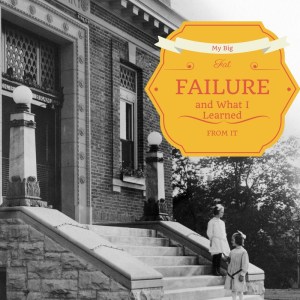
My Big Fat Failure and What I Learned From It

My Big Fat

I have a library marketing routine. Every six months, I go through all the promotions we’ve done and take a hard look at what worked and what didn’t. I adjust my email sending schedule and my promotional plans for the next six months based on the data I’ve gleaned from cardholders who’ve interacted with our messages and promotions.

This time,ย within about ten minutes of starting this process, I was reminded of what could be considered our library’s biggest promotional failure to date. It was an experiment, so the sting is lessened by the knowledge that we intended for this campaign to be a learning experience.

Yea, Ang, keep telling yourself that.

We have one library in our system with a cardholder cluster distribution that is something of a miracle. This branch is a perfect representative of our entire system as a whole. It makes it an amazing test subject for any promotion.

So our idea was to convince occasional users of that branch–people who only come in every couple of months–to come back to the branch by offering them a free gift in exchange for checking out any item. It was January and snow was swirling and we had these amazing library-branded snow scrapers. Maybe that sounds lame to you but trust me, at outreach events, those babies are flying off the table. In any case, we actually did not identify the free gift in the promotion.ย Our overall library strategic goal this year was to increase physical visits to the branch, and this promotion fell in line with that strategy.

So we identified the target audience with the help of Orangeboy, Inc., the company that manages our email promotions. Through them, we were able to pinpointย occasional users. We took a two-prong approach. We sent those cardholders a postcard, asking them to come into the branch with the postcard for their free gift. We also sent them a targeted email a week after the postcard, which you can see below.

monfort


We sent the email during a time period identified as successful for library emails in our system–on a Wednesday night at 7 p.m. 735 people got the email and the postcard.

The email’s vanity metrics were pretty good…ย  51.29% open rate and 5.57% click thru rate. But the overall results–getting people to come in and use the branch–was not exciting. 6.6% of recipients came in to claim a prize. Eight were email recipients. 41 people brought in their postcard.

What did we learn from this? Well, a couple of things may have been at play. Perhaps occasionals don’t use the library often because they can’t get to it physically. Perhaps they just don’t want to enter the building. A digital campaign–driving occasional users to our eBranch in exchange for a gift–may be more effective, although we’d have to work out the logistics of getting a gift to someone who doesn’t want to come into a branch. ย Perhaps it was the timing. The weatherย turned out to be pretty miserable, with record-breaking snowfall in the week after the postcard went out. ย The week in which the email was sent was mild. However, if we tried it in the spring or summer, we may have better luck.

And although I generally look at this as a failed promotion, I can say that we convinced 49 people who haven’t used the library in a long time to do so! ย Circulation at that branch increased by at least 49 items that month. It just seems like a lot of money and effort for a small result.

Still, we’ll keep experimenting with unique ways to draw our old customers back to our branch. Have you done something similar? Tell me about it in the comments. I’d love to hear how your library is working to increase physical visitors.

Subscribe to this blog and you’llย receiveย an emailย every time I post. To do that, click on “Follow” button on the bottom left-hand corner of the page. Connect with me on Twitter and Snapchat–it’s where I talk about library marketing! Iโ€™m @Webmastergirl.ย Iโ€™m also on LinkedIn, Slideshare, ย Instagramย and Pinterest.ย Views in this post are my own and do not represent those of my employer.

A WordPress.com Website.

Up ↑